
Cheap flights to Multan
Set your departure airport and maximum budget: SniperAir tracks prices to Multan and alerts you the moment a deal matching your criteria appears.
Quick summary
Country
Pakistan
Continent
Asia
Airport
MUX
Currency
Pakistani rupee (PKR)
Time zone
UTC+5, no daylight saving
Deals already spotted to Multan
Real flight examples detected by SniperAir, with their reference price.
Loading examples…
Why track Multan with SniperAir
The Sufi city of southern Punjab, to watch with care
Choose your departure
Enter your departure airport and maximum budget for a flight to Multan, via Multan Airport (MUX).
SniperAir keeps watching
Our systems continuously compare new prices with the real price history of the route. SniperAir monitors prices and alerts you: it does not sell or book tickets.
You get an alert
As soon as a price matches your criteria, you are notified without having searched for anything yourself.
Multan is a large city in southern Punjab province, on the east bank of the Chenab. It is one of the oldest continuously inhabited cities in Asia and the sixth-largest city in Pakistan according to the 2023 census (Wikipedia EN, FR). Its nickname, the City of Saints, comes from its many Sufi shrines, whose brick and blue-tile mausoleums dominate the cityscape (Wikipedia EN, FR; Wikivoyage EN). Wikivoyage (EN) says it holds a visitor's interest for one or two days: the old fort, the tombs and the blue pottery.
Important: official travel advice varies depending on the country you depart from, may advise against certain regions or movements, and changes quickly. Before planning, read your own government's official information on formalities, health, insurance and the situation on the ground. SniperAir monitors prices for flights to Multan (MUX) and alerts you; it does not sell or book tickets, and does not replace that advice. This page focuses on Multan; for the country, see the Pakistan page.
Airport and transfer
Multan Airport (MUX), under ten kilometres from the centre
Multan International Airport (MUX)
The airport is in the Cantonment area: Wikivoyage (EN) counts about 5 minutes to the cantonment centre and 20 minutes to the city centre, and Wikipedia (FR) puts it under ten kilometres away. Wikipedia (DE) says it serves Pakistani and Middle Eastern destinations. Airlines and routes change by season: we do not list them, and you should check before booking.
Distance MUX to Multan centre: under ten kilometres according to Wikipedia (FR). We do not publish a taxi fare.
Multan is on the main Peshawar - Karachi railway line, with Multan Cantt station, and on the N-5 national highway; Wikivoyage (EN) gives about 400 km to Lahore by road. Entry rules for Pakistan depend on your nationality: check with the Pakistani authorities and your own government's information before any booking.
Landmarks and sights
The Sufi mausoleums of brick and tile
Multan is visited above all for the tombs of its Sufi saints, grouped around the old fort. The Multani style is recognisable by its large brick walls reinforced with wooden beams and its blue tile decoration (Wikipedia EN). The five places shown below give an idea; others are described afterwards in text only. In shrines, covered clothing and removing shoes are the rule (Wikivoyage EN).
The tomb of Shah Rukn-e-Alam
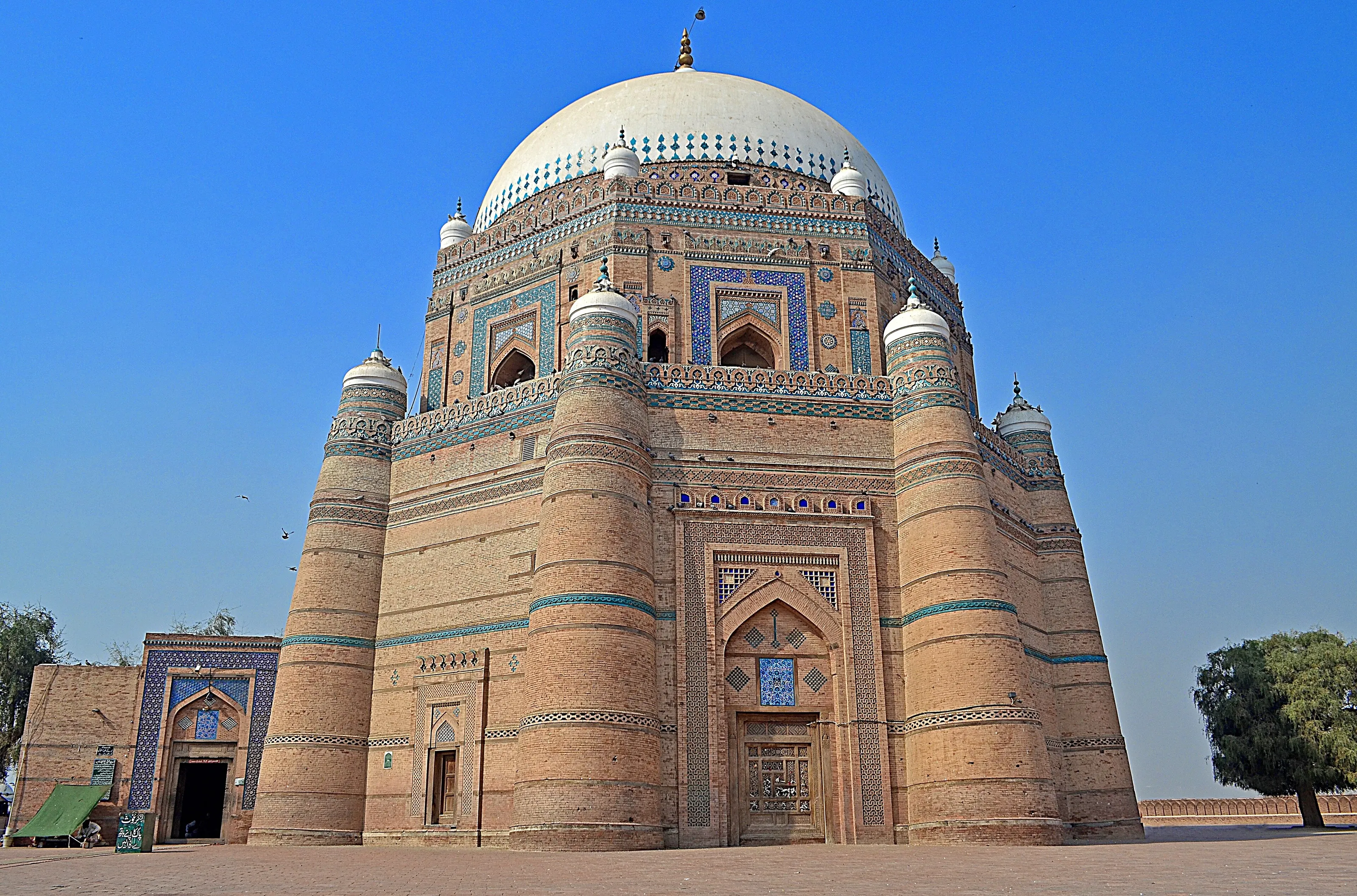
Built between 1320 and 1324 by Ghiyath al-Din Tughluq, it is the earliest surviving Tughluq monument, predating Tughluq buildings in Delhi (Wikipedia EN, FR). Its three tiers of red brick bonded with wooden beams end in a white dome, with blue tilework around its base (Wikipedia EN). Shah Rukn-e-Alam, a Sufi saint, died in 1335 (Wikivoyage EN; Wikipedia DE).
The blue tilework
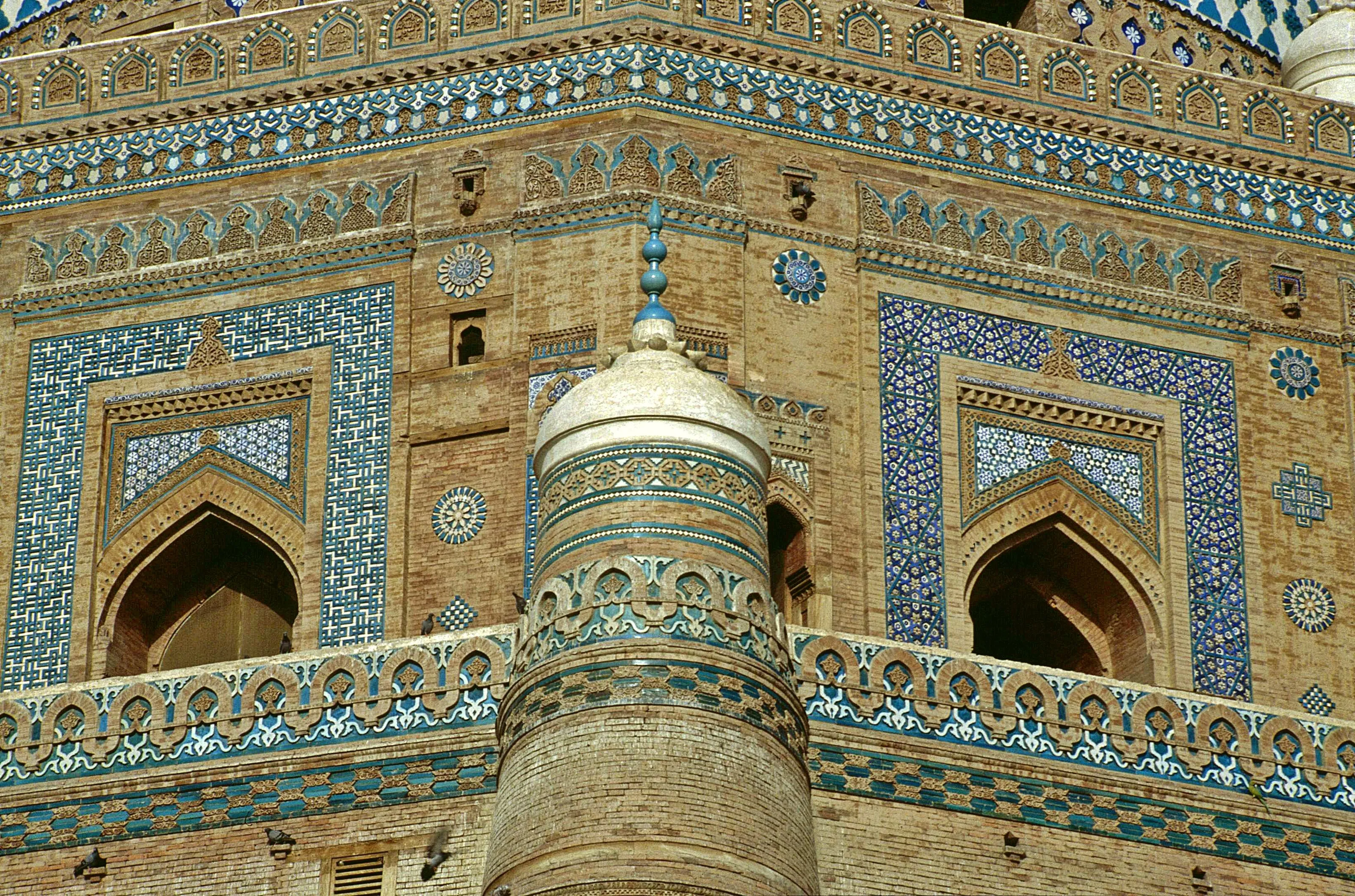
The polished red brick contrasts with floral, geometric and arabesque motifs in dark blue, azure and white tile (Wikipedia EN). Turrets and battlements recall Tughluq military architecture, even on a funerary monument. This tile tradition also lies behind Multan's reputation for blue pottery (Wikivoyage EN).
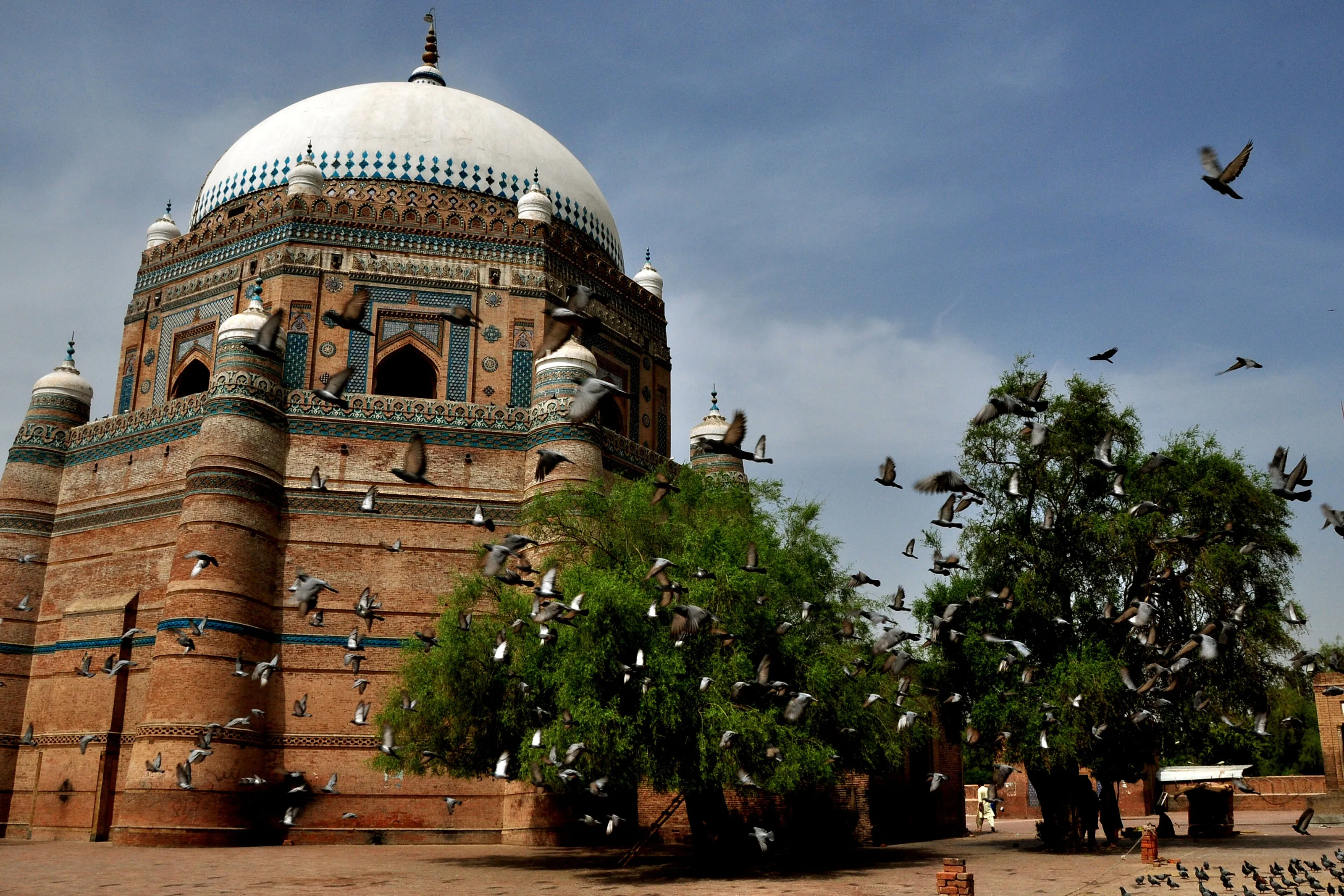
The shrine among trees and pigeons
Around the tomb, large trees shade the courtyards and flocks of pigeons wheel above the roofs. Wikipedia (EN) notes that the shisham wooden beams mixed with the brick have turned black over the centuries. The shrine draws many pilgrims every year for the urs festival marking the saint's death (Wikipedia EN).
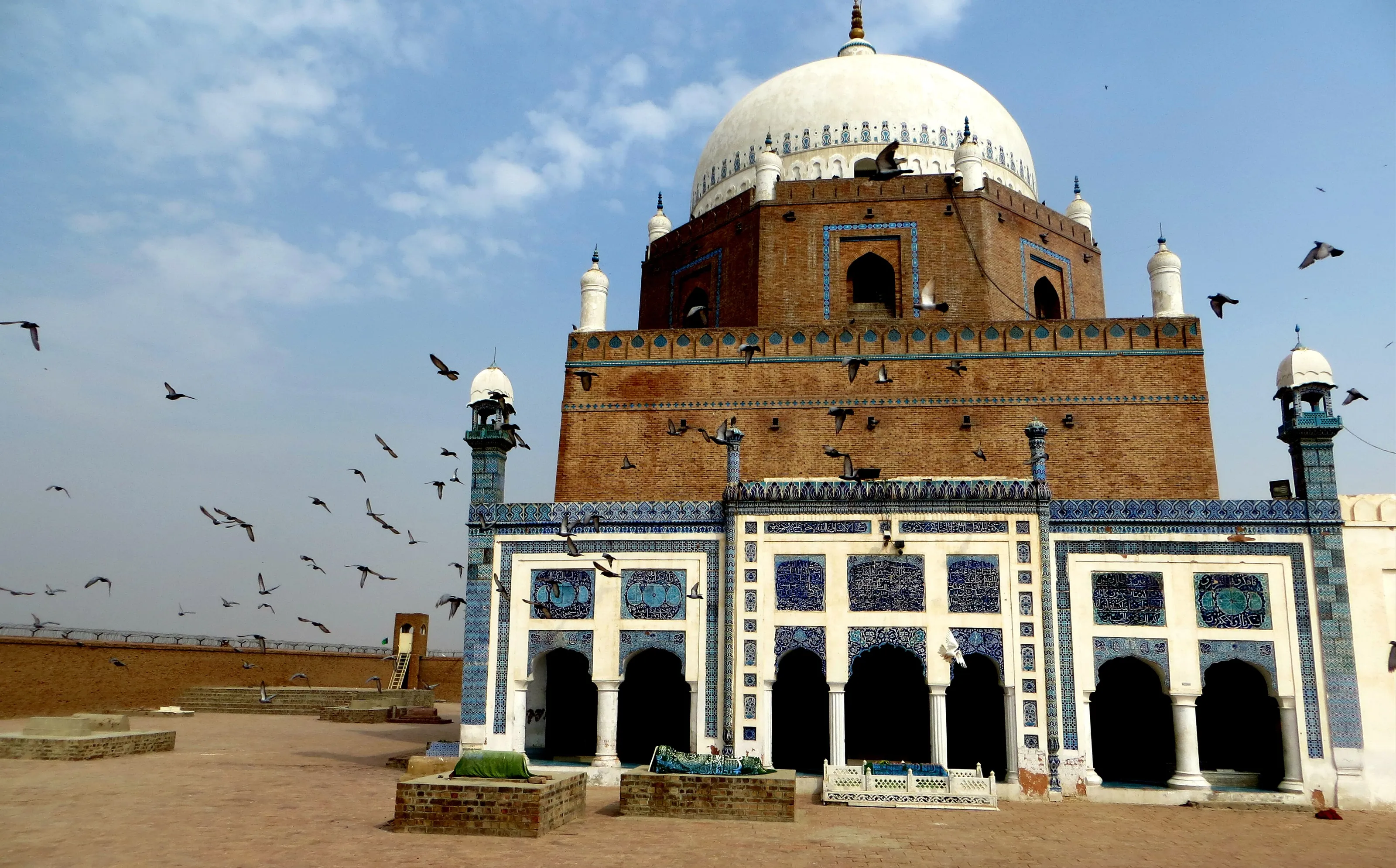
The tomb of Bahauddin Zakariya
Grandfather of Shah Rukn-e-Alam, Bahauddin Zakariya (died 1262) is considered Multan's most important saint: he established the Suhrawardiyya Sufi order here (Wikipedia DE, EN). His tomb stands near that of his grandson, on the hillock of the old fort (Wikivoyage EN); a white and blue tiled portico fronts the mausoleum with its large white dome.
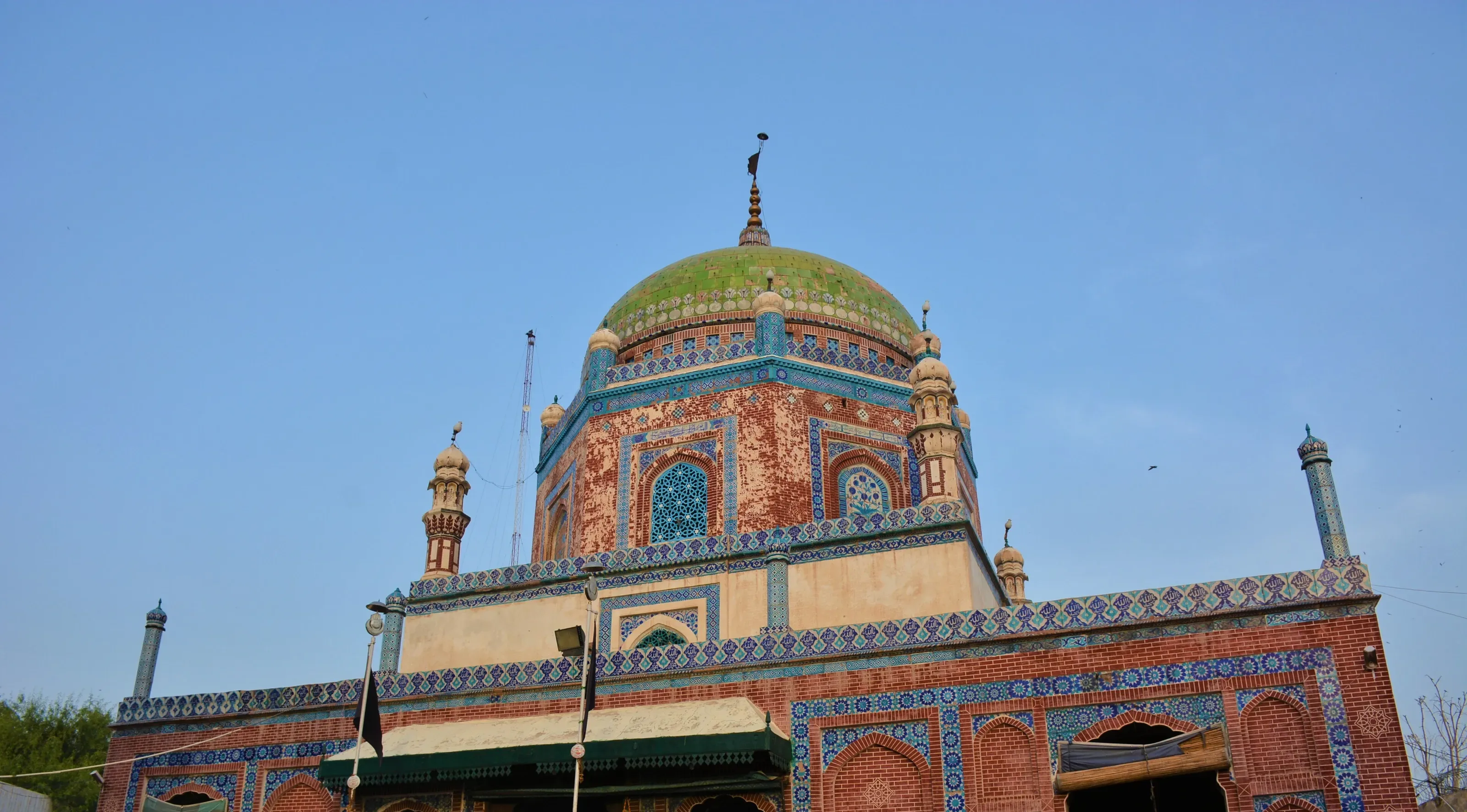
The shrine of Shah Shams Sabzwari
In the city, the shrine of Shah Shams Sabzwari, which Wikivoyage (EN) lists among Multan's main shrines, is recognisable by its green dome and its brick and blue-tile facade. Shrines are active places of worship: ask locally before you visit.
Among the places without a photo: Multan Fort, a citadel destroyed after the British siege of 1848-1849, of which a park (Fort Qasim Park) and the Damdama viewpoint remain (Wikipedia EN; Wikivoyage EN); the clock tower, Ghanta Ghar, a landmark of the old city; the Eidgah of 1735, the only building with a bulbous dome in southern Punjab according to Wikivoyage (EN); and the old city gates, such as the Delhi, Pak or Bohar gates (Wikivoyage EN).
Museums and culture
Multan Museum, blue pottery and Sufi culture
Multan Museum
Wikivoyage (EN) mentions coins, medals, stamps of the former State of Bahawalpur, manuscripts, wood carvings and camel-skin paintings. Hours change, so check before you go. We do not quote ticket prices.
The Institute of Blue Pottery
Wikivoyage (EN) names it, with the old fort and the tombs, as a highlight of a visit. Multan's blue tile and pottery are known across Pakistan, for tiles and vases alike.
A city of saints
Multan drew many Sufi mystics in the 11th and 12th centuries, hence its nickname (Wikipedia EN). It also had a Hindu past: the Sun Temple, Mulasthana, is thought to have given the city its name, but no trace remains (Wikipedia EN, DE; Wikivoyage EN).
Bazaars and crafts
The busy Hussain Agahi Bazaar sells textiles, spices, bangles, pottery and handicrafts; you can also find camel-skin lampshades, Multani shoes and jewellery, and Multani clay, multani mitti (Wikivoyage EN).
Food and drink
Mangoes, sohan halwa and Punjabi cooking
The city of mangoes
Wikivoyage (EN) calls Multan the city of mangoes, with varieties such as Sindhri, Anwar Ratol, Langra and Chaunsa. The season falls in the hottest months of the year.
Sohan halwa
This Multan dessert is made with sugar, ghee and flour, studded with nuts and pistachios (Wikivoyage EN). You find it in sweet shops and near tourist spots.
Street food and karahi
Street stalls serve kebabs, naan bread and chicken cooked several ways; karahi, made with chicken or mutton, is a speciality named by Wikivoyage (EN). We do not list addresses, which change.
Staying hydrated
Wikivoyage (EN) reminds visitors to drink plenty, as the mercury can rise sharply; bottled water is sold everywhere.
Getting around
Rickshaws, buses and rail
Rickshaws
Motorised rickshaws are the most common and most practical way to get around (Wikivoyage EN). Agree the price before you get in.
Buses and minibuses
Buses and minibuses cross the city; you pay the conductor in cash (Wikivoyage EN). Routes and fares change, so ask locally.
Taxis and apps
Taxis are found mainly at the airport and bus stands; Wikivoyage (EN) also mentions ride-booking apps.
Train and road
Multan is linked by rail to the country's main cities, and the N-5 national highway leads to Lahore, Karachi and Islamabad (Wikivoyage EN). Schedules change, so check them.
Budget and precautions
A budget to check, official advice to read
Price level
We do not publish price ranges for Multan: the amounts quoted by sources are old, from different dates and not cross-checked. Watching the flight price in advance is the simplest way to control the budget.
Official advice and insurance
Before any trip, read the official information from your country of departure: travel advice varies from one country to another and may advise against some regions or movements. Also check the terms of your insurance.
Health and heat
See a doctor or a travel medicine clinic before you go: risks such as dengue, malaria and food- or water-borne illness vary by region and season. In summer the heat is extreme, so avoid going out in the hottest hours.
Respect for places
In shrines, remove your shoes and dress in covered clothing; ask before photographing people (Wikivoyage EN).
When to go
Mild winters, extreme summers, monsoon from June to September
November to February
Mild winter, with generally clear weather; western disturbances can bring rain between December and February (Wikipedia EN): the most comfortable time for walking between the shrines.
March to April
The heat builds; days become hot, with mornings still pleasant.
May to June
Heat waves, with temperatures that can approach 50 degrees C according to Wikipedia (EN), and frequent summer dust storms (Wikipedia EN; Wikivoyage EN): a period to avoid for sightseeing on foot.
July to September
Monsoon from June to September: sometimes heavy rain, and land near the Chenab is often flooded (Wikipedia EN; Wikivoyage EN).
The climate is hot desert according to Wikipedia (EN): extremely hot summers and mild winters. We do not publish rainfall figures because the sources disagree. The time zone is UTC+5 all year, with no daylight saving.
By length of stay
How many days to spend in Multan
The mausoleums
The shrines of Shah Rukn-e-Alam and Bahauddin Zakariya, the fort site and an evening at the bazaar.
City and crafts
Add the shrine of Shah Shams Sabzwari, the clock tower, Multan Museum and the blue pottery.
Food and surroundings
With three days, taste sohan halwa and karahi, and plan a trip to the Chenab riverside, outside the monsoon season.
In pictures
Multan in pictures
You might also like
Similar destinations
FAQ
Frequently asked questions about flights to Multan
Where is Multan airport (MUX)?
In the Cantonment area, under ten kilometres from the centre according to Wikipedia (FR), about 20 minutes according to Wikivoyage (EN). Routes change: check before booking.
Is it safe to travel to Multan?
Official travel advice varies depending on the country you depart from and may advise against certain regions or movements: read your own government's before planning. SniperAir does not replace it.
What is there to see in Multan?
The tombs of Shah Rukn-e-Alam, Bahauddin Zakariya and Shah Shams Sabzwari, the fort site, the clock tower, Hussain Agahi Bazaar and Multan Museum.
Why is Multan called the City of Saints?
It drew many Sufi mystics in the 11th and 12th centuries and has many shrines, according to Wikipedia (EN).
When is the best time to visit Multan?
From November to February, when it is milder. May and June are extremely hot, with dust storms, and the monsoon runs from June to September.
What should I eat in Multan?
Mangoes in season, sohan halwa, karahi and kebabs. Stay well hydrated in summer.
How long should I stay in Multan?
One to two days are enough for the mausoleums, the fort and the bazaars; a third day lets you take your time.
How do I get alerted when a flight to Multan drops below my budget?
Create an alert profile with your departure airport, Multan Airport (MUX) as destination and your maximum budget. You are notified as soon as a matching price is detected. SniperAir monitors and alerts; it does not sell or book tickets.
Ready to head to Multan?
Set your budget and let SniperAir monitor fares for you.
Create my alert