
Cheap flights to Dushanbe
Set your departure airport and maximum budget: SniperAir tracks prices to Dushanbe and alerts you the moment a deal matching your criteria appears.
Quick summary
Country
Tajikistan
Continent
Asia
Airport
DYU
Currency
Tajikistani somoni (TJS)
Time zone
UTC+5 (all year)
Deals already spotted to Dushanbe
Real flight examples detected by SniperAir, with their reference price.
Loading examples…
Why track Dushanbe with SniperAir
A green capital at the foot of the mountains
Choose your departure
Enter your departure airport and your maximum budget for a flight to Dushanbe (DYU).
SniperAir keeps watch
Our systems continuously compare new prices with the real price history of the route. SniperAir monitors prices and alerts you: it does not sell or book tickets.
You receive an alert
As soon as a price matches your criteria, you are notified, without having searched for anything yourself.
Dushanbe is the capital and largest city of Tajikistan, with more than a million inhabitants: about 1.2 million according to Wikipedia (EN and DE), 1.56 million in 2024 according to Wikipedia (FR). It sits at about 800 m above sea level, in the Hisor Valley according to Wikivoyage (EN), and owes its name to the Tajik word for 'Monday', the day of a weekly market. It was called Stalinabad from 1929 to 1961 according to Wikipedia (FR). Wikivoyage (EN) describes a contrast between old Soviet buildings and big new ones, and the quaintest of the Central Asian capitals.
Air fares to Dushanbe vary by season and departure airport: a SniperAir alert saves you from comparing every day. You set your budget, we compare new prices with the route's real history and we let you know.
Airport and getting into town
Dushanbe airport, about 5 kilometres from the centre
Dushanbe (DYU)
Dushanbe International Airport (DYU) is about 5 km from the centre according to Wikivoyage (DE); a new terminal opened there in late October 2014 according to the same source. Wikivoyage (EN) describes it as small, with flights to Moscow, Istanbul, Urumqi, Dubai, Delhi, Tashkent and Almaty. It is a base for Tajik Air and Somon Air according to Wikipedia (DE). Taxis link the airport to the centre; agree the fare before getting in. No fare is published here.
Distance DYU - centre: about 5 km according to Wikivoyage (DE). No transfer fare is published here.
Wikivoyage (EN) notes that a flight links Dushanbe with Khujand in winter and early spring, when the mountain passes are closed. For a Central Asia circuit you can also track Tashkent (TAS), Bishkek (BSZ) and Almaty (ALA).
Landmarks
Mosques, parks, the national museum and the reclining Buddha
Dushanbe is explored on foot and by light transport, between its wide avenues, parks and museums. The five places below are illustrated with photos; others are described in text only further down.
Monuments on a grand scale
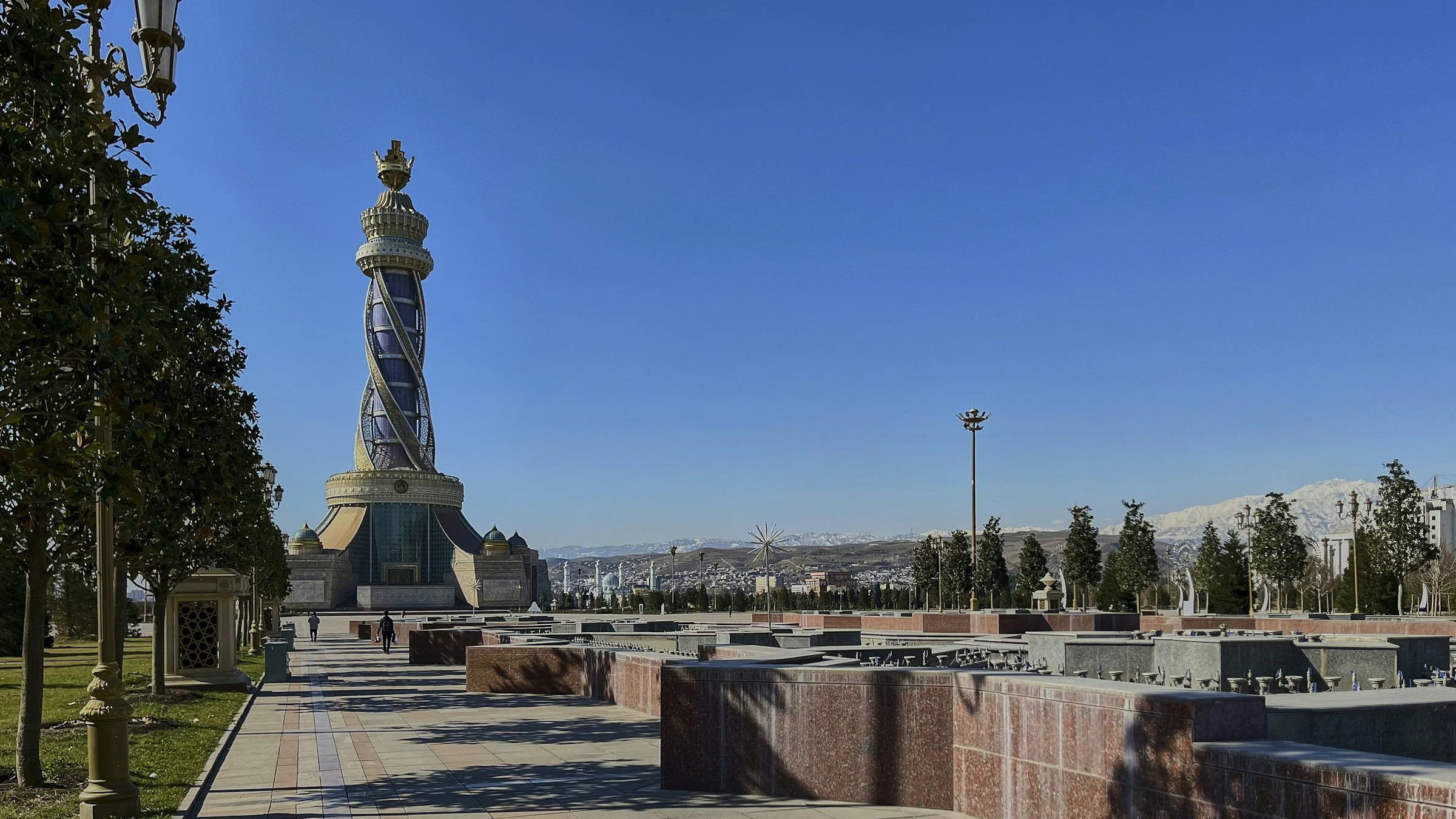
Wikipedia (DE) recalls that monumental buildings appeared in the 2000s, including the National Library, the National Museum, the Navruz Palace and the great Friday mosque. The photo shows a slender tower with a crowned top at the end of a vast pink granite esplanade, with the mountains behind.
The big mosques
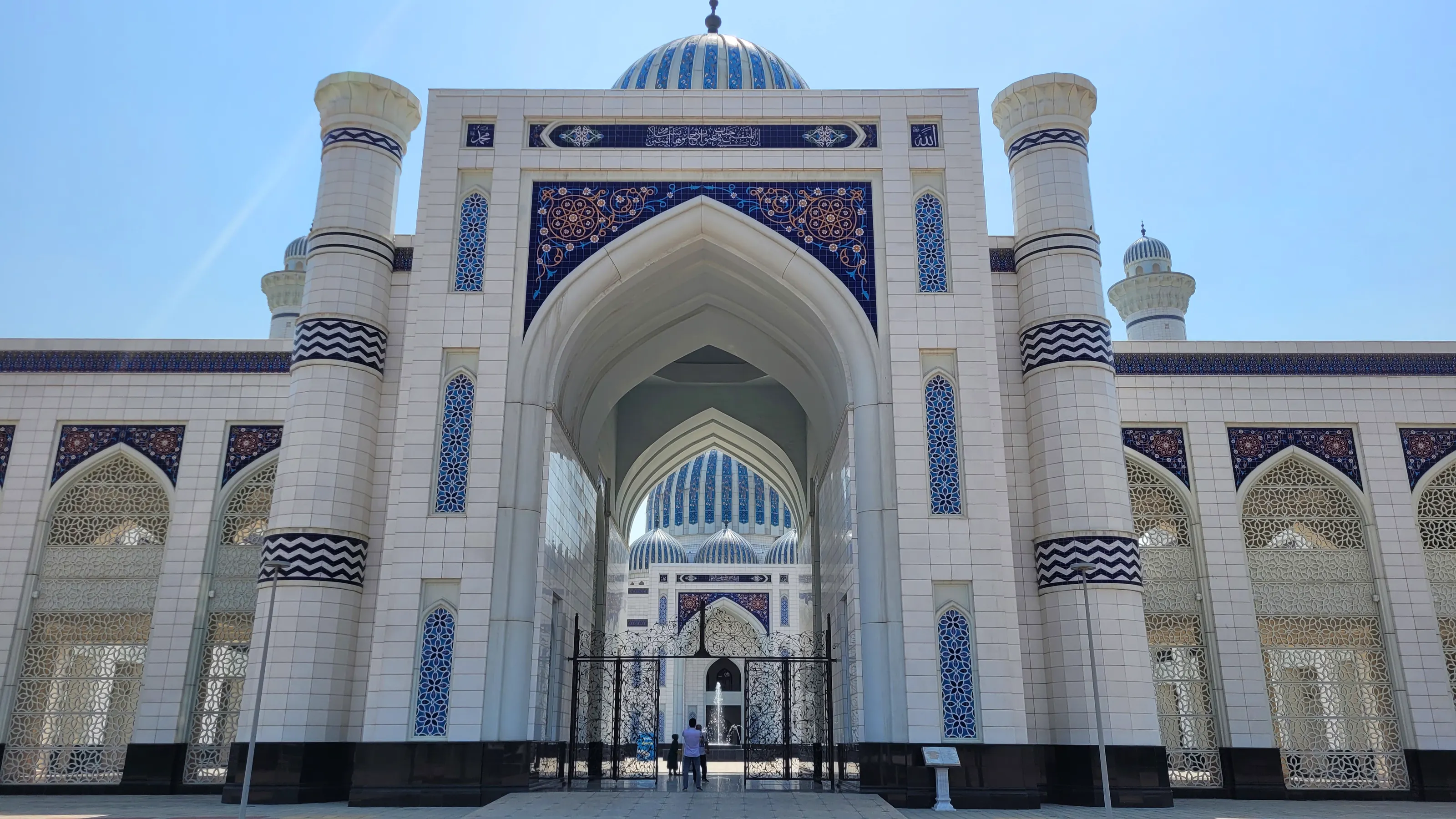
In October 2009, construction of a new central mosque, financed by Qatari investors, was launched according to Wikipedia (EN); it is meant to replace the Haji Yakub Mosque and become the largest in Central Asia. The white gate in the photo, decorated with blue tiles, illustrates this recent architecture. Covered dress is required to enter.
Parks and gardens
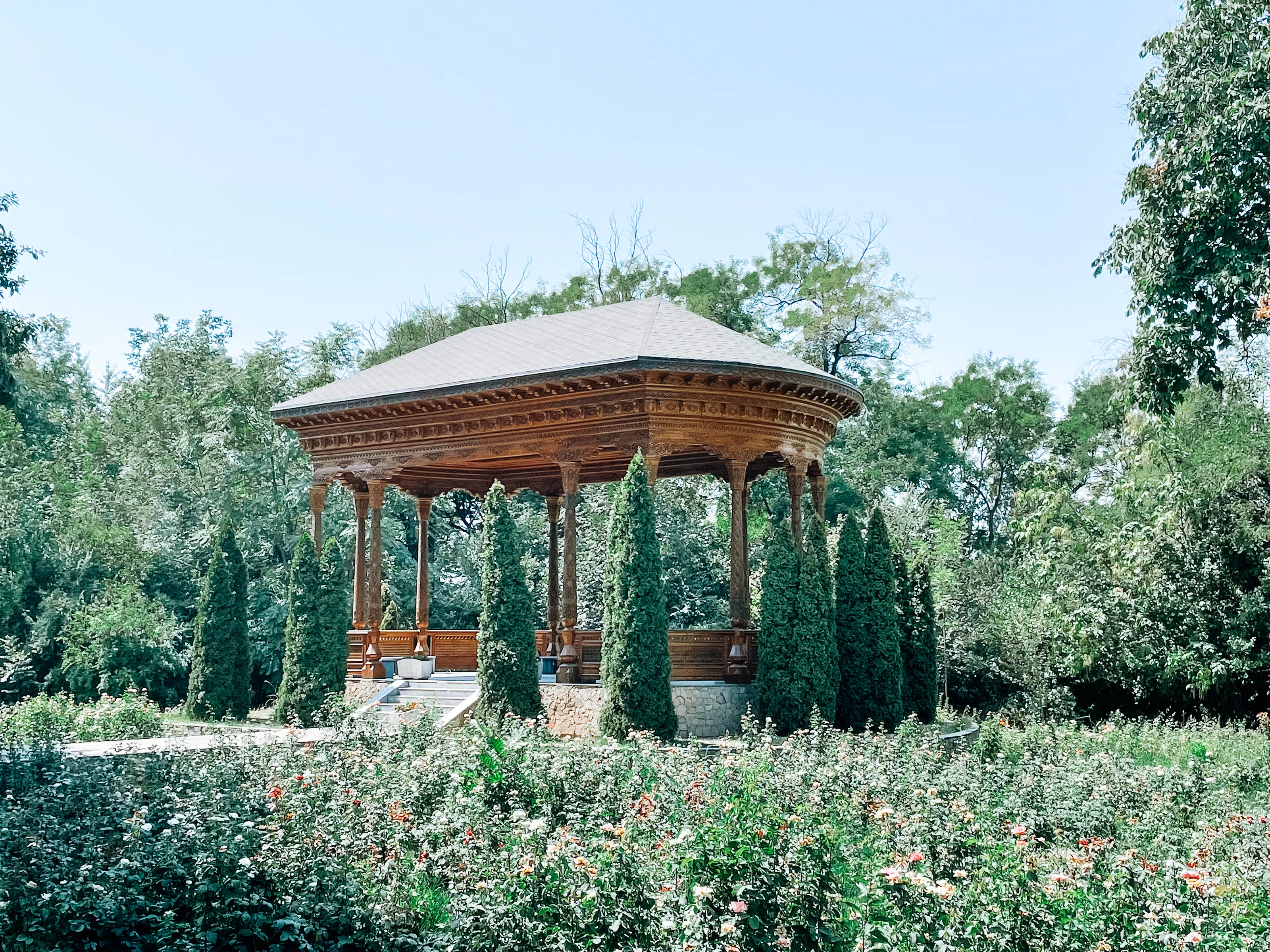
Wikivoyage (EN) lists the botanical garden, a green haven away from the dust and noise, Rudaki Park and its fountains, and Victory Park. A carved wooden pavilion, like those of tea houses, recalls the region's woodworking craft.
The National Museum
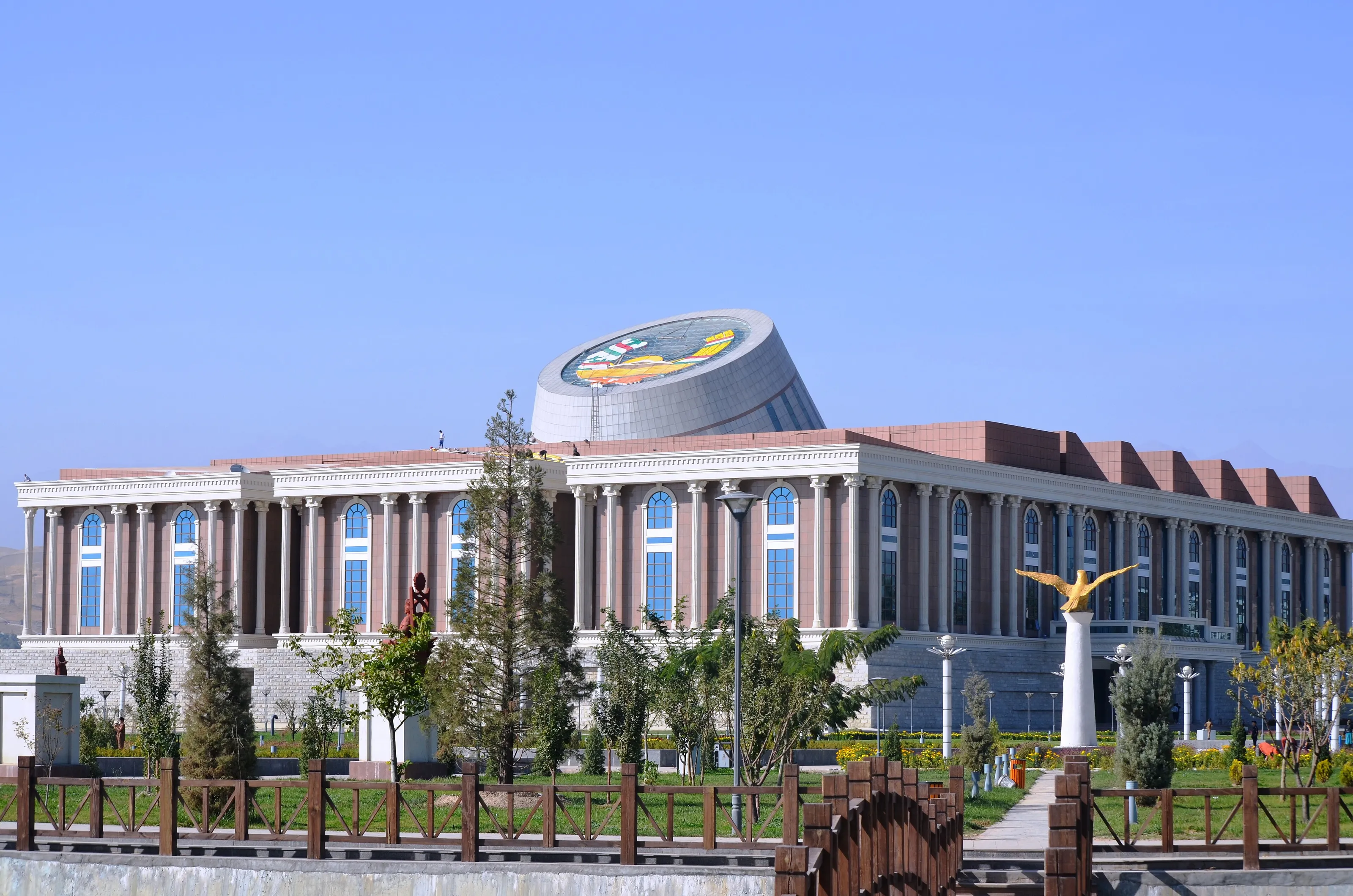
Wikivoyage (EN) describes four floors devoted to the country's history, from prehistory to the Soviet era. The building with columns is recognisable by its tilted dome, and the neighbouring park is decorated with sculptures. Opening hours and fares change, so check the official website.
The Buddha in nirvana
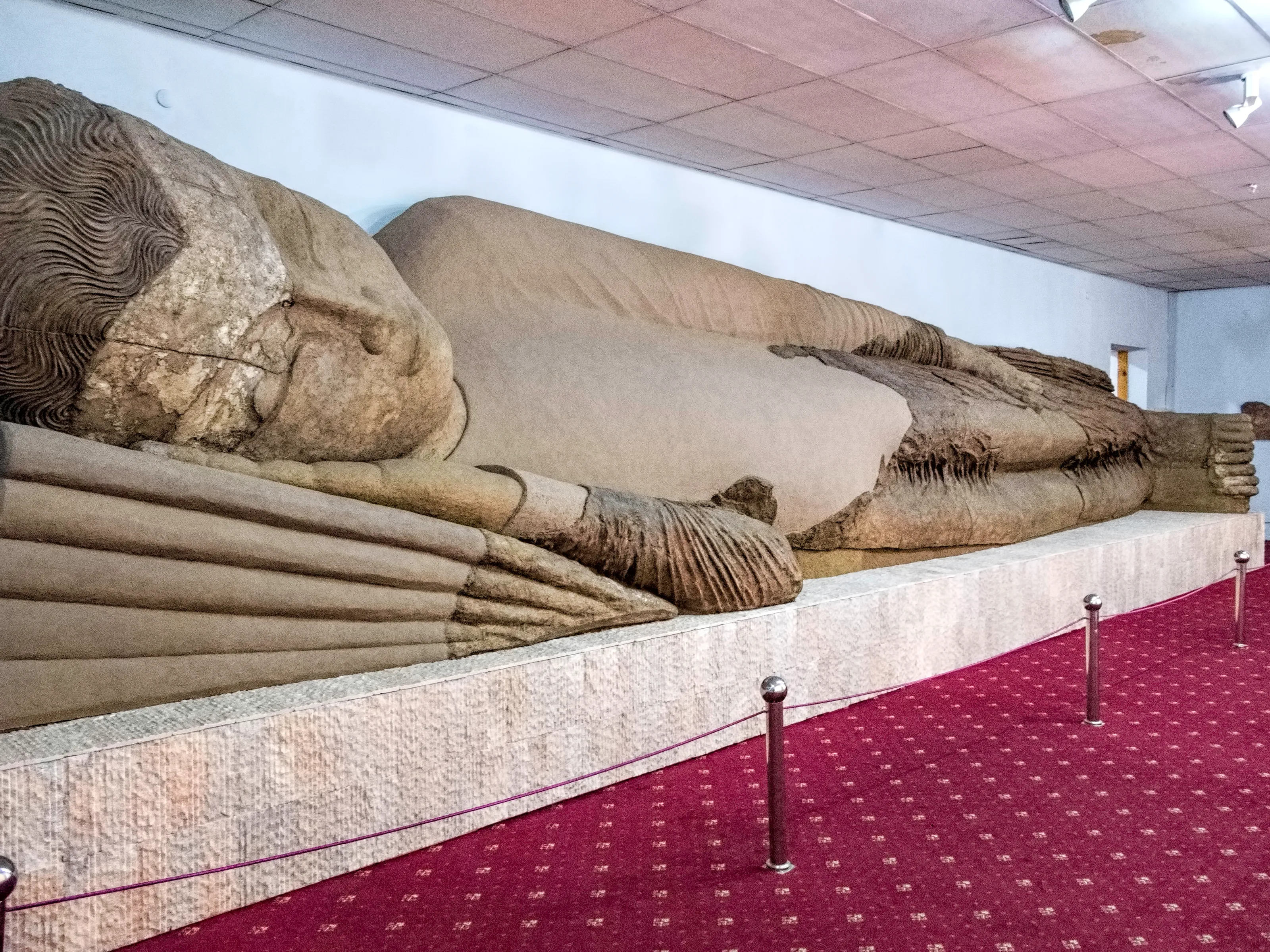
On the ground floor of the national museum, the Buddha in nirvana from Ajina-tepe, a giant clay statue, is the crown jewel of the collections according to Wikivoyage (EN). It bears witness to the Buddhist era of Central Asia.
Other places worth noting include the monument to Ismoil Somoni, founder of the Samanid dynasty in the 10th century according to Wikivoyage (EN), the Ayni Opera and Ballet Theatre, the flagpole in front of the Palace of Nations, the Shakhmansur Bazaar, known as the Green Bazaar, and Hisor Fortress, an excursion from the city according to Wikivoyage (EN). Wikivoyage (EN) advises against close-up photography of police near monuments.
Museums and culture
Museums: antiquities, musical instruments and theatres
The National Museum
It presents the country's history over four floors according to Wikivoyage (EN), with remains from each empire that crossed the region, then a gallery of paintings and sculptures from the Soviet era.
The Gurminj Museum of Musical Instruments
A small museum in the centre, it presents a variety of Central Asian instruments according to Wikivoyage (EN): rubab, tanbur, dutor, setor, and drums. It is best to go during a cultural event.
Antiquities and the Buddha
According to Wikivoyage (EN), the national museum is also presented as a museum of antiquities: the ground floor gathers remains of the empires that crossed the country, around the large Buddha in nirvana from Ajina-tepe.
The Ayni Opera and Ballet Theatre and the theatres
Wikivoyage (EN) lists the Ayni Opera and Ballet Theatre, which regularly stages concerts, the Lahuti Drama Theatre, the puppet theatre and the circus.
The Botanical Garden and the zoo
Wikivoyage (EN) lists the botanical garden, a green haven, and the zoo, the only institution of its kind in the country, with about 600 animals.
Food and drink
Food and drink: plov, qurutob, laghman and green tea
Specialities to try
Plov (osh), rice fried with carrots and meat, is the national dish according to Wikipedia (EN and FR). Qurutob, flaky bread soaked in dried cheese dissolved in water, is eaten by hand from a communal plate according to Wikipedia (EN). You also find kebabs, soups and samsa; Wikivoyage (EN) also lists Turkish, Indian, Georgian and European restaurants.
Drinks
Green tea is the national drink according to Wikipedia (FR and EN) and accompanies every meal as a sign of hospitality according to Wikipedia (EN). Wikivoyage (EN) advises against drinking tap water: choose bottled water and wash fresh fruit and vegetables with bottled water.
Markets and districts
Shakhmansur Bazaar, known as the Green Bazaar, is the biggest in the centre, with dried fruit, nuts, fruit, vegetables, spices, meat and bread according to Wikivoyage (EN). Restaurants cluster around Rudaki Avenue. No address is given here because venues open and close quickly.
Getting around
Getting around Dushanbe
Buses and trolleybuses
Wikivoyage (EN) says there are no published route maps or timetables; most tourist sites lie along Rudaki and Somoni avenues, and a mapping app helps to follow the ride. Trolleybus no. 1 runs along Rudaki Avenue.
Marshrutkas
Minibuses and shared cars follow fixed routes according to Wikivoyage (EN); to get off, you say 'hamin jo', 'right here'. Minibuses are often crowded.
Taxis
Wikivoyage (EN) recommends taxis within the city, with several licensed companies; the Yandex app does not work in Tajikistan according to the same source. Agree the fare before getting in.
Finding your way
Few streets are known by name according to Wikivoyage (EN): orient yourself with Rudaki and Somoni avenues and the big monuments.
Excursions and roads
Minibuses and shared taxis leave from bus terminals for Khujand, Varzob, Ayni, Panjakent, Hisor and the Pamirs according to Wikivoyage (EN), often early in the morning. Passes can be closed in winter: check the current situation.
Budget and precautions
Budget, entry rules and local customs
Price level
Dushanbe is generally very affordable compared with Western European capitals for meals and transport, with differences by district and season. No figure is published here because prices change quickly and sources diverge. Keep cash, as cards are not accepted everywhere.
Entry requirements
Entry conditions (a visa or e-visa if required, special permits for some regions, length of stay) depend on your nationality and change regularly. Check them before departure on your own foreign ministry's website and on that of the Tajik authorities.
Everyday safety
Wikivoyage (EN) judges Dushanbe generally safe, but flags rare robberies in broad daylight and improper requests for money from some officials, notably at the airport on departure. Stay courteous, avoid attracting the attention of law enforcement and do not hesitate to ask for official documents. Water and power cuts are possible.
Local customs
Residents are described as private and conservative, but very welcoming according to Wikivoyage (EN); visitors are offered tea. In mosques covered dress is expected and shoes come off. Always ask permission before photographing people, and avoid photographing police or official buildings.
When to go
When to go to Dushanbe
Spring (March to May)
Thunderstorms, rain and hail are at their most frequent according to Wikipedia (EN); the season starts around 22 February and ends around 17 May.
Summer (June to August)
Hot and dry: the July average is about 27 degrees according to Wikipedia (DE), and the dry season runs from late May to mid-October. Parks and fountains offer some coolness.
Autumn (September to November)
Warm and dry at first, according to Wikipedia (EN); autumn starts around 14 August.
Winter (December to February)
Cool: the January average is about 2 degrees according to Wikipedia (DE). It snows about 25 days a year, and precipitation mostly falls as rain according to Wikipedia (EN).
Wikipedia (EN and ES) classes Dushanbe's climate as Mediterranean with continental influence, with more than 500 mm of rain a year (653 mm according to Wikipedia DE). April-May and September-October are the most comfortable periods for the city; the mountains are visited from late May to September.
By length of stay
How many days in Dushanbe
Centre and museum
Two days are enough for the National Museum, the parks, the Green Bazaar and Rudaki Avenue.
Mosques, theatres and an excursion
With three days, add the musical instruments museum, the opera and an excursion to Hisor Fortress.
Lakes and the Fann Mountains
With five days, add an excursion to the mountains and lakes of the country, to organise with a driver.
In pictures
Dushanbe in pictures
You might also like
Similar destinations
FAQ
Frequently asked questions about flights to Dushanbe
Where is Dushanbe Airport?
Dushanbe International Airport (DYU) is about 5 km from the centre; taxis and minibuses link it to the city.
What currency is used in Dushanbe?
The Tajik somoni (TJS). Keep cash, as cards are not accepted everywhere, and check exchange fees.
What should I see first in Dushanbe?
The National Museum and its Buddha in nirvana, the parks, the Ismoil Somoni monument, the Green Bazaar, the musical instruments museum and, as an excursion, Hisor Fortress.
Do I need a visa for Dushanbe?
It depends on your nationality and the rules in force, which change. Check them before departure with the official authorities and your own foreign ministry.
When is the best time to go to Dushanbe?
April to May and September to October for the city; late May to September for the mountains. Summer is hot and dry.
Is Dushanbe safe for tourists?
Wikivoyage (EN) judges it generally safe, with rare but possible daytime robberies and improper requests for money from some officials. For any question about the region, refer to the official advice of your country of departure.
How much does a flight to Dushanbe usually cost?
The price depends mainly on your departure city, the time of year and how far ahead you book. The "opportunities" section above shows real examples of prices SniperAir has already detected to this destination.
How do I get alerted when a flight to Dushanbe drops below my budget?
Create an alert profile with your departure airport, Dushanbe (DYU) as the destination and your maximum budget. You are notified automatically as soon as a matching price is detected. SniperAir monitors and alerts, it does not sell or book tickets.
Ready to head to Dushanbe?
Set your budget and let SniperAir monitor fares for you.
Create my alert