
Cheap flights to Turku
Set your departure airport and maximum budget: SniperAir tracks prices to Turku and alerts you the moment a deal matching your criteria appears.
Quick summary
Country
Finland
Continent
Europe
Airport
TKU
Currency
Euro
Time zone
UTC+2 (UTC+3 during summer time)
Deals already spotted to Turku
Real flight examples detected by SniperAir, with their reference price.
Loading examples…
Why track Turku with SniperAir
You do not need to compare prices every day
Choose your departure
Enter your departure airport and your maximum budget for a flight to Turku (TKU).
SniperAir watches
Our systems continuously compare new fares with the route's real price history. SniperAir tracks prices and alerts you: it does not sell or book tickets.
You receive an alert
As soon as a fare matches your criteria, you are notified, without having searched for anything yourself.
Airport and getting into town
An airport about 8 km away, linked to the centre and the port by bus
Turku (TKU)
Turku Airport is about 8 km north of the centre, partly in the neighbouring municipality of Rusko. Bus line 1 links it with the centre and then the port, with a departure about every 20 minutes according to Wikivoyage; by taxi, allow around fifteen minutes. Flights are mostly regional and European and can change from season to season; from many countries it is simpler to fly into Helsinki-Vantaa (HEL), about 166 km away, and continue by coach (around 2 h 15 to 2 h 55) or by train.
Distance given by Wikipedia (EN, DE) and Wikivoyage (EN); the bus frequency comes from Wikivoyage and should be checked. Times are approximate and fares are not listed because they change.
Turku is the oldest city in Finland. The year 1229, the date of a bull by Pope Gregory IX, is traditionally taken as the year of its founding, although this interpretation is debated. For centuries it was the most important city in the country, and the capital of the Grand Duchy until Helsinki replaced it in 1812.
Turku lies at the mouth of the Aura River, facing the Baltic Sea archipelago. A great fire in 1827 destroyed much of the city, and few medieval buildings survived. Turku was European Capital of Culture in 2011, together with Tallinn, and it has two universities.
The castle and the Aura River
A medieval fortress by the sea
Turku Castle, whose construction began in the 1280s, is the symbol of the city. It served as a residence for the kings of Sweden and as a fortress, and today it can be visited as a museum. The Port of Turku, where the ferries depart, is very close.
The Aura River
The Aura River crosses the city and is its heart: museums, restaurants and cafés cluster along its banks, which form a national urban park. You can walk from the cathedral to the castle, or take the Föri, a small free ferry for pedestrians and bicycles.
The centre
The vast majority of sights are within a kilometre or two of the market square (Kauppatori), which is easy to reach on foot. The Kauppatori is not illustrated: it is described in text only.
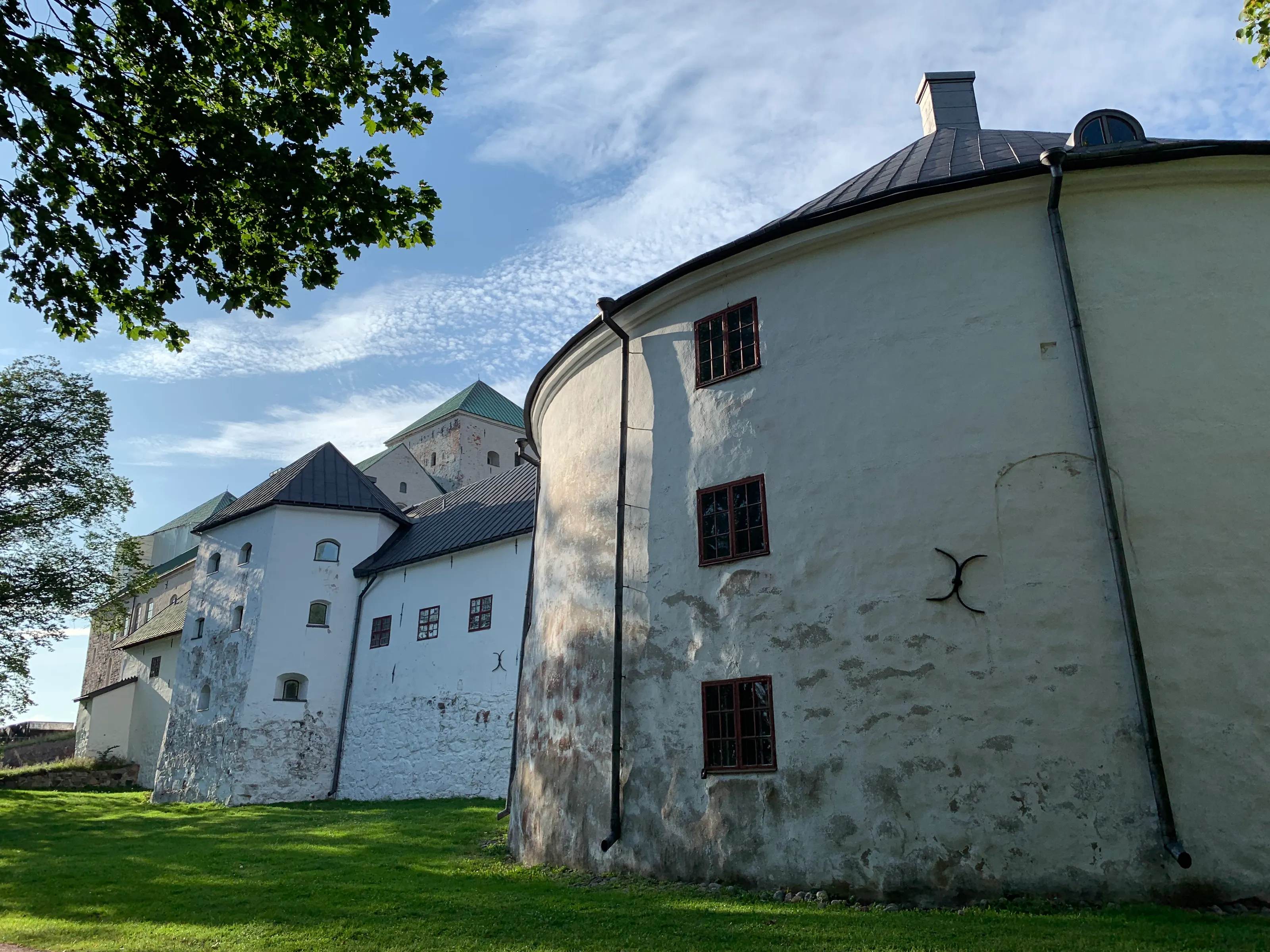
The castle's whitewashed walls
The whitewashed walls and rounded towers of the castle overlook the coast. Built of stone from the late 13th century, it was enlarged over the centuries. Check opening hours and visiting arrangements before you go.
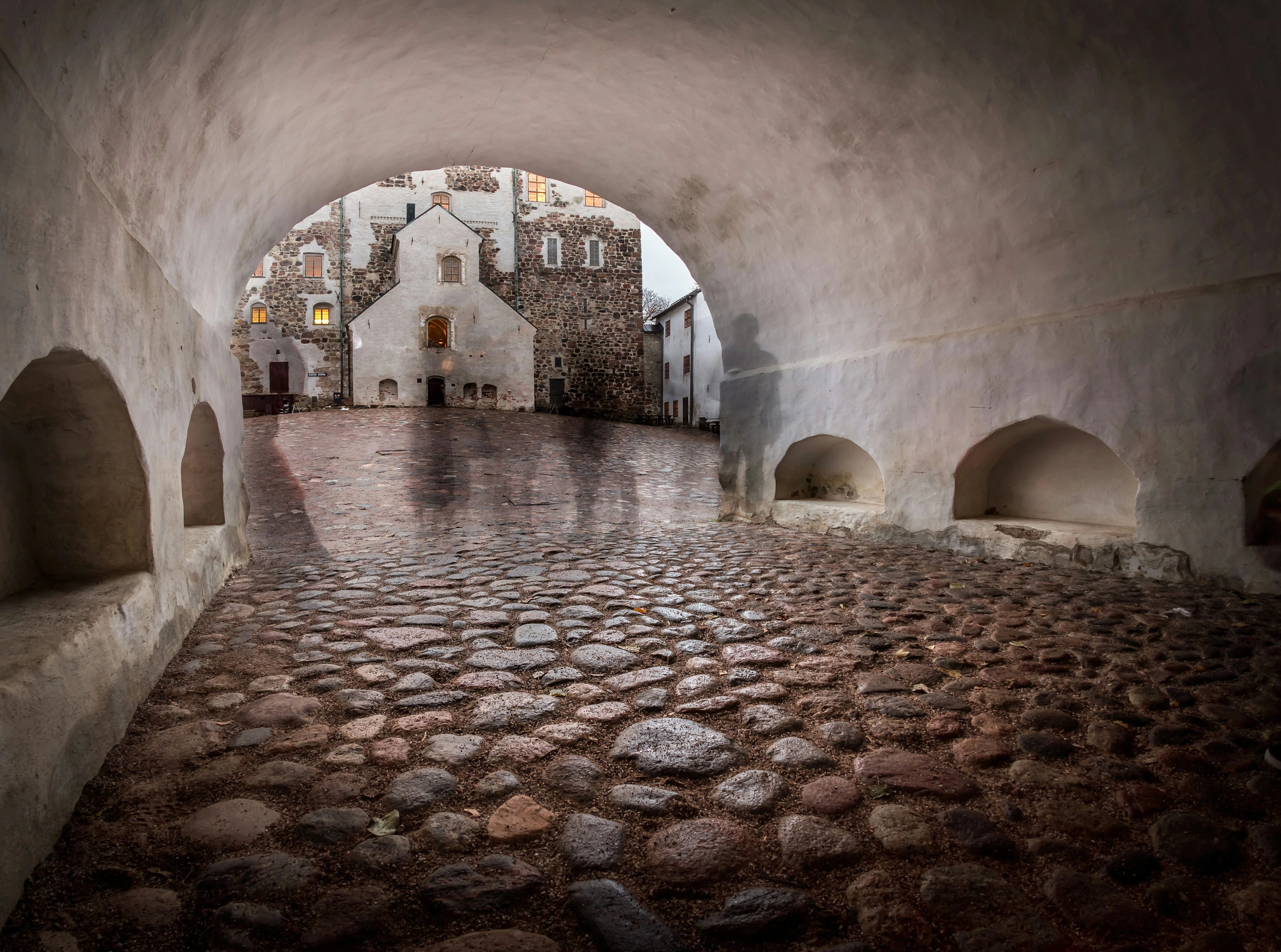
A vaulted passage and its cobbled courtyard
This photo shows a vaulted, whitewashed passage opening onto a cobbled courtyard and lit stone buildings; we do not tie it to a specific place. It conveys the atmosphere of the stone medieval fortresses of northern Europe.
The cathedral and the old town
The national cathedral and the district that was spared
Places without a photo in this section are described in text only.
Vanha Suurtori and Luostarinmäki
The Old Great Square (Vanha Suurtori) is the historic heart of the city. The Luostarinmäki district is the only large part of the city that survived the 1827 fire: its wooden houses now hold a living handicraft museum, with craftspeople working in traditional ways.
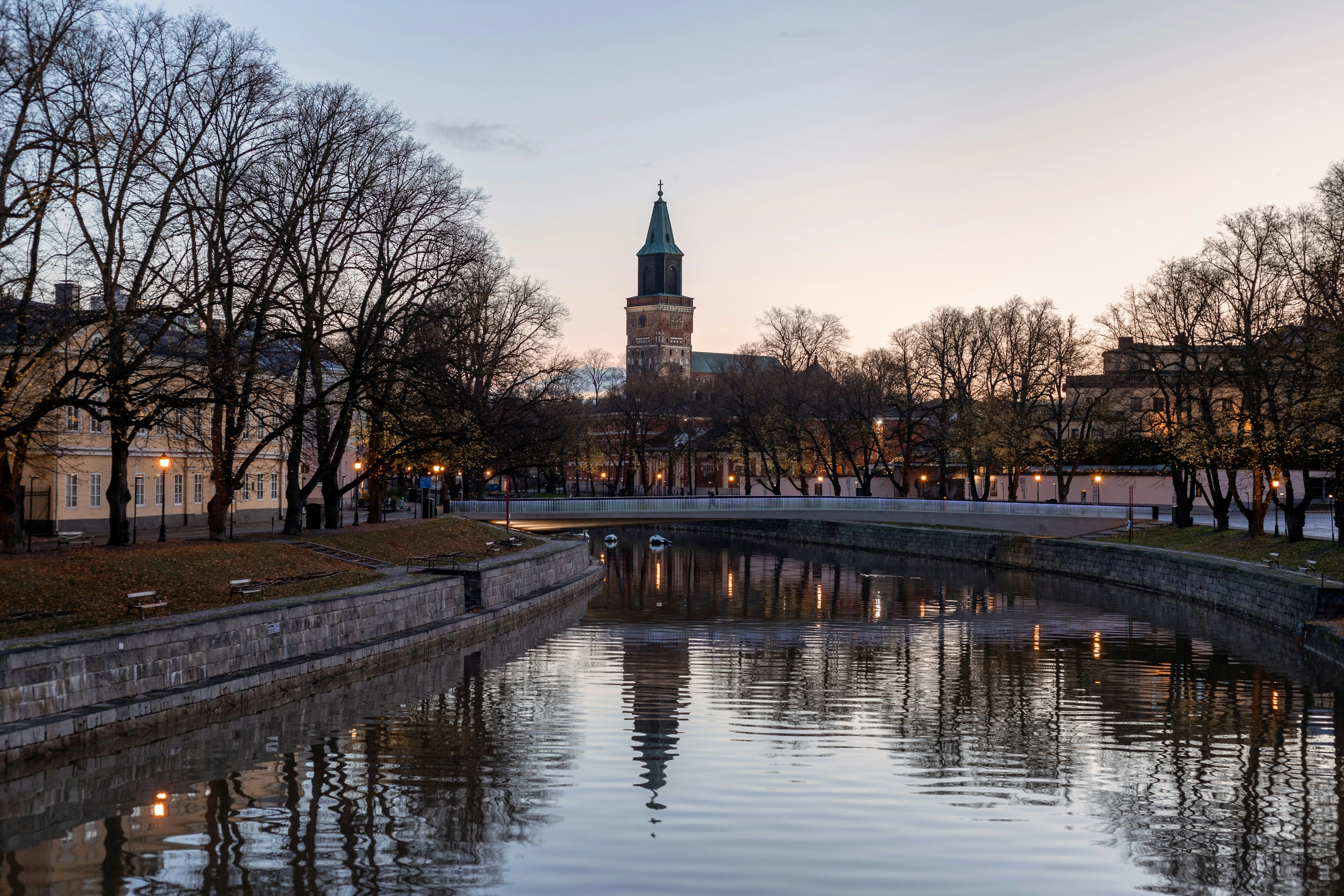
The cathedral on the banks of the Aura
Turku Cathedral, built in the 13th century, is Finland's national shrine and the country's main medieval church. Its brick tower rises over the left bank of the Aura; this photo shows it at dusk, reflected in the water, with a lit bridge.
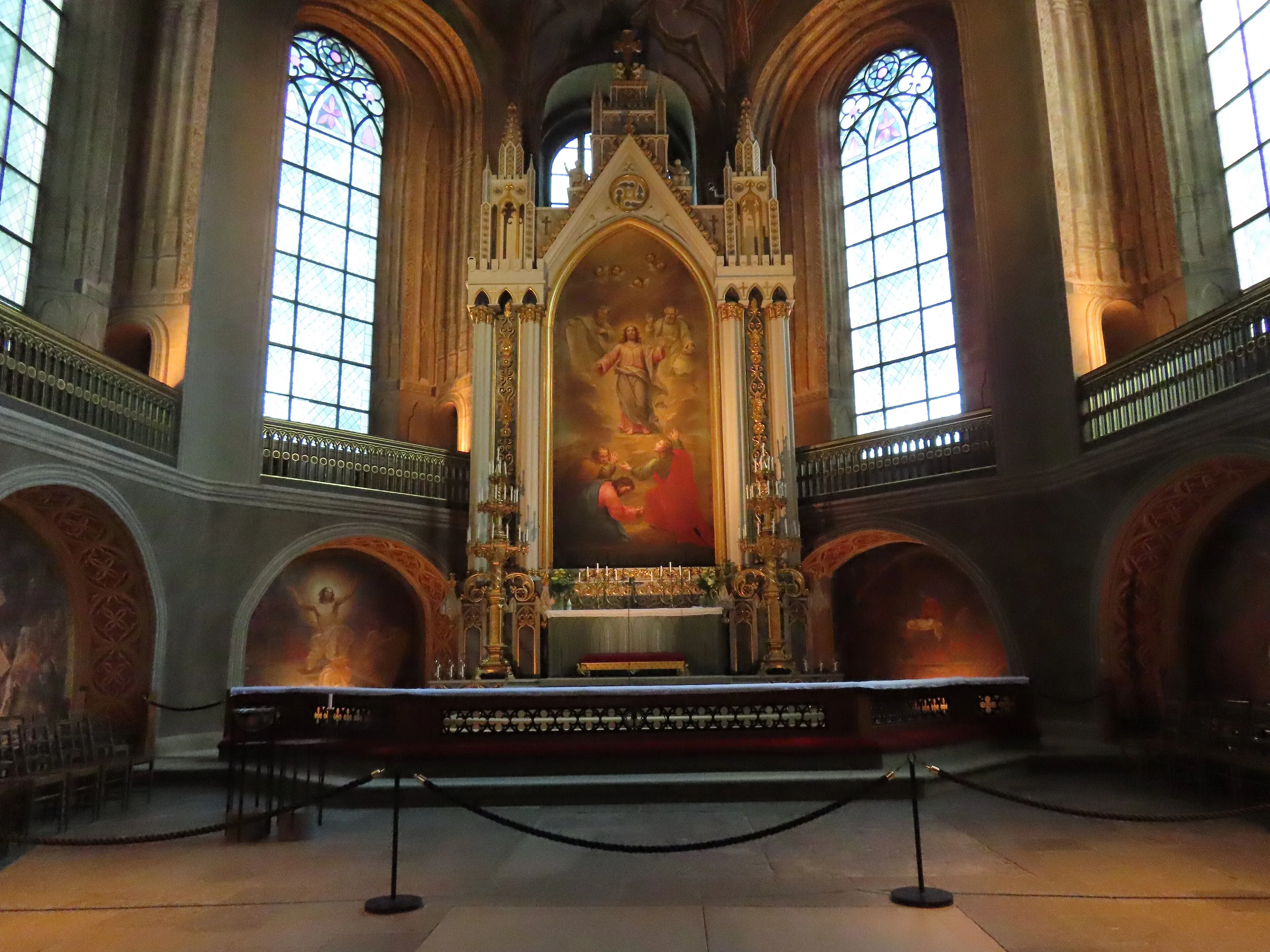
The chancel and its altarpiece
Inside, the chancel is dominated by a large painted altarpiece in a gilded frame, lit by tall windows. The cathedral is a working Lutheran church: respect services and visiting rules.
The archipelago, Naantali and Ruissalo
Ferries to Åland and Stockholm, a wooden town and an island of villas
Turku is the gateway to the Baltic Sea archipelago, one of the richest in islands in the world. Ferries link the Port of Turku daily with the Åland archipelago and Stockholm, a trip that has become a tradition for many Finns; check schedules and onboard conditions before you book. Cruise boats and a seasonal water bus also run on the Aura and to the islands.
Ruissalo
Ruissalo island, west of the centre, is a summer destination with beaches, large villas, a nature reserve and the University of Turku botanical garden, reachable by bus (line 28) or, in summer, by water bus. It also hosts a rock festival. The island is not illustrated: it is described in text only.
Naantali
Naantali is a small coastal town about 20 km from Turku, reached by bus or boat. It is known for its old town of wooden houses, its marina and a theme park devoted to the Moomins.
Naantali's old town
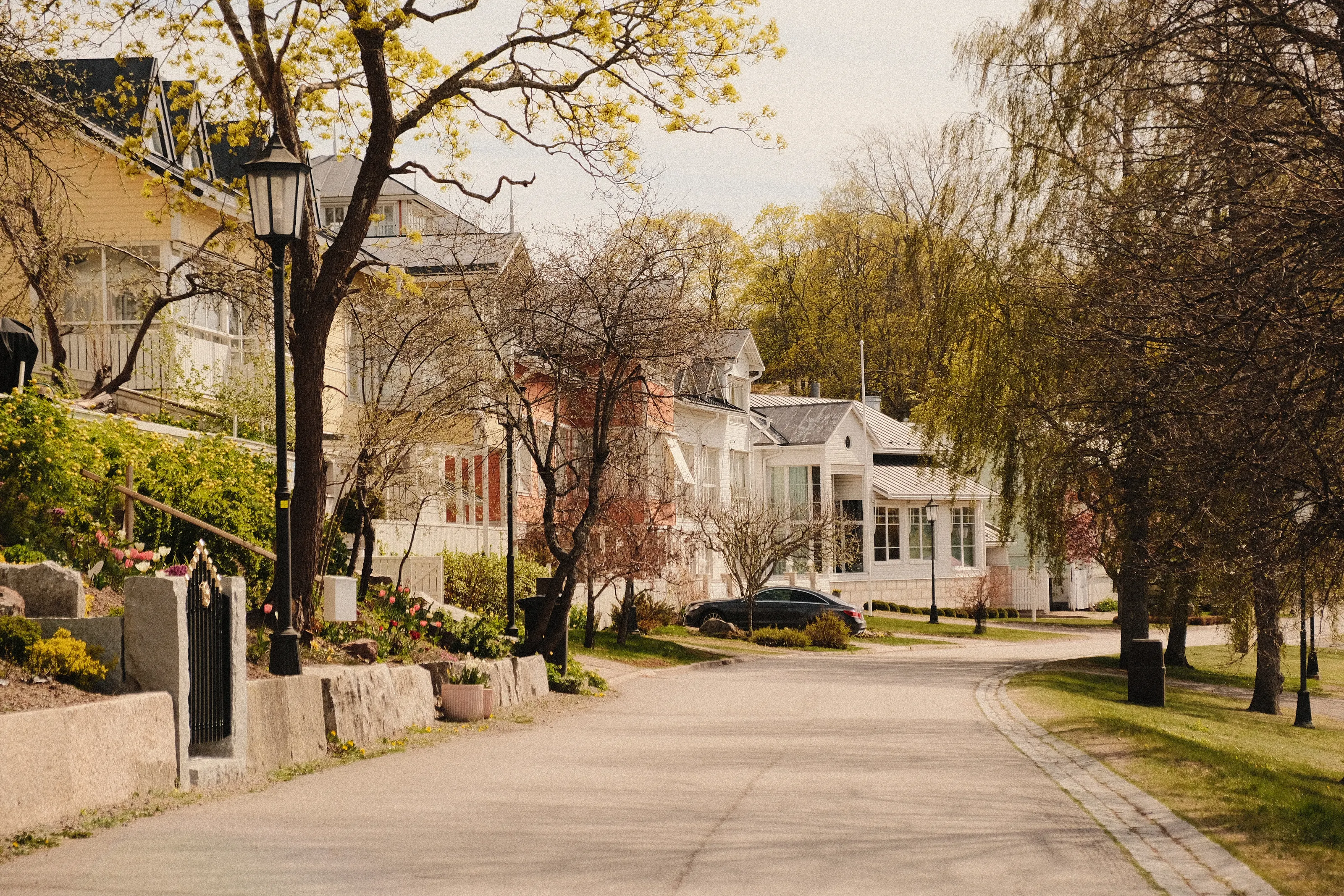
The quiet streets of Naantali's old town are lined with wooden houses and trees, with many cafés. It is an easy half-day or day trip, about 20 km from Turku; this photo was taken in Naantali, not in Turku itself.
Museums and culture
From medieval archaeology to contemporary art
The places in this section are not illustrated: they are described in text only. We do not give prices. Many museums can be visited with the Museokortti card.
Aboa Vetus & Ars Nova
This museum combines Turku's medieval history with contemporary art: you walk over the ruins of stone buildings uncovered by excavations, while Ars Nova shows modern art.
Luostarinmäki
The living handicrafts museum occupies the district of wooden houses spared by the great fire of 1827.
Other museums
The Turku Art Museum, housed in a granite building, presents works of the 19th-century national awakening and modern pieces. The Pharmacy Museum and Qwensel House show 18th-century bourgeois life, and the WAM museum is named after the sculptor Wäinö Aaltonen. There is also a biological museum, with dioramas of Finnish wildlife.
Food and drink
Herring, raisin sausage, archipelago bread and coffee
Cooking from sea and land
Turku and south-west Finland have a cuisine influenced by Sweden, Denmark and Germany. Herring, the regional fish, is eaten salted, fried, grilled or smoked; perch, whitefish and pike are also widely used. The city calls itself the food capital of Finland.
Specialities to try
Raisin sausage is a regional speciality; you can buy it, for example, at the market hall. The sweet malt bread of the archipelago, skärgårdslimpa, rye bread and Karelian pies round out the basket. At a café, try pulla, a cinnamon bun, or the Piispanmunkki, the "bishop's doughnut".
Restaurants and cafés
Many cafés and restaurants line the Aura, some on boats. Restaurants often offer cheaper lunch menus on weekdays; kitchens generally close fairly early in the evening.
Getting around
Föli buses, the Aura ferry, bikes, ferries and trains
In town
The centre is walkable. The Föli bus network serves the city and several neighbouring municipalities, including Naantali, Raisio and Kaarina, with harmonised tickets; line 1 links the airport, the centre and the port. Cycle routes are well signposted, and the Föri crosses the Aura free of charge.
Excursions
For Naantali, take the bus or, in summer, a boat. For Ruissalo, bus line 28 or the seasonal water bus. For the archipelago, ferries and seasonal boats serve many islands.
From the rest of the country
Turku is about 166 km from Helsinki: allow around 2 h 15 to 2 h 55 by coach, or take the train. Tampere and Oulu are linked by train; ferries sail to Åland and Sweden.
Budget and precautions
A medium to high budget
Price level
Turku is a medium to high budget destination compared with many European countries. Many sights are free (the Aura riverside walk, the outsides of the castle and cathedral, parks), and lunch menus and markets let you spend less. We give no figures because we could not confirm them from two independent sources.
Flights
The flight remains the most variable cost. SniperAir tracks fares to TKU and compares them with the route's history, but it does not sell or book tickets.
Entry rules and precautions
Finland is part of the Schengen Area: entry requirements depend on your nationality, so check them on official government sites. Also consult the official recommendations of your country of departure. In winter, cold and ice call for caution; if you board a ferry or a sea excursion, follow the crew's safety instructions.
When to go
A coastal climate: cold winters, bright summers
Winter (December to February)
Cold, with frequent snowfall; the sea and the archipelago soften temperatures a little compared with the interior. Days are short.
Spring (March to May)
Days lengthen fast, with changeable weather; parks bloom towards the end of the period.
Summer (June to August)
Bright and pleasant, with long days; it is the best season for the archipelago, the islands, festivals and terraces on the Aura.
Autumn (September to November)
Golden colours, falling temperatures and more rain; fewer people.
Turku has a humid continental coastal climate under the influence of the Baltic Sea: winter is cold but generally a little milder than inland, and summer is warm and bright. Summer is the best season for the archipelago; winter suits museum visits and the Christmas atmosphere.
By length of stay
What to do in Turku depending on how long you stay
The essentials
The castle, the cathedral, a walk on the Aura, a museum (Aboa Vetus & Ars Nova) and the market hall.
Around Turku
Naantali, Ruissalo and its botanical garden, or a bike ride.
The archipelago
A ferry crossing to Åland or excursions to the islands of the archipelago.
In pictures
Turku in pictures
You might also like
Similar destinations
FAQ
Frequently asked questions about flights to Turku
How do I get from Turku airport to the centre?
The airport (TKU) is about 8 km north of the centre. Bus line 1 goes to the centre and then the port, with a departure about every 20 minutes; a taxi takes around fifteen minutes.
When is the best time to visit Turku?
Summer, for the archipelago, the Aura terraces and long days; winter for museums and the Christmas atmosphere, with short days.
Is Turku expensive?
The budget is medium to high. Many sights are free, and lunch menus and markets help you spend less.
How long should I stay in Turku?
Two days for the castle, the cathedral and the museums; three days to add Naantali and Ruissalo; more for the archipelago.
How do I get around Turku?
On foot, by Föli bus, by bike, and by Föri ferry to cross the Aura. Naantali and Ruissalo are reachable by bus or boat.
What should I eat in Turku?
Herring in all its forms, raisin sausage, rye and archipelago bread, and pulla or Piispanmunkki at a café.
How much does a flight to Turku usually cost?
The price depends mainly on your departure city, the period and the booking date. The "opportunities" section above shows real examples of prices already detected by SniperAir for this destination.
How do I get alerted when a flight to Turku drops below my budget?
Create an alert profile with your departure airport, Turku as the destination and your maximum budget. You are notified automatically as soon as a matching fare is detected.
Ready to head to Turku?
Set your budget and let SniperAir monitor fares for you.
Create my alert