Cheap flights to Chicago
Set your departure airport and your maximum budget: SniperAir tracks prices to Chicago and alerts you the moment an opportunity matching your criteria appears.
Quick summary
Country
United States
Continent
North America
Airport
ORD
Currency
US dollar (USD)
Time zone
UTC-6
Opportunities already detected to Chicago
Real flight examples spotted by SniperAir, with their reference price.
Loading examples…
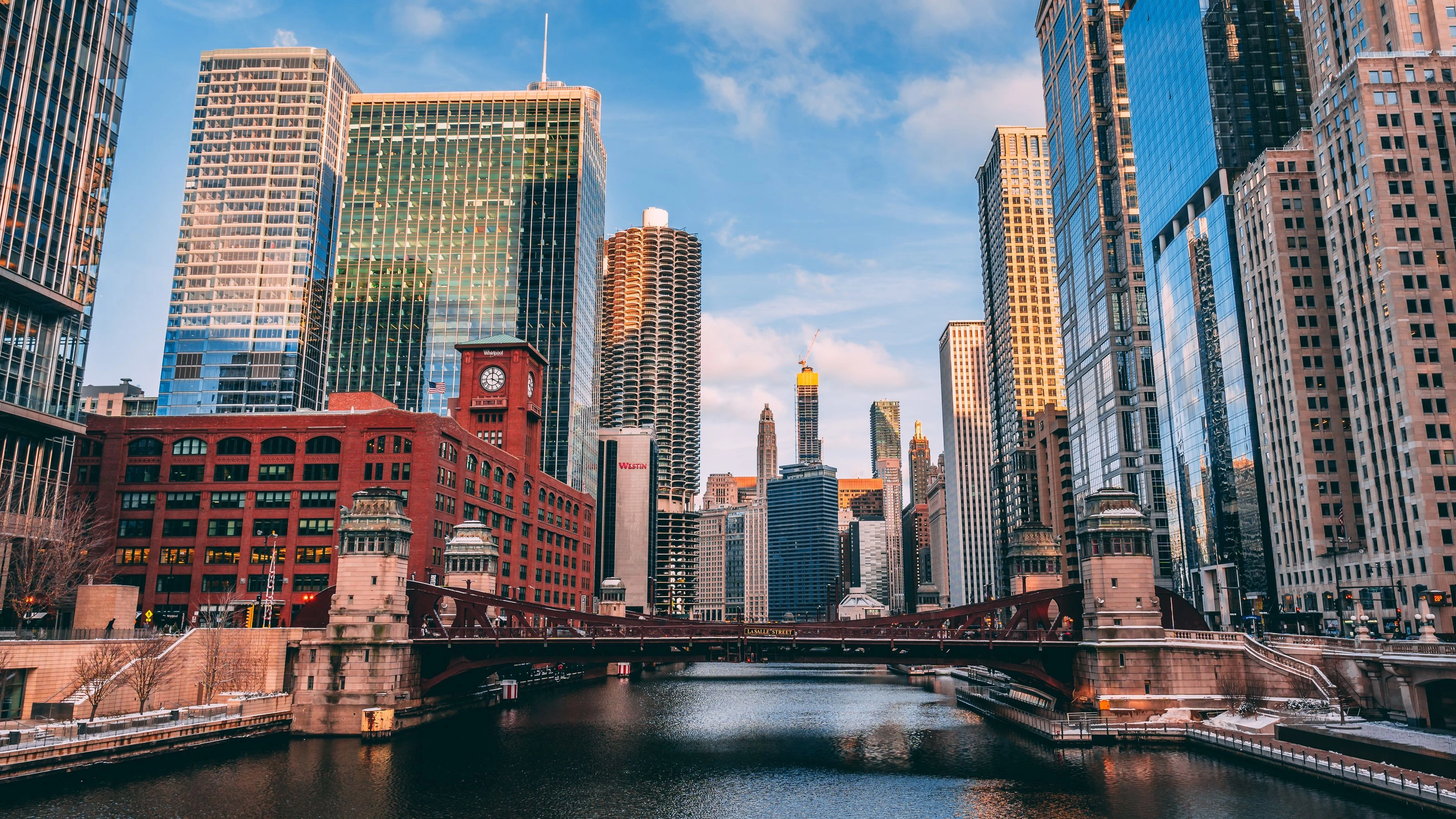
The city that invented the skyscraper
Third-largest city in the US, and its architectural laboratory
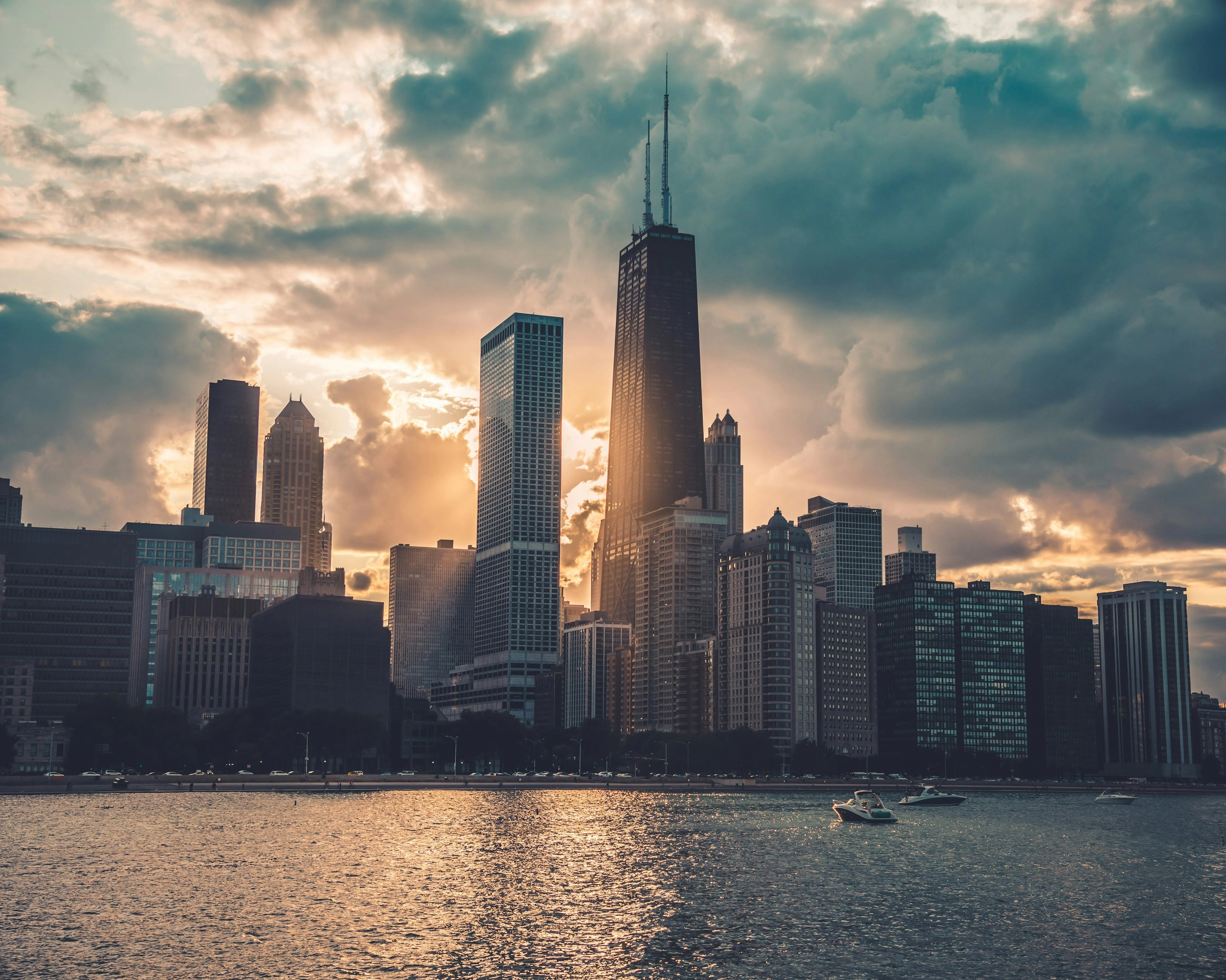
Chicago counts roughly 2.7 million residents within city limits and close to 9.9 million across its metro area, making it the third-largest city in the United States and the economic anchor of the Midwest, home to more than 400 corporate headquarters, 31 of them Fortune 500 companies. What sets it apart from the outset, though, is what happened after the Great Chicago Fire tore through the city on October 8, 1871: stricter building codes pushed architects toward steel and masonry instead of wood, and in 1885 the Home Insurance Building went up downtown — widely credited as the first skyscraper built on a metal frame. Chicago has been treated as the world's open-air textbook of vertical architecture ever since.
The Loop, financial core and open-air museum
Named after the loop the elevated train tracks trace around it, the Loop packs in the city's tallest towers, the Chicago Board of Trade and the Art Institute of Chicago — founded in 1879 during the reconstruction years and settled since 1893 into its Michigan Avenue building, guarded by its famous bronze lions.
Not to be missed
Millennium Park and the Bean
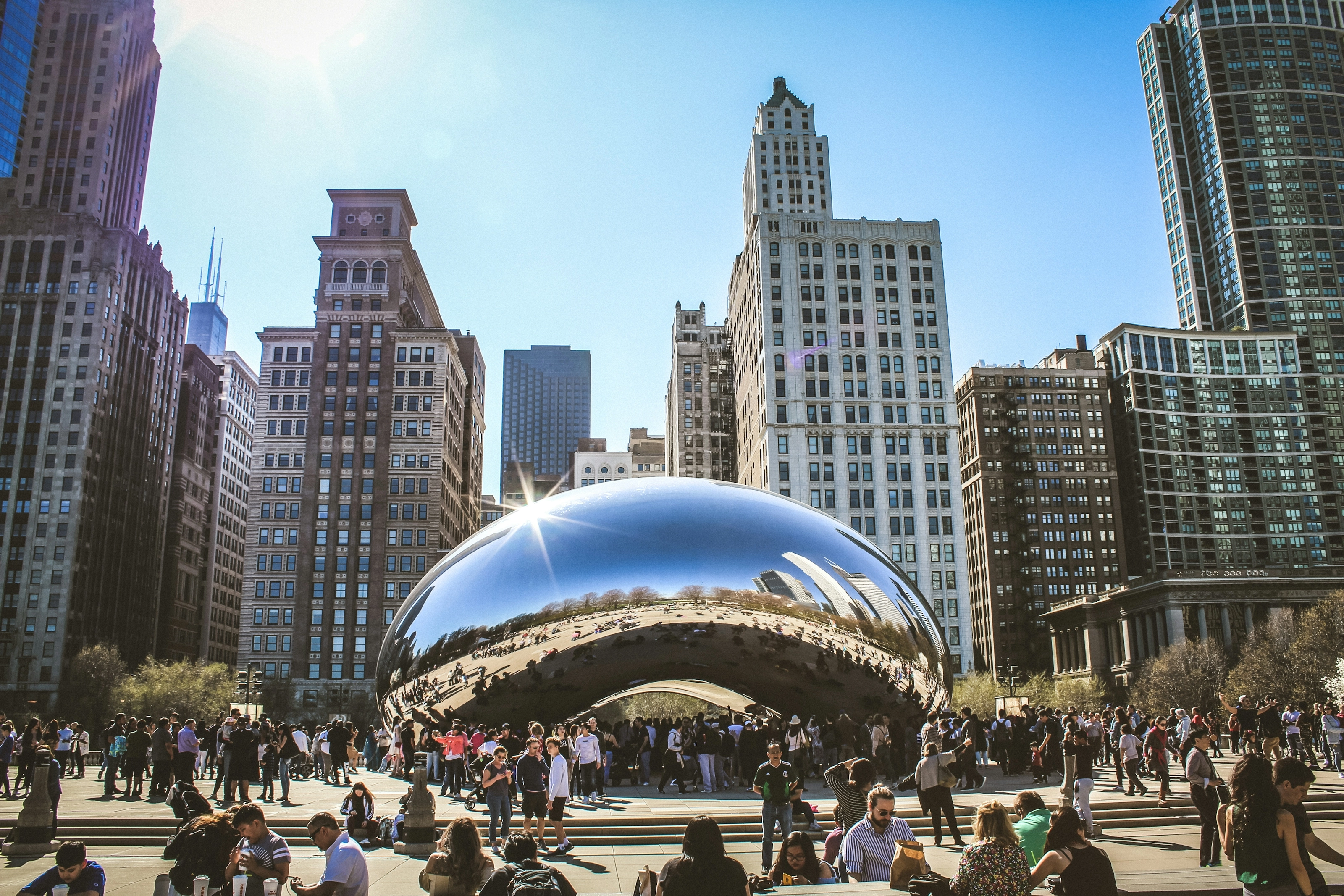
Opened in 2004, Millennium Park has become one of the most visited public spaces in the country. Its centerpiece is Cloud Gate — nicknamed "The Bean" for its shape — a 20-meter-long, 10-meter-high sculpture by Anish Kapoor made of 168 polished stainless steel plates fused into a single seamless, mirror-like surface that bends the skyline back at anyone standing beneath it. The park also holds Frank Gehry's Jay Pritzker Pavilion, an open-air concert venue whose ribboned steel bandshell is a landmark in its own right.
Views
The Willis Tower Skydeck, 412 meters above the street
Completed in 1973 as the Sears Tower, the Willis Tower rises 442 meters over 110 floors and held the title of world's tallest building for nearly 25 years. The Skydeck, on floor 103, is the highest observation deck in the country at roughly 412 meters above ground, and its glass-floored balconies — The Ledge — jut out more than a meter over open air for a straight-down view of the street below.
To discover
Museum Campus and the lakefront
Field Museum, Shedd Aquarium, Adler Planetarium
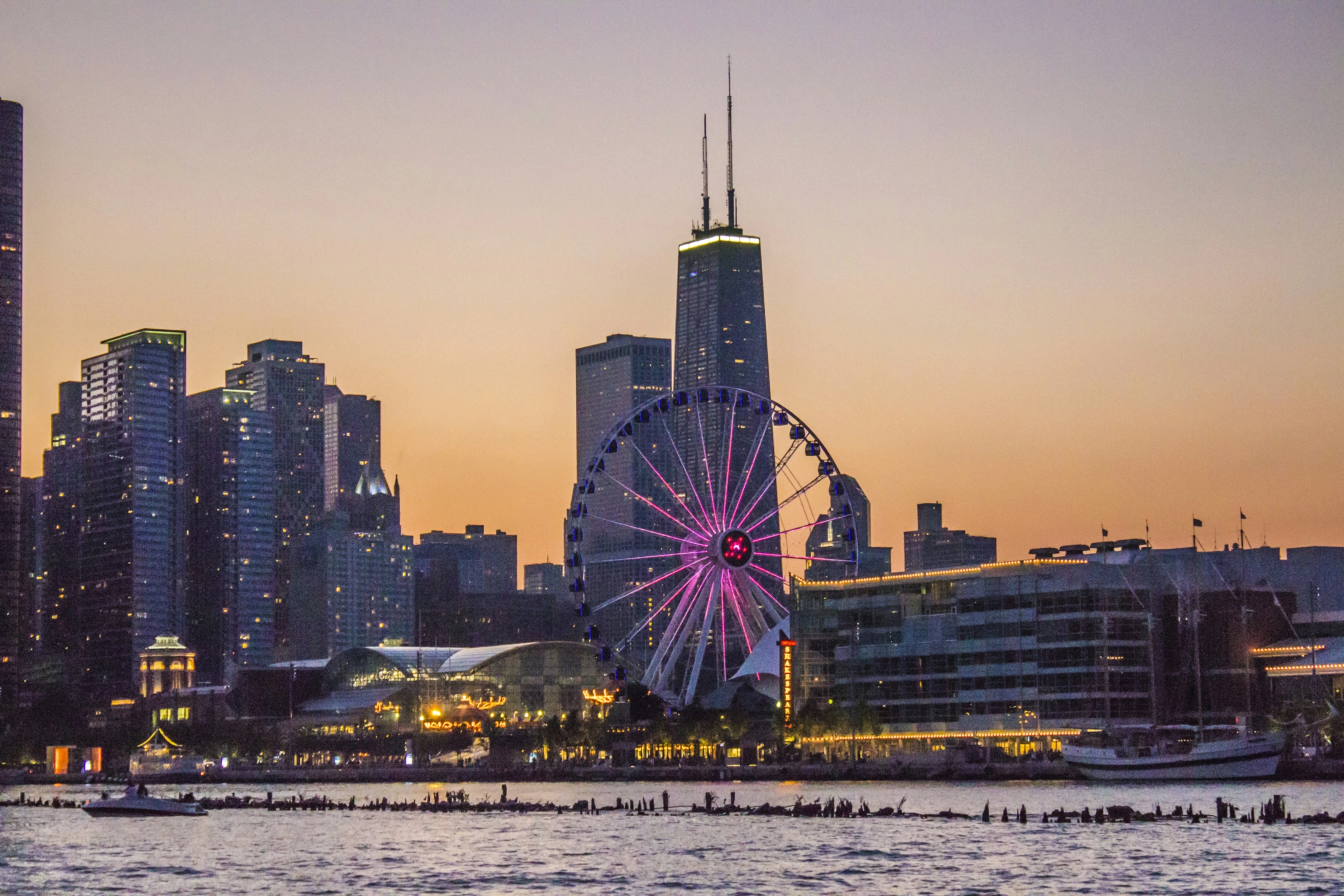
Three major institutions sit within walking distance of each other on roughly 23 hectares of lakefront parkland. The Field Museum's most famous resident is SUE, the most complete Tyrannosaurus rex skeleton ever found. The Shedd Aquarium, one of the first large indoor aquariums in the world when it opened in 1930, is now home to more than 32,000 aquatic animals, including belugas in an Oceanarium built to mirror the Pacific Northwest coast. Next door, the Adler Planetarium — the first planetarium in the Western Hemisphere, also from 1930 — pairs dome shows with one of the best free skyline views in the city, from the sloped lawn just outside.
42 kilometers of shoreline
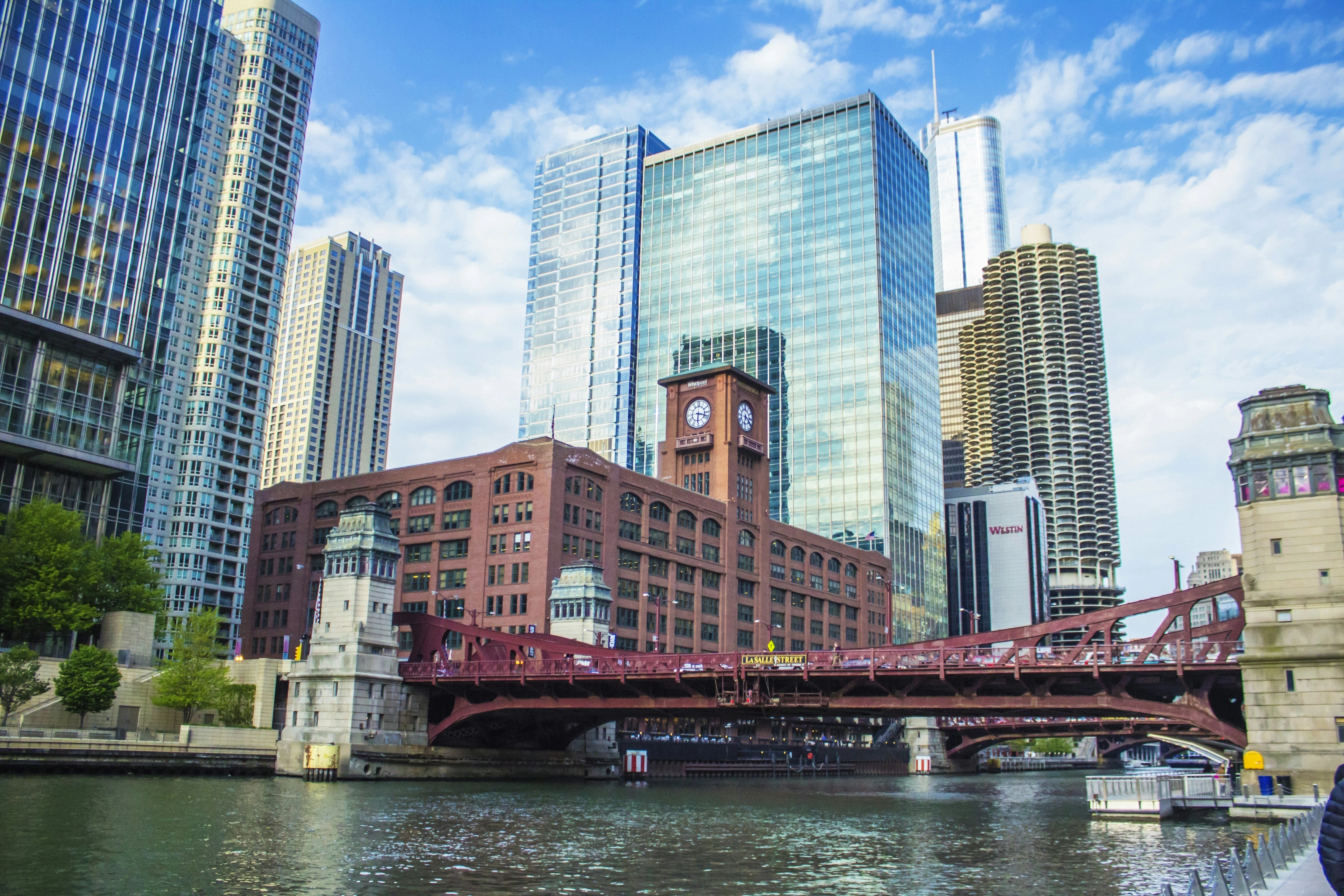
Chicago stretches for close to 42 kilometers along Lake Michigan, with public beaches and the Lakefront Trail running the length of it — a direct, uninterrupted relationship with open freshwater that few American cities of this size can match. Navy Pier, a nearly one-kilometer-long pier opened in 1916, adds a Ferris wheel, a children's museum and lake and river cruises to the mix, while the Riverwalk downtown strings together cafés and boarding docks for the architecture cruises that count among the city's best-reviewed tours.
Why track Chicago with SniperAir
You don't need to compare prices every day
Choose your departure
Tell us your departure airport and your maximum budget for a flight to Chicago.
SniperAir tracks it
Our systems continuously compare new prices against the route's real historical data.
You get an alert
As soon as a price matches your criteria, you're notified — without having to search yourself.
Getting around and budget
The Blue Line, and what things cost
O'Hare sits about 27 km northwest of downtown, and the "L" train's Blue Line is the simplest, cheapest way to cover that distance — roughly 40 minutes to the Loop, running 24 hours a day, a service only a handful of cities worldwide offer on a local rail line. A taxi or rideshare covers the same route in 30 to 45 minutes depending on traffic on the Kennedy or Eisenhower expressways, for something closer to $45-70. Once downtown, the Loop's colored lines (Red, Brown, Green) cover the main tourist neighborhoods without a car. On budget, Chicago runs mid-pack for a major US city: two-star hotels average roughly $85-110 a night outside peak season, with hostel beds starting under $55, though it's worth knowing the city layers a steep 17.4% hotel tax plus a flat destination fee onto quoted room rates — worth budgeting for before you book.
Shopping
The Magnificent Mile
This 13-block stretch of Michigan Avenue, between the Chicago River and Oak Street, lines up more than 450 stores — department stores like Bloomingdale's, Nordstrom and Neiman Marcus alongside luxury boutiques, all against a backdrop of skyscrapers and lake views. The nickname dates to the 1940s, when the corridor emerged as Chicago's retail spine in the years after the Great Depression. Water Tower Place and The Shops at North Bridge are its two big vertical malls.
Neighborhoods
Beyond the Loop
Wicker Park
A former working-class district turned one of the city's trendiest pockets, with vintage shops, record stores, independent breweries and a strong local music scene.
Hyde Park
South of downtown, this university neighborhood is home to the University of Chicago and the Museum of Science and Industry, housed in one of the last surviving buildings from the 1893 World's Columbian Exposition.
Pilsen and Chinatown
Pilsen, historically Mexican, is known for its street murals and Latin American food scene, anchored by the National Museum of Mexican Art. South of the Loop, one of the country's oldest Chinatowns organizes itself around Wentworth Avenue, marked by its red-and-gold ceremonial gate, traditional bakeries and dim sum restaurants — an easy detour by train from downtown.
Sport & music
Wrigley Field and the sound of Chicago blues
Built in 1914 and home to the Cubs since 1916, Wrigley Field is the second-oldest ballpark still in use in Major League Baseball, nicknamed the "Friendly Confines." Its ivy-covered outfield walls and hand-turned scoreboard, in continuous use since the 1930s, make it one of the most recognizable stadiums in American sport — it was also the last MLB park to install lights, in 1988. The surrounding Wrigleyville neighborhood fills with bars on game nights. Musically, Chicago is where Delta blues plugged in and went electric in the 1940s and '50s, through artists like Muddy Waters and Howlin' Wolf; historic clubs on the South Side and near the Loop keep that live tradition going most nights of the week, a very different way to hear the city than its downtown attractions.
Food
Deep-dish pizza and the Chicago dog
Chicago has invented or claimed several dishes that are now inseparable from its identity — and locals still argue, in earnest, about the "correct" way to make each one.
| Dish | Description |
|---|---|
| Deep-dish pizza | Born in the 1940s and popularized by Pizzeria Uno: a thick crust baked in a cast-iron pan, layered with cheese and toppings, then topped with tomato sauce — the reverse of a classic pizza. |
| Chicago-style hot dog | Mustard, onions, neon-green relish, tomato, pickle spear, sport peppers and celery salt — never ketchup, a rule locals take seriously. |
| Italian beef | Thinly sliced, slow-simmered beef piled on a roll dipped in its own jus, often topped with spicy giardiniera. |
| Garrett Popcorn | The caramel-and-cheese "Chicago Mix," a local specialty created by this popcorn shop founded in 1949. |
Day trip
Indiana Dunes, the only national park within reach
About 80 km southeast of downtown, Indiana Dunes National Park protects nearly 24 km of Lake Michigan shoreline, with sand dunes rising more than 60 meters above the water amid over 1,100 plant species. Reachable in a little over an hour by car or on the South Shore Line train, it's the only national park within easy day-trip range of Chicago — a solid nature break between hiking, beach time and summer swimming.
By length of stay
What to do in Chicago depending on how long you stay
The essentials
The Loop, Millennium Park and the Bean, then the Riverwalk and an architecture cruise on the river.
Go deeper
Add the Willis Tower Skydeck, Navy Pier, the Art Institute and a walk along the Lakefront Trail.
Neighborhoods and beyond
Wicker Park, Hyde Park and Pilsen, or head to Minneapolis to extend the trip across the Midwest.
Chicago's airports
Two airports, one clear choice for international flights
O'Hare International
The city's main airport, about 27 km northwest of downtown. One of the busiest in the country and the default entry point for direct flights from Europe.
Midway International
Smaller and closer to downtown (about 20 km, 25 minutes on the Orange Line), Midway is used mostly by low-cost carriers on domestic routes.
When to go
When to visit Chicago?
Spring
Still cool and changeable, but the city visibly wakes back up after winter.
Summer
Hot and humid, with the lakefront at its busiest — the best season for the Lakefront Trail and Navy Pier.
Fall
Pleasant temperatures and good foliage color, often considered the best time to visit.
Winter
Genuinely cold, with a biting wind that earned Chicago its "Windy City" nickname and frequent snowfall — pack accordingly.
You might also like
Similar destinations
FAQ
Frequently asked questions about flights to Chicago
What is Chicago's main airport?
O'Hare International (ORD) handles the vast majority of international flights, about 27 km northwest of downtown. Midway (MDW), smaller and closer in, is also tracked by SniperAir as a secondary airport.
How much does a flight to Chicago usually cost?
The price mainly depends on your departure city, the time of year and how far ahead you book. The "opportunities" section above shows real price examples already detected by SniperAir for this destination.
How long is a flight to Chicago from Europe?
Typically between 9 and 10 hours depending on your departure city.
What's the best time to book a flight to Chicago?
There's no universal rule — the best price depends on your specific route. That's exactly why SniperAir tracks prices on your behalf instead of giving you generic advice.
What should I prioritize in Chicago with just two days?
The Loop and Millennium Park with the Bean, an architecture cruise on the Chicago River, then the Willis Tower Skydeck for a wide view over Lake Michigan.
How do I get from O'Hare to downtown without a car?
The Blue Line "L" train runs directly from O'Hare to the Loop in about 40 minutes, operating 24 hours a day — the simplest and cheapest option.
Do I need to book ahead for Wrigley Field or Museum Campus?
For a Cubs game at Wrigley Field, yes, especially in peak season. For the Field Museum, Shedd Aquarium or Adler Planetarium, timed tickets booked in advance help avoid lines, particularly in summer.
How do I get alerted when a flight to Chicago drops below my budget?
Create an alert profile with your departure airport, Chicago as the destination, and your maximum budget. You'll be notified automatically as soon as a matching price is detected.
Ready to head to Chicago?
Set your budget and let SniperAir track fares for you.
Create my alert