
Cheap flights to Bissau
Set your departure airport and maximum budget: SniperAir tracks prices to Bissau and alerts you the moment a deal matching your criteria appears.
Quick summary
Country
Guinea-Bissau
Continent
Africa
Airport
OXB
Currency
West African CFA franc (XOF)
Time zone
UTC
Deals already spotted to Bissau
Real flight examples detected by SniperAir, with their reference price.
Loading examples…
Why track Bissau with SniperAir
You do not need to compare prices every day
Choose your departure
Enter your departure airport and your maximum budget for a flight to Bissau (OXB).
SniperAir keeps watch
Our systems continuously compare new prices with the real price history of the route. SniperAir monitors prices and alerts you: it does not sell or book tickets.
You receive an alert
As soon as a price matches your criteria, you are notified, without having searched for anything yourself.
First, a plain statement: Guinea-Bissau is the subject of official travel advice that differs from one departure country to another and can be restrictive. It sometimes advises against travel to the country or to certain areas. Do not assume that the whole country is accessible for you: read your own country's official recommendations before considering anything, and check them again before any booking. SniperAir monitors prices and alerts you; it does not sell or book tickets and does not recommend travelling.
This page therefore offers cultural and historical background only. Bissau, the capital, lies on the Geba River estuary, facing the Atlantic. According to Wikipedia (EN, FR, ES) the Portuguese founded a fortified trading post there in 1687; today it is the country's largest city, its main port and its administrative centre. It had 492,004 inhabitants at the 2015 census according to Wikipedia (EN, FR) and about 492,000 according to Wikivoyage (DE).
For health, ask a doctor or a vaccination centre well before any possible departure: yellow fever and malaria are among the usual topics.
Airport and getting into town
Osvaldo Vieira (OXB), about 9 km north-west of the centre
Bissau – Osvaldo Vieira International Airport (OXB)
Osvaldo Vieira airport, also called Bissalanca, is the country's only international airport according to Wikipedia (EN, DE). It lies about 9 km north-west of the centre according to Wikivoyage (FR) and Wikipedia (DE). Wikipedia (DE) mentions scheduled links to Casablanca, Dakar and Lisbon; airlines and timetables change often, and official advice may discourage some journeys: check before buying anything.
Approximate distance from Wikivoyage (FR) and Wikipedia (DE). We give no journey time, no taxi fare and no list of airlines.
The Trans-West African Coastal Highway is the main link with the rest of the country and the continent, according to Wikipedia (EN); paved roads lead to Bafatá, Gabú, São Domingos and Buba according to Wikivoyage (DE). Wikipedia (DE) also mentions a central bus station with connections to The Gambia and Senegal.
For any trip by road or boat towards the interior or the Bijagós archipelago, official advice often singles out areas that are discouraged. Do not build any itinerary without reading it.
Landmarks
Old colonial centre, avenues and buildings marked by history
Bissau is best approached through its old centre, its wide avenues and its public buildings, several of which suffered in the 1998 to 1999 civil war. The places pictured below are described from our sources; the others appear as text only.
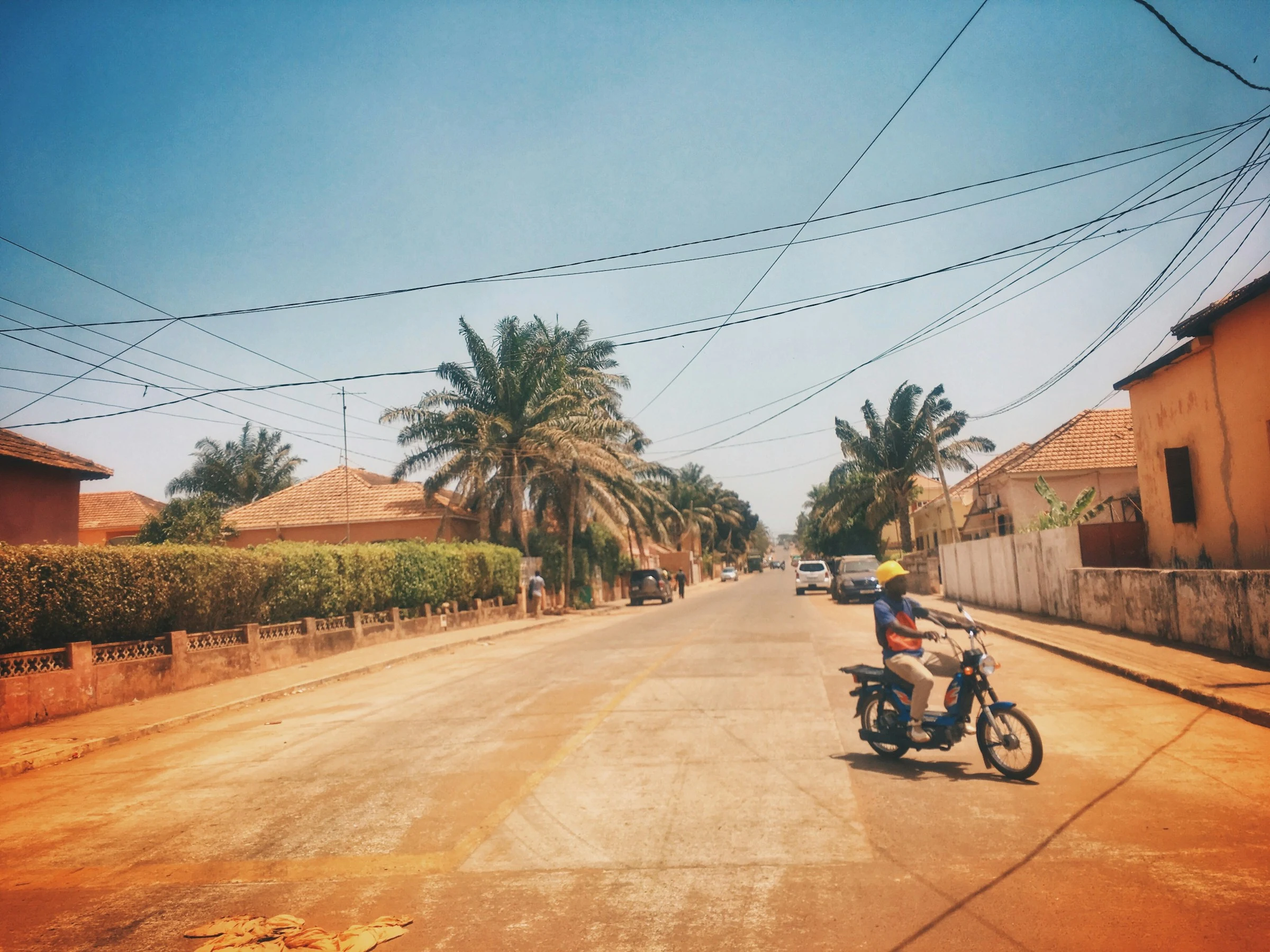
A neighbourhood street under the palms
Wikivoyage (DE) describes an old centre with streets laid out at right angles towards the port, and Wikivoyage (EN) a "Bissau Velho" where a few pharmacies and shops still occupy colonial houses. This sunny street, lined with palms and tile-roofed houses, gives a feel for an ordinary street in the city. Wikipedia (DE) notes that public electricity and water supply are irregular.
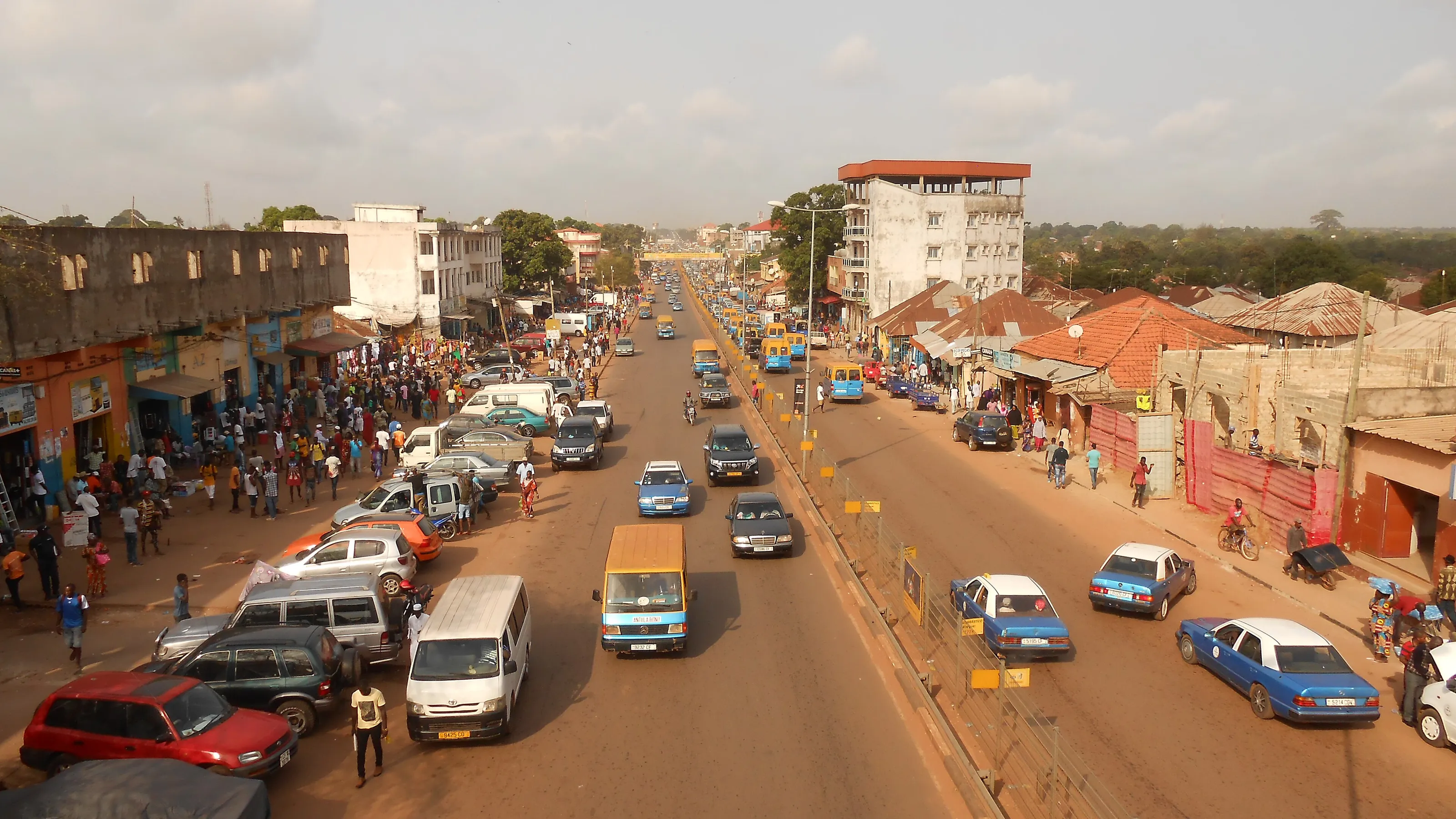
A busy main avenue
Seen from above, a wide avenue shows minibuses, blue taxis and pedestrians along the shops. Wikipedia (DE) explains that urban transport is privately run, with shared taxis and minibuses called "toca-tocas", and that Bandim market, the main trading place, lies along a major thoroughfare.
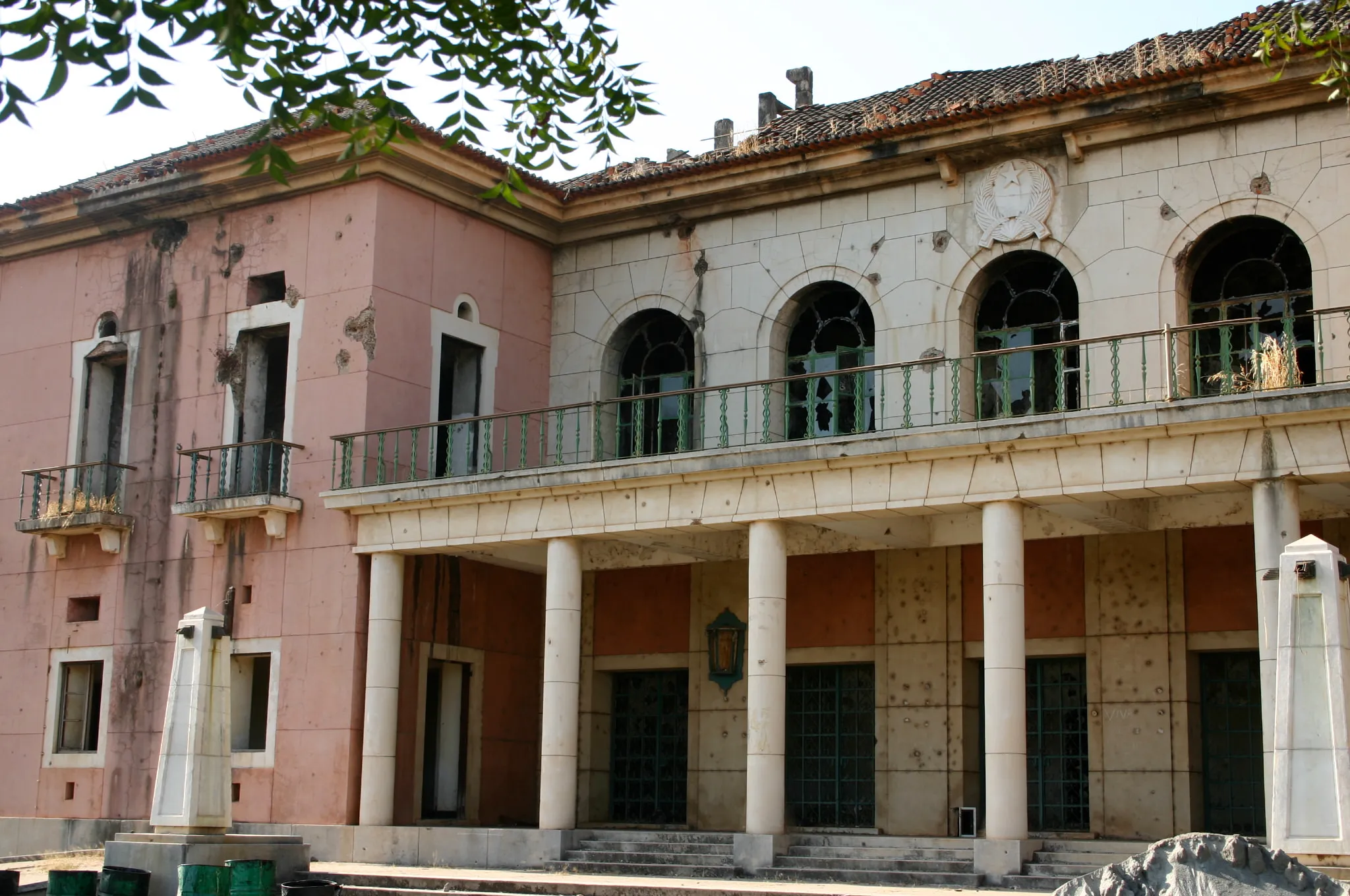
A large building marked by war
Wikipedia (EN, ES) recalls that many of the city's buildings were destroyed in the 1998 to 1999 civil war, including the presidential palace. This pink and cream columned façade, with broken windows and bullet-scarred walls, is presented in its original caption as the former presidential palace. We show it as a historical witness, with no advice to visit.
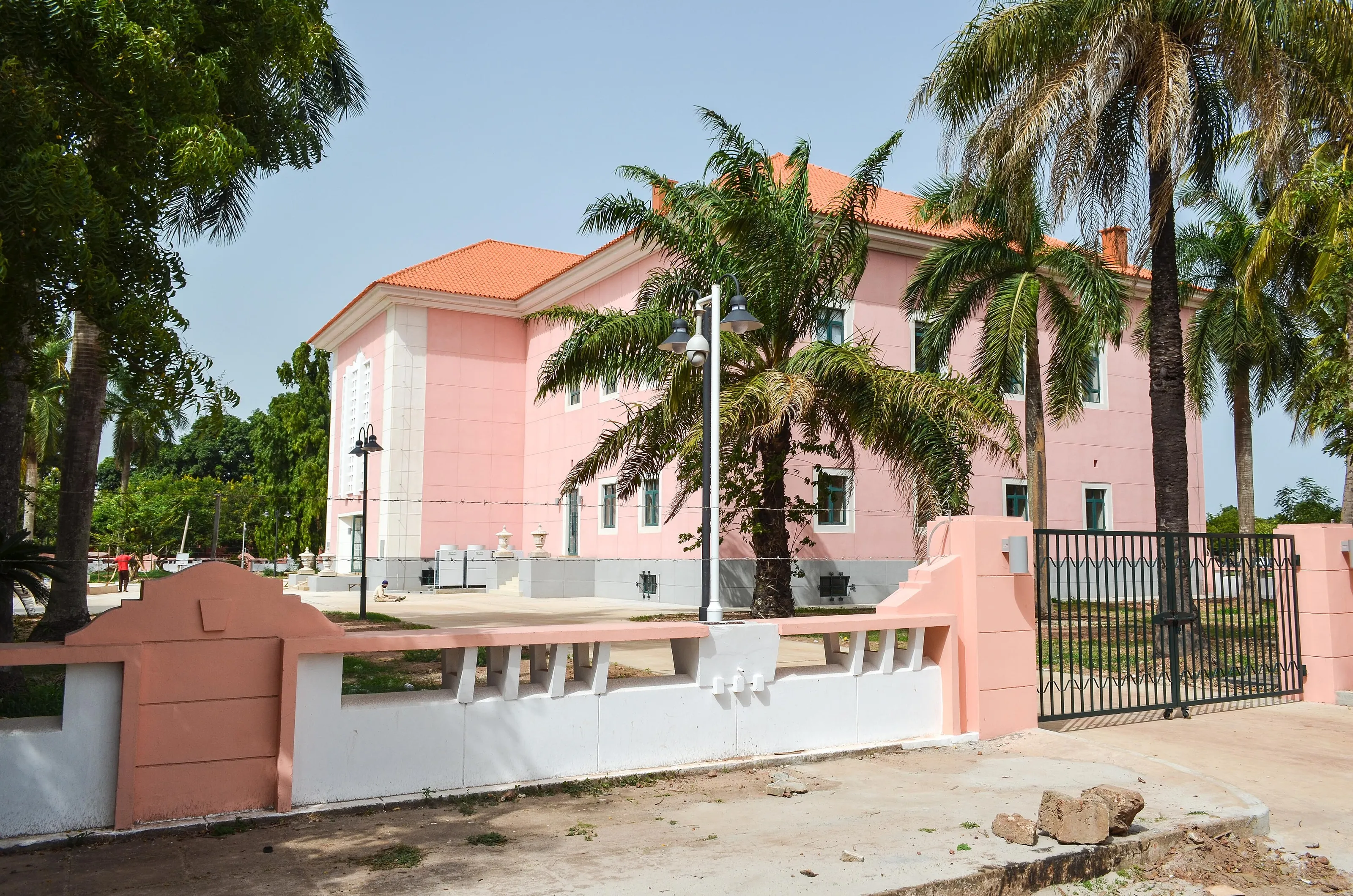
A pink building with a tiled roof
Wikivoyage (EN, ES) mentions a reconstructed presidential palace, once again the head of state's seat, and an Independence Monument recalling the unilateral declaration of 24 September 1973. This pink building with an orange tiled roof, behind a low wall and a gate, is presented in its original caption as the rear of the Palácio da República; we do not confirm it.
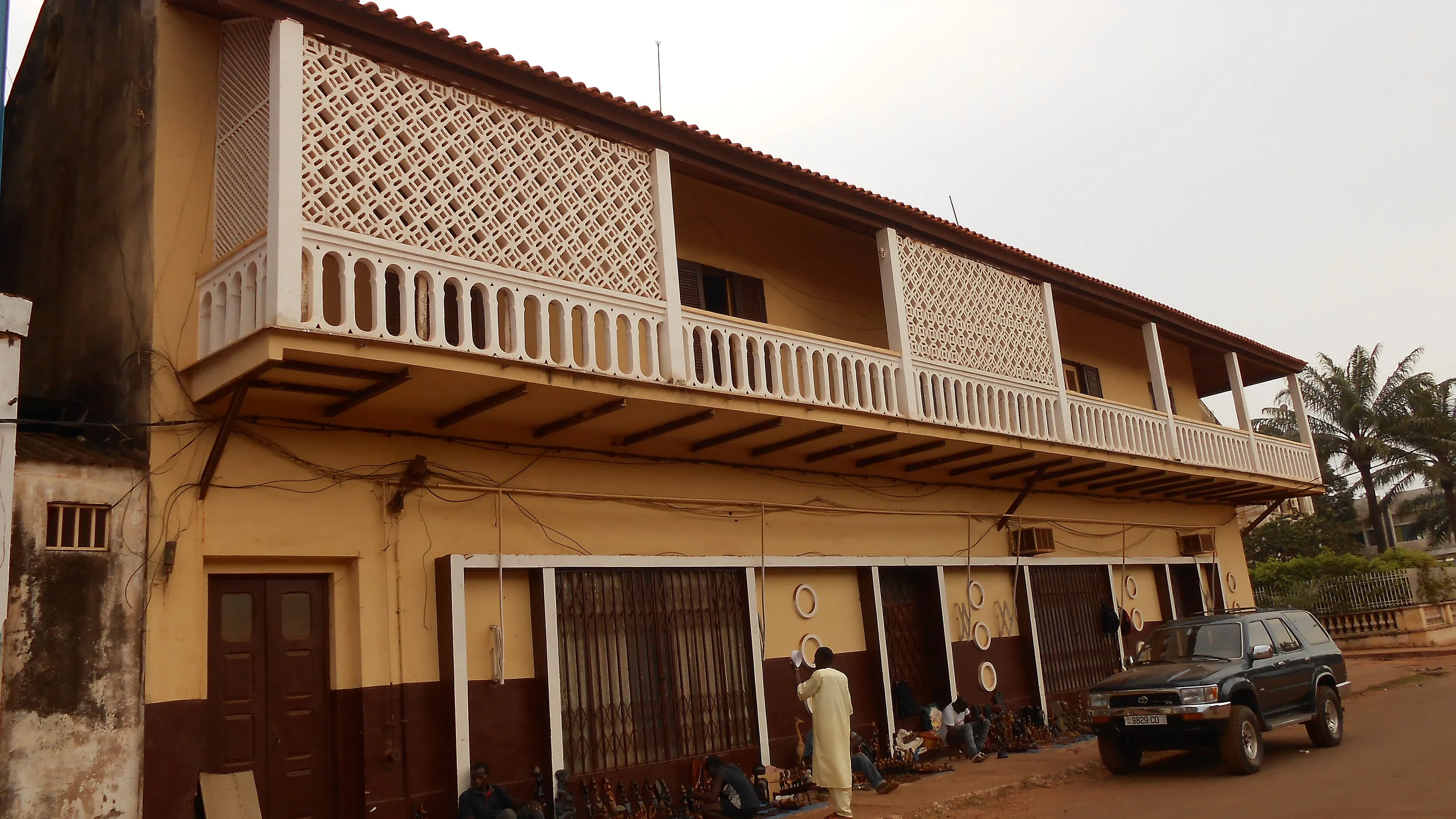
A colonial house with latticework
Wikivoyage (ES) mentions colonial-era buildings where businesses still operate. This two-storey ochre and brown building, with a white lattice balcony and a tiled roof, recalls Portuguese architecture; wooden carvings are displayed at the foot of the façade.
Other places cited: the São José da Amura fortress, a Portuguese fort housing the mausoleum of Amílcar Cabral according to Wikipedia (EN, FR) and Wikivoyage (EN, ES), which can be hard to enter; the Pidjiguiti memorial, dedicated to the dockers killed in the strike of 3 August 1959 (Wikipedia EN, FR), with a giant black fist monument according to Wikivoyage (EN, ES); and the Praça with its Monument to the Heroes of Independence (Wikivoyage DE). Access, hours and conditions vary: check the local situation before any trip.
Museums and culture
Ethnographic museum, arts and culture
The National Ethnographic Museum
Wikivoyage (EN, DE, ES) lists the Museu Etnográfico Nacional, a small collection of masks, wooden statues, baskets and cloth. Wikivoyage (EN) says the staff explain how the objects relate to traditional spiritual beliefs. Hours and fees change: we publish none.
National Arts Institute
Wikipedia (EN, FR, ES) lists the Guinea-Bissau National Arts Institute among the places visitors go to most, along with the ethnographic museum and the beaches. We give no programmes and no access details.
Cultural centres
Wikivoyage (EN, DE, ES) says the French and Portuguese cultural centres host concerts, films, classes and shows. Their programmes and access conditions change: we publish none.
Carnival and memory
Wikipedia (FR) and Wikivoyage (FR) cite a well-known carnival held every year in February around Shrove Tuesday; Wikivoyage (DE) says the city is especially lively then. Wikivoyage (EN) recalls that the 1959 Pidjiguiti strike marked the start of active resistance to Portuguese colonial rule.
Food and drink
Caldo de mancarra, rice and cashew nuts
Rice and its sauces
Rice is the staple near the coast and millet inland, according to Wikipedia (FR, ES). Dishes are often rice served with soups or stews of fish, meat, vegetables or peanut sauce, according to Wikipedia (EN).
Dishes mentioned
Wikipedia (EN, FR) mentions caldo de mancarra, a peanut stew often made with chicken; caldo de tcheben, a fish stew with palm oil and okra; cafriela, chicken marinated with lemon and garlic; arroz de cabra, rice with goat meat; and canja, a chicken and rice soup.
Portuguese heritage and cashews
Wikipedia (FR) also cites dishes and desserts of Portuguese tradition, such as feijoada, cod with cream and pudim. Cashew nuts are the main export crop according to Wikipedia (DE) and Wikivoyage (EN). Wikipedia (EN, PT) mentions drinks made from cashew fruit and palm wine.
Markets and places to eat
Bandim market is the city's main market (Wikivoyage EN), and Wikipedia (DE) counts more than twenty-five neighbourhood markets. Wikivoyage (ES) lists Portuguese and Lebanese tables and pizza places; we give no addresses and no prices.
Getting around
Blue shared taxis, toca-tocas and the bus station
Shared taxis
Wikipedia (DE) explains that urban transport is in private hands, with shared taxis that circulate freely; Wikivoyage (DE) says they are often old Mercedes painted blue. Wikivoyage (EN) describes a system where you tell the driver your destination. We publish no fares.
Toca-tocas
"Toca-toca" minibuses follow fixed routes between outlying districts and the centre according to Wikipedia (DE), and are often very crowded according to Wikivoyage (EN, ES).
Longer distances
Wikipedia (DE) mentions a central bus station near the national bank, with connections to almost every region of the country and to The Gambia and Senegal. Wikivoyage (DE) also mentions boats to the Bijagós archipelago, mostly pirogues. Do not build any itinerary without reading the official advice.
Electricity and water
Wikipedia (DE) and Wikivoyage (DE) note that electricity and water work mainly in the centre and only intermittently; generators supply power in the evening, with the noise that brings. Factor that into any thinking about a stay.
Budget and precautions
Budget and precautions
Price level
We give no range: prices in our sources are old, isolated or derived from the same text. The currency is the West African CFA franc (XOF).
Air travel and official advice
SniperAir monitors prices to OXB and compares them with the route's history, but it does not sell or book tickets. Official advice on Guinea-Bissau differs from one departure country to another, can be restrictive and sometimes warns against certain areas or against travel altogether: read your own country's advice before creating an alert, and again before any purchase.
Safety on the ground
Wikivoyage (DE) judges Bissau less dangerous than other large West African cities while advising against walking alone at night. Wikivoyage (ES) recommends researching well, not carrying all your valuables and asking hotel staff for advice. None of this replaces official advice.
Health and entry rules
Entry conditions depend on your nationality and change: check official websites. Ask a doctor or a vaccination centre well before any possible departure: yellow fever and malaria are among the usual topics.
When to go
A tropical savanna climate, very wet from June to October
Dry season (November to May)
Almost no rain falls from November to May, according to Wikipedia (EN, ES).
Wet season (June to October)
Wikipedia (EN, ES) mentions about 2,000 mm of rain a year, concentrated mostly between June and October. We stay approximate: stations and reference years vary.
Humid heat
Wikipedia (ES) notes that even in the months before the rains, high humidity makes the heat very uncomfortable.
Tides and mangroves
Wikivoyage (ES) notes that tides are felt far up the estuary, and Wikipedia (DE) that the city is surrounded by mangroves and swampy watercourses that make it almost an island.
Sources classify Bissau's climate as tropical savanna (Köppen: Aw). We give no monthly averages, as they differ by station and year. These climate pointers say nothing about conditions on the ground: only official advice can judge that.
By length of stay
What to discover in Bissau depending on the length of stay
Old centre and memory
If official advice one day allows travel: one to two days for the old centre, the Pidjiguiti memorial, Amura fort and the ethnographic museum, according to Wikipedia (EN, FR) and Wikivoyage (EN).
Markets and culture
Add Bandim market, the cultural centres and, in February, the carnival, after checking local conditions.
Beyond the capital
The Bijagós islands, Bolama and the interior are described for cultural purposes in our sources and on our Guinea-Bissau page; official advice often singles out areas that are discouraged and should not be read lightly.
In pictures
Bissau in pictures
You might also like
Similar destinations
FAQ
Frequently asked questions about flights to Bissau
Does official advice allow travel to Bissau?
Travel advice on Guinea-Bissau differs from one departure country to another and can be restrictive: some advise against travel or against parts of the country. Do not assume that the whole country is accessible for you: read your own country's official recommendations before any booking and check them again before departure.
Where is Bissau airport?
Osvaldo Vieira airport (OXB, also called Bissalanca) is about 9 km north-west of the centre according to Wikivoyage (FR) and Wikipedia (DE). It is the country's only international airport. We quote no taxi fares.
What is there to see in Bissau?
The old colonial centre, the Pidjiguiti memorial, the São José da Amura fortress with Amílcar Cabral's mausoleum, Bandim market and the ethnographic museum. Access to some places may vary: check the local situation.
What is the best time of year, climate-wise, for Bissau?
Almost no rain falls from November to May; the wet season runs from June to October. This climate information does not replace official advice.
How do I get around Bissau?
Wikipedia (DE) mentions shared taxis and "toca-toca" minibuses. Wikivoyage (EN, ES) adds that these minibuses are often very crowded. We publish no fares.
Do I need a visa or vaccinations for Guinea-Bissau?
Entry conditions depend on your nationality and change: check official websites. For health, ask a doctor or a vaccination centre well before any possible departure: yellow fever and malaria are the usual topics.
How much does a flight to Bissau usually cost?
The price depends mainly on your departure city, the time of year and how far ahead you book. The "opportunities" section above shows real examples of prices SniperAir has already detected to this destination.
How do I get alerted when a flight to Bissau drops below my budget?
Create an alert profile with your departure airport, Bissau (OXB) as the destination and your maximum budget. You are notified automatically as soon as a matching price is detected. SniperAir monitors and alerts, it does not sell or book tickets.
Ready to head to Bissau?
Set your budget and let SniperAir monitor fares for you.
Create my alert