
Cheap flights to Ko Samui
Set your departure airport and maximum budget: SniperAir tracks prices to Ko Samui and alerts you the moment a deal matching your criteria appears.
Quick summary
Country
Thailand
Continent
Asia
Airport
USM
Currency
Thai baht (THB)
Time zone
UTC+7
Deals already spotted to Ko Samui
Real flight examples detected by SniperAir, with their reference price.
Loading examples…
Why watch Ko Samui with SniperAir
A Gulf of Thailand resort island, worth catching at the right moment
Choose your departure
Enter your departure airport and your maximum budget for a flight to Ko Samui (USM).
SniperAir watches
Our systems continuously compare new prices with the route's real price history. SniperAir monitors prices and alerts you; it does not sell or book tickets.
You get an alert
As soon as a price matches your criteria, you are notified without having searched anything yourself.
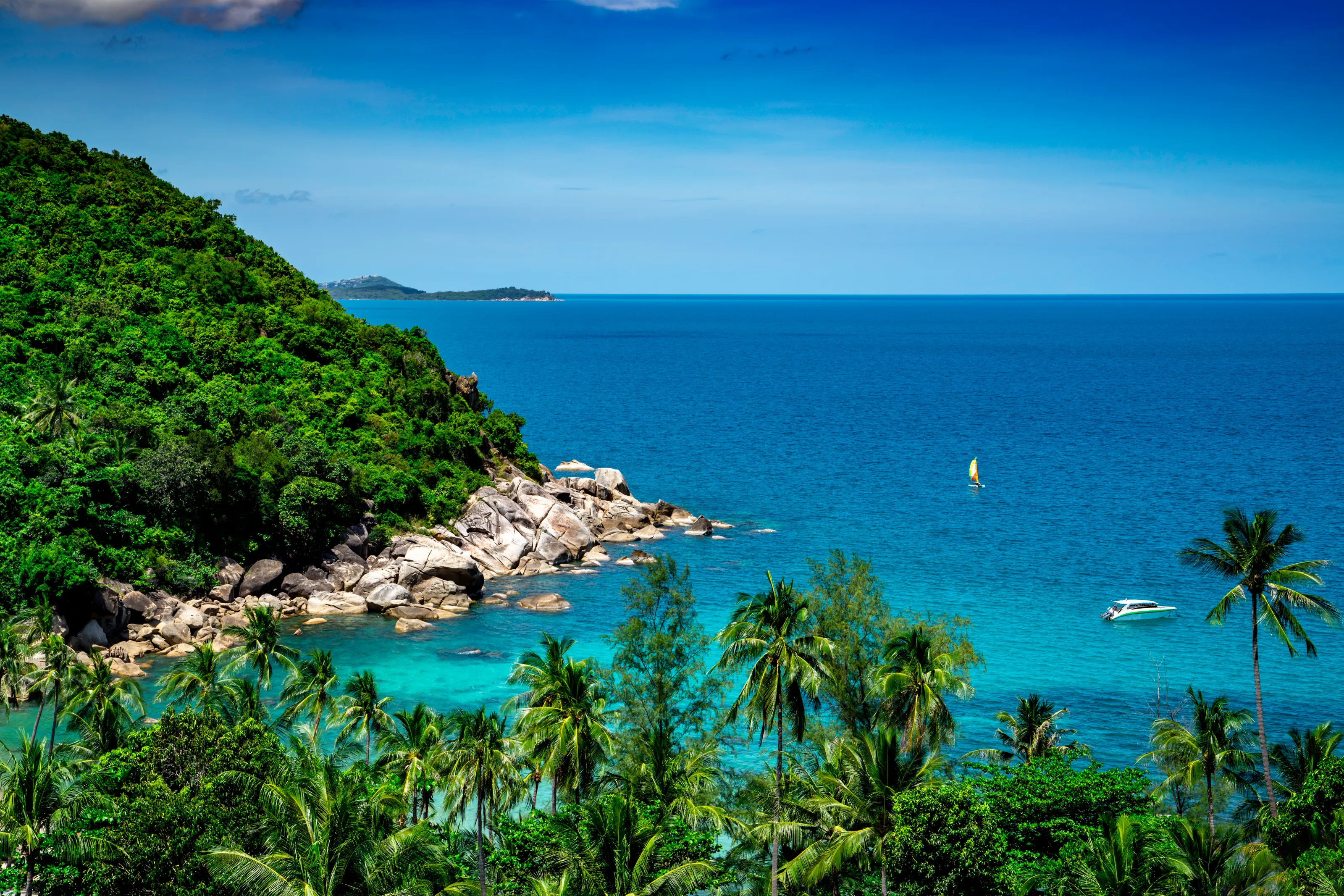
Ko Samui is Thailand's second-largest island after Phuket, off the coast of Surat Thani Province. It measures roughly 25 km by 21 km, with a mountainous jungle interior rising to 635 m, coconut palms and pale-sand beaches. A fishing community for centuries, it has become one of the best-known beach resorts in the country; Wikipedia reports 2.7 million tourists in 2018.
Its calendar differs from the Andaman coast: the island stays fairly dry during the southwest monsoon and gets most of its rain late in the year. The airport is small and privately run, so direct links are limited and flight prices can swing with origin and season. An alert helps you spot a good fare to USM, or to a mainland airport such as Surat Thani if you are happy to finish the trip by ferry.
Airport and getting into town
A private airport in the north-east, ferries on the west coast
Samui Airport (USM)
Samui Airport was built by Bangkok Airways and is still run by it; the airline operates most of the flights. It lies in the north-east of the island and opened in 1989. Bangkok flights are almost hourly and take about 65 to 70 minutes, according to Wikivoyage (DE) and Wikipedia (DE). Links to Phuket and a few South-East Asian cities exist at times. A minibus from the terminal to Chaweng takes about 20 minutes, says Wikivoyage (EN, ES); a taxi is a little quicker but costs more.
Surat Thani (URT) and the mainland ferries
Many travellers arrive via the mainland: fly to Surat Thani, then take a bus-and-ferry combination to Na Thon or Lipa Noi. Wikivoyage (EN) quotes about three hours from Surat Thani airport. From Don Sak, the crossing to Na Thon takes around 90 minutes, according to Wikivoyage (DE, EN).
Distances and times are approximate, based on Wikivoyage (DE, EN, ES) and Wikipedia; flight and ferry timetables change often. We do not quote fares.
Na Thon, on the west coast, is the island's main town and administrative port. It lies across the island from the airport, 25 to 30 km from Chaweng or Lamai according to Wikivoyage (EN). Other piers in the north (Mae Nam, Bo Phut, Big Buddha) serve Ko Pha-ngan and Ko Tao. A combined bus-and-catamaran ticket from Bangkok exists and takes roughly eleven hours, but the plane is much faster.
Beaches, temples and rocks
Chaweng, Lamai, the Big Buddha and the islets of the Gulf
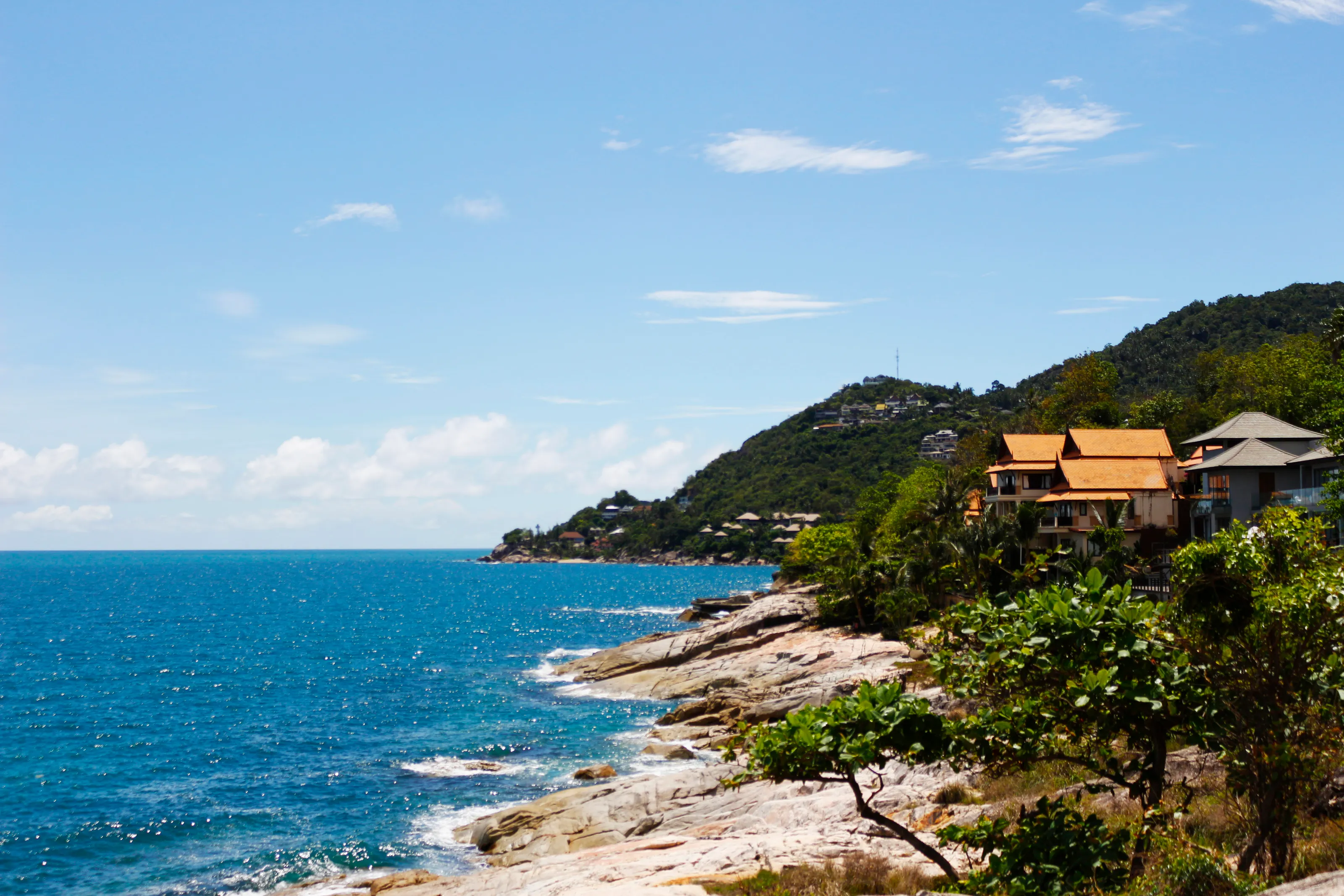
The best way to see the island is to follow the ring road, about 50 km long according to Wikipedia (FR) and Wikivoyage (DE). The places illustrated below are the Big Buddha, the rocky coast and the islets of the Gulf; several others are described in text only.
The Big Buddha of Wat Phra Yai
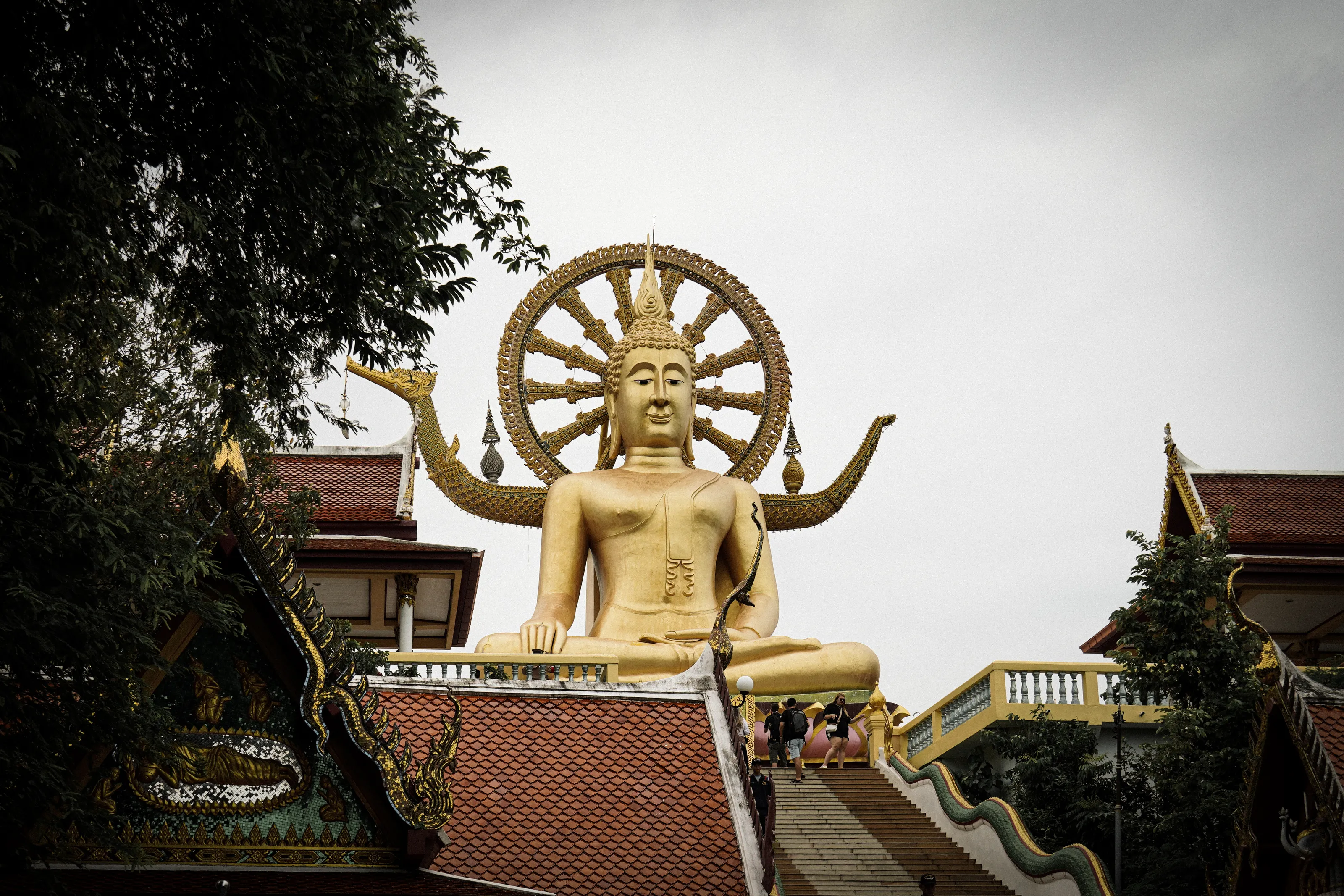
On a small islet linked to the north-east coast, the great gilded statue of a seated Buddha dates from 1972. Wikipedia (FR, DE, ES) gives its height as 12 m, Wikivoyage (EN) as 15 m, so sources disagree. A staircase leads up to the foot of the statue, which looks over Bang Rak bay.
Rocks and clear water
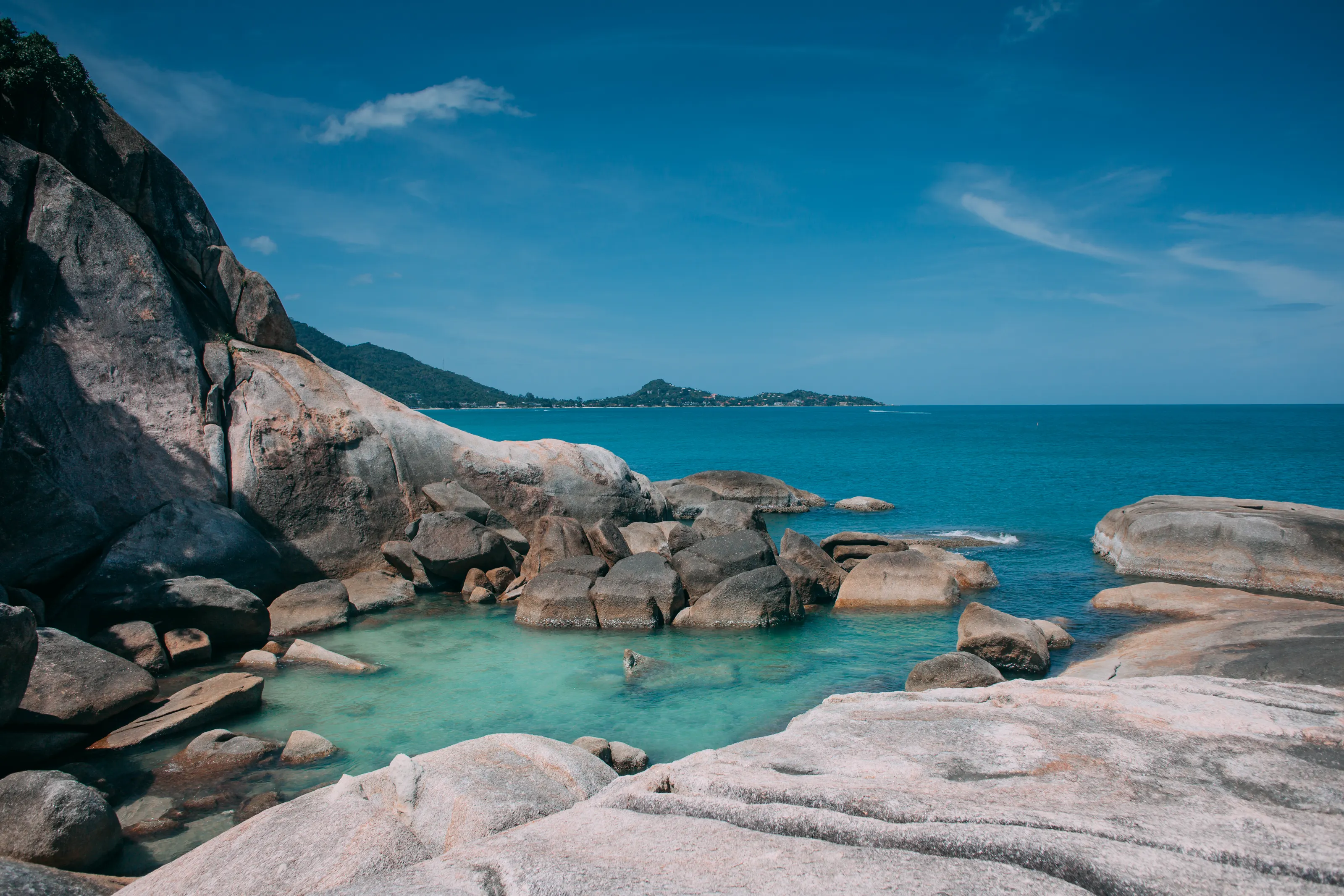
Ko Samui's coast alternates long beaches with rocky points. At the southern end of Lamai, Hin Ta and Hin Yai, the Grandfather and Grandmother rocks, are among the island's best-known formations. Along the coves, granite boulders enclose small lagoons of turquoise water.
The islets of the Gulf
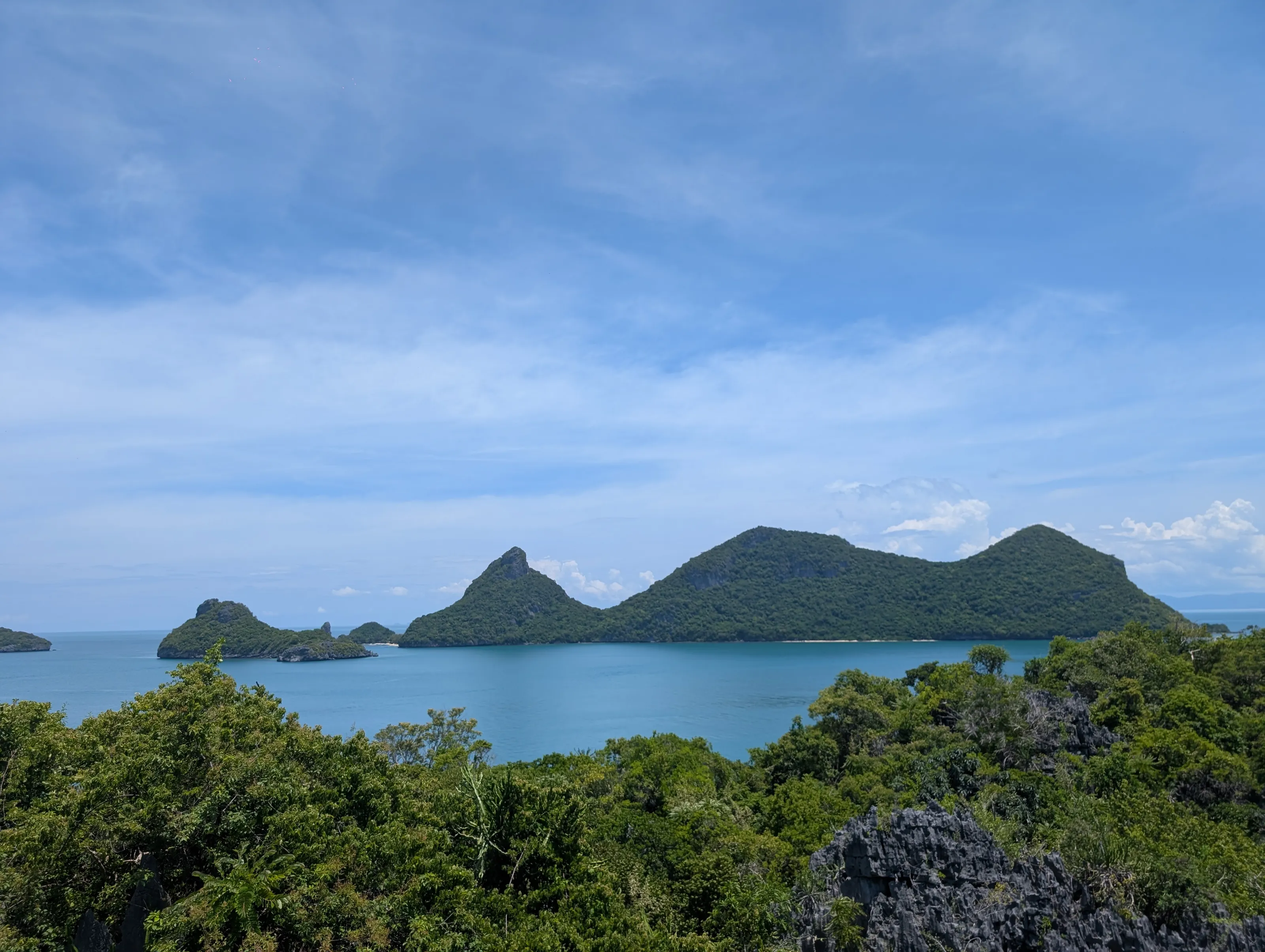
Ko Samui belongs to an archipelago of about 85 islets according to Wikipedia (FR), including Mu Ko Ang Thong National Marine Park to the west. Day trips by boat cover kayaking, swimming and viewpoints; outings can be cancelled when the sea is rough.
Wat Plai Laem, waterfalls and markets, in text
The lakeside temple of Wat Plai Laem is known for its multi-armed Guanyin statue; Wikivoyage (DE) says twelve arms and a Spanish-language guide says eighteen, so sources disagree. The Na Muang and Hin Lad waterfalls are more impressive in the wet season, and Na Muang 2 drops about 79 m according to Wikivoyage (EN). At Wat Khunaram you can see a mummified former abbot.
Museums and culture
Few museums, but temples and a fishing heritage
Temples and sacred sites
Ko Samui is not a big-museum destination; culture is found mostly in its shrines. The Big Buddha, Wat Plai Laem and its lake, Wat Khunaram with its mummified monk, and the chedi at Laem So on the southern cape are the most often cited visits. Remember to cover shoulders and knees in temples.
Nature as an attraction
Wikivoyage (DE) lists a butterfly garden (season January to March), a snake farm, an aquarium and a tiger zoo. Before booking any activity involving wild or captive animals, check how the animals are kept; Wikivoyage (DE) urges that caution for elephant trekking.
History and local life
The first inhabitants were fishermen from the Malay peninsula and southern China, and the island appears on a Chinese map of 1687 as Pulo Cornam. It had no road until the early 1970s; a fishing village such as Bophut or the old town of Na Thon gives some sense of that past. We do not quote admission prices.
Food and drink
Southern Thai cooking, seafood, coconuts and night markets
Southern specialities
Samui's cooking is that of southern Thailand: spicy, with Malay, Indonesian and Indian influences. Wikivoyage (EN, ES) mentions massaman curry, khanom jeen (rice noodles with sauce), chicken biryani and curry served over rice. Dishes from the north-east (Isaan) are common too.
Coconuts and seafood
The island long lived on coconuts: Wikipedia (FR) speaks of around four million palms. You can drink them everywhere, and seafood, often grilled, is a classic, though it can be scarcer in high season according to Wikivoyage (ES). Rambutans are among the fruits in season.
Markets and evenings
Wikivoyage (DE) lists night markets on Thursday in Mae Nam, Friday in Bophut and Sunday in Lamai, plus fish markets in Bang Rak, Mae Nam, Lamai and Bophut. Bophut's fishing village is a good place to start for a seafront dinner.
Getting around
Ring road, songthaews and two-wheelers
The ring road
A road of about 50 km circles the island, and Wikivoyage (EN) says it can be driven in a couple of hours. In high season traffic jams can build up, especially in the north-east (Wikivoyage, DE).
Songthaews and taxis
Songthaews, shared pick-up trucks, follow the ring road on fixed routes until about 18:00, after which you have to negotiate (Wikivoyage, EN, ES). Taxis often refuse the meter, so agree the price before you get in. A ride-hailing app is also available according to Wikivoyage (EN).
Scooters and cars
Scooters, bicycles and small cars can be rented. Guides advise reading the contract, photographing the vehicle and avoiding leaving your passport as a deposit; compulsory scooter insurance covers very little, says Wikivoyage (ES). Take care on mountain roads.
Budget and precautions
Resort-island price levels, to be checked
Price level
Ko Samui is a beach destination: accommodation and meal prices vary enormously between a modest bungalow and a luxury hotel, and between high and low season. We give no ranges or figure-based comparisons because we could not cross-check them on two independent, up-to-date sources; Wikivoyage (EN, DE, ES) itself quotes 150 or 200 baht for the airport minibus depending on the page. The currency is the baht.
Flights
The flight is the most variable item. SniperAir monitors prices to USM and compares them with the route's history, but it does not sell or book tickets. Surat Thani (URT), Phuket (HKT) or Krabi (KBV) can complement your watch if you accept a ferry or bus connection.
Entry rules and precautions
Entry rules for Thailand depend on your nationality: check them on official sites and read your country's travel advice before leaving. Drink bottled water, take out travel insurance and keep an eye on your belongings on buses and on beaches at night.
Best time to go
Drier than the Andaman coast, with a wet season late in the year
January to March
The driest months according to several guides and Wikivoyage (EN): calm seas and little rain, but high season and higher prices in December and January.
April to June
Hot, with brief showers. Wikivoyage (EN) says the island is fairly dry from April to September, when the monsoon hits the rest of the country.
July to September
Still fairly dry for the island and quieter; diving around Ko Tao is at its best from June to August according to Wikivoyage (EN).
October to December
The wet season: the heaviest rain falls from mid-October to early December, with November the wettest month; trips to Ang Thong may be cancelled.
The climate is monsoonal, with an annual average around 28 C and sea temperatures of 27 to 29 C according to Wikipedia (FR, DE). Annual rainfall is around 1,900 to 2,000 mm, but sources disagree on monthly peaks, so we do not publish them. Gulf tides make beaches much wider at low tide. Check the forecast before you go.
By length of stay
What to do in Ko Samui depending on how long you stay
The essentials
One beach (Chaweng or Lamai), the Big Buddha, Wat Plai Laem and a night market.
Around the island
The ring road with its waterfalls, the Lamai rocks, Bophut fishing village and the west coast at sunset.
Beyond Samui
A day trip to Ang Thong, or a ferry return to Ko Pha-ngan or Ko Tao.
In pictures
Ko Samui in pictures
You might also like
Similar destinations

FAQ
Frequently asked questions about flights to Ko Samui
How do I get from Ko Samui airport (USM) to Chaweng?
The airport is in the north-east of the island, about 20 minutes from Chaweng by minibus according to Wikivoyage (EN, ES). Taxis and songthaews are also available; agree the price before boarding.
When is the best time to visit Ko Samui?
January to March is often cited as the driest period. The island is also fairly dry from April to September; the heaviest rain falls from October to December.
Is Ko Samui expensive?
Prices vary widely between modest stays and luxury hotels, and by season. We quote no amounts because we could not cross-check them. The flight is the item you can optimise with a price alert.
How long should I stay on Ko Samui?
Three to four days is enough to circle the island; add two days for Ang Thong or another island in the Gulf.
How do I get around Ko Samui?
By songthaew along the ring road, by taxi (negotiate the price), or by rented scooter or car. Mountain roads call for caution.
What should I eat on Ko Samui?
Massaman curry, khanom jeen, curry over rice, grilled seafood and fresh coconut; the night markets of Bophut, Mae Nam and Lamai are a good start.
How much does a flight to Ko Samui usually cost?
The price depends mainly on your departure city, the season and how far ahead you book. The opportunities section above shows real examples of prices SniperAir has already detected for this destination.
How can I be alerted when a flight to Ko Samui drops below my budget?
Create an alert profile with your departure airport, Ko Samui (USM) as the destination and your maximum budget. You are notified automatically as soon as a matching price is detected. SniperAir monitors prices and alerts you; it does not sell or book tickets.
Ready to head to Ko Samui?
Set your budget and let SniperAir monitor fares for you.
Create my alert