
Cheap flights to Antakya
Set your departure airport and maximum budget: SniperAir tracks prices to Antakya and alerts you the moment a deal matching your criteria appears.
Quick summary
Country
Turkey
Continent
Asia
Airport
HTY
Currency
Turkish lira (TRY)
Time zone
UTC+3 all year, no daylight saving
Deals already spotted to Antakya
Real flight examples detected by SniperAir, with their reference price.
Loading examples…
Why track Antakya with SniperAir
Ancient Antioch, a city of memory, mosaics and food
Choose your departure
Enter your departure airport and maximum budget for a flight to Antakya, via Hatay Airport (HTY).
SniperAir keeps watching
Our systems continuously compare new prices with the real price history of the route. SniperAir monitors prices and alerts you: it does not sell or book tickets.
You get an alert
As soon as a price matches your criteria, you are notified without having searched for anything yourself.
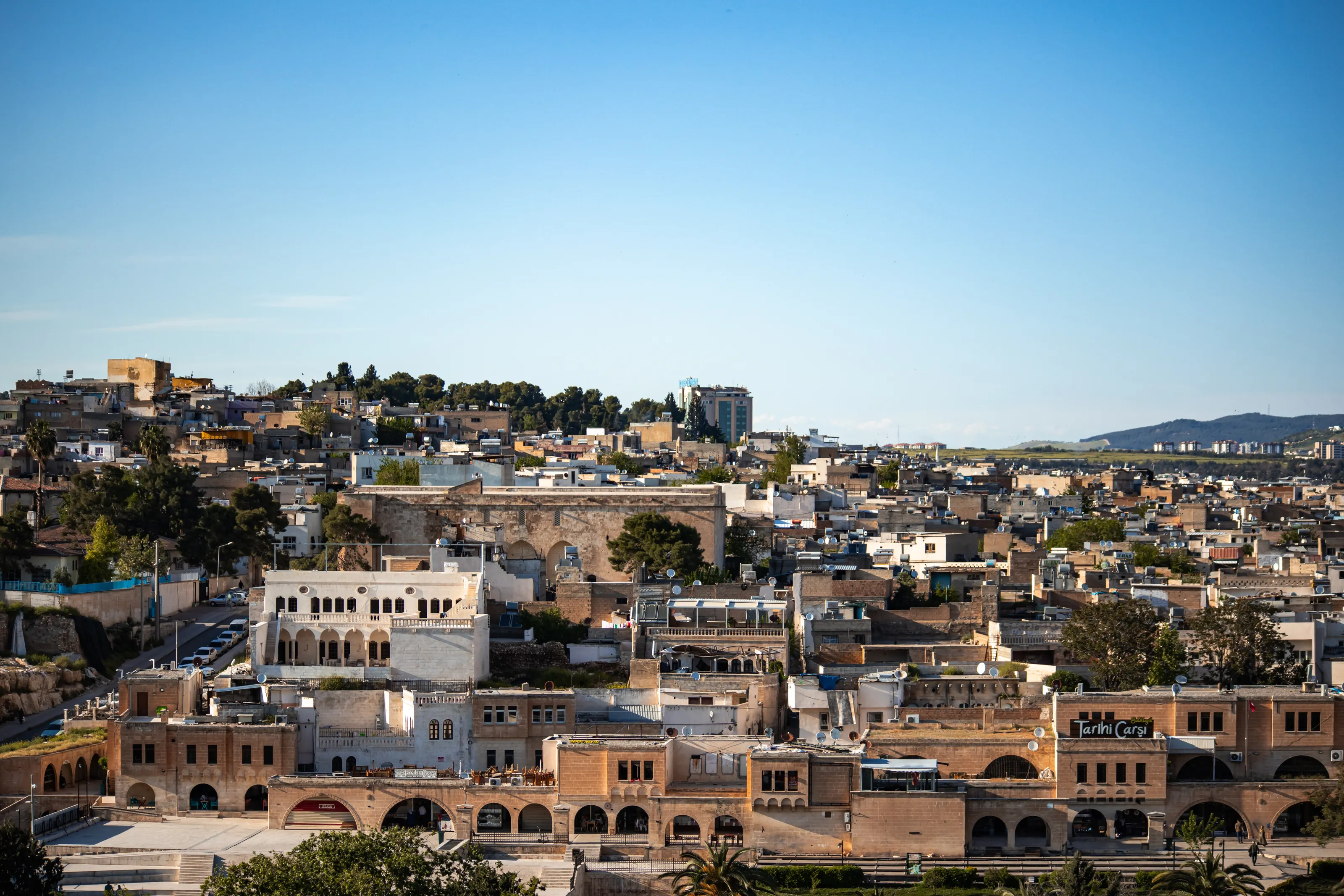
Antakya, ancient Antioch on the Orontes, was founded around 300 BC by Seleucus I Nicator. It became one of the largest cities of the Roman world and a major centre of early Christianity: according to the Acts of the Apostles, it was here that the disciples were first called "Christians" (Wikipedia EN, ES). Capital of Hatay Province, it has been part of Turkey since 1939 and remains a crossroads where you hear Turkish and Arabic and where Muslim, Christian and Alawite communities have lived side by side (Wikipedia DE, EN).
Antakya was hard hit by the 2023 earthquake, and the region is rebuilding. This page covers heritage, mosaics, nearby nature and food, while being honest that some sites may be closed, under restoration or hard to reach: always check their status before you travel. It complements the page on Turkey. SniperAir tracks flight prices to Hatay and alerts you when one drops below your budget; we do not sell or book anything.
Airport and transfer
Hatay Airport (HTY), about 25 km from town
Hatay (HTY)
Hatay Airport, opened in 2007, lies about 25 km by road from Antakya and 45 km from Iskenderun (Wikipedia EN, DE; Wikivoyage EN); Wikipedia FR says 19 km, showing that the distance depends on the route taken. Its runway was badly damaged in the 2023 earthquake and repaired; according to Wikipedia FR it is operational again despite improvement works, and the Turkish aviation press reported the resumption of regular flights from Istanbul. Its status and connections may still change: check with DHMI, the Turkish airport authority, and with the airlines.
Distance HTY to Antakya: about 25 km by road (19 to 25 km depending on the source). Istanbul to Hatay: about 1 hr 50 by air (Wikivoyage EN). No shuttle or taxi fare is quoted here.
From the airport a Havas shuttle bus is supposed to serve the centre in about an hour; taxis and dolmus also run (Wikivoyage EN). There is no train station in Antakya: the nearest is at Iskenderun (Wikivoyage DE, EN). By coach from Istanbul, allow about fourteen hours (Wikivoyage EN). Watch HTY, but also compare Adana (ADA) and Gaziantep (GZT), two other airports in the region, depending on your itinerary.
Landmarks and sights
Roman mosaics, laurel waterfalls and an ancient tunnel
Antakya is famous for its Roman mosaics, and its surroundings for surprising nature. The six photos below show mosaics from the Hatay Archaeology Museum, the Harbiye waterfalls and the Roman Titus and Vespasian tunnel; other places are described further down in text only. Because some sites suffered in 2023, check access before planning.
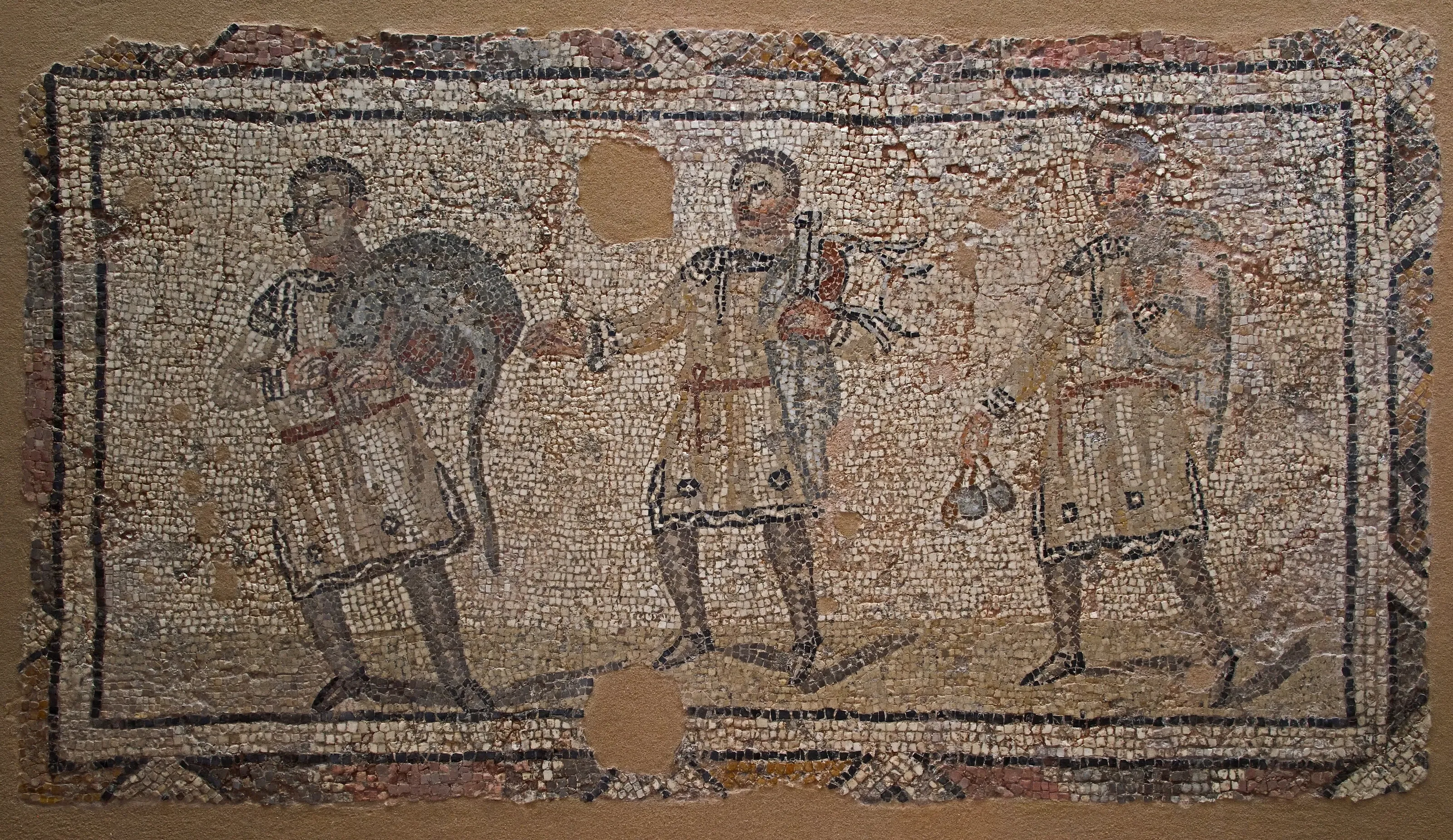
The mosaic of the three figures
The mosaics of Antioch and its suburbs, such as Daphne or Seleucia Pieria, rank among the richest in the Roman world. This scene of three figures in tunics, in restrained colours, gives a taste: mosaic makers depicted everyday scenes as much as myths (Wikipedia EN, ES).
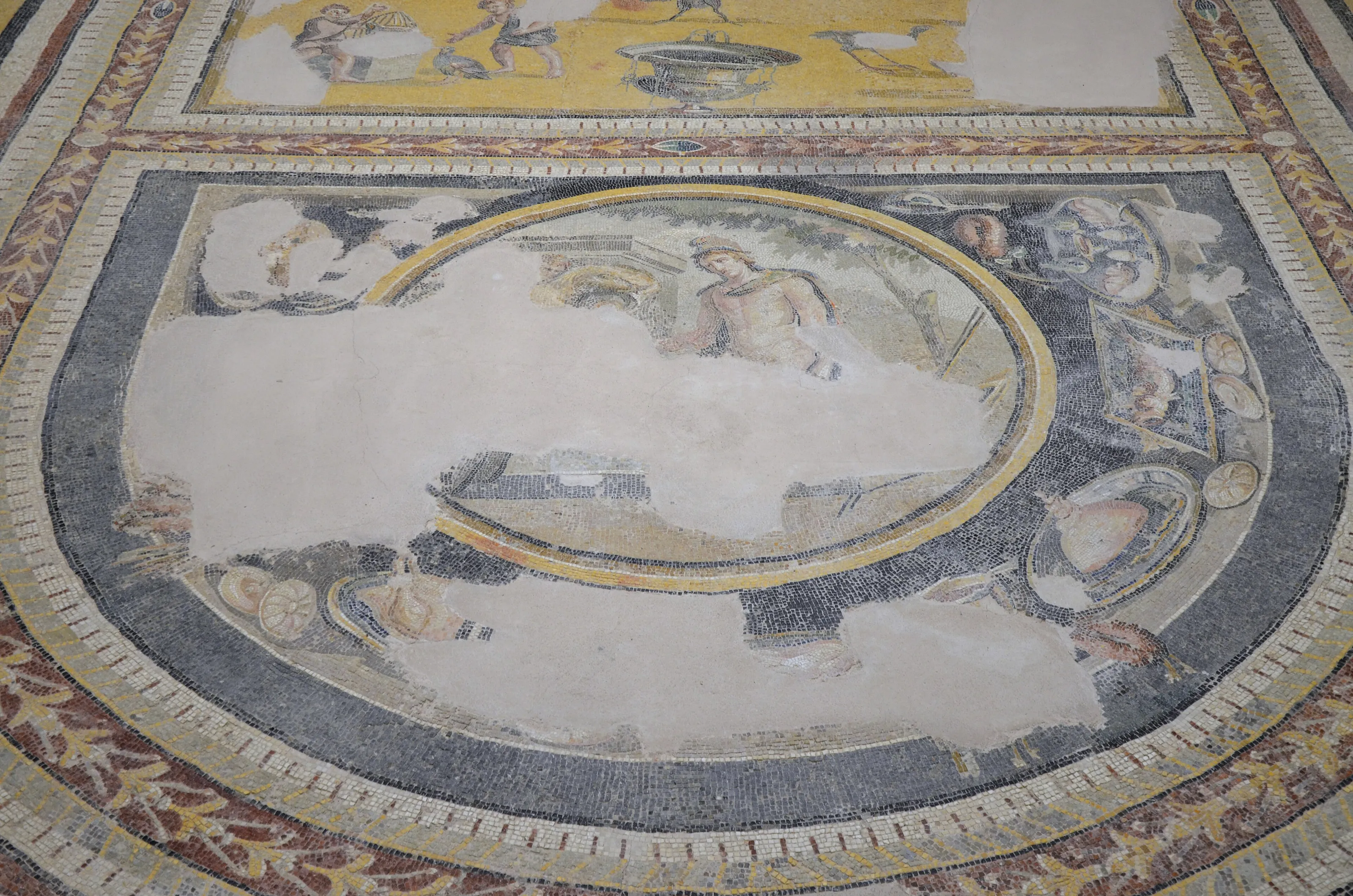
A Roman mosaic floor
Floors in Antioch's wealthy houses combined geometric or plant borders with figurative medallions; surviving pieces come mainly from Daphne, Seleucia Pieria and Antioch (Wikipedia EN). Drunken Dionysus, Orpheus and Ariadne abandoned are among the most famous subjects in the collection.
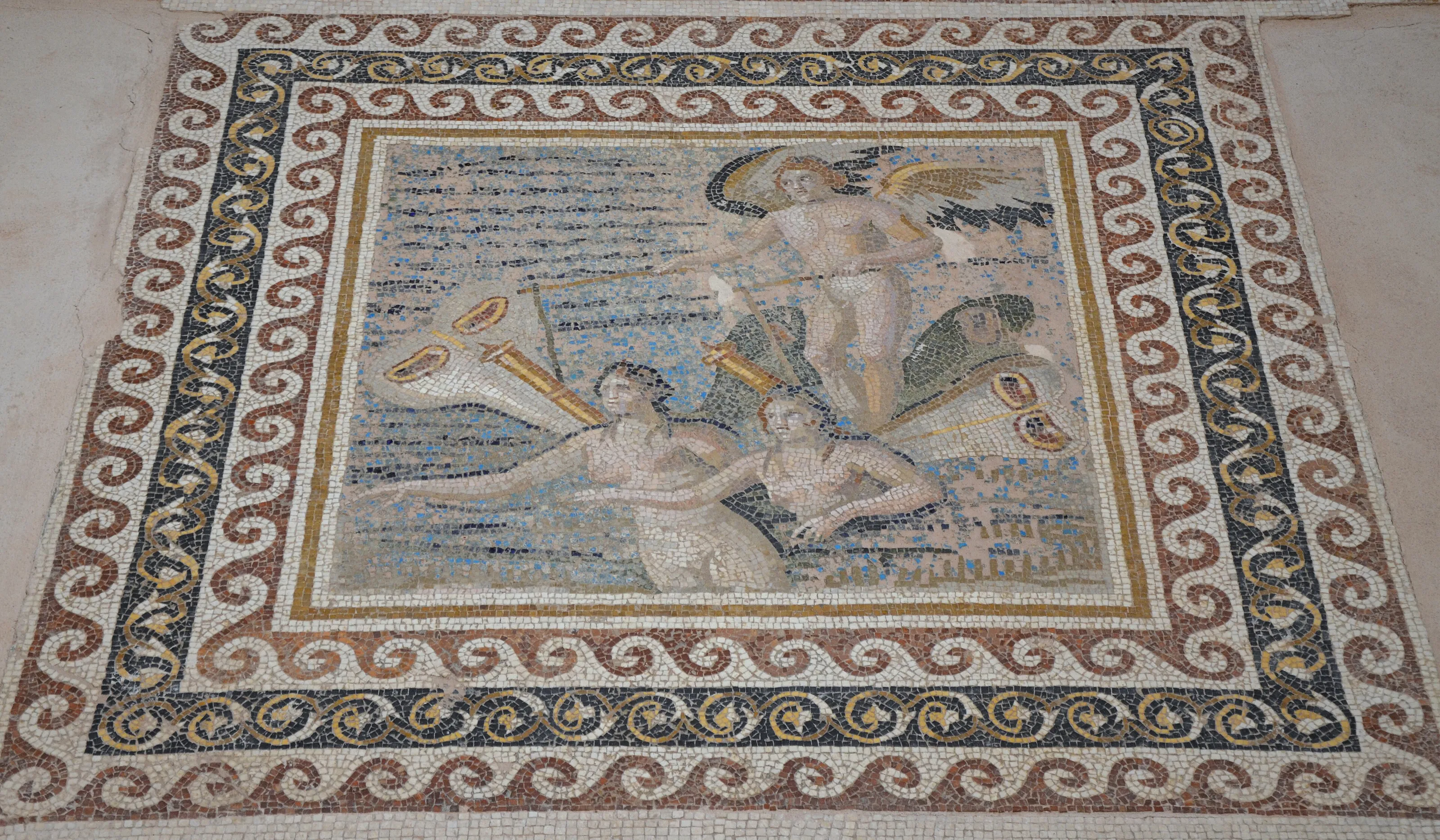
Water, wings and waves
The mosaic makers drew on Greek mythology: winged figures, nymphs and sea deities, framed by wave-pattern borders. Many of these panels were found during twentieth-century excavations of ancient villas in the region (Wikipedia ES).
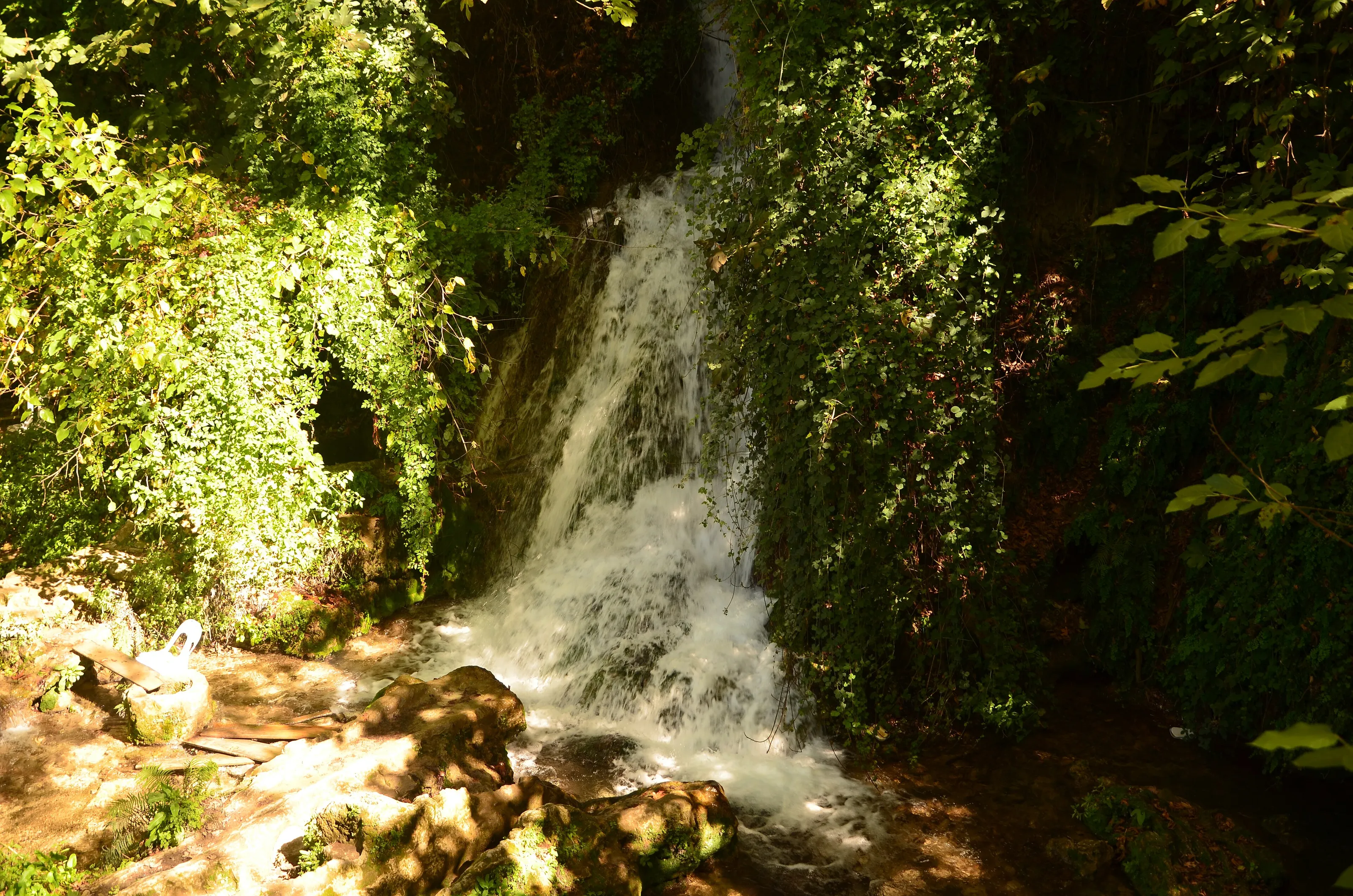
Harbiye, ancient Daphne
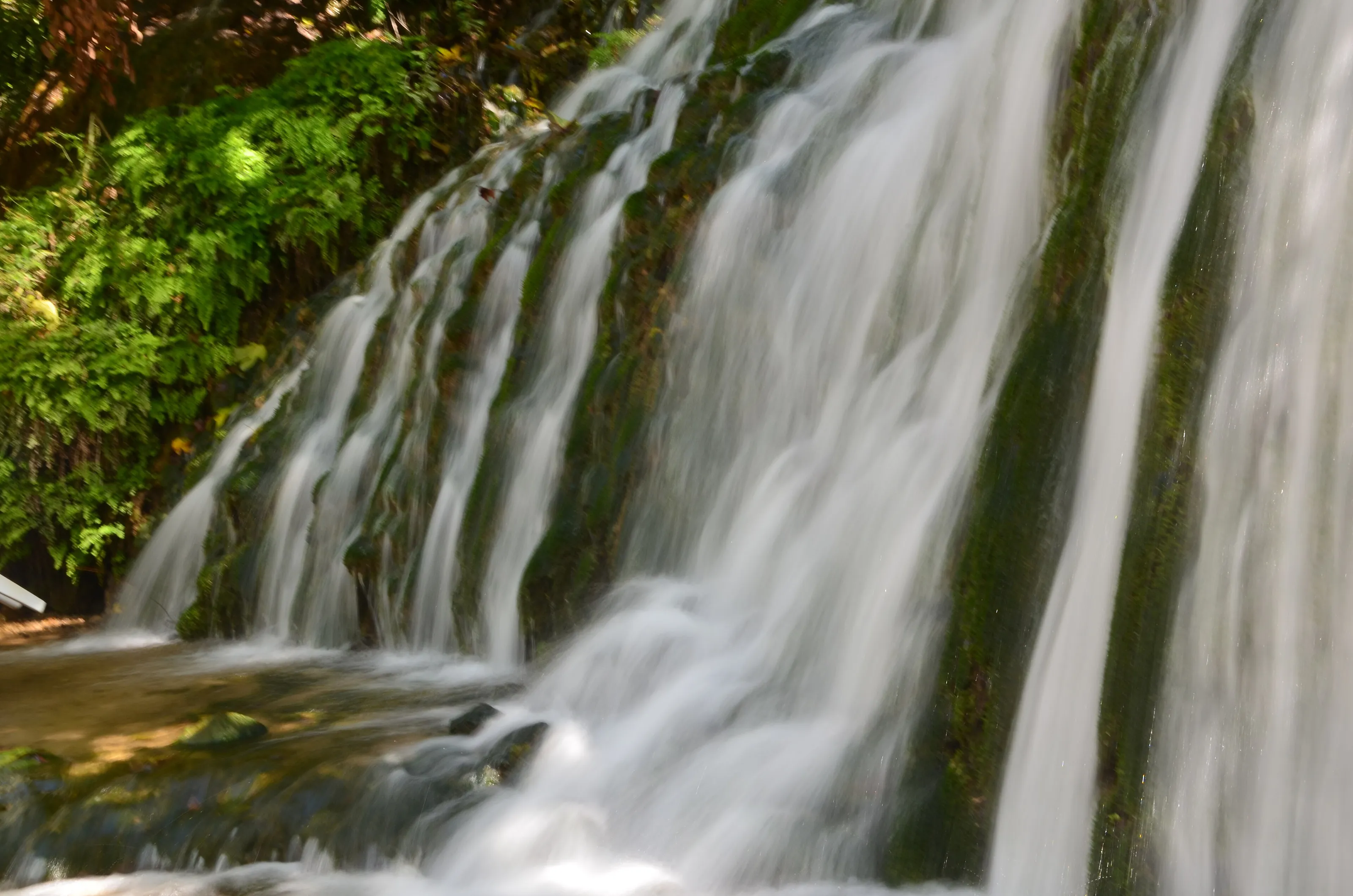
About 7 to 10 km south of the centre, Harbiye is named after the nymph Daphne, turned into a laurel tree in the legend. It is an area of springs, laurels and waterfalls, a favourite spot for walks and meals among Antakya's residents, notably for its meze (Wikipedia EN; Wikivoyage EN, DE).
Woodland and small falls
The region's springs feed dense vegetation, especially in spring. In summer this is a cooler refuge away from the hot streets of the city; keep to the paths and respect neighbouring properties.
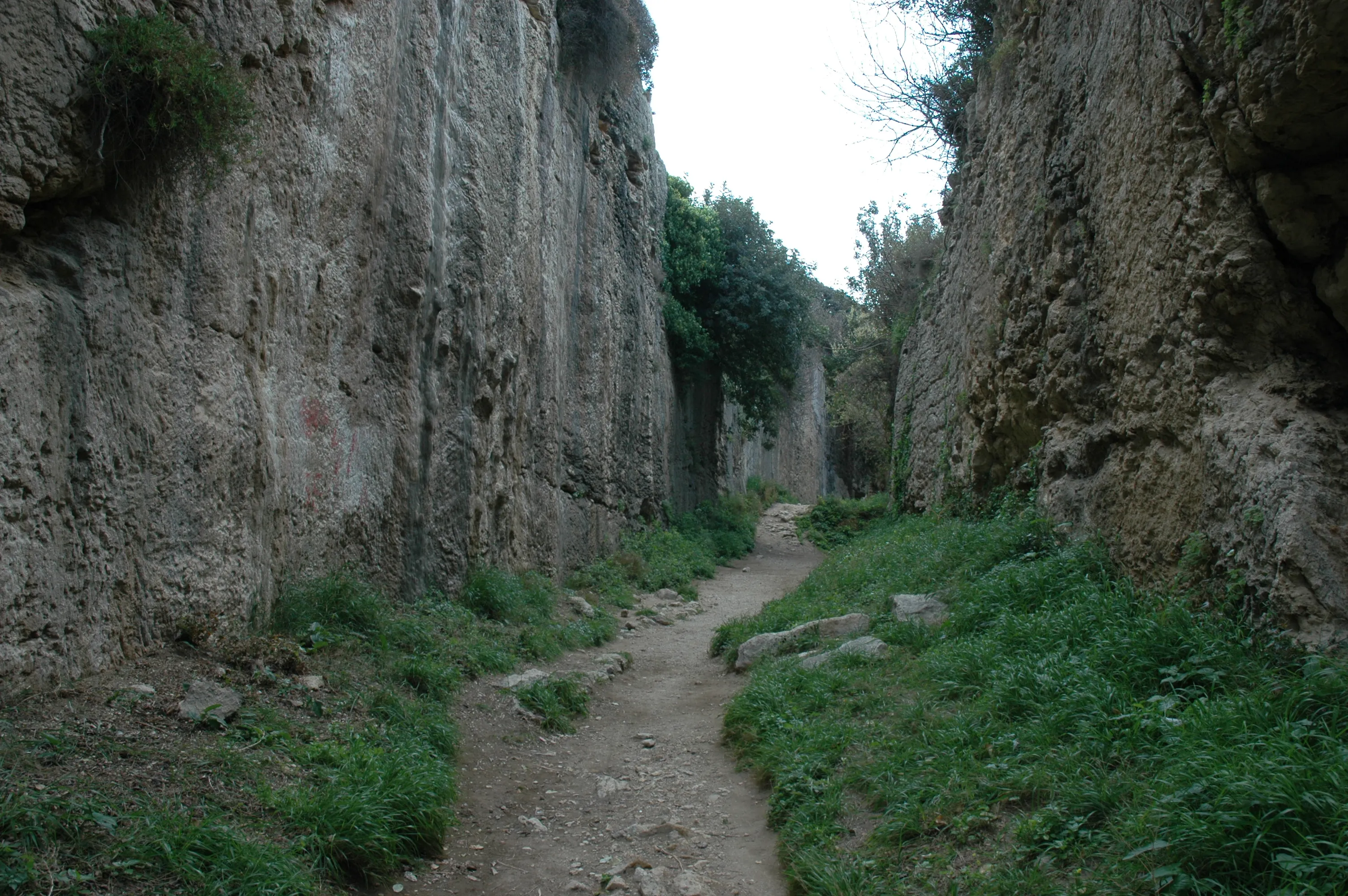
The Vespasian and Titus tunnel
Near Cevlik, about 35 km south-west of Antakya, a hand-cut trench and tunnel diverted floodwater to protect the Roman harbour of Seleucia Pieria. Work began under Vespasian (69-79 AD), continued under Titus and was finished under Antoninus Pius (138-161); inscriptions carved into the rock record it (Wikipedia EN; about 1.4 km according to Wikivoyage EN).
Among the places without a photo: the Cave Church of St Peter, cut into the rock north-east of the centre, is often described as one of the oldest Christian churches (Wikipedia FR; Wikivoyage EN). The Habib-i Neccar Mosque, the Uzun Carsi (Long Bazaar) and Kurtulus Caddesi, the historic axis of the city, were affected in 2023; restoration is under way according to Wikivoyage (EN) and the state of each place changes, so ask locally. Further out, the monastery of St Symeon the Younger, the long beach at Samandag and the Armenian village of Vakifli complete the picture.
Museums and culture
The mosaic museum and the layers of history
Hatay Archaeology Museum
Known for its huge collection of Roman and Byzantine mosaics, it is presented by Wikipedia (EN) as possibly the largest mosaic museum in the world. It sustained damage in 2023; its access, open rooms and hours should be checked with the Turkish Ministry of Culture before any visit. No admission fee is quoted here.
Necmi Asfuroglu Archaeological Museum
Built over remains found during hotel construction, it shows an ancient road surface, baths and floor mosaics, according to Wikivoyage (EN). Check its opening hours.
The Church of St Peter
This building, both a place of Christian memory and a visited site, occupies a cave thirteen metres deep (Wikivoyage EN). Check its access and hours.
A city of mixed cultures
Turks, Arabs, Christians, Alawites and a once-large Jewish community made Antakya a city of coexistence (Wikipedia DE, EN). The food, languages and religious festivals still bear traces of it: a reason to come with curiosity and discretion.
Food and drink
Kunefe, meze and a UNESCO-recognised cuisine
A recognised cuisine
Hatay has been a UNESCO Creative City of Gastronomy since 2017, with some 600 dishes counted (Hurriyet Daily News; South China Morning Post). The cooking has Arab influences: hummus, tahini, meze, kebab, stuffed vegetables, olive oil.
Antakya's kunefe
The signature dessert combines shredded kadayif, melted unsalted fresh cheese, butter and syrup, sometimes with pistachios (Wikipedia EN, DE, FR). It is eaten hot in pastry shops.
Restaurants and neighbourhoods
Dining is being rebuilt step by step, with temporary or relocated addresses: the cafes and restaurants of Harbiye among the laurels remain a classic. We do not list addresses, which change quickly.
To take home
Laurel soap (defne sabunu) is a typical souvenir; patch-test it on a small area of skin before use (Wikivoyage EN).
Getting around
Dolmus, taxis, car and a little walking
On foot
The centre can be explored on foot, but the Church of St Peter is several kilometres north-east, on an unpleasant walk in the sun (Wikivoyage EN).
Dolmus and taxis
Shared minibuses (dolmus) and taxis serve the city and nearby villages (Wikivoyage DE, EN). Fares are not quoted here.
By car
To reach Harbiye, Samandag or the Titus tunnel, a car makes things easier: much of the city has changed and works occupy whole streets (Wikivoyage EN).
Train and coach
There is no train station in Antakya; the nearest is at Iskenderun. Coaches link Adana, Iskenderun and Mersin (Wikivoyage DE, EN).
Around Antakya
Harbiye, Samandag, Cevlik and Iskenderun
Harbiye
Seven to ten kilometres south, the laurel-and-waterfall area is the easiest outing: a cool break, meze and a stroll.
Samandag and Cevlik
About 27 km west per Wikivoyage (EN), Samandag has a long beach; at Cevlik, the old port of Seleucia Pieria, you can visit the Titus tunnel. A current can exist near the shore in central Samandag, so swim with care (Wikivoyage DE).
St Symeon and Vakifli
The monastery of St Symeon the Younger, to the south-west, and Vakifli, the only Armenian-majority village in Turkey (Wikivoyage EN), are cultural stops; Vakifli was hard hit in 2023 and its facilities should be checked.
Iskenderun
The port city, about forty kilometres from the airport, serves as a rail hub and a base (Wikipedia EN, FR).
Budget and precautions
A budget to check, a region to approach with respect
Price level
We do not publish price ranges for Antakya: the available figures are scarce, dated and from a single source, and we publish figures only when two independent sources confirm them. Watching the flight price in advance remains the simplest way to control the budget.
Entry rules and currency
The currency is the Turkish lira. Entry conditions depend on your nationality: check with the authorities before booking.
Safety and respect
The region is seismically active (Dead Sea fault, per Wikivoyage EN), several districts are building sites and some buildings are weakened. Syria is close: consult your government's official travel advice before you go. Stay in areas open to the public, do not photograph people without their consent and remember that many residents have been through a great deal.
When to go
Spring and autumn to avoid the heat
Spring
Mild and green, ideal for Harbiye and excursions; the region is at its most pleasant then (editorial judgement).
Summer
Hot, dry summers in a Mediterranean climate: the highest temperature on record is 45.2 degrees C on 13 August 2023 (Wikipedia EN). Plan for water, a hat and early-morning visits.
Autumn
Temperatures become more bearable again and the light is beautiful; a pleasant season for heritage and waterfalls.
Winter
Mild, rainy winter with short days; some sites may keep reduced hours. Bring a rain jacket.
Antakya has a hot-summer Mediterranean climate (Csa), with hot, dry summers and mild, wet winters (Wikipedia EN). The time zone is UTC+3 all year, with no clock change. For comfortable walking and visits, aim for spring and autumn.
By length of stay
How many days to spend in Antakya
Mosaics and food
The mosaic museum (if accessible), a meze lunch and a kunefe give a first impression.
Antakya and Harbiye
Add Harbiye, the Church of St Peter and the Titus tunnel, with slack for access.
Coast and villages
With four days, combine Samandag, St Symeon and Iskenderun, at the pace of the roads and building works.
In pictures
Antakya in pictures
You might also like
Similar destinations
FAQ
Frequently asked questions about flights to Antakya
Which airport do I use for Antakya?
Hatay Airport (HTY), about 25 km from Antakya by road. Its status and connections may change after the repair works: check with DHMI or the airline.
How do I get from Hatay Airport to Antakya?
By shuttle, taxi or dolmus: the trip takes about an hour by shuttle according to Wikivoyage. There is no train station in Antakya; the nearest is at Iskenderun.
What is there to see in Antakya?
The Roman mosaics of the archaeology museum, the Cave Church of St Peter, Harbiye and its waterfalls, and the Titus and Vespasian tunnel near Cevlik. The state and access of each site should be checked.
Can I visit Antakya today?
Yes, but the city is rebuilding after the 2023 earthquake: some places are open, others closed or under works. Ask the Turkish authorities and consult your government's official travel advice before you go.
What should I eat in Antakya?
Kunefe, the hot cheese-and-syrup dessert, meze, hummus and kebab: Hatay has been a UNESCO Creative City of Gastronomy since 2017.
When is the best time to visit Antakya?
Spring and autumn, to avoid the heat of the hot, dry summers. Winter is mild and rainy.
How many days should I plan for Antakya?
One day for the mosaics and food, two to three with Harbiye and the Titus tunnel, four with Samandag and Iskenderun.
How do I get alerted when a flight to Antakya drops below my budget?
Create an alert profile with your departure airport, Hatay Airport (HTY) as destination and your maximum budget. You are notified as soon as a matching price is detected. SniperAir monitors and alerts; it does not sell or book tickets.
Ready to head to Antakya?
Set your budget and let SniperAir monitor fares for you.
Create my alert