
Cheap flights to Graz
Set your departure airport and maximum budget: SniperAir tracks prices to Graz and alerts you the moment a deal matching your criteria appears.
Quick summary
Country
Austria
Continent
Europe
Airport
GRZ
Currency
Euro
Time zone
UTC+1 (UTC+2 during summer time)
Deals already spotted to Graz
Real flight examples detected by SniperAir, with their reference price.
Loading examples…
Why track Graz with SniperAir
You do not need to compare prices every day
Choose your departure
Enter your departure airport and your maximum budget for a flight to Graz (GRZ).
SniperAir keeps watch
Our systems continuously compare new prices with the real price history of the route. SniperAir monitors prices and alerts you: it does not sell or book tickets.
You receive an alert
As soon as a price matches your criteria, you are notified, without having searched for anything yourself.
Airport and getting into town
A small airport about 9 km from the centre, connected by train
Graz (GRZ)
Graz Airport (Thalerhof) is about 9 km south of the centre. The airport train station is a few minutes' walk from the terminal: the S5 S-Bahn reaches Graz main station in about fifteen minutes according to Wikivoyage (EN). Buses and taxis also make the link. It is a regional airport: many travellers come through Vienna (VIE), about 2 h 40 away by train, or through Munich or Frankfurt. From Klagenfurt, the Koralm tunnel link, opened in December 2025, takes about 45 minutes according to Wikivoyage (EN).
Distances and times are approximate, based on Wikivoyage (EN, DE); train and bus timetables change: check them before you travel. We give no fares.
Graz is the capital of Styria and Austria's second-largest city, with about 308,000 inhabitants with their main residence, according to Wikipedia (EN). The city stretches on both sides of the Mur, around the Schlossberg hill, which was a fortress from 1125 to 1809 according to Wikipedia (DE).
It is a major university city, with about 60,000 students, and a city of culture: Graz was European Capital of Culture in 2003. Its historic centre has been on the UNESCO list since 1999, with Eggenberg Palace added in 2010. The climate is hotter and drier in summer than in the west of the country, with sunshine that visitors appreciate.
Old town and landmarks
Red roofs, the Schlossberg and contemporary architecture
Graz's centre mixes Renaissance, baroque and contemporary architecture. It is best visited on foot. The places below are illustrated; the Kunsthaus and others are described in text only.
The old town rooftops
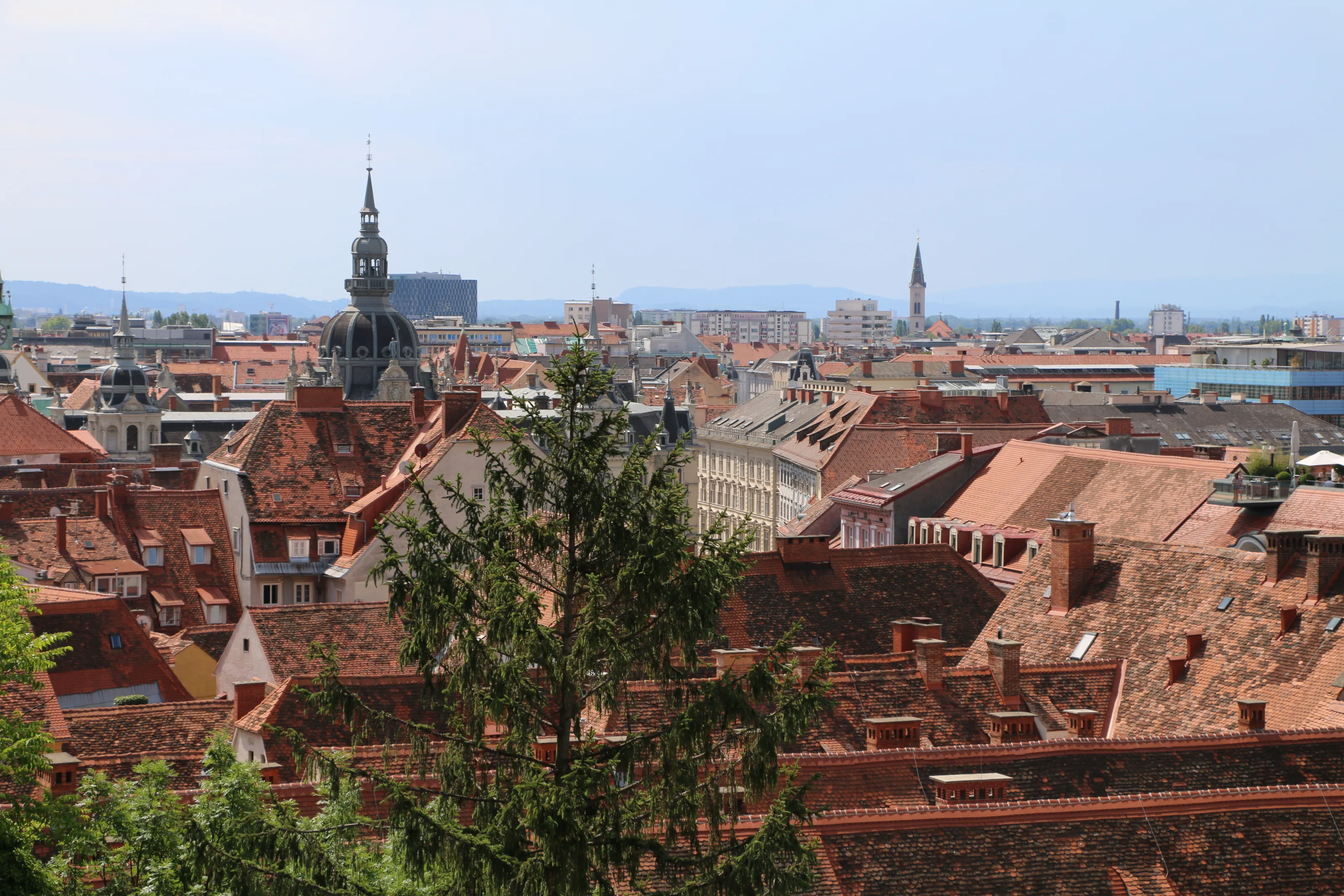
Seen from the Schlossberg, the old town is a sea of red-tiled roofs, one of the reasons for its UNESCO listing: the centre preserves the evolution of its architecture. You can reach the top on foot, by funicular (Schlossbergbahn) or by lift (Schlossberglift).
The Clock Tower (Uhrturm)
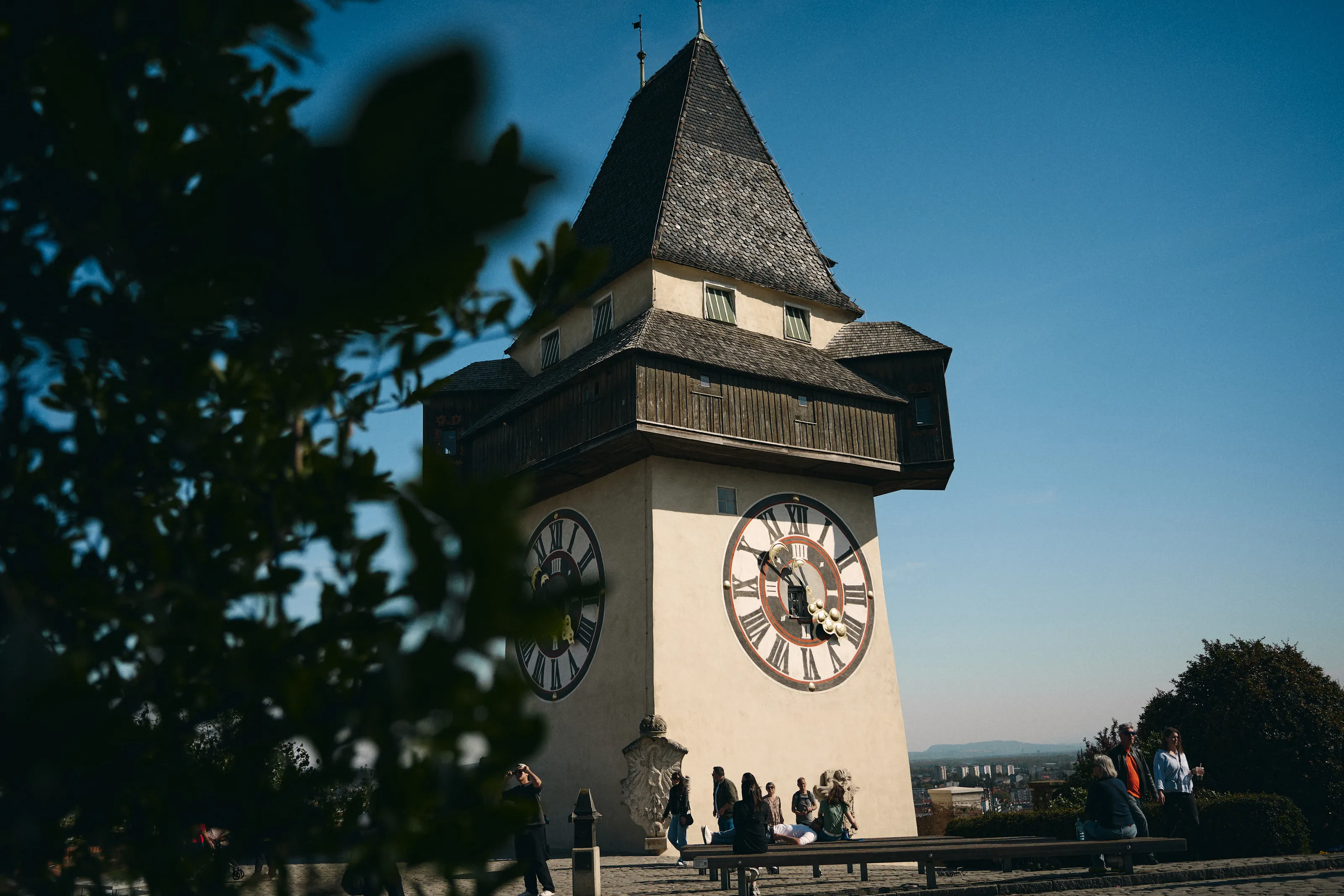
A symbol of Graz, the Clock Tower overlooks the city from the Schlossberg. Its large dials have a quirk: the long hand shows the hours and the short one the minutes. The Schlossberg fortress never fell to the Ottomans, according to Wikivoyage (EN).
Eggenberg Palace
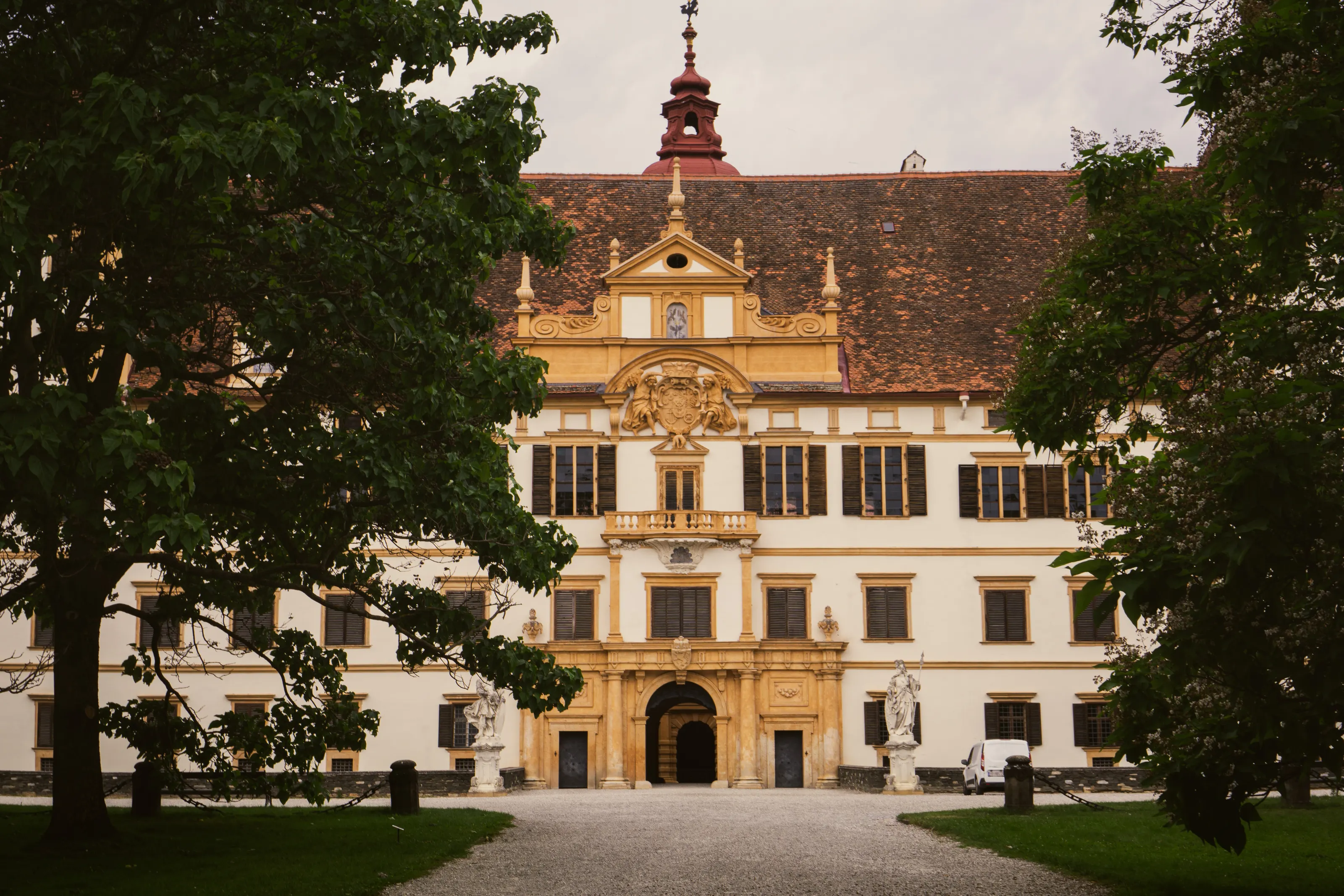
West of the centre, Eggenberg Palace is Styria's most important baroque complex, with its state rooms and park. It has been listed by UNESCO along with the historic centre since 2010, and also houses collections (an old masters gallery, a coin cabinet, an archaeology museum). You can get there by tram.
The Landhaus courtyard
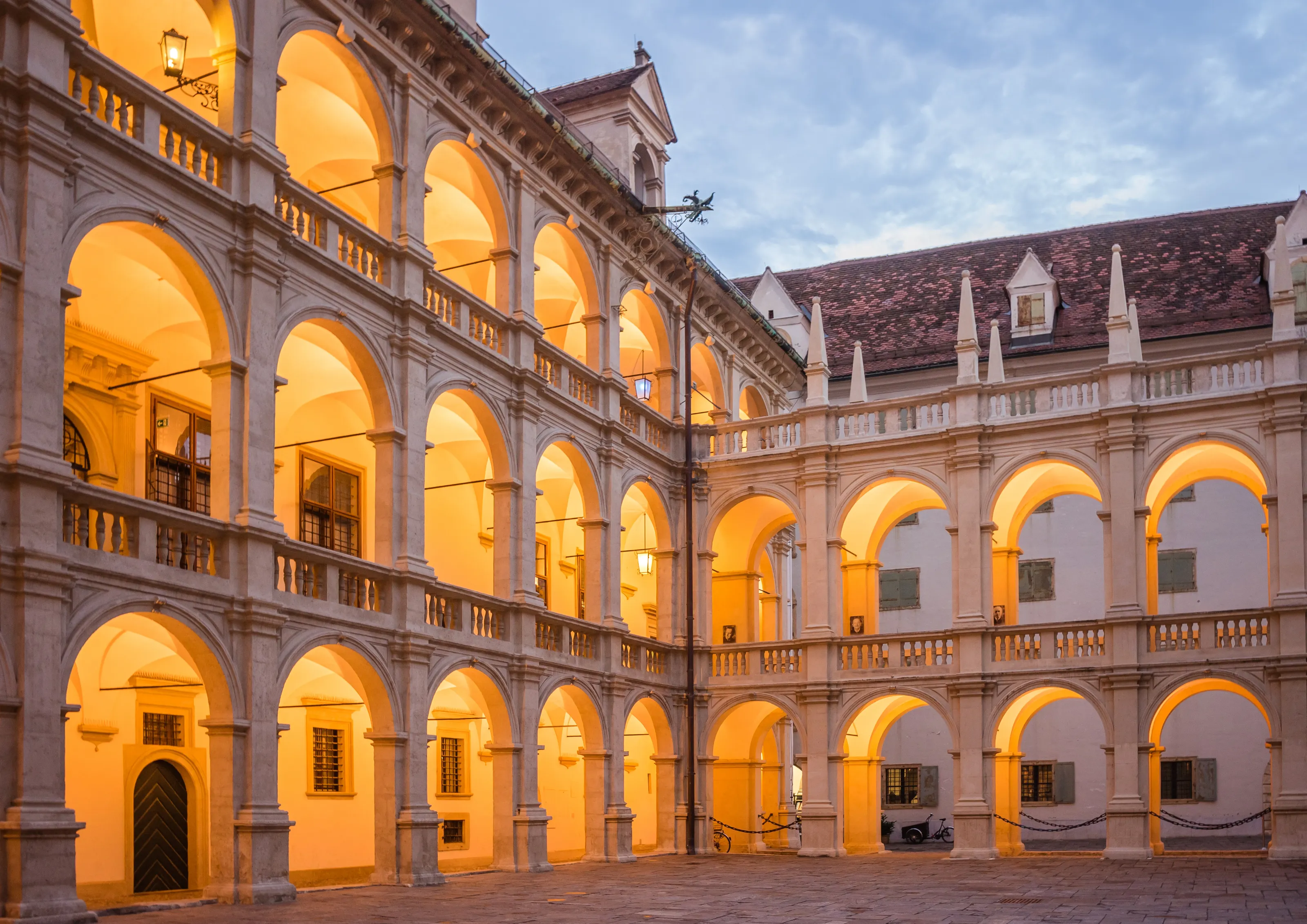
On Herrengasse, the Landhaus courtyard, with Renaissance arcades, is one of the most beautiful spots in the old town, especially lit up in the evening. It is next to the Landeszeughaus, the armoury.
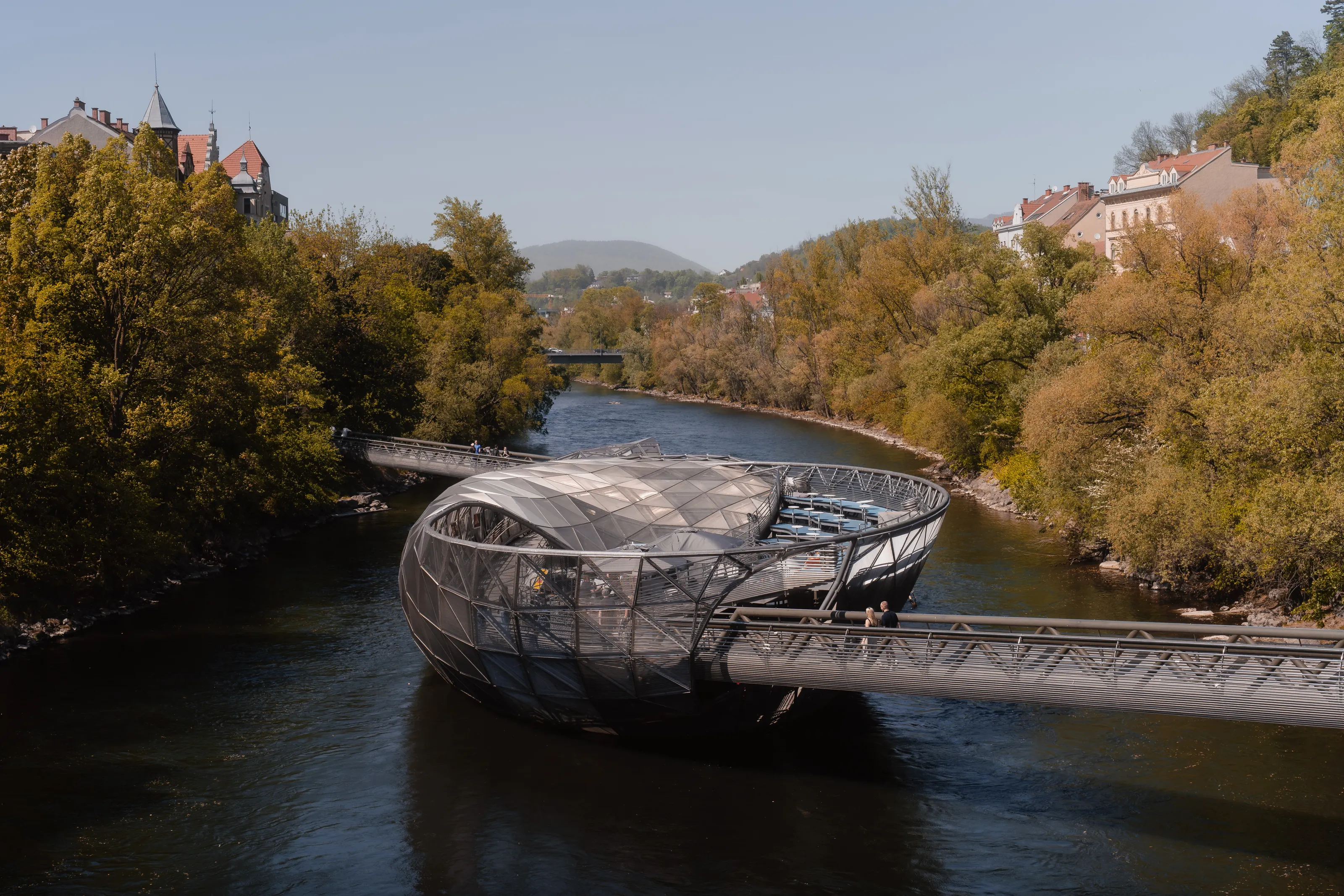
The Murinsel
The Mur island, a steel platform designed by the artist Vito Acconci, was built for 2003, the year of European Capital of Culture. It houses a café and a stage, and is reached by footbridges from both banks.
The Kunsthaus and other sights, text only
The Kunsthaus, by Peter Cook and Colin Fournier, is a blue bubble-shaped building on the right bank of the Mur, nicknamed the friendly alien; it hosts contemporary art exhibitions. Herrengasse, a baroque street, links the main square (Hauptplatz) with Jakominiplatz. The cathedral and the neighbouring mausoleum are near the centre.
Museums and culture
A giant armoury, contemporary art and baroque palaces
The Landeszeughaus
The city arsenal on Herrengasse is said to be the largest collection of early modern weapons in the world according to Wikipedia (DE): thousands of suits of armour and weapons lined up over several floors. A top priority for its unique character.
Joanneum and Kunsthaus
The Joanneum is Styria's large network of museums: art, natural history, folk culture and more. The Kunsthaus (contemporary art) is part of it. We give no prices; check opening times before you go.
Eggenberg, opera and music
Eggenberg Palace offers guided tours and collections. The city also has an opera house, theatres and festivals all year; the 2003 Capital of Culture year left several contemporary buildings, such as the Murinsel and the Kunsthaus.
Food and drink
Pumpkin seed oil, Styrian wine and markets
The produce
Styria is known for pumpkin seed oil (Kürbiskernöl), dark and strongly flavoured, poured over salads, soups and even ice cream. The region is also wine country; Styrian white wines are drunk in the city's taverns. Graz likes to present itself as a gastronomic capital of Austria, which shows in the quality of its restaurants and markets.
Markets and squares
The Kaiser-Josef-Platz market offers fruit, vegetables, cheese, cured meats and Styrian products, depending on opening days; Lendplatz has another market. From May to September the terraces on the central squares are lively.
Cafés and sweets
Old-town cafés serve pastries and coffee all day. As elsewhere in Austria, try the classic cooking (schnitzel, dumplings), but also dishes based on pumpkin or fried chicken (Backhendl), depending on the menu.
Getting around
Tram, bus, bike and the Schlossberg funicular
Tram and bus
The tram network, which crosses at Jakominiplatz, serves the centre, the main station and Eggenberg. Buses complete the network; tickets are validated on board and bought at machines, kiosks or via an app, and day passes exist. Service runs from about 5 am to midnight on weekdays according to Wikivoyage (EN), with night buses on some evenings.
By bike
Graz is a cycling city, with a good network of paths and little rain according to Wikivoyage (EN). Bikes can be rented. The centre is flat and easy to cover by bicycle.
Schlossberg and trains
The funicular (Schlossbergbahn) and the lift (Schlossberglift) go up the Schlossberg. The main station connects to Vienna (about 2 h 40), Klagenfurt and Slovenia; the airport is served by the S5 train.
Budget and precautions
A medium budget, gentler than the big tourist cities
Price level
Graz is a medium-budget destination by European standards: generally more affordable than Salzburg or Innsbruck, with a varied choice of restaurants and accommodation. Prices rise at Christmas and during events. We give no figures because we could not confirm them from two independent sources.
Flights
The flight remains the most variable cost. SniperAir monitors prices to GRZ and compares them with the route's history, but it does not sell or book tickets. Vienna (VIE) is another gateway worth watching, with a train ride onward.
Entry rules and precautions
Austria is part of the Schengen area: entry requirements depend on your nationality, so check them on official sites. Also consult the official recommendations of your country of departure. In summer, bring water and sun protection; if you hike in the surrounding hills, check the weather.
When to go
Hot summers, cool winters, lovely shoulder seasons
Winter (December to February)
Cool to cold, with Christmas markets in December. The Schlossberg is calm and the city quieter.
Spring (March to May)
Terraces reopen and parks bloom again; a good time for the city at gentler prices.
Summer (June to August)
Hot, sometimes very hot, with thunderstorms: favour mornings and evenings for walking. Terraces are full.
Autumn (September to November)
Soft light, the grape harvest in Styria and colours along the Mur; a popular time for food.
Graz has a continental climate, with hot summers and cool winters, and somewhat less rain than in the west of the country according to Wikivoyage (EN). We give no precise temperatures because we could not cross-check them; consult forecasts before you travel. Spring and autumn are the most pleasant seasons for walking and eating outdoors.
By length of stay
What to do in Graz depending on how long you stay
The essentials
The old town, the Schlossberg and Clock Tower, the Murinsel, the Landeszeughaus and a Styrian meal.
Palaces and museums
Eggenberg Palace, the Kunsthaus and another Joanneum museum, the markets and a bike ride.
Styria
Trips into the wine region, the mountains, or by train to Vienna, Klagenfurt or Slovenia.
In pictures
Graz in pictures
You might also like
Similar destinations
FAQ
Frequently asked questions about flights to Graz
How do I get from Graz airport to the centre?
The airport (GRZ) is about 9 km south of the centre. The S5 train reaches the main station in about fifteen minutes; buses and taxis also make the link.
When is the best time to visit Graz?
Spring and autumn for walks and food; summer if you like heat and terraces; December for the Christmas markets.
Is Graz expensive?
The budget is medium by European standards, generally gentler than in the country's big tourist cities. Prices rise at Christmas and during events.
How long should I stay in Graz?
Two days for the old town, the Schlossberg and the Murinsel; four days if you add Eggenberg, museums and an excursion.
How do I get around Graz?
On foot in the centre, by tram and bus, by bike (the terrain is flat). The funicular and the lift go up the Schlossberg.
What should I eat in Graz?
Pumpkin seed oil (Kürbiskernöl), Styrian wines, classic Austrian cooking and produce from the Kaiser-Josef-Platz markets.
How much does a flight to Graz usually cost?
The price depends mainly on your departure city, the time of year and how far ahead you book. The "opportunities" section above shows real examples of prices SniperAir has already detected to this destination.
How do I get alerted when a flight to Graz drops below my budget?
Create an alert profile with your departure airport, Graz as the destination and your maximum budget. You are notified automatically as soon as a matching price is detected.
Ready to head to Graz?
Set your budget and let SniperAir monitor fares for you.
Create my alert