
Cheap flights to Innsbruck
Set your departure airport and maximum budget: SniperAir tracks prices to Innsbruck and alerts you the moment a deal matching your criteria appears.
Quick summary
Country
Austria
Continent
Europe
Airport
INN
Currency
Euro
Time zone
UTC+1 (UTC+2 during summer time)
Deals already spotted to Innsbruck
Real flight examples detected by SniperAir, with their reference price.
Loading examples…
Why track Innsbruck with SniperAir
You do not need to compare prices every day
Choose your departure
Enter your departure airport and your maximum budget for a flight to Innsbruck (INN).
SniperAir keeps watch
Our systems continuously compare new prices with the real price history of the route. SniperAir monitors prices and alerts you: it does not sell or book tickets.
You receive an alert
As soon as a price matches your criteria, you are notified, without having searched for anything yourself.
Airport and getting into town
An airport a few kilometres from the centre, at the foot of the mountains
Innsbruck (INN)
Innsbruck Airport (Kranebitten) lies west of the city, about 4 km from the centre. A bus line (line F) links the airport with the main station and the centre, roughly every fifteen minutes during the day according to Wikivoyage (DE); allow around twenty minutes. Taxis are quicker. In winter, seasonal flights and ski shuttles add to the offer. Other useful gateways: Munich (MUC), about 200 km away, and Salzburg, about 185 km, both connected by train.
Distances and times are approximate, based on Wikipedia (DE, EN) and Wikivoyage (DE, EN); bus and shuttle timetables change with the season: check them before you travel. We give no fares.
Innsbruck is the capital of Tyrol and has about 132,000 inhabitants, making it Austria's fifth-largest city. It sits in the Inn valley, between the Nordkette range (part of the Karwendel) to the north and the foothills of the Patscherkofel to the south, about thirty kilometres from the Brenner Pass. A large part of the municipal territory is unbuilt mountain land.
It is a crossroads between Bavaria and northern Italy, and a university centre (about 30,000 students according to Wikipedia DE). The city hosted the Winter Olympics in 1964 and 1976: the mix of old town, sport and high mountains makes it a winter and summer destination alike.
Old town and landmarks
Golden Roof, colourful facades and the Alps at the end of every street
Here the mountains are visible from almost everywhere in the centre. The pedestrian old town can be covered in half a day; the places below are illustrated, while others (Nordkette, Bergisel, Ambras Castle) are described in text only.
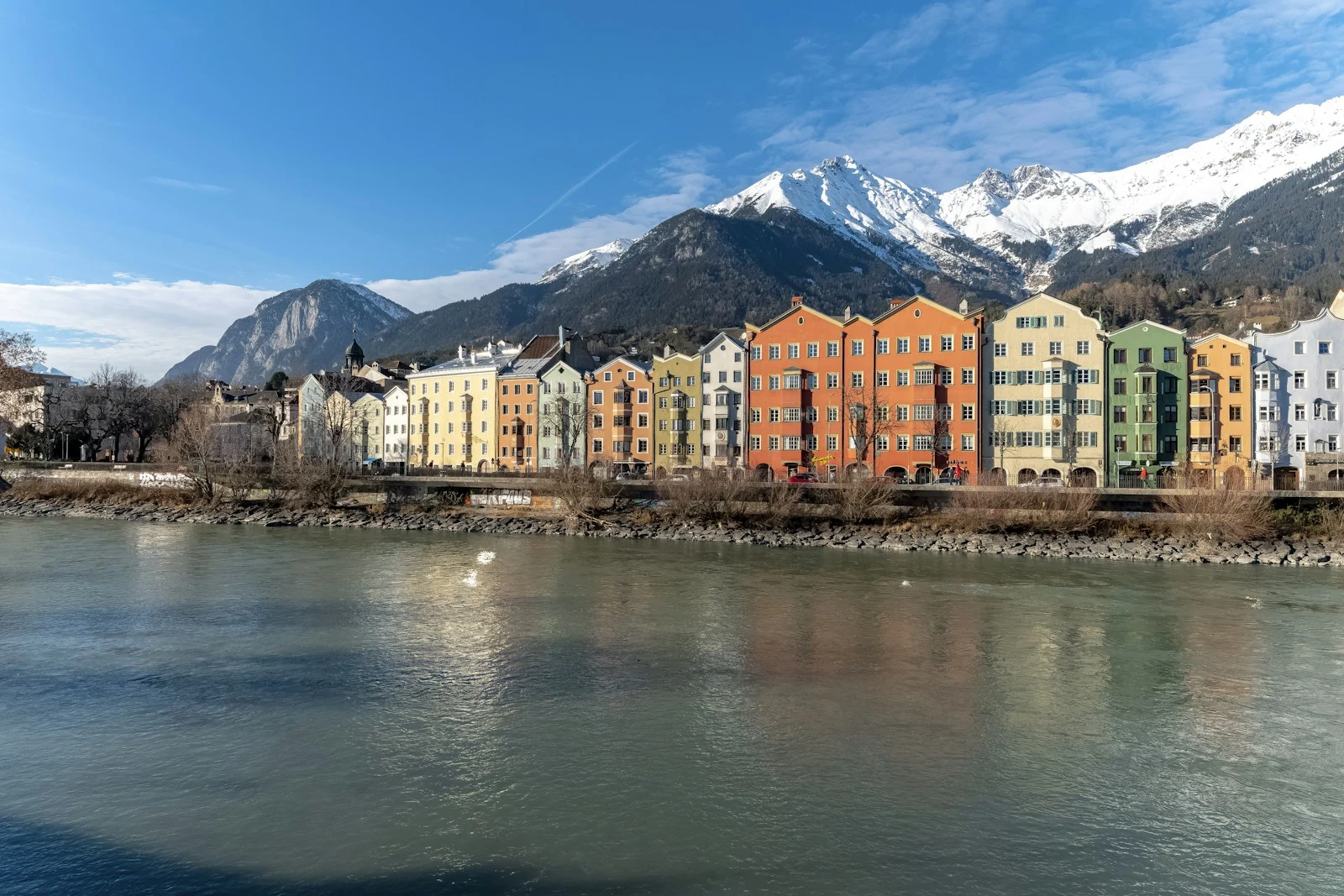
The banks of the Inn
Brightly coloured facades line the river, with the snow-covered Nordkette range as a backdrop: it is the best-known image of the city. The embankments are open for strolling and offer fine viewpoints, especially on clear winter days.
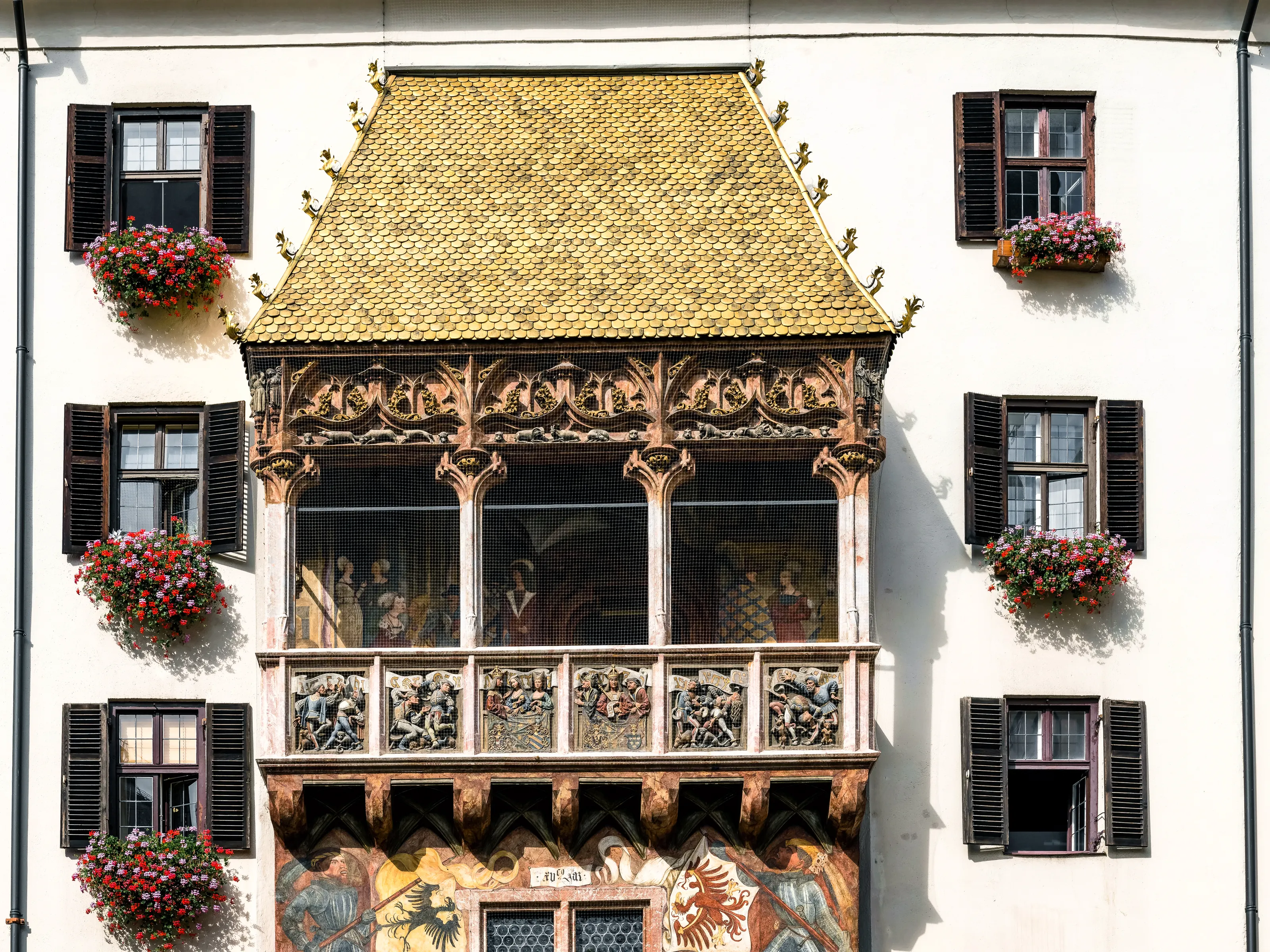
The Golden Roof
In the old town, the oriel covered in gilded copper tiles is the city's symbol; it was built in the time of Emperor Maximilian I, who left a strong mark on Innsbruck. The facade is decorated with reliefs, paintings and flower boxes. A small museum is devoted to its history; check opening times.
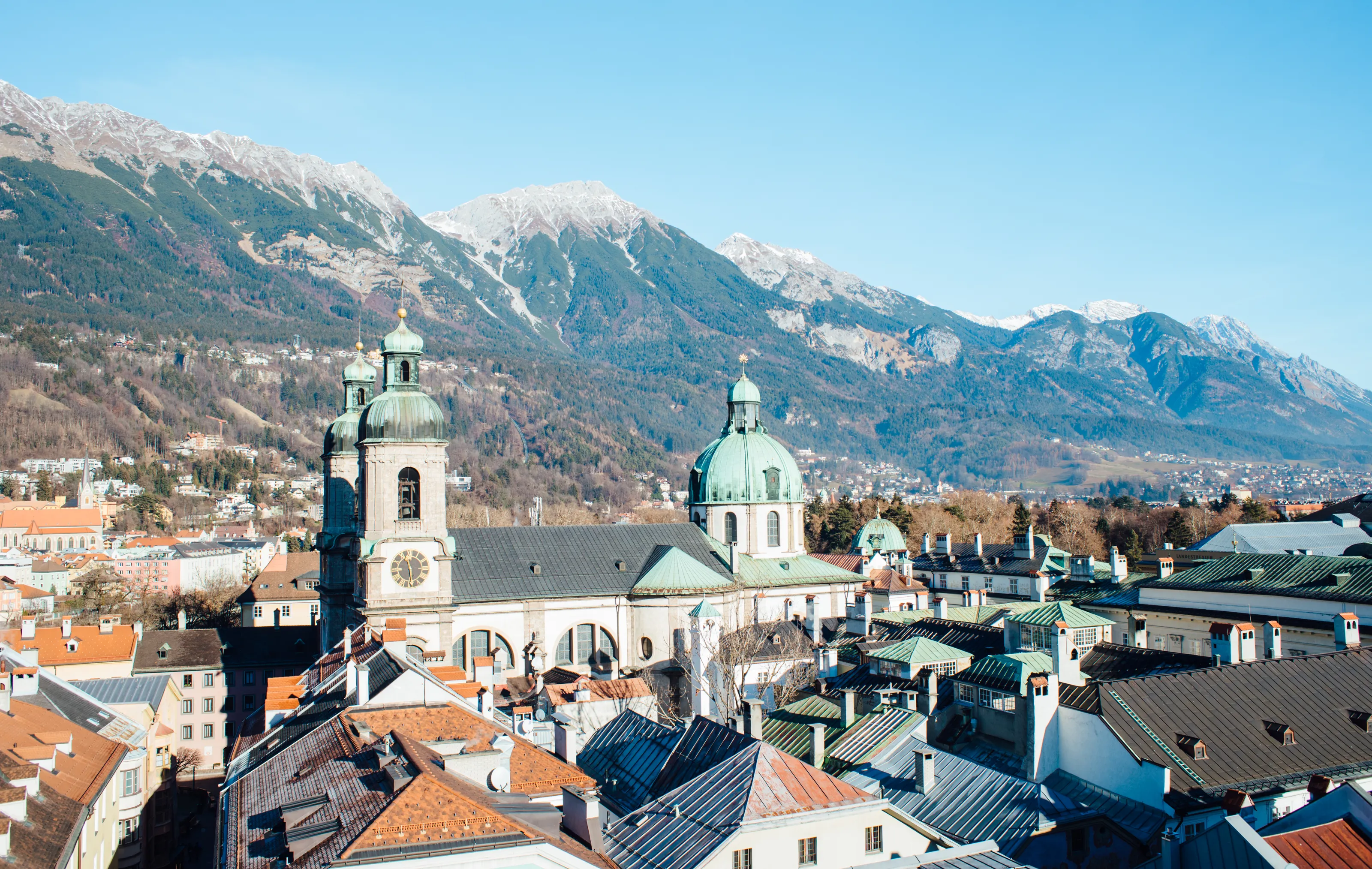
St James' Cathedral and the Alps
Seen from above, the old town shows its tiled and green-copper rooftops, the cathedral towers and the mountain wall. It is the best illustration of Innsbruck's character: a baroque and medieval city hugging the mountains.
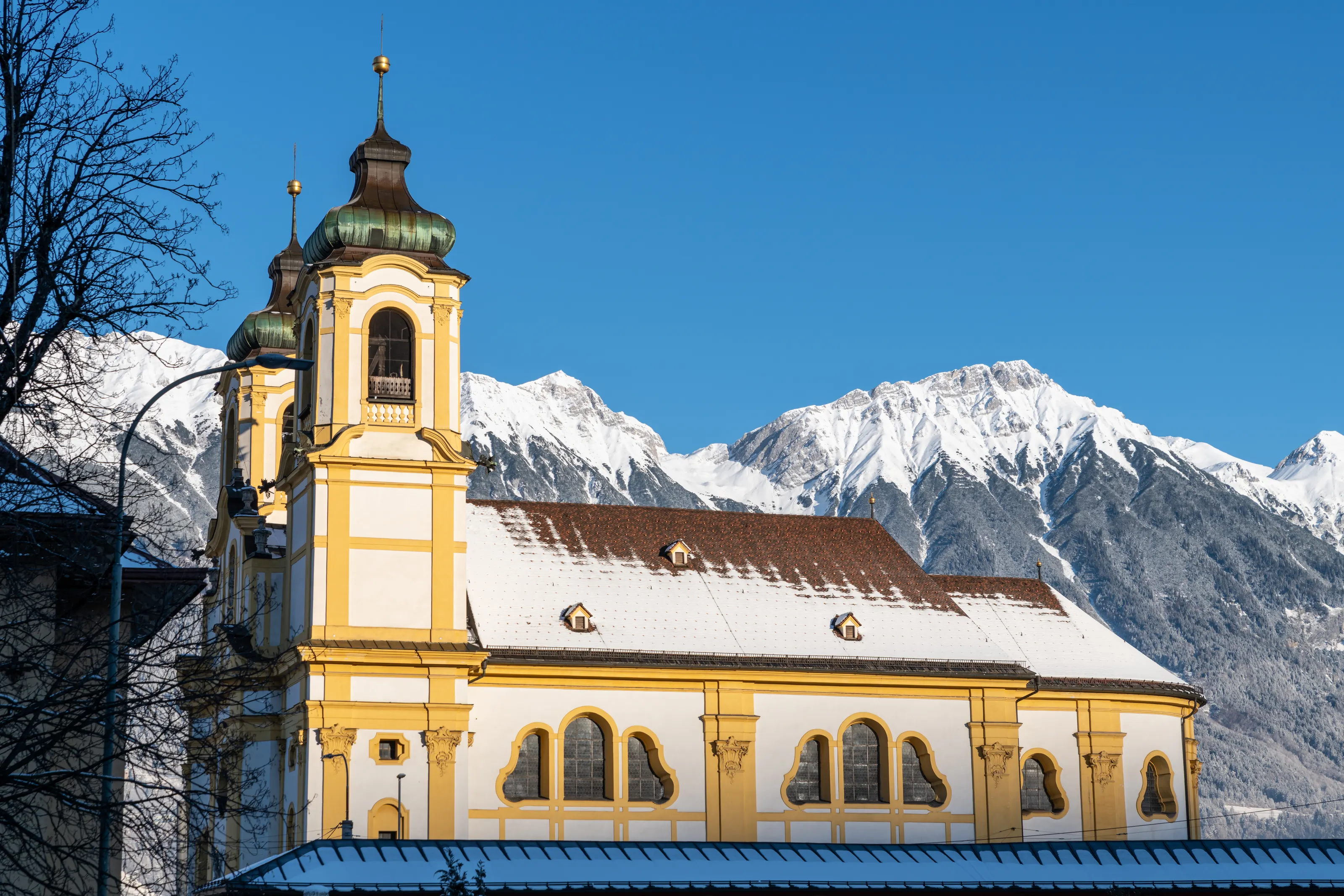
Wilten Basilica
South of the centre, the yellow and white Wilten Basilica is an example of Tyrolean baroque. Its two onion-domed towers stand out against the snow-covered peaks in winter. It is in the Wilten district, near the Bergisel ski jump.
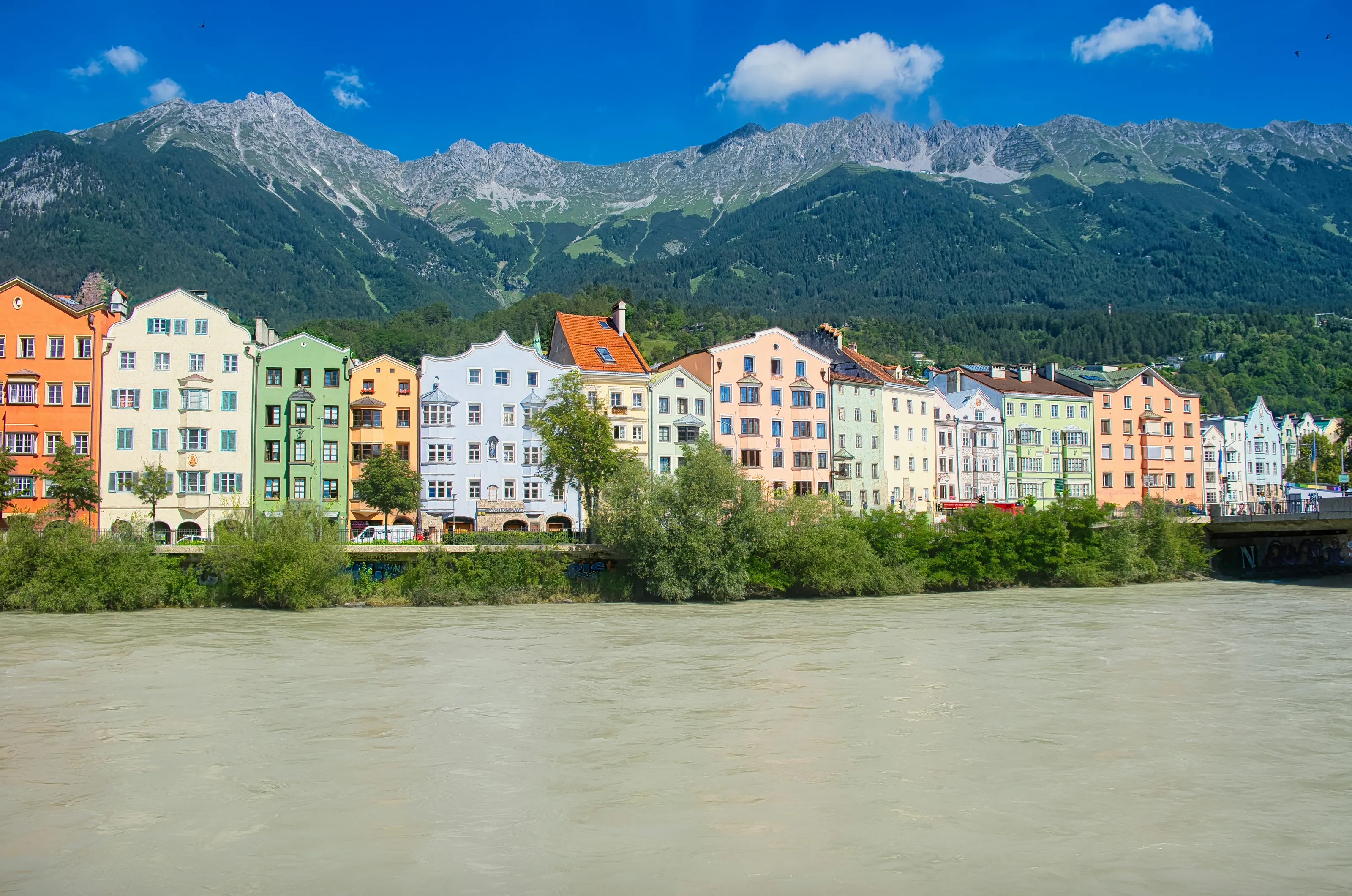
The Mariahilf embankment
In summer, the colourful facades on the opposite bank reflect in the silt-laden river, under the wooded slopes of the Nordkette. This district, facing the old town, is a good place for a walk.
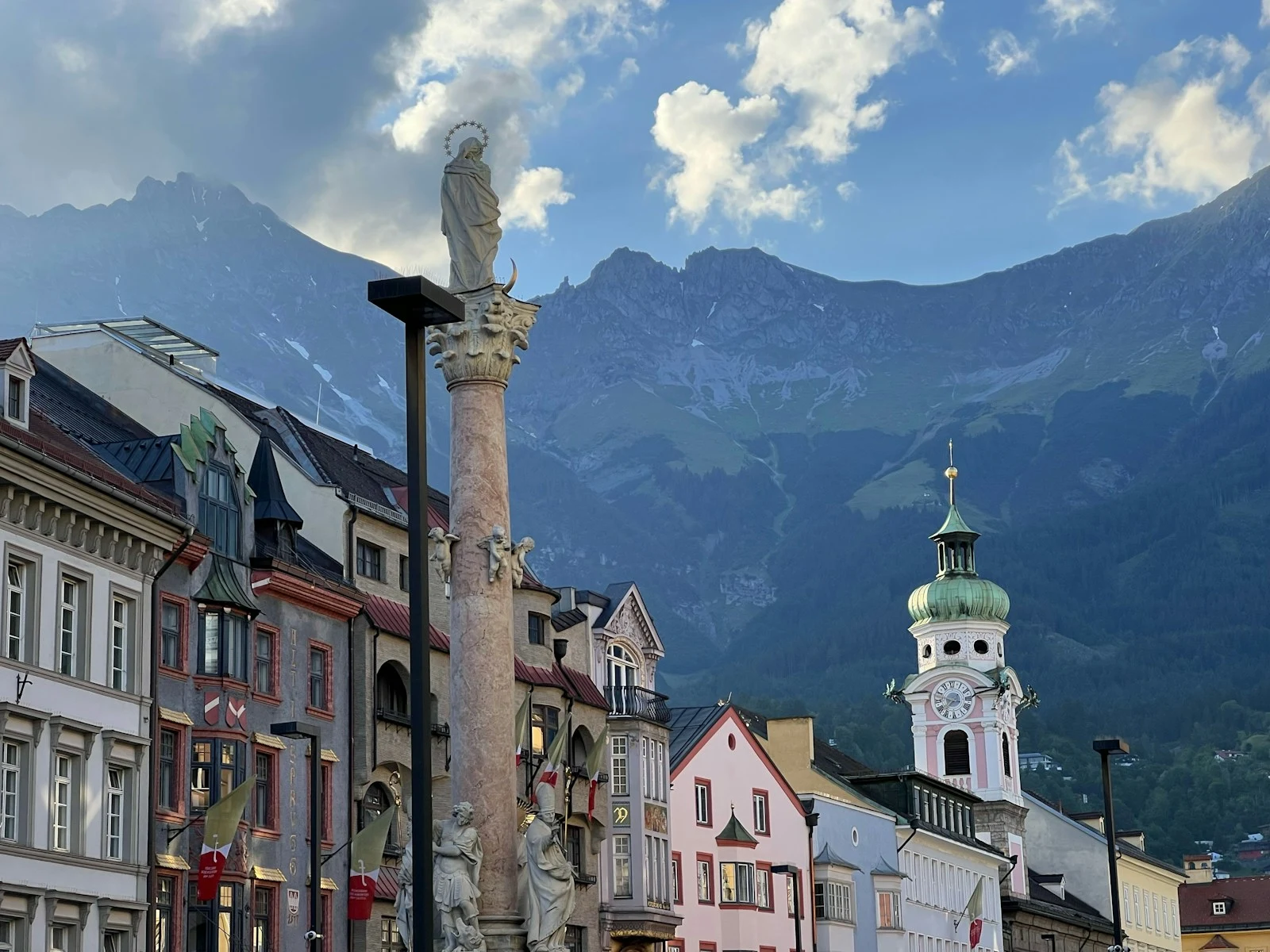
Maria-Theresien-Strasse
The main street of the centre, lined with old facades, is dominated by St Anne's Column and opens onto the mountains in the background. It is the shopping heart and the starting point for most visits.
Mountains and sights, text only
The Nordkettenbahn takes you up from the city to the Nordkette: a funicular leaves near the Congress for the Hungerburg, then cable cars go up to the Hafelekar (the Hafelekar station is at 2,269 m, the summit at 2,334 m). The Bergisel ski jump, used at the 1964 and 1976 Olympics, overlooks the city; a panorama exhibition is on site. Ambras Castle, to the east, is a Renaissance residence. We give no prices; check opening times and the weather before going up to altitude.
Museums and culture
Habsburgs, Tyrolean art and winter sports
Hofkirche and Hofburg
The Court Church (Hofkirche) houses the cenotaph of Emperor Maximilian I, surrounded by large bronze statues. The Hofburg, the former imperial residence, shows its state apartments. These places tell the story of Innsbruck as a Habsburg residence.
Museums
The Tiroler Landesmuseum Ferdinandeum presents the art and history of Tyrol. Ambras Castle holds Renaissance collections, including a cabinet of curiosities, according to the local tourist office. A panorama and a ski museum are on the Bergisel site. The Tyrolean Folk Art Museum (Volkskunstmuseum) is close to the Hofkirche. We give no prices.
Cards and passes
A visitor card (the Innsbruck Card) bundles, depending on the offer, entry to the main sights, public transport and one ride on the mountain lifts. Compare it with your plans before buying; ski passes are sold separately.
Food and drink
Tyrolean cooking: Gröstl, dumplings and Kaiserschmarrn
The dishes
Tiroler Gröstl is a dish of pan-fried potatoes with meat and an egg, often served in mountain inns. Knödel (bread or potato dumplings, sometimes with spinach or cheese) accompany soups and mains. Kaiserschmarrn, a shredded caramelised pancake served with fruit compote, is the star dessert.
Where to eat
The old town has many restaurants, more touristy; the traditional Stuben (parlours) and mountain inns are more characterful. In town and on the slopes, cafés serve cakes and hot chocolate. Book in the evening in peak ski season.
Drinks
Regional beers and Austrian wines are served everywhere. In winter, Christmas markets and mulled wine liven up the old town squares in December.
Getting around
On foot, by tram, bus and funicular
In town
The centre can be covered on foot. The public network (IVB) has six tram lines and many buses; tickets are valid across the Tyrolean network (VVT). A sightseeing bus line (TS) links outlying sights (Ambras, Bergisel, Alpenzoo) with the centre, using a special ticket.
Trams and funicular
Tram no. 6 goes up to the village of Igls; the STB line, 18 km long, serves the villages of the Stubai valley and the Bergisel stop. The Hungerburgbahn (funicular) starts near the Congress.
Skiing and cycling
Ski shuttles link the city with nearby ski areas in winter. A bike-share system (Stadtrad) exists, with compulsory registration. From the centre, the station is well connected to Munich, Salzburg and Verona via the Brenner Pass.
Budget and precautions
A medium to high budget, especially in ski season
Price level
Innsbruck is a medium to high budget destination compared with the rest of Europe, notably in the peak ski season (roughly December to March), during school holidays and at Christmas. Accommodation in town is more expensive than on the well-connected outskirts. We give no figures (ski passes included) because we could not confirm them from two independent sources.
Flights
The flight remains the most variable cost. SniperAir monitors prices to INN and compares them with the route's history, but it does not sell or book tickets. Munich and Salzburg are other gateways worth watching.
Entry rules and precautions
Austria is part of the Schengen area: entry requirements depend on your nationality, so check them on official sites. Also consult the official recommendations of your country of departure. In the mountains the weather changes fast: check conditions and avalanche risk before off-piste skiing or a hike, and use suitable equipment.
When to go
Cold, snowy winters and mild summers
Winter (December to February)
Cold, with snow in the mountains and often in town too. It is peak season for skiing and Christmas markets; days are short.
Spring (March to May)
Lifts stay open for a while in March, then the snow melts; mid-altitude trails only open after the thaw.
Summer (June to August)
Mild, with possible thunderstorms; the season for hiking, cycling and walks at altitude. Days are long.
Autumn (September to November)
Colours on the slopes and clear light; some lifts close in the off-season, so check timetables.
Innsbruck has an alpine climate: cold winters, mild summers, with precipitation in every season. We give no precise temperatures because we could not cross-check them; consult forecasts before you travel. For skiing, aim for roughly December to March, depending on the year's snow; for hiking, June to September.
By length of stay
What to do in Innsbruck depending on how long you stay
The essentials
The old town, the Golden Roof, Maria-Theresien-Strasse, the Inn embankments and a funicular ride for the view.
Mountains and museums
Bergisel, Ambras Castle, a Tyrolean museum and a day of skiing or hiking.
Further into Tyrol
Nearby ski areas, the Stubai valley and excursions to Salzburg, Munich or Italy over the Brenner Pass.
In pictures
Innsbruck in pictures
You might also like
Similar destinations
FAQ
Frequently asked questions about flights to Innsbruck
How do I get from Innsbruck airport to the centre?
The airport (INN) is about 4 km to the west. Bus line F reaches the main station and the centre in roughly twenty minutes, every fifteen minutes during the day; a taxi is quicker.
When is the best time to visit Innsbruck?
December to March for skiing and Christmas markets, June to September for hiking and walks. The shoulder seasons are quieter but some lifts close.
Is Innsbruck expensive?
The budget is medium to high by European standards, especially in peak ski season. Well-connected accommodation on the outskirts costs less than in the old town.
How long should I stay in Innsbruck?
Two days for the city and a view from altitude; four or five days if you ski or hike.
How do I get around Innsbruck?
On foot in the centre, by tram and bus (IVB network), by funicular and cable car for the mountains. In winter, shuttles serve the ski areas.
What should I eat in Innsbruck?
Tiroler Gröstl, dumplings, Kaiserschmarrn for dessert, and mulled wine and Christmas markets in December.
How much does a flight to Innsbruck usually cost?
The price depends mainly on your departure city, the time of year and how far ahead you book. The "opportunities" section above shows real examples of prices SniperAir has already detected to this destination.
How do I get alerted when a flight to Innsbruck drops below my budget?
Create an alert profile with your departure airport, Innsbruck as the destination and your maximum budget. You are notified automatically as soon as a matching price is detected.
Ready to head to Innsbruck?
Set your budget and let SniperAir monitor fares for you.
Create my alert