
Cheap flights to Antwerp
Set your departure airport and maximum budget: SniperAir tracks prices to Antwerp and alerts you the moment a deal matching your criteria appears.
Quick summary
Country
Belgium
Continent
Europe
Airport
BRU
Currency
Euro
Time zone
UTC+1
Deals already spotted to Antwerp
Real flight examples detected by SniperAir, with their reference price.
Loading examples…
Why track Antwerp with SniperAir
Let SniperAir watch the fares for Antwerp
Pick your departure
Tell us your departure airport and maximum budget for a flight to Antwerp, or to Brussels, the usual gateway.
SniperAir watches
Our systems continuously compare new prices against the route's real price history.
You get an alert
The moment a price matches your criteria, you're notified, with no searching on your end.
Airports
Brussels Airport and the train, or Antwerp's small airport
Brussels Airport
The gateway for most visitors, about 40 km from Antwerp. A direct train links the airport to Antwerpen-Centraal station, and a direct coach also runs.
Antwerp Airport
A small airport on the southern edge of the city, roughly 3 to 5 km from the centre, used mainly for regional, seasonal and business flights. Few routes, so check what flies before choosing it.
Rough figures; lines, timetables and journey times change, so check before you travel.
| Journey | Approximate time | Good to know |
|---|---|---|
| BRU to Antwerpen-Centraal by train | about 25 to 45 min | Direct train, quicker on weekdays; at weekends and on public holidays it can take longer |
| BRU to Antwerp by direct coach | about 45 min to 1 h (to be checked) | Depends on traffic; stops in the centre |
| ANR to the centre | about 15 to 30 min by bus, tram or taxi | A change at Antwerpen-Berchem may be needed; check the line |
| Amsterdam Schiphol to Antwerp | about 1 h 15 by EuroCity Direct | An alternative if flights via the Netherlands are cheaper; check the service before booking |
The city
A big Flemish port between golden age and avant-garde
Antwerp (Antwerpen in Dutch, Anvers in French) is Belgium's second-largest city, in Flanders on the Scheldt, about 40 km north of Brussels and roughly 15 km from the Dutch border. Its port is the second largest in Europe after Rotterdam. Less preserved than Bruges but more cosmopolitan than many Flemish towns, it lives on two registers: a historic core inherited from the 16th-century golden age, and a city of fashion, design and diamonds.
A station worth the trip
Antwerpen-Centraal, built between 1895 and 1905 to designs by Louis Delacenserie, is often called the "railway cathedral". Damage from a V-2 rocket in the Second World War is still visible in the roof, and a tunnel opened in 2007 turned the terminus into a through station. It is also a handy starting point, with the diamond district next door and the shopping streets leading on foot to the cathedral.
Old town
The cathedral, the Grote Markt and the Brabo legend
The heart of the old town
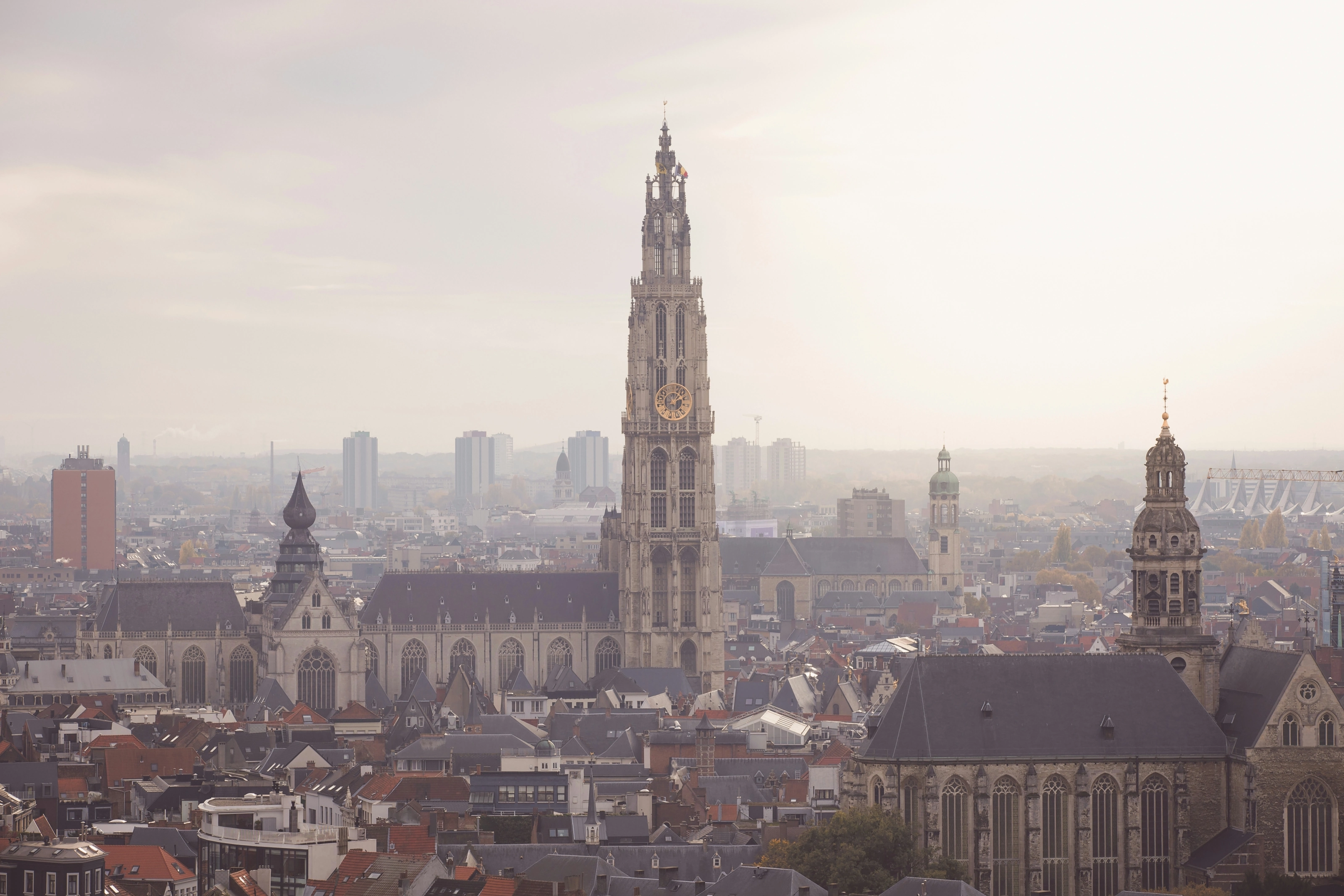
Begun in 1352 and largely finished in 1521, the Cathedral of Our Lady is Belgium's largest Gothic church, with a 123 m tower. It holds several major works by Rubens, and its belfry is UNESCO-listed as part of the Belfries of Belgium and France. A few steps away, the Grote Markt is lined with guild houses and the Renaissance City Hall.
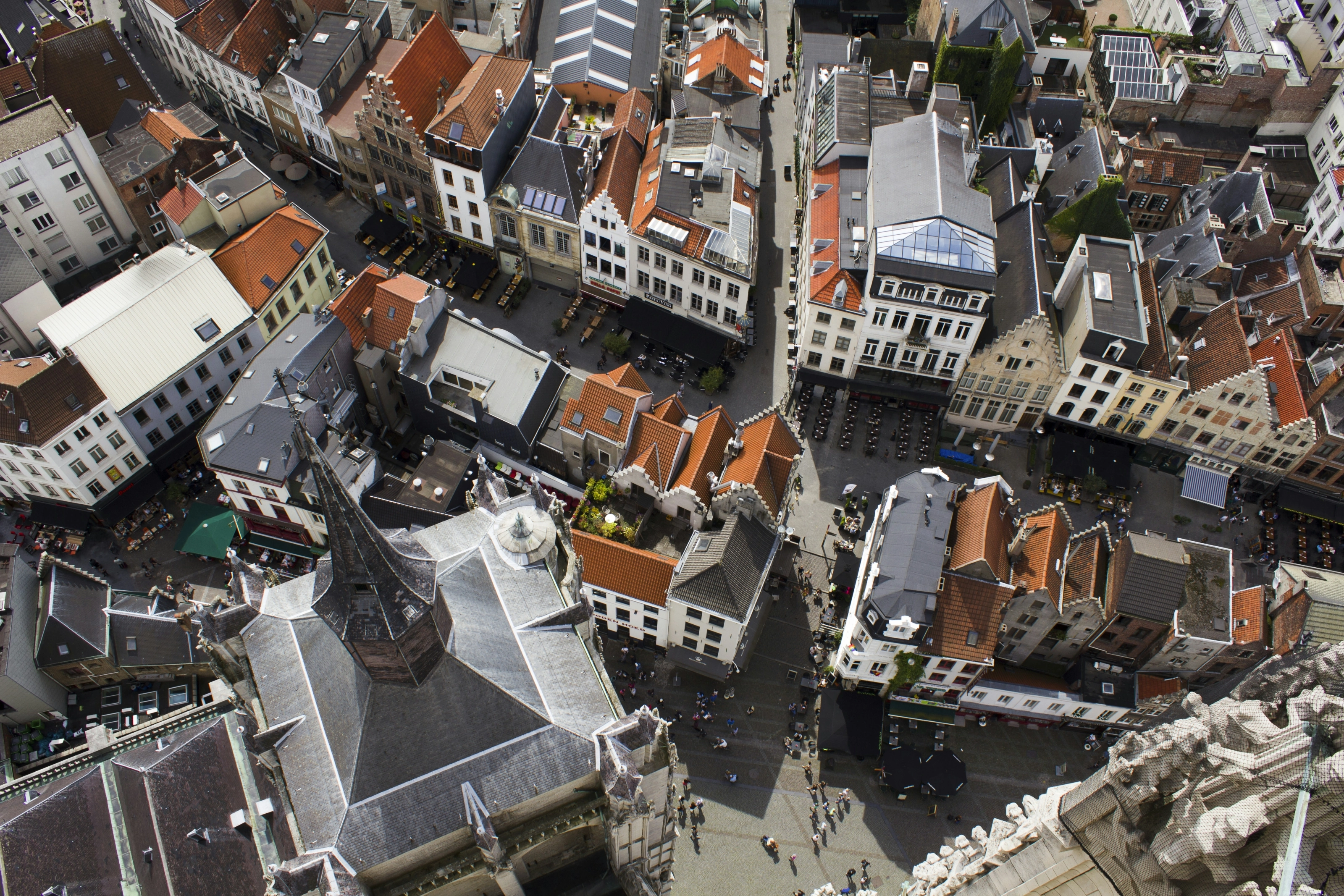
The Brabo fountain
In the middle of the Grote Markt, the fountain tells the founding legend: Silvius Brabo defeated the giant Druon Antigoon, who cut off the hands of boatmen refusing to pay his toll, and threw the giant's hand into the river. Folk etymology links the city's name to "hand werpen", throwing the hand; the explanation usually given by scholars is "aan de werpe", a spit of land on the river.
Alleys and a fortress
The hidden Vlaeykensgang alley near the cathedral and the Steen, a medieval fortress on the riverbank, round off a walk.
Golden age
Rubens, Plantin and the Renaissance presses
In the 16th century Antwerp was one of Europe's leading financial and trading centres, with the first purpose-built commodity exchange, and its population doubled between 1500 and 1569. The golden age ended with the Spanish Fury of 1576, when Spanish soldiers sacked the city, and the fall of Antwerp after a siege in 1585.
Rubens
The Baroque painter lived and worked in Antwerp. His house and studio can be visited, and the cathedral holds major canvases, including The Raising of the Cross and The Descent from the Cross.
Plantin-Moretus
Christophe Plantin settled in Antwerp around 1550 and founded one of the leading printing houses of his day. His workshop, now a museum, has been UNESCO-listed since 2005 and keeps some of the oldest surviving printing presses.
Diamonds
The diamond district, next to the station
Diamond trading began in Antwerp in the 15th century, and the scaif polishing wheel of Lodewyk van Berken is attributed to the city. The diamond district beside Centraal station has four diamond bourses, about 1,500 companies and 380 workshops, and a large share of the world's rough diamonds passes through it. Walk it on a weekday, as business stops on Saturdays. The DIVA museum tells the story with jewellery and silverwork.
Museums
From Flemish masters to the modern port
| Museum or site | What you will see |
|---|---|
| Rubens House | The painter's house and studio, with period furniture and a garden |
| Plantin-Moretus | The Renaissance printing house, its presses and manuscripts; UNESCO World Heritage |
| KMSKA | The Royal Museum of Fine Arts and its Flemish art collection |
| MAS (Museum aan de Stroom) | The history of the city and port, with a free panoramic rooftop |
| DIVA | Diamonds, jewellery and silverwork |
| Het Steen | A medieval fortress on the Scheldt at the foot of the old town |
Opening hours, closing days and prices change, so check before you go. An Antwerp City Card exists; compare what it covers with your plans before buying.
Districts
Diamonds, Art Nouveau and docks
Diamond district
Around the station: bourses, jewellers and polishing workshops.
Zurenborg
A residential area known for its Art Nouveau houses, street after street.
Eilandje
The old docks, now a district of museums, restaurants and offices, home to the MAS.
Sint-Andries
Cafes, boutiques and vintage shops, close to the fashion district.
Fashion and food
Designers, fries, brown cafes and chocolate
The city of the Antwerp Six
Trained at Antwerp's fashion academy, the "Antwerp Six" put the city on the fashion map in the 1980s. The Meir is the main shopping street, Hopland gathers the luxury brands, and designer boutiques cluster around the Nationalestraat.
Eating and drinking
From fritkot stands to fine dining, the choice is wide: Belgian fries with sauces, hand-shaped Antwerpse handjes biscuits, chocolate and waffles, and De Koninck beer served as a "bolleke" in the traditional brown cafes.
Evenings
Cocktail bars, electronic music clubs and brown cafes share the nightlife. De Muze, a jazz cafe, hosts live concerts.
Around Antwerp
Brussels, Ghent, Bruges and Amsterdam by train
| Destination | From Antwerp |
|---|---|
| Brussels | about 30 to 45 min by train |
| Ghent | about 1 h by train (to be checked, depends on the connection) |
| Bruges | about 1 h to 1 h 20 by train (to be checked) |
| Amsterdam | about 1 h 15 by EuroCity Direct |
Times are rough orders of magnitude from available information; check the NMBS/SNCB timetable before you go.
Budget
What does Antwerp cost?
Antwerp is mid-range for prices, typical of a Western European city: accommodation and eating out weigh the most, especially in high season and during big events. You can lighten the bill with fritkot snacks, markets, the MAS rooftop, which is free, and walking in a compact centre.
We do not publish a price grid, which goes out of date quickly: the plane ticket is often the easiest cost to optimise, and that is where SniperAir's monitoring helps.
Getting around
On foot, by tram, by bike and through the Sint-Anna tunnel
The centre is compact and easy to walk. De Lijn runs the trams (partly underground) and buses, and shared bikes are available. The Sint-Anna pedestrian tunnel runs under the Scheldt to the left bank. Taxis are fairly pricey and wait at set ranks. For other cities, the train from Antwerpen-Centraal is the simplest option. Lines and fares change, so check before you travel.
By length of stay
What to do in Antwerp depending on how long you stay
The essentials
The station, the cathedral, the Grote Markt and Rubens House.
A full weekend
Add Plantin-Moretus, the MAS and the docks, the diamond district and some shopping.
Beyond Antwerp
A day in Brussels, Ghent or Bruges, or time for Zurenborg and the left bank.
When to go
When is the best time to visit Antwerp?
Spring
April and May bring back terraces and longer days, with changeable weather.
Summer
The best season for walking: highs average around 23 degrees C, with hotter spells during heatwaves.
Autumn
September is still mild, then days shorten and the rain sets in.
Winter
Cool winters and short days, with daylight roughly from 8:45 to 16:45 in midwinter. A good time for museums and cafes.
The climate is mild and oceanic, with light, frequent rain all year: a waterproof jacket is useful in every season.
In pictures
Antwerp in pictures
You might also like
Similar destinations
FAQ
Frequently asked questions about flights to Antwerp
How far is Brussels Airport from Antwerp?
About 40 km. A direct train reaches Antwerpen-Centraal in roughly 25 to 45 minutes depending on the day, and a direct coach also runs. Antwerp's own airport is a few kilometres from the centre but has few routes.
What should I see first in Antwerp?
The Cathedral of Our Lady and its Rubens paintings, the Grote Markt, Rubens House, the Plantin-Moretus Museum, the diamond district with the DIVA museum, and the MAS rooftop for views over the port.
How many days do you need in Antwerp?
Two to three days cover the centre, the main museums and the docks. Antwerp combines easily with Brussels, Ghent or Bruges.
When is the best time to visit Antwerp?
From May to September for mild weather and long days; the climate is oceanic, with rain possible all year. Winter suits museums and cafes.
Is Antwerp expensive?
Prices are mid-range, typical of Western Europe: accommodation and eating out weigh the most. The MAS rooftop is free and the centre is walkable.
How do you get around Antwerp?
On foot in the centre, by tram and bus with De Lijn, by bike, and by train from Antwerpen-Centraal for other cities. Check lines and fares before you travel.
What should I eat in Antwerp?
Belgian fries, Antwerpse handjes biscuits, chocolate and waffles, and De Koninck beer in a brown cafe. The city also has a contemporary dining scene.
How much does a flight to Antwerp usually cost?
It mostly depends on your departure city, the season and how far ahead you book. The "deals" section above shows real examples of prices already detected by SniperAir for this destination.
How do I get alerted when a flight to Antwerp drops below my budget?
Create an alert profile with your departure airport, Antwerp as the destination and your maximum budget. You'll be notified automatically the moment a matching price is detected.
Ready to head to Antwerp?
Set your budget and let SniperAir monitor fares for you.
Create my alert