
Cheap flights to Split
Set your departure airport and maximum budget: SniperAir tracks prices to Split and alerts you the moment a deal matching your criteria appears.
Quick summary
Country
Croatia
Continent
Europe
Airport
SPU
Currency
Euro (EUR)
Time zone
UTC+1 (UTC+2 during summer time)
Deals already spotted to Split
Real flight examples detected by SniperAir, with their reference price.
Loading examples…
Why track Split with SniperAir
You don't need to compare prices every day
Choose your departure
Enter your departure airport and your maximum budget for a flight to Split (SPU).
SniperAir keeps watch
Our systems continuously compare new prices with the real price history of the route. SniperAir monitors prices and alerts you: it does not sell or book tickets.
You receive an alert
As soon as a price matches your criteria, you are notified, without having searched for anything yourself.
Airport and getting into town
An airport about 25 km away, linked by bus and taxi
Split (SPU)
Split airport lies between Kaštela and Trogir, about 25 km west of the centre. A shuttle bus links the airport with the intercity bus station near the old town in about 30 minutes; city bus line 37 reaches Split in about 50 minutes with stops, and a taxi takes about 30 minutes, according to Wikivoyage. The airport handles mostly low-cost and charter flights, highly seasonal. There is no train to the airport.
Distances and times are approximate, based on Wikipedia (FR, EN), Wikivoyage (FR, EN) and the official tourist board; bus timetables change: check them before you travel. We give no fares.
Split is Croatia's second-largest city, with about 180,000 residents, on the Adriatic coast in central Dalmatia. Its historic centre, a UNESCO site since 1979, grew inside and around the palace built around the year 300 for the Roman emperor Diocletian. More than a million visitors come each year, according to Wikipedia.
The palace is not a frozen museum: it is the city centre, with its lanes, shops, cafes and homes, where you pass under ancient gates to reach the waterfront.
Diocletian's Palace and old town
A city born in a Roman palace, still lived in
Central Split can be covered on foot in a few hours. Four places are illustrated here; the beach, the fortress and the national park appear below, under excursions.
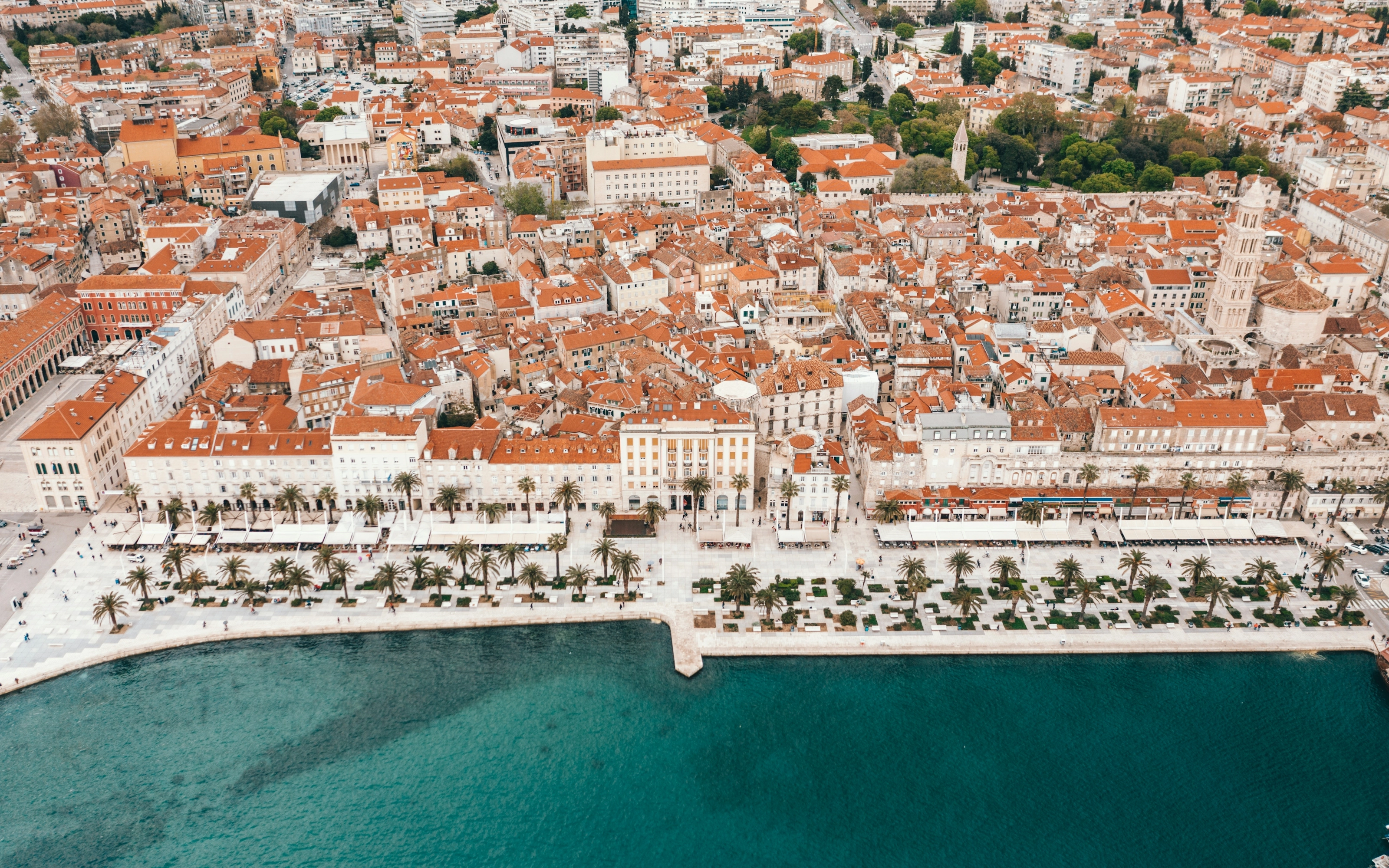
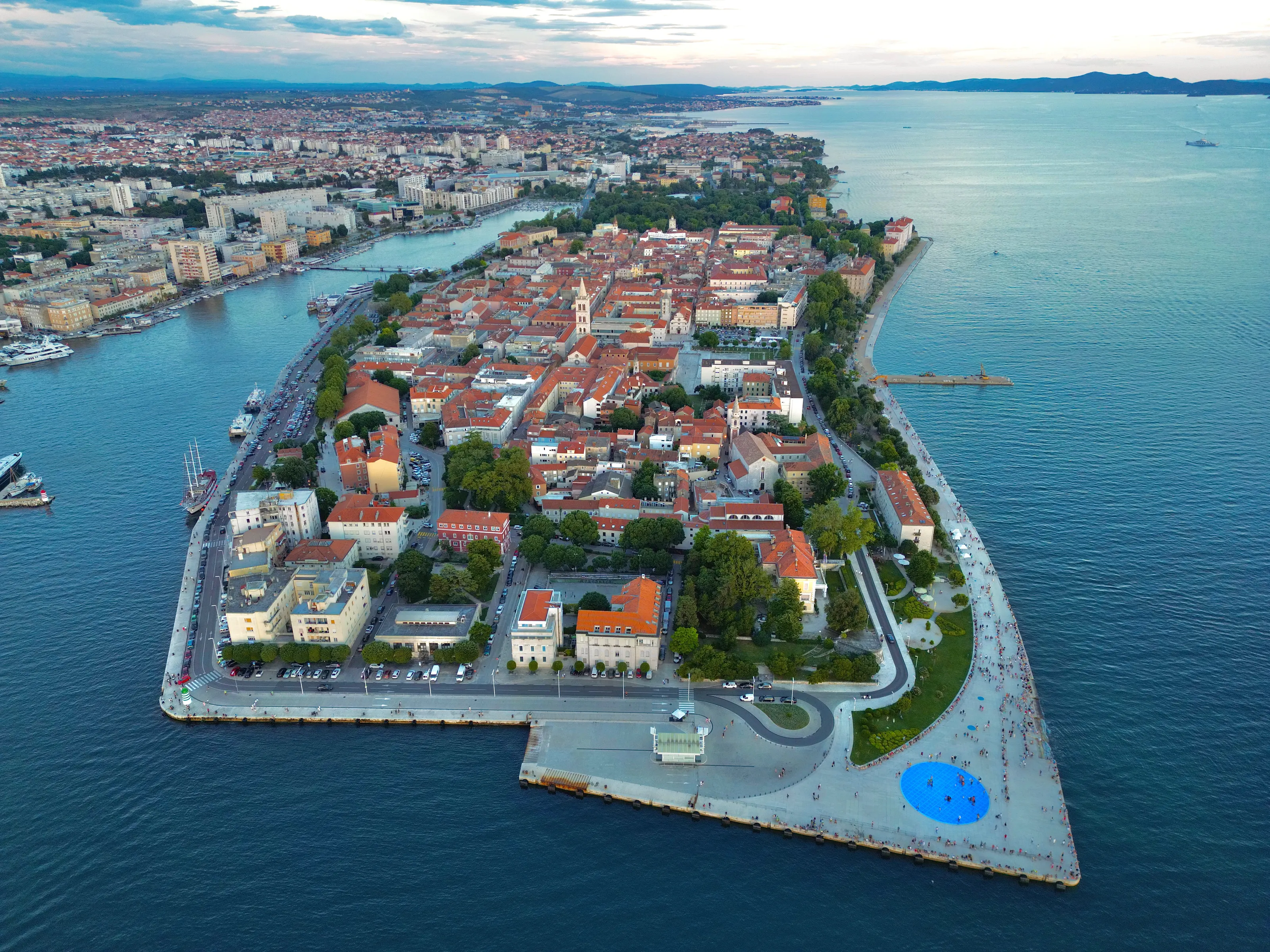
The old town and the Riva from above
Seen from the sky, the old town is a patchwork of tight orange roofs between the sea and the modern city. The palace, still ringed by its walls on the sea side, opens onto the Riva, the grand waterfront promenade. The cathedral's bell tower rises above the roofs on the right.
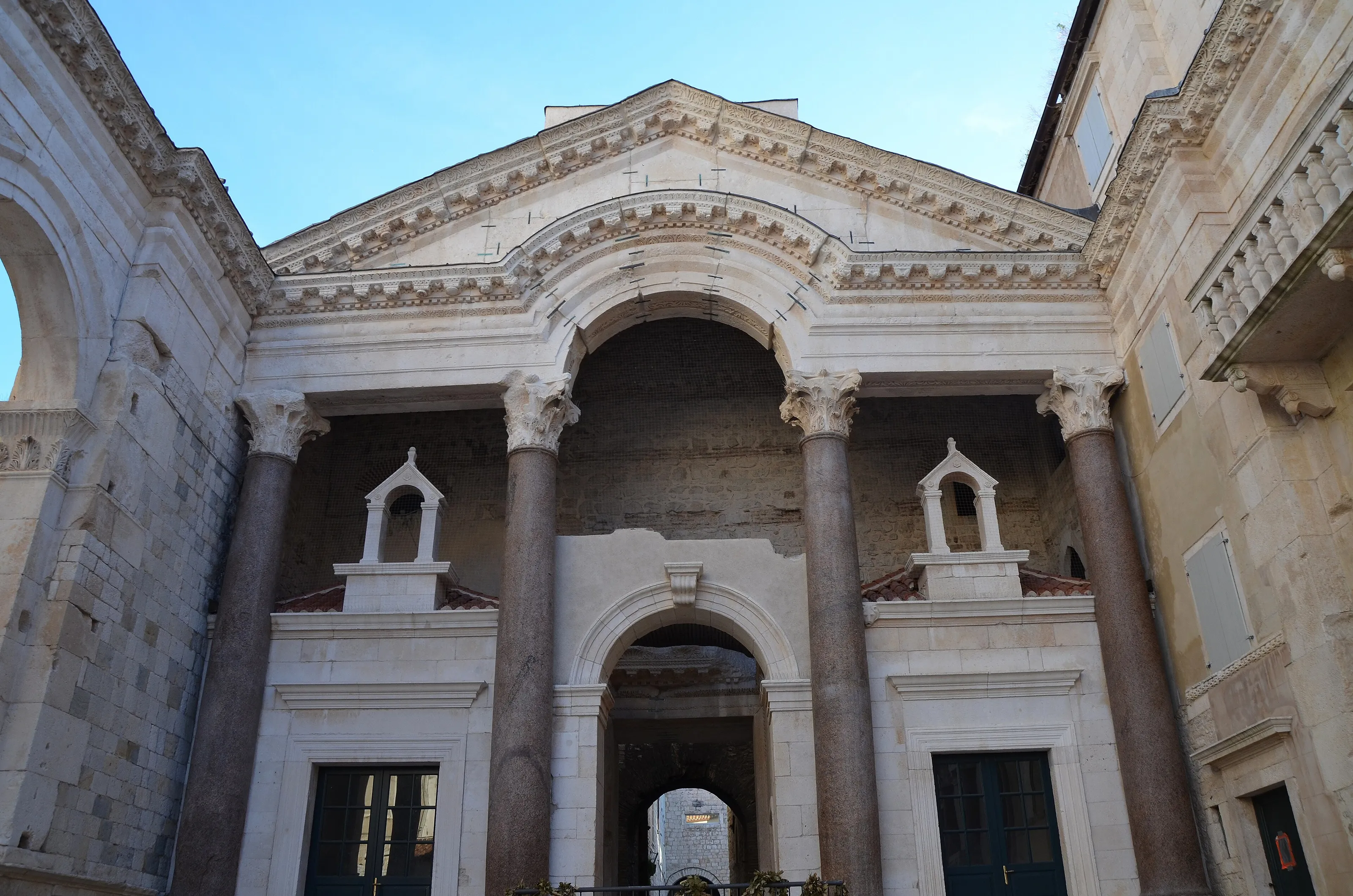
The Peristyle
At the heart of the palace, the Peristyle is the main square: a portico of granite columns and capitals that once led to the imperial apartments. Cafe terraces now spread across it. The Egyptian sphinxes and the Temple of Jupiter (now a baptistery) are close by.
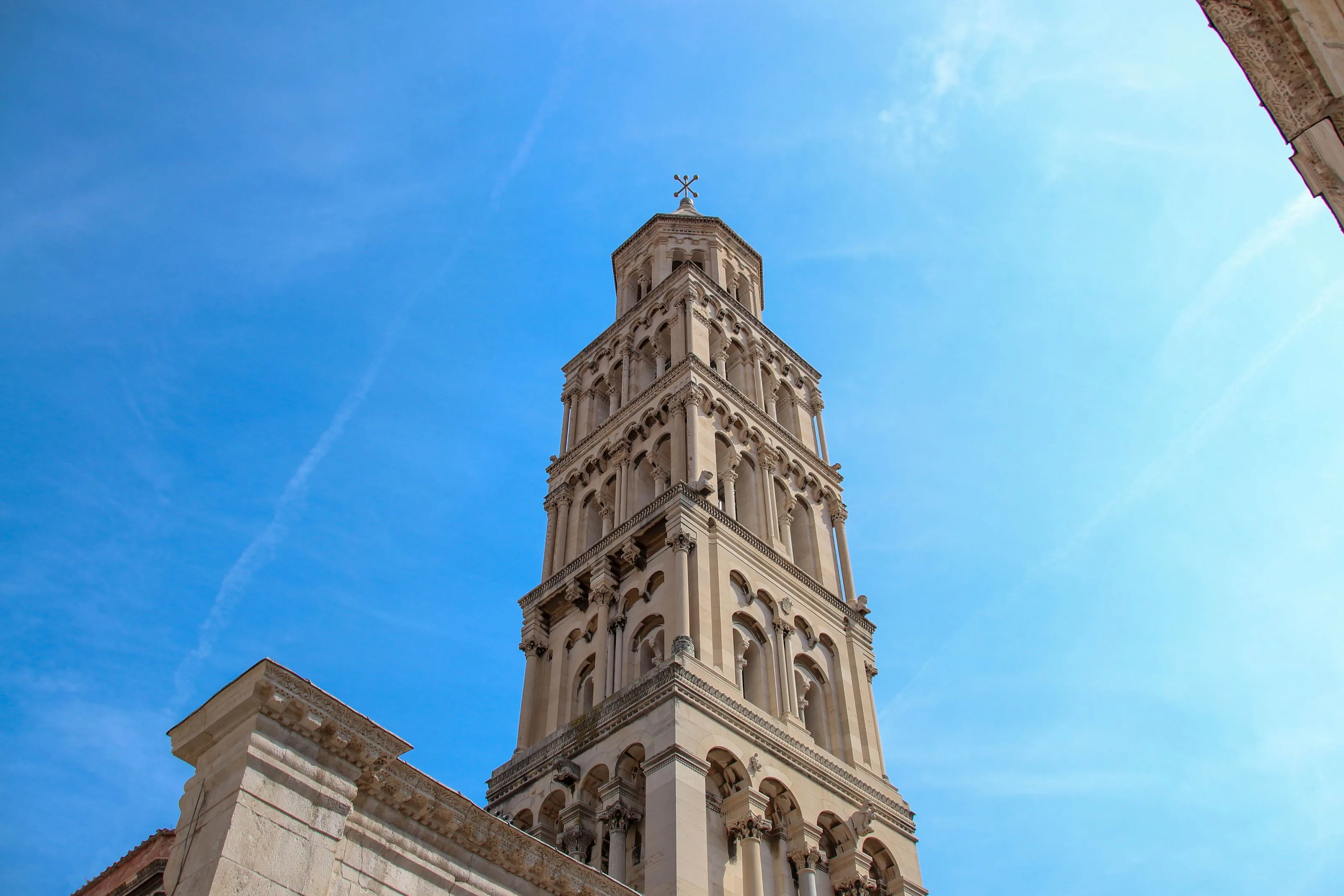
St Domnius cathedral and its bell tower
The cathedral occupies Diocletian's former mausoleum and is often presented as one of the oldest cathedrals still in use. Its Romanesque bell tower can be climbed for views of the city, the islands and Marjan hill; the climb is not advised if you suffer from vertigo.
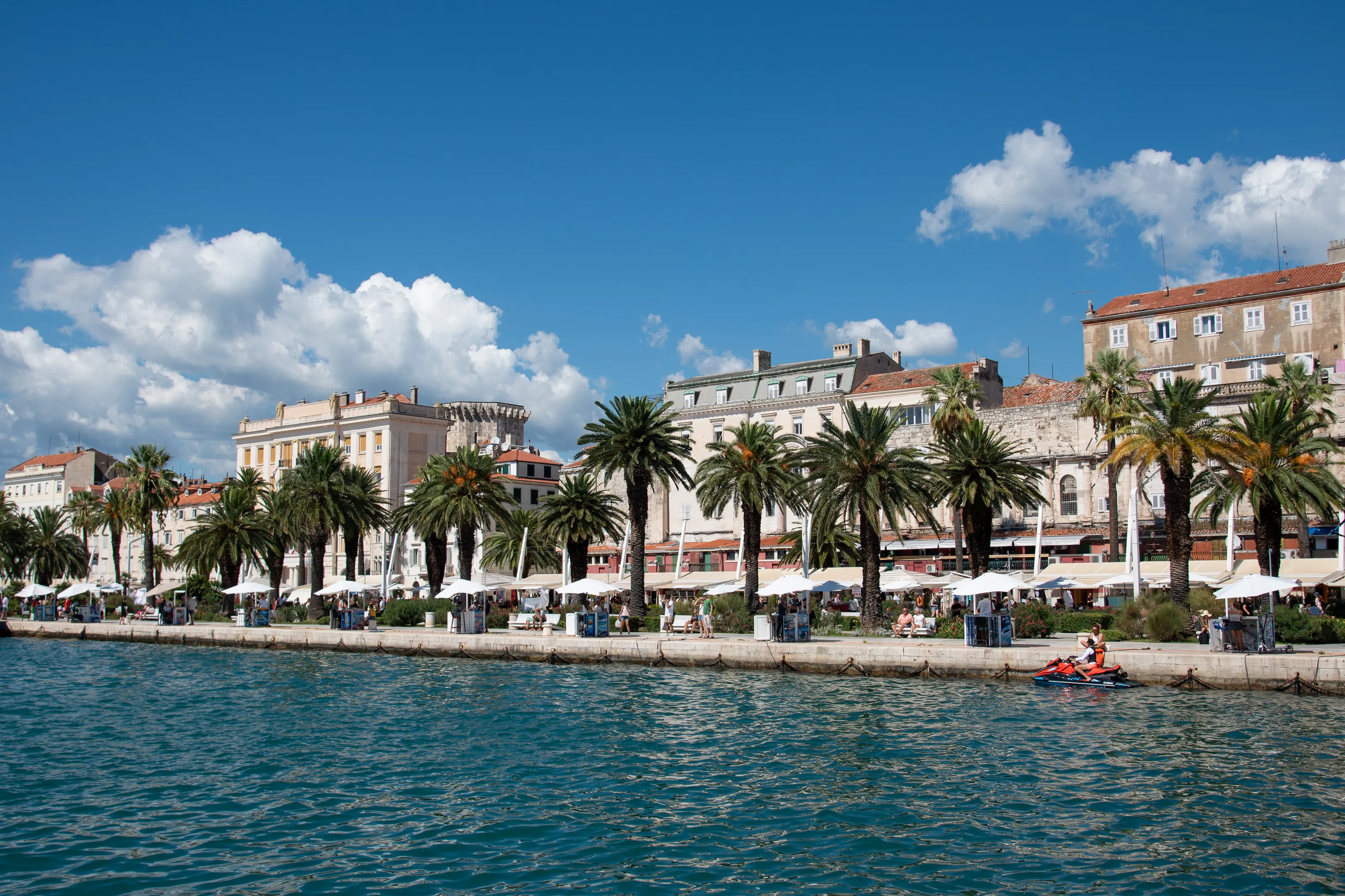
The Riva, Split's waterfront
The Riva is Split's promenade: palm trees, cafe terraces in the shade of parasols and, opposite, the harbour from which ferries leave for the islands. It was remodelled in 2007. People gather here in the evening for a stroll.
Other sights, in text
The well-preserved palace cellars can be visited; it is better to go with a guide, as the halls are almost empty. The Golden Gate, the Silver Gate and the Iron Gate are the gates of the imperial fortress. Marjan hill, covered in pines to the west, offers trails, viewpoints and beaches; the nearby Varoš quarter keeps fishermen's lanes. In the historic centre it is forbidden to walk around shirtless or in swimwear, on pain of a fine.
Museums and culture
Archaeology, sculpture and Dalmatian history
Archaeological Museum
This is the oldest museum in Croatia (1820), about a twenty-minute walk north of the old town. It shows objects and monuments from the Roman colonies of Salona and Narona. Many panels are in Croatian.
Meštrović Gallery and Museum of Croatian Archaeological Monuments
The Meštrović Gallery, housed in the former villa of the sculptor Ivan Meštrović, presents his works. The Museum of Croatian Archaeological Monuments is also among the city's museums.
Other venues
The art gallery and the natural history museum complete the offer. We give no prices; check opening times before you go. The national theatre and several venues also stage concerts and festivals depending on the season.
Food and drink
Fish, black risotto and pašticada
Dalmatian cooking
Split's table is one of grilled fish and seafood, risotto with prawns or black squid ink (crni rižot), pašticada, a marinated and slow-cooked beef served with gnocchi, and Dalmatian pršut, a dry-cured ham. Pag island cheese and Dalmatian wines are worth trying. In winter you may also find soparnik, a chard pie.
Markets and drinks
The Pazar market offers fruit and vegetables, and the Ribarnica fish market next door sells fresh fish. The local sodas Pipi and Orela are classics; the Riva has many terraces.
Where to eat
Konobas, traditional taverns, serve Dalmatian dishes and the catch of the day in the centre and nearby lanes. Ćevapi, small grilled sausages of Balkan origin, are also common.
Beaches, islands and excursions
Urban sand, a fortress, waterfalls and islands
Around Split there is no shortage of excursions. Three places are illustrated.
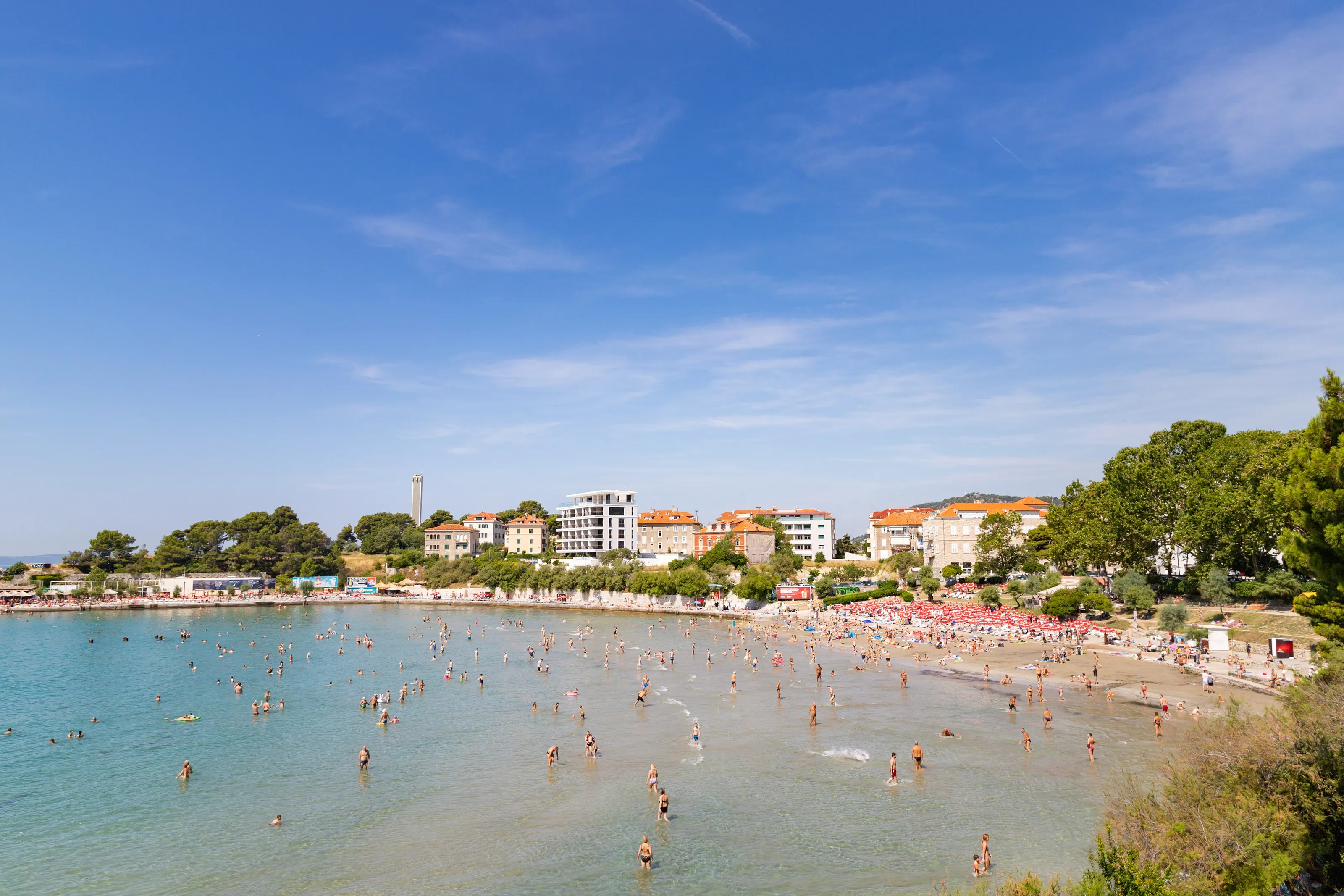
Bačvice beach
A few minutes' walk from the centre, Bačvice is a bay of fine, very shallow sand, the urban beach of Split's residents. It is very busy in summer; people play picigin, a ball game in the water. The quieter beaches of Marjan hill are another option.
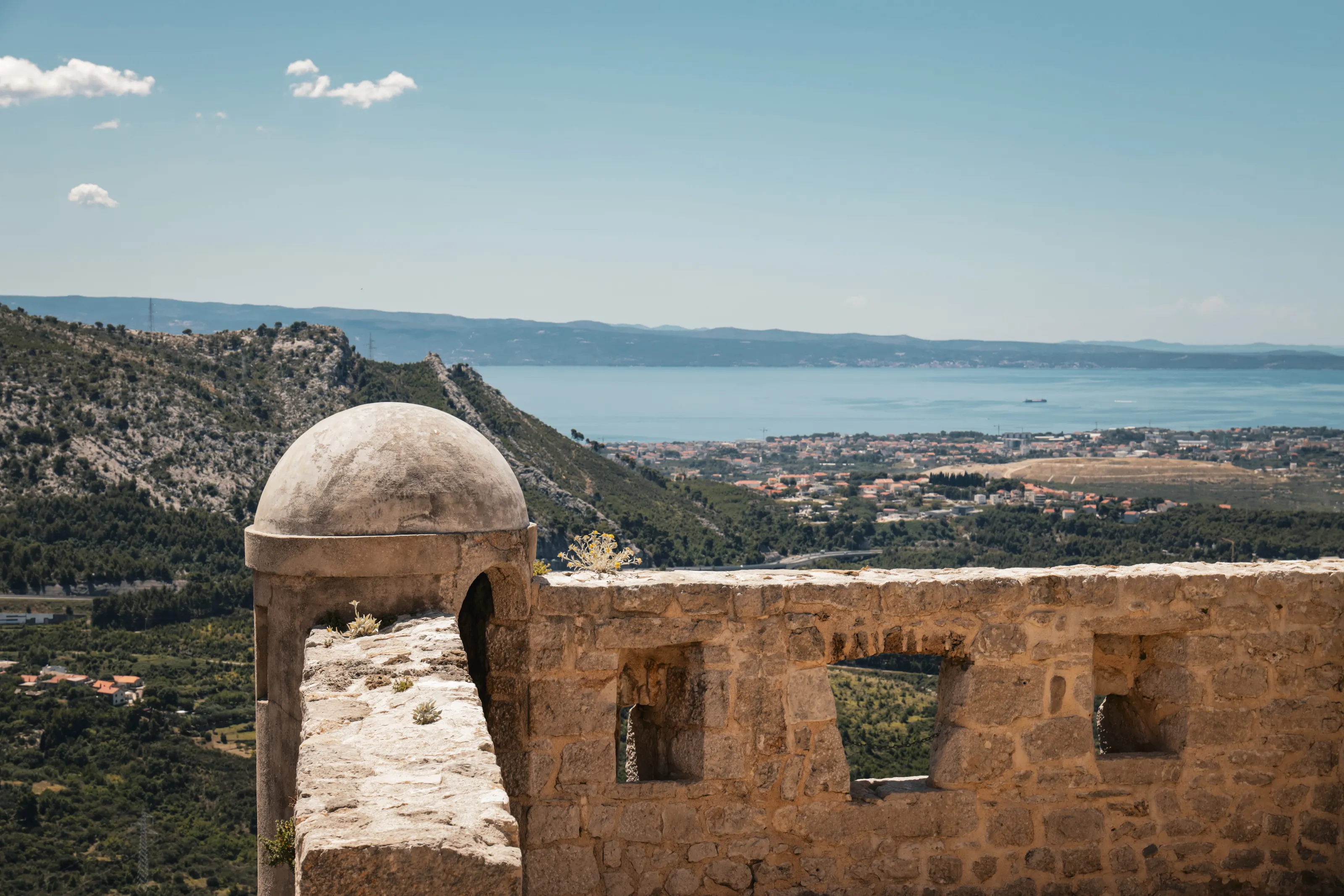
Klis Fortress
About ten kilometres north-east of the city, Klis Fortress overlooks a pass between two massifs, at 360 m altitude, with views of the plain and the sea. It was the seat of Croatian kings and a bastion against the Ottomans. The site has also served as a TV series location: we mention it in passing.
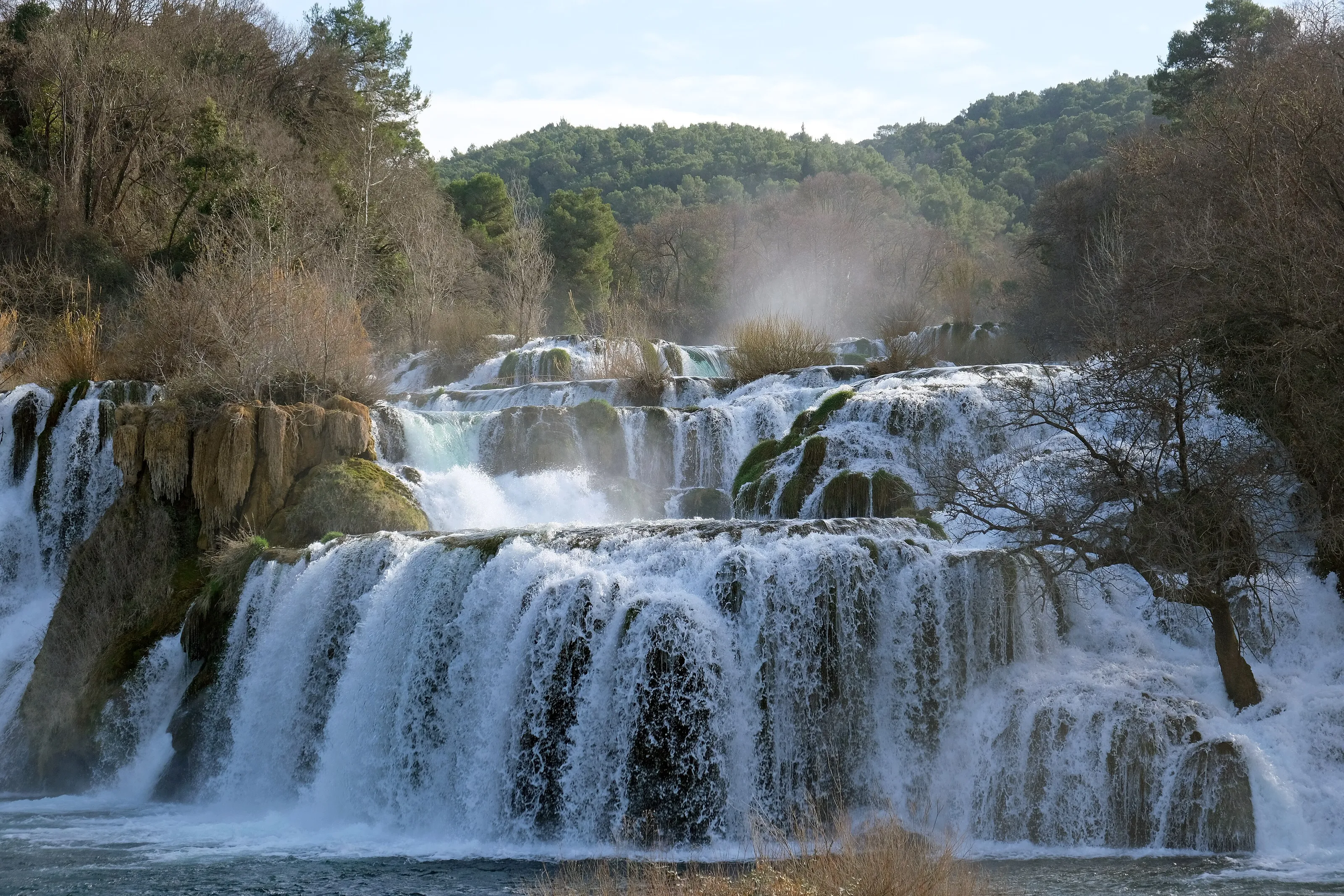
Krka National Park
North of Split, near Šibenik, Krka National Park covers about 109 km² along the river of the same name. The Skradinski buk, with its stepped waterfalls, is its best-known site; the excursion takes a full day, with more than an hour's drive.
Trogir, Salona, Omiš and the islands
Trogir, 27 km west of Split, has been a UNESCO site since 1997 for its Venetian architecture. Salona, former capital of the Roman province of Dalmatia, is 10 to 20 minutes away by bus. Omiš, at the mouth of the Cetina, is known for rafting. The islands of Brač, Hvar, Šolta and Vis can be reached by ferry or fast boat from Split's port. Plitvice is another, longer excursion.
Getting around
Lanes on foot, city buses and ferries to the islands
On foot and by bus
Central Split is compact and best seen on foot. Buses run by the Promet company serve the districts, the airport and the surroundings, with fares by zone; tickets are bought at kiosks, from the driver or by app. The bus station, the railway station and the port stand side by side, close to the old town.
Ferries and boats
Split is central Dalmatia's main port: ferries and fast boats leave for Brač, Hvar, Šolta, Vis, Korčula and Lastovo, several times a day in summer. Ferries also link Italy. Timetables vary strongly by season.
Taxis and bikes
Taxis are available at the airport and near the port, and ride-hailing apps exist. Cycling lets you reach Marjan along the Riva (about 7 km), and you can take a bike on some ferries.
Budget and precautions
A medium to high budget, especially in high season
Price level
Split is a medium to high budget destination in season, depending on the period and the type of accommodation; demand is strong in summer. We give no figures, as we could not cross-check them on two independent sources.
Flights
The flight is the most variable cost. SniperAir monitors prices to SPU and compares them with the route's history, but does not sell or book tickets. Zagreb and Dubrovnik are other gateways to Croatia worth comparing.
Entry requirements and precautions
Croatia is part of the Schengen area: entry requirements depend on your nationality, so check them on official sites. Also consult the official recommendations of your country of departure. In summer the heat and sun are intense: bring water, a hat and sun cream.
When to go
Hot summers, mild winters, a very busy season
Winter (December to February)
Mild and rainy by European standards, with snow on a day or two in some winters; the city is quiet and more affordable.
Spring (March to May)
Terraces reopen, the light is lovely and crowds are moderate; the sea is still cool for swimming.
Summer (June to August)
Hot and dry, with very heavy visitor numbers in July and August: crowded beaches, a lively old town and pricier accommodation.
Autumn (September to November)
The water is still pleasant in September and crowds thin out; November is the wettest month.
Split has a hot-summer Mediterranean climate: hot, fairly dry summers and mild, rainy winters, with about 2,800 hours of sunshine a year according to Wikivoyage. January is the coldest month and July the hottest. We give no precise temperatures, as we could not cross-check them; check the forecast before you leave.
By length of stay
What to do in Split depending on how long you stay
The essentials
Diocletian's Palace, the Peristyle, the cathedral and its bell tower, the Riva and a Dalmatian dinner.
Beaches and museums
Bačvice, Marjan, the Archaeological Museum, the Meštrović Gallery, then half a day in Trogir or Salona.
Islands and nature
Brač, Hvar, Šolta or Vis by ferry, Krka and Klis Fortress as excursions.
In pictures
Split in pictures
You might also like
Similar destinations
FAQ
Frequently asked questions about flights to Split
How do I get from Split airport to the city centre?
The airport (SPU) is about 25 km west. The shuttle to the bus station takes about 30 minutes, city bus 37 about 50 minutes, and a taxi about 30 minutes.
When is the best time to visit Split?
May-June and September for warmth without the crowds; July and August are very busy but ideal for swimming.
Is Split expensive?
The budget is medium to high in high season, especially accommodation. Out of season it is noticeably more affordable.
How long should I stay in Split?
Two days for the palace, the Riva and a museum; four days with the beaches, Trogir and an island; more if you head to Krka or other islands.
How do I get around Split?
On foot in the old town, by Promet bus for the districts and the airport, by ferry or fast boat to the islands.
What should I eat in Split?
Grilled fish, black risotto, pašticada with gnocchi, Dalmatian pršut, Pag cheese and Dalmatian wines.
How much does a flight to Split usually cost?
The price depends mainly on your departure city, the time of year and how far ahead you book. The "opportunities" section above shows real examples of prices SniperAir has already detected to this destination.
How do I get alerted when a flight to Split drops below my budget?
Create an alert profile with your departure airport, Split as the destination and your maximum budget. You are notified automatically as soon as a matching price is detected.
Ready to head to Split?
Set your budget and let SniperAir monitor fares for you.
Create my alert