
Cheap flights to Perpignan
Set your departure airport and maximum budget: SniperAir tracks prices to Perpignan and alerts you the moment a deal matching your criteria appears.
Quick summary
Country
France
Continent
Europe
Airport
PGF
Currency
Euro (EUR)
Time zone
UTC+1 (UTC+2 during daylight saving time)
Deals already spotted to Perpignan
Real flight examples detected by SniperAir, with their reference price.
Loading examples…
Why track Perpignan with SniperAir
France's big Catalan city, between Canigou, the Pyrenees and the Mediterranean
Choose your departure
Enter your departure airport and your maximum budget for a flight to Perpignan (PGF).
SniperAir keeps watch
Our systems continuously compare new prices with the real price history of the route. SniperAir monitors prices and alerts you: it does not sell or book tickets.
You receive an alert
As soon as a price matches your criteria, you are notified, without having searched for anything yourself.
Perpignan is the prefecture of the Pyrénées-Orientales department in southern France, in the heart of the Roussillon plain. English Wikipedia gives it 119,656 inhabitants in 2021 for the commune and 205,183 for the agglomeration; Wikivoyage (EN) says about 120,000. It calls Perpignan the last major French city before the Spanish border, sometimes seen as the entrance to the Iberian Peninsula (Wikipedia EN). The Catalan name is Perpinyà, and the city was the continental capital of the Kingdom of Majorca in the 13th and 14th centuries (Wikipedia EN). Wikivoyage describes a crossroads of French and Spanish, Catalan and Languedocian cultures, with narrow streets of brick houses, a citadel with a royal palace, the Castillet and ramparts, and the emblematic Pic du Canigou visible to the south-west. The Mediterranean is about 13 km away (Wikipedia EN) and the Côte d'Améthyste beaches lie 10 to 15 km from the centre (Wikivoyage EN). This guide presents Perpignan as open sources describe it; SniperAir tracks fares to PGF, compares them with the real price history of the route and alerts you when one drops below your budget.
Airport and getting into town
A small airport north of town, and high-speed trains to Barcelona
Perpignan – Perpignan-Rivesaltes Airport (PGF)
Perpignan-Rivesaltes airport (PGF) is small, according to Wikivoyage (EN). French Wikipedia places it across the communes of Peyrestortes, Rivesaltes and Perpignan, and German Wikivoyage puts it about 6 km north of the city. Wikivoyage (EN) and French Wikipedia both mention bus line 6 of the Sankeo network into town, but German Wikivoyage says there is no public transport to the airport, so check before you travel and keep a taxi in mind. The station is the other way in, with TGV and regional TER trains (Wikivoyage FR, DE); the high-speed line from Figueres opened in 2010 and the missing section on to Barcelona in 2013 (Wikivoyage EN). Perpignan sits on the motorway from Narbonne and Montpellier to the Spanish border at Le Boulou (Wikivoyage FR).
Distance to the sea and the border according to French Wikipedia: 13 km and 25 km. German Wikivoyage lists Béziers, Montpellier and Girona as nearby airports. Airport passenger figures differ between sources and are not repeated; we do not publish timetables or fares.
For a price alert, PGF is the code to watch. German Wikivoyage also points to the airports of Béziers, Montpellier (MPL) and Girona in Spain: if you are willing to continue by train, coach or car, extra alerts widen your options. Entry conditions, travel advice and flight connections can change depending on where you start from: check your own government's official advice and confirm that flights actually operate before you book.
Landmarks
Pink rooftops, the Kings of Majorca palace, Campo Santo and Canigou
Perpignan runs from the citadel to the cathedral, in pink brick and pebbles. The six views below are followed by other places mentioned in the text, such as the Castillet and the Loge de Mer.
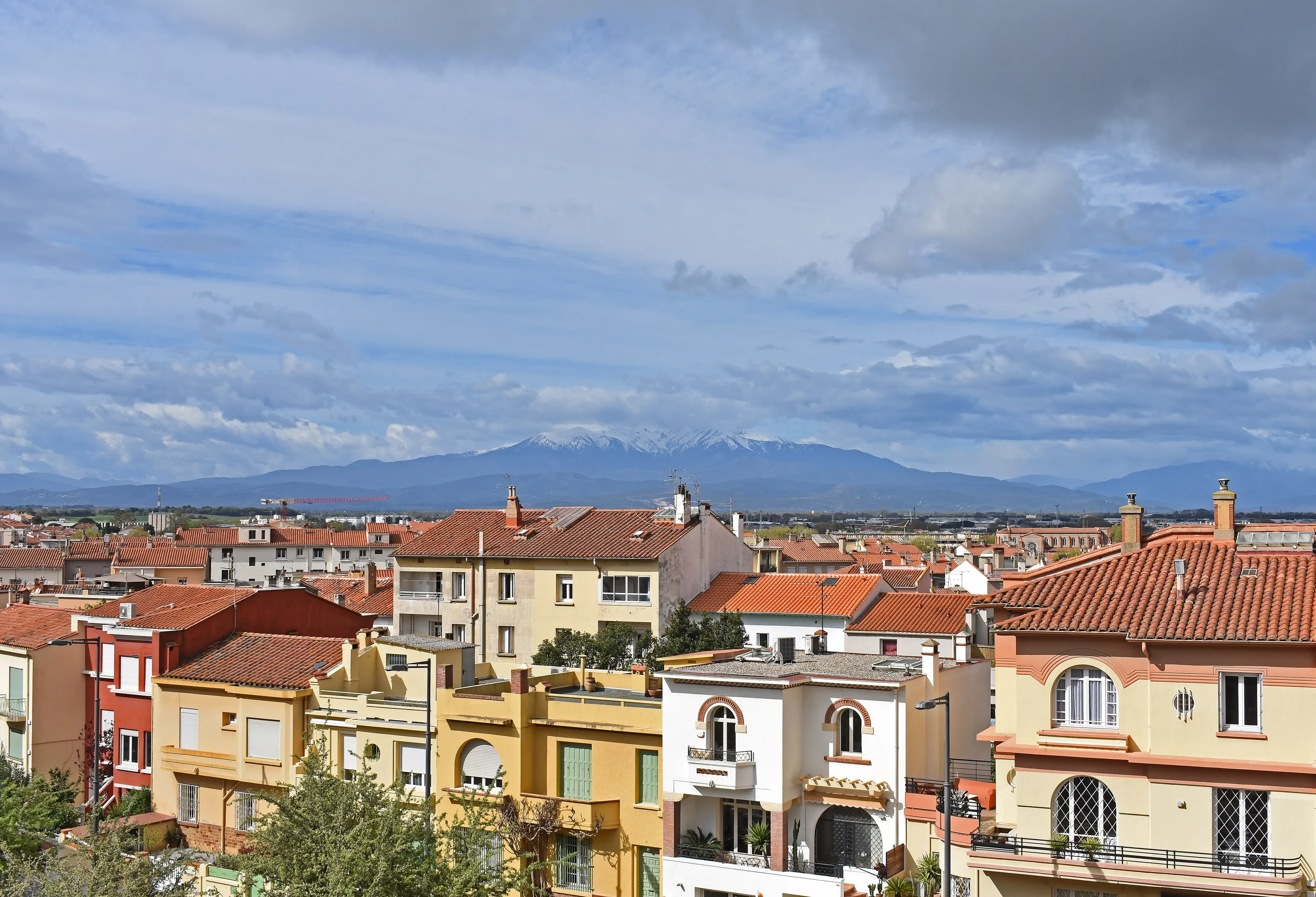
Rooftops and snowy peaks
A view from the citadel over the tiled roofs and coloured facades of the centre: French Wikivoyage describes warm-toned houses in raw or rendered brick at the foot of the Pyrenees. On a clear day a snowy summit shows on the horizon: Canigou, visible to the south-west according to Wikivoyage (EN).
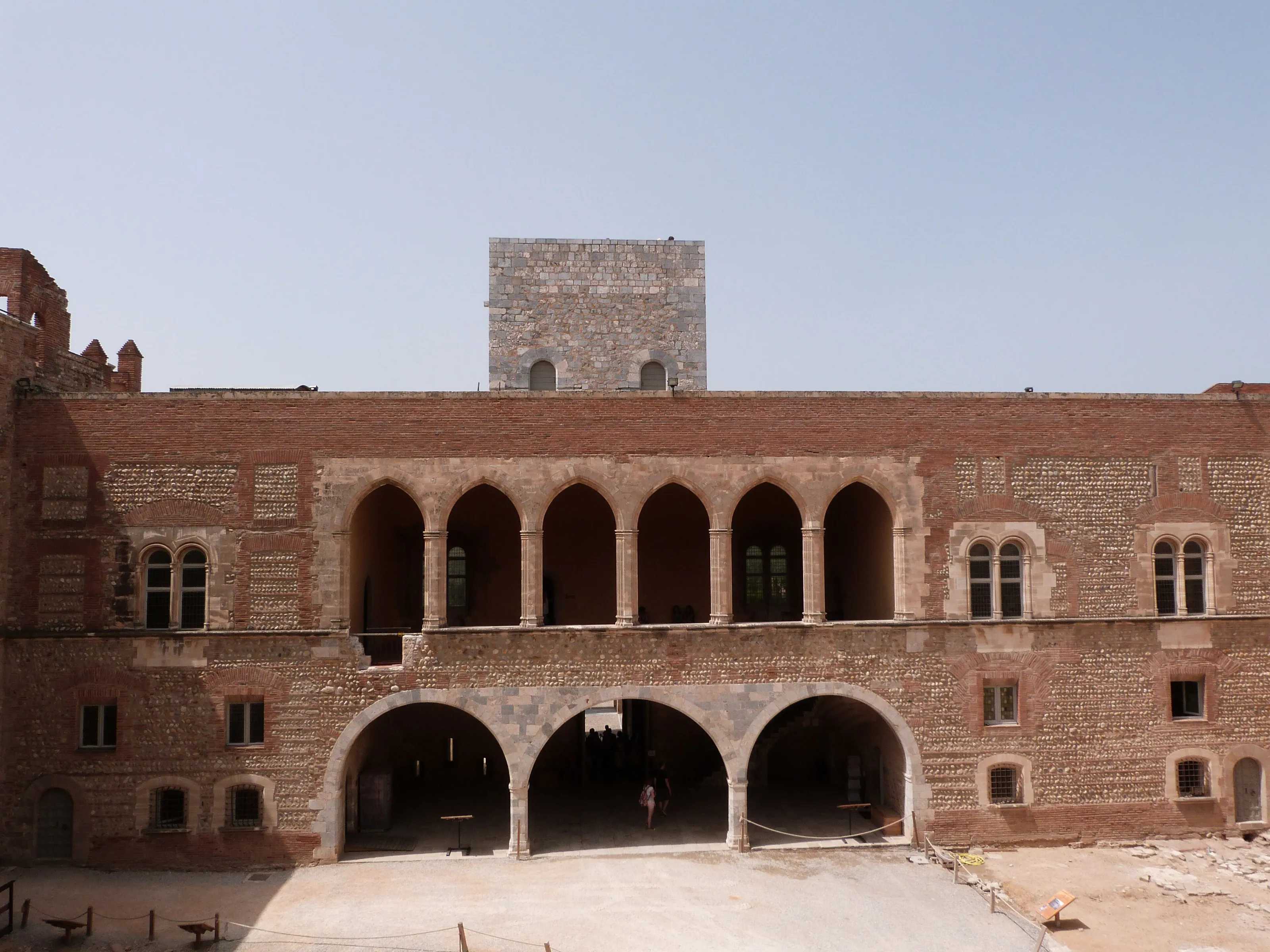
The courtyard of the Kings of Majorca palace
The palace of the Kings of Majorca, from the 13th century, stands inside an 18th-century citadel in the south of the old town, in the La Réal district (Wikipedia DE). English Wikivoyage counts it, with the Castillet and the ramparts, among the monuments of the time when Perpignan was the continental capital of the Kingdom of Majorca. Here, the inner courtyard with its pointed-arch gallery.
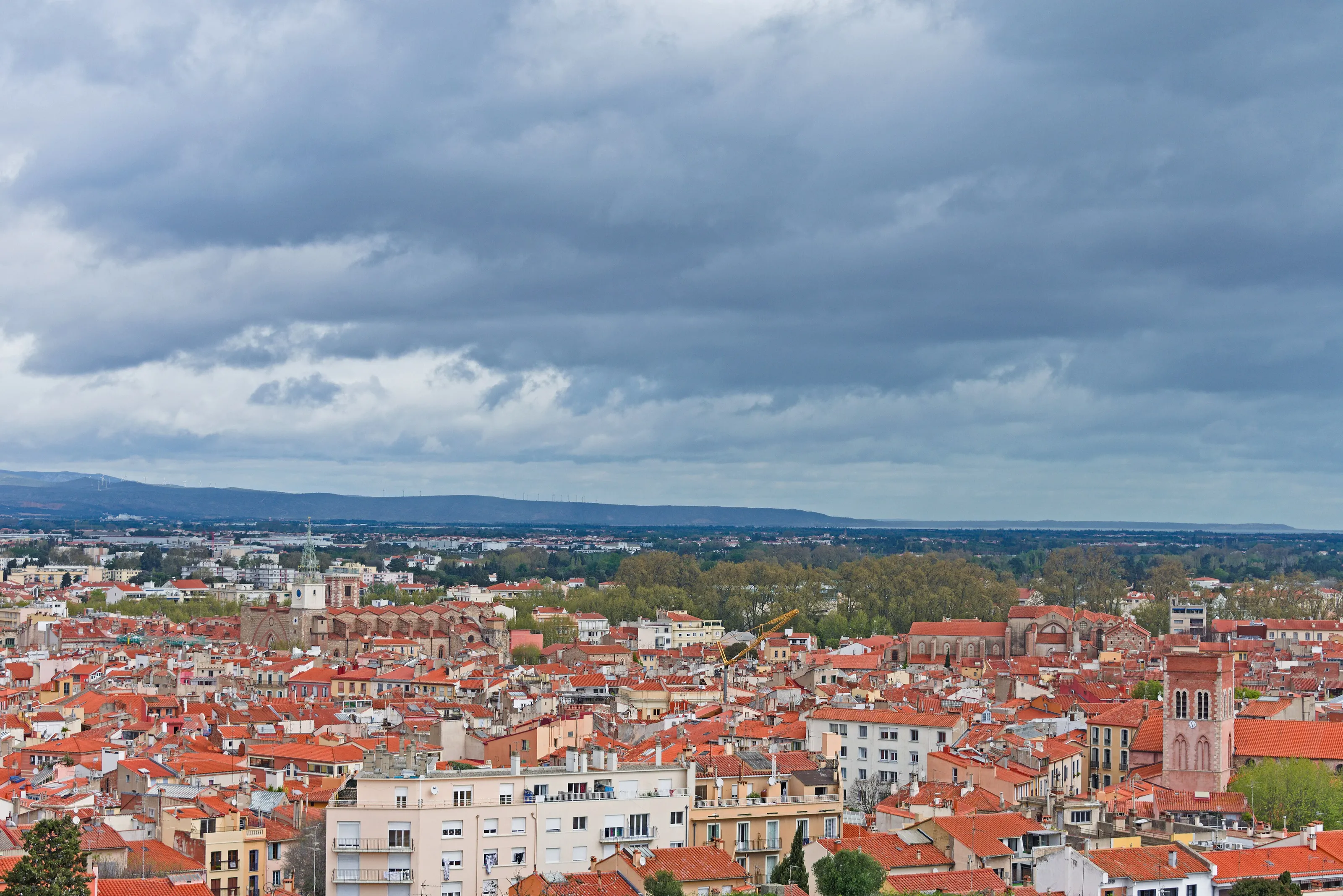
The city from a palace tower
From the top of a palace tower the red-tiled roofs spread out towards the Roussillon plain under a stormy sky. The city sits in the middle of the plain, with the Pyrenees to the south, the Corbières to the west and the sea to the east (Wikipedia FR).
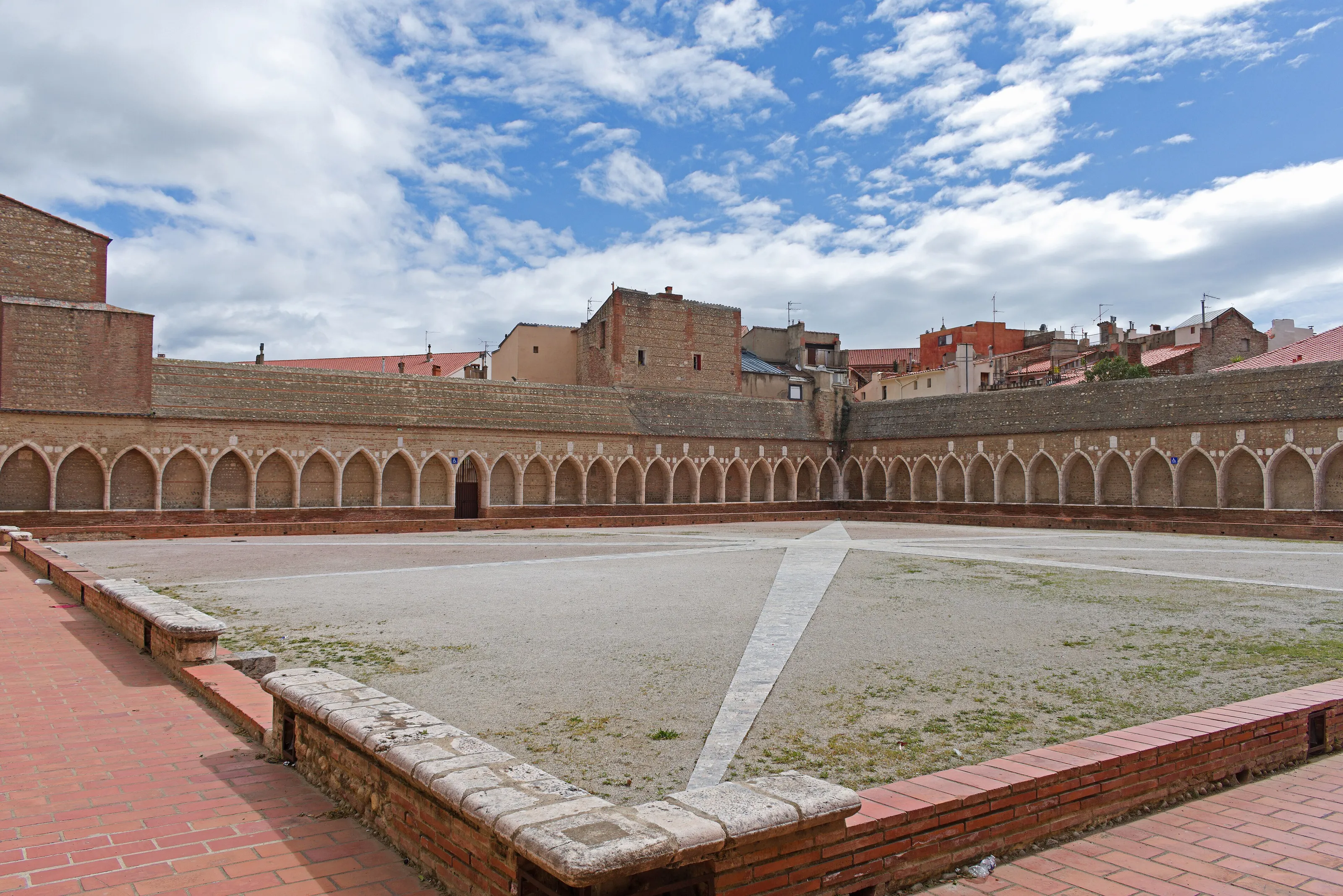
The Campo Santo
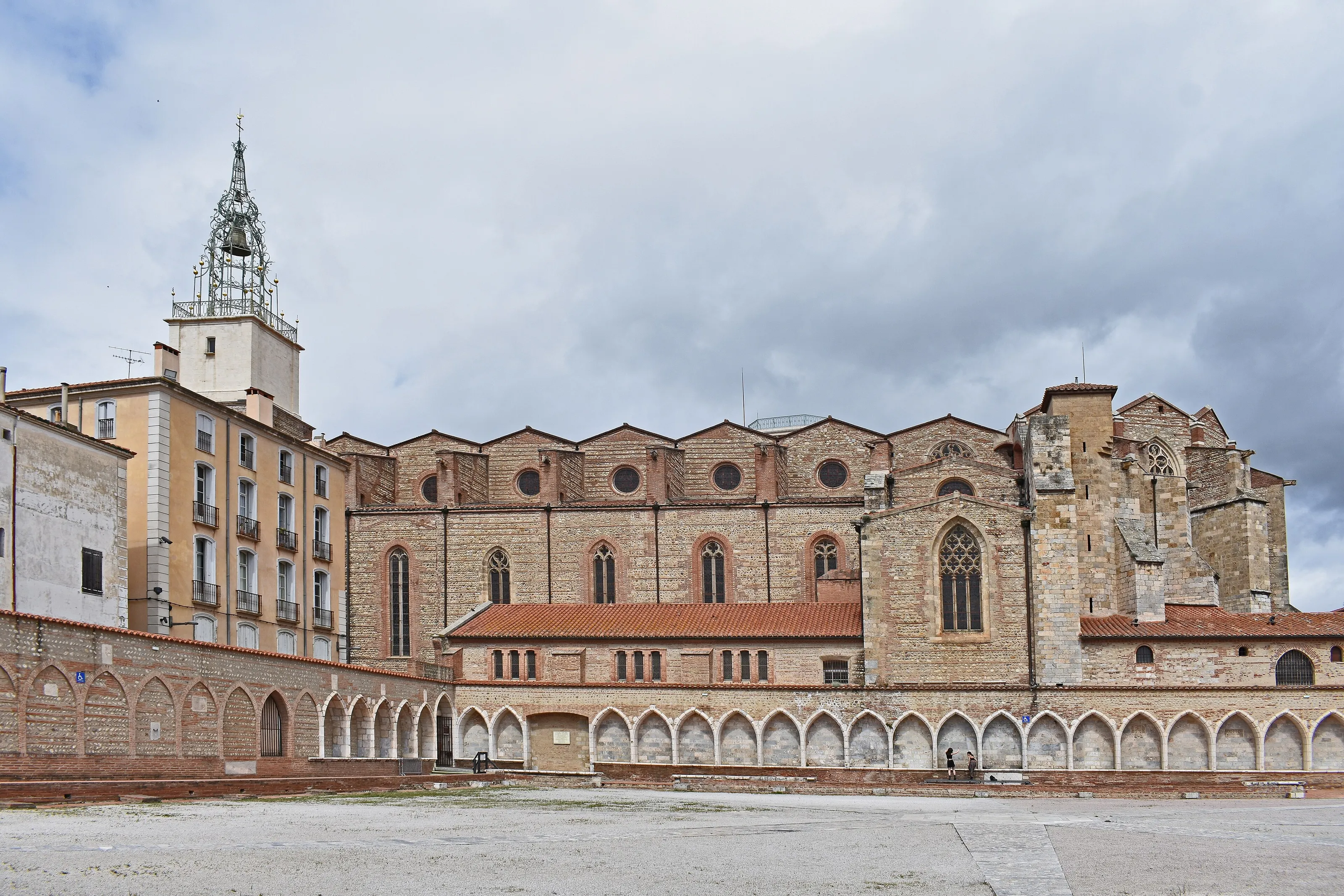
The Campo Santo is a former cloister and cemetery of the 14th century, attached to the cathedral (Wikipedia FR, DE). German Wikipedia calls it a historic cemetery unique in the world. Its pointed-arch niches now open around a wide sandy esplanade, with the neighbourhood's roofs behind.
Saint-Jean-Baptiste cathedral
Built between 1324 and 1509 according to French and German Wikipedia, the cathedral is an example of southern Gothic in pink brick and rolled pebbles (Wikivoyage FR). Its wrought-iron bell tower holds a historic carillon by Amédée Bollée, mentioned by Wikipedia (DE). French Wikivoyage says the church can be entered freely; still, check service times.
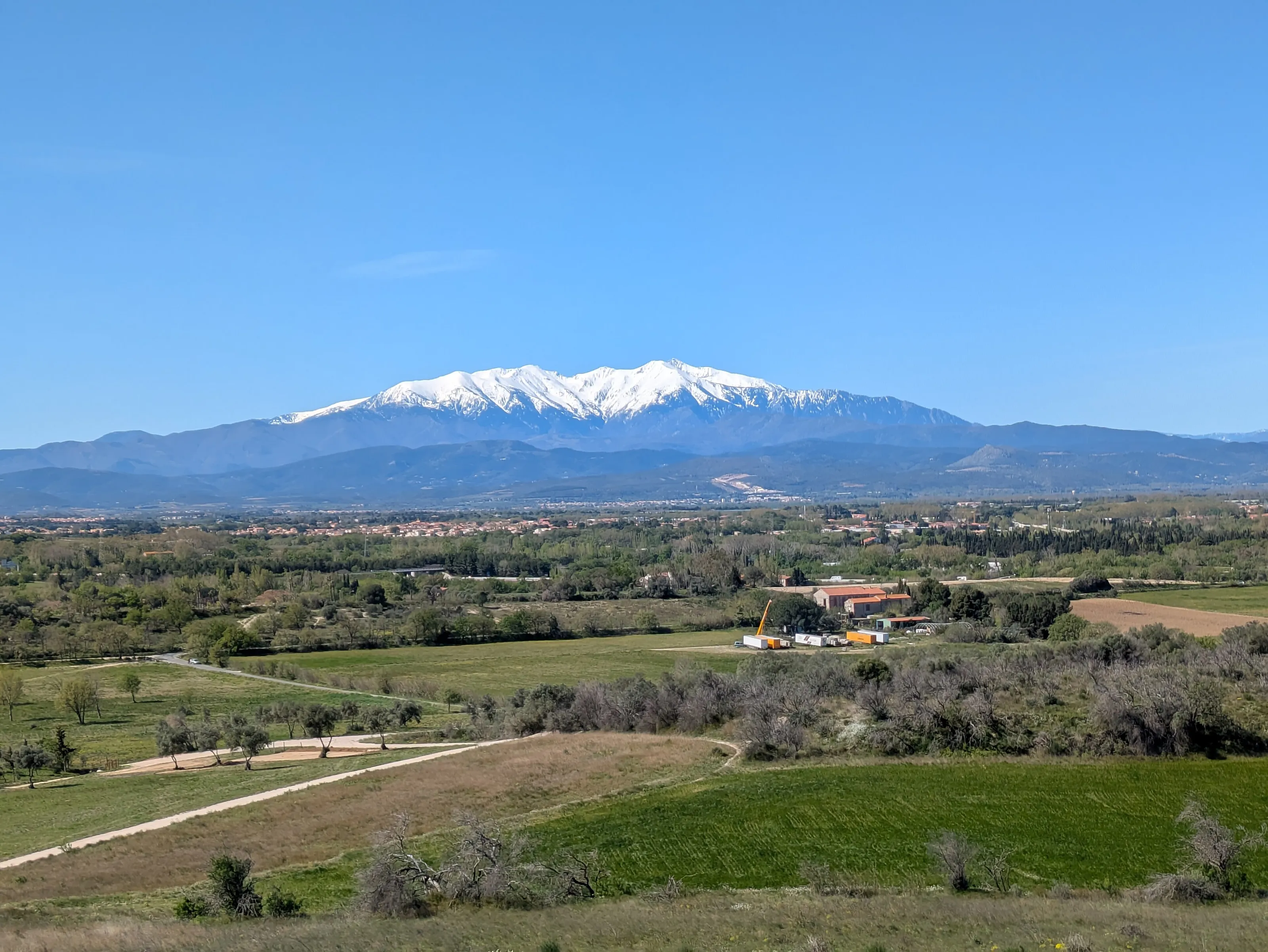
Canigou from the plain
Canigou, the emblematic mountain of the Pyrénées-Orientales, rises above the Roussillon plain and remains visible from the city (Wikivoyage EN, FR). This picture, taken on the outskirts, shows the snow-covered massif above green fields and villages.
More places in Perpignan: the Castillet, a small 14th-century fortress that was the main gate of the old walls and a prison until the end of the 19th century (Wikipedia EN); Place de la Loge, with the Loge de Mer, a former court and exchange in local Gothic style, the town hall and Aristide Maillol's statue of the Venus with a necklace (French Wikivoyage; German Wikipedia); Quai Vauban along the Basse river (Wikipedia DE); and the railway station, whose hall keeps a ceiling painting by Salvador Dalí completed in 1965 according to German Wikipedia, which the artist is said to have regarded as the centre of the world (Wikivoyage FR).
Museums and culture
Hyacinthe-Rigaud, Casa Pairal and natural history
The Hyacinthe-Rigaud museum
Perpignan's fine arts museum has carried the name of the local painter Hyacinthe Rigaud, portraitist at the court of Louis XIV and Louis XV, since 1959, according to French Wikipedia. It holds Hispanic paintings from the Primitives onwards. We give no admission prices or opening hours.
Casa Pairal and the natural history museum
French Wikipedia also lists the Casa Pairal, dedicated to Catalan heritage, the Muséum d'histoire naturelle, also mentioned by German Wikipedia, and the Joseph-Puig museum of coins and medals. Programmes and opening days change, so check before you go.
Other curiosities
French Wikipedia mentions the Bella doll museum and a conservatory of aviation heritage at Mas Palégry. German Wikipedia points to the Arago cave, about 20 km north-west, where fossils of Homo erectus have been found.
Food and drink
Catalan cooking, sea and mountain, and sweet wines
Sea and mountains on the plate
English Wikivoyage describes Roussillon cuisine as a variant of Catalan cooking, mar i muntanya, the sea and the mountains: fish and seafood, charcuterie, and fruits of the land such as tomatoes, peppers, peaches, apricots and cherries, with aioli, here called all i oli. Classics include suquet, a fish stew with saffron and tomatoes, bullinada, a fish and seafood pot, and cargollada, barbecued snails.
Sausages and sweet things
Botifarra and fuet sausages, anchovies from Collioure, crema catalana, rousquilles, anise cookies, bras de gitan, a sponge roll filled with custard, and mel i mato, fresh cheese with honey, are all listed by Wikivoyage (EN, FR).
Sweet wines
The region is famous for sweet wines such as Banyuls, Rivesaltes, Muscat de Rivesaltes and Maury, and for table wines such as Côtes du Roussillon and Collioure (Wikivoyage EN, FR). German Wikipedia adds that Perpignan is a trading centre for wine. We name no address and no brand.
Getting around
On foot, by bus, and caution with a car
Walking
The centre is compact and partly pedestrianised: Wikivoyage (EN, FR) recommends walking between the main monuments, concentrated in the Saint-Jean, Saint-Jacques and La Réal districts. German Wikivoyage describes a small free line called Cœur de ville between the station and the centre, which does not run on Sundays.
Buses and taxis
The Sankeo bus network also serves nearby towns (Wikivoyage EN) and taxis wait at the station and the airport. We publish no fares.
By car
Wikivoyage (EN, FR) advises against driving in the old town: narrow streets, hard parking, and heavy summer traffic from holidaymakers heading for the coast. Several underground car parks exist according to French Wikivoyage.
Budget and precautions
Budget, health and general precautions
Price level
The open sources we consulted do not allow us to publish reliable, cross-checked price ranges: the tour prices that Wikivoyage cites come from a single, dated source. We therefore give no amounts. The currency is the euro.
Flights, entry rules and insurance
SniperAir tracks prices to PGF and compares them with the route's history, but it does not sell or book tickets. Entry rules, travel advice and health cover depend on where you start from and can change: check your own country's official advice before booking.
Heat, wind and storms
Summers are very hot, with temperatures that can reach 40 °C according to English Wikipedia. The tramontane blows regularly from the north-west, and rain, though rare, can be violent in late summer and autumn (Wikivoyage FR). Bring water, sun cream and a windbreaker.
When to go
A sunny Mediterranean climate with the tramontane wind
Winter
Winters are fairly mild according to English Wikipedia, with very little snow in the city for decades, while Canigou keeps its snow in the distance.
Spring
A pleasant season for walking the old town and enjoying the light before the strong heat. Bring a jacket for windy days.
Summer
Summers are hot and dry: French Wikivoyage notes an arid July, and English Wikipedia temperatures up to 40 °C. The nearby coast draws many holidaymakers.
Autumn
Mediterranean rain, sometimes torrential, falls mostly in late summer and early autumn (Wikivoyage FR, EN). The rest of the season stays mild.
English Wikipedia classifies Perpignan's climate as Köppen Csa, a hot-summer Mediterranean climate, and notes patchy rain that can fall in hours after weeks without a drop. English Wikivoyage gives about 2,506 hours of sun a year, which it attributes to the Pyrenees blocking Atlantic weather. The French edition gives the same figure; both pages belong to the same project, so treat it as an order of magnitude.
By length of stay
What to do in Perpignan depending on how long you stay
The essentials
The Castillet, Place de la Loge, the cathedral and Campo Santo, the Kings of Majorca palace and a Catalan meal.
Perpignan in depth
The Hyacinthe-Rigaud museum, Quai Vauban, the Dalí station hall and a day on the nearby coast at Canet-en-Roussillon or further south (Wikivoyage FR).
Beyond the city
Collioure, Argelès-sur-Mer or Port-Vendres on the Côte Vermeille, Prades and Font-Romeu towards the mountains, or Barcelona by TGV (Wikivoyage FR).
In pictures
Perpignan in pictures
You might also like
Similar destinations
FAQ
Frequently asked questions about flights to Perpignan
Where is Perpignan airport PGF?
Perpignan-Rivesaltes airport (PGF) lies north of the city, across the communes of Peyrestortes, Rivesaltes and Perpignan, about 6 km away according to German Wikivoyage. French Wikipedia mentions a Sankeo bus line; check it before you travel.
What should I see first in Perpignan?
The Castillet, Place de la Loge, Saint-Jean-Baptiste cathedral with its Campo Santo, and the palace of the Kings of Majorca, according to Wikipedia (FR, DE, EN) and Wikivoyage (FR, EN).
Is the sea close to Perpignan?
Yes, about 13 km by the expressway to Canet-en-Roussillon according to Wikipedia (FR, EN), or 10 to 15 km according to English Wikivoyage.
What should I eat in Perpignan?
Catalan Roussillon cooking: suquet, bullinada, cargollada, crema catalana, rousquilles, and sweet wines such as Banyuls or Rivesaltes, according to Wikivoyage (EN, FR).
What entry rules apply when travelling to France?
This depends on where you start from and can change: check your own country's official advice before booking.
How many days do I need in Perpignan?
Two days cover the old town and the palace; three or four add the museums and the coast; five or more let you explore Collioure, the mountains or Barcelona.
How much does a flight to Perpignan usually cost?
The price depends mainly on your departure city, the time of year and how far ahead you book. The "opportunities" section above shows real examples of prices SniperAir has already detected to this destination.
How do I get alerted when a flight to Perpignan drops below my budget?
Create an alert profile with your departure airport, Perpignan (PGF) as the destination and your maximum budget. You are notified automatically as soon as a matching price is detected. SniperAir monitors and alerts, it does not sell or book tickets.
Ready to head to Perpignan?
Set your budget and let SniperAir monitor fares for you.
Create my alert