
Cheap flights to Cephalonia
Set your departure airport and maximum budget: SniperAir tracks prices to Cephalonia and alerts you the moment a deal matching your criteria appears.
Quick summary
Country
Greece
Continent
Europe
Airport
EFL
Currency
Euro (EUR)
Time zone
UTC+2 (UTC+3 during summer time)
Deals already spotted to Cephalonia
Real flight examples detected by SniperAir, with their reference price.
Loading examples…
Why track Cephalonia with SniperAir
You do not need to compare prices every day
Choose your departure
Enter your departure airport and your maximum budget for a flight to Cephalonia (EFL).
SniperAir keeps watch
Our systems continuously compare new fares with the route's real price history. SniperAir tracks prices and alerts you: it does not sell or book tickets.
You get an alert
As soon as a fare matches your criteria you are notified, without having searched for anything yourself.
Cephalonia, also spelled Kefalonia, is the largest of the Ionian Islands and one of the most mountainous, off Greece's west coast. Its capital is Argostoli. The island combines dramatic beaches, caves and an underground lake, fishing villages and vineyards. SniperAir monitors fares to EFL airport and alerts you when a price drops under your budget; it does not sell or book tickets.
This page covers the whole island, with Argostoli as the base reference: beaches, villages, local specialities and ways to get there by air or sea. It gives no timetables or prices, which change from season to season.
A general reminder: the island lies in an active seismic area and was badly hit in 1953. Check your government's travel advice before setting up an alert and again before booking, and check road and sea conditions before you travel.
Airport and getting into town
A small airport south of Argostoli, and ferries to the mainland
Kefalonia Island International Airport 'Anna Pollatou' (EFL)
The island's airport lies south of Argostoli; sources give different distances (from a few kilometres to about ten), so expect a short taxi or rental-car transfer. Flights to Athens run regularly, and seasonal flights connect the island with several European cities; outside the season the choice is smaller. We do not list airlines or prices.
We publish no detailed journey times or prices. Compare flights to Athens followed by a connection or a ferry, and check timetables before you go.
By sea, the main ports are Sami (links to Patras and Ithaca), Poros (to Kyllini on the mainland), Argostoli (a crossing to Lixouri and, in summer, to Zakynthos) and Fiskardo (Lefkada and Ithaca). Frequencies depend heavily on season and weather: check timetables, we name no operators.
On the island, intercity buses are infrequent and a rental car is almost essential to reach the beaches. Mountain roads are often narrow and winding.
Landmarks and sights
Myrtos, Assos, Argostoli: the island in pictures
Cephalonia is best discovered along its coast and villages. Here are five pictures, then more places in text.
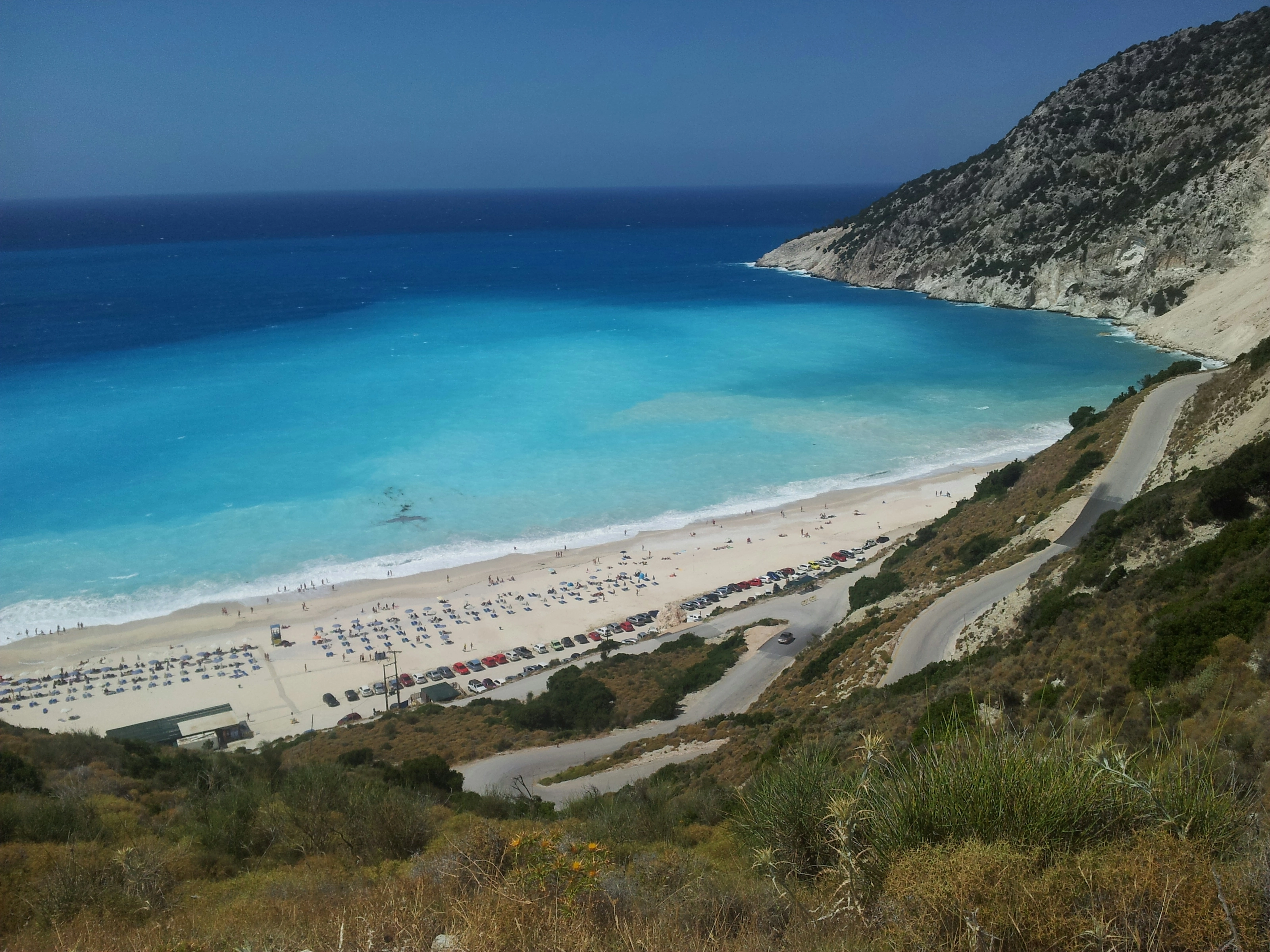
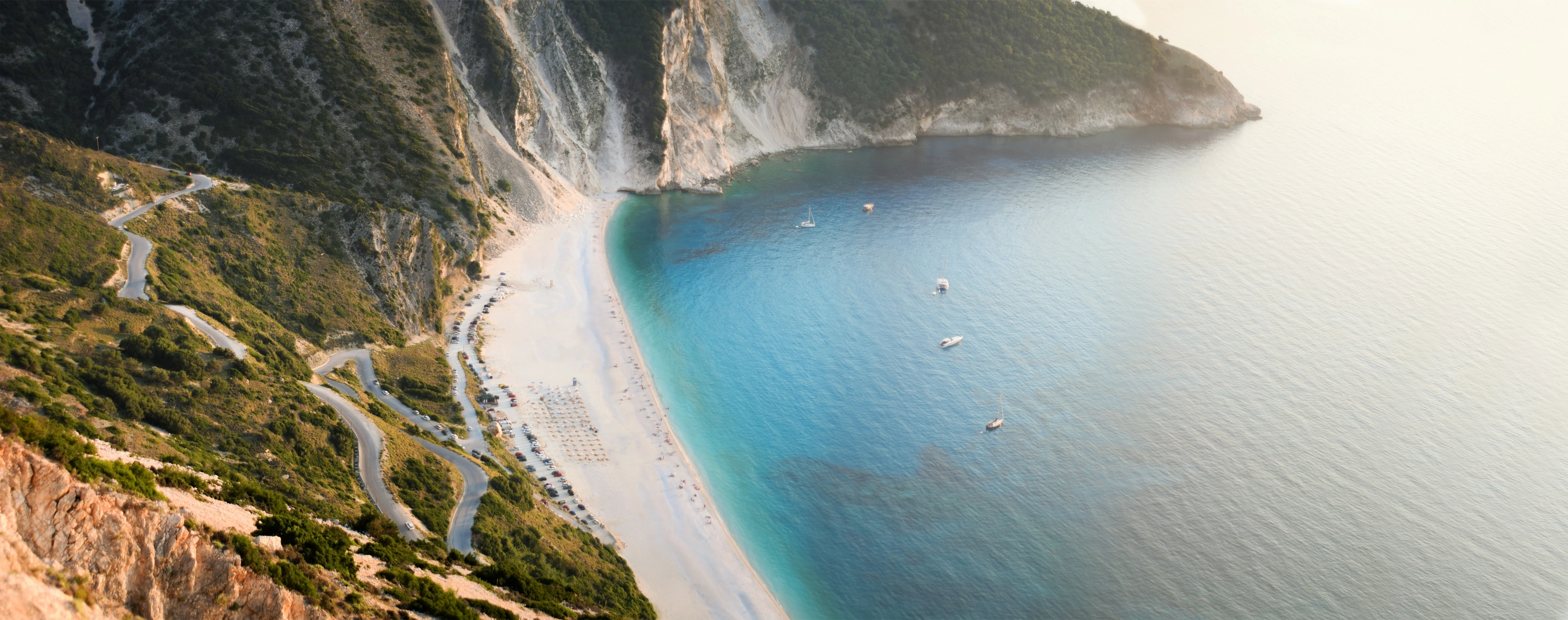
Myrtos Beach
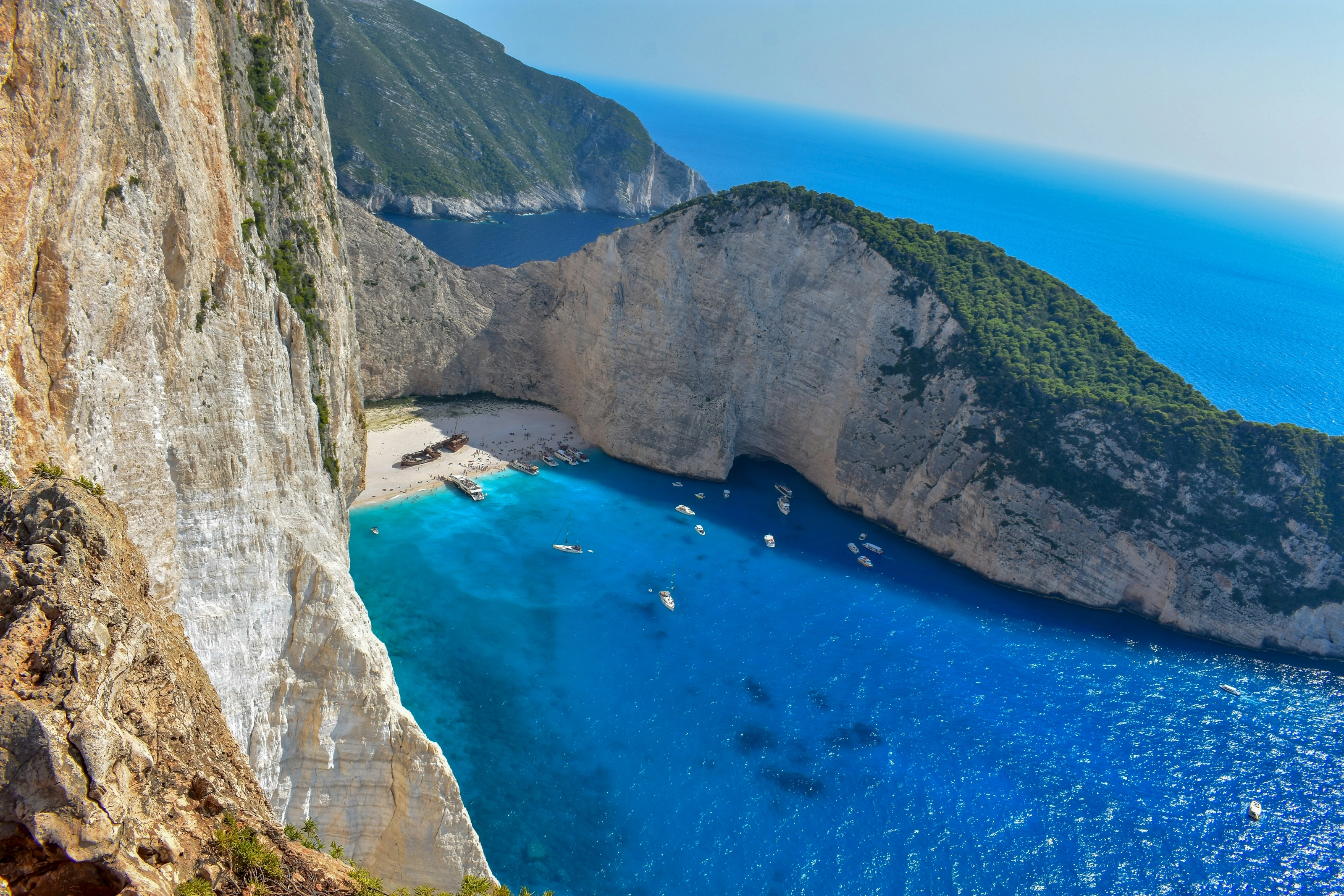
In the northwest, Myrtos is one of Greece's most famous beaches: a wide arc of white pebbles under limestone cliffs, with intensely turquoise water. A steep, winding road of about 2 km leads down from the village of Divarata. In high season a municipal bus can serve the beach from Agia Efimia. The sea can have strong currents, so swim with care.
The viewpoint over the bay
The road down to Myrtos gives a viewpoint over the bay framed by mountains, between Agia Dynati and Kalon Oros. Late afternoon is the best moment, when the light turns the cliffs golden. Wear sturdy shoes and take care on this winding road.
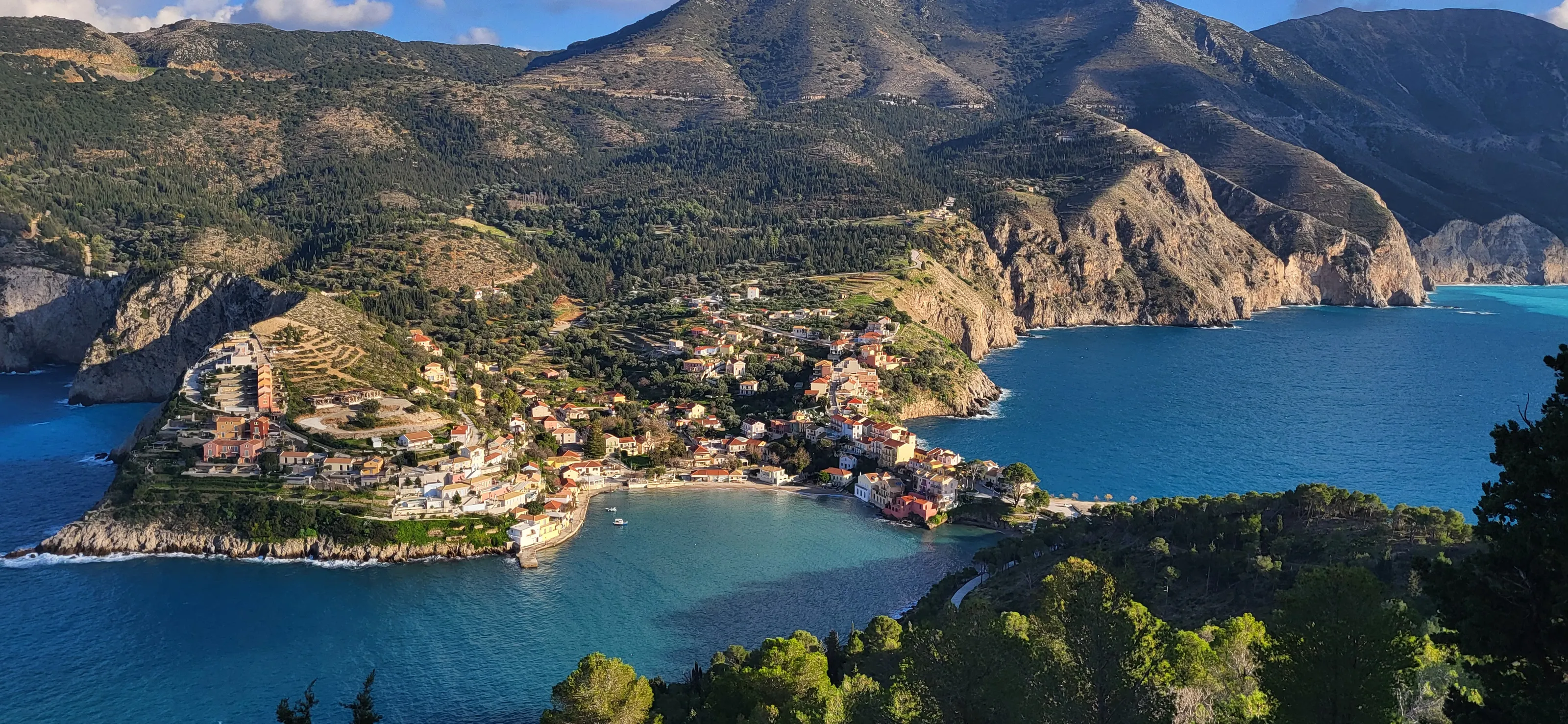
Assos and its peninsula
Assos, in the northwest, is a village of colourful houses nestled at the foot of a narrow peninsula crowned by a Venetian fortress whose construction began in 1593. People come for the view, the small harbour and the walk. The Square of the Parisians recalls help received after the 1953 earthquake.
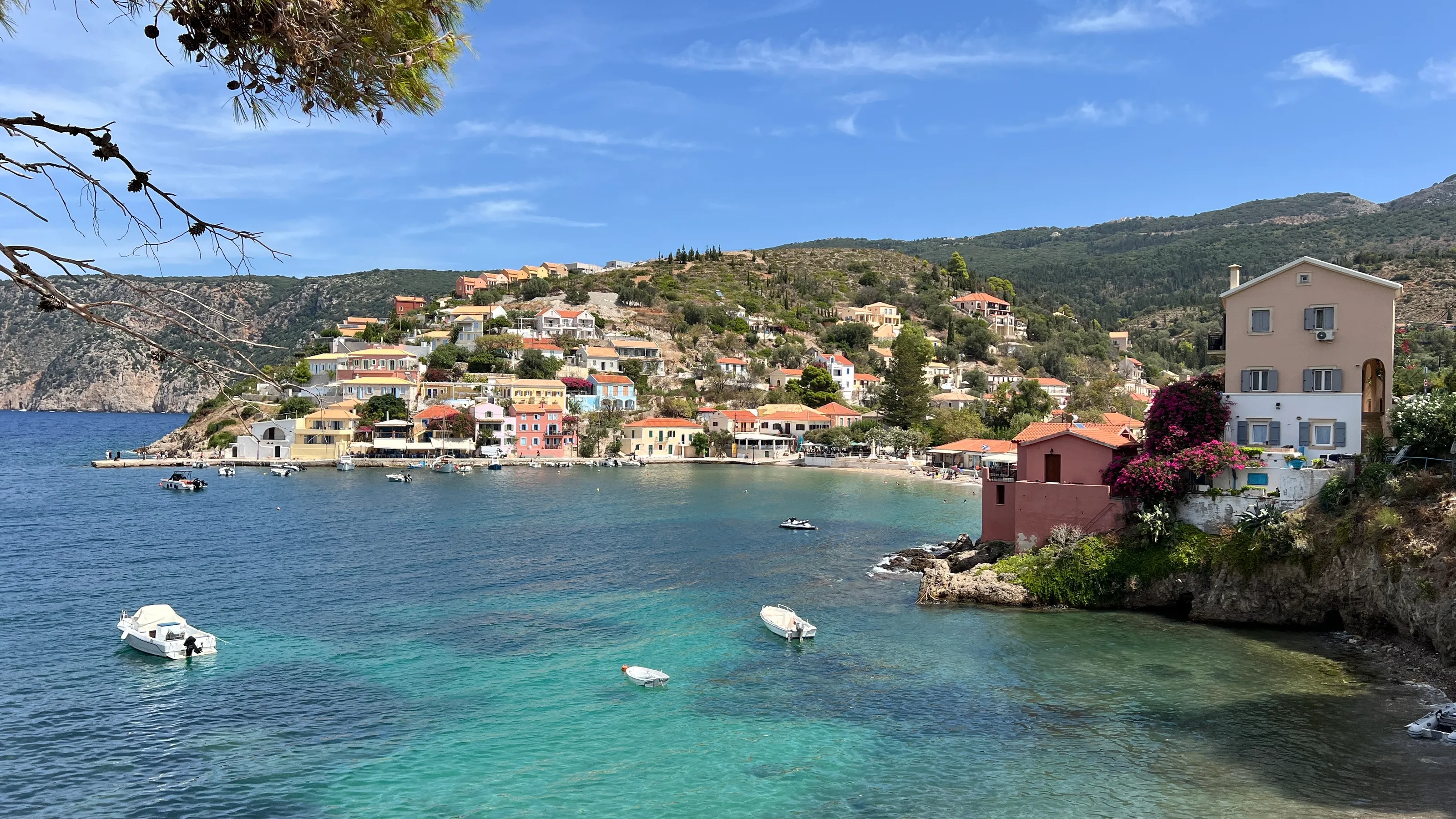
The harbour of Assos
The harbour is a quiet place for a stroll: pastel-fronted houses, small pine-lined coves and clear water for a swim. Fishing and leisure boats show that the village still looks to the sea.
Argostoli and the Koutavos lagoon
Argostoli has been the island's capital since 1757 and is its main port. The town was rebuilt after 1953 and has a waterfront promenade, the pedestrian Lithostroto and a lagoon where loggerhead turtles (Caretta caretta) can be seen from the stone bridge that crosses it, the De Bosset bridge, built in the British period.
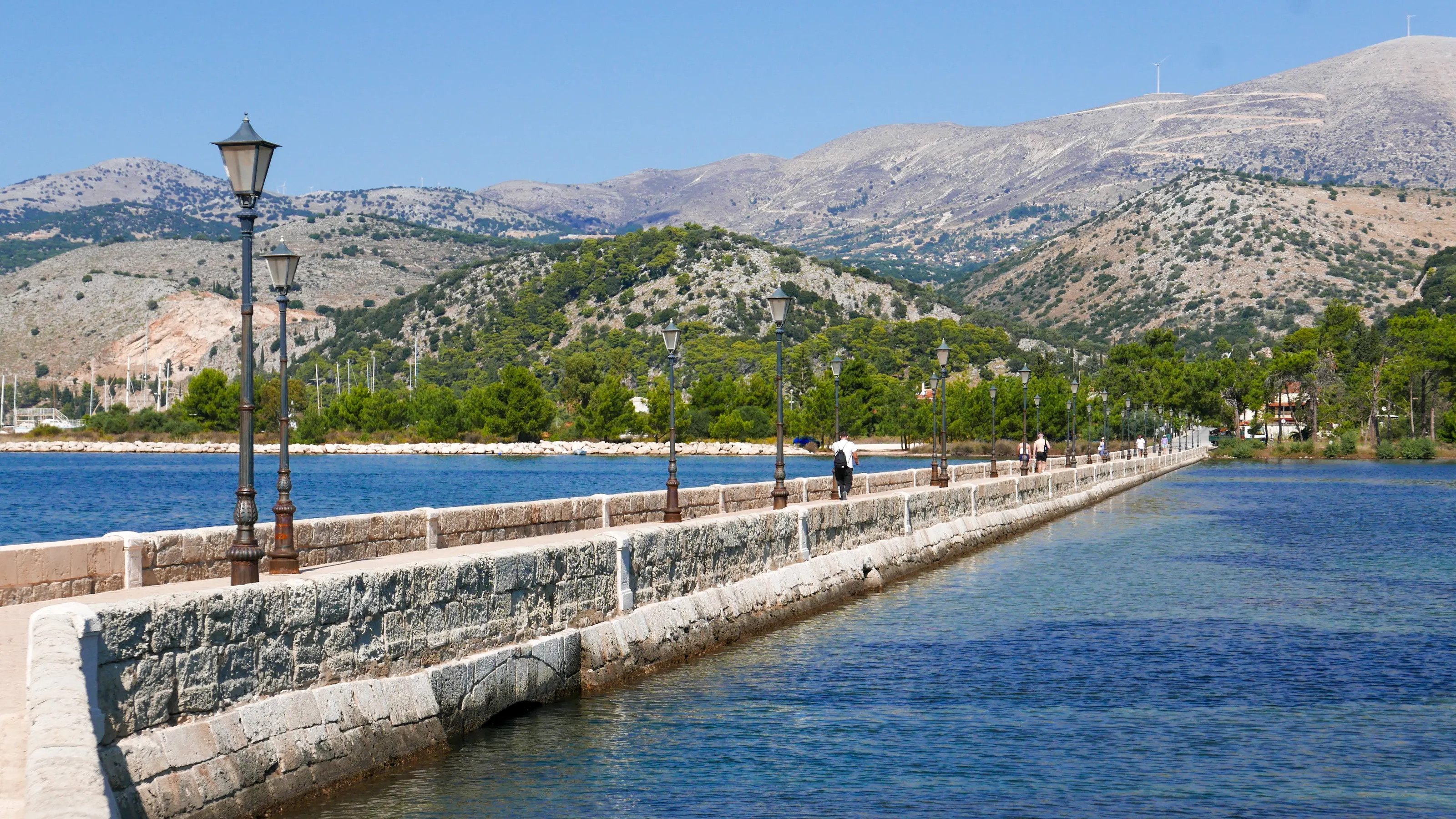
Other places to note: the Melissani underground lake near Sami, explored by rowing boat under a partly collapsed roof; Drogarati cave, around 18 C all year; Fiskardo, the only northern village spared by the 1953 earthquake; the katavothres near Argostoli, where sea water disappears underground; St George's fortress above Peratata; and Mount Ainos, a national park with semi-wild horses and the Cephalonian fir.
Museums and culture
Museums, caves and monasteries: the island's heritage
Argostoli's museums
The Archaeological Museum, housed in a building from the 1960s, gathers finds from across the island, from prehistory to Roman times, with a notable Mycenaean collection. The Korgialenios Historical and Folklore Museum shows costumes, tools and photographs from before and after 1953. Other small museums, such as the Cosmetatos foundation, round off the visit. Check opening hours and access conditions before you come.
Sami and the east coast
Sami has a maritime museum and lies near two natural wonders. Melissani was a cult site of the god Pan in antiquity; Drogarati cave, discovered in the 19th century, is sometimes a concert hall in summer thanks to its acoustics. We publish no ticket prices.
Skala Roman villa and monasteries
At Skala, a 2nd-century Roman villa keeps floor mosaics. The monastery of Saint Gerasimos, in the Omala valley, honours the island's patron saint, with processions on 16 August and 20 October; Kipouria monastery near Lixouri overlooks the sea. Respect opening times and dress codes in places of worship.
Food and drink
Robola wine, meat pie and Ionian flavours
A cuisine with Venetian influence
The island's cooking bears Venice's mark: kreatopita, a meat pie of beef, pork and goat with rice in puff pastry, sofrito, bourdeto, and fish and tomato dishes in many variations. Riganada, a toasted, seasoned rusk, and white almond nougat are classics.
Robola and olive oil
Robola is the island's dry, light, lemony white wine, grown on the Omala plateau at about 700 m, notably around the monastery of Saint Gerasimos. The island has more than a million olive trees and a green oil of low acidity. Look for orzata (soumada), an almond drink.
Where to eat
Argostoli's waterfront tavernas, the harbours of Fiskardo and Assos and inland villages offer simple meals. Fiskardo, popular with yacht owners, is more upmarket. We name no particular address.
Getting around
Car, bus, boat: getting around
By rental car
This is the simplest way to reach Myrtos, Assos, Fiskardo or the caves. Mountain roads are narrow and winding: allow time and drive carefully after dark.
By bus and local ferry
Intercity buses (KTEL) serve the main places but not often. The ferry between Argostoli and Lixouri crosses the bay several times a day in season; check timetables.
On the water
Boat trips run from places such as Agia Efimia and Sami to beaches reached mainly by sea, or to Ithaca. Conditions vary with the wind.
Budget and precautions
Price level: no unverified figures
What we know
Cephalonia is a mid-range destination, with strong seasonal swings. Accommodation is usually the biggest cost, especially in August; Fiskardo, popular with yachts, is pricier than inland villages.
What we do not publish
Entry, meal, ferry or rental prices quoted here and there are not backed by two independent sources, so we publish no ranges. The currency is the euro.
Precautions
The island is in a seismic zone and wildfires can occur in summer: follow local instructions. Also check your government's official travel advice.
When to go
A Mediterranean climate, hot and dry in summer
Spring (April to June)
The island is green and the days lengthen. Beaches become pleasant from May, and it is a good time for walking.
Summer (July to August)
Hot and dry, with afternoons near 30 C and nights around 21 C. It is peak season, with the busiest beaches and roads.
Autumn (September to November)
September and early October stay warm and calmer. Rain returns as autumn goes on.
Winter (December to March)
Mild, with daytime highs around 14 to 15 C and frequent rain. Tourism is mostly seasonal: some businesses close.
These figures are guidelines; weather changes from year to year. For beaches, caves and walking, May, June and September are often the easiest months.
By length of stay
How many days in Cephalonia?
A short stay
Argostoli, Myrtos Beach and Assos, with a visit to Melissani lake.
Taking your time
Add Fiskardo, Drogarati cave, the katavothres, Mount Ainos and a Robola tasting.
Around the island
Range around the four peninsulas, with a trip to Ithaca and time for several beaches.
In pictures
Cephalonia in pictures
You might also like
Similar destinations
FAQ
Frequently asked questions about flights to Cephalonia
Which airport serves Cephalonia?
The island is served by EFL airport (Anna Pollatou), south of Argostoli. Flights link Athens all year, and seasonal flights arrive from several European cities.
What should I see first in Cephalonia?
Myrtos Beach, the village of Assos, Fiskardo, the Melissani underground lake, Drogarati cave and Argostoli with its lagoon turtles.
How do I get around the island?
A rental car is almost essential. Intercity buses are rare, and a ferry links Argostoli and Lixouri.
Can I arrive by boat?
Yes: ferries link Sami with Patras and Ithaca, Poros with Kyllini and Fiskardo with Lefkada. Timetables vary by season; we name no operator.
When is the best time to go?
May, June, September and early October strike a good balance between warmth and crowds. July and August are peak season.
What are the local specialities?
Kreatopita (meat pie), Robola white wine, olive oil, fish and tomato dishes, and almond sweets.
How much does a flight to Cephalonia usually cost?
The price depends mostly on your departure city, the season and how early you book. The opportunities section above shows real examples of fares SniperAir has already detected to this destination.
How do I get alerted when a flight to Cephalonia drops below my budget?
Create an alert profile with your departure airport, Cephalonia as the destination and your maximum budget. You are notified automatically as soon as a matching fare is detected.
Ready to head to Cephalonia?
Set your budget and let SniperAir monitor fares for you.
Create my alert