
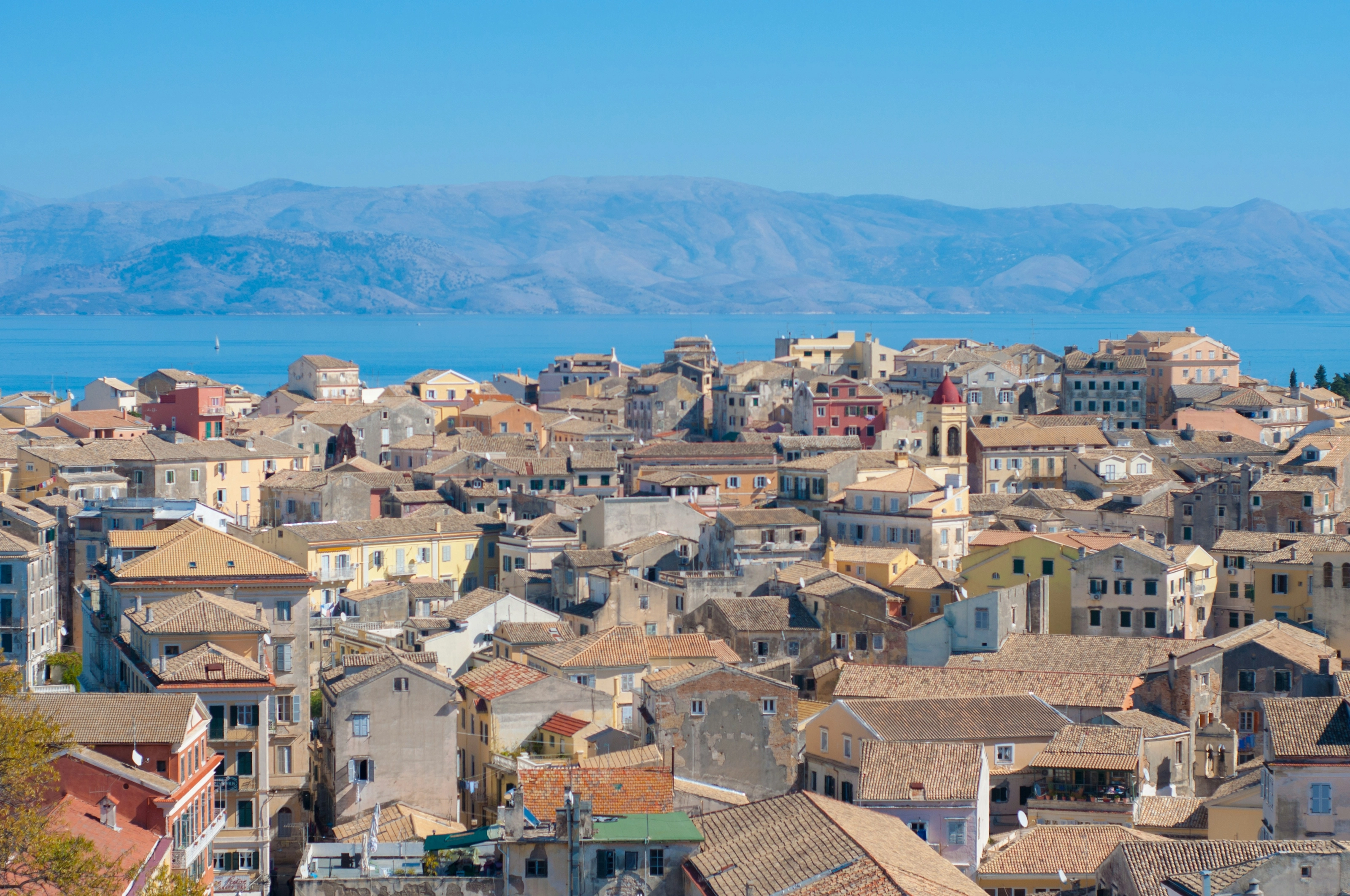
Cheap Flights to Corfu
Set your departure airport and maximum budget: SniperAir tracks prices to Corfu and alerts you the moment a deal matching your criteria appears.
Quick summary
Country
Greece
Continent
Europe
Airport
CFU
Currency
Euro (EUR)
Time zone
UTC+2 (EET)
Population
~25,000
Deals already spotted to Corfu
Real flight examples caught by SniperAir, with their reference price.
Loading examples…
Identity
A Venetian island the Ottomans never conquered
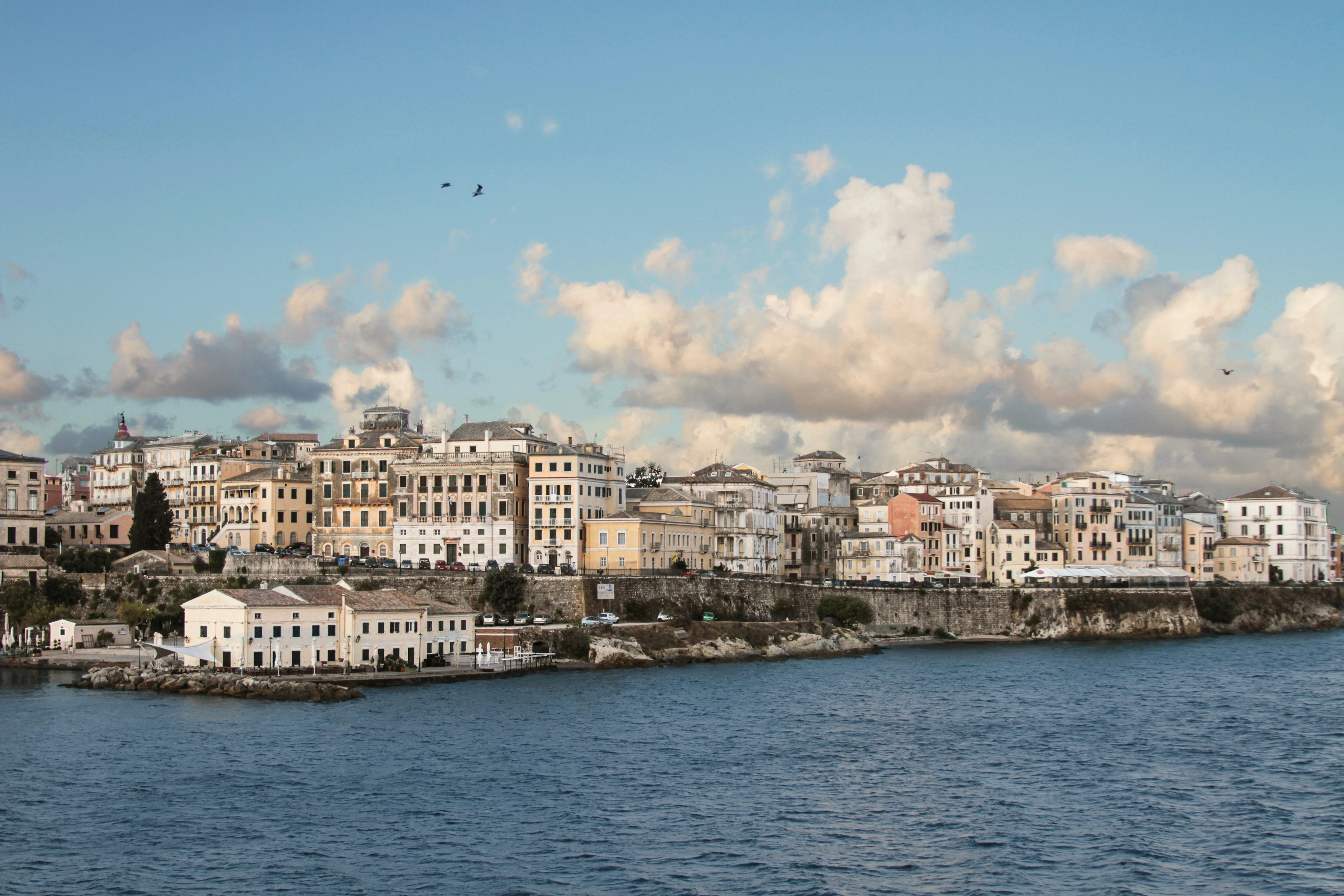
Corfu (Kerkyra) owes its character to more than four centuries of Venetian rule, from 1386 to 1797. Facing Ottoman expansion, the Venetians fortified the island, and its defences repelled several sieges, notably in 1537, 1571, 1573 and 1716: Corfu never fell to the Ottomans (Wikipedia). French and then British rule followed before the island was united with Greece in 1864. The Liston, an arcaded promenade inspired by Paris's Rue de Rivoli, was built in 1807 under French administration (Wikivoyage EN). According to Strabo, Corcyra was Homer's Scheria, land of the Phaeacians.
In 2007 the old town was inscribed on the UNESCO World Heritage List. The ICOMOS evaluation points out that most pre-20th-century buildings date from the British period and that whole blocks destroyed in Second World War bombing were rebuilt in the 1960s and 1970s; what gives the site its value is above all the layout of the fortified town and its Venetian works (Wikipedia EN).
Don't miss
Kantounia, the Esplanade, the Liston and the two fortresses
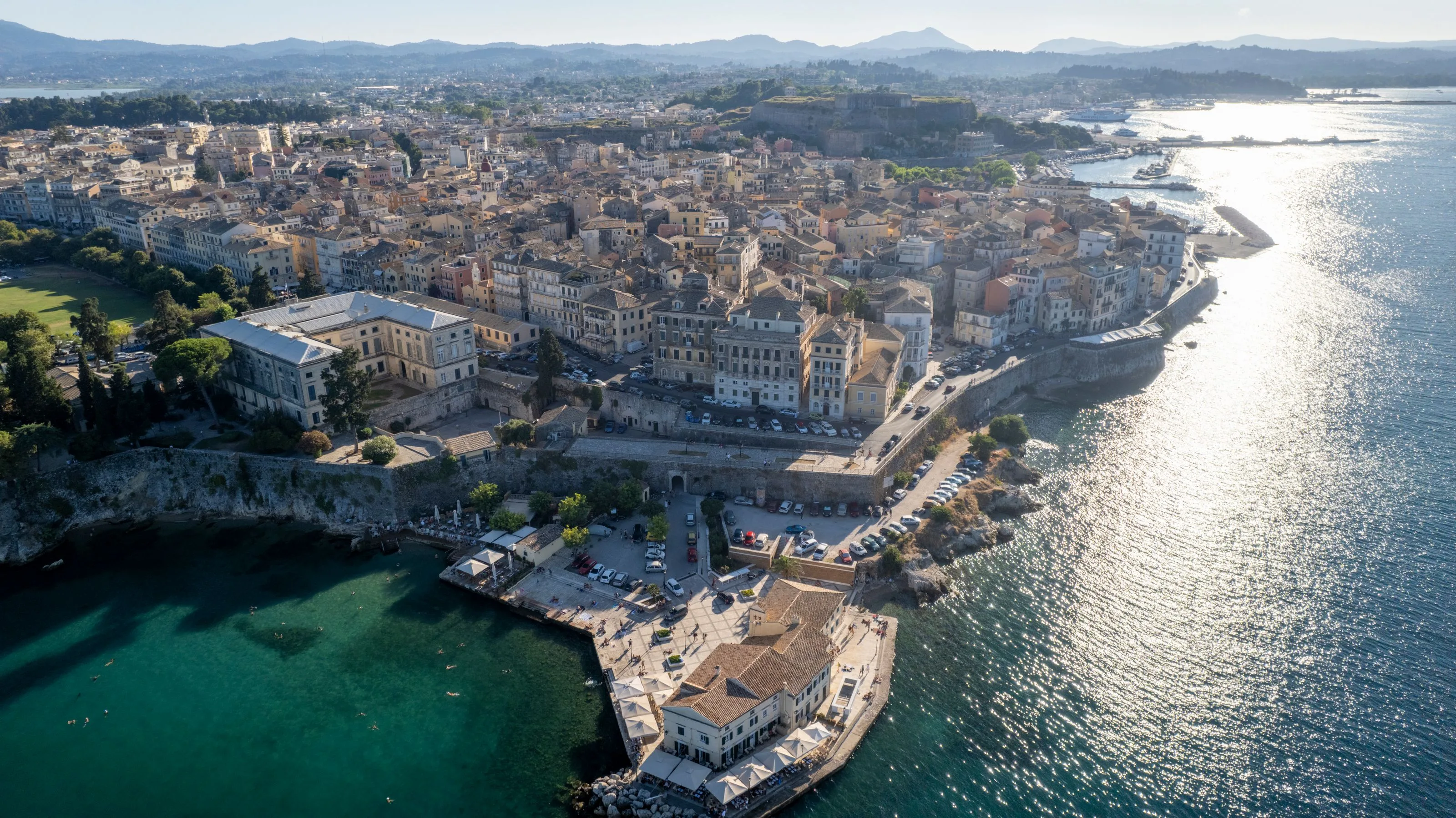
The old town is best explored on foot, through a maze of narrow lanes called kantounia: tall buildings with painted shutters, wrought-iron balconies and ochre-pink facades. It is framed by two fortresses. The Old Fortress (Palaio Frourio), Byzantine in origin and reworked by the Venetians, stands on a promontory cut off from the town by a sea channel, the Contrafossa, and repelled the three great Ottoman sieges. The New Fortress, built by the Venetians in the 16th century, has underground galleries and a ceramics museum. Between them lies the Esplanade (Spianada), a large square split into two parts and bordered by the Liston and its cafes, where the evening promenade still takes place. The church of Saint Spyridon, built in 1589, houses the relics of the island's patron saint.
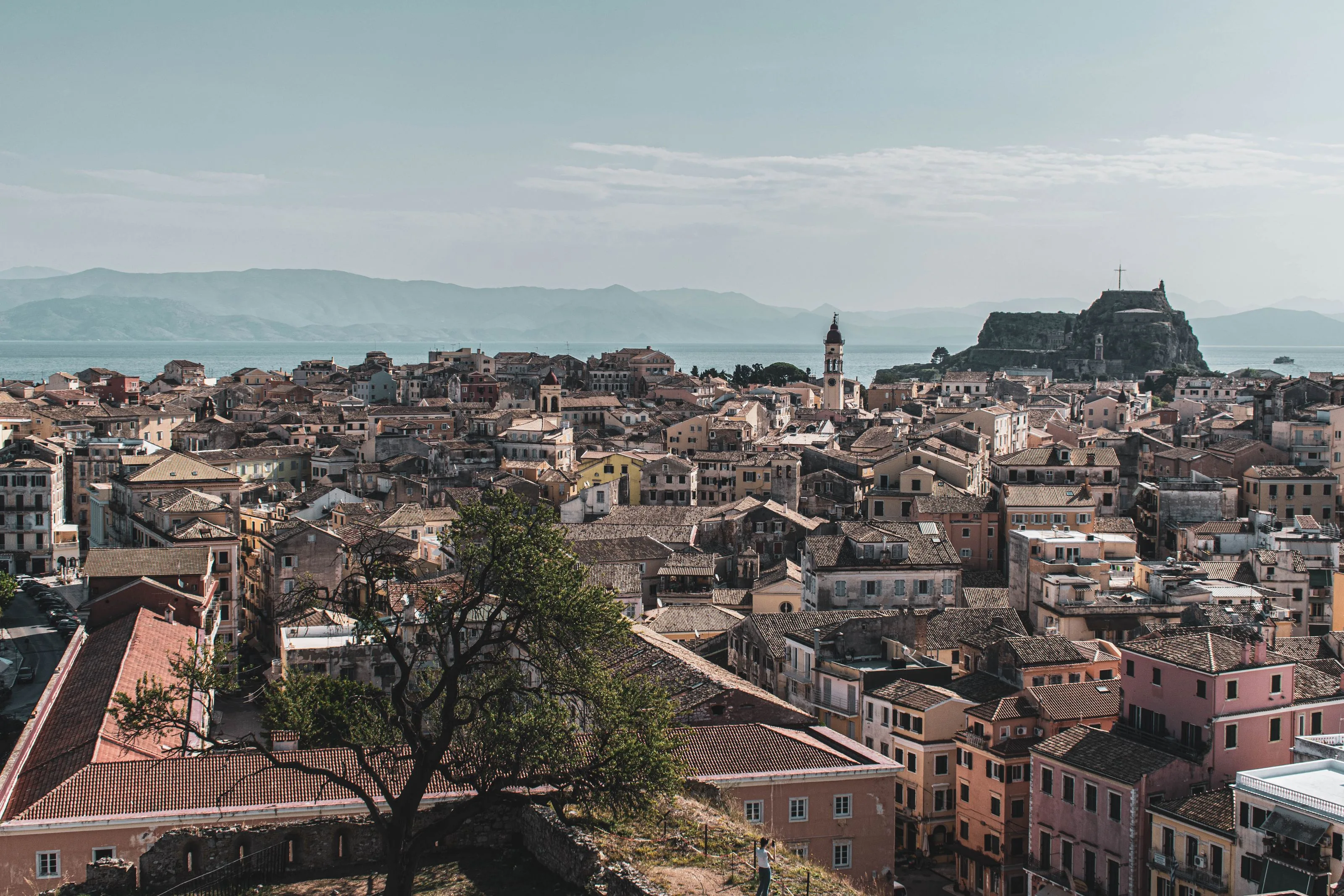
Festivals. According to Wikivoyage EN, Greek Easter in Corfu is the most famous in the country and the carnival has a history of over 450 years: two good reasons to book early if your stay falls on those dates.
Museums
Archaeology, Asian art and Byzantine icons
Corfu has several museums in the old town, easy to link on foot. Opening hours and prices vary by season and change from year to year: check the official websites before you go.
| Place | Good to know |
|---|---|
| Archaeological Museum | The island's collections, including the Gorgon pediment from the Temple of Artemis (about 585 BC), the oldest stone pediment in Greece, and the Lion of Menecrates. |
| Museum of Asian Art | More than 10,000 objects from China, Japan, India, Tibet and Southeast Asia, in the former royal palace at the north end of the Esplanade. |
| Byzantine Museum (Antivouniotissa) | Byzantine and post-Byzantine icons in a small church. |
| Municipal Art Gallery | Works by 19th-century Corfiot painters. |
| Mon Repos (Palaiopolis Museum) | A neoclassical villa where Prince Philip was born in 1921, now a museum devoted to the ancient city of Palaiopolis. |
| Old and New Fortress | Admission to the Old Fortress is charged (a few euros); the New Fortress hosts a ceramics museum and events. |
Food and drink
Sofrito, pastitsada and kumquat liqueur
Corfiot cooking stands apart from the rest of Greece with its slow-cooked sauces and spices, a legacy of Venetian rule: sofrito (veal or beef in garlic and white wine), pastitsada (meat stewed with tomato and cinnamon, served over pasta) and bourdeto (spicy fish stew) are the essentials. Also look out for bianco (fish with garlic, lemon and potatoes), savoro (fried fish marinated in vinegar), strapatsada (scrambled eggs with tomato and feta) and kreatopita, a minced-meat pie (Wikivoyage EN).
Drinks and produce. Kumquat, a citrus fruit introduced to the island, comes as a liqueur or preserve. Ginger beer (tsitsibira), a British legacy, is served at the Liston. Olive oil from very old groves remains at the heart of a cuisine that is both Greek and Italian.
Where to eat. Wikivoyage EN warns that in the beach resorts some "traditional" tavernas are expensive and characterless; real Corfiot cooking is found mostly in mountain villages and in the small tavernas of the old town.
Nature and day trips
Kanoni, the Achilleion, beaches and northern villages
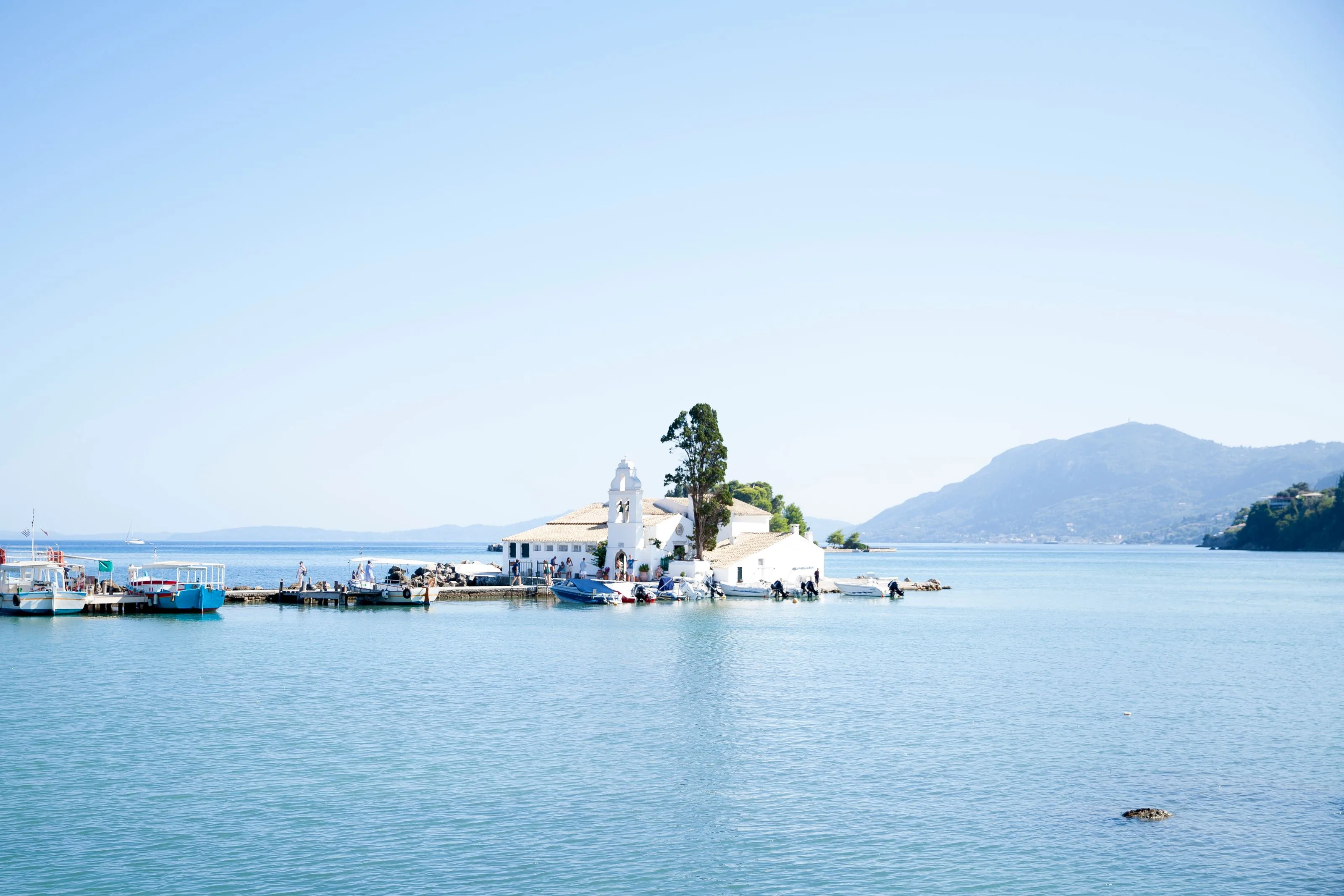
South of the town, the Kanoni peninsula has the famous islet of Pontikonisi and small white monasteries on the water, right next to the airport. The Achilleion palace, built for Empress Elisabeth of Austria (Sisi) at Gastouri, lies about 10 km south of the town. The town itself has no real beach: Faliraki, facing the Old Fortress, is the nearest swimming spot. On the west coast beaches are sandier; on the east the water is calmer (Wikivoyage EN). Paleokastritsa on the west coast and Kassiopi in the north, with its Byzantine castle, are classic destinations.
Hiking and excursions. The Corfu Trail, about 220 km long, crosses the island from north to south; on its slopes Old Perithia, the island's oldest village, nestles beneath Mount Pantokrator (around 910 m, the highest point). Day trips to Paxos or to Saranda and the site of Butrint in Albania are also offered (Wikivoyage EN); check border-crossing formalities.
Getting around
Airport, blue and green buses, ferries and cars
Ioannis Kapodistrias International Airport lies about 2 km south of the old town. A blue city bus links the airport with the centre in about ten minutes (route 15 or 19 depending on the source, to be checked); a taxi is the most direct option, but Wikivoyage EN advises asking for the price or the meter before setting off. The blue buses serve the town and its surroundings from San Rocco Square; the green buses fan out across the island from the station near the New Port (Paleokastritsa, Sidari, Kassiopi, Kavos).
By sea. Corfu is a major Adriatic port, with regular links from Italy (Venice, Ancona, Bari, Brindisi), from Igoumenitsa and Patras on the Greek mainland and from Saranda in Albania; cruise ships also call at the New Port. Crossing fares vary a lot by season and vessel type: check them with the operators.
On the island. A rental car is the easiest way to reach beaches and villages far from town. Many roads are narrow and sometimes in poor condition, so choose a small car and check the insurance. Renting a boat of up to 30 hp requires no licence (Wikivoyage EN).
Budget
A budget that varies by season and area
Corfu has welcomed tourists for over a century: accommodation ranges from simple rooms to five-star hotels in town. Wikivoyage EN notes that budget accommodation is scarcer in the old town than on the coast and that prices climb in July and August. Tavernas used by locals remain clearly cheaper than those in heavily touristed areas. Out of season many hotels and businesses close (Wikivoyage DE), which means lower rates but less choice. Check current prices before booking.
Corfu Airport
The gateway to the Ionian Sea
Ioannis Kapodistrias Airport
About 2 km south of the town centre. In summer it receives direct flights from many European cities, including low-cost carriers; the terminal dates from the 1970s, and Wikivoyage EN warns of long queues at departures in peak season.
| Route | Distance or indicative time |
|---|---|
| Airport to old town | about 2 km; around ten minutes by bus |
| Old town to the Achilleion (Gastouri) | about 10 km south |
| Length of the island | about 62 km, up to 30 km wide |
| Highest point | Mount Pantokrator, around 910 m |
SniperAir watches prices and alerts you; it does not sell or book tickets.
When to go
When to visit Corfu
May to June
Lush greenery at its peak, mild temperatures, before the summer crowds arrive.
July to August
Peak season: hot, dry summers with highs that can reach 33 °C, and the old town and beaches at their busiest.
September to October
The sea stays warm, softer light on the Venetian facades, fewer visitors; rain returns towards the end of September.
November to April
Mild, wet winters (around 10 °C), wetter than on other Greek islands; many businesses close, but flight prices are often the lowest of the year.
Corfu has about 3,000 hours of sunshine a year (Wikivoyage EN) and a Mediterranean climate with hot summers; most rain falls from November to March. Wikivoyage DE puts the best period from May to September.
How many days
Three to four days is enough
Old town
Kantounia, the Esplanade and the Liston, Saint Spyridon, the Old and New Fortress.
Museums and Kanoni
Archaeological Museum, Museum of Asian Art, Mon Repos, then the Kanoni peninsula and the Achilleion.
Coasts and villages
Paleokastritsa, Kassiopi or the northern villages, with a rental car.
Why watch Corfu with SniperAir
You don't need to compare prices every day
Pick your departure
Enter your departure airport and your maximum budget for a flight to Corfu (CFU).
SniperAir watches
Our systems continuously compare new prices with the real price history of the route. SniperAir watches prices and alerts you: it does not sell or book tickets.
You get an alert
As soon as a price matches your criteria you are notified, without having searched anything yourself.
You might also like
Similar destinations
FAQ
Frequently asked questions about flights to Corfu
What's the airport for reaching Corfu?
Ioannis Kapodistrias Airport (CFU), about 2 km from the old town, offers direct links to many European cities during the season.
How do I get from the airport to the old town?
By city bus in around ten minutes or by taxi; ask for the price or the meter before you set off.
Why does Corfu look so different from the rest of Greece?
Nearly four centuries of Venetian presence, followed by French and British periods, gave it an architecture and cuisine that set it apart. The Ottomans never conquered it.
What's the best time to visit Corfu?
May-June and September-October offer the best balance of climate and crowds. July-August is the hottest and busiest period.
Is Corfu an expensive destination?
It depends on the season and the area: prices climb in July and August and heavily touristed tavernas cost more than those used by locals. Check current prices before booking.
How do I get around Corfu?
On foot in the old town, by blue (town) and green (island) buses or by taxi; a rental car is useful for beaches and remote villages.
What should I eat in Corfu?
Sofrito, pastitsada, bourdeto, kumquat liqueur and ginger beer, plus the island's olive oil.
Which museums should I visit in Corfu?
The Archaeological Museum, the Museum of Asian Art, the Byzantine Museum, the Municipal Gallery, Mon Repos and the two fortresses.
How much does a flight to Corfu usually cost?
The price mainly depends on your departure city, the travel period and how far in advance you book. The "deals" section above shows real prices already spotted by SniperAir for this destination.
How do I get alerted when a flight to Corfu drops below my budget?
Create an alert profile with your departure airport, Corfu as the destination, and your maximum budget. You'll be notified automatically the moment a matching price is detected.
Ready to head to Corfu?
Set your budget and let SniperAir track the fares.
Create my alert