
Cheap Flights to Rhodes
Set your departure airport and your maximum budget: SniperAir tracks prices to Rhodes and alerts you the moment a deal matching your criteria appears.
Quick facts
Country
Greece
Continent
Europe
Airport
RHO
Currency
Euro (EUR)
Time zone
UTC+2 (EET)
Population
~51,000 residents
Deals already spotted to Rhodes
Real examples of flights tracked by SniperAir, with their reference price.
Loading examples…
Identity
Europe's largest inhabited medieval town
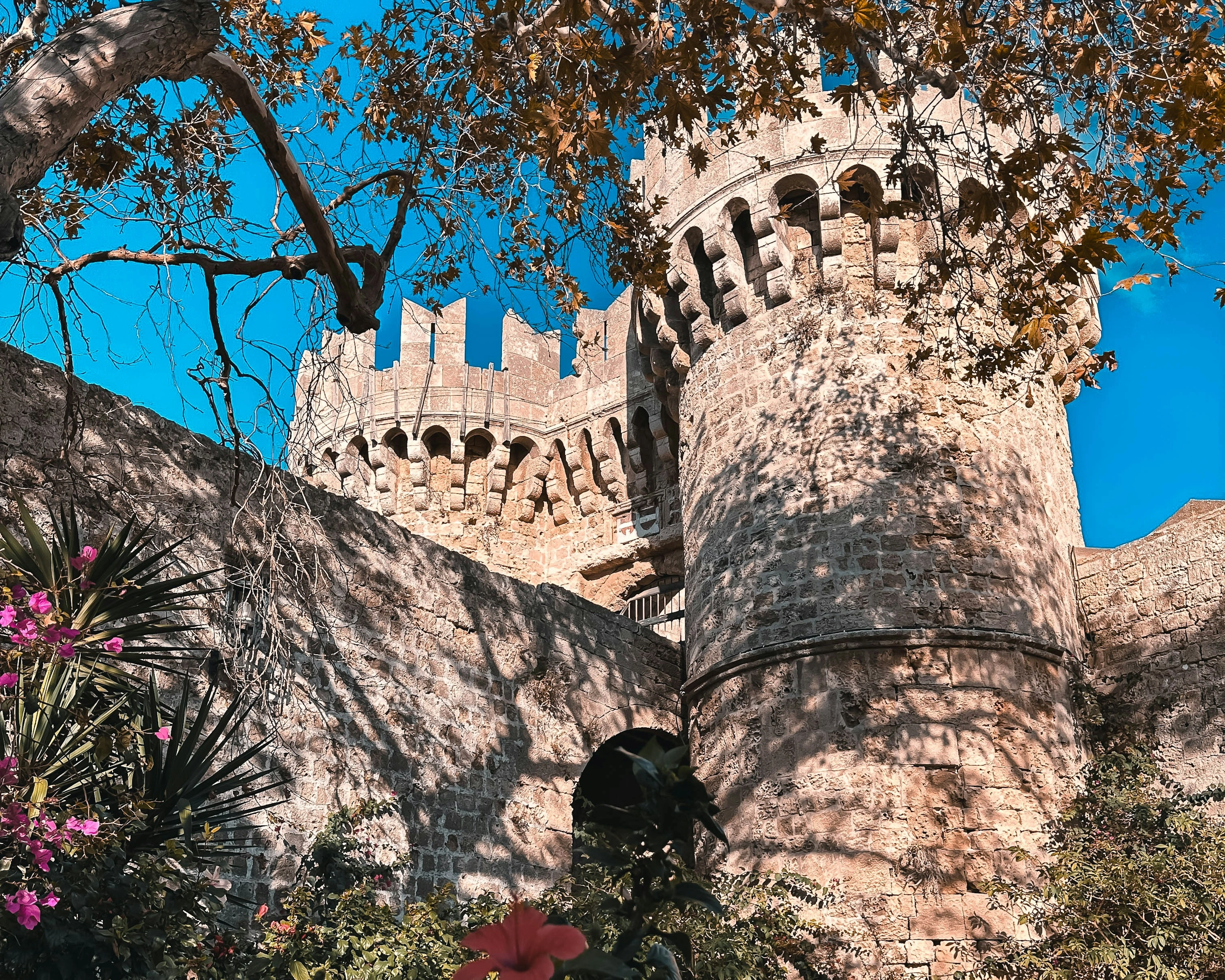
Driven out of the Holy Land after losing Saint-Jean-d'Acre in 1291, the Knights Hospitaller of St John arrived in Rhodes in 1309 and made it their stronghold for over two centuries. They fortified the city with imposing walls, defensive moats and a maze of narrow streets, withstanding major sieges — from the Sultan of Egypt in 1444 to Mehmet II in 1480 — before finally surrendering to the Ottomans in 1522. Under terms of safe passage the knights departed, and Rhodes came under Ottoman rule for nearly four centuries, followed by Italian occupation in the first half of the 20th century, before joining Greece in 1946 with the rest of the Dodecanese. That layered history of Byzantine, Hospitaller, Ottoman, Italian and British rule left Rhodes with something unique in the Mediterranean: its Old Town, a UNESCO World Heritage Site since 1988, is regarded as the largest and best-preserved inhabited medieval city in Europe, often compared to fortified towns like Carcassonne or Ávila.
Don't miss
The Street of the Knights and the Palace of the Grand Master
The Street of the Knights (Ippoton) is Rhodes' most iconic cobbled street, lined with the perfectly preserved Inns where the Order's different "tongues" (nations) were headquartered — the Inns of France, Italy, Spain and Provence among them. It leads to the Palace of the Grand Master, a 14th-century citadel with around 150 rooms; the state rooms open to the public reveal Roman and early Christian floor mosaics alongside Flemish tapestries. A little further on, the former Hospital of the Knights, built between 1440 and 1489, now houses Rhodes' Archaeological Museum, with collections spanning the Mycenaean to the Roman era. A combined ticket (around €10, €5 reduced) covers the Palace, the Archaeological Museum and the Museum of Decorative Arts.
To discover
Mandraki, the Colossus and the Süleyman Mosque
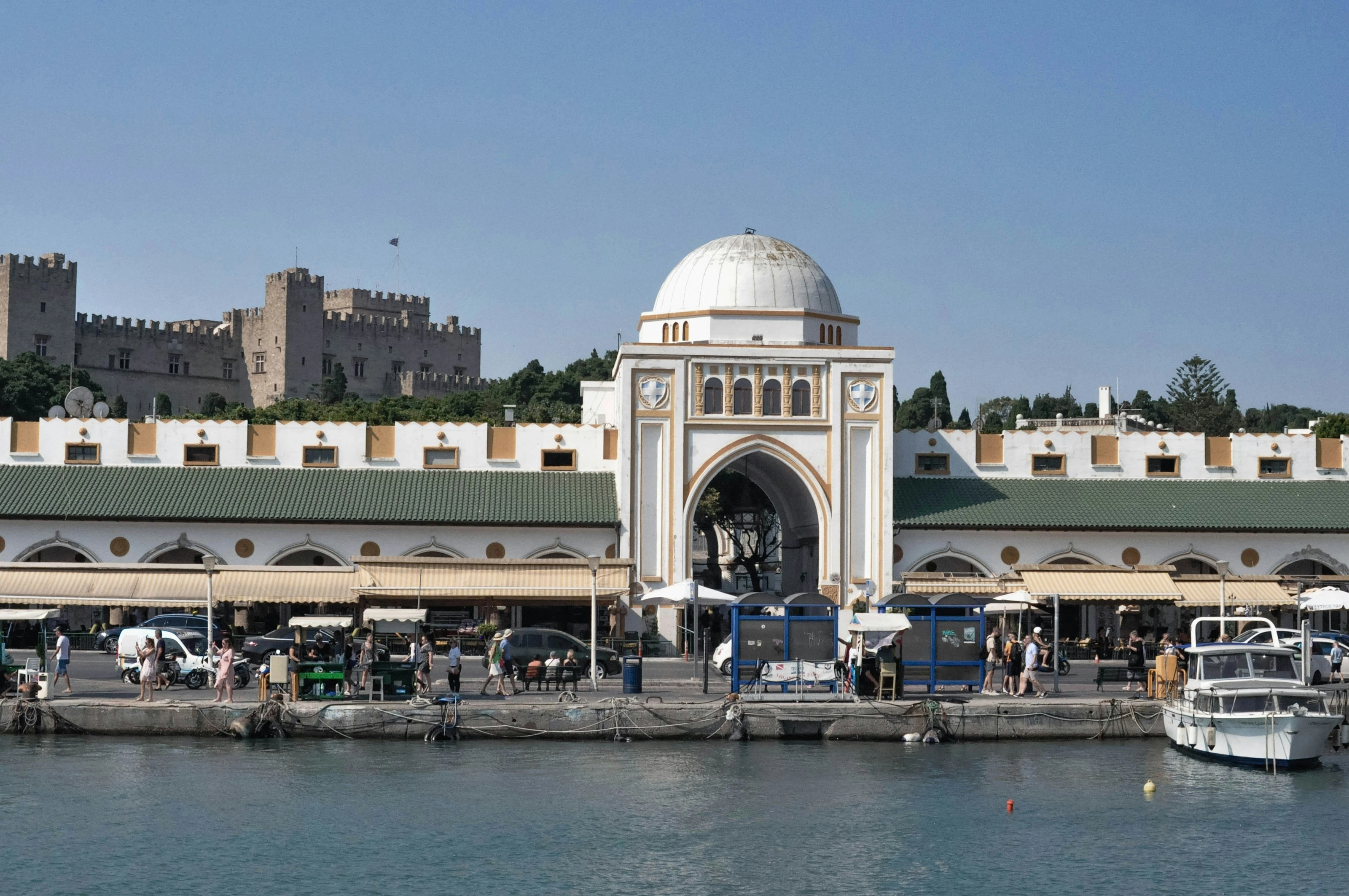
Mandraki harbour, at the junction of the Old and New Towns, once moored the Knights' galleys. At its entrance, two columns topped with bronze deer statues mark the spot traditionally associated with the Colossus of Rhodes: this 37-metre bronze statue of the sun god Helios, one of the Seven Wonders of the Ancient World, collapsed in an earthquake around 226 BC — historians still debate its exact original location. In the lower town, the Süleyman Mosque, built after the 1522 conquest and rebuilt in 1808, is a lingering reminder of nearly four centuries of Ottoman rule, as is the former Jewish quarter of the Juderia, centred on Dossiadou Street: in the 1930s Rhodes counted around 6,500 Jewish residents and 6 synagogues, and the 16th-century Kahal Shalom Synagogue remains Greece's oldest active synagogue today.
Day trip
Lindos and its clifftop acropolis
About 45 km south of Rhodes Town, Lindos combines a village of gleaming whitewashed houses with a dramatic acropolis perched 116 metres above the sea, where a Doric temple of Athena Lindia, a Knights' castle and an ancient amphitheatre all sit side by side — the climb up can be done on foot or, traditionally, by donkey. Below, St Paul's Bay is a heart-shaped cove that ranks among the island's most photographed spots. Symi, a 1 to 1.5-hour ferry ride away, is also well worth the detour for its pastel-coloured neoclassical mansions around Gialos harbour and the Monastery of the Archangel Michael at Panormitis; quieter Chalki centres on the small port of Emporio, where you can swim straight off the quay.
Food
Pitaroudia and cumin, an Anatolian inheritance
Rhodian cooking stands apart from mainland Greek cuisine through its generous use of cumin — a spice rarely found elsewhere in the country — and its frequent reliance on bulgur, both echoes of the island's proximity to Anatolia. The island's signature dish, pitaroudia, are fried chickpea fritters seasoned with onion, tomato, mint and cumin, varying from village to village with additions like courgette or cauliflower. Other local staples include lakani, a stew of goat and chickpeas, giaprakia (stuffed vine leaves), and, for dessert, melitinia — small cheese-and-honey pastries. The nearby island of Symi is famous for its tiny fried garidaki shrimp, served as an appetiser throughout the Old Town.
Beaches
From Elli in town to windswept Prasonisi
Elli Beach, with its clear blue water, sits right in Rhodes Town and ranks among the finest urban beaches in the Mediterranean. Further south, Tsambika Bay (26 km) unfurls fine golden sand in a family-friendly setting that gets very busy in peak season, while Anthony Quinn Bay, named after the actor who filmed "The Guns of Navarone" here, is a favourite with divers and snorkellers. At the island's southern tip, Prasonisi marks the point where the Aegean and Mediterranean seas meet: its crossing winds make it one of Europe's best-known windsurfing and kitesurfing spots.
Getting around & budget
Diagoras Airport, KTEL buses and Dodecanese ferries
Rhodes International Airport, named "Diagoras" after a famed 5th-century BC Greek boxer, sits about 14 km southwest of town, with direct flights to Athens in under an hour and numerous European charter routes in summer. The KTEL bus network, departing from two terminals in town, regularly serves the east coast as far as Lindos as well as the west coast; renting a car is still recommended for exploring the island's interior and south, which are less well served. By sea, the port of Rhodes runs daily seasonal connections to Symi (1 to 1.5 hours) and Kos (2 to 3.5 hours), regular services to Karpathos, Kastellorizo, Nisyros, Patmos and Tilos, plus seasonal crossings to nearby Turkey (Fethiye and Marmaris).
Best time to go
When to visit Rhodes?
April to June
Ideal for the medieval town without summer's heat or crowds, sea still cool.
July to August
Peak beach season, strong heat, Lindos and the beaches very busy.
September to October
Sea still warm, sites less crowded, cheaper fares than midsummer.
November to March
Low season, a quieter island, a good time to explore the Old Town without the crowds.
Rhodes Airport
The gateway to the Dodecanese
"Diagoras" International Airport
About 14 km southwest of town, with direct flights to Athens and many European cities in summer.
You might also like
Similar destinations

FAQ
Frequently asked questions about flights to Rhodes
What's the best airport for reaching Rhodes?
"Diagoras" International Airport (RHO), about 14 km southwest of town, offers direct flights to Athens and many European cities in summer.
How much time should I set aside for the Old Town of Rhodes?
Allow at least a full day for the Street of the Knights, the Palace of the Grand Master and the Archaeological Museum; the medieval town is also well worth a second, evening visit.
What's the best time to visit Rhodes?
April to June and September-October offer the best balance of weather and crowds. July-August is the hottest and busiest period, especially at Lindos.
How much does a flight to Rhodes usually cost?
The price mainly depends on your departure city, the season and how far ahead you book. The "deals" section above shows real examples of prices already spotted by SniperAir for this destination.
How do I get alerted when a flight to Rhodes drops below my budget?
Create an alert profile with your departure airport, Rhodes as the destination and your maximum budget. You'll be notified automatically as soon as a matching price is detected.
Ready to fly to Rhodes?
Set your budget and let SniperAir track the fares.
Create my alert