
Cheap Flights to Thessaloniki
Set your departure airport and your maximum budget: SniperAir tracks prices to Thessaloniki and alerts you the moment a deal matching your criteria appears.
Quick facts
Country
Greece
Continent
Europe
Airport
SKG
Currency
Euro (EUR)
Time zone
UTC+2 (EET)
Population
Greece's 2nd largest city
Deals already spotted to Thessaloniki
Real examples of flights tracked by SniperAir, with their reference price.
Loading examples…
Identity
2,300 years of Roman, Byzantine and Ottoman history, at human scale
Founded around 315 BC by Cassander, King of Macedonia, who named the city after his wife, half-sister of Alexander the Great, Thessaloniki became, under the Byzantine Empire, the "First after the First" — the most important city after Constantinople itself. Conquered by the Ottomans in 1430, it remained the capital of the empire's European territories for nearly five centuries, while simultaneously hosting one of the world's largest Sephardic Jewish communities following the expulsion from Spain in 1492. Integrated into the Greek state in 1912 during the First Balkan War, the city's "Greekness" was reinforced in 1922 by the arrival of refugees from Asia Minor, who brought with them much of the culinary culture it's known for today. Fifteen of the city's early Christian and Byzantine monuments have been UNESCO World Heritage Sites since 1988 — a historical depth comparable to Athens, but in a city with half the population and a fraction of the tourist crowds.
Don't miss
The White Tower, from Ottoman prison to city symbol
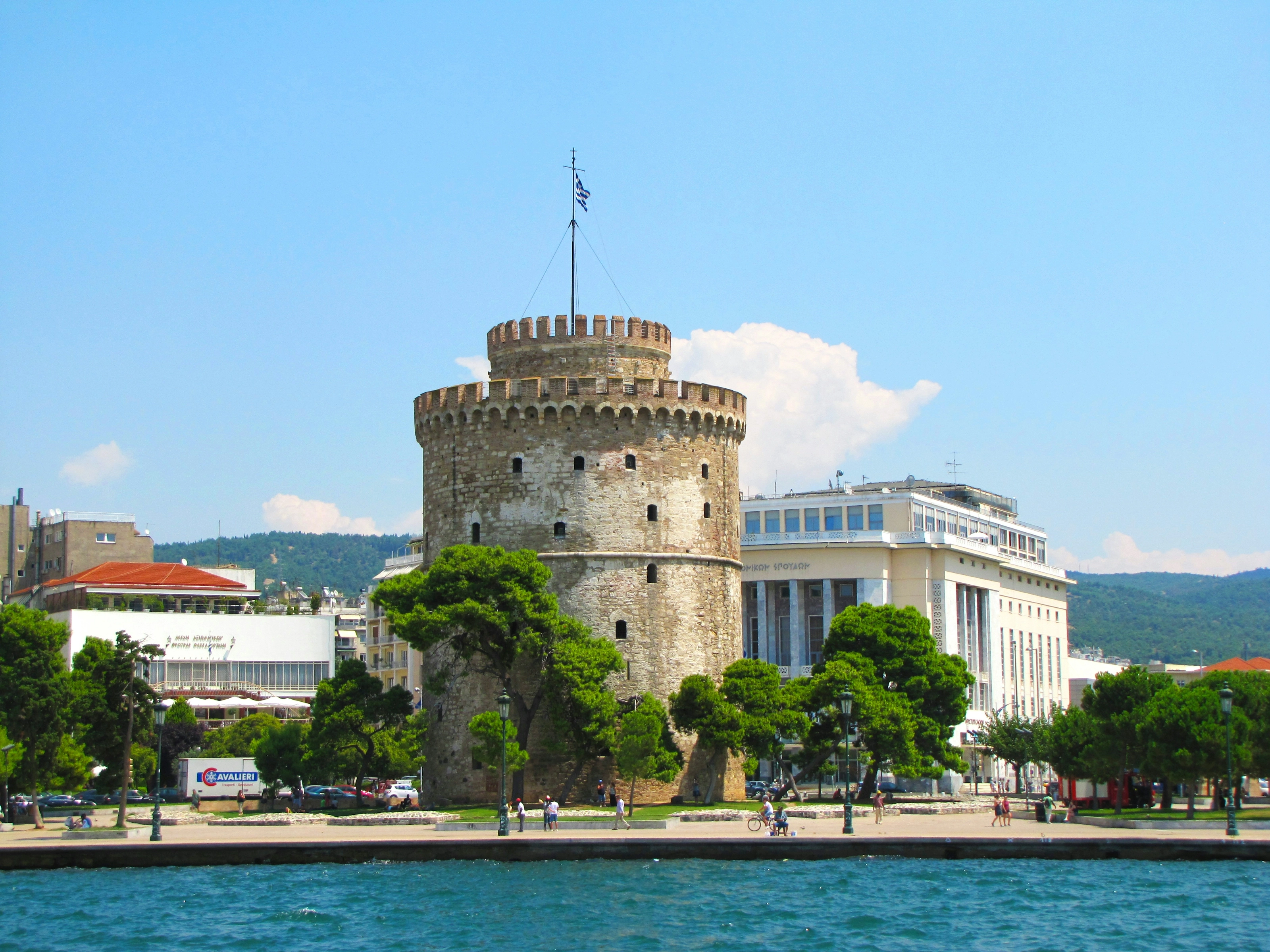
On the seafront, the White Tower (Lefkos Pyrgos) replaces a Byzantine fortification first mentioned in the 12th century; its current cylindrical form, around 34 m high, dates from the Ottoman rebuilding that followed Sultan Murad II's capture of the city in 1430. Long nicknamed the "Tower of Blood" for its use as a prison where the rebelling janissaries were executed in 1826 on Sultan Mahmud II's orders, it was whitewashed after the city joined Greece in 1912 — a symbolic gesture marking the end of that brutal chapter. Now a museum, it houses four floors of exhibitions curated by the Museum of Byzantine Culture covering the city's history, and its rooftop platform offers one of the best views over the city, the harbour and the Thermaic Gulf, especially at sunset.
To discover
Ano Poli, the Rotunda and Modiano Market
Ano Poli, the Upper Town, is the only district to survive the great fire of 1917: its cobbled lanes lined with wooden Ottoman houses and encircled by 4th-century Byzantine walls offer, from the Trigonion Tower, a panoramic view over the whole bay away from the crowds of the seafront. Below, the Rotunda of St George, a Roman-era monument from the Tetrarchy dating to around 300 AD, and the 8th-century early Christian basilica of Hagia Sophia testify to the scale of the city's Byzantine legacy. Ladadika, a former oil and spice warehouse district near the port, now concentrates much of the city's nightlife and tavernas, while Modiano Market, built in the 1920s, and the neighbouring Athonos Square remain the best places to sample spices, cheeses and local produce right in the city centre.
Day trip
Meteora, Vergina and the Chalkidiki peninsula
Thessaloniki is an ideal base for exploring northern Greece: the monasteries perched atop Meteora's sandstone towers, the country's most spectacular day trip, are just a few hours' drive west, as are the royal tombs of Vergina, burial site of Philip II of Macedon, father of Alexander the Great, and Pella, Alexander's own birthplace. About an hour to the southeast, the Chalkidiki peninsula unfolds its three "fingers" — Kassandra with its fine sandy beaches, Sithonia with wilder coves, and the approach to Mount Athos near Ouranoupoli — giving the city quick access to the sea it lacks along its own urban shoreline.
Food
Bougatsa, koulouri and gyros: Greece's best food scene?
Recognised as a UNESCO City of Gastronomy, Thessaloniki is considered by many Greeks to have the country's best food scene, a direct legacy of its cosmopolitan Ottoman, Sephardic and Asia Minor refugee past. Bougatsa, a filo pastry filled with custard, cheese or meat and dusted with icing sugar and cinnamon, is the absolute local institution — Serraikon Bougatsa, founded in 1952, and Bantis, since 1969, are among the historic addresses. Koulouri, a sesame-covered bread ring, is sold on every street corner for breakfast, while Aristotelous Square remains famous for its gyros, notably at "O Gyros tis Aristotelous". This taste for shared mezze, brought by the 1920s refugees, also shows up in patsa (tripe soup) and the region's Macedonian pies.
Student life & nightlife
A university city, young and lively
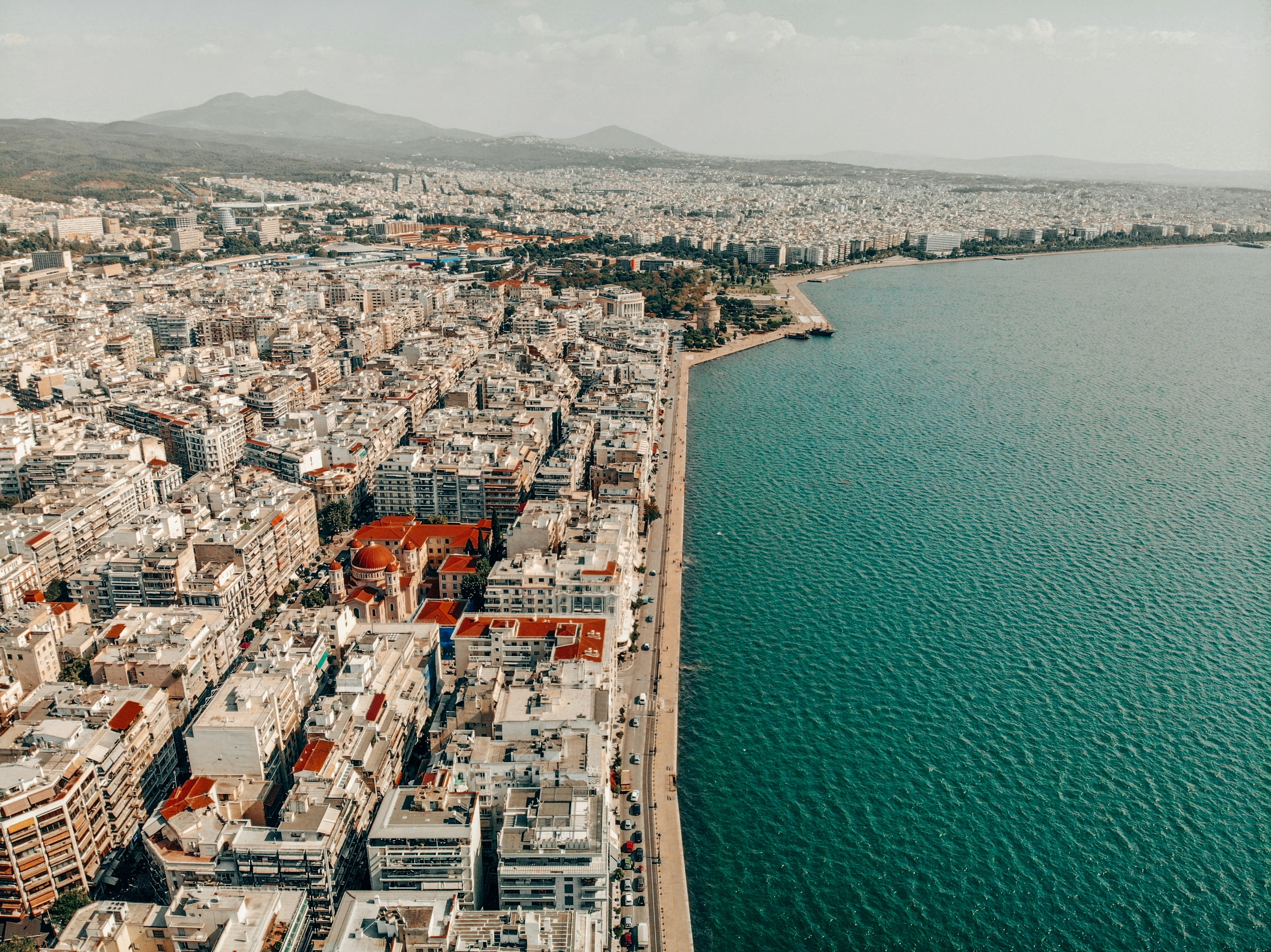
With around 150,000 students, Thessaloniki keeps a vibrant music and cultural scene alive year-round, not just in summer. Ladadika and the streets around Aristotelous Square are packed with bars and clubs, in an atmosphere famous throughout Greece; the Nea Paralia promenade, stretching from the White Tower, is the city's daily artery, popular with cyclists, families and street performers. This student energy contrasts with the historical depth of the centre, offering a very different urban experience from Athens — with far fewer crowds for a comparable wealth of heritage.
Getting around & budget
Makedonia Airport, Chalkidiki and links to Athens
Thessaloniki "Makedonia" Airport sits about 16 km southeast of the city centre, with direct flights to numerous European destinations. Thessaloniki is also connected to Athens by train (around 4 hours) or coach (around 5 hours), covering roughly 500 km between the two cities. Renting a car is recommended for exploring beyond the very walkable, compact centre: Ano Poli, the Byzantine walls and the beaches of Chalkidiki are all easy to reach by car, while parking remains limited and paid in the city core.
Best time to go
When to visit Thessaloniki?
April to June
Mild climate, ideal for walking Ano Poli and the historic centre on foot.
July to August
Hot and sometimes humid, above 30°C; the sea breeze off the gulf softens the heat.
September to October
Student life picks back up, temperatures still pleasant, a good balance year-round.
December to February
Cooler winter than the islands, rarely below 0°C, occasional snow possible.
Thessaloniki Airport
The gateway to northern Greece
"Makedonia" International Airport
About 16 km southeast of the city centre, direct flights to numerous European destinations.
You might also like
Similar destinations
FAQ
Frequently asked questions about flights to Thessaloniki
What's the best airport for reaching Thessaloniki?
"Makedonia" International Airport (SKG), about 16 km southeast of the city centre, offers direct flights to many European cities.
How many days should I plan for Thessaloniki?
Two to three days are enough for the historic centre, the food scene and the seafront; add a day or two for a trip to Meteora, Vergina or the beaches of Chalkidiki.
Does Thessaloniki have beaches?
No, the city itself has no beach; the closest beaches are on the Chalkidiki peninsula, about 1 to 1.5 hours' drive to the southeast.
How much does a flight to Thessaloniki usually cost?
The price mainly depends on your departure city, the season and how far ahead you book. The "deals" section above shows real examples of prices already spotted by SniperAir for this destination.
How do I get alerted when a flight to Thessaloniki drops below my budget?
Create an alert profile with your departure airport, Thessaloniki as the destination and your maximum budget. You'll be notified automatically as soon as a matching price is detected.
Ready to fly to Thessaloniki?
Set your budget and let SniperAir track the fares.
Create my alert