
Cheap flights to Cagliari
Set your departure airport and maximum budget: SniperAir tracks prices to Cagliari and alerts you the moment a deal matching your criteria appears.
Quick summary
Country
Italy
Continent
Europe
Airport
CAG
Currency
Euro (EUR)
Time zone
UTC+1 (UTC+2 during summer time)
Deals already spotted to Cagliari
Real flight examples detected by SniperAir, with their reference price.
Loading examples…
Why track Cagliari with SniperAir
You do not need to compare prices every day
Choose your departure
Enter your departure airport and your maximum budget for a flight to Cagliari (CAG).
SniperAir keeps watch
Our systems continuously compare new prices with the real price history of the route. SniperAir monitors prices and alerts you: it does not sell or book tickets.
You receive an alert
As soon as a price matches your criteria, you are notified, without having searched for anything yourself.
Airport and getting into town
An airport to the north-west, linked to the centre by train
Cagliari-Elmas (CAG)
Cagliari-Elmas, the busiest airport in Sardinia according to Wikivoyage (EN), sits at Elmas, about 6 km north-west of the centre (Wikivoyage EN). Elmas Aeroporto station, next to the terminal, is linked with Cagliari station by regional trains: a ride of about ten minutes, with departures roughly every twenty minutes per Wikivoyage (EN); Wikivoyage (DE) also mentions a metropolitan rail service calling at the airport. Taxis and ARST buses also run during the day (Wikivoyage FR). Olbia and Alghero airports are much farther away and mean a long road trip to reach the south of the island.
Distances and times are approximate, from Wikivoyage (EN, FR, DE, ES); timetables change, so check them before you travel. We do not quote fares.
Cagliari, Casteddu ("castle") in Sardinian, is the capital of Sardinia: about 146,000 residents according to Wikipedia (EN, DE, ES) and more than 430,000 in the wider urban area according to Wikipedia (FR) and Wikivoyage (EN); figures vary by source. The city spreads around a gulf and over limestone hills, between lagoons, salt pans and beaches, and was successively Phoenician, Roman, Pisan and Aragonese.
Landmarks
Castello, Pisan towers, the Saint Remy bastion and old-town lanes
The heart of the old town is the Castello quarter, on a hill facing the gulf (Wikivoyage EN). Wikivoyage recommends exploring it on foot: almost everything worth seeing is within walking distance, and the best views of the gulf are not reachable by car. The places below are illustrated; the cathedral, the Pisan towers and the Roman amphitheatre are covered at the end of the section.
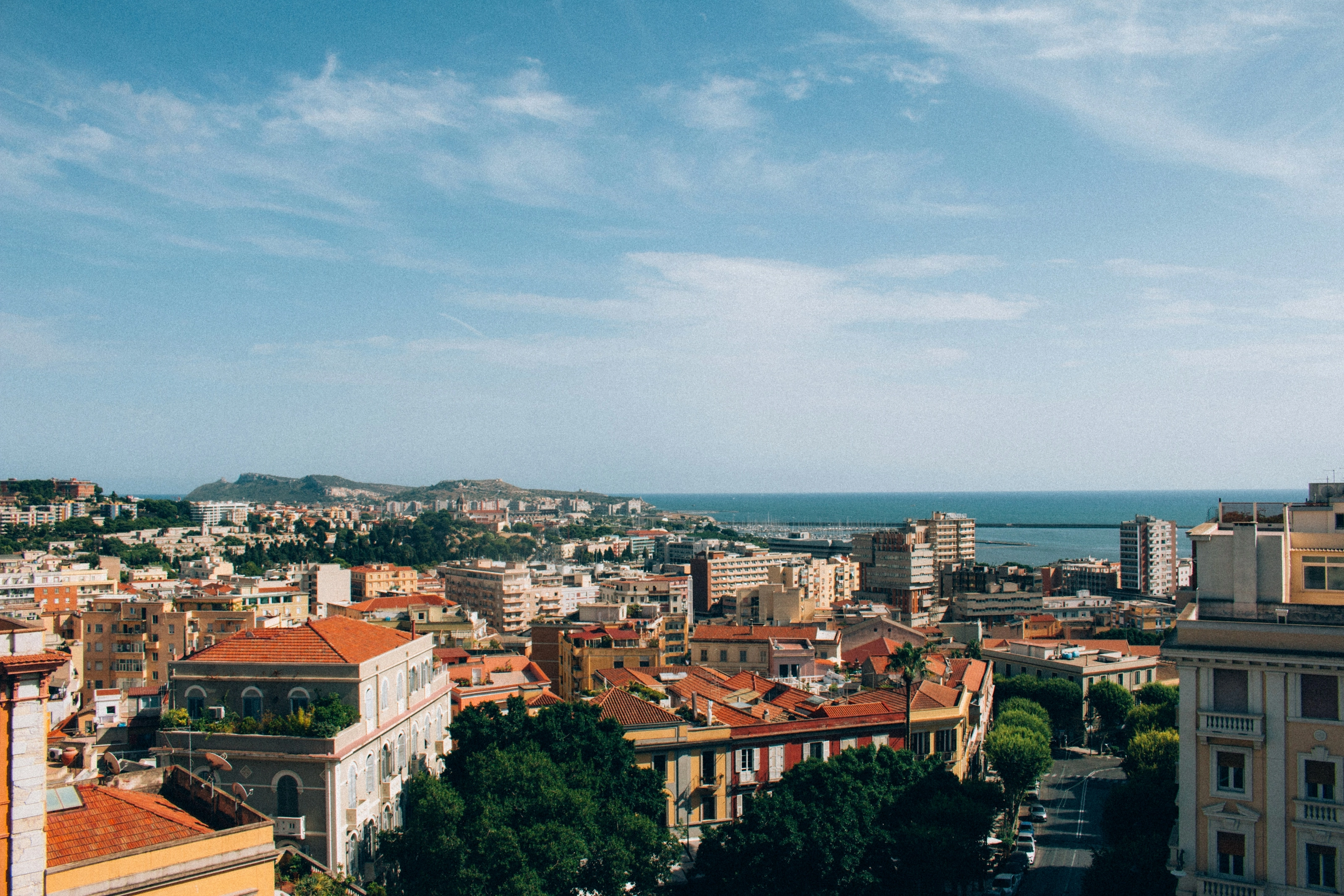
A gulf seen from above
Tiled roofs step down to the sea, with the hills of the gulf in the distance. Cagliari is built on several hills: Castello, the highest in the centre, but also Bonaria, Monte Urpinu and the hill of St Elias, called Sella del Diavolo ("the Devil's saddle") for its shape, per Wikipedia (FR, ES).
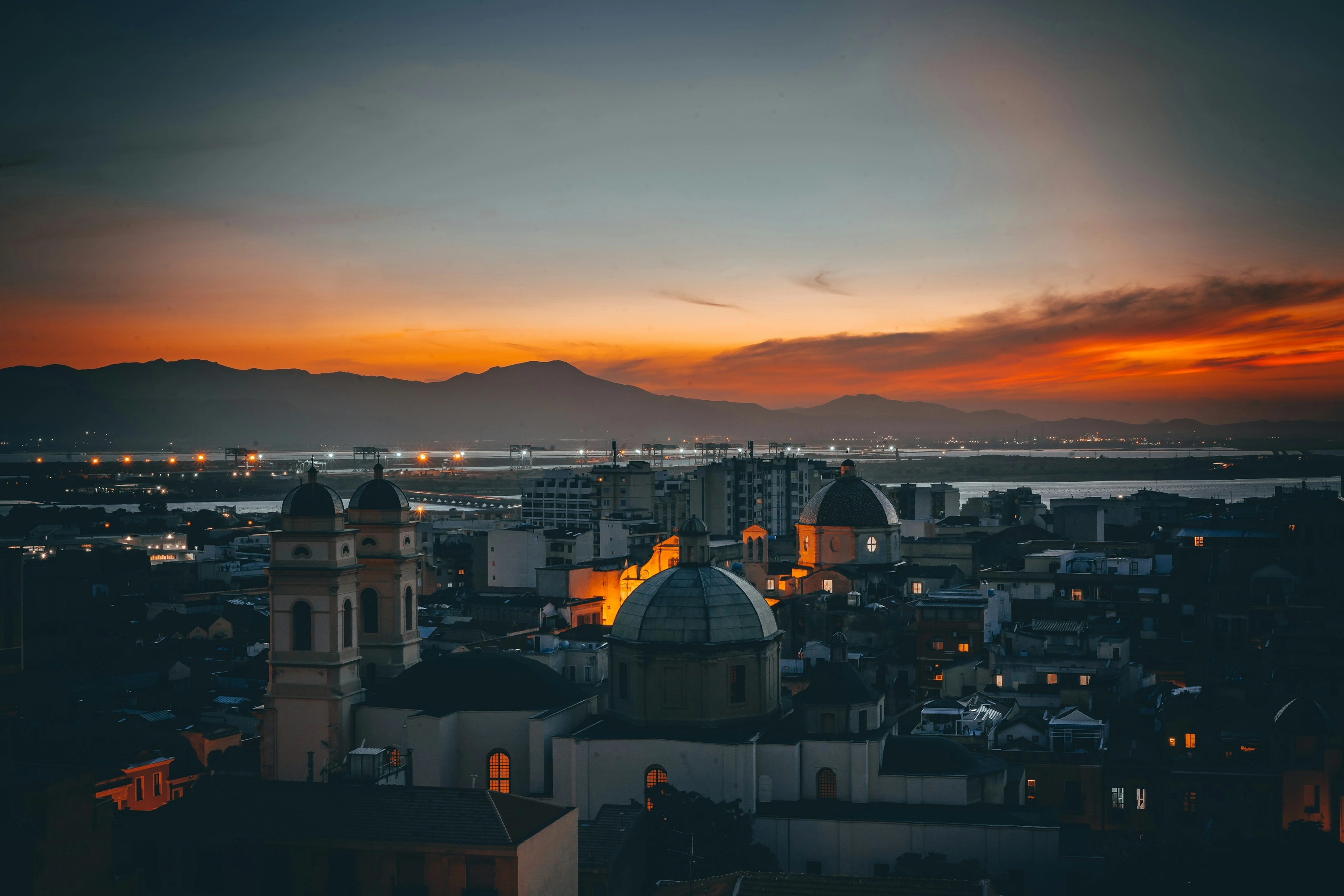
Old-town churches at dusk
As night falls, the domes and bell towers of the churches stand out above the roofs. San Michele in the Stampace quarter, consecrated in 1538, is the best example of Spanish Rococo decoration on the island according to Wikivoyage (EN); Wikipedia (DE) sees it as Catalan Baroque. The Sanctuary of Our Lady of Bonaria has parts dating to 1335.
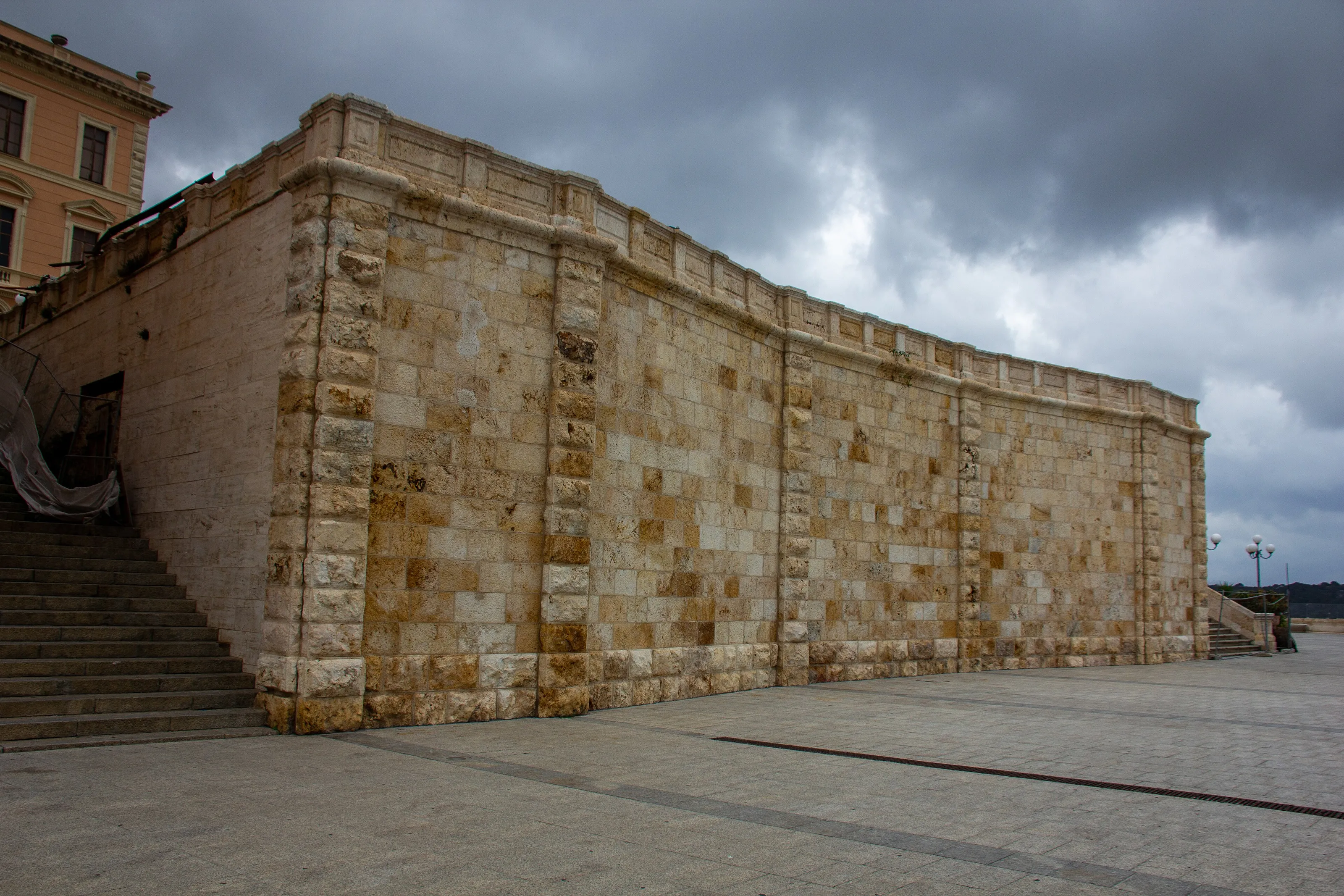
The Saint Remy bastion
This imposing fortification, built in the late 19th century according to Wikivoyage (EN), serves as a monumental entrance to Castello. You can climb its great stairways, or take the lift, for views of the city, the sea and the mountains. The facades of Via Roma, with the 1907 Palazzo Civico, are eclectic and Liberty in style.
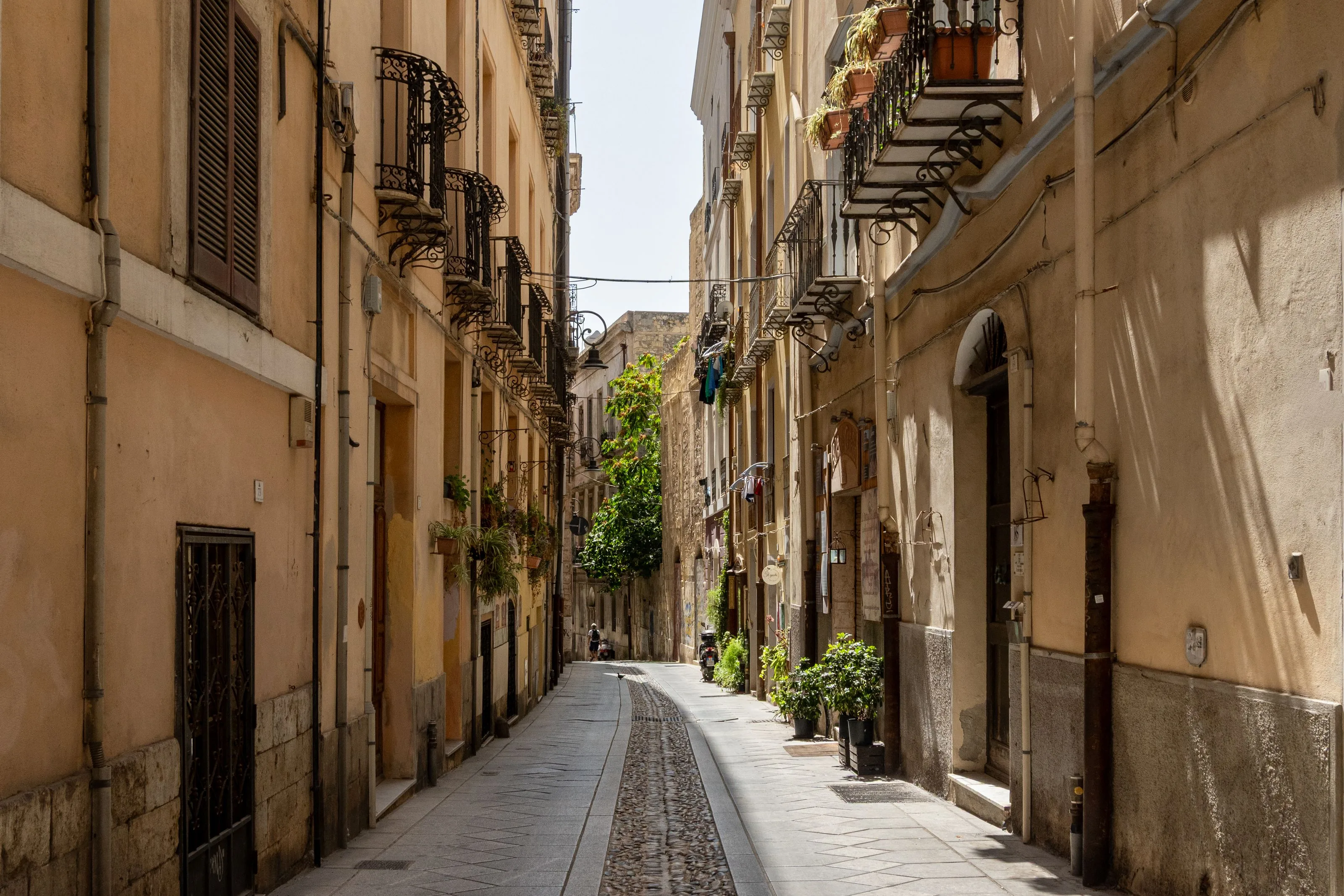
Old-town lanes
The narrow streets of Castello and Stampace, with ochre facades and wrought-iron balconies, are pedestrian or limited-traffic zones. The old town is hilly, so you are going up or down nearly everywhere, and comfortable shoes help (Wikivoyage FR).
The Molentargius salt pans
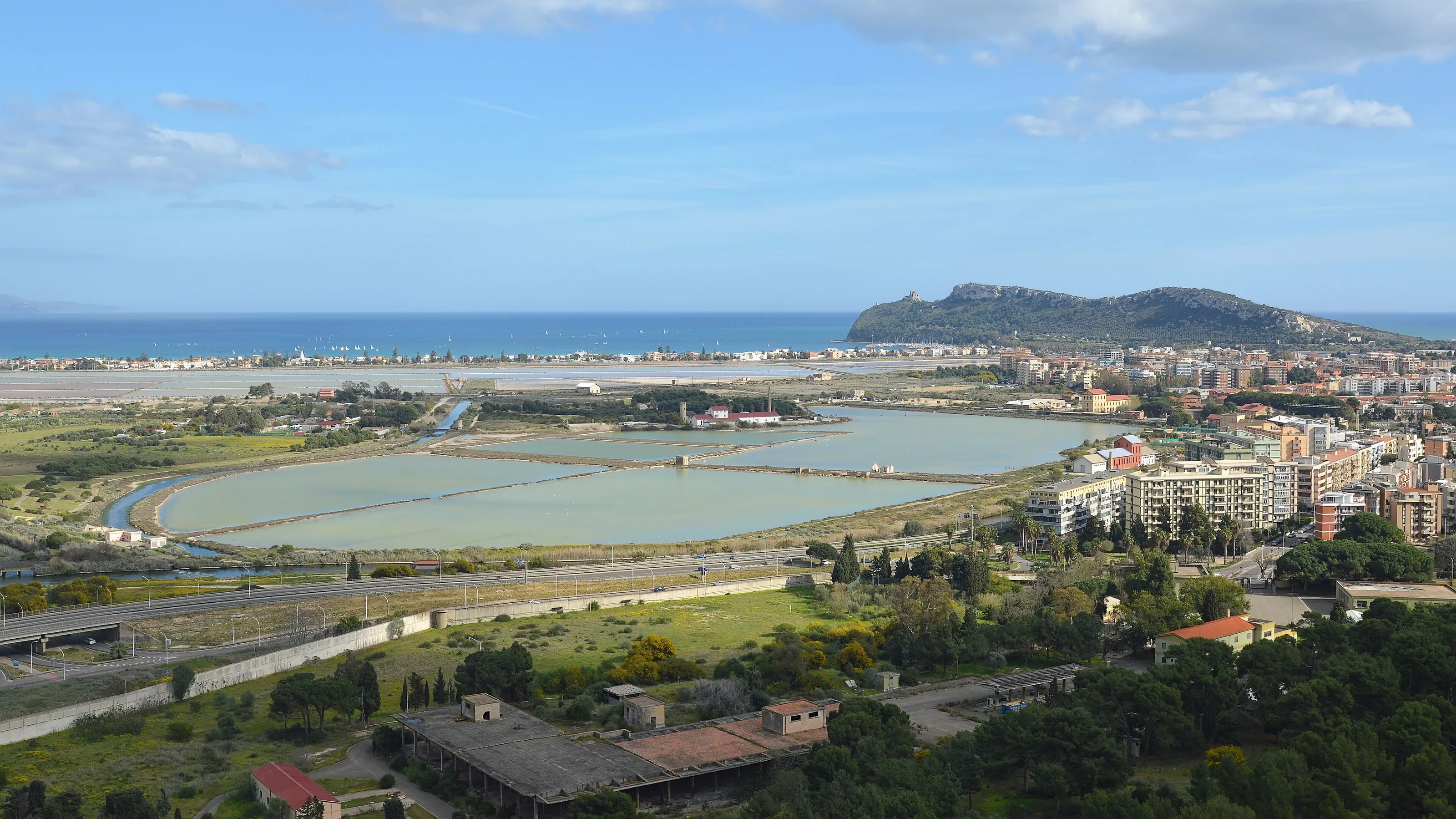
Between the city and Poetto beach, the salt pans and ponds of Molentargius form a regional nature park; salt production there stopped in 1984 (Wikipedia DE). Flamingos land there in summer according to Wikivoyage (EN), and a path allows you to watch them. It makes a striking contrast with the ochre city next door.
Poetto beach
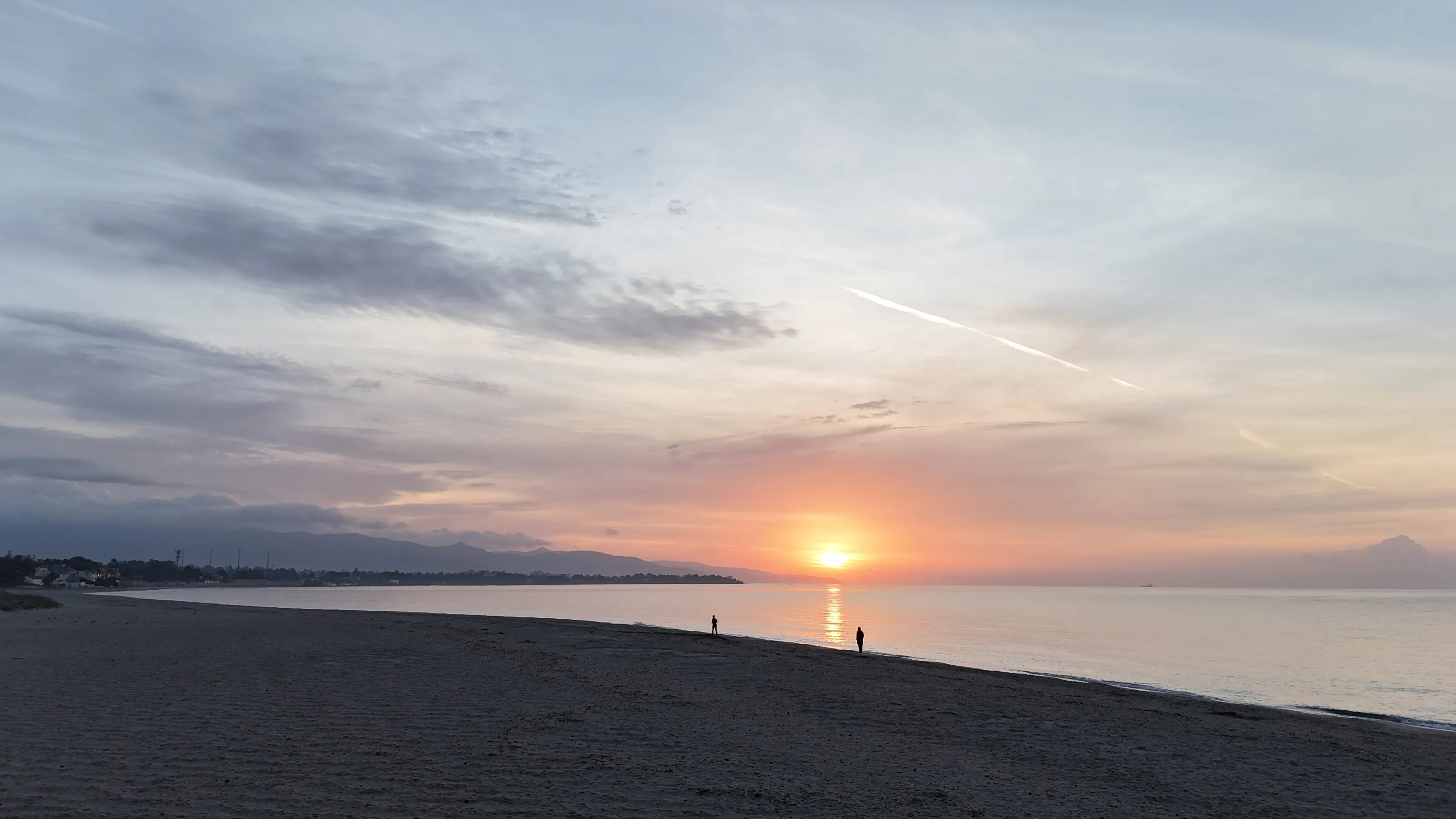
Poetto beach stretches south-east of the city for several kilometres of fine sand; sources give anything from 7 to 10 km, so we quote no length. It is split between free areas and beach clubs with umbrellas and showers, and several bus lines go there (Wikivoyage FR, EN). At dawn it is also a place for a walk.
Cathedral, Pisan towers, amphitheatre
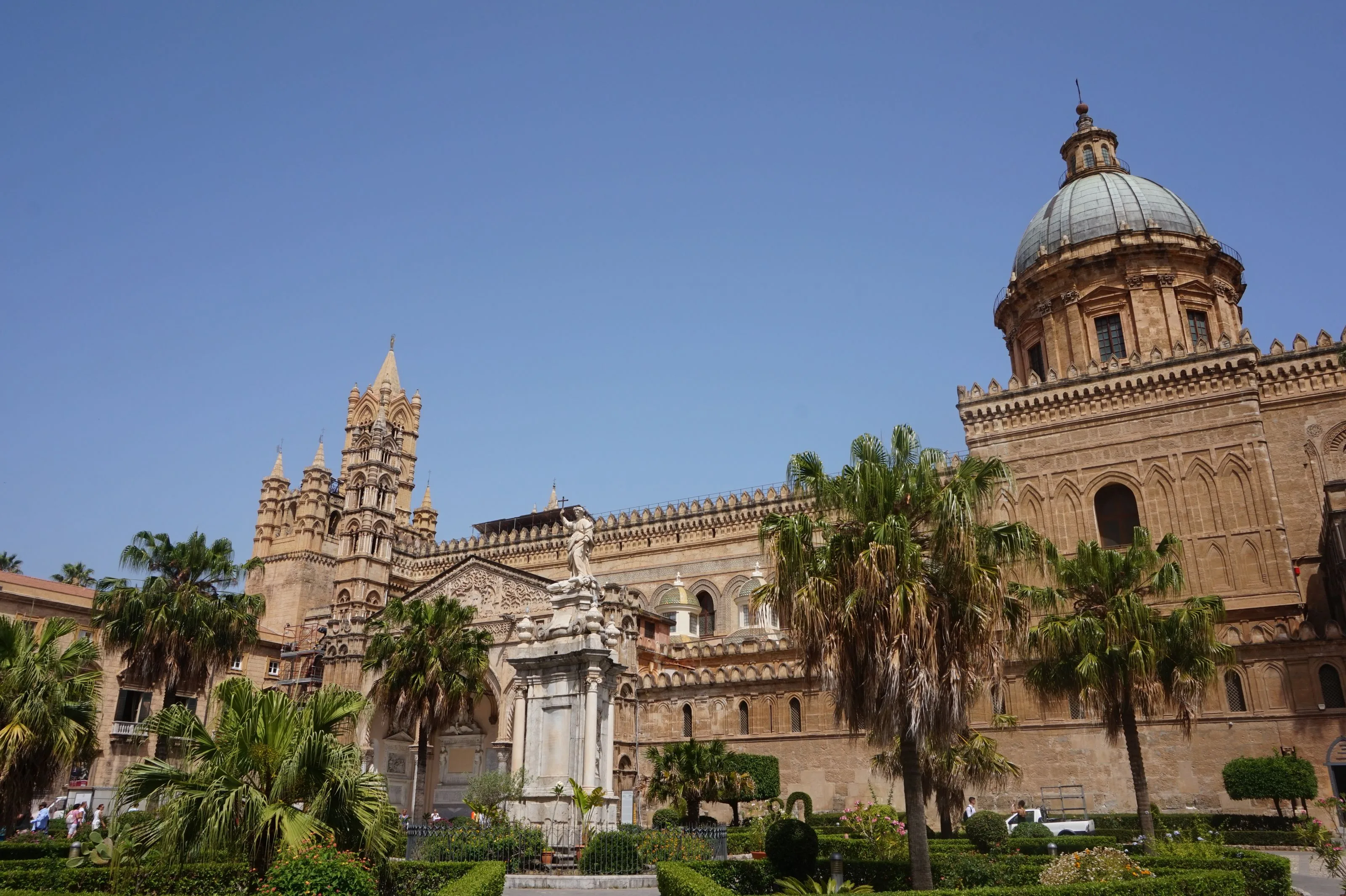
The 13th-century Cathedral of Santa Maria di Castello houses the Shrine of the Martyrs, cut into the rock (Wikivoyage EN). The towers of San Pancrazio (1305) and the Elephant (1307), both by the Sardinian architect Giovanni Capula, date from Pisan rule. The Roman amphitheatre, the Basilica of San Saturnino, the city's oldest church with an early Christian core from the 5th century, and the Capuchin garden round off a visit.
Museums and culture
Archaeology, Sardinian art, anatomical waxes and the Sant'Efisio festival
The National Archaeological Museum
It stands in Piazza Indipendenza and traces Sardinia's prehistory and antiquity according to Wikivoyage (EN). We do not quote prices or opening times.
Picture gallery, art gallery and Siamese museum
The Pinacoteca Nazionale gathers Sardinian paintings from the 16th to 20th centuries, works of the Genoese, Neapolitan and Roman schools, and Sardinian and Catalan altarpieces. The municipal art gallery, in the public gardens, shows 19th- and 20th-century works, and the "Stefano Cardu" Siamese art museum a collection of Oriental art (Wikivoyage EN).
Anatomical waxes and the Sant'Efisio festival
The Clemente Susini anatomical wax museum at the university holds wax models of the body (Wikivoyage EN). On 1 May the feast of Sant'Efisio is the most important religious event in the city and on the island, with folk groups from all over Sardinia in traditional costume (Wikipedia FR, EN, DE).
Food and drink
Seafood, malloreddus, fregola and bottarga
A cuisine turned to the sea
Wikipedia (FR) stresses that, unlike the rest of the island, Cagliari's cooking relies mainly on fish and seafood, with Spanish, Sicilian and Genoese influences. Dishes it names include burrida (cold dogfish in vinegar), fregola with clams, pan-cooked mussels and clams, boiled lobster and bottarga (salted, dried mullet roe) grated over pasta.
Pasta and festive dishes
Malloreddus, small semolina gnocchi with saffron, tomato sauce, sheep's cheese and sausage, are the traditional pasta, alongside culurgionis stuffed with ricotta. Porceddu (roast suckling pig) is a Christmas dish and roast lamb an Easter one (Wikipedia FR).
Desserts and drinks
Look for pardulas made with fresh cheese, pabassinas with raisins, pani de saba and candelaus layered with orange-scented almond paste. Vineyards in the nearby Campidano produce cannonau, nuragus and monica, and myrtle liqueur is the best known (Wikipedia FR). Wikivoyage (FR) also mentions ice-cream parlours and small lunch spots on Piazza Yenne. We do not recommend specific addresses and do not quote prices.
Getting around
On foot in the centre, buses and light rail
Walking
Almost everything worth seeing is within walking distance (Wikivoyage EN, FR). The old town is hilly, with ups and downs: good shoes help.
Buses and light rail
The CTM bus network has about 30 bus lines and 3 trolleybus lines, reliable "by Italian standards" according to Wikivoyage (EN). Metrocagliari, run by ARST, is a two-line light rail serving the city and part of its metropolitan area, away from the centre (Wikivoyage EN, DE).
Driving
Parking and driving in rush hour are very difficult (Wikivoyage EN, FR), and several central areas such as Marina, Castello, Villanova and Stampace are limited-traffic zones. Leave the car for coastal excursions.
Budget and precautions
A human-sized city to approach with common sense
Price level
We give no figures because we could not cross-check them against two independent sources; prices for meals, lodging, private beaches and transport change from year to year. Wikivoyage (EN) notes that free beaches sit alongside paid clubs.
Precautions
The centre is explored on foot, with sloping streets and stairs: take care in rain or heat. Take the usual port-city precautions: closed bag, documents kept safe, water in summer.
Flights and entry
SniperAir tracks prices to CAG and compares them with the route's history, but it does not sell or book tickets. Also watch Olbia (OLB) in the north-east of the island for the Costa Smeralda. Italy is part of the Schengen area: check entry rules for your nationality and your government's official advice.
When to go
Hot dry summers, mild winters, rainy season from September
Winter (December to February)
Mild, with January averaging about 10 °C according to Wikipedia (EN). The first cold days arrive in December; snow is rare.
Spring (March to May)
Temperatures suit walking in Castello; 1 May is the busy feast of Sant'Efisio.
Summer (June to August)
Hot and dry, with peaks above 40 °C and sometimes high humidity per Wikipedia (EN, ES). The sea breeze known as s'imbattu brings some relief; from mid-June to mid-September rain is rare.
Autumn (September to November)
The rainy season begins in September according to Wikipedia (EN); temperatures stay mild, and the sea is still warm for Poetto early in the season.
Sources disagree on the climate type: Mediterranean (Csa) for Wikipedia (ES), cold semi-arid (BSk) for Wikipedia (EN). We therefore give no classification and no precise temperatures beyond cautious markers. Winds, mistral and sirocco, are frequent (Wikipedia EN).
By length of stay
What to do in Cagliari depending on how long you stay
The essentials
Castello on foot, the cathedral, the Pisan towers, the Saint Remy bastion, Via Roma and a stroll round the port.
Archaeology and beach
The archaeological museum, the Roman amphitheatre, Bonaria, the Molentargius salt pans and a day at Poetto.
Around Cagliari
Excursions along the south-east coast to Villasimius and Costa Rei, or towards Iglesias and Carbonia, with Cagliari as your base.
In pictures
Cagliari in pictures
You might also like
Similar destinations
FAQ
Frequently asked questions about flights to Cagliari
How do I get from Cagliari airport to the centre?
Cagliari-Elmas (CAG) is about 6 km north-west. The train reaches Cagliari station in around ten minutes, and buses and taxis also run. Timetables change: check them before you travel.
When is the best time to visit Cagliari?
In spring and early autumn. Summer is hot and dry, with peaks above 40 °C; winter is mild.
What is there to see in Cagliari?
The walled Castello quarter, the cathedral, the Pisan towers of San Pancrazio and the Elephant, the Saint Remy bastion, the Roman amphitheatre and the archaeological museum.
Can I swim in Cagliari?
Yes, at Poetto beach, a few kilometres from the centre and served by several bus lines; it mixes free areas and paid beach clubs.
What should I eat in Cagliari?
Seafood, fregola with clams, malloreddus, bottarga and, depending on the season, porceddu or roast lamb.
How long should I stay in Cagliari?
Two days for the old town and museums; four days with the salt pans and Poetto; five days or more for the south-east coast.
How much does a flight to Cagliari usually cost?
The price depends mainly on your departure city, the time of year and how far ahead you book. The "opportunities" section above shows real examples of prices SniperAir has already detected to this destination.
How do I get alerted when a flight to Cagliari drops below my budget?
Create an alert profile with your departure airport, Cagliari as the destination and your maximum budget. You are notified automatically as soon as a matching price is detected.
Ready to head to Cagliari?
Set your budget and let SniperAir monitor fares for you.
Create my alert