
Cheap flights to Catania
Set your departure airport and maximum budget: SniperAir tracks prices to Catania and alerts you the moment a deal matching your criteria appears.
Quick summary
Country
Italy
Continent
Europe
Airport
CTA
Currency
Euro (EUR)
Time zone
UTC+1 (UTC+2 during summer time)
Deals already spotted to Catania
Real flight examples detected by SniperAir, with their reference price.
Loading examples…
Why track Catania with SniperAir
You do not need to compare prices every day
Choose your departure
Enter your departure airport and your maximum budget for a flight to Catania (CTA).
SniperAir keeps watch
Our systems continuously compare new prices with the real price history of the route. SniperAir monitors prices and alerts you: it does not sell or book tickets.
You receive an alert
As soon as a price matches your criteria, you are notified, without having searched for anything yourself.
Airport and getting into town
An airport south of the city, linked by bus and train
Catania-Fontanarossa (CTA)
Catania-Fontanarossa Airport sits on the coast south of the centre, a few kilometres away according to Wikivoyage (EN, DE); sources disagree on the exact distance, so we do not quote one. The Alibus links the airport with the seaport and the central station in about half an hour, then loops through the centre on the way back (Wikivoyage EN, DE). A railway station opened at the end of 2020, roughly 500 to 600 m from the terminal on foot or by shuttle; regional trains reach Catania Centrale in a few minutes and continue towards Taormina and Messina (Wikivoyage DE, EN). Eruptions of Etna can disrupt flights, as in July 2024 according to Wikivoyage (EN), and the airport occasionally closes for a day; Comiso, Trapani and Palermo then act as fallbacks (Wikivoyage DE).
Distances and times are approximate, from Wikivoyage (EN, FR, DE, ES); timetables change, so check them before you travel. We do not quote fares.
Catania is Sicily's second city after Palermo, with about 297,000 residents according to Wikipedia (FR, DE) and around a million in its urban area according to Wikivoyage (EN). It lies on the Ionian coast at the foot of Mount Etna, Europe's largest active volcano per Wikipedia (DE, ES). Greek settlers from Chalcis founded it around 729 BCE (Wikipedia FR, DE, ES), and the volcanic ash that has sometimes buried it also makes the surrounding plain fertile.
Landmarks
Piazza del Duomo, St Agatha's Cathedral, the Elephant Fountain and Etna
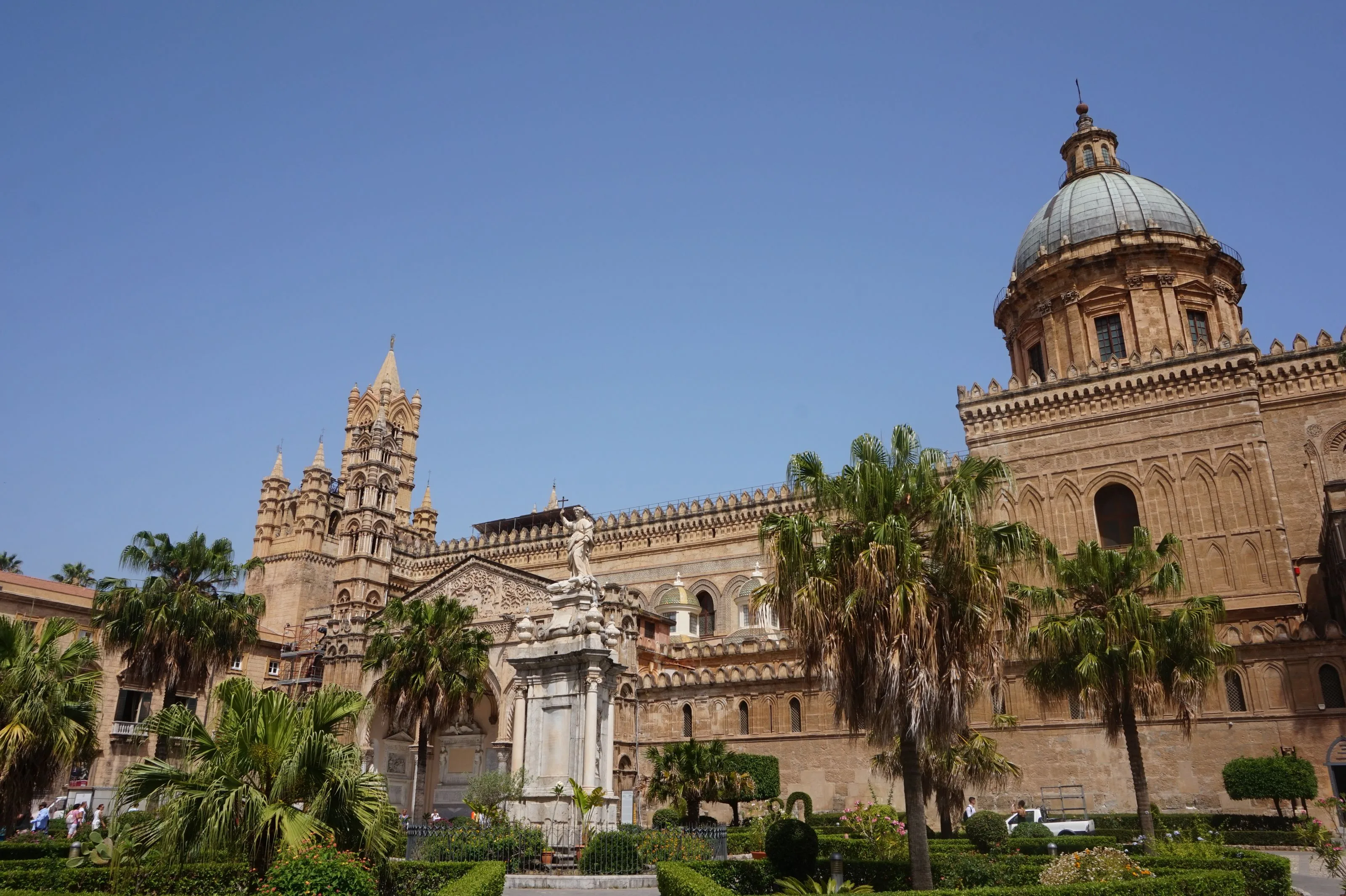
Destroyed by the 1693 earthquake after the great eruption of 1669, Catania was rebuilt in Sicilian Baroque style with wide streets and large squares designed to shelter people in any new quake (Wikivoyage DE). Its historic centre has been a UNESCO World Heritage Site since 2002, together with seven other towns of the Val di Noto (Wikipedia FR). The places below are illustrated; Castello Ursino, the Roman theatre and Via Crociferi are covered at the end of the section.
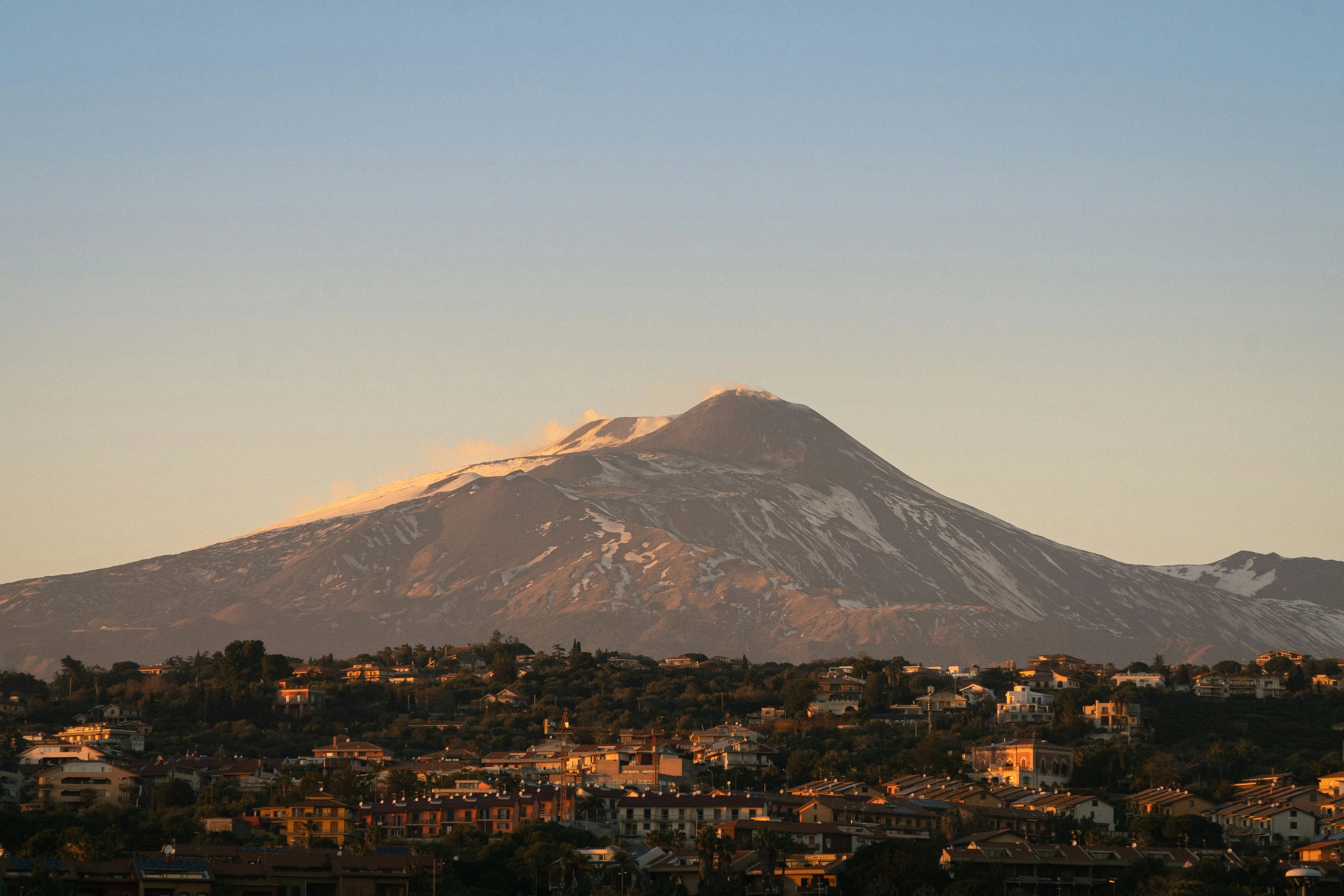
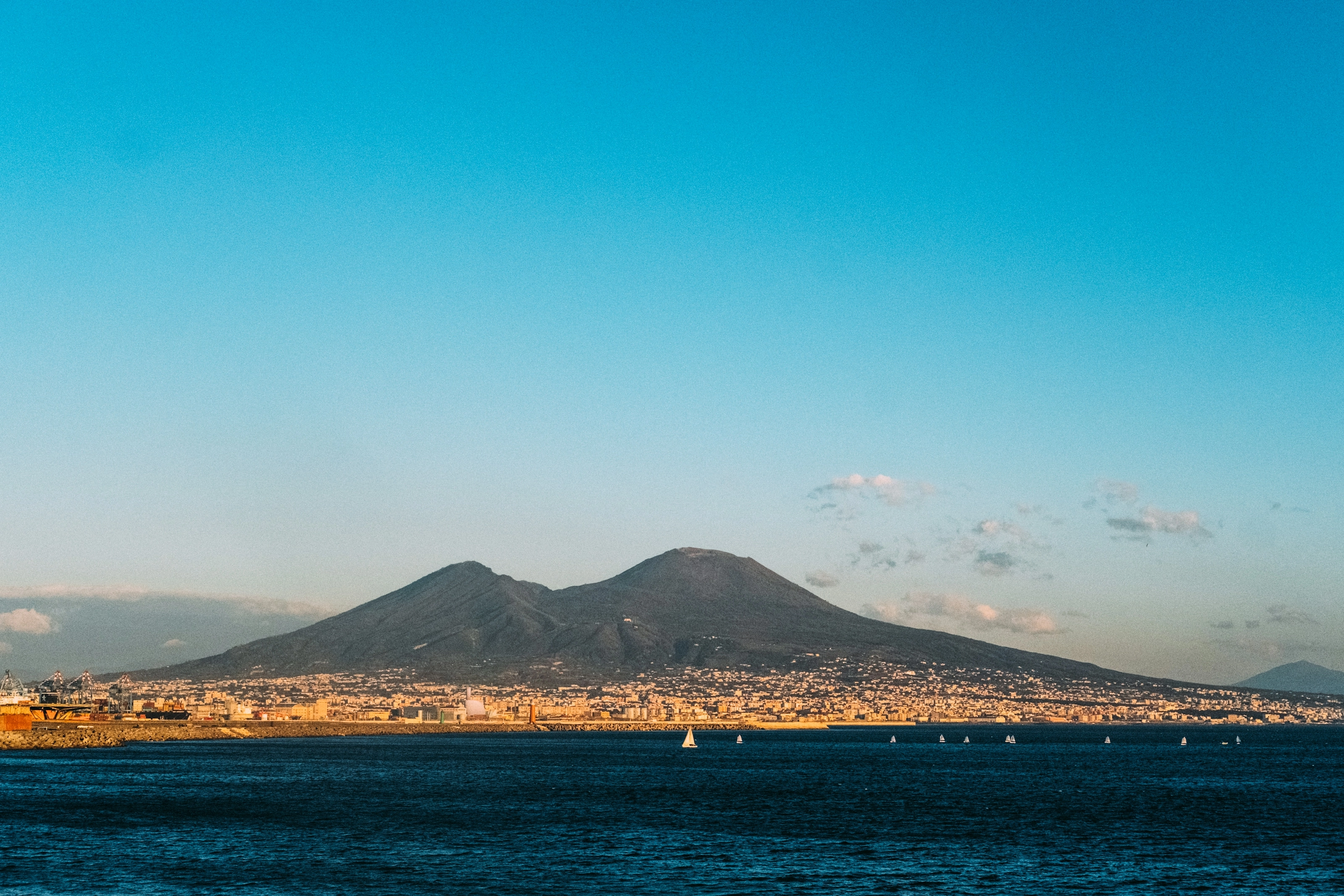
Mount Etna next door
The volcano dominates Catania's skyline, and the city has long lived between its threat and the fertility it brings: Strabo regarded the setting as both a curse and a blessing, per Wikipedia (FR). Excursions by 4x4 or bus leave town for the craters, and the narrow-gauge Circumetnea railway circles the mountain over 110 km (Wikivoyage FR, DE). The summit's plume of smoke is a common sight, especially at sunset.
Piazza del Duomo and the Elephant Fountain
Piazza del Duomo is the Baroque heart of the city, listed by UNESCO with three of its buildings according to Wikivoyage (EN). At its centre, a black lava elephant carrying an obelisk, known as U Liotru, is the symbol of Catania. The Palazzo degli Elefanti, home of the town hall, borders the square, which opens onto Via Etnea. The white marble Amenano fountain stands close by, near the fish market.
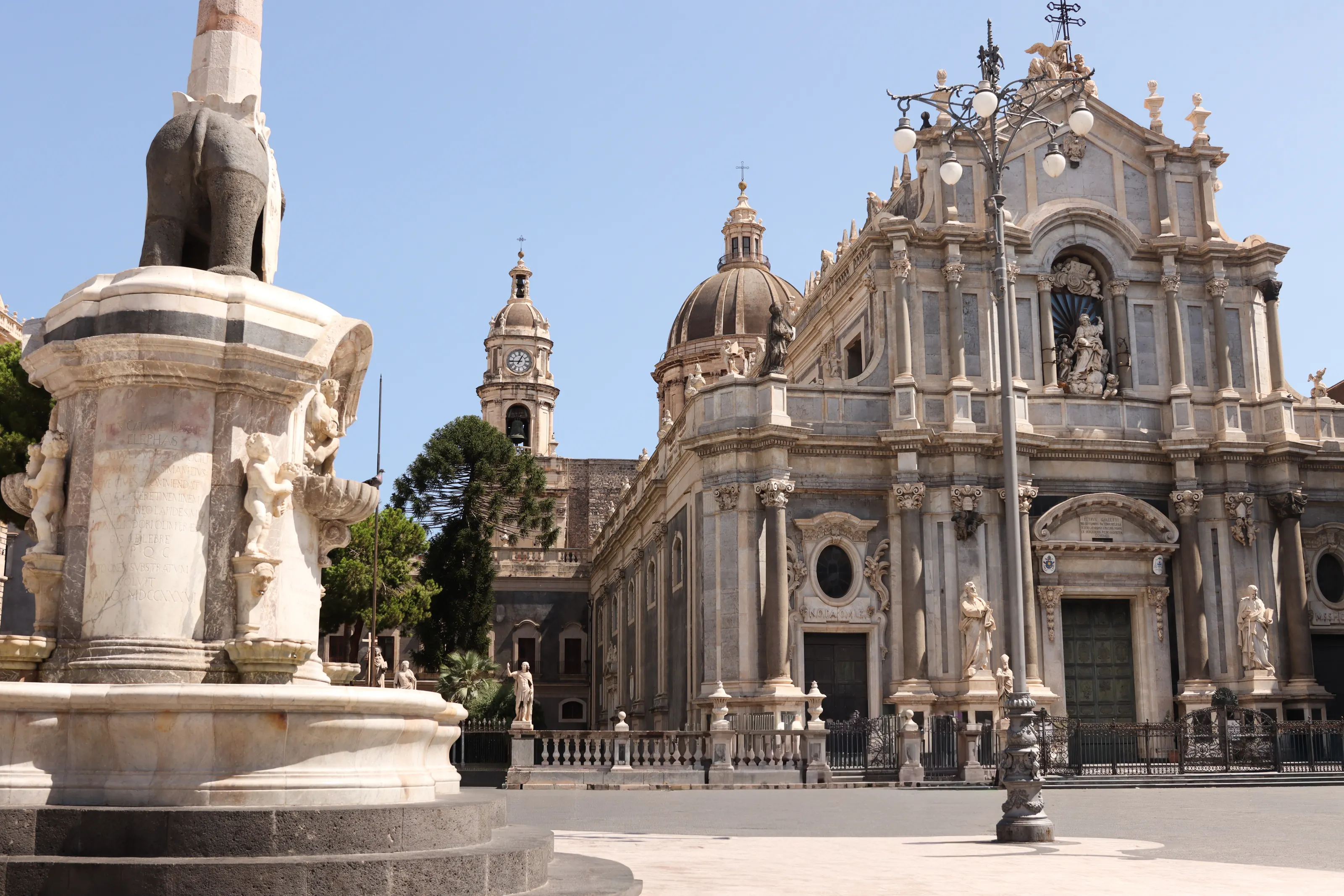
St Agatha's Cathedral
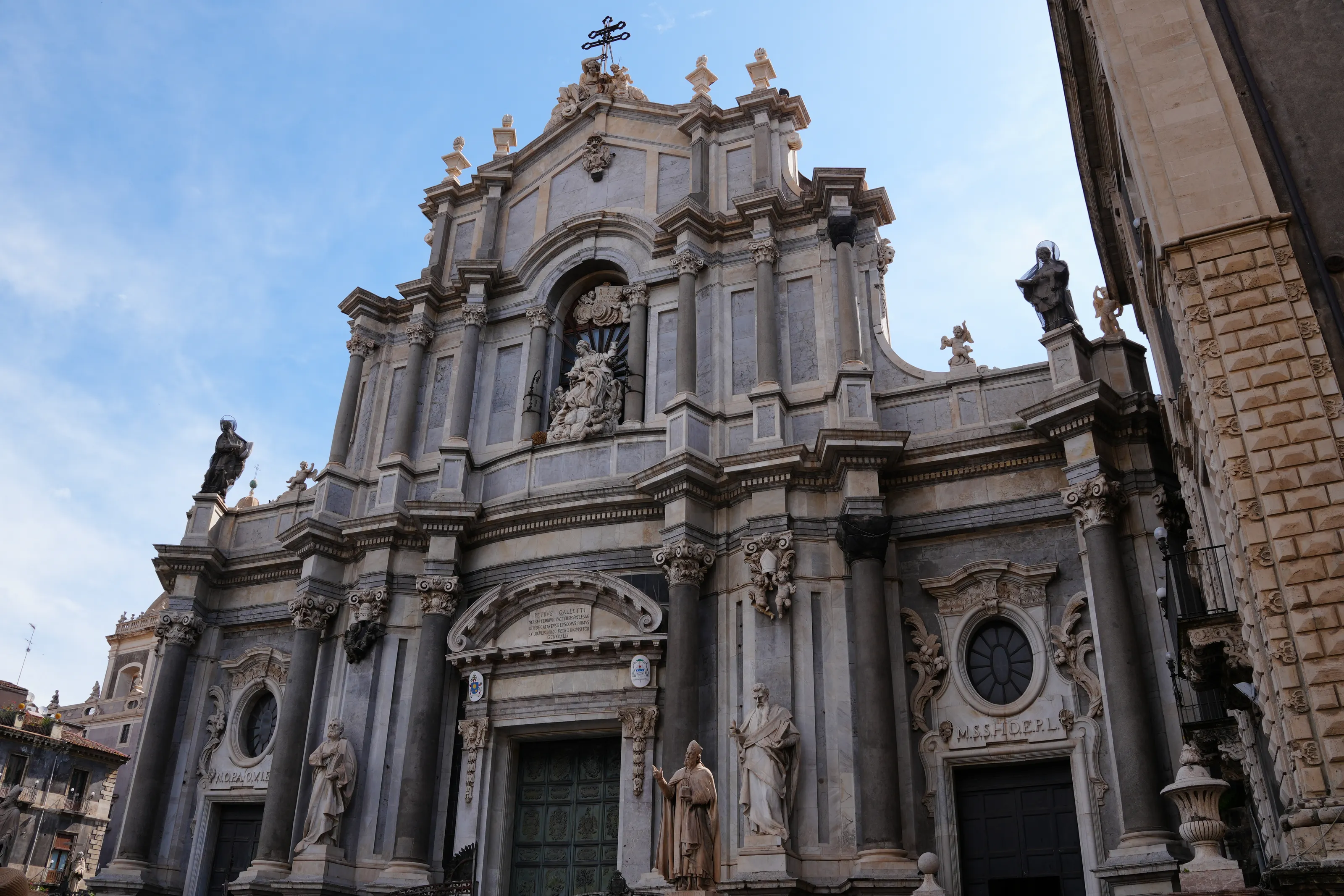
The cathedral's dome and facade, raised after the 1693 earthquake, show the Catanian take on Baroque: dark lava stone, columns, niches and statues (Wikivoyage EN). It is dedicated to St Agatha, patron of the city, whose feast on 5 February draws huge crowds according to Wikivoyage (EN). Beneath the square, the Achillean Baths, remains of a large ancient complex, can be visited together with the diocesan museum.
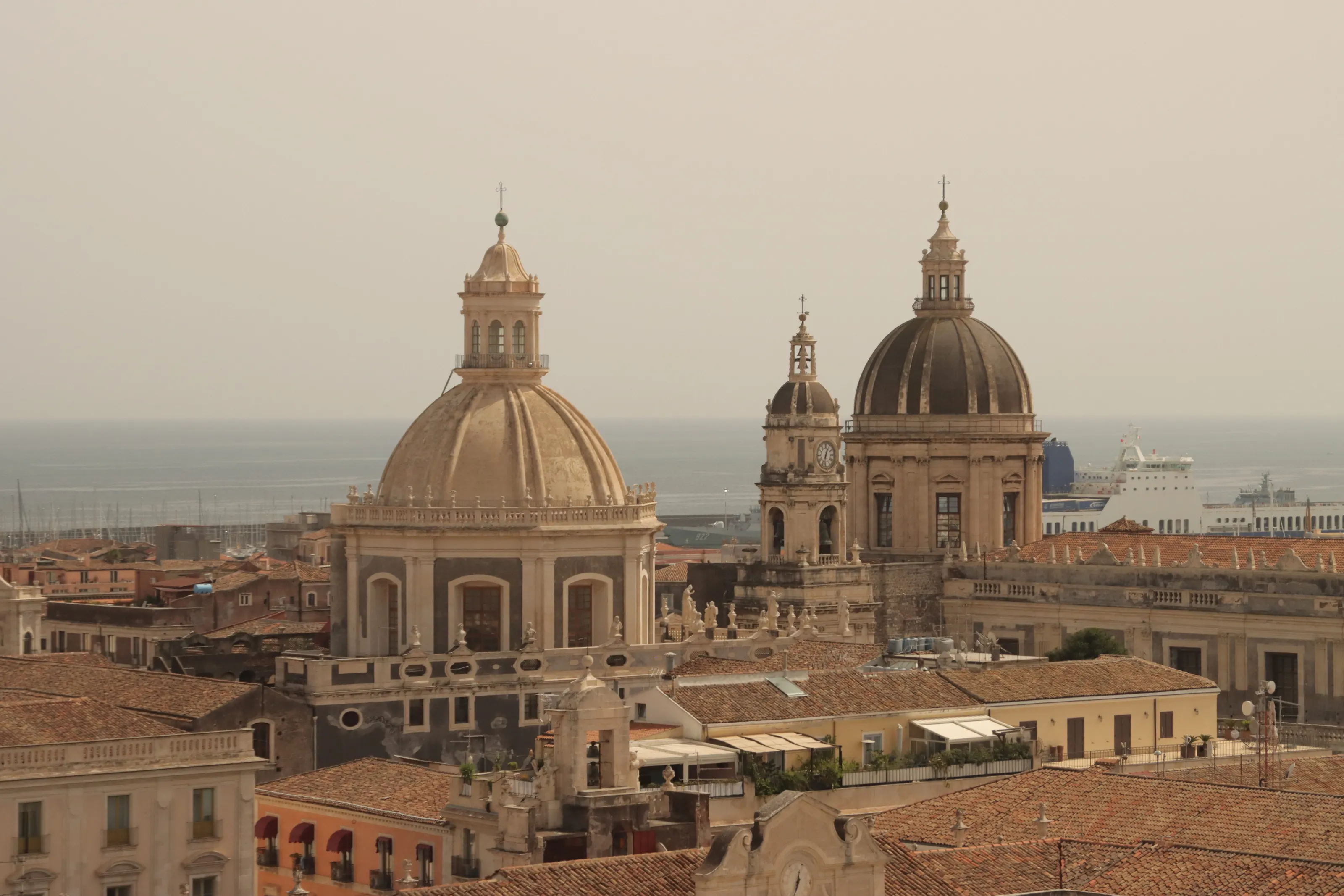
Domes and rooftops of the old centre
Seen from above, the city reads as a series of domes, bell towers and tiled roofs opening onto the sea. Wikivoyage (EN) picks out three features of Catanian Baroque: the use of dark lava stone, the bell built into the facade, and grotesque masks and putti. Guided visits to the dome of the Badia di Sant'Agata on Via Vittorio Emanuele give access to the terraces.
Castello Ursino, Roman theatre, Via Crociferi
Castello Ursino, a 13th-century fortress built under Frederick II according to Wikivoyage (DE), houses the civic museum. The Roman theatre and its odeon, from the 1st century CE, once seated up to 7,000 spectators (Wikivoyage EN). Via Crociferi packs four churches, three monasteries and a college into about 200 m; the Benedictine monastery of San Nicolò l'Arena, one of Europe's largest, now houses the university. Via Etnea, the main shopping street, links the Piazza del Duomo with the Bellini garden.
Museums and culture
Castello Ursino, Bellini, ancient baths and gardens
The civic museum in Castello Ursino
It holds Greek and Roman finds from the city, 17th- to 19th-century art and about 2,000 ancient bronze figurines according to Wikivoyage (EN), plus temporary exhibitions. We do not quote prices.
Vincenzo Bellini and the Teatro Massimo
The composer of Norma was born in Catania: Palazzo Gravina-Cruyllas houses the Bellini Museum and the Emilio Greco Museum (Wikivoyage EN). The 19th-century Teatro Massimo Bellini stages opera and concerts, and its square is lively in the evening. The airport, the Villa Bellini park and a pasta dish also carry his name (Wikipedia DE).
Antiquity under the city
Besides the Roman theatre, the amphitheatre in Piazza Stesicoro, the Rotonda baths and the Achillean Baths beneath the cathedral show fragments of mosaics and marble floors (Wikivoyage EN). The Bellini garden, with its 18th-century Biscari labyrinth, and the university botanical garden on Via Etnea make good green breaks.
Food and drink
Pasta alla Norma, arancini, fish and granita
Signature dishes
Pasta alla Norma, macaroni in tomato sauce with fried aubergine, salted ricotta and basil, is the great speciality and a tribute to Bellini's opera (Wikivoyage EN, ES; Wikipedia DE). Aubergine parmigiana, spaghetti with cuttlefish ink and seafood also feature, Catania being a major port. Horse meat, notably around the Benedictine monastery, is a local quirk according to Wikivoyage (EN).
Street food and pastries
Arancini, fried rice balls filled with meat, aubergine or spinach, tavola calda and salumeria sandwiches make quick lunches. For something sweet: ricotta cannolo, cassatella di Sant'Agata and almond pastries (Wikivoyage EN, ES). In summer the classic breakfast is an almond or black mulberry granita with a brioche; hazelnut and pistachio ice cream from Bronte has a good name (Wikivoyage ES).
Markets
The La Pescheria fish market near Piazza del Duomo and Fera 'o Luni, the historic market in Piazza Carlo Alberto, run on weekday and Saturday mornings according to Wikivoyage (EN). We do not recommend specific addresses and do not quote prices.
Getting around
On foot in the centre, bus, metro and the train around Etna
Walking and buses
The centre is compact and best explored on foot (Wikivoyage EN, FR). For outlying districts, the AMTS bus network serves the city, with a ticket valid for 90 minutes (Wikivoyage EN, FR).
Metro and Circumetnea
Catania has Sicily's only metro, a single line linking Stesicoro station in the centre with the central station and the north-western districts (Wikipedia ES). Sources differ on its length, so we do not quote one. At Borgo station you can join the Circumetnea, the narrow-gauge train that circles Etna; it does not run on Sundays according to Wikivoyage (EN).
Driving and day trips
Driving in the centre is hard: congestion, one-way streets and a limited traffic zone (Wikivoyage EN, FR). Wikivoyage (ES) calls driving very dangerous, mainly because of scooters. Buses reach Taormina in about 90 minutes, and the train reaches Syracuse in around an hour (Wikivoyage EN).
Budget and precautions
A lively city to approach with common sense
Price level
Wikivoyage (EN) describes street meals (salumeria sandwiches, arancino, tavola calda) as cheap. We give no figures because we could not cross-check them against two independent sources; prices for lodging, museums and transport change from year to year.
Precautions
Traffic and scooters make roads hazardous (Wikivoyage ES), so cross with care. Take the usual big-city precautions: closed bag, documents kept safe, official taxis or public transport.
Flights and entry
SniperAir tracks prices to CTA and compares them with the route's history, but it does not sell or book tickets. Also watch Palermo (PMO), about 2 h 30 by bus according to Wikivoyage (EN). Italy is part of the Schengen area: check entry rules for your nationality and your government's official advice.
When to go
Long hot summers, mild winters and rain from October to February
Winter (December to February)
Mild, with most of the rain between October and February according to Wikipedia (DE). In clear weather days can feel like spring, while nights stay cool.
Spring (March to May)
The climate turns dry from April (Wikipedia DE): a good season for the city, the markets and an Etna excursion.
Summer (June to August)
Long, hot and dry; the sirocco can push temperatures above 40 °C according to Wikipedia (FR). The sandy beaches of La Plaja to the south and the rocky coast of the Cyclops Riviera to the north offer relief (Wikivoyage EN).
Autumn (September to November)
Temperatures stay mild, and rain returns from October. September suits city walks and excursions.
Catania has a hot-summer Mediterranean climate (Csa), among the sunniest in Europe according to Wikipedia (FR, DE). Average temperatures vary from source to source, so we give no figures. Etna eruptions sometimes disrupt the airport; keep your dates flexible.
By length of stay
What to do in Catania depending on how long you stay
The essentials
Piazza del Duomo and the cathedral, the Elephant Fountain, the fish market, Via Etnea and Castello Ursino.
Baroque and antiquity
Via Crociferi, the Roman theatre, the baths, the Benedictine monastery, the Bellini garden and the Teatro Massimo.
Etna and the coast
A day on Etna, Taormina, Syracuse or the Cyclops Riviera, with Catania as your base.
In pictures
Catania in pictures
You might also like
Similar destinations
FAQ
Frequently asked questions about flights to Catania
How do I get from Catania airport to the centre?
Catania-Fontanarossa (CTA) is south of the city. The Alibus reaches the centre in about half an hour, and a railway station lies 500-600 m from the terminal. Timetables change: check them before you travel.
When is the best time to visit Catania?
In spring and early autumn. Summer is long, hot and dry; winter is mild, with rain mostly between October and February.
What is there to see in Catania?
Piazza del Duomo with St Agatha's Cathedral and the Elephant Fountain, Via Etnea, Castello Ursino, the Roman theatre and Via Crociferi, in a UNESCO-listed Baroque centre.
Can I visit Etna from Catania?
Yes: guided excursions and buses leave the city, and the Circumetnea train circles the volcano. The volcano's activity can change visits and occasionally flights.
What should I eat in Catania?
Pasta alla Norma, arancini, fish, granita with a brioche and ricotta cannoli, in the markets and pastry shops of the centre.
How long should I stay in Catania?
Two days for the Baroque centre and markets; four days adding antiquity and gardens; five days or more for Etna, Taormina and Syracuse.
How much does a flight to Catania usually cost?
The price depends mainly on your departure city, the time of year and how far ahead you book. The "opportunities" section above shows real examples of prices SniperAir has already detected to this destination.
How do I get alerted when a flight to Catania drops below my budget?
Create an alert profile with your departure airport, Catania as the destination and your maximum budget. You are notified automatically as soon as a matching price is detected.
Ready to head to Catania?
Set your budget and let SniperAir monitor fares for you.
Create my alert