
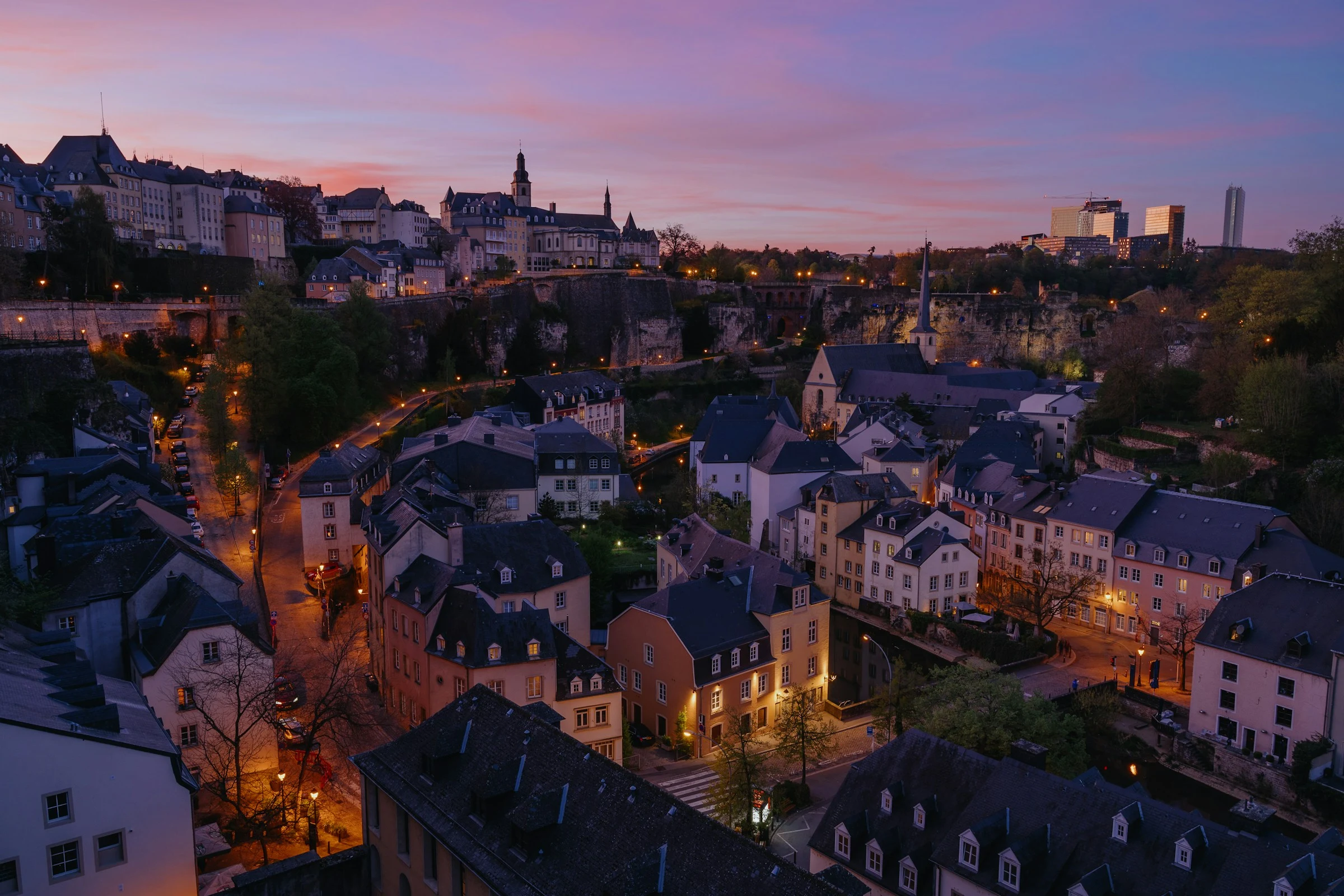
Cheap flights to Luxembourg City
Set your departure airport and maximum budget: SniperAir tracks prices to Luxembourg City and alerts you as soon as an opportunity matching your criteria appears.
Quick summary
Country
Luxembourg
Continent
Europe
Airport
LUX
Currency
Euro (€)
Time zone
UTC+1
Opportunities already detected to Luxembourg City
Real flight examples spotted by SniperAir, with their reference price.
Loading examples…
Why watch Luxembourg City with SniperAir
You don't need to compare prices every day
Choose your departure
Enter your departure airport and maximum budget for a flight to Luxembourg City.
SniperAir watches
Our systems continuously compare new prices against the route's real price history.
You get an alert
As soon as a price matches your criteria, you're notified — without having to search yourself.
Identity
A fortress, a gorge city and a European crossroads
Luxembourg City is the capital of the Grand Duchy and the country's largest commune, yet it remains a small place: around 137,000 inhabitants spread over roughly 52 km2, with about 160 nationalities living side by side. Foreigners make up roughly 70 % of residents, which explains why the city feels so international. It is the seat of the government and, mostly on the Kirchberg plateau, of several European institutions: the Court of Justice, the Court of Auditors and the European Investment Bank. The Council of the EU also meets here in April, June and October.
The story starts in 963, when Siegfried, Count of the Ardennes, acquired the site of the Lucilinburhuc castle on the Bock rock through a land exchange with the abbey of Saint Maximin of Trier. That moment is treated as the birth of both the city and the country. Legend adds his wife Melusina, who is said to have vanished into the Alzette after he saw her fish tail. The Burgundians took the place in 1443, then Spanish, French, Austrian and Prussian rulers each strengthened the fortress in turn, Vauban himself having worked here under Louis XIV. The nickname that stuck was the "Gibraltar of the North". After the Treaty of London in 1867 confirmed independence and neutrality, the walls were dismantled between 1867 and 1883, but enough survives that the old quarters and fortifications were inscribed on the UNESCO World Heritage list in 1994.
What makes the capital unusual today is its landscape. The city is built on several levels around two rivers, the Alzette and the Pétrusse, which carved gorges roughly 70 m deep. Bridges such as the Adolphe Bridge and the Grand Duchess Charlotte Bridge link the upper town with the station district and Kirchberg. On top of that, Luxembourg City has also been named European Capital of Culture twice, in 1995 and in 2007 together with Sibiu in Romania.
What to see
The Old Quarters, the Bock Casemates and the Grand Ducal Palace
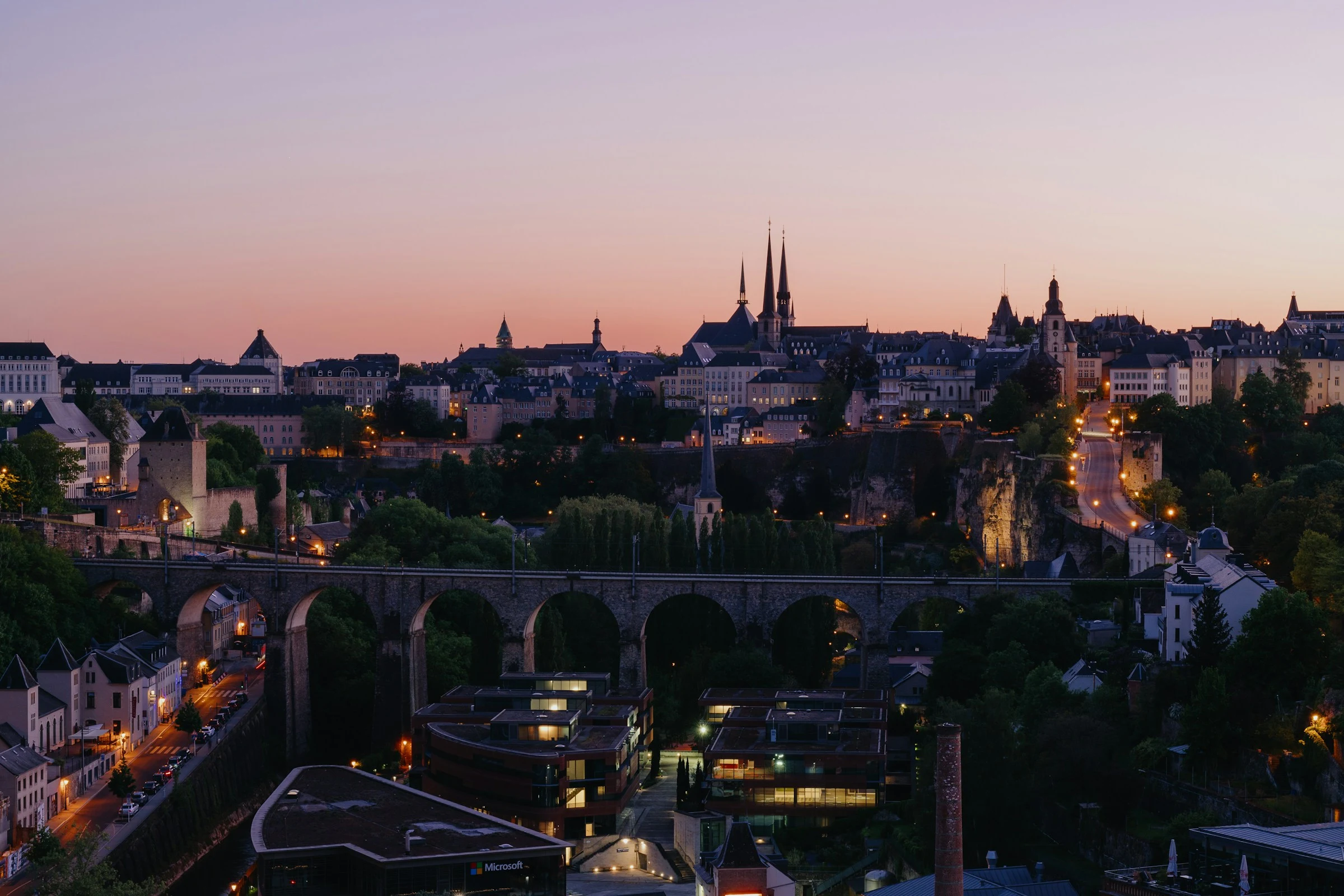
The UNESCO-listed old town gathers the Grand Ducal Palace, the Gothic Revival Notre-Dame Cathedral, Place Guillaume II, Place d'Armes and the Gëlle Fra war memorial, all within a few minutes' walk. Beneath it lies the heart of the fortress: the Bock Casemates, underground galleries from the Spanish and Austrian periods, entered from the Montée de Clausen. The visit is limited to a maximum of 45 minutes, the last admission depends on the season (later in July and August, much earlier from early November to late March), and the site is closed on 25 December and 1 January. The Castle Bridge, built by the Austrians in 1735, leads out towards the Corniche. Other fortification sites are worth a stop if you have time: the Pétrusse Casemates, the Holy Ghost Citadel, the Wenzel wall, Fort Thüngen and the Three Towers.
The city also has a serious cultural offer. Mudam covers modern art, the City History Museum and Villa Vauban the past and the fine arts, Casino Luxembourg and Am Tunnel contemporary creation, and the National Museum of Natural History completes the list. The Philharmonie concert hall and the Grand Théâtre handle music and stage. Opening hours and ticket prices change, so check each venue's website before you plan a day around one. Away from the centre, the Luxembourg American Cemetery in Hamm commemorates the Second World War.
Don't miss
The Chemin de la Corniche, the Grund and the gorges
The Chemin de la Corniche is attributed to the writer Batty Weber as "Europe's most beautiful balcony", and the nickname is easy to understand once you stand on it: the old ramparts overlook the Alzette valley and the rooftops of the Grund below. The Bock promontory itself rises 45 m above the Alzette and offers a 360-degree view. Down in the valley, the Grund, Clausen and Pfaffenthal quarters sit along the river, with the former abbey of Neimënster in the Grund. The Grund and Clausen are natural places to end a day on foot, with the river beside you and the fortifications above.
Because the city is built on several levels, getting up and down is part of the experience. Public lifts connect the upper town with the Grund and with Pfaffenthal, and the city's only funicular climbs to the Kirchberg plateau. The city is compact and easily walkable, but it is also hilly, so comfortable shoes matter more than a map. In autumn, the colours over the Pétrusse valley are one of the best sights of the year.
Food and drink
Hearty national dishes and Moselle wines
Luxembourgish cooking is hearty and sits between its French and German neighbours. The city advertises a handful of Michelin-starred tables for a more formal dinner (that figure is dated, so check before you book).
| Speciality | Description |
|---|---|
| Judd mat Gaardebounen | The national dish: smoked pork collar served with broad beans, a plate to try at least once. |
| Bouneschlupp | A green bean soup, one of the best-known traditional dishes. |
| Gromperekichelcher | Potato fritters. |
| Rieslingspaschtéit | A pâté made with Riesling, a regional speciality. |
| Träipen | Black pudding. |
| Kachkéis | A soft cheese spread, served as a starter or a snack. |
| Forelle in Rieslingsauce | Trout cooked in a Riesling sauce. |
| Quetschentaart | Plum tart, a traditional dessert. |
| Moselle wines and beer | Riesling, Pinot gris and Crémant de Luxembourg from the Moselle, plus local beers such as Diekirch. |
Getting around
Free public transport and day trips beyond the capital
Public transport is free across the whole country since 2020, and that covers tourists as well as residents: trains, buses and the tram. It means that, once you have landed, you can reach most of the sights without buying a ticket. The central station is about ten minutes on foot from the centre, with direct links to Paris by TGV and to Strasbourg, Metz, Trier, Cologne, Brussels, Liège and Basel. The Veloh bike-share scheme is another option.
Outside the capital, the tourist board points visitors towards three regions: the Mullerthal, the Moselle and the Éislek. The Moselle, on the German border, is the wine country behind the Riesling and the Crémant on your plate. Across the border, Trier is only 48 km away by road and Metz 60 km, which makes both easy additions for a longer trip, while Strasbourg lies 222 km away, Frankfurt 275 km and Paris 370 km. For the Mullerthal and the Éislek, travel times from the capital were not verified, so check them before you plan the day.
Depending on your time
How long to stay in Luxembourg City?
The upper town and the fortress
The UNESCO old quarters, the Grand Ducal Palace, Notre-Dame Cathedral, the Bock Casemates and the Chemin de la Corniche.
The valleys and the modern side
The Grund and Clausen by lift, then Kirchberg by funicular for Mudam and the Philharmonie.
Out into the country
Add day trips to the Mullerthal, the Moselle or the Éislek, using the free public transport.
Good to know
A compact city, a high cost of living
The country has three everyday languages, Luxembourgish, French and German, and the euro is the currency. Luxembourg City is among the more expensive places in Europe for accommodation and eating out, and it is better to plan for that from the start than to be surprised on the spot. We have no reliable budget figures to quote, which is one more reason to make the flight the part you do not overpay for. Because the old town sits on a small perimeter, you can see the essentials in two days without hiring a car, and the combination of free transport and short distances keeps the other costs under control.
Luxembourg's airport
The country's only airport
Luxembourg Airport (Findel) is the only international airport in the country, about 6 km from the centre and around 10 km from the main railway station. Tram line T1 has run between the airport and the city centre since March 2025, and buses 16 and 29 run every 10 to 15 minutes; taxis are the alternative. The airport carried over 5 million passengers in 2024 and is the home hub of Luxair and Cargolux. We did not find a verified journey time into town, so allow some margin on your first trip.
Luxembourg
The country's only airport, about 6 km from the city center.
When to go
When should you visit Luxembourg City?
The climate is oceanic and the sky is overcast for roughly two thirds of the year. Rain is spread fairly evenly across the months, with December the wettest, and July averages about 18 to 19 degrees. The valleys can stay foggy in winter while the upper town is sunny.
Spring
Mild temperatures, a great time to explore the old town on foot.
Summer
The best tourist season, with the most outdoor events.
Autumn
Still pleasant weather, with lighter crowds than summer.
Winter
The Christmas market brings the city center to life despite the cold.
You might also like
Similar destinations
FAQ
Frequently asked questions about flights to Luxembourg City
How long should I plan for a visit to Luxembourg City?
Two days cover the essentials: the UNESCO old quarters, the casemates, the Grund and Kirchberg. With three to four days you can add trips to the Mullerthal, the Moselle or the Éislek region.
What is Luxembourg City's airport?
There is only one airport in the country: Luxembourg (LUX), about 6 km from the city center. Tram line T1 and buses 16 and 29 connect it with the city.
How much does a flight to Luxembourg City usually cost?
The price mainly depends on your departure city, the season and how far ahead you book. The "opportunities" section above shows real price examples already detected by SniperAir for this destination.
How long is a flight to Luxembourg City from Europe?
Generally between 1 and 2 hours depending on your departure city.
What is the best time to book a flight to Luxembourg City?
There's no universal rule — the best price depends on your specific route. That's exactly why SniperAir monitors prices on your behalf instead of giving you generic advice.
How do I get alerted when a flight to Luxembourg City drops below my budget?
Create an alert profile with your departure airport, Luxembourg City as the destination and your maximum budget. You'll be notified automatically as soon as a matching price is detected.
Ready to head to Luxembourg City?
Set your budget and let SniperAir watch the fares.
Create my alert