
Cheap flights to Yekaterinburg
Set your departure airport and maximum budget: SniperAir tracks prices to Yekaterinburg and alerts you the moment a deal matching your criteria appears.
Quick summary
Country
Russia
Continent
Europe
Airport
SVX
Currency
Russian rouble (RUB)
Time zone
UTC+5
Deals already spotted to Yekaterinburg
Real flight examples detected by SniperAir, with their reference price.
Loading examples…
Why track Yekaterinburg with SniperAir
The big city of the Urals, at the gateway to Asia
Choose your departure
Enter your departure airport and your maximum budget for a flight to Yekaterinburg (SVX).
SniperAir keeps watch
Our systems continuously compare new prices with the real price history of the route. SniperAir monitors prices and alerts you: it does not sell or book tickets.
You receive an alert
As soon as a price matches your criteria, you are notified, without having searched for anything yourself.
Yekaterinburg, also spelled Ekaterinburg, is the administrative centre of Sverdlovsk Oblast and the Ural Federal District, on the Iset River east of the middle Urals (Wikipedia EN, FR). The sources agree that it is one of Russia's four largest cities, after Moscow, Saint Petersburg and Novosibirsk (Wikipedia EN, FR, DE, ES; Wikivoyage EN), with roughly 1.5 million residents: Wikipedia (DE) gives 1.55 million in 2025, while the older Wikivoyage (EN) says over 1.3 million. Founded in 1723 as a metallurgical works on the orders of Peter the Great, it is named after Empress Catherine and was called Sverdlovsk from 1924 to 1991 (Wikipedia EN, FR, DE, ES). Wikipedia (DE) places it a little under 40 km east of the imaginary line separating Europe from Asia. People come for its constructivist architecture, museums and opera house, and for the chance to stand on either side of the continental divide. This guide relies on open sources; SniperAir tracks fares to SVX, compares them with the real price history of the route and alerts you when one drops below your budget.
Airport and getting into town
An international airport 16 to 18 km south-east of the centre
Yekaterinburg - Koltsovo International Airport (SVX)
Koltsovo International Airport (SVX) serves the city from the south-east: 16 km away according to Wikipedia (EN) and 18 km according to Wikivoyage (EN). Wikipedia (EN) also names a smaller airport, Aramil. Wikivoyage (EN) mentions a bus, an express train and taxis to the city; these links and their fares change, so we give no timetables or prices. The central railway station, on the Trans-Siberian route, is in the city (Wikivoyage EN; Wikipedia FR).
Distance from Wikipedia (EN): 16 km; Wikivoyage (EN): 18 km. A range is published; journey times and fares are not.
For a price alert, track SVX. Flight links, entry rules, traveller advice and payment options can change quickly depending on your departure country: check that country's official recommendations and the real availability of routes before booking. Wikipedia (DE) notes that the time difference with Moscow is two hours (UTC+5).
Landmarks
The centre by the pond, the Sevastyanov House, the Plotinka and the opera
The heart of Yekaterinburg lies around the city pond and the Iset, in a centre that can be covered on foot. The five views below are followed by other places mentioned in the text.
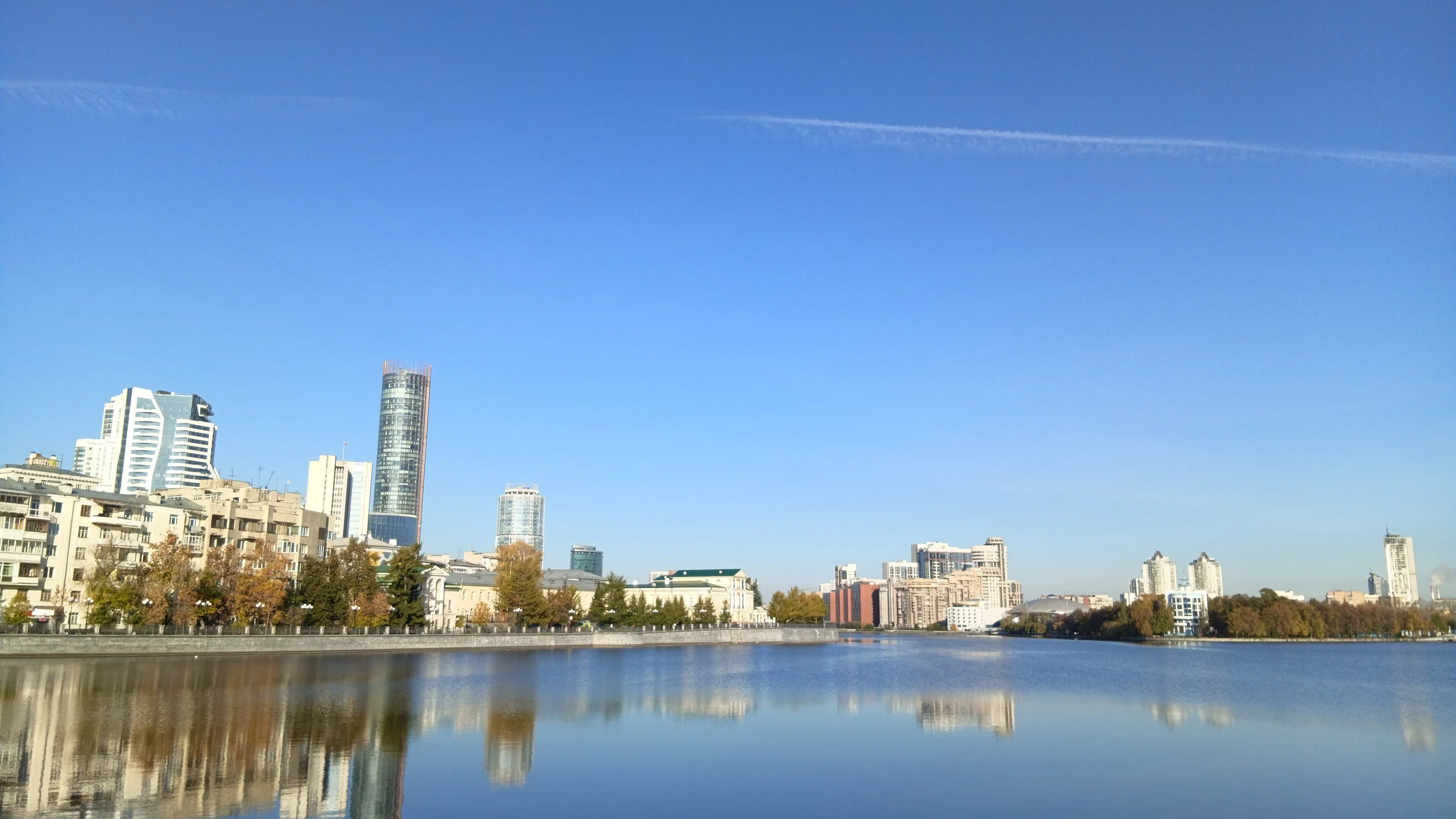
The centre seen from the water
Yekaterinburg is dotted with bodies of water: Wikipedia (ES) counts four reservoirs and four natural lakes within city limits, and Wikivoyage (EN) devotes a sightseeing area to the City Pond embankment in the centre. This view shows buildings and towers reflected in the water under a clear Urals sky.
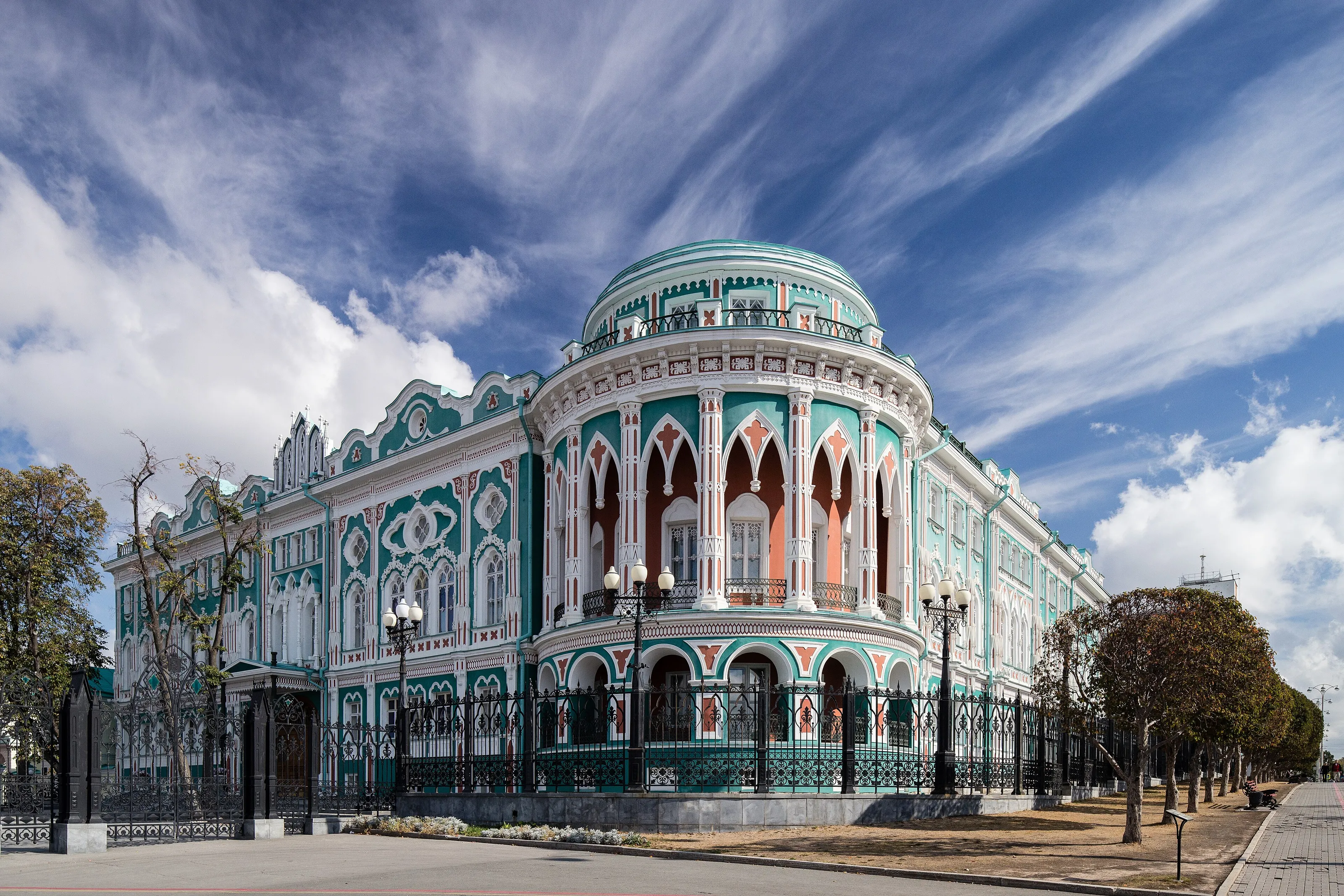
The Sevastyanov House, a colourful mansion with pointed arches
Wikivoyage (EN) lists the Sevastyanov House, on Lenin Avenue, among the buildings to see near the pond. Its verdigris-and-white facade, with a rotunda and slender columns, stands out in a city best known for constructivism. We do not state the building's current use, which the sources do not detail.
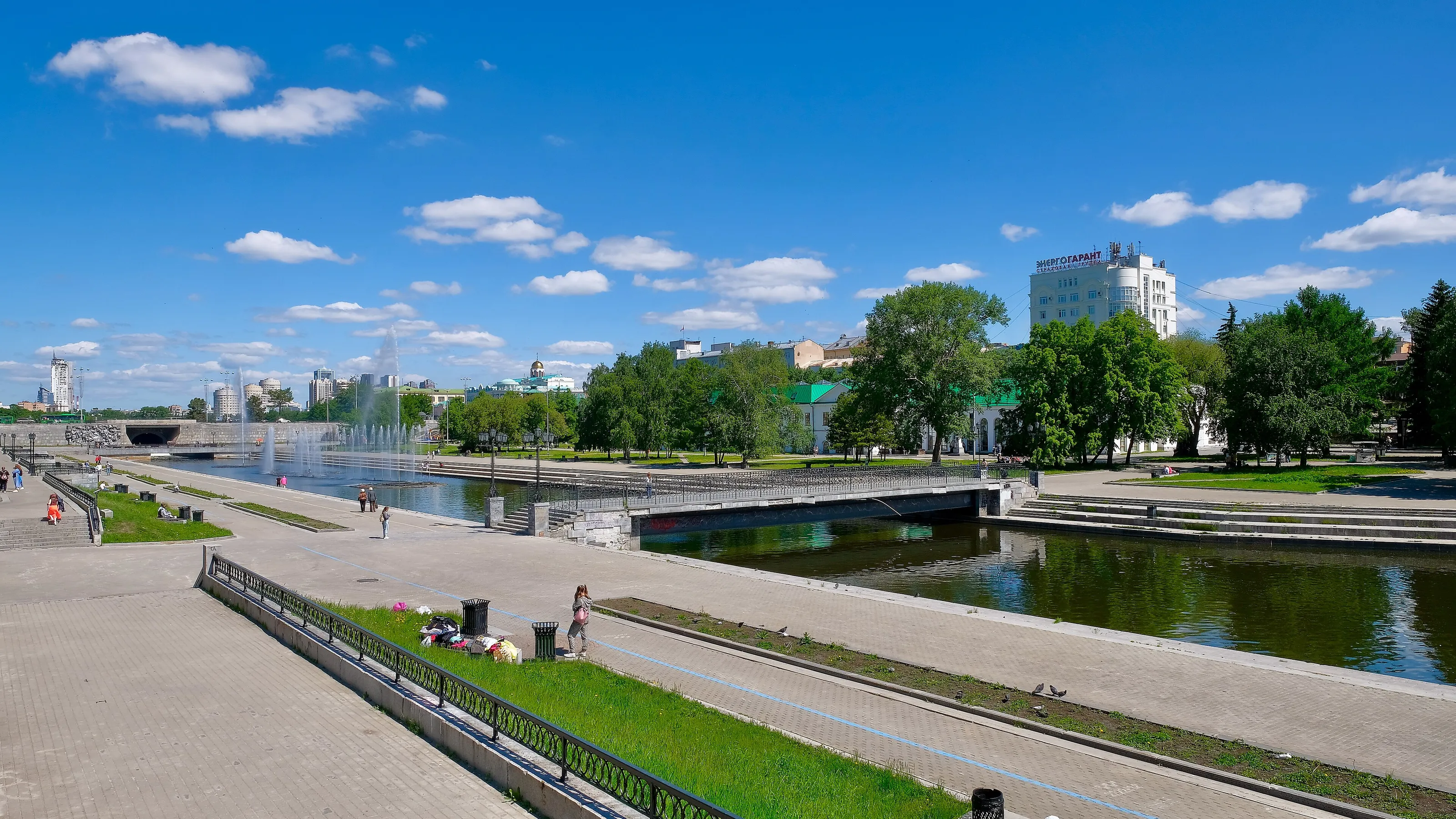
The Plotinka, Iset quays in the heart of the city
Wikivoyage (EN) lists the Plotinka, the dam on the Iset, about 300 m from Ploshchad 1905 Goda metro station. Wikipedia (FR) recalls that the city was born in 1723 around a metallurgical works with a fortress. The stone embankments with stairs, bridges and lawns make it a central place for a stroll.
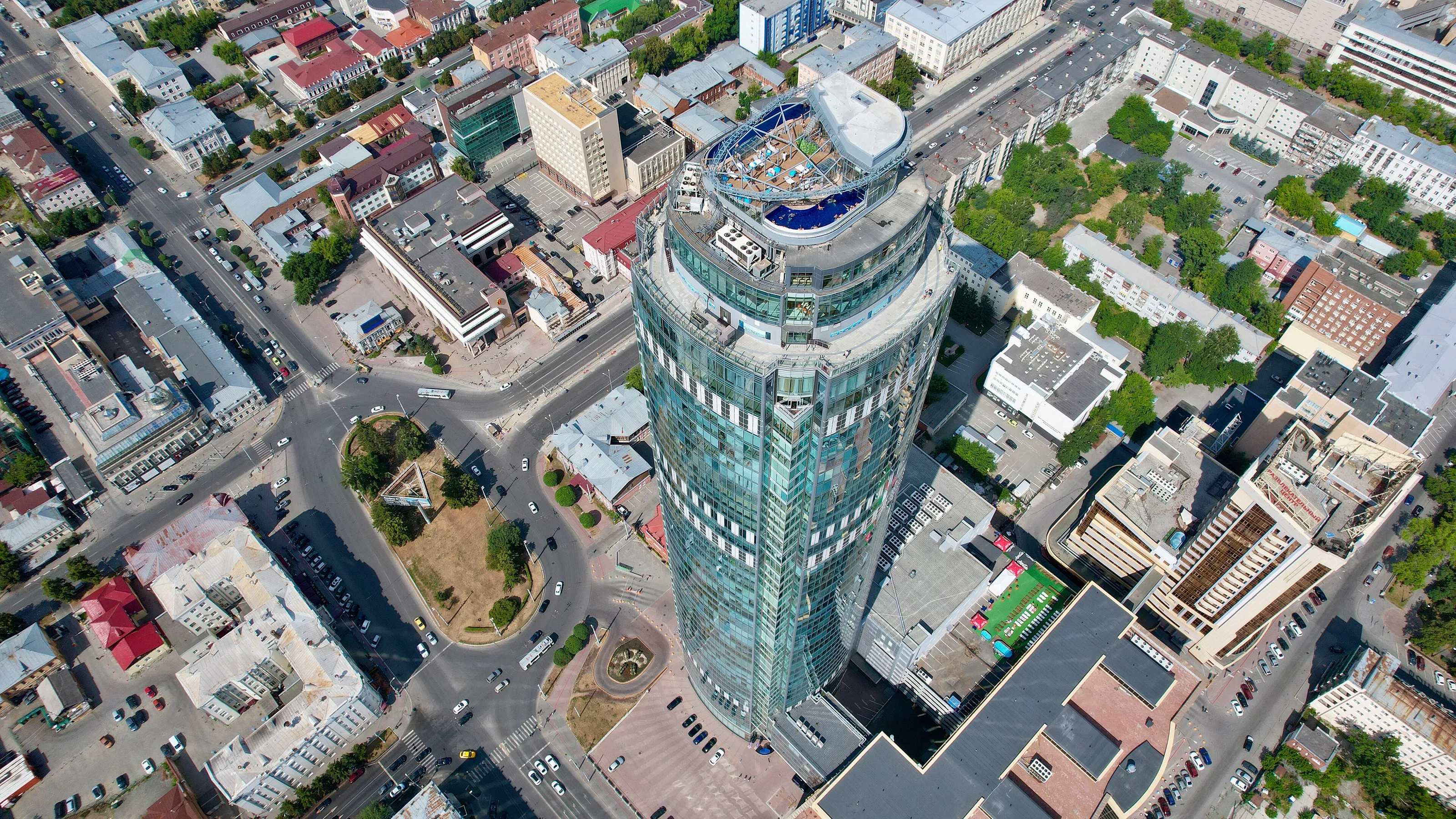
The city centre streets from above
Wikipedia (EN) says the Vysotsky Business Center, begun in 2006 and completed in 2011, was the city's first skyscraper. This aerial view shows the glass tower amid a grid of streets, squares and low buildings.
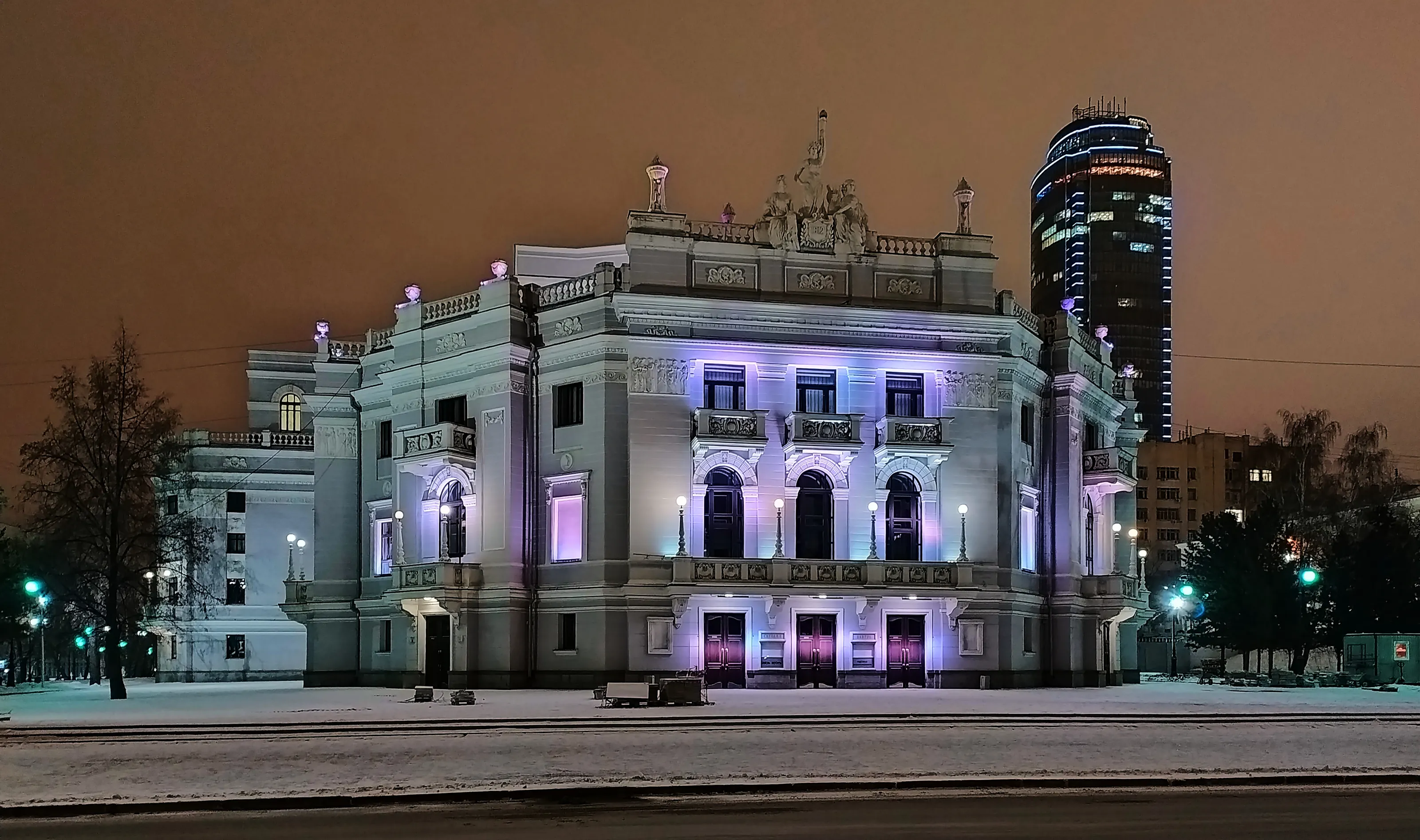
The opera house, a facade lit at dusk
Wikipedia (FR) states that the Yekaterinburg opera house was built in 1912, using for its technical side the same improved plans as the Bolshoi in Moscow; Wikipedia (DE) calls it a magnificent opera house from the early 20th century. Wikivoyage (EN) places it on Lenin Avenue. The photo shows it on a winter night, with a glass tower in the background.
Other places in Yekaterinburg: the Chekists' Town and the Iset Hotel, a constructivist ensemble from 1929 to 1936 (Wikipedia DE; Wikivoyage EN); the Iset Tower, completed in 2015-2016 (Wikipedia EN); the Church on the Blood, built in 2003 on the site of a house linked to the end of the imperial family in 1918 (Wikivoyage EN; Wikipedia ES); and the large mining museum park in the middle Urals (Wikipedia DE). The symbolic border between Europe and Asia is marked by several monuments, including one near Pervouralsk, about 38 to 40 km to the west (Wikipedia DE, ES; Wikivoyage EN); tours go there from the station or the north bus station.
Museums and culture
Museums, the opera and the stages of the Urals
The Museum of Fine Arts
Wikipedia (FR) names the Yekaterinburg Museum of Fine Arts as the main institution of cultural heritage. Wikipedia (ES) mentions its collections of Russian painting, and Wikivoyage (EN) works by Russian artists of the 18th and 19th centuries. We give no fares or hours.
A museum for every taste
Wikipedia (ES) counts about fifty museums, with collections of jewellery and stone objects, Nevyansk icons and a museum of Ural writers. Wikipedia (FR) also names the Ural geological museum and a natural history museum. Ural stone is a theme that runs through the city, down to the metro stations (Wikivoyage EN).
Theatres and opera
Wikipedia (FR) ranks it third among Russian cities by number of theatres, including the opera and ballet theatre. Wikipedia (ES) recalls that local theatre life was boosted during the Second World War by the evacuation of Moscow companies. Wikivoyage (EN) notes that many theatres surround 1905 Square. Programmes change, so check them before booking.
Food and drink
Pelmeni, pirogi and Ural Russian cooking
Pelmeni, an Urals classic
Wikipedia (EN, Pelmeni article) says these dumplings became a staple of Russian cuisine during the expansion towards the Urals and Siberia. They are filled with pork, lamb, beef, fish or mushrooms. Wikivoyage (EN, FR, ES) lists Ural pelmeni restaurants, though we do not name them.
Traditional Russian dishes
Wikivoyage (ES) lists pelmeni, pirogi, borscht, salo, holodets, fish and local mushrooms, which go with vodka. Wikivoyage (EN) notes that cafes and restaurants mostly offer a mix of Russian, Japanese and Italian food and that the level of international cuisine is not very high.
Markets and drinks
The sources we consulted do not detail Yekaterinburg's markets. Wikivoyage (EN) mentions cafes and restaurants in the centre, including in large hotels, but we name no addresses or brands. Ask locally.
Getting around
Metro, trams, commuter trains and taxis
The metro
Yekaterinburg has a single metro line, opened in 1991 and with nine stations (Wikipedia FR, ES, EN; Wikivoyage EN). Wikivoyage (EN) stresses that the stations are decorated with Ural stone, granite and marble. We publish no fares.
Trams and commuter trains
Wikipedia (EN) says the tram network was completed in 1929; Wikivoyage (EN) claims it is Russia's densest, which we do not repeat without a second source. Wikivoyage (EN) also mentions a commuter train line crossing the city from north-west to south.
Long-distance trains and excursions
Wikivoyage (EN) says all Trans-Siberian trains stop at the central station; Wikipedia (FR) lists the Trans-Siberian among the city's logistical assets. Timetables change, so check them before booking.
Budget and precautions
Budget, health and general precautions
Price level
The open sources we consulted do not allow reliable, cross-checked price ranges: the Wikivoyage (EN) prices are several years old and not confirmed by a second independent source. We therefore publish no amounts. The currency is the rouble.
Flights, entry rules and payments
SniperAir monitors prices to SVX and compares them with the route's history, but it does not sell or book tickets. Entry conditions, traveller advice, flight links and payment options depend on your departure country and can change: check that country's official recommendations before booking.
Before you go
Ask a doctor or travel clinic for advice before departure, take out suitable travel insurance and pack very warm clothing in winter, since the sources describe intense cold.
When to go
A continental climate with long, very cold winters
Winter
Wikipedia (ES) describes very cold winters lasting about seven months, from late October to mid-April; Wikipedia (DE) speaks of six months at most. Temperatures can fall to -40 °C according to Wikipedia (EN, DE).
Spring and autumn
Short seasons with sharp temperature swings. Wikipedia (EN) stresses strong fluctuations and weather anomalies, with spells from frost to thaw in winter.
Summer
Wikipedia (DE) mentions summers shorter than in central Europe, reaching up to 35 °C; Wikipedia (EN) also mentions temperatures above 35 °C. Wikipedia (ES) notes that it is rare to exceed 25 °C in the daytime in the Ural range.
Wikipedia (EN) classes the climate of Yekaterinburg as humid continental (Dfb), with warm summers and cold winters; Wikipedia (ES, DE) speaks of a continental climate. Wikipedia (EN) gives averages for January and July, which we do not repeat because they are not cross-checked on a second source. The length of winter (six or seven months) and cold records vary between sources.
By length of stay
What to do in Yekaterinburg depending on the length of your stay
The essentials
The pond and the Plotinka, the Sevastyanov House, a museum, the opera and the metro with its decorated stations.
Yekaterinburg in depth
The constructivist architecture, the Chekists' Town, the stone and art museums and a performance.
At the gateway to Asia
A trip to the Europe-Asia border monument near Pervouralsk, according to Wikivoyage (EN) and Wikipedia (DE, ES).
In pictures
Yekaterinburg in pictures
You might also like
Similar destinations
FAQ
Frequently asked questions about flights to Yekaterinburg
How far is SVX airport from Yekaterinburg?
Koltsovo Airport (SVX) is 16 km south-east according to Wikipedia (EN) and 18 km according to Wikivoyage (EN). Links with the centre change, so check them before you travel.
What is there to see in Yekaterinburg?
The pond and the Plotinka, the Sevastyanov House, the opera, constructivist architecture, the stone and art museums and the metro with its decorated stations, according to Wikipedia (EN, FR, DE, ES) and Wikivoyage (EN).
Is Yekaterinburg in Europe or Asia?
It lies east of the Urals, about 38 to 40 km east of the Europe-Asia border monument near Pervouralsk (Wikipedia DE, ES), so on the Asian side of the symbolic line.
When is the best time to visit Yekaterinburg?
Summer, shorter than in central Europe, suits outdoor sightseeing; winter is long and very cold, down to -40 °C (Wikipedia EN, DE, ES). Choose according to your tolerance for cold.
What entry rules apply for Russia?
They depend on your departure country and can change: check your country's official recommendations before booking.
How many days do I need in Yekaterinburg?
Two days cover the essentials; three to four days add the architecture and museums, and five days or more allow the trip to the Europe-Asia border.
How much does a flight to Yekaterinburg usually cost?
The price depends mainly on your departure city, the time of year and how far ahead you book. The "opportunities" section above shows real examples of prices SniperAir has already detected to this destination.
How do I get alerted when a flight to Yekaterinburg drops below my budget?
Create an alert profile with your departure airport, Yekaterinburg (SVX) as the destination and your maximum budget. You are notified automatically as soon as a matching price is detected. SniperAir monitors and alerts, it does not sell or book tickets.
Ready to head to Yekaterinburg?
Set your budget and let SniperAir monitor fares for you.
Create my alert