
Cheap flights to Gran Canaria
Set your departure airport and maximum budget: SniperAir tracks prices to Gran Canaria and alerts you the moment a deal matching your criteria appears.
Quick summary
Country
Spain
Continent
Europe
Airport
LPA
Currency
Euro (EUR)
Time zone
UTC+0 (UTC+1 during summer time)
Deals already spotted to Gran Canaria
Real flight examples detected by SniperAir, with their reference price.
Loading examples…
Why track Gran Canaria with SniperAir
You do not need to compare prices every day
Choose your departure
Enter your departure airport and your maximum budget for a flight to Gran Canaria (LPA).
SniperAir keeps watch
Our systems continuously compare new prices with the real price history of the route. SniperAir monitors prices and alerts you: it does not sell or book tickets.
You receive an alert
As soon as a price matches your criteria, you are notified, without having searched for anything yourself.
Airports and getting into town
An airport on the east coast, and a lively capital in the north-east
Gran Canaria – Gando (LPA)
Gran Canaria Airport, known as Gando, is the island's international airport, according to Wikivoyage. It receives flights from Madrid in about 2.5 hours, from Barcelona and Bilbao in about 3 hours, and from the UK in 4 to 4.5 hours. To reach Las Palmas, bus 60 runs about every 30 minutes from 06:15 to 20:50; for Maspalomas, bus 50 is the fastest and also stops at the airport, while routes 66 and 90 link Playa del Ingles. Car hire desks are at the airport.
Frequencies and journey times are approximate, based on Wikivoyage (EN); timetables change by season, so check before you travel. We do not quote fares.
Gran Canaria is the third-largest island of the archipelago, with 1,560 km2 and more than 850,000 inhabitants according to Wikipedia (DE, ES). It lies 210 km off the coast of southern Morocco according to Wikipedia (DE), and 46% of its territory has been protected since it was named a UNESCO biosphere reserve in 2005, according to Wikipedia (FR).
The capital: Las Palmas
Las Palmas de Gran Canaria, in the north-east, has about 380,000 inhabitants according to Wikipedia (DE, ES, FR), making it the largest city in the Canaries. Founded in 1478, it is a joint capital of the Canary Islands with Santa Cruz de Tenerife. It is the archipelago's most cosmopolitan city according to Wikipedia (FR), with a historic quarter, Vegueta, and a long urban beach, Las Canteras.
Landmarks and nature
Dunes, a volcanic rock and a continent in miniature
Gran Canaria is often described as a continent in miniature because of the variety of its landscapes and climates, according to Wikivoyage and Wikipedia (FR). The south coast is dominated by resorts, the centre by mountains and pine forests. The places below are illustrated.
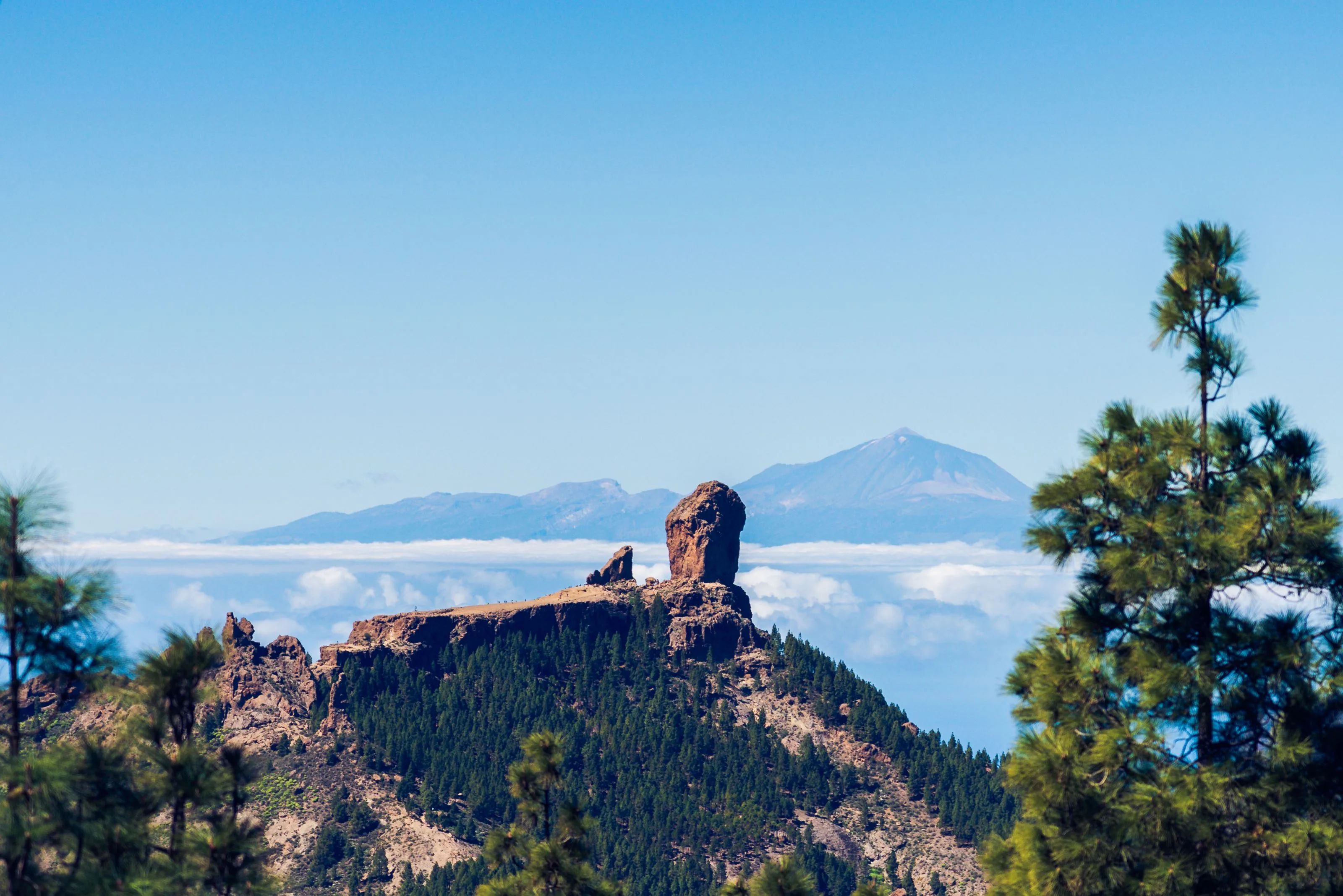
Roque Nublo
Roque Nublo, a 1,813 m monolith according to Wikipedia (DE, ES), is the symbol of the island. It stands in the heart of the central massif among the pines, and on a clear day you can see Mount Teide on Tenerife rising above a sea of clouds. Wikipedia (ES) lists Roque Bentayga and other volcanic rocks beside it.
The Maspalomas dunes
The Maspalomas dunes form a special nature reserve with three ecosystems: the dunes, a palm grove and a coastal lagoon known as La Charca, according to Wikipedia (ES). In the photo, walkers follow a dune crest in the evening light, and their footprints draw lines across the sand.
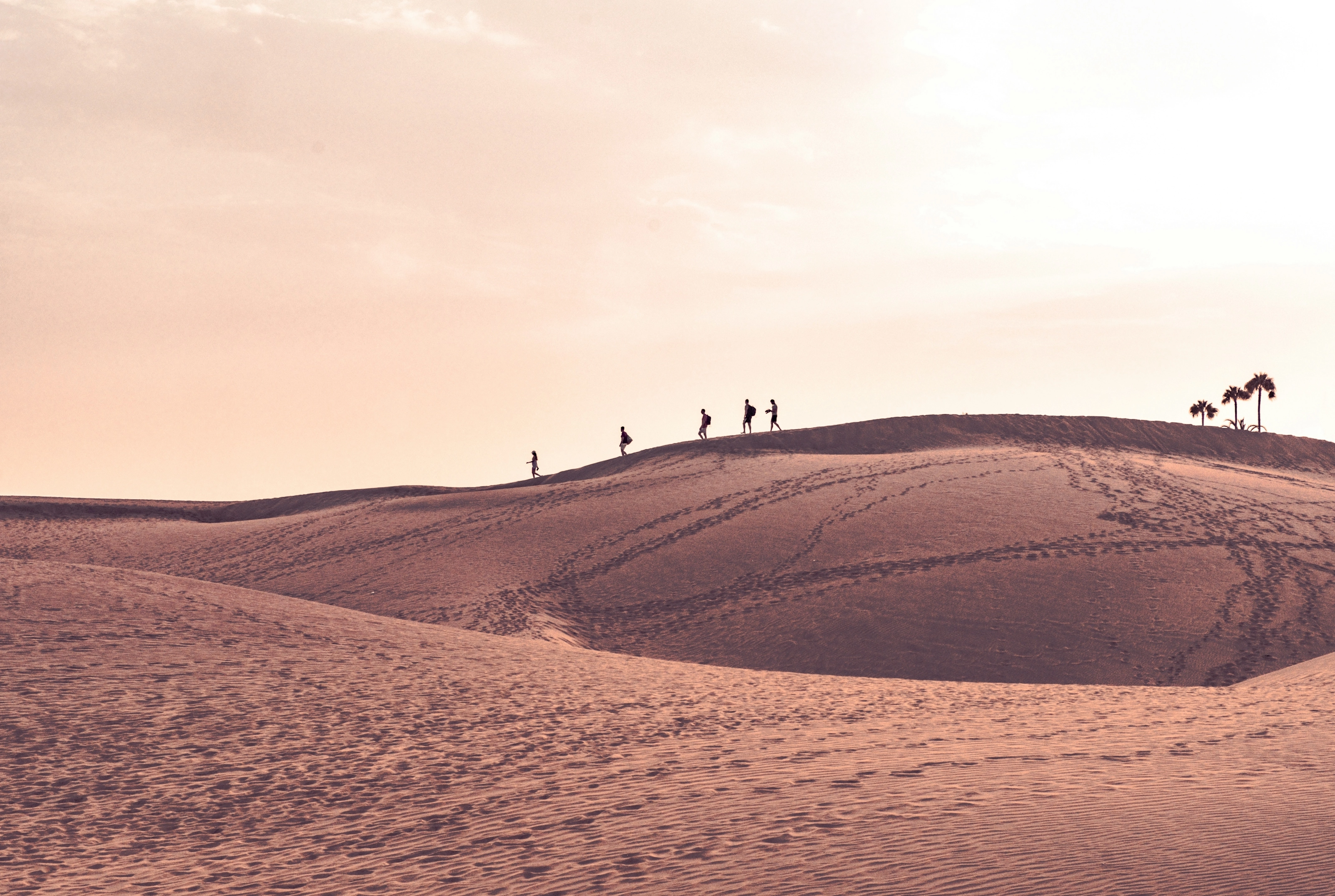
A desert beside the ocean
The golden dunes stretch to Playa del Ingles, the island's biggest tourist centre, with a natural beach of 2,700 m according to Wikipedia (ES). The same source warns that conservation of the dunes is threatened by urban development, so stay on the permitted routes.
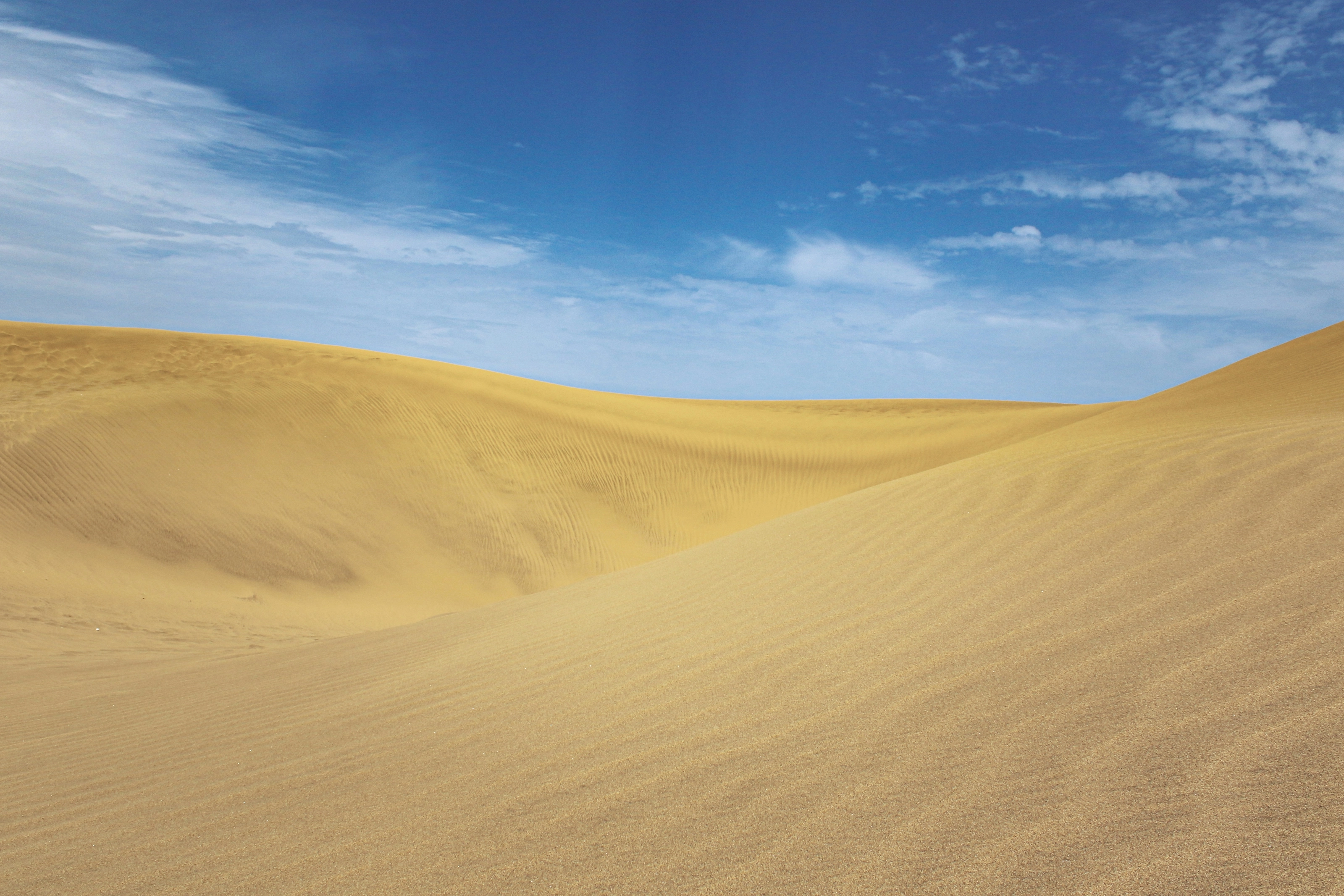
Sand ripples and the sea
The wind draws regular ripples on the dunes, most visible when the sun is low. The ocean can be seen in the distance; Wikivoyage advises carrying water in summer and seeking shade when a hot Saharan wind pushes temperatures above 40 C.
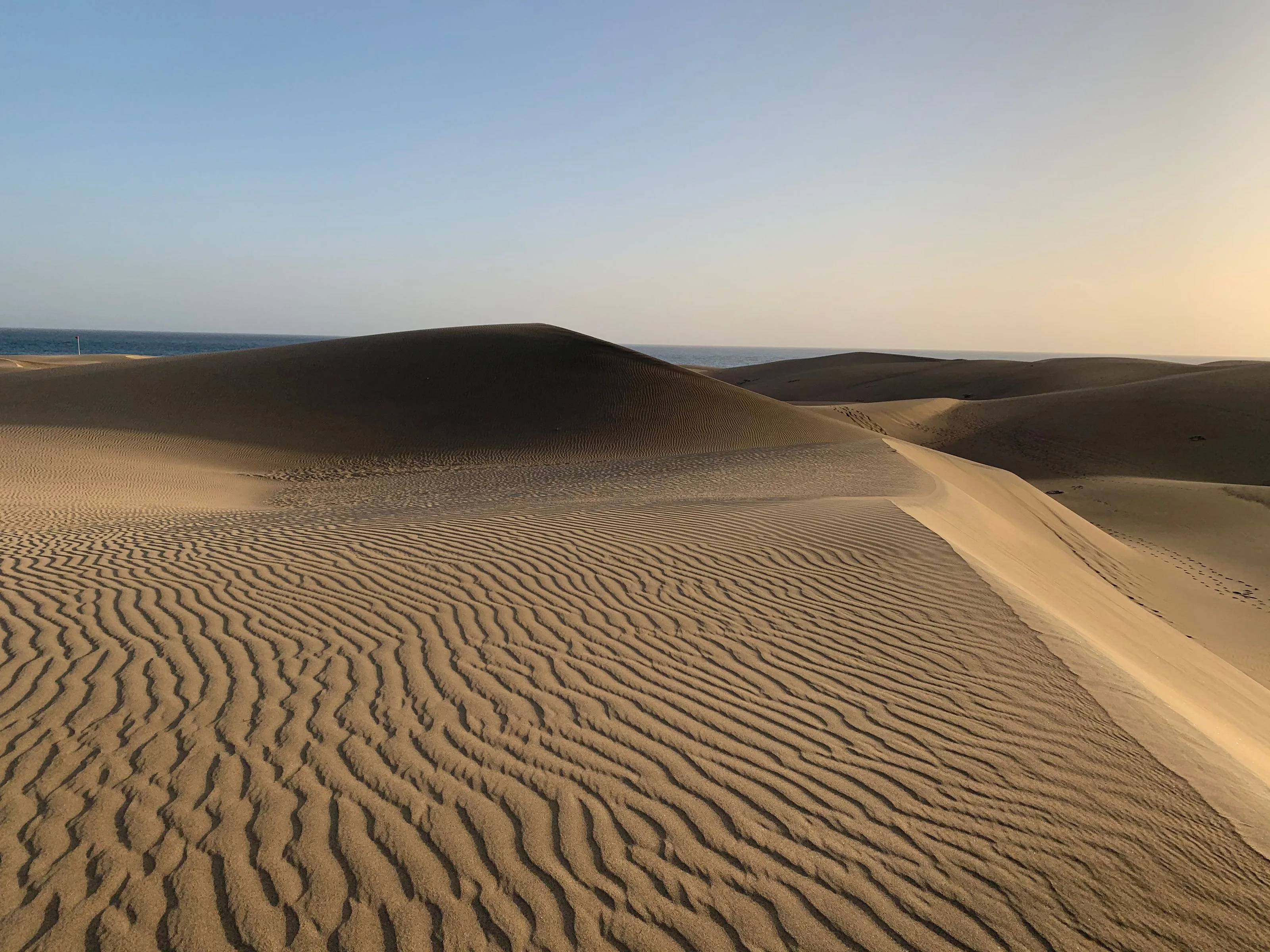
Villages and pine forests inland
Teror, with Our Lady of the Pine, and Arucas, with its imposing basalt church, are among the sites listed by Wikipedia (DE) and Wikivoyage. The caves of Artenara and the Risco Caido archaeological site, a UNESCO World Heritage Site, recall the island's pre-Hispanic culture.
Mogan and the resorts
Puerto de Mogan, a fishing village nicknamed the Venice of the South, and Palmitos Park, with its exotic birds, are listed by Wikipedia (DE) and Wikivoyage. Arguineguin, west of Maspalomas, has the best climate on the island and the least wind, according to Wikivoyage.
Museums and culture
Columbus, modern art and Guanche archaeology in Las Palmas
Vegueta: the Columbus house and CAAM
Vegueta is the historic core of Las Palmas. The Casa de Colon recalls Christopher Columbus, who stopped to repair a ship here in 1492, according to Wikivoyage. The Centro Atlantico de Arte Moderno occupies the former Banco de Espana building and has shown works from Europe, Africa and the Americas since 1989.
The Museo Canario
Founded in 1879, the Museo Canario holds the largest collection of pre-Hispanic objects from the island, with a replica of the painted cave of Galdar, according to Wikivoyage. The Perez Galdos house-museum, for the writer born in Las Palmas, is in the Triana district.
Carnival and events
The Las Palmas carnival, in February, is one of the best known in Spain according to Wikipedia (FR); Wikipedia (DE) says it has been a festival of national tourist interest since 2017. The international film festival is held in late May or early June. We do not quote prices: tickets and opening hours change.
Food and drink
Flower cheese, Canarian wines and island cooking
Cheeses
Gran Canaria makes protected-origin cheeses in the north-west, in Galdar, Santa Maria de Guia and Moya, according to Wikipedia (ES). Queso de flor is curdled with thistle flower, which gives it a thin, elastic rind that often cracks.
Wine
Vines have been grown since the late 15th century, with cuttings brought from Crete, and from the 16th century Canarian wines were exported to England, according to Wikipedia (ES).
In Las Palmas
Along Las Canteras beach, the promenade has many restaurants, bars and cafes, according to Wikipedia (DE). We do not list specific addresses.
Getting around
Buses, hire cars, taxis and a ferry to Tenerife
Buses
The bus network is well organised and economical, according to Wikivoyage: most routes useful to tourists run through Playa del Ingles and head to Las Palmas or along the coast to Puerto Rico. The bright yellow city buses of Las Palmas are called guaguas municipales. Contactless payment is accepted on all routes.
Car and taxi
There are no trains: a motorway covers much of the island, with plenty of speed cameras, according to Wikivoyage. A hire car is the best option for remote places, and rental offices are in all resorts. Taxis are metered; avoid any without a meter.
Ferry to Tenerife
Fred Olsen links Agaete, on the west coast, with Santa Cruz de Tenerife in about 50 minutes, and Transmediterranea links Las Palmas with Santa Cruz in about 3 hours, according to Wikivoyage. Timetables change, so check them.
Budget and precautions
A very touristy island: prices vary mostly with the season
Price level
The island lives mainly from tourism, with resorts dominating the south coast, according to Wikivoyage. We do not quote figures, because we could not confirm them across two independent sources.
Currency and payment
The currency is the euro. Spain is in the Schengen area, so check the entry rules for your nationality.
Flights and precautions
SniperAir watches prices to LPA and compares them with the route's history, but it does not sell or book tickets. You can also watch Tenerife (TFS, TFN) or Fuerteventura (FUE) for comparison. Wikivoyage advises carrying water in summer and avoiding the heat when Saharan winds push temperatures above 40 C.
When to go
A semi-arid subtropical climate, mild in winter
Winter (December to February)
About 23 C by day and 16 to 17 C at night in Maspalomas, according to Wikivoyage; bad weather is possible from mid-October to March, with 11 to 12 C and wind. At Pozo de las Nieves, freezing temperatures are possible.
Spring (March to May)
Mild days; Las Palmas can stay cloudy, even in May, according to Wikivoyage.
Summer (June to August)
28 to 33 C by day in July in Maspalomas, 21 to 24 C at night, according to Wikivoyage. Carry water.
Autumn (September to November)
Generally pleasant, with a risk of bad weather from mid-October according to Wikivoyage.
The climate is subtropical semi-arid for most places but varies a lot depending on where you are, according to Wikivoyage. Arguineguin is cited for its sheltered, dry winters. We do not quote precise monthly averages, because the sources differ.
By length of stay
What to do in Gran Canaria depending on how long you stay
The essentials
The Maspalomas dunes, then Las Palmas: Vegueta, a museum and Las Canteras beach.
Mountains and villages
Roque Nublo, Teror, Arucas and Puerto de Mogan, with a hire car to link the villages.
The whole island
Risco Caido, Artenara, the south of the island and a return ferry trip to Tenerife.
In pictures
Gran Canaria in pictures
You might also like
Similar destinations
FAQ
Frequently asked questions about flights to Gran Canaria
How do I get from Gran Canaria airport to Las Palmas?
Bus 60 links the airport (LPA) with the city about every 30 minutes, from 06:15 to 20:50, according to Wikivoyage. For Maspalomas, take bus 50.
Can I visit the Maspalomas dunes?
Yes: they form a special nature reserve, according to Wikipedia (ES), which warns that their conservation is threatened by urban development. Stay on the marked routes.
When is the best time to visit Gran Canaria?
The climate is mild all year: a hot, dry summer and a cooler winter with a risk of bad weather from mid-October to March, according to Wikivoyage.
Do I need a hire car?
It makes the villages and the mountainous centre easier to reach; buses do cover the island well, especially between the airport, Las Palmas and Playa del Ingles.
What should I see in Las Palmas de Gran Canaria?
Vegueta, the Casa de Colon, the Museo Canario, the CAAM and Las Canteras beach, plus the carnival in February.
How do I get from Gran Canaria to Tenerife?
By ferry, from Agaete to Santa Cruz (about 50 minutes) or from Las Palmas (about 3 hours), according to Wikivoyage; or by air.
How much does a flight to Gran Canaria usually cost?
The price depends mainly on your departure city, the time of year and how far ahead you book. The "opportunities" section above shows real examples of prices SniperAir has already detected to this destination.
How do I get alerted when a flight to Gran Canaria drops below my budget?
Create an alert profile with your departure airport, Gran Canaria as the destination and your maximum budget. You are notified automatically as soon as a matching price is detected.
Ready to head to Gran Canaria?
Set your budget and let SniperAir monitor fares for you.
Create my alert