
Cheap flights to Sion
Set your departure airport and maximum budget: SniperAir tracks prices to Sion and alerts you the moment a deal matching your criteria appears.
Quick summary
Country
Switzerland
Continent
Europe
Airport
SIR
Currency
Swiss franc (CHF)
Time zone
UTC+1 (UTC+2 during summer time)
Deals already spotted to Sion
Real flight examples detected by SniperAir, with their reference price.
Loading examples…
Why track Sion with SniperAir
A town of two castles, sunshine and vines in the heart of Valais
Choose your departure
Enter your departure airport and your maximum budget for a flight to Sion (SIR).
SniperAir keeps watch
Our systems continuously compare new prices with the real price history of the route. SniperAir monitors prices and alerts you: it does not sell or book tickets.
You receive an alert
As soon as a price matches your criteria, you are notified, without having searched for anything yourself.
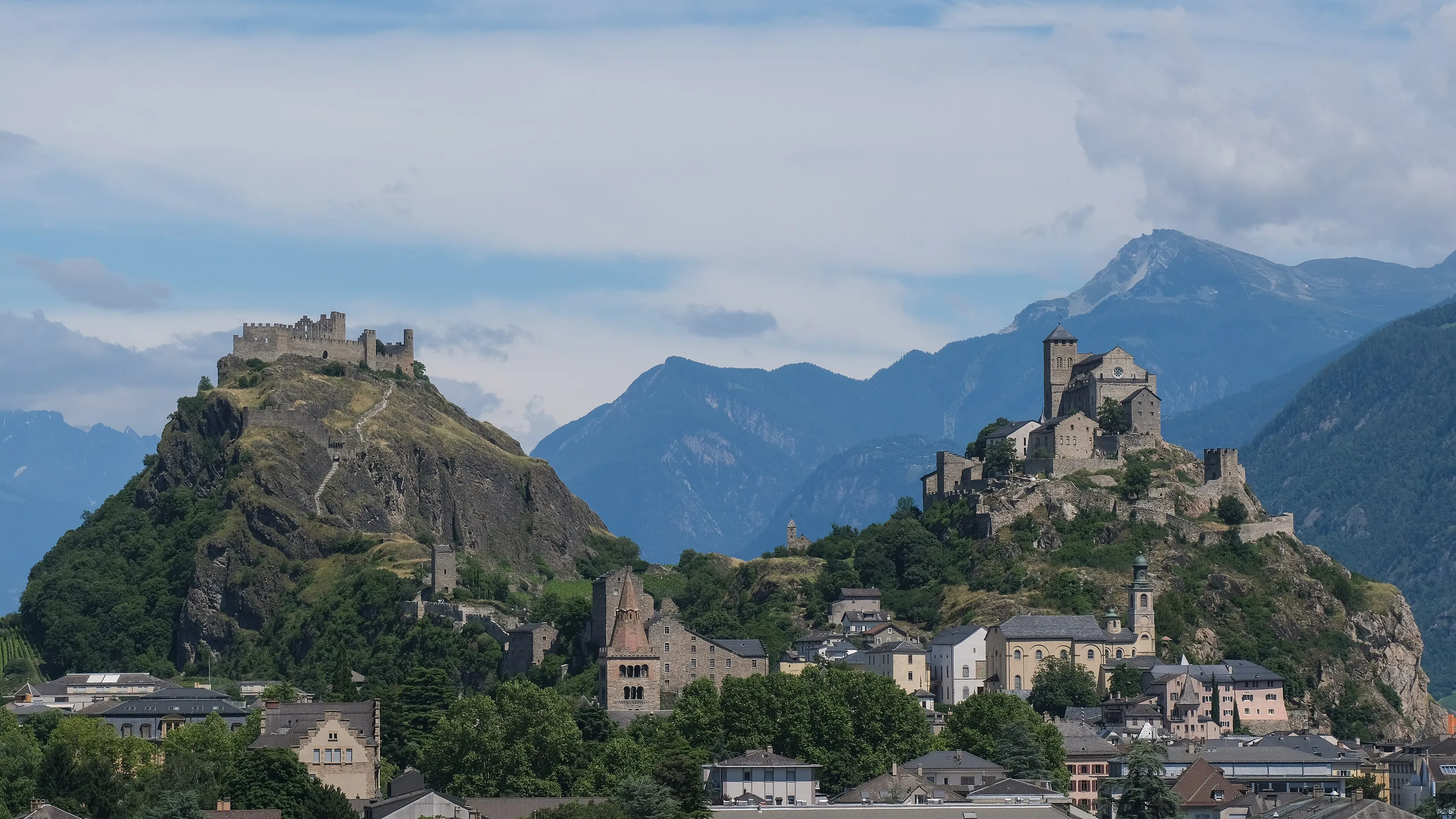
Sion, capital of the canton of Valais, lies in the Rhone valley between the Valais Alps and the Bernese Alps (Wikipedia FR, ES). About 35,000 people live here according to Wikipedia (EN, ES), mostly French-speaking. Two rocky hills overlook the old town: the fortified basilica of Valère and the ruins of Tourbillon castle, former homes of the bishop, who was count of Valais from the year 999 (Wikipedia FR, EN). The climate is one of the driest and sunniest in Switzerland, which explains the vineyards: Sion is the third-largest wine-growing commune in the country (Wikipedia FR, EN, DE). It is also a gateway to the ski and hiking resorts of Valais such as Anzère, Crans-Montana and the Val d'Hérens (Wikivoyage EN, FR). This guide presents Sion as open sources describe it; SniperAir tracks flight prices to SIR, compares them with the real price history of the route and alerts you when one falls below your budget, without selling or booking anything.
Airport and getting into town
A small civil and military airport, with Geneva as the main gateway
Sion (SIR)
Sion Airport (SIR) is about 2.5 km south-west of the town in the Rhone valley and serves both civil and military traffic (Wikipedia EN, FR). It offers only seasonal scheduled flights and charter flights (Wikipedia FR, EN); Wikipedia (DE) recalls that there was a regular service from 1996 to 2005 and seasonal flights in 2018 and 2019. Connections therefore depend on the season and can change from year to year: we publish neither a route list nor timetables, and there may be no flight to SIR on the date you want.
Air services at Sion are limited and change by season (Wikipedia FR, EN, DE). Sources disagree on the distance from Geneva airport, so we do not publish it. We do not publish fares.
For a wide choice of flights, most travellers land in Geneva (GVA), the nearest international airport, and continue by train: Sion station, on the Lausanne-Brig-Milan line, has half-hourly trains to Geneva, calling at the airport, and to Brig (Wikivoyage EN, DE). Bern (BRN) or Zurich (ZRH) can also serve as gateways by rail. If you cannot find a flight to SIR at your price, set up an alert for GVA or ZRH. The A9 motorway serves Sion via the Sion-Ouest and Sion-Est exits (Wikipedia FR).
Landmarks
Valère, Tourbillon, terraced vineyards and the old town
The photos below show the two hills, the vineyards and the old town seen from above. The Witches' Tower, the town hall and the pedestrian streets are covered at the end of this section.
Valère and Tourbillon, two hills for one skyline
The twin hills shape the skyline of Sion: the fortified basilica of Valère, completed in the twelfth and thirteenth centuries, and facing it the ruins of Tourbillon, the episcopal castle left in ruins by the fire of 1788 (Wikipedia FR, EN; Wikivoyage EN). They can be seen from far along the Rhone valley. Both hills are climbed on foot from the centre, and Wikivoyage (DE, EN) calls the views breathtaking.
Terraced vines beneath the castles
The slopes around the hills are covered with terraced vineyards. In the canton the vineyard covers more than 5,000 hectares and makes up about a third of Swiss wine production (Wikipedia FR); Sion is the country's third-largest wine-growing commune (Wikipedia FR, EN). The very dry, sunny climate, in which even cacti grow at the foot of Valère (Wikipedia FR, DE), suits the vine.
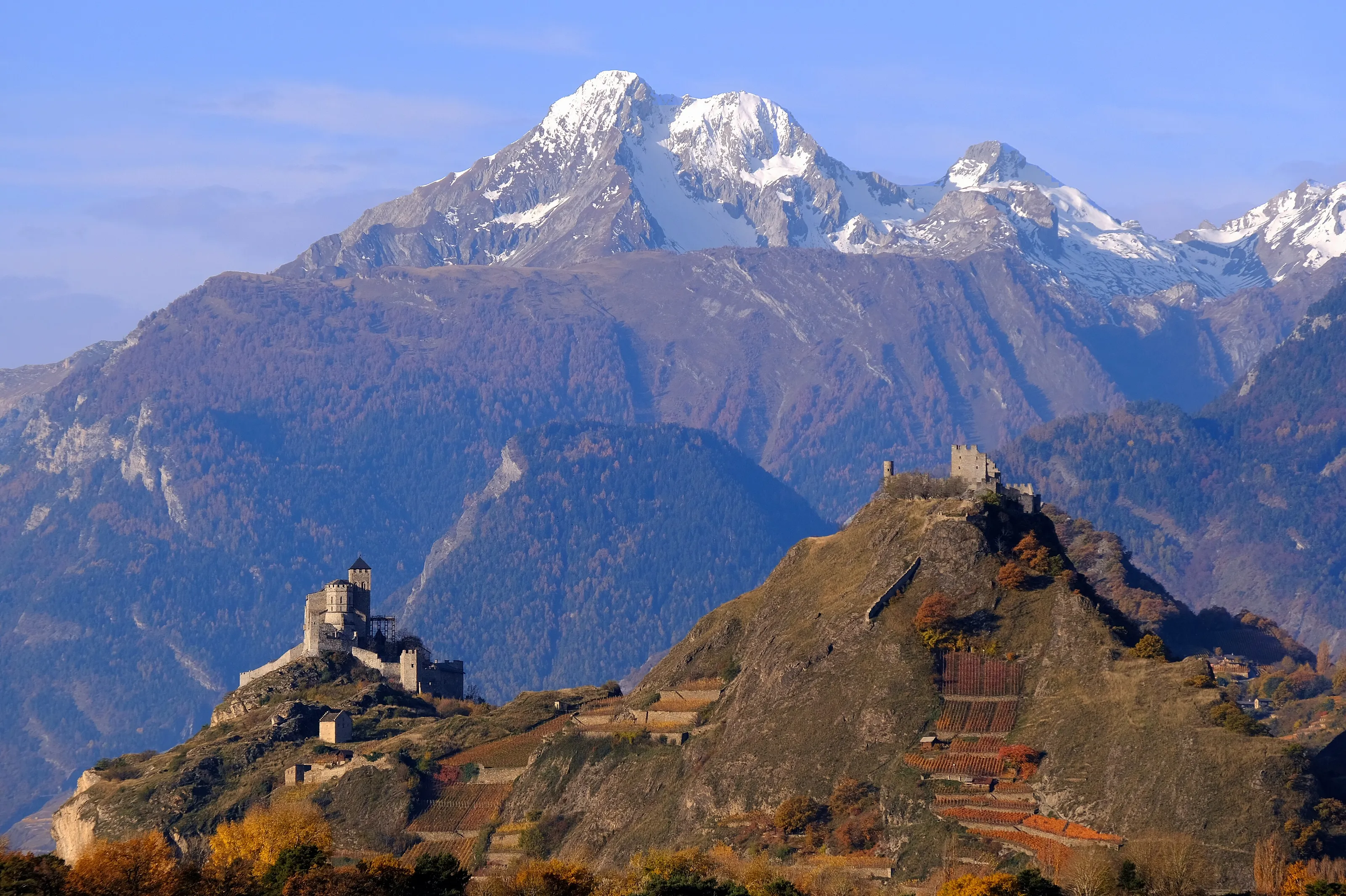
The basilica of Valère and its organ
Notre-Dame de Valère, a fortified church on its hill, houses the oldest playable organ in the world, built around 1430 according to Wikipedia (EN, DE); Wikipedia (FR) gives a construction date between 1390 and 1430. It became a minor basilica during the visit of John Paul II in 1984 (Wikivoyage EN). The neighbouring buildings house the Valais history museum (Wikipedia DE).
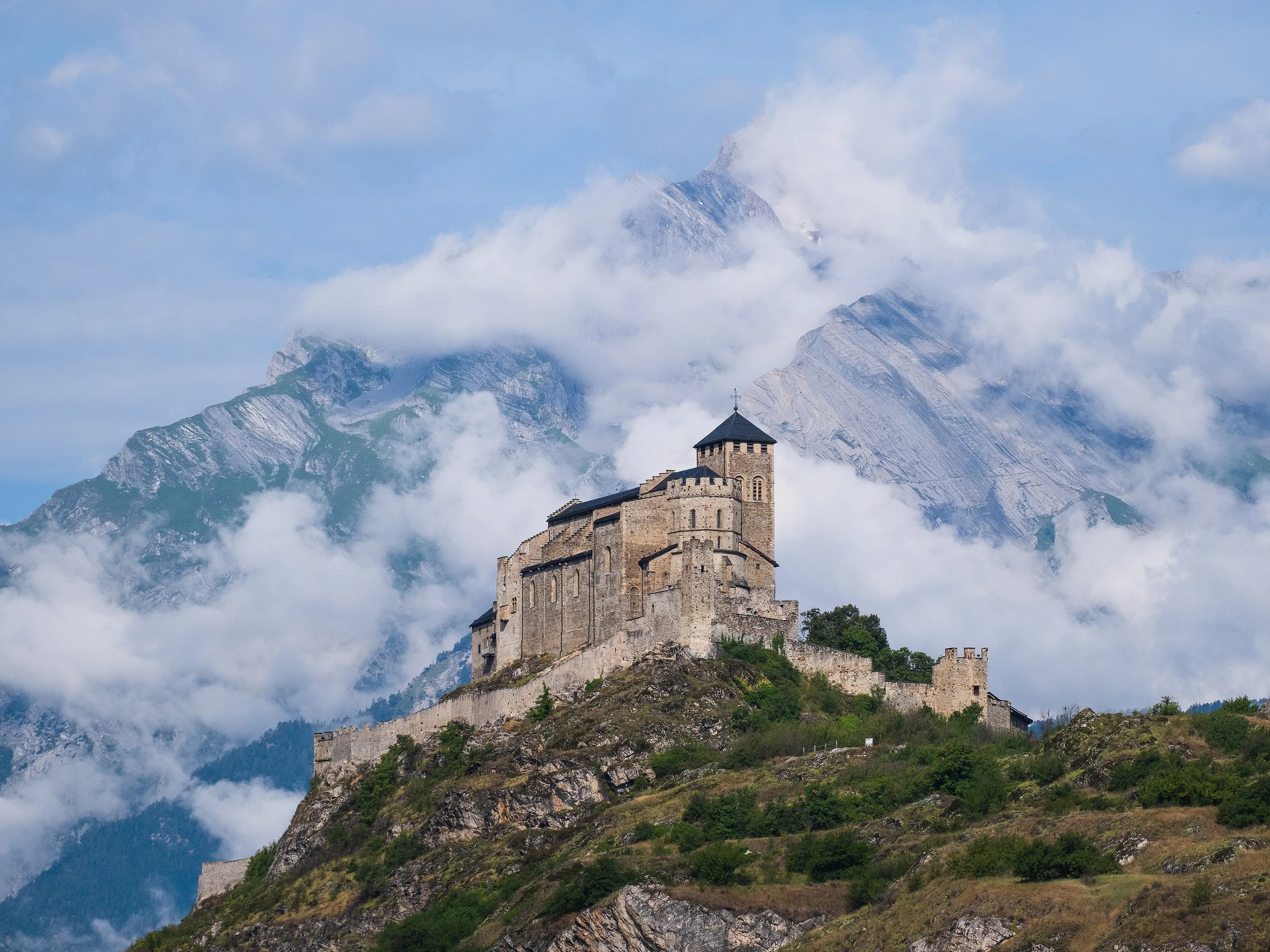
The ramparts of Valère seen from Tourbillon
From Tourbillon you look down on the ramparts, the towers and the roof of the Valère basilica, with the Rhone plain and its rooftops behind. This overall view of the stronghold shows how church, castle and canons' houses form a single fortified block (Wikipedia FR, EN).
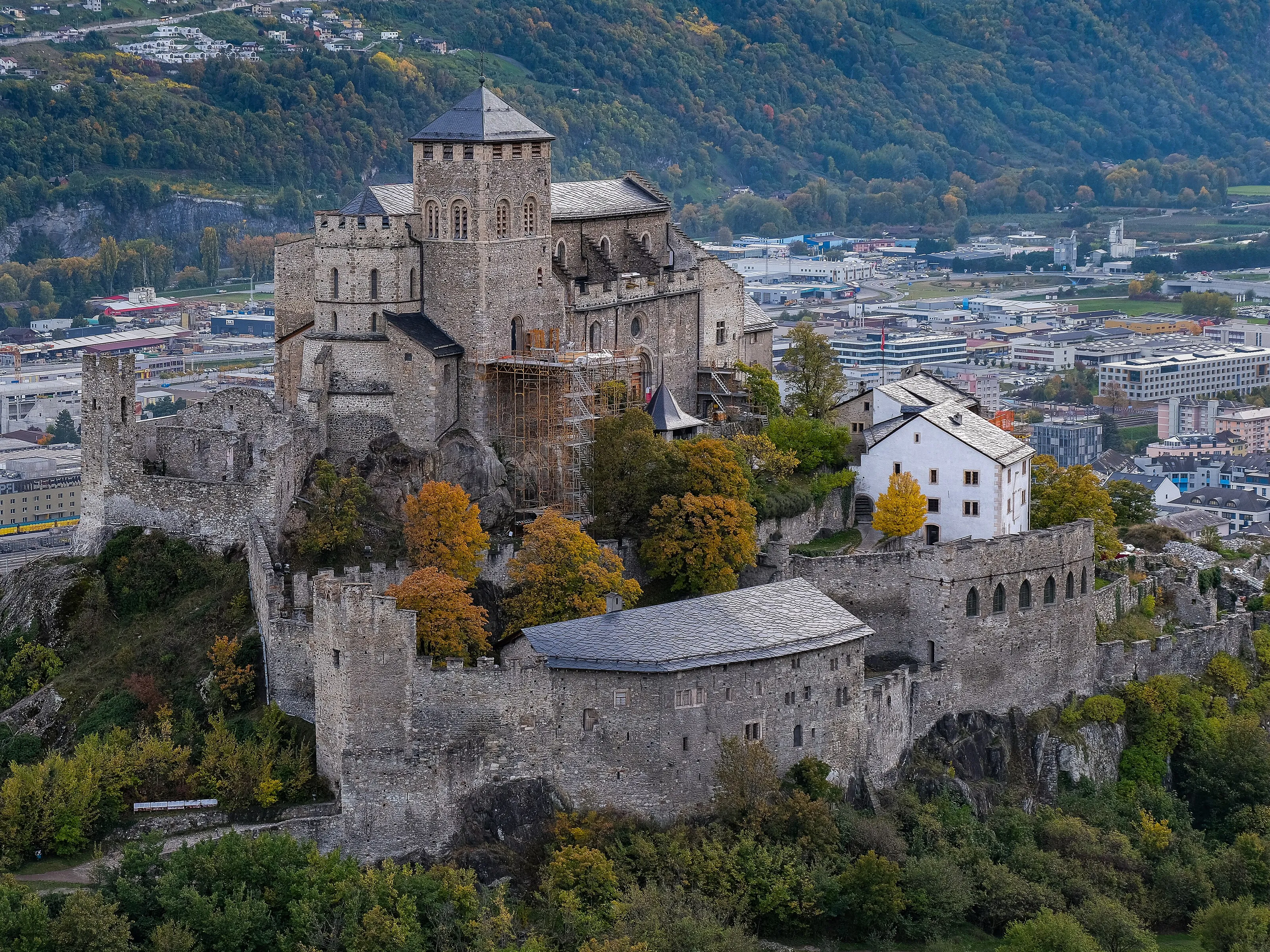
The vineyard in autumn
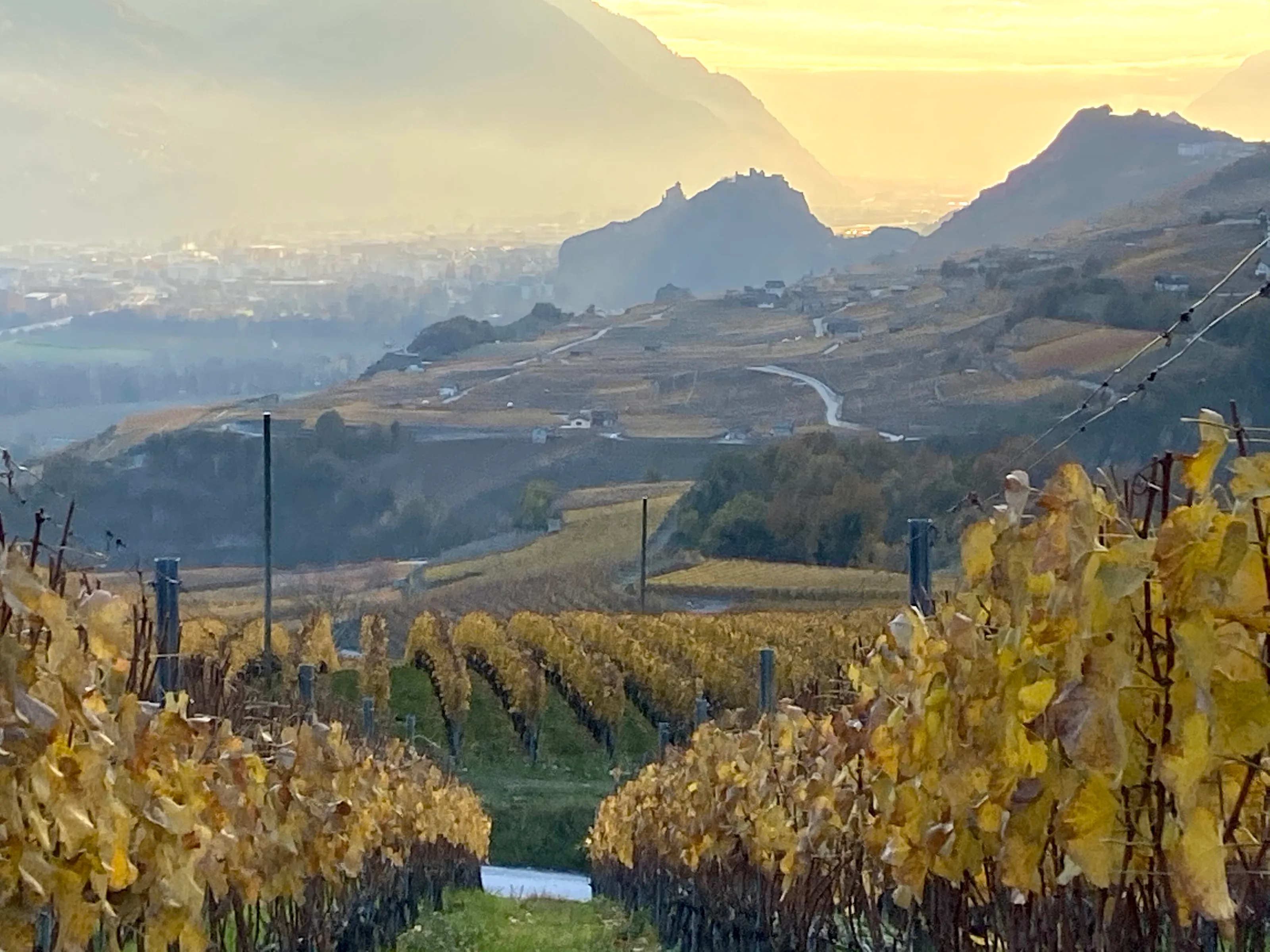
In autumn the vine leaves turn yellow and gold: the Valais vineyard, planted mostly on the right bank of the Rhone valley, then shows all its colours (Wikipedia FR). In this photo the two hills of Sion can be made out in the distance. The harvest takes place in late summer and autumn: check dates and cellar visits, which change every year.
The old town seen from Valère
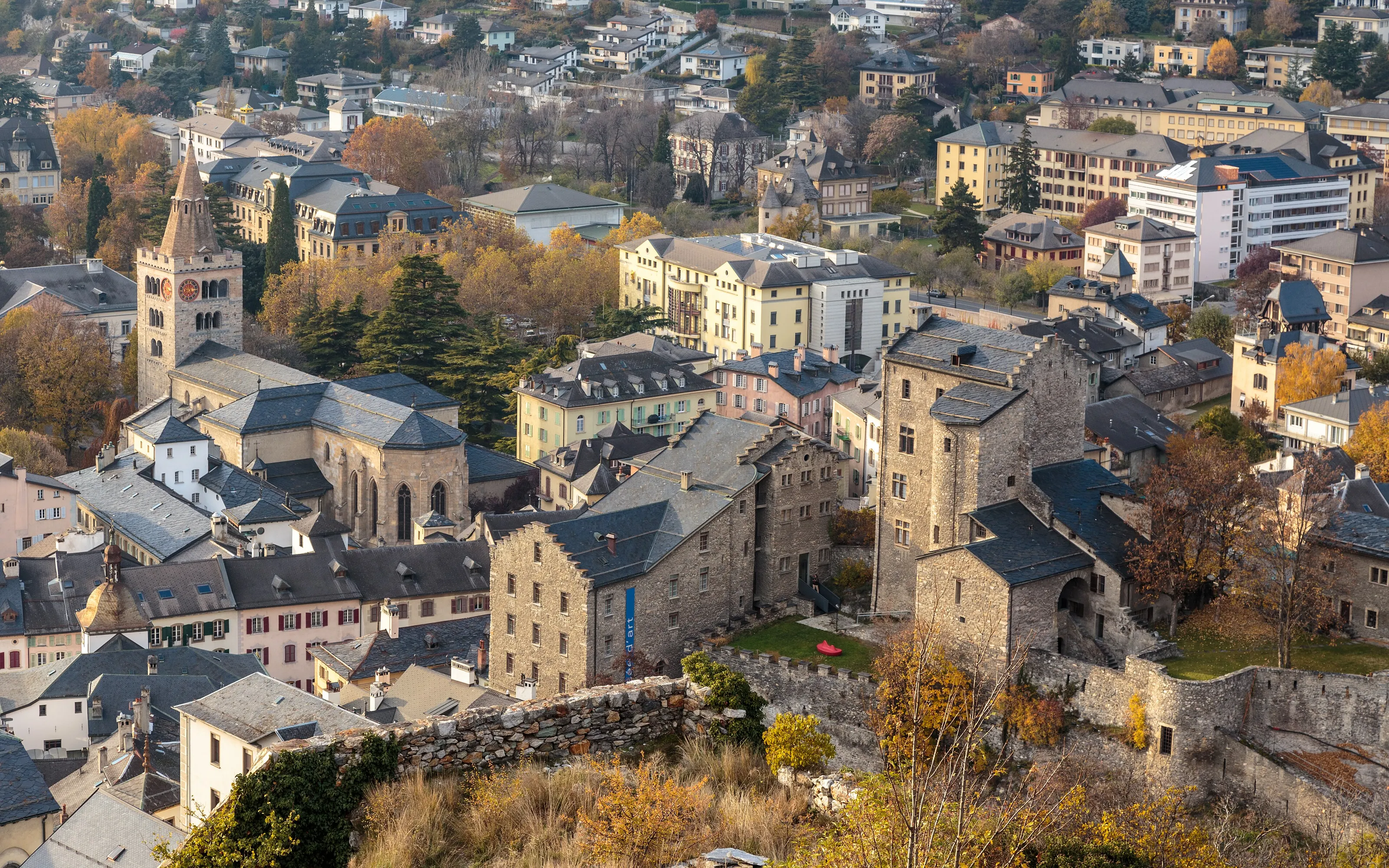
From Valère the view drops onto the roofs of the old town, the Romanesque bell tower of Notre-Dame-du-Glarier cathedral, whose Gothic body dates from the fifteenth century (Wikipedia DE, Wikivoyage DE), and the Majorie castle, a former episcopal residence that now houses the Valais art museum (Wikipedia DE). Much of the town was destroyed by the fire of 24 May 1788 and rebuilt (Wikipedia FR, EN).
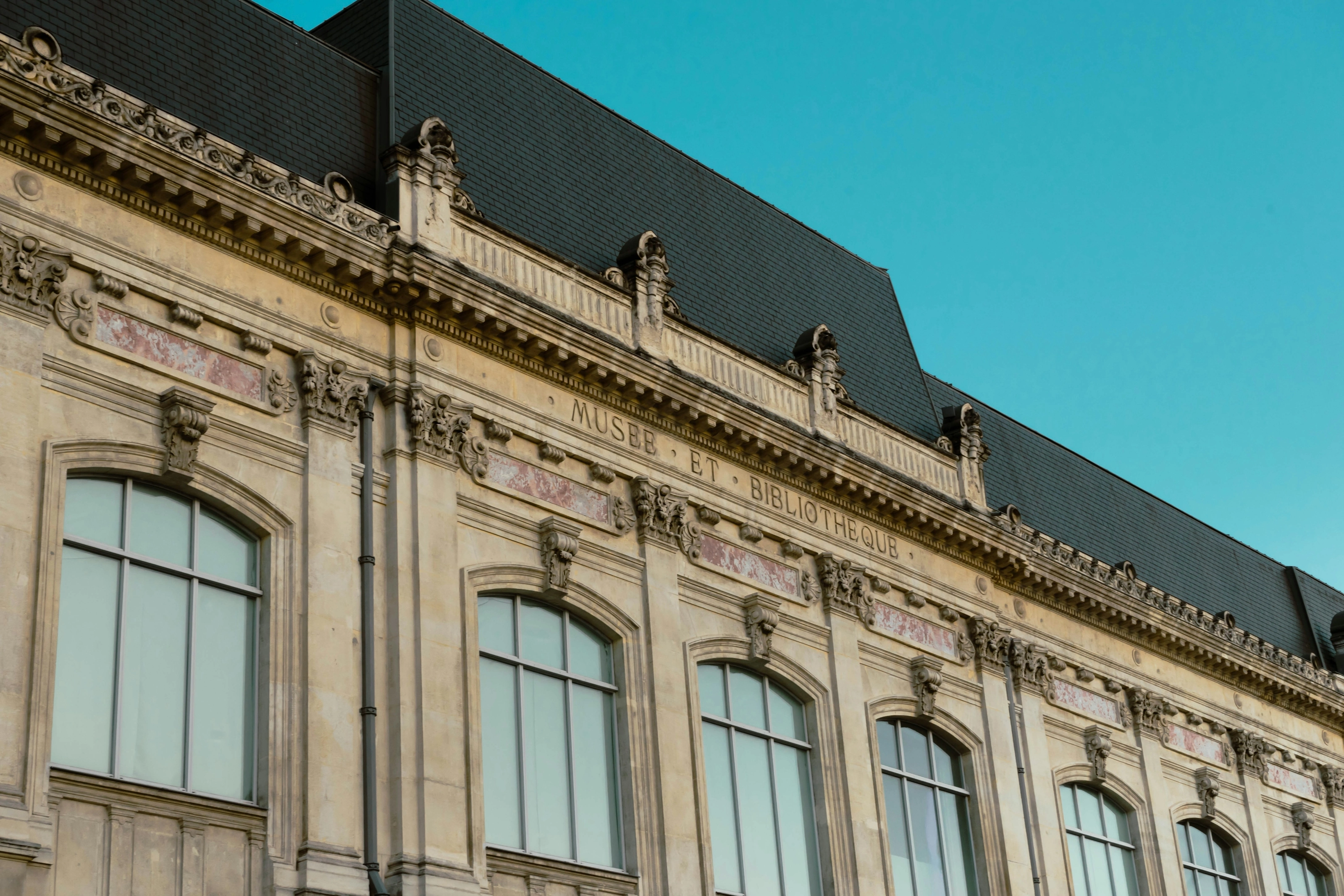
In town: the Witches' Tower, a fourteenth-century guard tower that later served as a prison (Wikivoyage EN), one of only two surviving traces of the walls along with the Watch Tower (Wikipedia FR); the town hall, built from 1657 to 1665 with a tower holding an astronomical clock (Wikipedia EN, Wikivoyage DE); St Theodul's church, begun in 1516 (Wikivoyage DE); and the Supersaxo house in the old town (Wikipedia FR). The pedestrian streets of the old town around the Grand-Pont are best walked, and on Fridays there is a market that the tourist office presents as the largest weekly market in French-speaking Switzerland.
Museums and culture
Museums and culture: history, art, nature and festivals
The cantonal museums
The town houses the cantonal museums of history, nature and art (Wikipedia FR). The Valais history museum is at Valère; the Valais art museum has occupied the former episcopal residences of La Majorie and Le Vidomnat since 1947 (Wikipedia DE); there is also an archaeological museum (Wikipedia DE). The tourist office presents a museum complex covering art, history and nature. We give no opening hours or prices: they change regularly.
A town with very old traces
Sion is one of the most important prehistoric sites in Europe: the alluvial fan of the Sionne has been settled almost continuously since the late Mesolithic, around 6200 BC (Wikipedia EN). The Petit-Chasseur necropolis bears witness to the Neolithic (Wikipedia FR, ES). The bishop moved here in the fifth century (Wikipedia FR).
Music, organ and festivals
Several music festivals take place here: the Sion Festival, the Tibor Varga international violin competition, Sion sous les étoiles and the Early Organ Festival, devoted to the Valère organ (Wikipedia FR). Wikivoyage (FR) mentions the Sion Carnival. Dates change every year: check before you book.
Food and drink
Valais wines, raclette and the Friday market
Valais wines
Valais has the largest vineyard in Switzerland, over 5,000 hectares and about 32 percent of national output according to Wikipedia (FR), with 59 grape varieties. Chasselas, known as fendant, pinot noir, gamay, petite arvine, cornalin and humagne rouge are among the varieties cited (Wikipedia FR, DE). Dole is a blend of pinot noir and gamay (Wikipedia DE).
Raclette
Raclette, in which melted cheese is scraped off before a fire or a heating device, comes from Valais (Wikipedia FR, EN); Valais raclette cheese has protected status (AOP). It is served with potatoes, gherkins and onions. Wikivoyage (EN) also mentions fondue in old-town restaurants.
Market and terraces
The weekly old-town market is held on Fridays, according to the tourist office. Most traditional restaurants are in the pedestrian zone, with outdoor tables in summer (Wikivoyage EN). Wikivoyage (FR) points out that having a drink is a Valais tradition: know your limits. We name no brand and no address.
Getting around
On foot, by train and by bus to the resorts
A walkable town
The centre is walkable; Wikivoyage (EN) notes that city buses are infrequent and that the historic core is not served by them. Valère and Tourbillon are climbed on foot (Wikivoyage DE).
Train and motorway
Sion station, on the Simplon line, is an intermodal hub with a bus station (Wikipedia FR); trains leave every half hour for Brig and Geneva (Wikivoyage EN, DE), and a few EuroCity services link Geneva, Sion and Milan (Wikivoyage DE). We publish no fares.
To the resorts
Anzère is about 15 km to the north, with a 40-minute bus ride from the station according to Wikivoyage (EN); Crans-Montana is the largest neighbouring resort; bus lines also go to Thyon 2000 and the Val d'Hérémence (Wikipedia DE). The Val d'Hérens, with the Euseigne pyramids and the Grande Dixence dam, is cited by Wikivoyage (FR).
Budget and precautions
Budget, formalities and precautions
Price level
Switzerland is among the most expensive destinations in Europe, and Wikivoyage (EN) adds that accommodation in Sion can be costly depending on the time of year. We give no figures because we could not confirm them on two independent open sources.
Currency and payment
The currency is the Swiss franc (CHF). Check the exchange and payment conditions of your card before you leave.
Flights, formalities and precautions
SniperAir monitors prices and alerts you; it does not sell or book tickets. Switzerland is not in the European Union but applies the Schengen rules: entry conditions depend on your nationality and may change, so consult your own government's official advice before you book. In the mountains, check the weather and road conditions; protect yourself from sun and heat in summer.
When to go
Hot, dry summers and cold but sunny winters
Winter (December to February)
Cold, with about 88 frost days a year and a January average around 0.5 C (Wikipedia DE, FR). It often snows, but the snow cover melts quickly on the valley floor; the neighbouring ski resorts get more (Wikipedia FR).
Spring (March to May)
Temperatures rise and the vines begin to turn green; a good time to climb Valère and Tourbillon before the heat.
Summer (June to August)
Hot and dry: about 20.6 C on average in July and some twenty days a year at 30 C or more (Wikipedia DE, FR). With Zermatt, Sion is the sunniest place in Switzerland according to Wikipedia (DE).
Autumn (September to November)
The harvest and the yellow vine leaves make this a beautiful season; days often stay pleasant and dry, with spells of foehn wind (Wikipedia FR).
Sion enjoys a dry, mild climate sheltered by the Alps, with an annual mean temperature of about 10.7 C and close to 2,158 hours of sunshine a year (Wikipedia DE, FR). The foehn is frequent. We give no other monthly averages because reference periods differ between sources.
By length of stay
What to do in Sion depending on how long you stay
The essentials
The climb to Valère and Tourbillon, the old town and its cathedral, a glass of Valais wine and a raclette at the end of the day.
Museums and vineyards
Add the cantonal museums, a walk through the vines around the hills, the Friday market if you are there and the Domaine des Iles for a summer swim.
Sion and its mountains
Use Sion as a base for Anzère, Crans-Montana or the Val d'Hérens, or combine the visit with Geneva or Bern by train.
In pictures
Sion in pictures
You might also like
Similar destinations
FAQ
Frequently asked questions about flights to Sion
Which airport is the most convenient for Sion?
Sion has a small airport (SIR) with seasonal flights, sometimes none at all. Most travellers fly to Geneva (GVA) and take the train: trains leave for Sion every half hour.
Can you climb to Valère and Tourbillon?
Yes, but on foot: both hills are climbed from the centre and give a wide view of the town and the Rhone valley, according to Wikivoyage.
When is the best time to visit Sion?
From May to September for the heat and hiking, in autumn for the harvest and golden vines; winter is cold but very sunny, with ski resorts nearby.
Is Sion expensive?
Switzerland is expensive and accommodation in the region varies widely by season. We give no figures because we could not confirm them.
Which ski resorts are near Sion?
Anzère is about 15 km away, Crans-Montana is the largest resort in the area and Thyon 2000 is linked by bus, according to Wikivoyage and Wikipedia.
What should I try in Sion?
Valais wines such as fendant, pinot noir, petite arvine or cornalin, and raclette, a dish that originated in the canton.
How much does a flight to Sion usually cost?
The price depends mainly on your departure city, the time of year and how far ahead you book. The "opportunities" section above shows real examples of prices SniperAir has already detected to this destination.
How do I get alerted when a flight to Sion drops below my budget?
Create an alert profile with your departure airport, Sion (SIR) as the destination and your maximum budget. You are notified automatically as soon as a matching price is detected. SniperAir monitors and alerts, it does not sell or book tickets.
Ready to head to Sion?
Set your budget and let SniperAir monitor fares for you.
Create my alert