
Cheap flights to Newcastle
Set your departure airport and maximum budget: SniperAir tracks prices to Newcastle and alerts you the moment a deal matching your criteria appears.
Quick summary
Country
United Kingdom
Continent
Europe
Airport
NCL
Currency
Pound sterling (GBP)
Time zone
UTC+0 (UTC+1 during summer time)
Deals already spotted to Newcastle
Real flight examples detected by SniperAir, with their reference price.
Loading examples…
Why track Newcastle with SniperAir
You don't need to compare prices every day
Choose your departure
Enter your departure airport and your maximum budget for a flight to Newcastle (NCL).
SniperAir keeps watch
Our systems continuously compare new fares with the real price history of the route. SniperAir tracks prices and alerts you: it does not sell or book tickets.
You get an alert
As soon as a fare matches your criteria, you are notified, without having searched for anything yourself.
Airport and getting into town
An airport about 11 km out, linked to the centre by Metro
Newcastle International (NCL)
Newcastle International Airport sits about 11 km north-west of the city centre. The Tyne and Wear Metro runs from the terminal to Central Station and the city centre in roughly 20 to 25 minutes, with a train every few minutes in the daytime, according to Wikivoyage (EN, DE). An express bus also serves Eldon Square, and a taxi or car takes about 15 to 20 minutes outside the rush hour. There is one compact terminal. Most routes link the rest of the UK, Ireland and Europe; for long-haul flights many travellers connect through London, Amsterdam, Paris or Manchester.
Distances and times are approximate, based on Wikivoyage (EN, DE); Metro and bus frequencies change, so check them before you travel. We give no fares.
Newcastle upon Tyne has a little under 300,000 residents, more across the wider Tyneside conurbation, and stands on the north bank of the River Tyne in north-east England, facing Gateshead. London King's Cross is about three hours away by train and Edinburgh about an hour and a half; Central Station, opened in 1850, is a few minutes' walk from the castle and the centre.
Old town and landmarks
Bridges, a Norman keep and a classical city centre
Newcastle is best met first along the Tyne, with its bridges, and then in the pale stone streets of the Victorian centre. Four places are illustrated below; the keep, Grainger Town, the cathedral and other sights are described in text only.
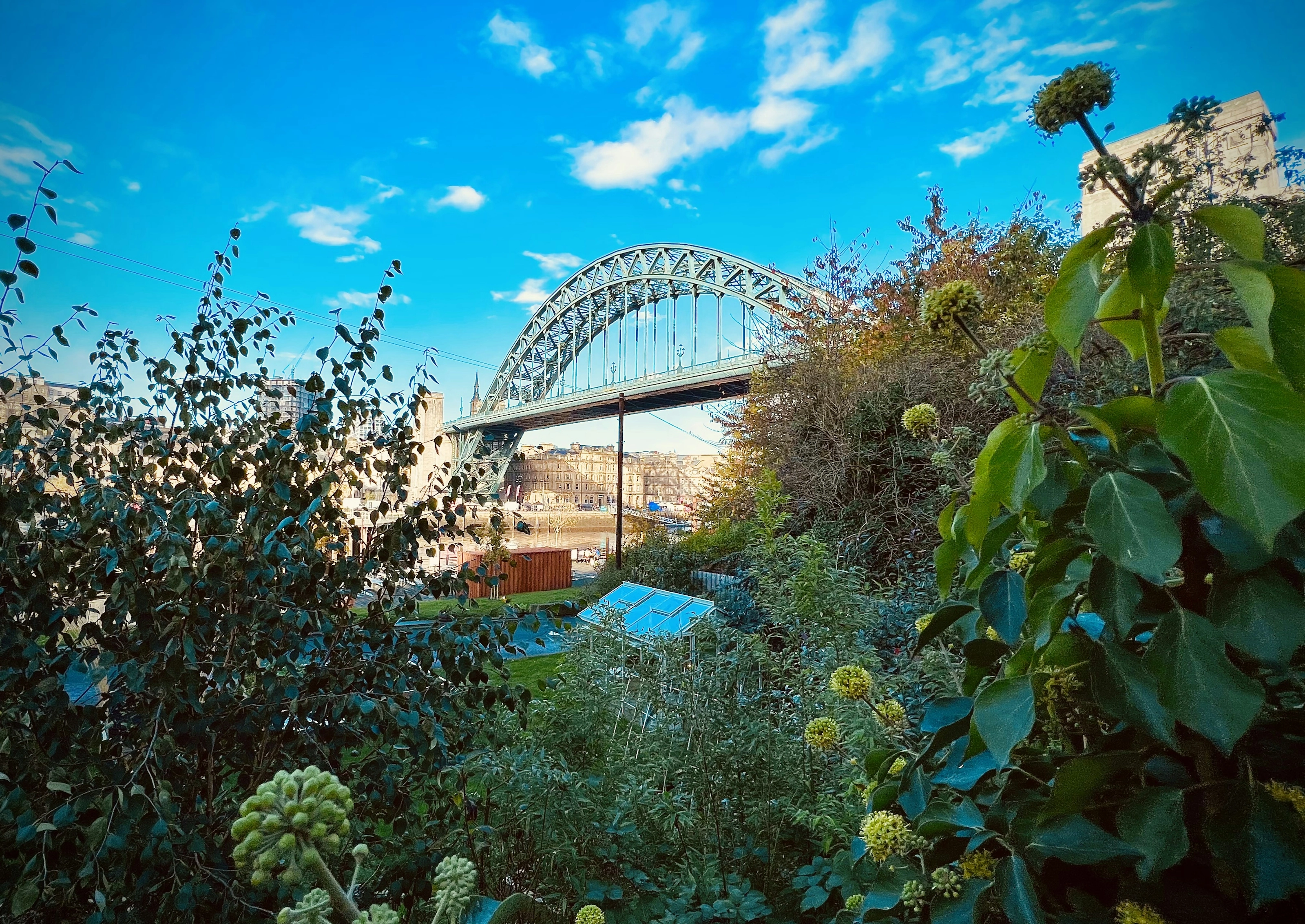
The Tyne Bridge
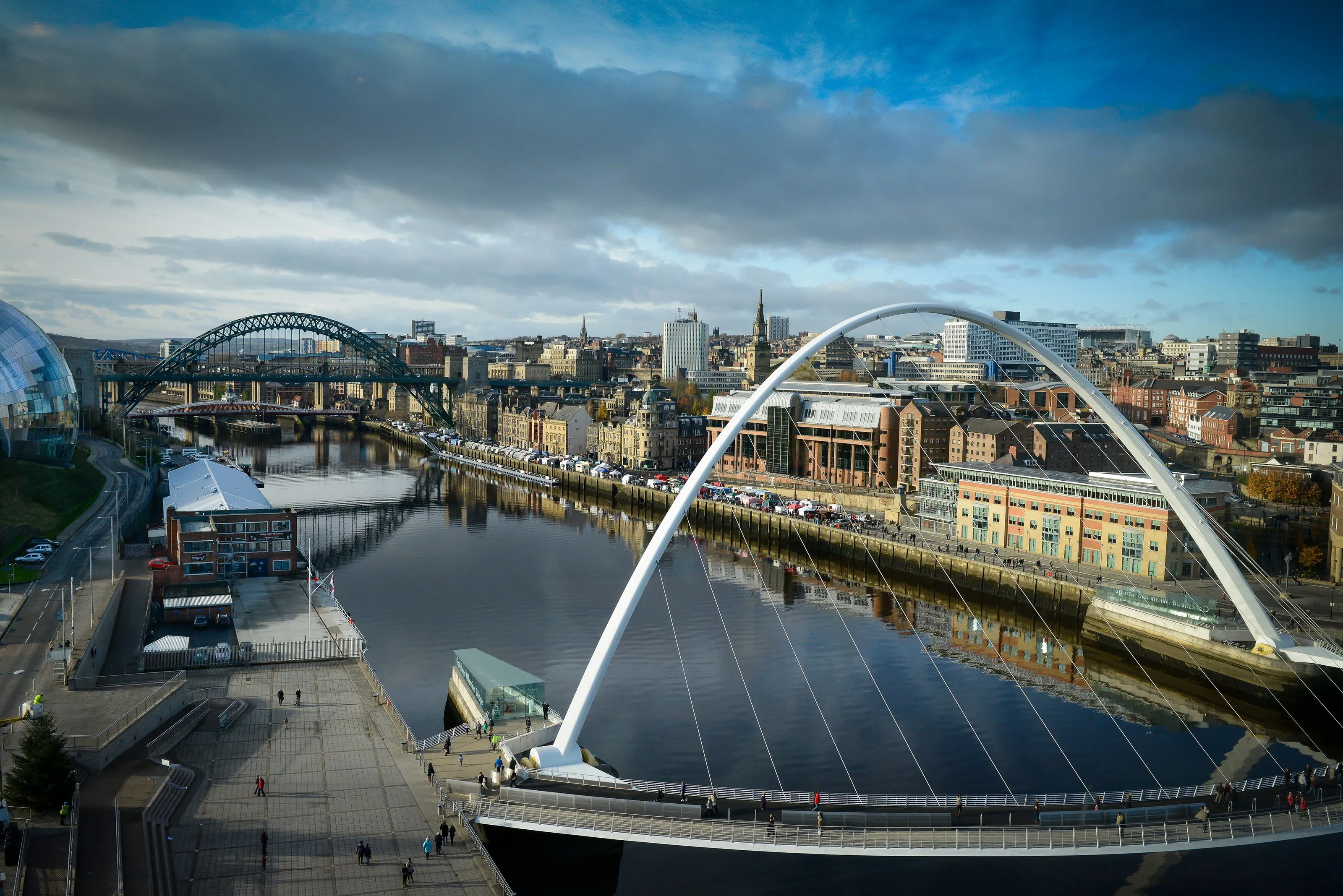
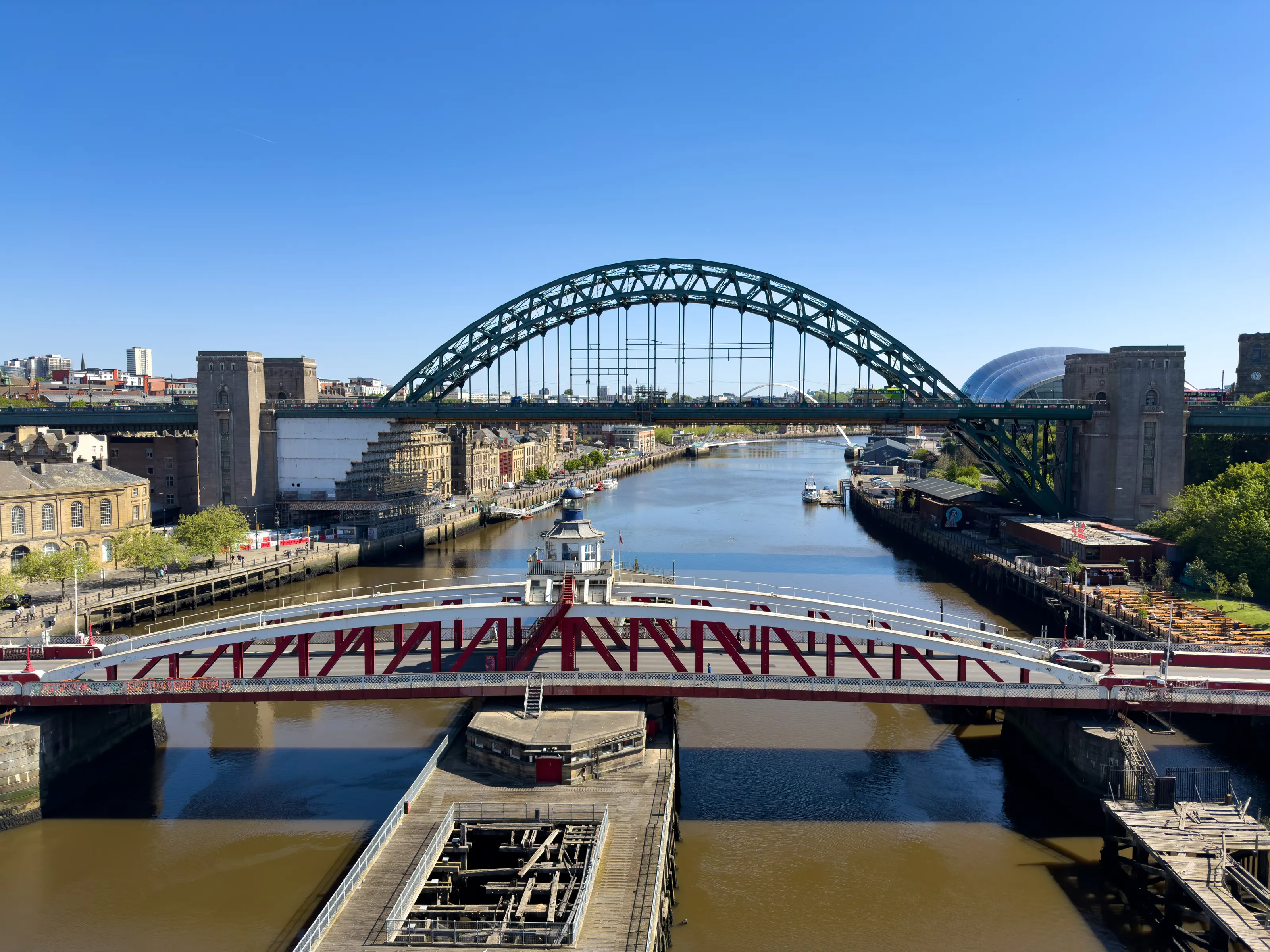
Completed in 1928, the Tyne Bridge is the city's signature: a great steel arch often likened to Sydney Harbour Bridge, carrying traffic between Newcastle and Gateshead. Seen from the riverbank it towers above an older red and white swing bridge lower down. Almost every photograph of the city is built around it.
The Gateshead Millennium Bridge
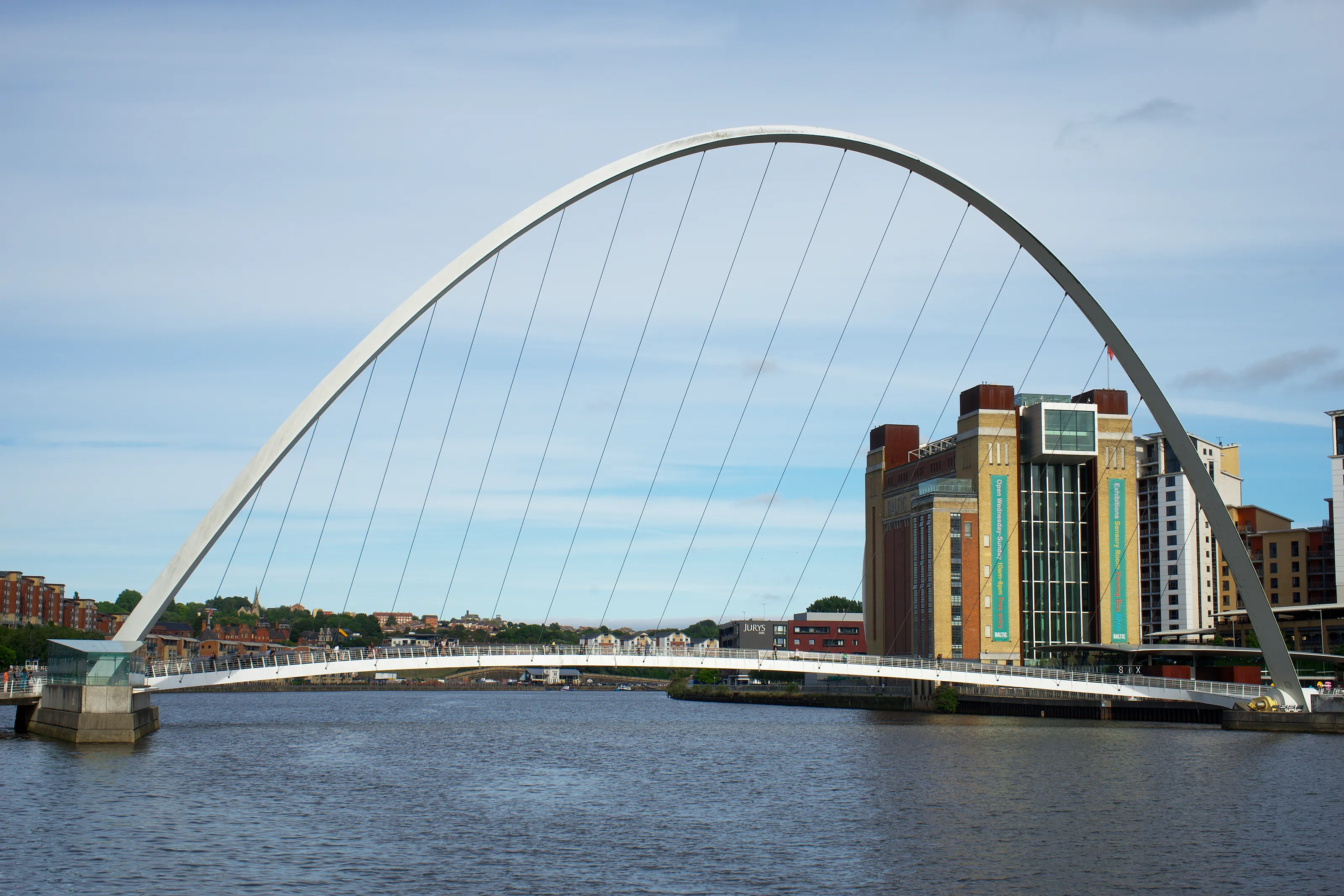
Opened in 2001, this pedestrian and cycle bridge tilts upwards like a blinking eye to let boats through, which explains its nickname. It links the Quayside to the south bank, where the BALTIC contemporary art centre, housed in a former flour mill, and the Sage concert hall are a short walk away.
Quayside after dark
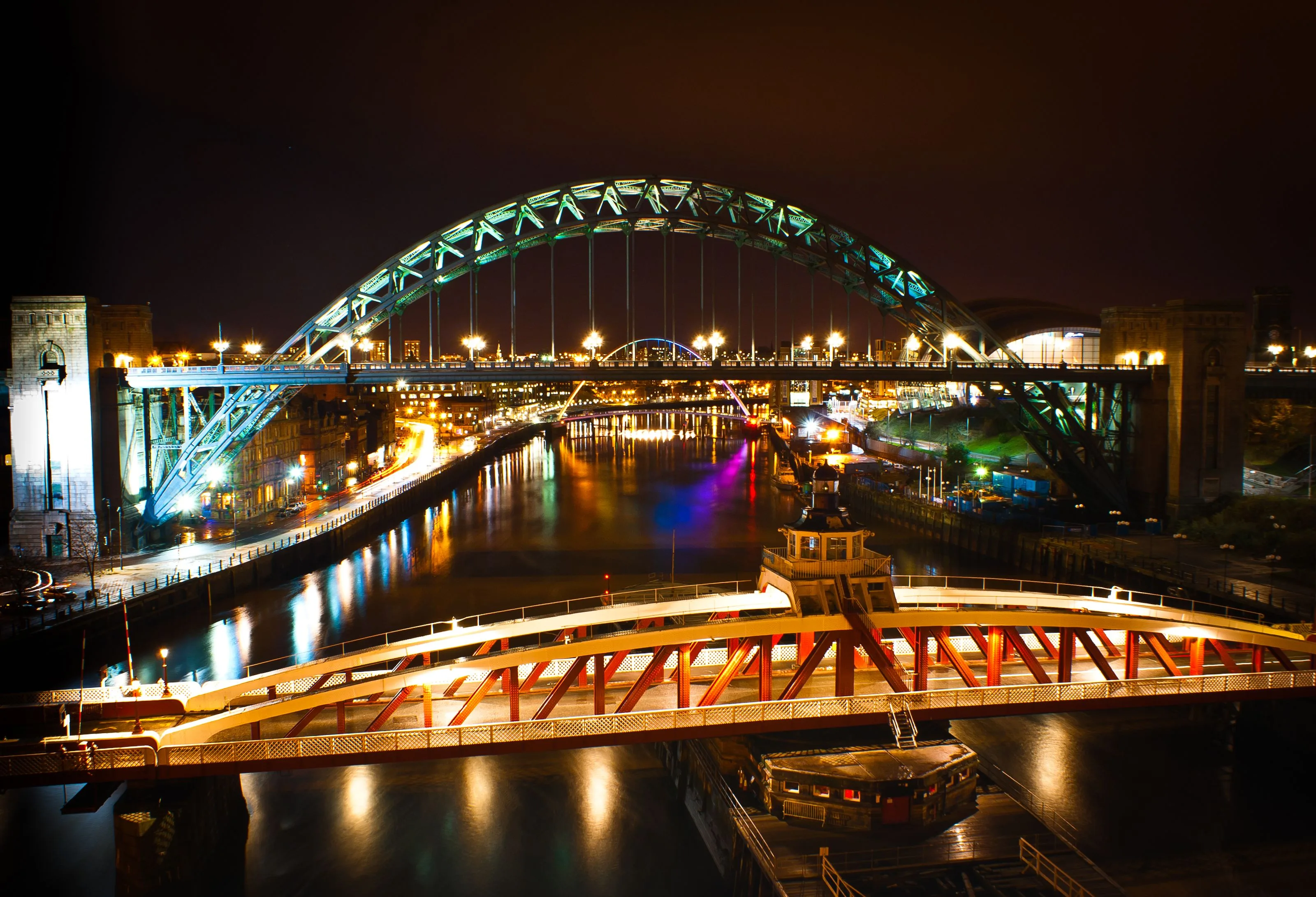
The north quay of the Tyne is the city's front room: a promenade with restaurants and bars facing the bridges, which light up at dusk. The colourful reflections in the river are worth the detour, and the walk between the Tyne Bridge and the footbridge takes only a few minutes.
The Tyne, bridge after bridge
The river is Newcastle's backbone. Several bridges follow one another over a few kilometres, among them the High Level Bridge designed by Robert Stephenson in the mid-19th century. This overview shows the contrast between the brick and stone quayside architecture and the more recent structures.
Keep, Grainger Town and cathedral, in text
Newcastle Castle, which gave the city its name, was rebuilt around 1172 under Henry II on the site of the Roman fort; the Black Gate dates from the 14th century, and the railway runs between the two. Grainger Town, built between 1835 and 1842, is the classical heart of the city; Grey Street, curving and elegant, is often named among the finest streets in England, and Grey's Monument (1838) stands at its head. The cathedral of St Nicholas, completed in the 14th century, is recognisable by the lantern spire added in 1448. Chinatown on Stowell Street, Jesmond Dene and, across the river, the Angel of the North, Antony Gormley's sculpture about 20 m tall, extend the visit.
Museums and culture
Natural history, fine art, science and children's books
Great North Museum: Hancock and the Hatton Gallery
The Great North Museum: Hancock gathers fossils, mummies, stuffed animals and local history, and admission is free according to Wikivoyage (EN). Close by, the Hatton Gallery, the university gallery founded in 1925, shows works from the 14th century to modern art.
The Laing, the Discovery Museum and BALTIC
The Laing Art Gallery, built in 1901, shows British paintings of the 18th and 19th centuries as well as local glass, silverware and ceramics. The Discovery Museum, devoted to science and engineering, houses Turbinia, the world's first turbine-powered ship (1894). On the Gateshead side, BALTIC offers contemporary art.
Seven Stories, stage and science
Seven Stories, in a former mill in the Ouseburn valley, is the first gallery in Britain wholly devoted to children's books. The Theatre Royal on Grey Street and the Sage hall programme theatre, opera and concerts all year. The Life Science Centre adds an option for families. We give no admission prices.
Food and drink
Stotties, world cuisine and a lively quayside
The dishes
North-east England has its own classics: the stottie, a flat bread filled with ham and pease pudding, fish and chips, pies, and the Sunday roast served in pubs. Alongside them sits a very broad international scene, with plenty of Indian and Italian restaurants.
Chinatown and markets
Stowell Street is home to Newcastle's Chinatown, with Chinese, Korean and Japanese restaurants. Grainger Market, a covered hall from 1835 in the middle of town, is the place to snack, pick up local produce and wander.
Bars and neighbourhoods
Nights out centre on the Quayside, the Bigg Market and the area around Central Station, and the city's nightlife is well known, helped by a large student population. Jesmond to the north and the Ouseburn valley offer quieter addresses. Restaurants set in old buildings, one in a 13th-century refectory, add character to a dinner.
Getting around
Metro, buses and your own two feet
The Metro
The Tyne and Wear Metro has two lines: the Green Line links the airport with the city centre, Gateshead and Sunderland; the Yellow Line makes a loop towards the coast, via Tynemouth and Whitley Bay, and returns through the centre. Trains run from about 6 am to 11 pm, a few minutes apart in normal times, and fares are set by zone. Every station has step-free access, according to Wikivoyage (EN).
Buses, bikes and walking
The centre, the universities and the Quayside are all easy on foot. Buses from several operators serve the districts and sights such as the Angel of the North. There are cycle lanes and lock-up points, but only folding bikes are allowed on the Metro, and there is no public bike-share scheme.
Heading out
Tynemouth and its beaches are about twenty minutes away by Metro. Hadrian's Wall begins at Wallsend, east of the centre, and its best stretches lie to the west, towards Hexham. By train you can reach Durham, Edinburgh or London without leaving Central Station.
Budget and precautions
A gentler budget than the south, with flights to watch
Price level
Newcastle is generally seen as more affordable than London and the south of England for eating out, going out and accommodation. The currency is the pound sterling (GBP). We give no figures, because we could not cross-check them against two independent open sources.
Flights
The flight is still the most variable cost. SniperAir tracks prices to NCL and compares them with the route's history, but it does not sell or book tickets. For northern England, Manchester (MAN) or Leeds Bradford are other gateways worth comparing, a few hours away by train.
Entry rules and precautions
The UK is not part of the Schengen area, and entry rules, including a possible electronic travel authorisation, depend on your nationality: check the official sites. Newcastle is a broadly safe city; as anywhere, keep an eye on your belongings and avoid rowdy crowds late in the evening, especially on match nights.
When to go
Cool summers, mild winters and rain at any time
Winter (December to February)
Cool and damp, rarely below freezing, with short days; Christmas markets enliven the centre and prices ease.
Spring (March to May)
Parks turn green and days lengthen; the weather stays changeable, so pack a jacket.
Summer (June to August)
Mild to cool for a summer, with long evenings; the best season for Quayside terraces, coast trips and Hadrian's Wall.
Autumn (September to November)
Golden light in Jesmond's parks, cool temperatures and the return of the rain; a good season for museums.
Newcastle's climate is oceanic and cool: summer temperatures stay moderate, winter seldom drops below freezing, and rain can fall at any time of year. We give no exact temperatures, as they were not cross-checked; look at the forecast before you go. May to September is the most pleasant period for walking and outdoor sights.
By length of stay
What to do in Newcastle depending on how long you stay
The essentials
The Tyne bridges, the Quayside, the keep, Grey Street and Grainger Town, a free museum and dinner in Chinatown or by the river.
Culture and valleys
The Laing, the Discovery Museum, BALTIC, Seven Stories, the Ouseburn valley, Jesmond Dene and an evening at the Theatre Royal or the Sage.
The North East
Tynemouth and the coast, the Roman fort of Segedunum at Wallsend, Durham, Alnwick Castle or a stretch of Hadrian's Wall towards Hexham.
In pictures
Newcastle in pictures
You might also like
Similar destinations
FAQ
Frequently asked questions about flights to Newcastle
How do I get from Newcastle airport to the city centre?
NCL is about 11 km north-west of the centre. The Metro reaches Central Station in roughly 20 to 25 minutes, an express bus serves Eldon Square, and a taxi takes about 15 to 20 minutes outside the rush hour. Check the timetables before you travel.
When is the best time to visit Newcastle?
From May to September for long days, terraces and trips to the coast; December for the Christmas markets; the rest of the year suits museums and evenings out, with a waterproof layer.
Is Newcastle expensive?
It is generally seen as more affordable than London and the south of England. We give no amounts because we could not cross-check them against two independent sources.
How long should I stay in Newcastle?
Two days for the bridges, the castle and the centre; four days with the museums, the Ouseburn and the Tynemouth coast; five days or more with Durham, Alnwick or Hadrian's Wall.
How do I get around Newcastle?
On foot in the centre and along the Quayside. The Tyne and Wear Metro (two lines, zone fares) serves the airport, Gateshead, the coast and Sunderland, and buses complete the network.
What should I eat in Newcastle?
A ham and pease pudding stottie, fish and chips, a Sunday roast in a pub, then the cooking of Chinatown; Grainger Market is a good place to start.
How much does a flight to Newcastle usually cost?
The price depends mostly on your departure city, the season and how early you book. The opportunities section above shows real examples of fares SniperAir has already detected to this destination.
How do I get alerted when a flight to Newcastle drops below my budget?
Create an alert profile with your departure airport, Newcastle as the destination and your maximum budget. You are notified automatically as soon as a matching fare is detected.
Ready to head to Newcastle?
Set your budget and let SniperAir monitor fares for you.
Create my alert