
Cheap flights to San Pedro Sula
Set your departure airport and maximum budget: SniperAir tracks prices to San Pedro Sula and alerts you the moment a deal matching your criteria appears.
Quick summary
Country
Honduras
Continent
North America
Airport
SAP
Currency
Honduran lempira (HNL)
Time zone
UTC-6 (no clock change)
Deals already spotted to San Pedro Sula
Real flight examples detected by SniperAir, with their reference price.
Loading examples…
Why track San Pedro Sula with SniperAir
An industrial metropolis and gateway to northern Honduras, to approach with care
Choose your departure
Enter your departure airport and your maximum budget for a flight to San Pedro Sula (SAP).
SniperAir keeps watch
Our systems continuously compare new prices with the route's real history. SniperAir monitors prices and alerts you: it does not sell or book tickets.
You receive an alert
As soon as a price matches your criteria you are notified, without having searched for anything yourself.
First of all: Honduras is the subject of very restrictive official travel advice in many departure countries. Depending on your country, that advice warns against certain areas, sometimes the whole country, and big cities such as San Pedro Sula are often named. Do not assume that the country is accessible: read the official advice of your departure country and the terms of your insurance before committing to anything. This page describes the city from open sources; it is not an invitation to travel.
San Pedro Sula is the second largest city in Honduras after Tegucigalpa, the country's economic capital and the seat of Cortés Department (Wikipedia FR, EN). Population figures vary strongly depending on whether you count the city or the metropolitan area, so we publish no exact number. Founded in 1536 by Pedro de Alvarado as Villa de San Pedro de Puerto Caballos, it took its present name five years later, after the Sula Valley where it lies (Wikipedia FR, EN).
Wikivoyage (EN) describes it as a mostly modern city, less picturesque than Comayagua or Tegucigalpa, but a good base for visiting the country. SniperAir monitors flight prices to SAP, compares them with the route's real history and alerts you when one falls below your budget. It does not sell or book tickets and never replaces the official advice of your departure country.
Airport and getting into town
A single airport, east of the city
Ramón Villeda Morales (SAP), known as La Mesa
Ramón Villeda Morales International Airport, also called La Mesa, is in La Lima, east of San Pedro Sula. Sources differ on the distance: 11 km according to Wikivoyage (EN, FR, ES), 12 km south-east according to Wikipedia (DE) and 15 km according to Wikipedia (ES). Count on 11 to 15 km. Wikipedia (ES) adds that it is the busiest in the country, busier even than Tegucigalpa's. The sources give no reliable journey time, so we publish none.
Services, airlines and entry conditions change: check your connections and the official websites before booking. Wikivoyage (FR) notes that domestic airlines often cancel flights and are not obliged to refund. We publish no taxi fares or timetables.
Wikivoyage (EN) notes that taxis are plentiful at the airport. For the transfer, favour a ride arranged in advance with your accommodation: Wikivoyage (FR) recommends, at night, a radio-dispatched taxi rather than a vehicle hailed in the street.
Spanish is the country's language and the currency is the lempira. Entry rules depend on your nationality: check the official websites of your country and of the Honduran embassy before booking.
Landmarks and sights
San Pedro Apóstol Cathedral, the central park and the Sula Valley
San Pedro Sula follows the colonial quadrant plan: streets run east to west, avenues north to south, and First Street and First Avenue mark the centre (Wikipedia EN, ES). The city occupies the western part of the Sula Valley, a plain gently sloping to the east, between the Merendón mountains to the west and the Chamelecón River to the south (Wikipedia ES). Wikivoyage (EN) sees mostly a modern city: you come for a few landmarks, a museum or two and the proximity of the north of the country.
San Pedro Apóstol Cathedral
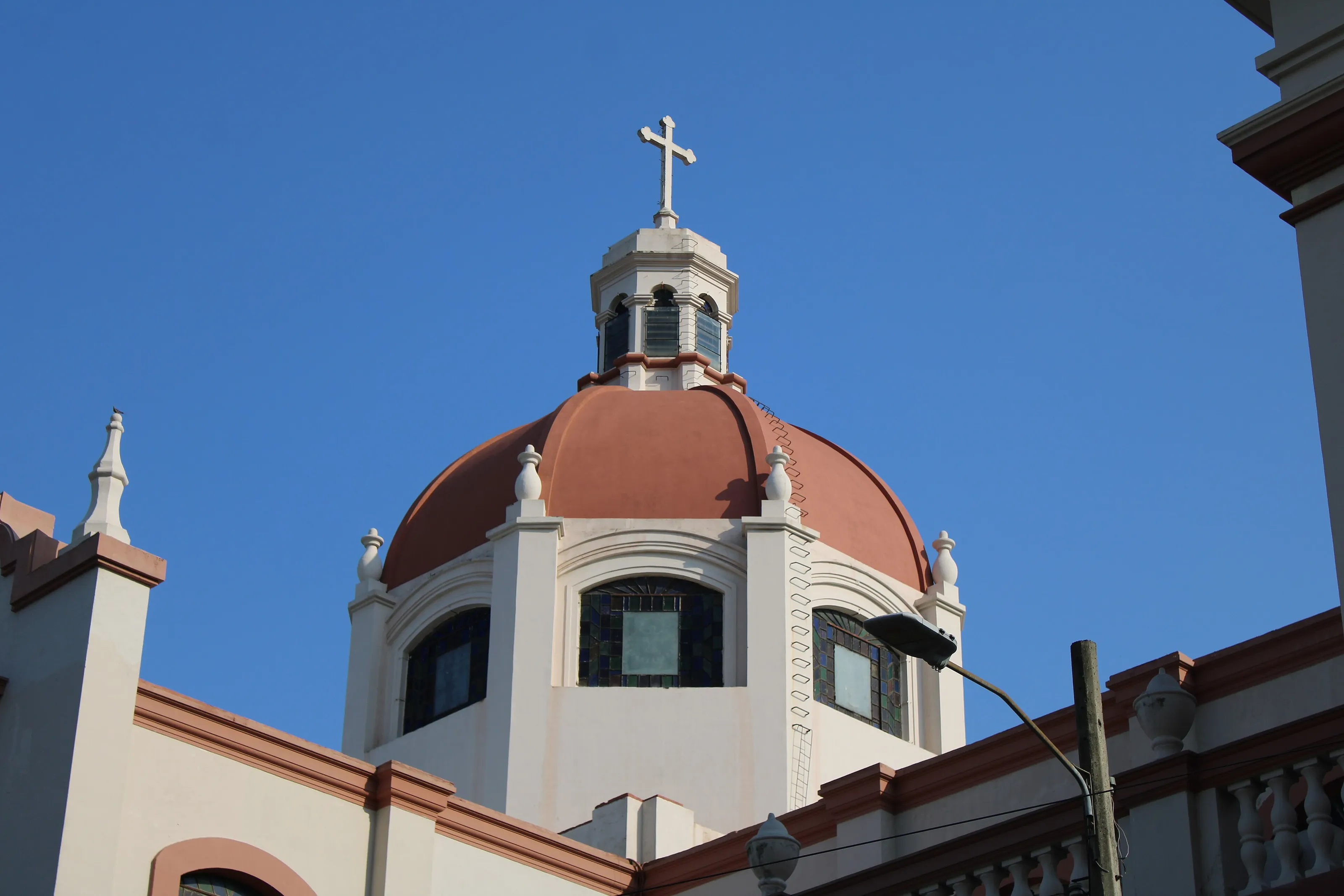
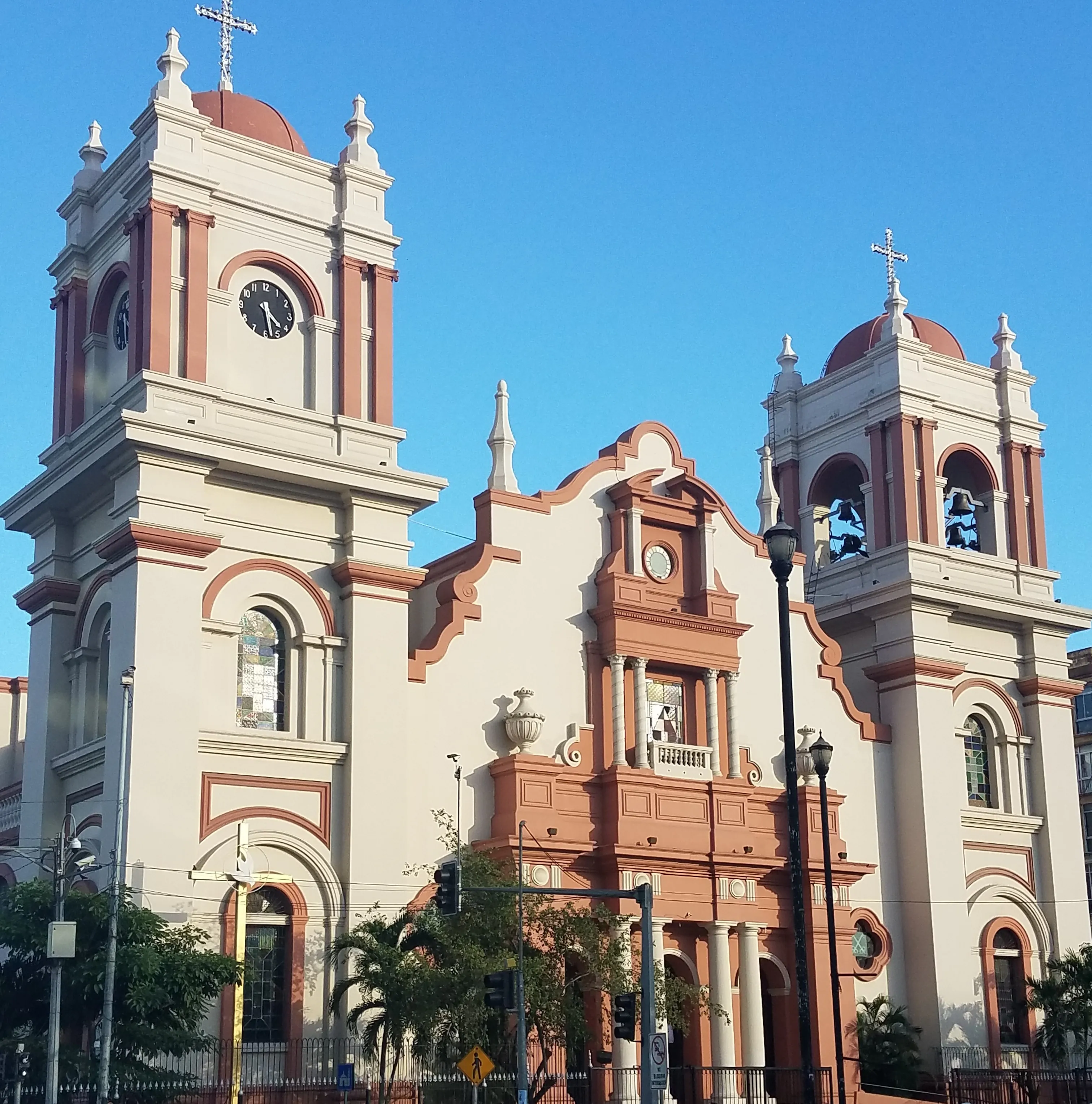
The idea of a cathedral dates from 1941; the first stone was laid in August 1949 and the crypt blessed on 3 February 1953 (Wikipedia ES). Wikipedia (ES) makes it an icon of the city's identity, and Wikipedia (EN) dates it to 1949. Its cream facade picked out in ochre, its two clock towers and its bell towers make it the most recognisable building in the centre.
Dome and bell towers
Seen up close, the red lantern dome and the bell towers make up the cathedral's silhouette. Wikipedia (EN) also mentions a Greek Orthodox cathedral, St John the Baptist, built in 1963, and Wikipedia (ES) the Maguen David Synagogue, built in 1954 and one of only two in the country.
The centre after dark
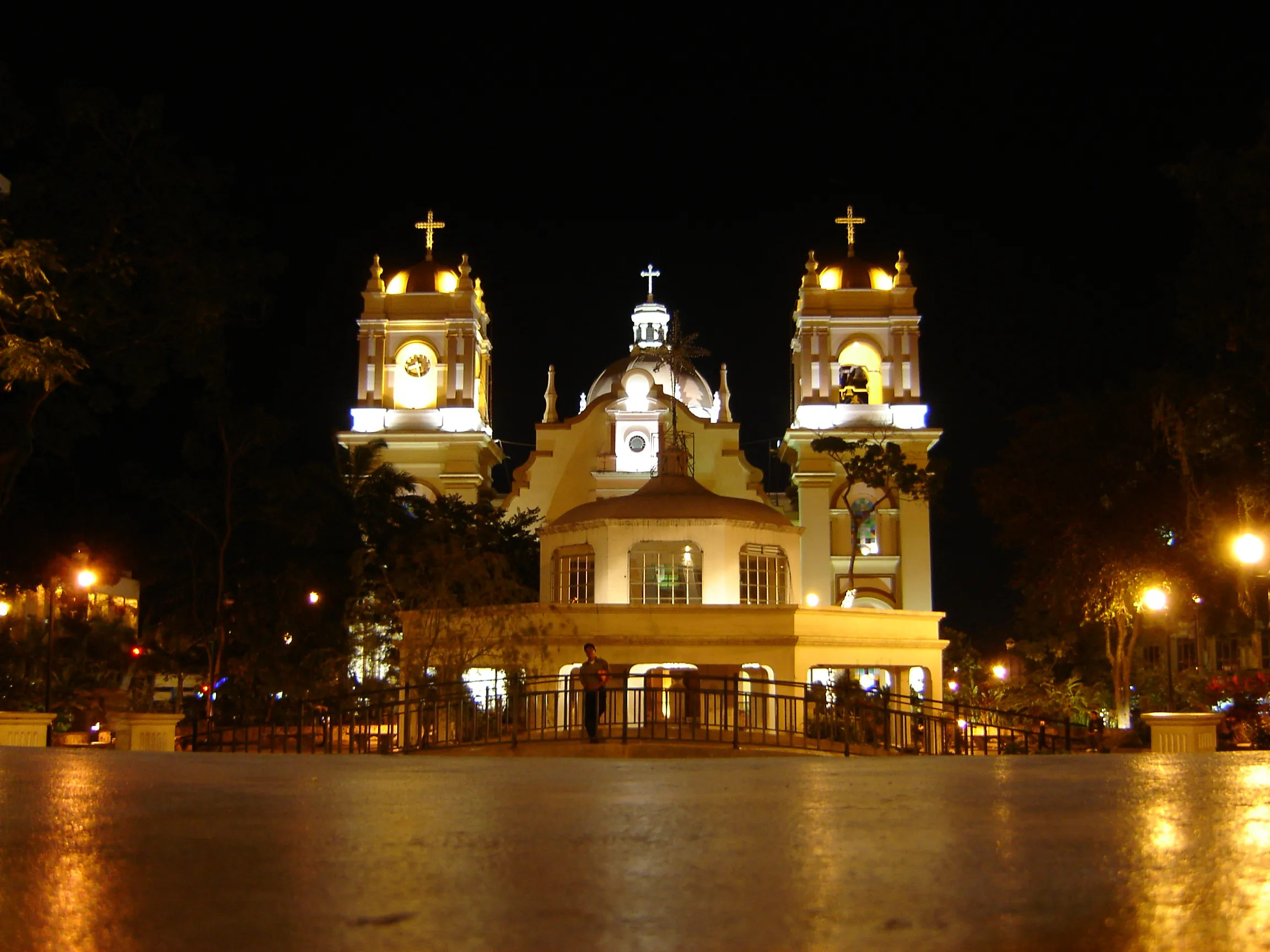
Lit up in the evening, the centre is best enjoyed by day: Wikivoyage (EN) advises taking a taxi, even for a few blocks, after dark, and walking only within a block or two of the Zona Viva.
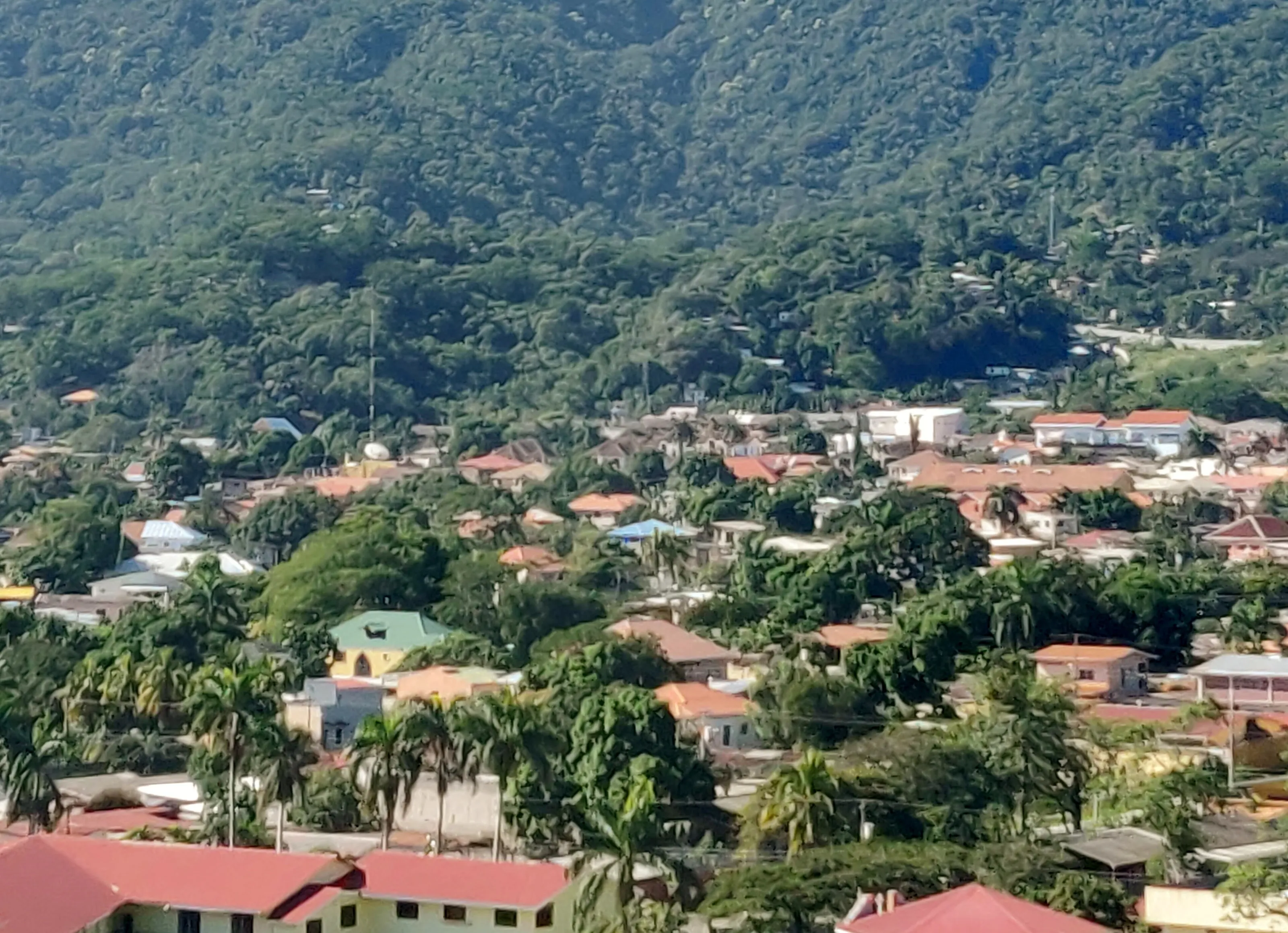
A city in the Sula Valley
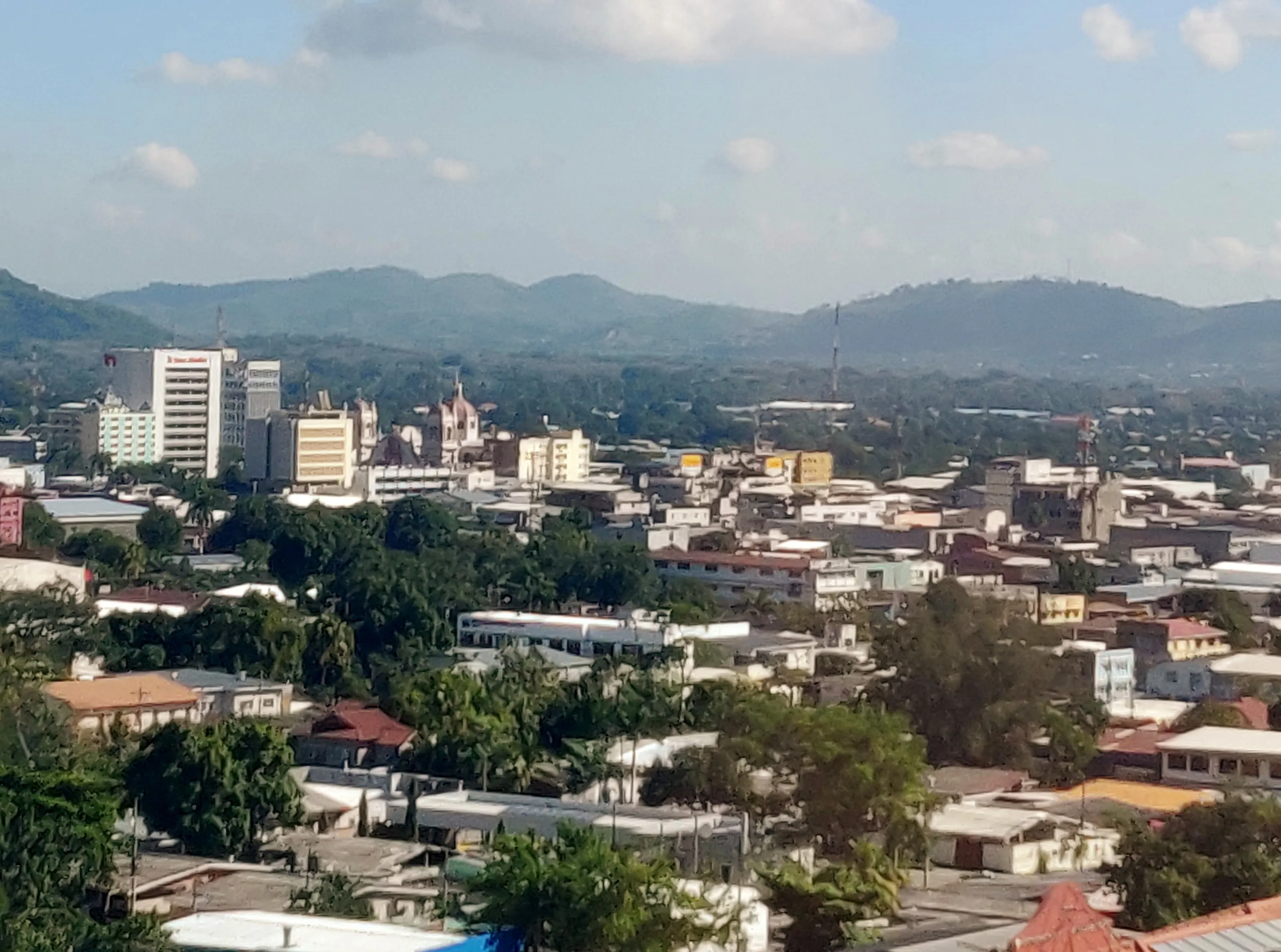
From a height you see the city spreading across the plain at the foot of the hills. Tegucigalpa is 244 km away, Puerto Cortés 58 km to the north, Tela about 99 km and La Ceiba about 203 km (Wikipedia ES).
The Merendón, the city's water tower
To the west, the Merendón mountains supply the city with water and shelter Cusuco National Park, a cloud forest about forty kilometres away whose summits rise to 2,242 m (Wikipedia ES).
Central park and the Guamilito market
Wikivoyage (EN) suggests people-watching in the Parque Central, the main square; Wikipedia (DE) notes that a small pavilion marks the spot where the city was founded. The Guamilito market gathers crafts, pottery, souvenirs, flowers and local dishes (Wikipedia DE), with carved wooden boxes, Lenca pottery, hammocks and leather goods according to Wikivoyage (FR).
Excursions from the city
Wikipedia (DE) lists Copán, about three hours away, Lake Yojoa, the Pulhapanzak waterfalls, the Cusuco cloud forest, Tela, Puerto Cortés and Omoa. Wikipedia (EN) recalls that the San Fernando fortress at Omoa was built in the mid-eighteenth century against English attacks. Check your country's official advice for each area before considering it.
Museums and culture
Anthropology and history, Honduran painting, nature and the June fair
San Pedro Sula has several museums, mostly devoted to the history of the valley, to painting and to nature. We give no opening hours or prices, and you must not assume that any place is open: check before you come.
Museum of Anthropology and History
Opened to the public on 25 January 1994 (Wikipedia ES), it tells of the arrival of the Spanish, the conquest, cultural and racial mixing, the founding of the city and banana exploitation. The ground floor covers the history of Honduras and of San Pedro Sula, the upper floor the early history of the valley, with a library of Honduran history (Wikipedia DE). Wikivoyage (EN) mentions pre-Columbian pottery, grinding stones and items up to colonial times, with few labels in English.
Daisy Fasquelle Bonilla Museum
It pays tribute to Honduran painters: the collection brings together canvases by artists past and present (Wikipedia ES), and it was inaugurated on 27 September 2007.
Nature museum and children's museum
The nature museum has 24 rooms devoted to the environment, the biology of Honduras and natural resources, with stuffed birds, mammals and reptiles (Wikipedia ES); Wikipedia (DE) also lists insects and the fauna of the Merendón. The El Pequeño Sula children's museum and a planetarium complete the offer.
The Feria Juniana and the June carnival
The Feria Juniana, the patron saint fair since 1846, runs through most of June until 4 July; on 29 June the Gran Carnaval Bailable, the country's second after La Ceiba's, parades along Avenida Circunvalación (Wikipedia ES). Wikipedia (DE) also lists the Francisco Saybe Theatre and the Centro Cultural Sampedrano.
Food and drink
Baleadas, conch soup and north-coast cooking
Specialities
Baleadas, a thick flour tortilla filled with refried beans, cheese and cream, are a Honduran original and a cheap fast meal almost everywhere (Wikivoyage FR). Wikipedia (ES) explains that they emerged on the north coast after the banana companies arrived and introduced wheat flour. Conch soup, cooked in coconut milk with cassava, coriander and green bananas (Wikipedia EN), and tapado are the typical soups of the north coast, from Puerto Cortés to Trujillo (Wikipedia ES).
Breakfast and the coast
A typical breakfast combines eggs, refried beans, cream, fresh cheese, avocado, fried plantains and tortillas (Wikipedia EN). On the north coast you also find Garifuna cooking, with plantain, machuca (green plantain mashed with coconut) and cassava bread (Wikipedia ES).
Markets and tables
Wikivoyage (EN) speaks of many choices from budget to upmarket, and of nightlife concentrated in the Zona Viva; Wikivoyage (ES) mentions Honduran and Garifuna dishes, with seafood specialities. The Guamilito market offers local dishes (Wikipedia DE). We recommend no particular address: ask your host.
Drinks
Horchata and agua de nance accompany meals, and Honduran coffee, grown on the volcanic slopes, is renowned for its delicacy (Wikipedia EN).
Getting around
Taxis, intercity buses and the quadrant plan
In the city
The centre is fairly compact and can be walked by day; cars, taxis and buses run around the city (Wikivoyage EN). At night, Wikivoyage (EN) advises taking a taxi even for a few blocks, and Wikivoyage (FR) recommends a radio-dispatched taxi and advises against shared buses because of thefts.
Intercity buses
The Gran Central Metropolitana bus station, on the Bulevar del Sur, is presented by Wikipedia (DE) as the largest in Central America, with a shopping centre and a food area. Wikivoyage (EN, FR) lists connections to Tegucigalpa, Tela, La Ceiba, Puerto Cortés and Copán Ruinas, and a first-class company with a secure terminal.
Cars and roads
To find your way by car, just remember the quadrant plan (north-east, south-east, north-west, south-west): streets numbered east to west, avenues north to south (Wikipedia ES). Wikivoyage (FR) notes that the country's minor roads are often in poor condition, especially in the rainy season.
Budget and precautions
No price ranges, and caution ahead of budget
Price level
Wikivoyage (EN) describes a wide variety of venues from budget to upmarket, but its prices are old. The currency is the lempira. We publish no ranges, because we could not confirm them on two independent sources.
Flights
The flight is the most variable item in the budget. SniperAir monitors prices to SAP and compares them with the route's history, but it does not sell or book tickets.
Safety before budget
Wikipedia (EN, DE) recalls that the city long ranked among the most violent in the world, and Wikivoyage (FR) calls it the country's worst-hit city for murders, mostly between rival gangs, with frequent thefts, even by day in the wrong neighbourhood. Wikipedia (FR) mentions a state of exception declared against gangs in San Pedro Sula and Tegucigalpa. Official advice varies by departure country: some advise against certain areas, others against the whole country. Read your own country's advice, check that your insurance covers you, and do not carry valuables.
Hurricanes and floods
Wikipedia (EN) says the city is exposed to hurricanes and tropical storms during the hurricane season, from June to November; Wikivoyage (FR) recalls that Hurricane Mitch devastated the country in 1998. Keep your dates flexible.
When to go
Warm all year, with a drier season from January to April
December to February
The end of the wet season and the start of the drier period according to the sources; warm days.
March to May
March and April are the hottest months (Wikipedia ES); rains return from May according to Wikipedia (FR).
June to August
Wet season, with frequent showers; the Atlantic hurricane season begins.
September to November
Rain still present and hurricane season until November; keep dates flexible.
Wikipedia (FR, EN) puts the dry season from January to April or May and the wet season over the rest of the year, while Wikipedia (ES) speaks of a transitional climate between tropical savanna and monsoon, with rain every month. The sources differ: we give no average temperatures. Honduras stays on UTC-6 all year, with no clock change.
By length of stay
What to do in San Pedro Sula by length of stay, if travel is possible
An urban stopover
The cathedral, the central park, the Guamilito market and a museum, by day, with transfers arranged in advance and in the areas your country's official advice recommends.
Museums and nearby nature
The anthropology museum, the nature museum, and an excursion to Cusuco or the Pulhapanzak waterfalls with a trusted local organiser, if the advice allows.
A springboard to the north
The city as a base for Copán Ruinas, Lake Yojoa or Tela; do not stack up stops without checking official advice for each area.
In pictures
San Pedro Sula in pictures
You might also like
Similar destinations
FAQ
Frequently asked questions about flights to San Pedro Sula
Can you travel to San Pedro Sula?
Do not assume that you can. Honduras is the subject of very restrictive official travel advice in many departure countries; depending on your country, some areas, sometimes the whole country, are advised against. Read your country's advice and check your insurance before doing anything.
Where is San Pedro Sula airport and how do I reach the centre?
Ramón Villeda Morales Airport (SAP) is in La Lima, 11 to 15 km from the centre depending on the source. Arrange the transfer in advance with your accommodation; at night, prefer a radio-dispatched taxi.
Is San Pedro Sula safe?
The sources describe it as one of the cities most affected by violence in the country, with frequent thefts. Official advice varies by departure country: read your country's advice rather than a guide page.
What is there to see in San Pedro Sula?
San Pedro Apóstol Cathedral, the central park, the Guamilito market, the Museum of Anthropology and History, the nature museum and, in June, the Feria Juniana. Check hours and access before you come.
When is the best time to go to San Pedro Sula?
January to April is the drier period according to several sources, though they differ. The hurricane season runs from June to November. Keep your dates flexible.
What should you try in San Pedro Sula?
Baleadas, conch soup, tapado and machuca from the north coast, with horchata or Honduran coffee.
How much does a flight to San Pedro Sula usually cost?
The price depends mainly on your departure city, the season and how far ahead you book. The "opportunities" section above shows real examples of prices already detected by SniperAir to this destination.
How do I get alerted when a flight to San Pedro Sula falls below my budget?
Create an alert profile with your departure airport, {n} as the destination and your maximum budget. You are notified automatically as soon as a matching price is detected.
Ready to head to San Pedro Sula?
Set your budget and let SniperAir monitor fares for you.
Create my alert