
Cheap flights to Dunedin
Set your departure airport and maximum budget: SniperAir tracks prices to Dunedin and alerts you the moment a deal matching your criteria appears.
Quick summary
Country
New Zealand
Continent
Oceania
Airport
DUD
Currency
New Zealand dollar
Time zone
UTC+12 (UTC+13 during austral daylight saving time)
Deals already spotted to Dunedin
Real flight examples detected by SniperAir, with their reference price.
Loading examples…
Why track Dunedin with SniperAir
You do not need to compare prices every day
Choose your departure
Enter your departure airport and your maximum budget for a flight to Dunedin (DUD).
SniperAir watches
Our systems continuously compare new fares with the route's real price history. SniperAir tracks prices and alerts you: it does not sell or book tickets.
You receive an alert
As soon as a fare matches your criteria, you are notified, without having searched for anything yourself.
Airport and getting into town
An airport about twenty kilometres out, with no long-haul flights
Dunedin (DUD)
Dunedin Airport is near the village of Momona on the Taieri Plains, south-west of the centre: sources give anywhere from about 22 to 30 km. There is no scheduled public transport to the airport. Taxis and shared shuttles wait outside the terminal when flights arrive, and several car rental companies operate there. Allow roughly 20 to 30 minutes to the centre depending on traffic. The airport mainly handles domestic flights from Auckland, Wellington and Christchurch; from Europe you should therefore plan at least one connection within New Zealand, after a long-haul flight to one of those larger airports.
Dunedin is the South Island's second city after Christchurch, at the head of Otago Harbour on the south-east coast. Founded in 1848 by Scottish settlers, its name comes from Scottish Gaelic: Dùn Èideann, that is, Edinburgh. The city has about 130,000 inhabitants, around 100,000 of them in the urban area, and students make up a large share. Its Māori name is Ōtepoti. The centre, laid out around the Octagon, an eight-sided plaza, is walkable, but the city climbs quickly: the hills are steep.
Landmarks and sights
The Edinburgh of the South: dark stone, spires and a Gothic Revival castle
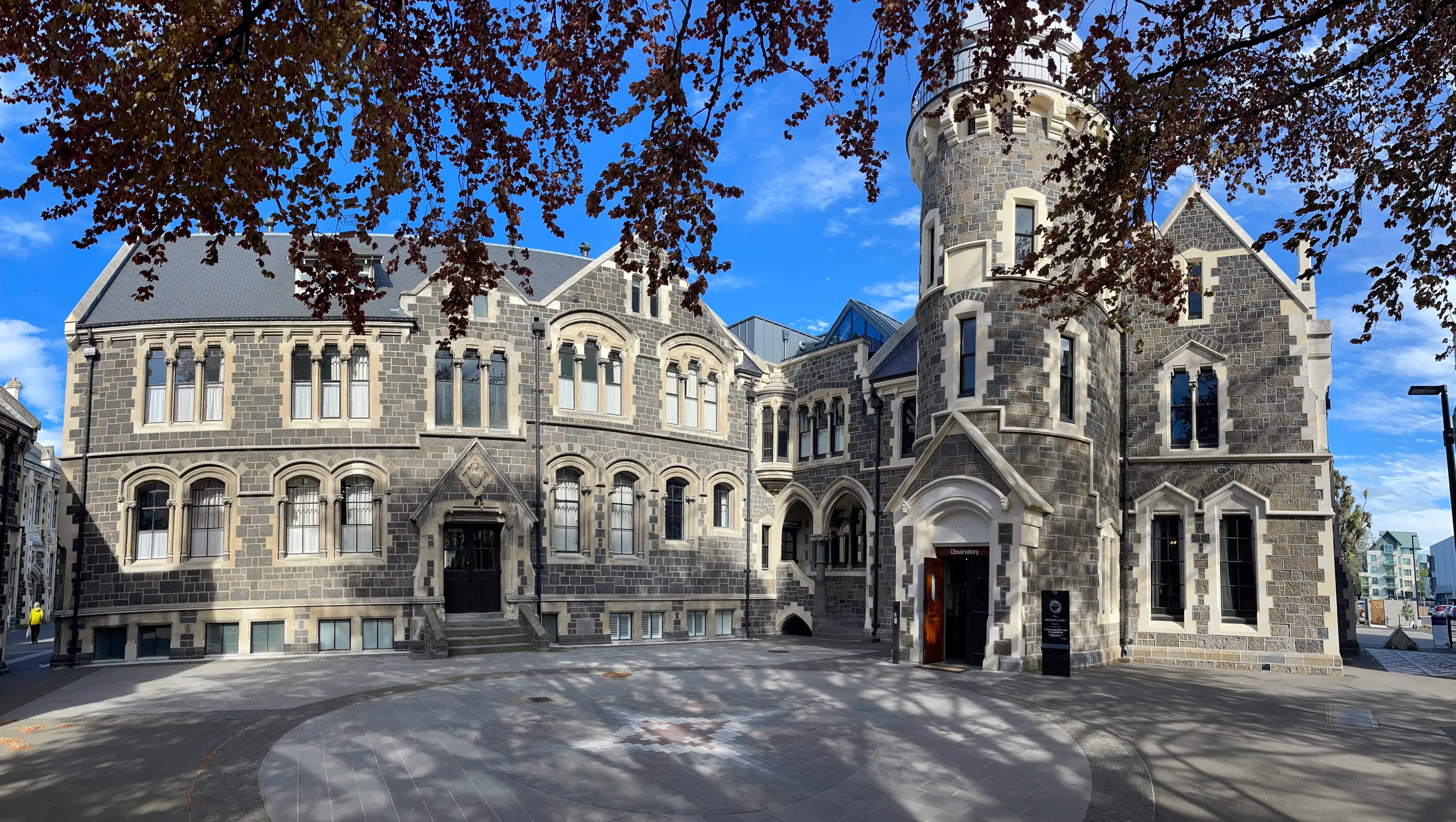
Dunedin is often nicknamed "the Edinburgh of the South". The gold rush of the 1860s enriched the city and left it a legacy of Victorian and Edwardian architecture, with several buildings designed by the architect R. A. Lawson. Three places are illustrated below; the Octagon, the university and Baldwin Street are covered in text only.
The Octagon, the university and Baldwin Street
The Octagon is the city's heart, with the town hall, the public art gallery and the visitor information centre. The University of Otago, founded in 1869, is the oldest in the country; its stone buildings and clock tower give the university district the feel of a British campus. Baldwin Street, in the north of the city, has long been cited as the world's steepest residential street (a gradient of about 35%); that title has since changed hands according to some sources, but the climb remains spectacular, and free. A race up the street is held every year in February.
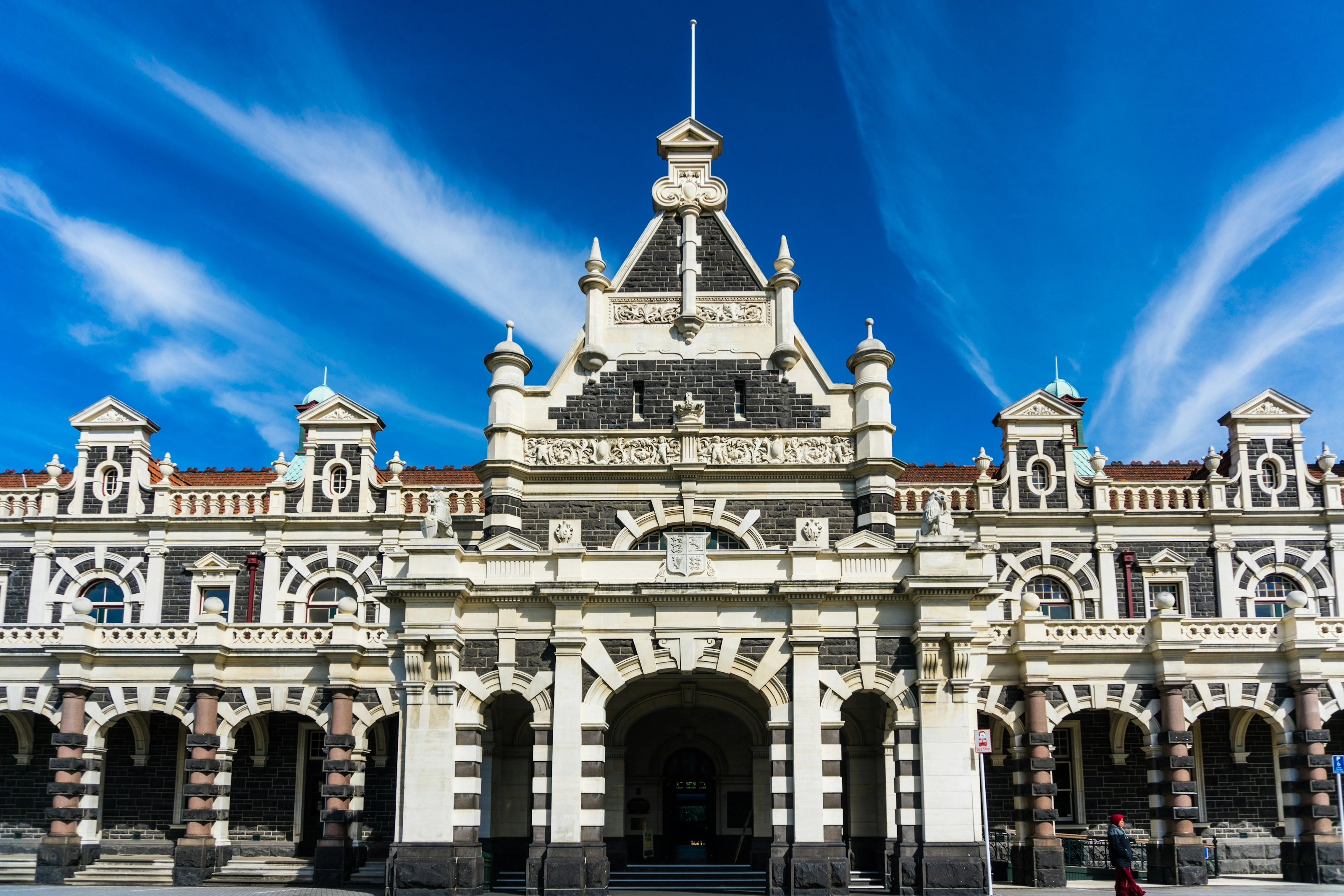
Dunedin Railway Station
Opened in 1906, Dunedin Railway Station is one of the most photographed buildings in the country. Its style, often described as Edwardian or Flemish Renaissance, combines dark stone with pale limestone, with a richly decorated facade, turrets and arcades. It stands at the end of Lower Stuart Street, about 400 m from the Octagon, next to the settlers museum. Scenic rail excursions sometimes leave from here: check the schedule.
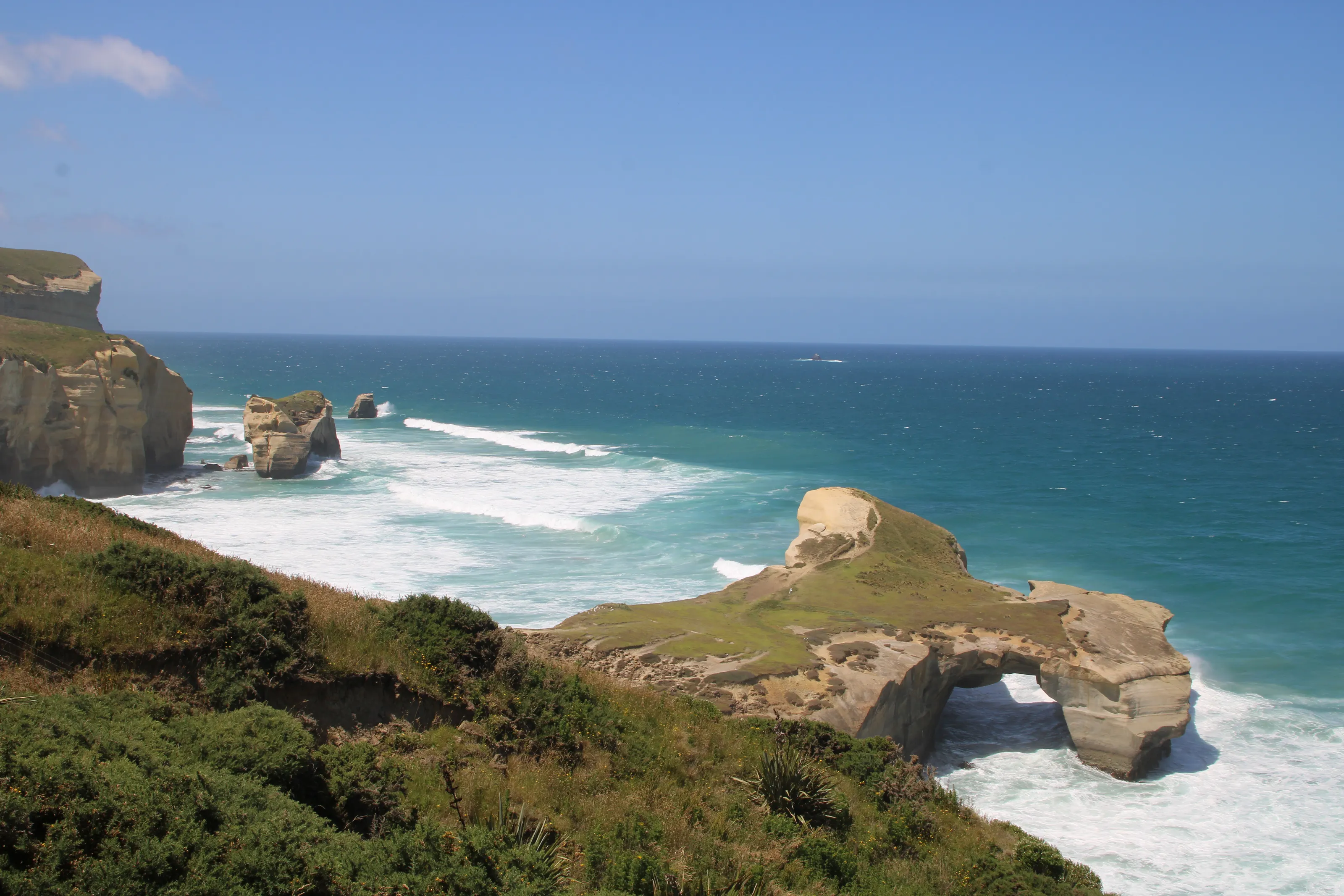
First Church of Otago
First Church, built by Scottish Presbyterians, is one of the city's great Gothic Revival buildings, designed by the architect R. A. Lawson. Its spire rises above the city-centre district, behind a gate and a garden. In this wide-angle photo the lines are slightly distorted. Dunedin's churches can generally be visited free of charge, outside service times.
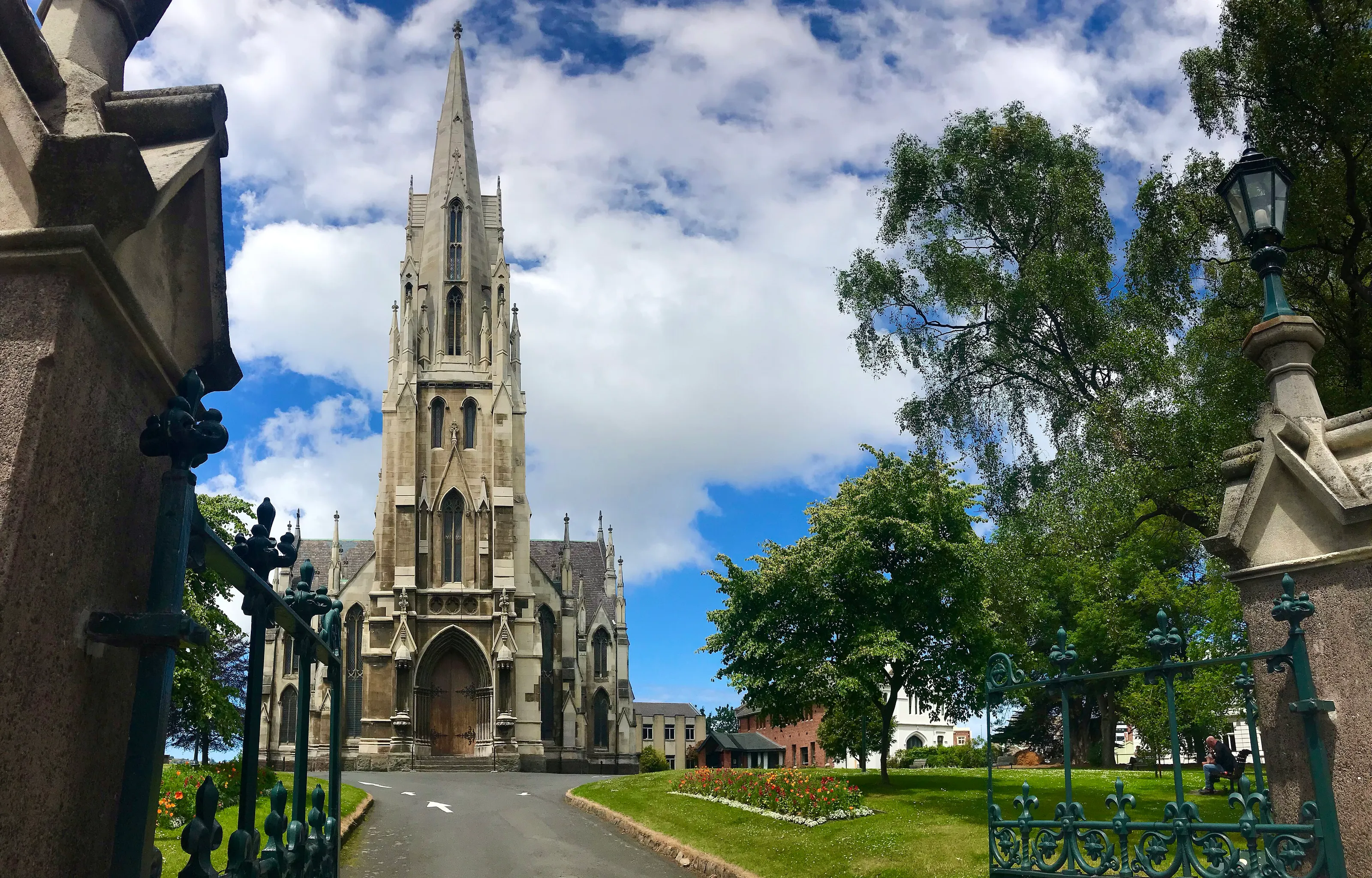
Larnach Castle
Larnach Castle, completed in 1871, is sometimes described as New Zealand's only castle. It was built for the banker and politician William Larnach, on the heights of the Otago Peninsula. Its crenellated towers, cast-iron verandas and gardens offer views over the harbour. You reach it by car or on a tour; we give no fares or opening hours, which change.
Nature and the Otago Peninsula
Cliffs, penguins and albatrosses within an hour of the centre
The coast around Dunedin is one of its great assets: sandstone cliffs, sandy beaches, sea lions and seabirds less than an hour from the centre. Wildlife stays wild: follow the signs on site, keep your distance and respect closed areas.
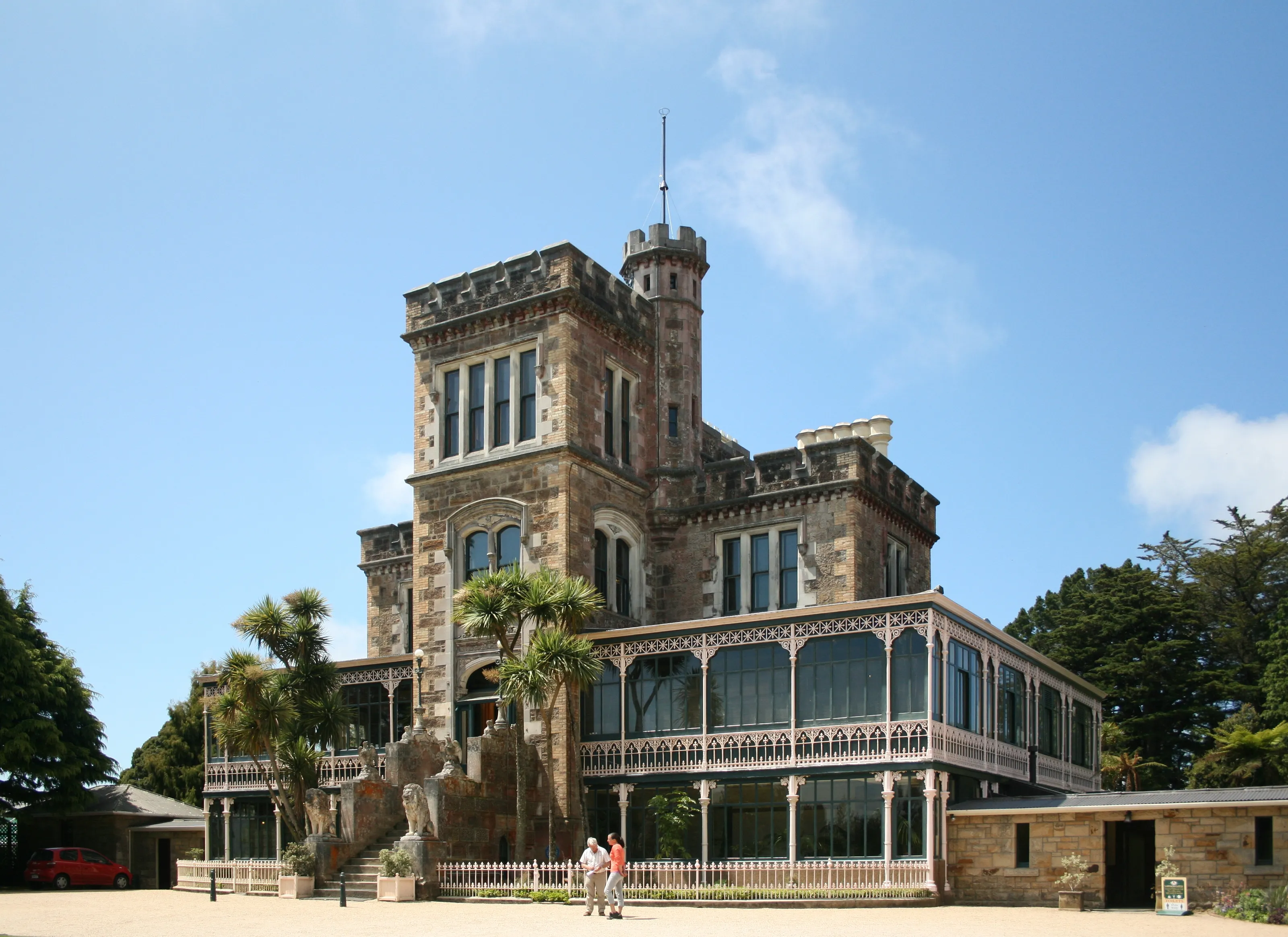
Tunnel Beach
Tunnel Beach, south of the city, is known for its sandstone cliffs carved by the sea, a natural arch and an access tunnel cut through the rock. A path of about 20 minutes crosses farmland down to the beach, steep on the way back and slippery in wet weather. Waves can be powerful: low tide is recommended, and it is wise to stay back from the cliff edge.
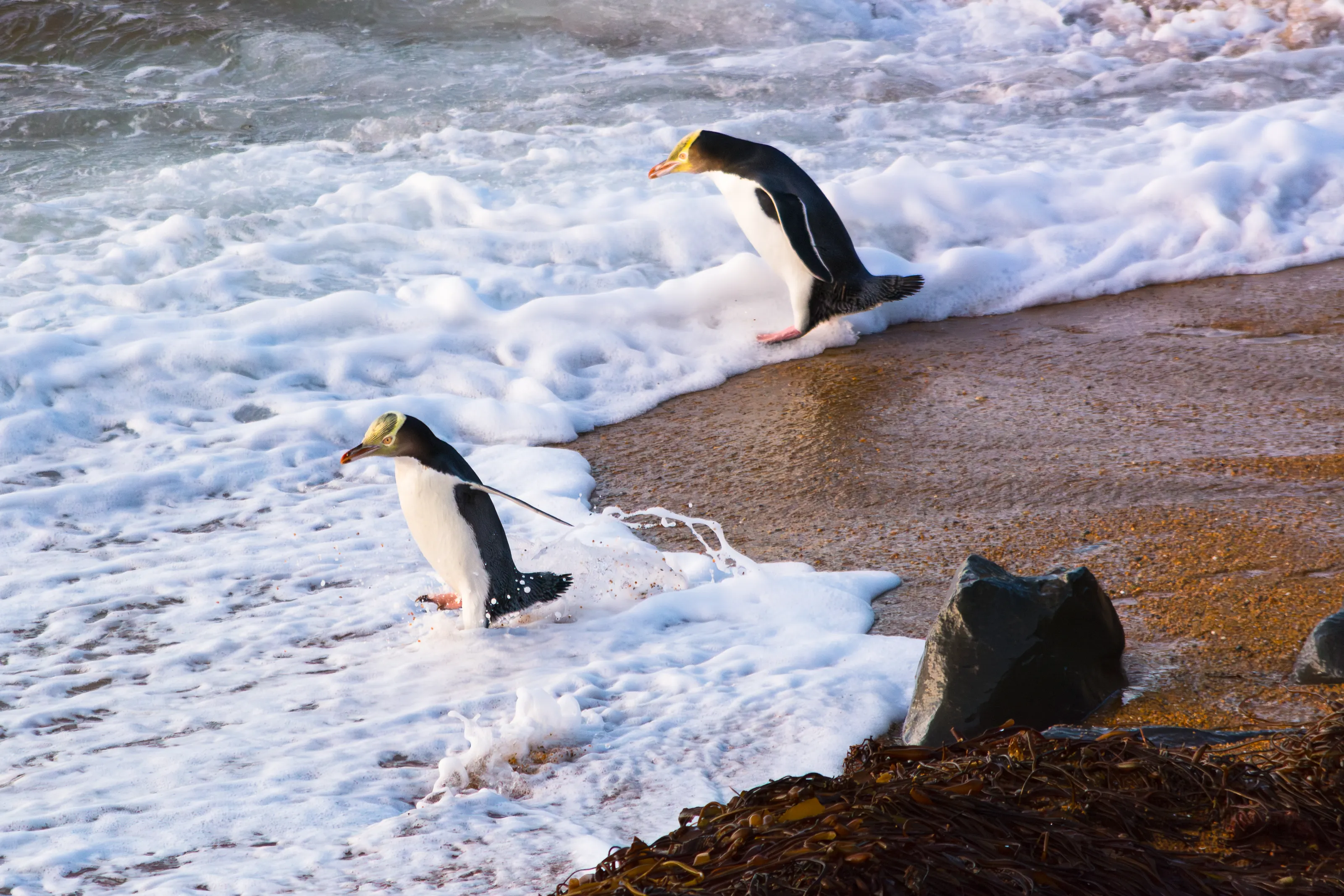
Yellow-eyed penguins
The yellow-eyed penguin (hoiho in Māori) is one of the rarest penguin species in the world, and the Otago Peninsula is one of its strongholds. It is recognised by the yellow band around its eyes. You may sometimes see one on certain beaches late in the day, but it is threatened and easily disturbed: prefer designated viewing sites or a guided visit, and never approach an animal.
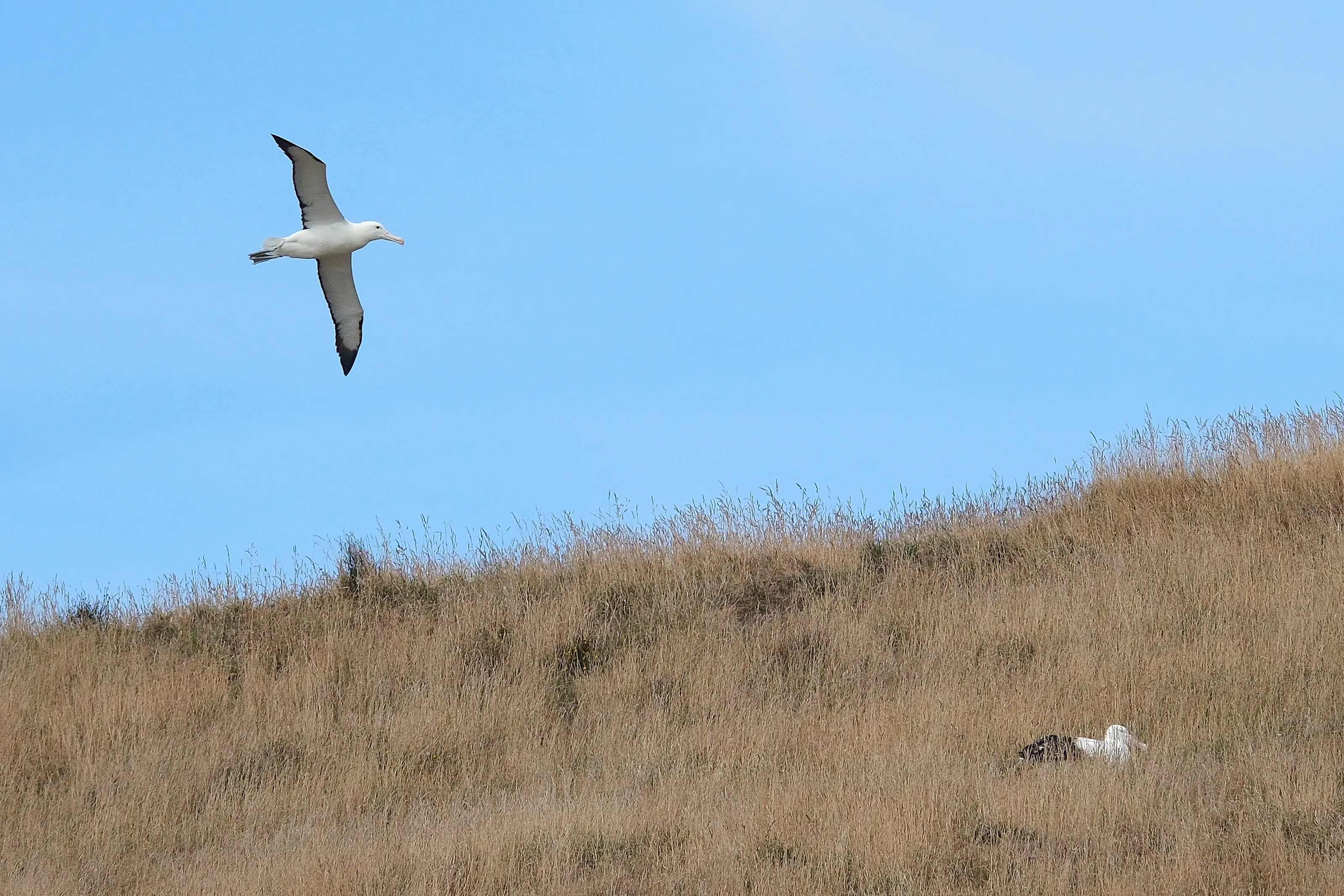
Royal albatrosses at Taiaroa Head
At Taiaroa Head, at the tip of the peninsula, is the only northern royal albatross colony breeding on an inhabited mainland: a site of global ecological significance. The birds are mainly seen in the austral summer, and viewing is done on guided visits; in the photo the albatross is small in the frame, above a grassy hill. Allow about an hour by road from the centre, along a narrow coastal road: if you drive little, choose a guided excursion.
Sea lions and seals
Sea lions and seals visit several beaches on the south coast and the peninsula, such as Sandfly Bay and Allans Beach. Animals may look asleep yet react fast: stay well back and leave them a way to the sea.
Museums and culture
Settlers, science, art and Māori heritage
Toitū Otago Settlers Museum
The settlers museum, next to the railway station, traces the history of the region and its people, from the first Māori to the gold rush and Scottish, Chinese and other immigration. It is one of the best starting points for understanding the city.
Otago Museum and the Dunedin Public Art Gallery
The Otago Museum, opened in 1868, presents natural history, Pacific cultures and science. The Dunedin Public Art Gallery, on the Octagon, shows New Zealand and international art. According to Wikivoyage, these two venues, like the settlers museum, are among the city's free or partly free attractions: check before you visit.
Olveston, the Hocken Collections and literature
Olveston is a large historic house, visited by guided tour only. The Hocken Collections, attached to the university, hold archives and works on the country's history. Dunedin is also recognised as a UNESCO Creative City of Literature, with a cultural life energised by its student population.
Māori culture
Dunedin is called Ōtepoti in Māori. Ngāi Tahu is the iwi (tribe) of the south of the island, with several marae in and around the city. You are invited to approach this history with curiosity and respect, especially in museums and at heritage sites.
Food and drink
Student cuisines, fish and chips and craft chocolate
A well-fed student city
Because Dunedin is a student city, it has many affordable restaurants and world cuisines: Chinese, Japanese, Indian, Turkish, Malaysian and more. Most are concentrated on Lower Stuart Street, around the Octagon, and in the north of George Street.
Southern specialities
The cheese roll, a toasted rolled bread with cheese and onion, is a speciality of the south of the South Island and turns up in cafés. Fish and chips remain the classic for small budgets, and fresh seafood from the coast is easy to find.
Beer, chocolate and the market
The city has a brewing tradition, with a historic brewery that offers tours, and craft chocolate makers have opened workshops; the large industrial chocolate factory closed in 2018. A weekly farmers' market enlivens the railway station district. We name no brands: ask on the spot.
Getting around
On foot, by bus and taxi; a car for the peninsula
On foot and by bike
The centre is compact and fairly flat near the harbour, but the city climbs quickly: the shortest route on the map is not always the easiest. Standard and electric bikes can be rented in the centre.
Buses, taxis and cars
An urban bus network, Orbus, serves the city and its surroundings, including the Otago Peninsula along a coastal road. Taxis are available and ride-hailing such as Uber works. For the peninsula (Larnach, Taiaroa Head, beaches), a rental car gives the most freedom; the road is narrow in places, with no guardrail on some stretches.
From the rest of the country
Dunedin is linked by domestic flights to Auckland, Wellington and Christchurch. By road, Christchurch is about 4.5 hours away by car and Invercargill about 2.5 hours; long-distance buses also serve Queenstown and Christchurch (about 6 hours for the latter).
Budget and precautions
A medium budget, without cross-checked figures
Price level
Dunedin is a medium-budget destination compared with many European countries, with a range of simple restaurants tied to the student population; accommodation and car rental weigh more, especially in summer. Many places, such as the station, the churches and several museums, are free or nearly so. We give no figures, as we could not confirm them from two independent sources.
Flights
The long-haul flight remains the most variable cost. SniperAir tracks prices to DUD and compares them with the route's history, but it does not sell or book tickets.
Entry requirements and precautions
New Zealand generally requires a travel authorisation or a visa depending on nationality: check the official New Zealand government websites. Also consult the official recommendations of your country of departure. The weather changes fast, especially by the sea; on coastal paths and near cliffs, stay careful and find out about conditions.
When to go
Reversed seasons, cool and changeable all year
Austral summer (December to February)
Mild, with average highs around 18 °C; it can exceed 22 °C, and more rarely 30 °C. From November to April the weather is generally more settled. Albatrosses are mainly seen in summer.
Austral autumn (March to May)
Cool, bright weather and fewer crowds; days get shorter.
Austral winter (June to August)
Cold on the coast (about 3 to 5 °C on average), with frosts; snow is uncommon in the centre, roughly every two or three years, but more frequent on the hills.
Austral spring (September to November)
Very changeable weather, sometimes "four seasons in one day"; the gardens come into bloom.
Mind the reversed seasons: New Zealand is in the southern hemisphere, so austral summer runs from December to February and winter from June to August, the opposite of Europe.
Dunedin has a temperate oceanic climate, cooler than the north of the country: roughly 1,600 to 1,800 hours of sunshine a year depending on the source, and frequent but rather moderate rain. Pack several layers and a windbreaker, even in summer.
By length of stay
What to do in Dunedin depending on the length of your stay
The essentials
The station, the Octagon, the settlers museum, Baldwin Street, First Church.
Otago Peninsula
Larnach Castle, Taiaroa Head and its albatrosses, beaches in search of penguins and sea lions.
Coast and beyond
Tunnel Beach, a rail excursion or a road trip south, to Queenstown or Christchurch.
In pictures
Dunedin and its surroundings in pictures
You might also like
Similar destinations
FAQ
Frequently asked questions about flights to Dunedin
How do I get from Dunedin Airport to the centre?
The airport (DUD) is about 22 to 30 km south-west of the centre, depending on the source. There is no regular public transport: taxis and shuttles wait outside the terminal, for a journey of roughly 20 to 30 minutes.
When is the best time to visit Dunedin?
From November to April for the most settled weather, and in summer for the albatrosses; the city stays cool all year. The seasons are reversed compared with Europe.
Is Dunedin expensive?
The budget is medium. The student city offers affordable meals; accommodation and rental cars weigh more, especially in summer.
How long should I stay in Dunedin?
Two days for the city, one or two more for the Otago Peninsula and the coast.
How do I get around Dunedin?
On foot in the centre, by Orbus bus, taxi or rental car for the peninsula. The hills are steep.
What should I eat in Dunedin?
The cheese roll, fish and chips, the world cuisines of the student city, craft beer and craft chocolate.
How much does a flight to Dunedin usually cost?
The price depends mainly on your departure city, the period and the booking date. The "opportunities" section above shows real examples of prices already detected by SniperAir for this destination.
How do I get alerted when a flight to Dunedin drops below my budget?
Create an alert profile with your departure airport, Dunedin as the destination and your maximum budget. You are notified automatically as soon as a matching fare is detected.
Ready to head to Dunedin?
Set your budget and let SniperAir monitor fares for you.
Create my alert