
Cheap flights to Bogotá
Set your departure airport and maximum budget: SniperAir tracks prices to Bogotá and alerts you the moment a deal matching your criteria appears.
Quick summary
Country
Colombia
Continent
South America
Airport
BOG
Currency
Colombian peso (COP)
Time zone
UTC-5
Deals already spotted to Bogotá
Real flight examples detected by SniperAir, with their reference price.
Loading examples…
Why track Bogotá with SniperAir
You do not need to compare prices every day
Choose your departure
Enter your departure airport and your maximum budget for a flight to Bogotá (BOG).
SniperAir keeps watch
Our systems continuously compare new prices with the real price history of the route. SniperAir monitors prices and alerts you: it does not sell or book tickets.
You receive an alert
As soon as a price matches your criteria, you are notified, without having searched for anything yourself.
Airport and getting into town
A major airport about fifteen kilometres west of the centre
El Dorado (BOG)
El Dorado International Airport is about fifteen kilometres west of the centre. By taxi, the trip takes about twenty minutes according to Wikivoyage (EN) when traffic is light, and much more at rush hour, which you should allow for. Feeder buses lead to a TransMilenio station (large luggage can be a problem there, according to Wikivoyage (EN)); regular buses and shuttle services are another option. On leaving, avoid informal offers: take the official airport taxi or order a car through an app. Many travellers then continue by domestic flight to Medellín, Cartagena or other cities.
Distances and times are approximate, based on Wikivoyage (EN) and Wikipedia; transport arrangements change: check them before you travel. We give no fares.
Bogotá is the capital of Colombia, founded in 1538 by Gonzalo Jiménez de Quesada, and one of the largest cities in South America. It spreads over a high plateau of the Andes' Eastern Cordillera, the Bogotá savanna, at about 2,640 m on average, which makes it one of the highest capitals in the world. The mountains that border the city to the east serve as a landmark everywhere.
Candelaria, Plaza de Bolívar and Monserrate
Panorama, colonial quarter, cathedral and sanctuary
Bogotá reveals itself in layers: the colonial quarter of La Candelaria, Plaza de Bolívar and its official buildings, then the heights of Monserrate. The places below are illustrated; Usaquén, Paloquemao and the Botero Museum are described in text only.
A panorama over the savanna
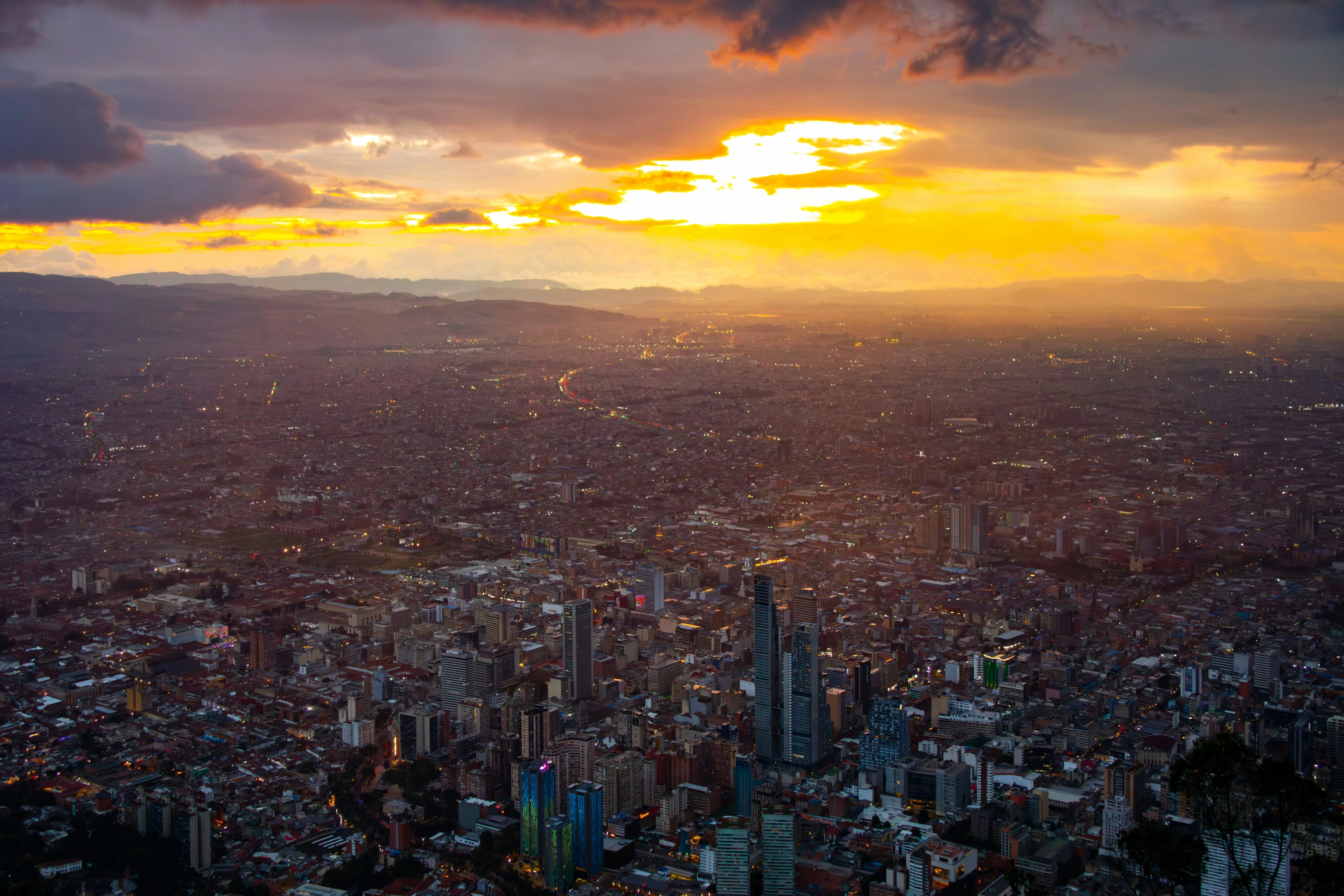
In the evening, from the heights, the city stretches as far as the eye can see to the distant mountains, with the downtown skyscrapers in the foreground. This is what strikes first: Bogotá is a very large city set on a high plateau.
La Candelaria, the historic quarter
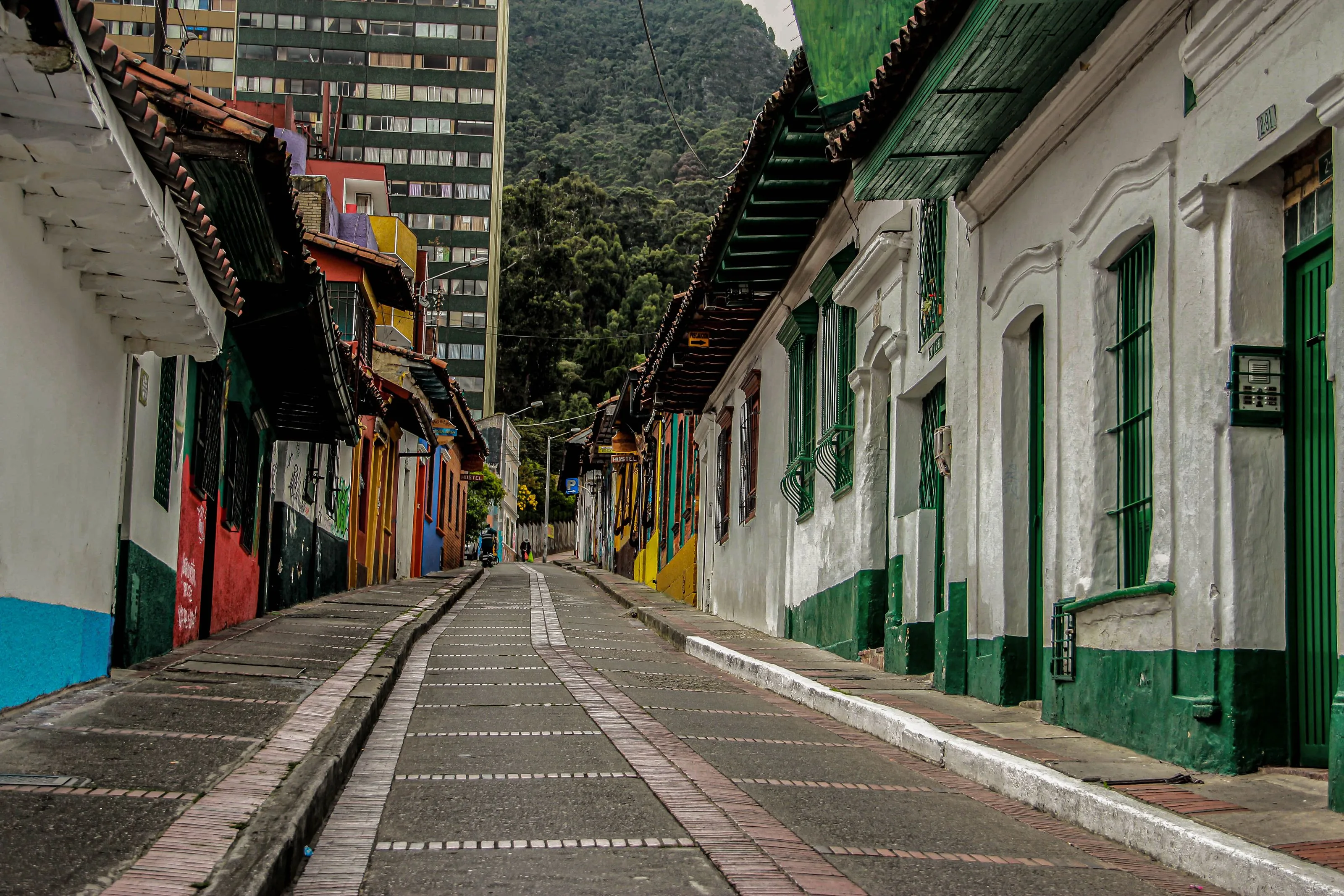
Bogotá's old centre winds at the foot of the mountains: paved lanes, colonial houses with white walls and colourful doors, squares, small museums and cafés. It is best explored on foot; the Chorro de Quevedo, the Casa de la Moneda and the Teatro Colón are among its landmarks. As anywhere in the centre, keep an eye on your belongings.
Plaza de Bolívar and the Primatial Cathedral
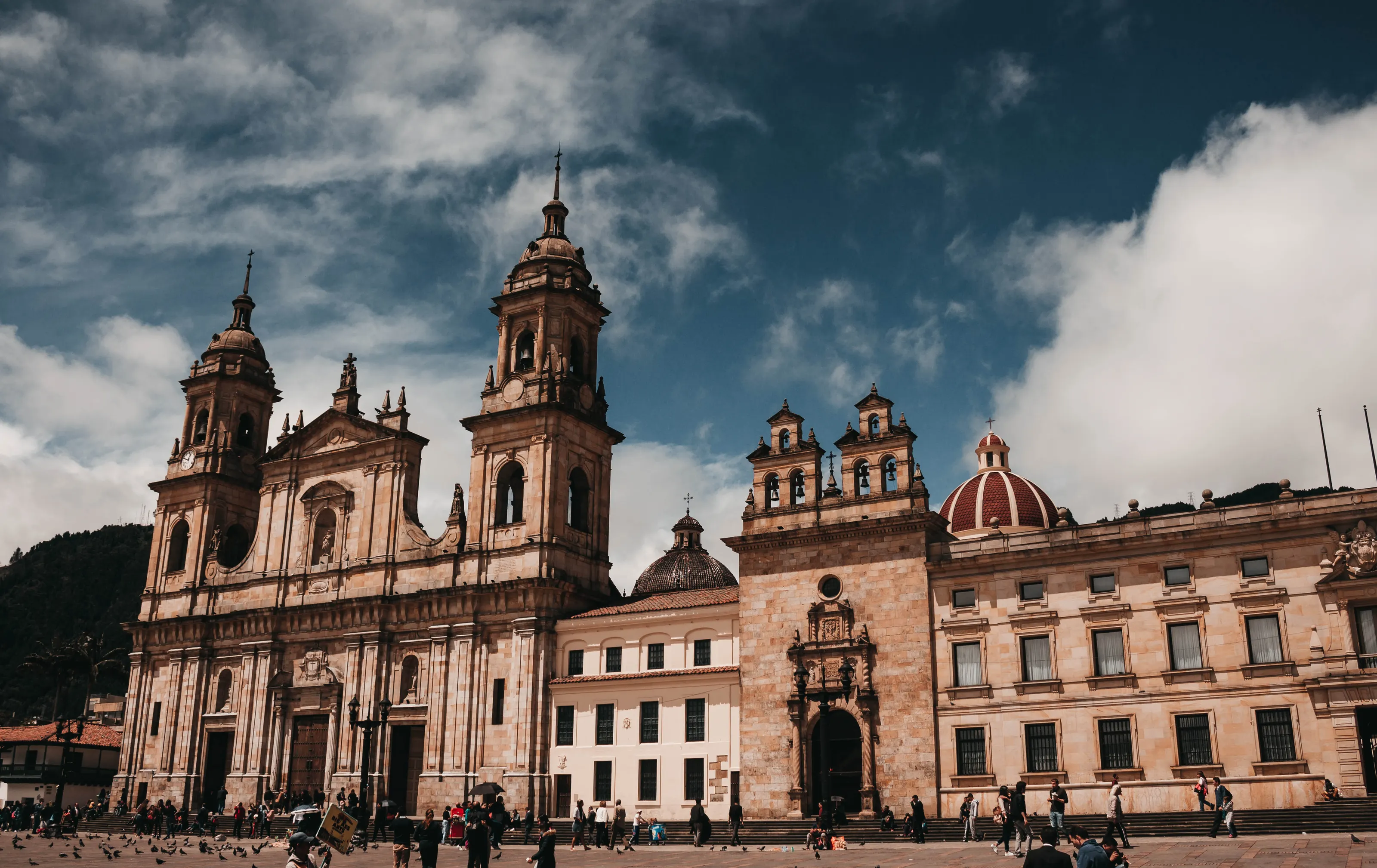
Plaza de Bolívar is the city's main square, surrounded by the Primatial Cathedral, the National Capitol, the Palace of Justice and the city hall. The neoclassical cathedral is the country's principal church; the pinkish stone façade looks rather dark under low clouds.
Monserrate
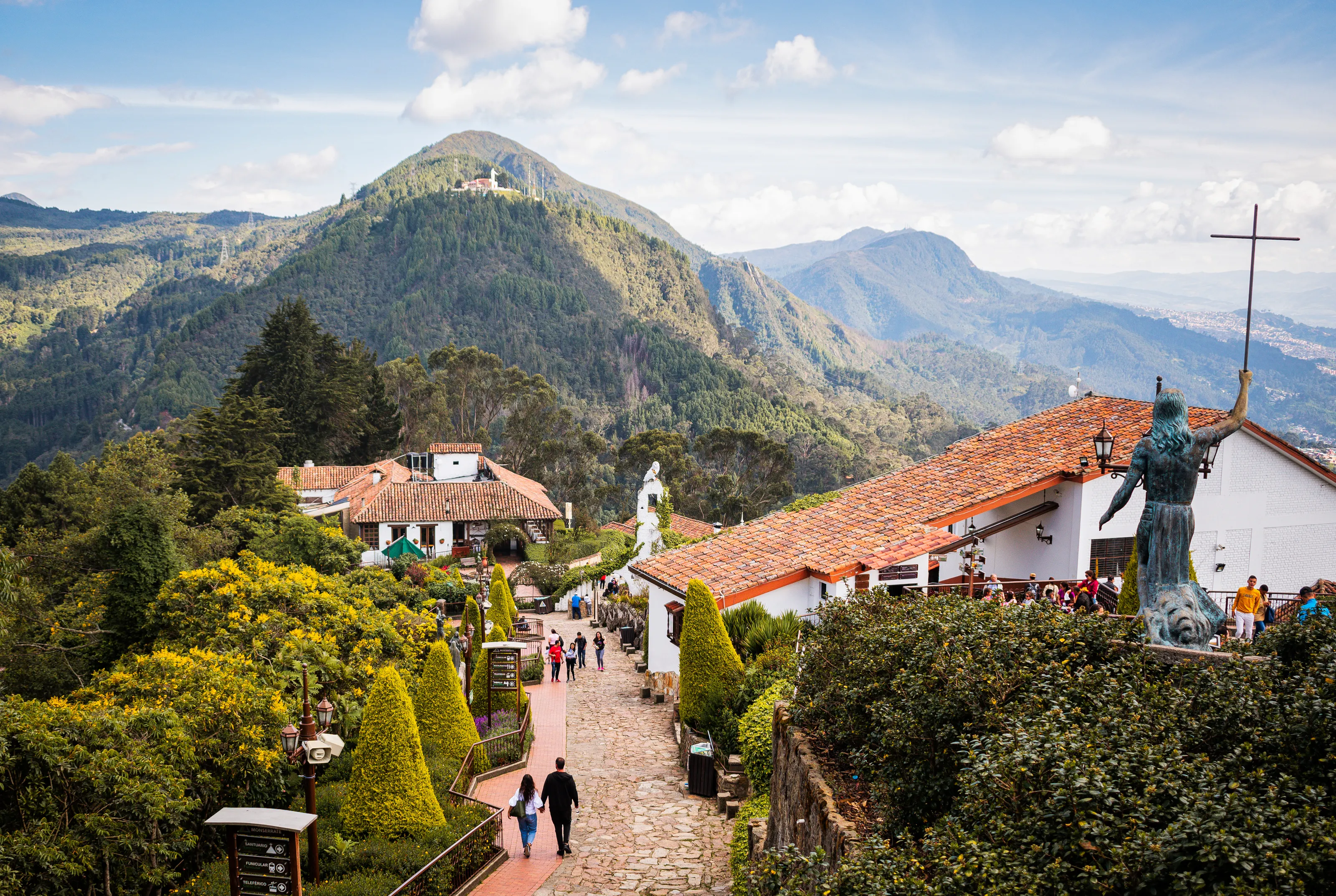
The Monserrate sanctuary overlooks the city at over 3,000 m above sea level. You reach it by funicular or cable car, or on foot along a path: check whether it is open, and go up in daylight. The summit offers a full panorama of the savanna, flowering terraces and restaurants; it is very busy on Sundays.
Usaquén and Paloquemao, in text
Usaquén, a former village in the north of the city, is known for its Sunday flea market, its restaurants and its squares. Paloquemao market is a big market of fruit, flowers and fresh produce, where you can try juices and tropical fruit. The Botero Museum, in La Candelaria, is described below.
Museums and culture
Pre-Columbian gold, art and national history
The Gold Museum
The Gold Museum holds thousands of goldwork pieces from Colombia's pre-Columbian cultures; it is one of the city's most visited museums. You discover the offerings room, masks, jewellery and the technique of embossed gold leaf, like this bracelet. We give no ticket prices; check opening hours before you come.

The Botero Museum and other museums
The Botero Museum, in La Candelaria, brings together works by the Colombian artist Fernando Botero, which he donated to the country, and by other artists. The National Museum of Colombia, housed in a former penitentiary building, traces the country's history and art. These are safe bets on a rainy day.
Theatres and cultural life
Bogotá is also a city of theatres, libraries and festivals; Wikivoyage (EN) calls it the "Athens of South America". Programmes change: check them locally.
Food and drink
Ajiaco, chocolate with cheese and coffee
The dishes
Ajiaco santafereño is the city's emblematic soup: chicken, three kinds of potato and herbs, served with cream, capers and avocado. People also eat tamal, changua (a milk and egg soup), empanadas and cheese bread.
Drinks
Colombian coffee is drunk everywhere; chocolate santafereño is hot chocolate served with cheese and bread. Fresh fruit juices are a good chance to discover little-known fruit, and canelazo, a hot cinnamon drink, warms cool evenings.
Markets and neighbourhoods
Paloquemao for fresh produce, Usaquén for restaurants and the Sunday market, La Candelaria for cafés and small addresses.
Getting around
TransMilenio, buses, taxis and the Sunday bike ride
TransMilenio and SITP
TransMilenio is a system of articulated buses on dedicated lanes, used with a rechargeable card; it is fast but very busy at rush hour, and the usual caution applies in stations. SITP buses complete the network, with more lines and stops.
Taxis and apps
Taxis and ride apps are widespread and practical in the evening; use official services and have yourself dropped at your door.
Ciclovía and cable car
On Sundays and public holidays, main roads are closed to cars for the Ciclovía: you can rent a bike and ride across the city. The funicular and the cable car lead to Monserrate. Distances are long: allow time, especially at rush hour.
Budget and precautions
A moderate budget, gentler than Europe
Price level
Bogotá is a moderate-budget destination: more affordable than Europe for food and transport, with large differences between neighbourhoods and types of accommodation. The currency is the Colombian peso (COP). We give no figures because we could not cross-check them on two independent open sources.
Flights
The flight remains the most variable item. SniperAir monitors prices to BOG and compares them with the route's history, but it does not sell or book tickets. Medellín (MDE) and Cartagena (CTG) are neighbouring destinations to watch in parallel.
Health, altitude and safety
Consult your country of departure's official recommendations for formalities, health and safety. At about 2,640 m, give yourself a day to adapt and protect yourself from the sun, which is strong at altitude. Bogotá is a big city: take the usual precautions (keep your phone and valuables discreet, use official taxis, avoid isolated areas at night).
When to go
Cool all year, with drier periods
December to February
A drier period, with often sunny days but cool mornings and evenings. A good season for outdoor visits and Monserrate.
March to May
A wetter period: bring a raincoat. Showers are frequent, often in the afternoon.
June to August
July and August form a second, drier episode, with wind and good clear spells; June remains mixed.
September to November
The year's second wetter period; museums and cafés take over.
Bogotá is close to the equator: there are no marked seasons as in Europe, but more or less rainy periods, with generally two drier spells, in December-February and in July-August. Temperatures vary little through the year and are cool, especially in the morning and evening; we give no precise temperatures because we could not cross-check them. Dress in layers and carry a raincoat in every season.
By length of stay
What to do in Bogotá depending on how long you stay
The essentials
La Candelaria, Plaza de Bolívar, the Gold Museum and Monserrate, with an ajiaco.
Museums and neighbourhoods
The Botero Museum, the National Museum, Paloquemao market, Usaquén on Sunday and the Ciclovía.
Around Bogotá
Day trips, such as the Zipaquirá salt cathedral or Lake Guatavita, or a flight to Medellín and Cartagena.
In pictures
Bogotá in pictures
You might also like
Similar destinations
FAQ
Frequently asked questions about flights to Bogotá
How do I get from Bogotá airport to the centre?
El Dorado Airport (BOG) is about fifteen kilometres west of the centre. A taxi takes about twenty minutes according to Wikivoyage (EN) in light traffic, more at rush hour; buses and TransMilenio links exist. Use the official airport taxis or a ride app.
When is the best time to visit Bogotá?
December to February and July to August, which are drier, to limit rain; the city is cool all year and a jacket is useful in every season.
Is Bogotá expensive?
The budget is moderate: generally gentler than Europe for food and transport, with differences between neighbourhoods. We give no amounts because we could not cross-check them.
How long should I stay in Bogotá?
Two days for La Candelaria, Plaza de Bolívar, the Gold Museum and Monserrate; four days if you add the Botero Museum, Usaquén, a Sunday Ciclovía and an excursion. Take it easy on the first day at about 2,640 m.
How do I get around Bogotá?
By TransMilenio, articulated buses on dedicated lanes, by SITP buses, by taxi or ride app, and by bike during the Sunday Ciclovía. The historic centre is best explored on foot.
What should I eat and drink in Bogotá?
Ajiaco, a chicken and potato soup, tamal, changua, hot chocolate with cheese and, of course, Colombian coffee.
How much does a flight to Bogotá usually cost?
The price depends mainly on your departure city, the time of year and how far ahead you book. The "opportunities" section above shows real examples of prices SniperAir has already detected to this destination.
How do I get alerted when a flight to Bogotá drops below my budget?
Create an alert profile with your departure airport, Bogotá as the destination and your maximum budget. You are notified automatically as soon as a matching price is detected.
Ready to head to Bogotá?
Set your budget and let SniperAir monitor fares for you.
Create my alert