
Cheap flights to Fez
Set your departure airport and maximum budget: SniperAir tracks prices to Fez and alerts you the moment a deal matching your criteria appears.
Quick summary
Country
Morocco
Continent
Africa
Airport
FEZ
Currency
Moroccan dirham (MAD)
Time zone
UTC+1 (UTC+0 during Ramadan)
Deals already spotted to Fez
Real flight examples detected by SniperAir, with their reference price.
Loading examples…
Why track Fez with SniperAir
Morocco's spiritual capital, best watched at the right moment
Choose your departure
Enter your departure airport and your maximum budget for a flight to Fez (FEZ).
SniperAir keeps watch
Our systems continuously compare new prices with the real price history of the route. SniperAir monitors prices and alerts you: it does not sell or book tickets.
You receive an alert
As soon as a price matches your criteria, you are notified, without having searched for anything yourself.
Fez is one of Morocco's four imperial cities and has more than a million inhabitants: about 1.26 million in the 2024 census according to Wikipedia (EN), and a little over 1.1 million in 2014. It has three parts: the medina of Fes el-Bali, founded in the late 8th century, Fes el-Jdid, added in the 13th, and the Ville Nouvelle built during the protectorate. The medina has been a UNESCO World Heritage Site since 1981. Fares change with the season and the day of the week, so a SniperAir alert saves you from checking departures to FEZ every day.
Airport and getting into town
An airport south of the city, linked by bus and grand taxi
Fès-Saïss (FEZ)
Fès-Saïss airport is 14 km south of the centre according to Wikivoyage (FR) and roughly 15 km south of Fes el-Bali according to Wikipedia (EN, ES), so expect about fifteen kilometres. A terminal opened in 2017 handles international flights. Outside, you can take a white grand taxi or a shuttle bus to the railway station in the Ville Nouvelle, then a petit taxi to the medina. A bus line linked the airport to the station until about 8 pm per Wikivoyage (FR), a dated detail worth checking again.
Distances are approximate, from Wikivoyage (FR) and Wikipedia (EN, ES); bus times change. We do not give fares.
Fez is also reached by train from Casablanca and Rabat, and by coaches of the main Moroccan operators. To compare, you can also track the airports of Casablanca (CMN), Rabat (RBA) and Tangier (TNG); Fez is a base for Meknes, Volubilis and the cedar forests near Ifrane.
Landmarks
A car-free medina of gates, madrasas and terraces
Fes el-Bali is one of the largest car-free areas in the world, with nearly 9,500 lanes according to Wikivoyage (FR). The places below are illustrated; Nejjarine Square, the Rcif market and Seffarine Square are described in text only.
The medina and its walls
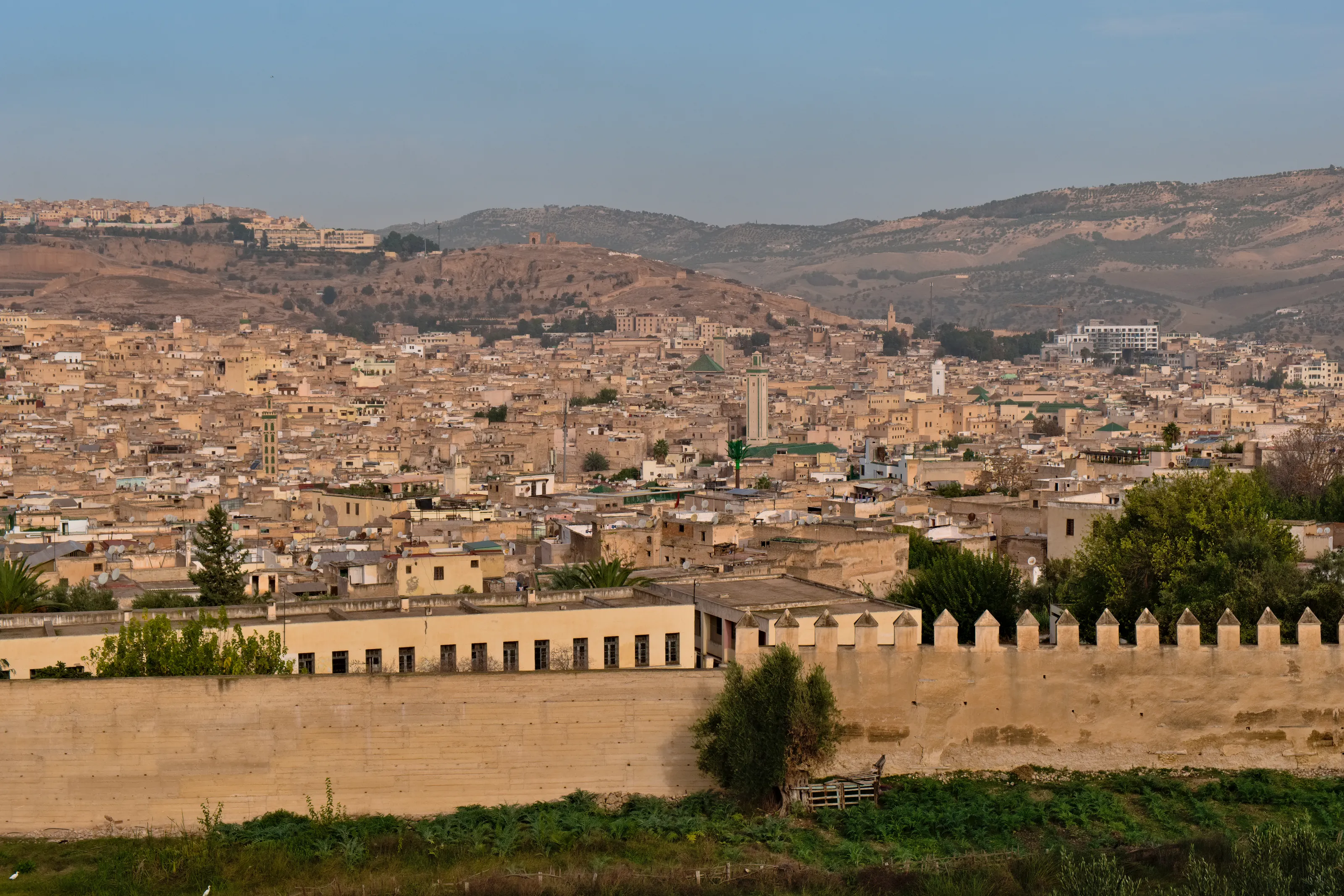
Founded in 789 by Idris I according to Wikipedia (EN, DE), Morocco's oldest imperial city spreads across a valley crossed by the Fez river. Its rammed-earth walls, about seven metres high per Wikivoyage (FR), enclose a dense mass of roofs in ochre tones. It was the national capital at several periods, notably under the Marinids in the 13th century.
Bab Bou Jeloud, the blue gate
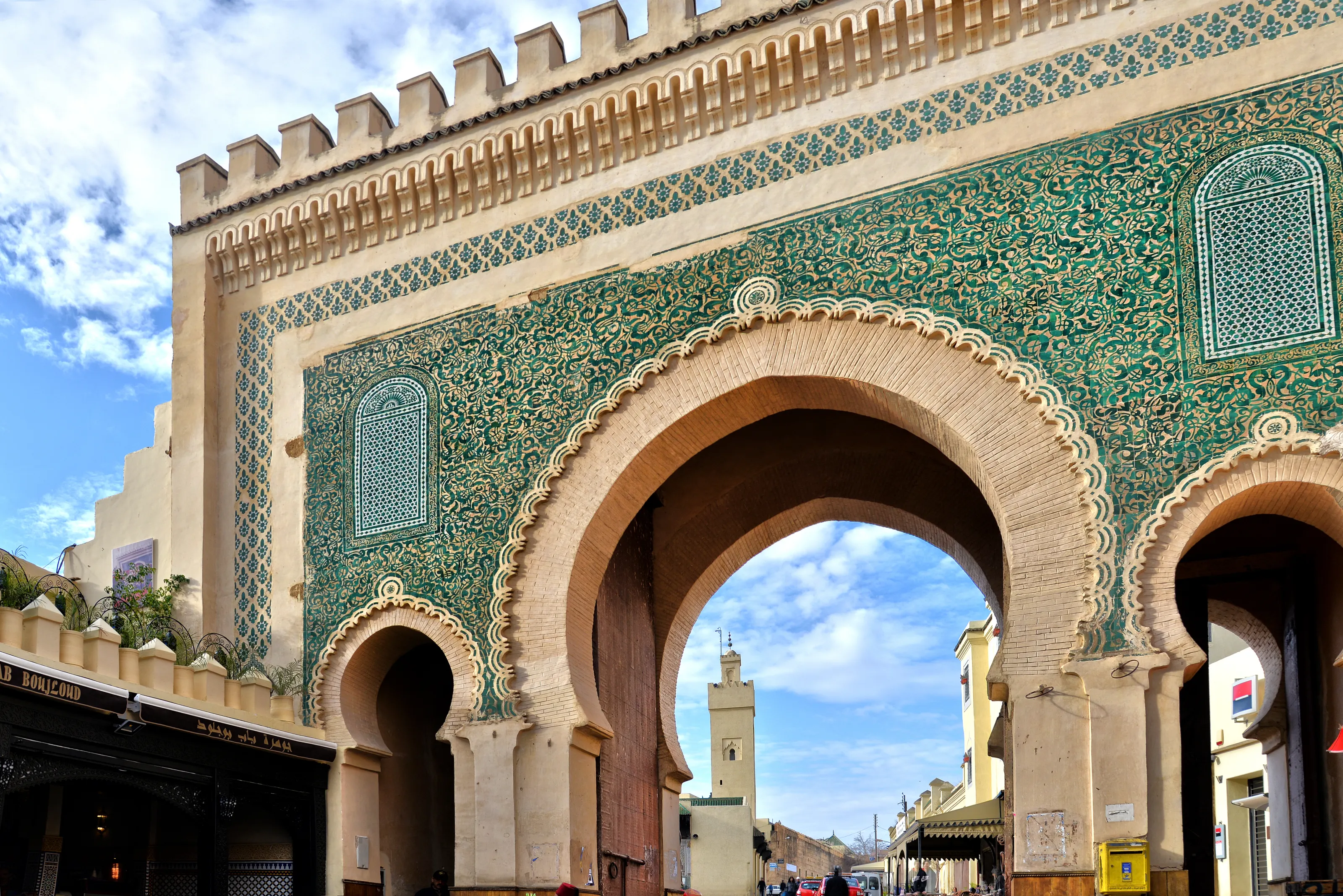
This monumental gate opens onto the medina. Rebuilt in 1912 according to Wikivoyage (FR), it is covered in blue tiles on the outside and green ones on the medina side, a colour linked to Islam. It is one of Fez's best-known images and the classic starting point for entering the lanes.
The Chouara tanneries
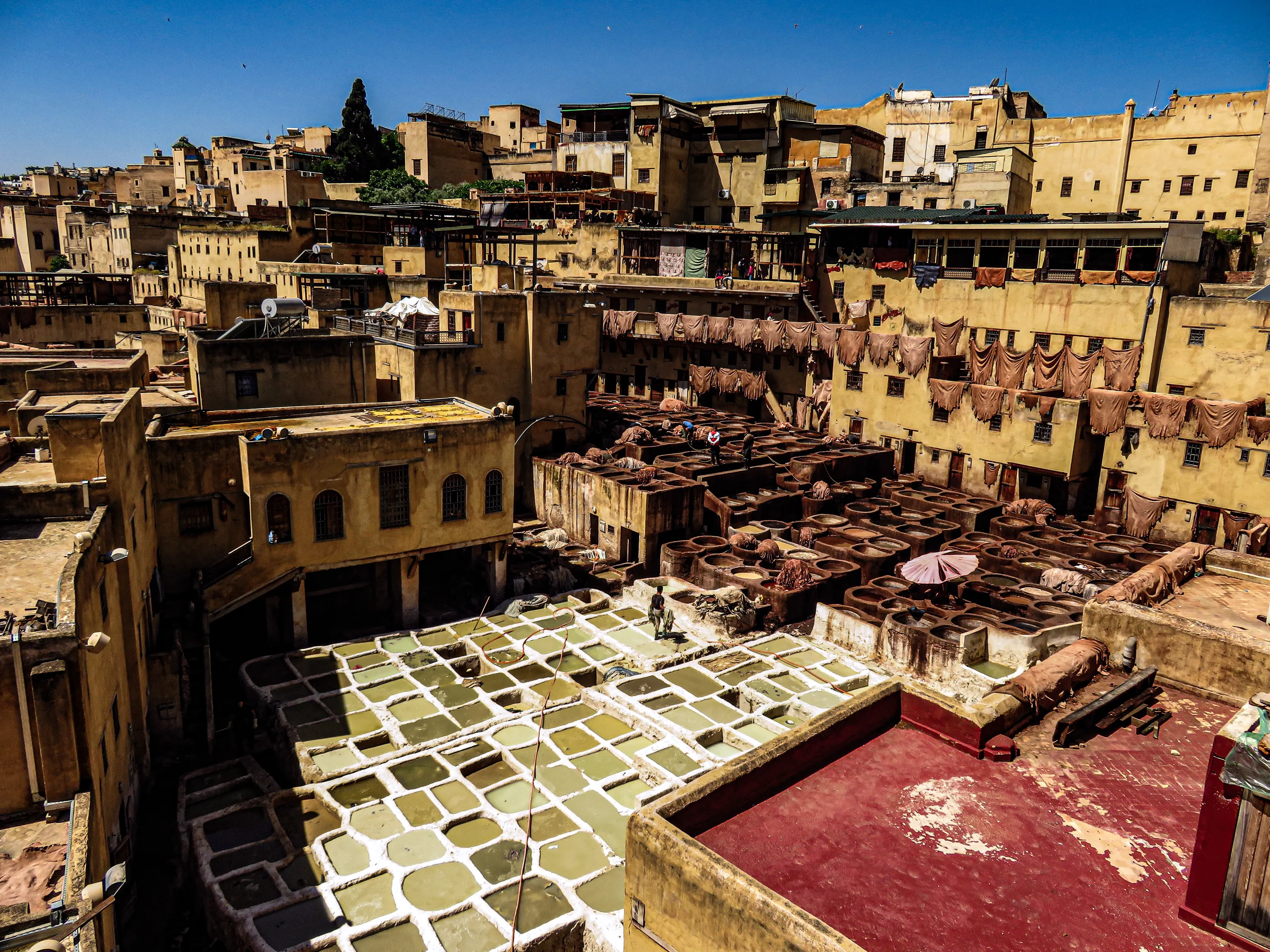
The largest of Fez's three traditional tannery complexes is viewed from the terraces of the leather shops around it, according to Wikivoyage (FR). The round vats are used to tan and dye hides. The smell is less strong early in the morning, the same guide says.
The dye vats
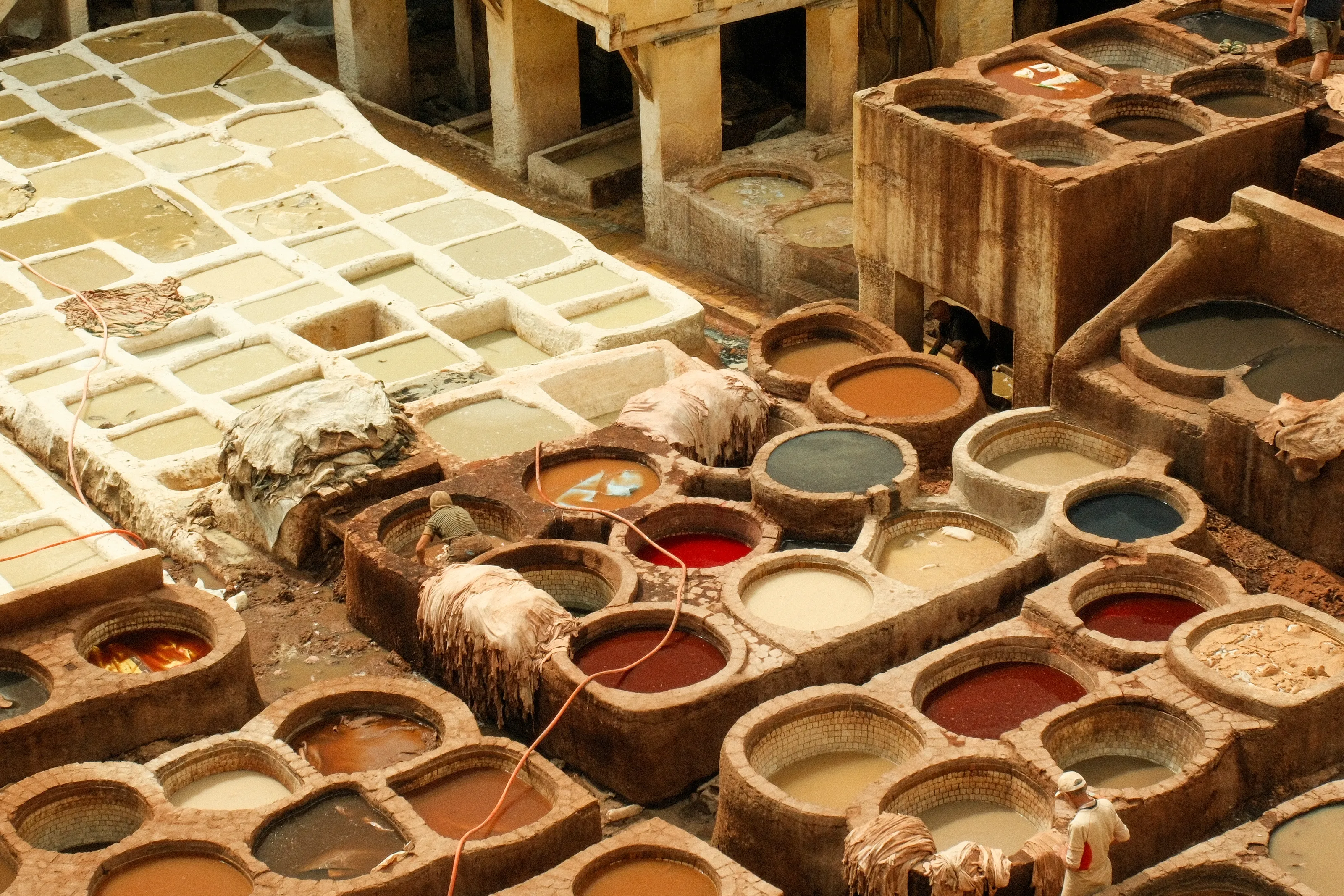
Seen up close, the ochre, white and red vats show an old craft that continues. Workers stay in contact with the products: look without getting in their way and ask before photographing anyone.
A great mosque courtyard
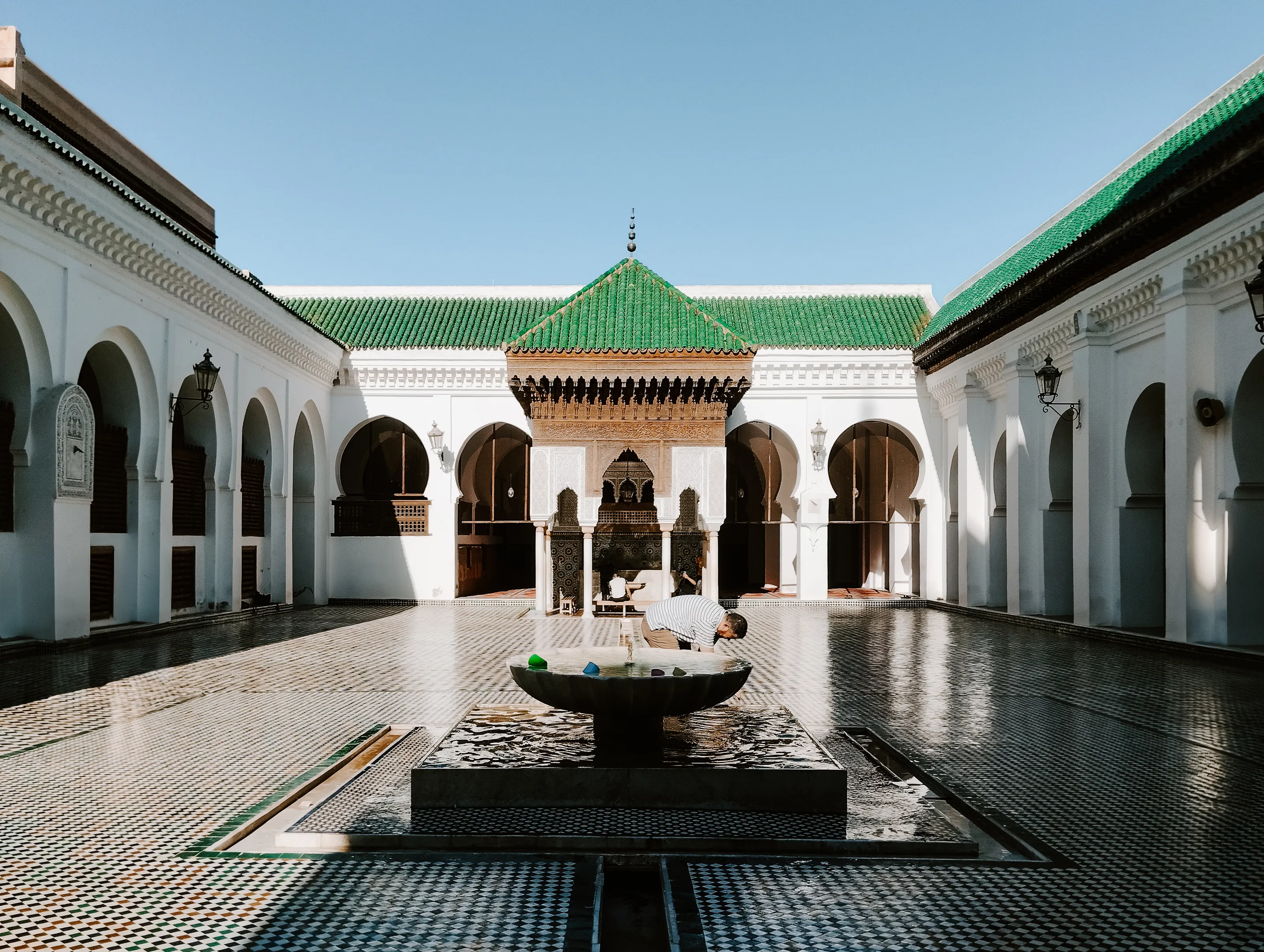
Around the Qarawiyyin mosque-university, founded in 857 according to Wikipedia (EN) and 859 according to Wikipedia (DE, ES), the interior is for Muslims only. Non-Muslims can still glimpse the courtyard through the Bab el-Ward door, which stays open, per Wikivoyage (FR). Green-tiled pavilions, added in Saadian times according to Wikipedia (EN), are a visual signature of the medina.
Rooftops and minarets
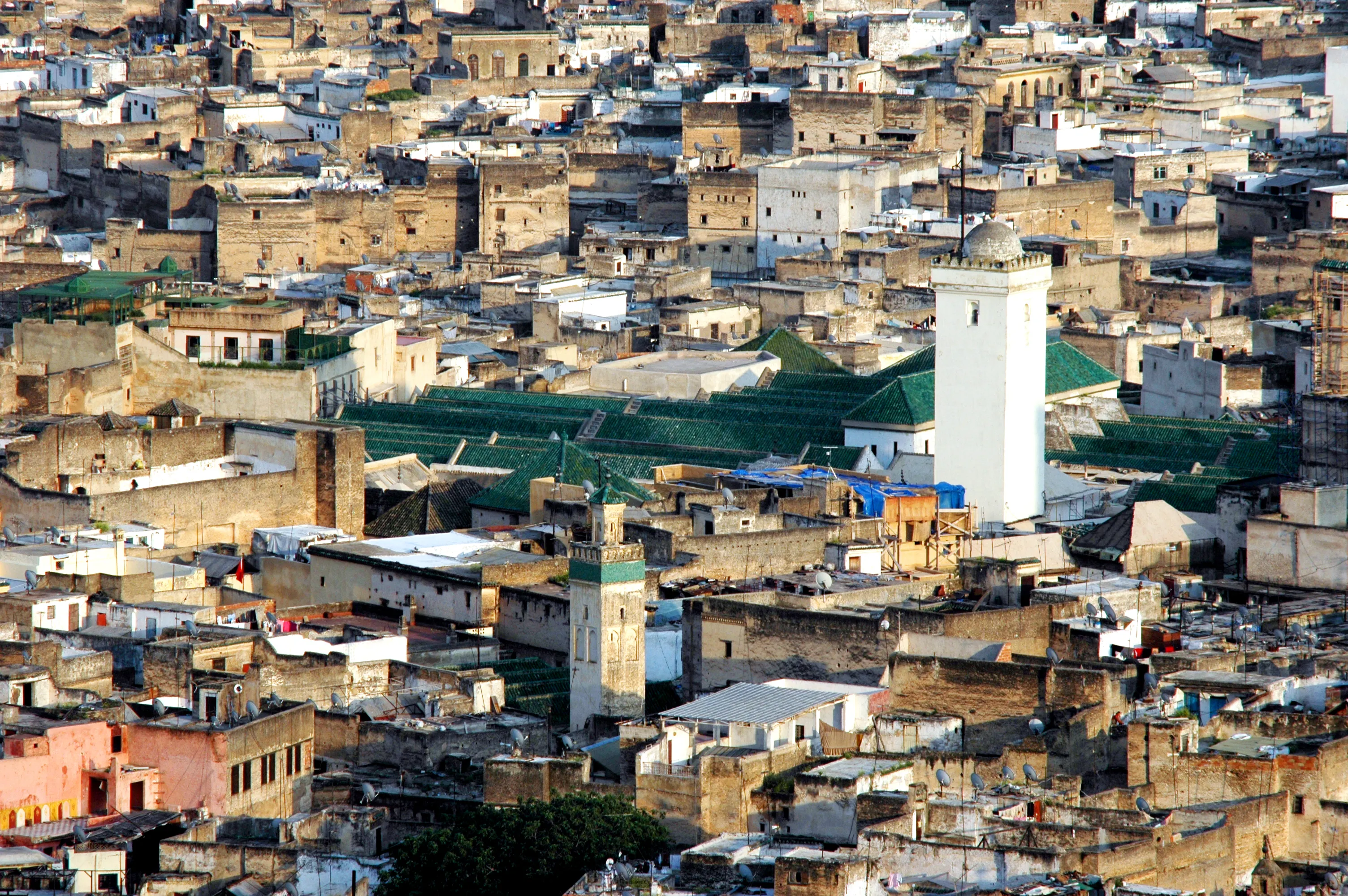
From a terrace, the medina reads as a chequerboard of flat roofs dotted with white minarets and green-tiled religious buildings. Several shops and cafes in the medina open their terraces to visitors: it is the simplest way to understand the layout.
Nejjarine Square, the Rcif market and Seffarine Square, in text
Nejjarine Square has a fountain decorated with ceramics and woodwork and dates from the early 18th century according to Wikivoyage (FR); it opens onto the carpenters' fondouk. The Rcif market sells fresh food, with butchers and poultry sellers, and is a handy landmark when you are lost. Seffarine Square is where the coppersmiths still work. The royal palace (Dar el-Makhzen) in Fes el-Jdid cannot be visited, but its gilded bronze doors can be seen from Alaouites Square.
Museums and culture
Madrasas, fondouks turned museums and palaces
Madrasas and Marinid architecture
The Bou Inania madrasa, completed in 1357 per Wikivoyage (FR), is the largest in Marinid style and even has a minaret; its courtyard can be visited outside prayer times. The al-Attarine madrasa, from the early 14th century, is considered one of the finest of the period. Access conditions change: check hours on site.
Museums
The Nejjarine fondouk, an early 18th-century caravanserai, houses a woodworking museum. The Batha palace, built in the late 19th century between Fes el-Bali and Fes el-Jdid, became a crafts museum and then a museum of Islamic arts. The Borj Nord, a Saadian fort from the late 16th century, has housed an arms museum since 1963, per Wikivoyage (FR).
Mellah and gardens
In Fes el-Jdid, the mellah, the Jewish quarter created from the 15th century, keeps houses with open balconies over the street and the Ibn Danan synagogue, turned into a museum in 2013. The Jnan Sbil garden, the city's oldest public garden, covers about seven hectares. We give no admission prices: they change.
Food and drink
Pastilla, tagines, khlii and medina markets
Specialities
In Fez people eat tagines, dishes made with khlii, dried meat then preserved in fat, and chicken pastilla, a sweet-and-savoury pastry dusted with cinnamon, according to Wikivoyage (FR). A fish version also exists. Skewers and grills are found in the small eateries of the medina.
Markets and souks
The Rcif market, for fresh produce, and the henna souk, one of the oldest in the medina, give a feel for daily life. When shopping, bargaining is the rule except for food, whose price is rarely negotiated. Craftspeople do not work on Fridays and only food stalls stay open in the souks.
Cafes and evenings
Terraces in the medina and the Ville Nouvelle serve mint tea, salads and Moroccan cooking; per Wikivoyage (FR), one medina cafe held gnawa music concerts on Sundays, a dated detail worth rechecking.
Getting around
On foot in the medina, by petit taxi elsewhere
In the medina
Fes el-Bali is closed to cars and, unlike Marrakech, motorbikes are rare there. It is easy to get lost: orient yourself by the main lanes and the gates, and note that signposted markets are useful landmarks.
In the Ville Nouvelle
Traffic is heavy on the main boulevards. Red petits taxis serve the city; there are no more horse-drawn carriages in Fez according to Wikivoyage (FR). Grand taxis and coaches cover trips between cities.
Excursions
Classic day trips go to Meknes and the Roman ruins of Volubilis, or to Ifrane and its cedar forests via Sefrou. Many agencies and private drivers offer them; compare and check credentials.
Budget and precautions
A variable budget, to check before you go
Price level
We give no ranges or figures, as we could not cross-check them on two independent, up-to-date sources. The currency is the Moroccan dirham; guidebook prices age quickly.
Flights
The flight remains the most variable cost. SniperAir tracks prices to FEZ and compares them with the route's history, but it does not sell or book tickets. Casablanca (CMN), Rabat (RBA) or Tangier (TNG) can complete the watch.
Formalities and precautions
Entry formalities depend on your nationality: check them on official sites and consult your country's travel advice. In the medina, follow the rules for places of worship and keep an eye on your belongings in crowded lanes.
When to go
Four distinct seasons, a hot and dry summer
Winter (December to February)
Cool and wetter; daytime highs reach about 15 C according to Wikipedia (EN). Snow is rare: on average once every three to five years.
Spring (March to May)
Days warm up and terraces come back to life; a good time to walk the medina.
Summer (June to September)
Hot and dry: visit early in the morning and late in the day, and rest in the hottest hours.
Autumn (October to November)
Soft light and less heat; the first rains may arrive late in the season.
Fez has a hot-summer Mediterranean climate with strong continental influence (Csa), per Wikipedia (EN): cool, wet winters, dry summers from June to September, and up to 800 mm of rain in good years. We give no other temperatures, as we could not cross-check them; check the forecast before you travel. Spring and autumn are often the most pleasant.
By length of stay
What to do in Fez depending on your stay
The essentials
Bab Bou Jeloud, the Bou Inania madrasa, the tanneries, Seffarine Square and a rooftop terrace.
Going deeper
The woodworking and Islamic arts museums, the mellah, Fes el-Jdid, the Borj Nord and the Jnan Sbil garden.
Around Fez
Meknes and Volubilis, Sefrou, Ifrane and its cedars, or a loop to other imperial cities.
In pictures
Fez in pictures
You might also like
Similar destinations
FAQ
Frequently asked questions about flights to Fez
How do I get from Fez airport to the centre?
The airport (FEZ) is about fifteen kilometres south of the centre. You can take a grand taxi or a shuttle bus to the Ville Nouvelle railway station, then a petit taxi to the medina. Times change: check them before you travel.
When is the best time to visit Fez?
Spring and autumn are often the most pleasant for walking. Summer is hot and dry, winter cool and wetter.
Can you visit the mosques of Fez?
Access to mosques, such as the Qarawiyyin, is reserved for Muslims. Several madrasas, like Bou Inania, can be visited outside prayer times.
How long should I stay in Fez?
Two days for the medina, the tanneries and two or three madrasas; three to four days if you add the museums, the mellah and an excursion.
Is Fez expensive?
We give no amounts because we could not cross-check them. The flight is the cost you can optimise with a price alert.
What should I try in Fez?
Pastilla, tagines, khlii dishes and market produce from the medina; mint tea on a terrace goes well with sightseeing.
How much does a flight to Fez usually cost?
The price depends mainly on your departure city, the time of year and how far ahead you book. The "opportunities" section above shows real examples of prices SniperAir has already detected to this destination.
How do I get alerted when a flight to Fez drops below my budget?
Create an alert profile with your departure airport, Fez (FEZ) as the destination and your maximum budget. You are notified automatically as soon as a matching price is detected. SniperAir monitors and alerts, it does not sell or book tickets.
Ready to head to Fez?
Set your budget and let SniperAir monitor fares for you.
Create my alert