
Cheap flights to Siem Reap
Set your departure airport and maximum budget: SniperAir tracks prices to Siem Reap and alerts you the moment a deal matching your criteria appears.
Quick summary
Country
Cambodia
Continent
Asia
Airport
SAI
Currency
Cambodian riel (KHR)
Time zone
UTC+7
Deals already spotted to Siem Reap
Real flight examples detected by SniperAir, with their reference price.
Loading examples…
Why watch Siem Reap with SniperAir
The gateway to Angkor, worth catching at the right moment
Choose your departure
Enter your departure airport and your maximum budget for a flight to Siem Reap (SAI).
SniperAir watches
Our systems continuously compare new prices with the route's real price history. SniperAir monitors prices and alerts you; it does not sell or book tickets.
You get an alert
As soon as a price matches your criteria, you are notified without having searched anything yourself.
Siem Reap is the capital of the province of the same name in north-west Cambodia and the country's second-largest city, with 245,494 residents at the 2019 census. Its importance comes from its immediate proximity to the Angkor Archaeological Park, a UNESCO World Heritage Site since 1992: Angkor Wat, the Bayon, Ta Prohm and dozens of other sanctuaries. More than half of local jobs depended on tourism by a 2010 estimate (Wikipedia, EN).
For anyone searching flights, one point matters: Siem Reap-Angkor International Airport (SAI), opened in October 2023, replaced the old airport that lay close to town. It is about 50 km away, which lengthens the transfer. Flight prices vary with the season and your departure point, and an alert lets you spot a good fare without checking every day.
Airport and getting into town
A new airport about fifty kilometres away
Siem Reap-Angkor International Airport (SAI)
The airport opened on 16 October 2023 in Soutr Nikom, according to Wikipedia (EN); it replaces the old Siem Reap airport, now closed. It lies about 50 km east of the city and 40 km east of Angkor Wat, according to the same source. It is linked to Bangkok, Kuala Lumpur, Singapore, Hanoi, Ho Chi Minh City, Phnom Penh and Sihanoukville according to Wikipedia (EN) and Wikivoyage (EN); routes change, so check before booking. Wikivoyage (EN, ES) says the transfer is longer and pricier than from the old airport.
Distances and times are approximate, based on Wikipedia (EN) and Wikivoyage (DE, EN, ES); routes change. We do not quote fares: they differ from source to source.
From the airport to the town centre, allow about 40 to 60 minutes by car according to Wikivoyage (DE); minibuses, taxis and tuk-tuks are possible, the last being much slower. From Phnom Penh the bus takes about five hours and a boat has also been cited. Overland from Bangkok via Poipet takes 6 to 10 hours, but Wikivoyage (EN) reports that buses from Thailand have been suspended since June 2025 and advises against travel within 50 km of the border: read travel advice before planning an overland trip.
Angkor and its temples
Angkor Wat, the Bayon, Ta Prohm and Banteay Srei
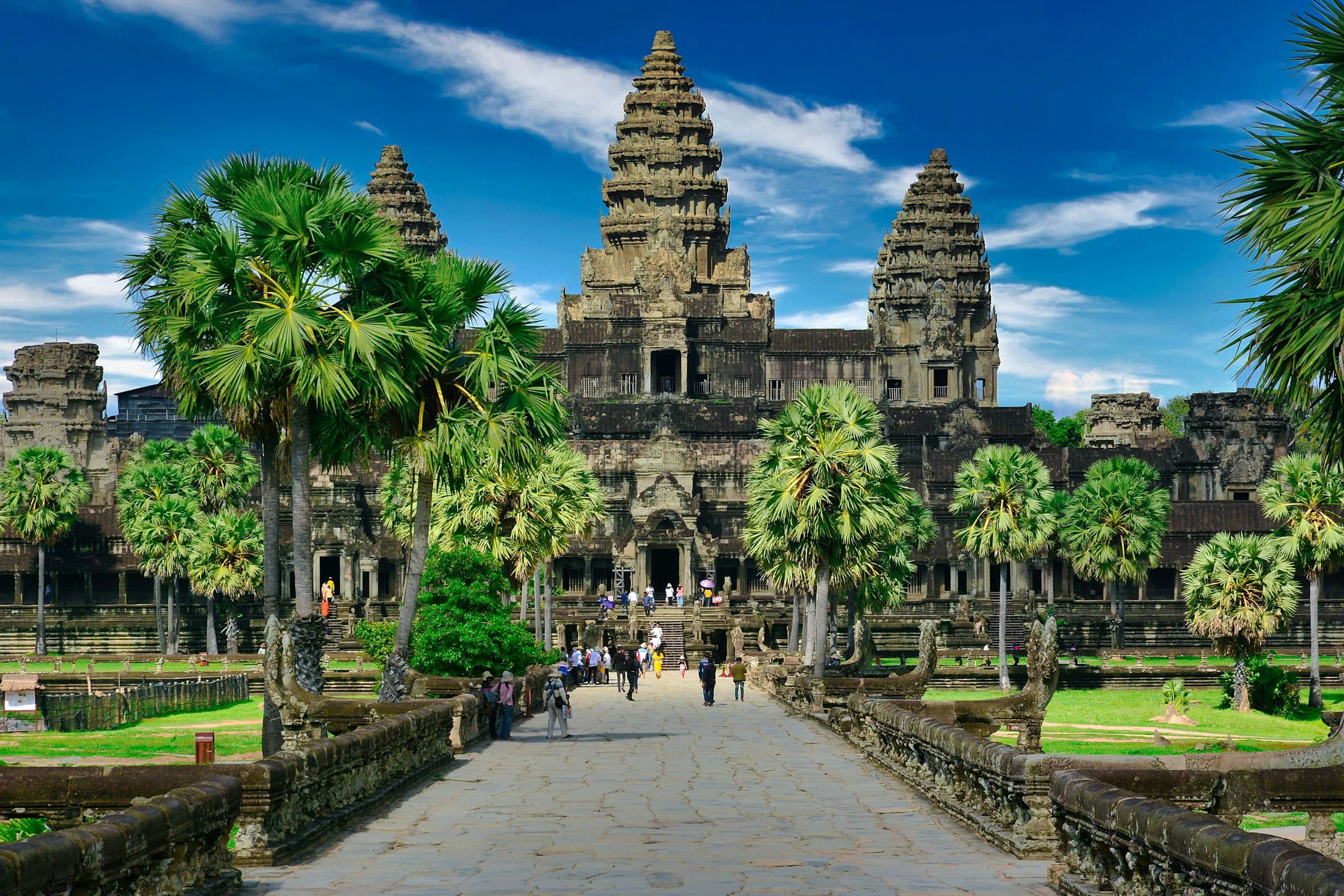
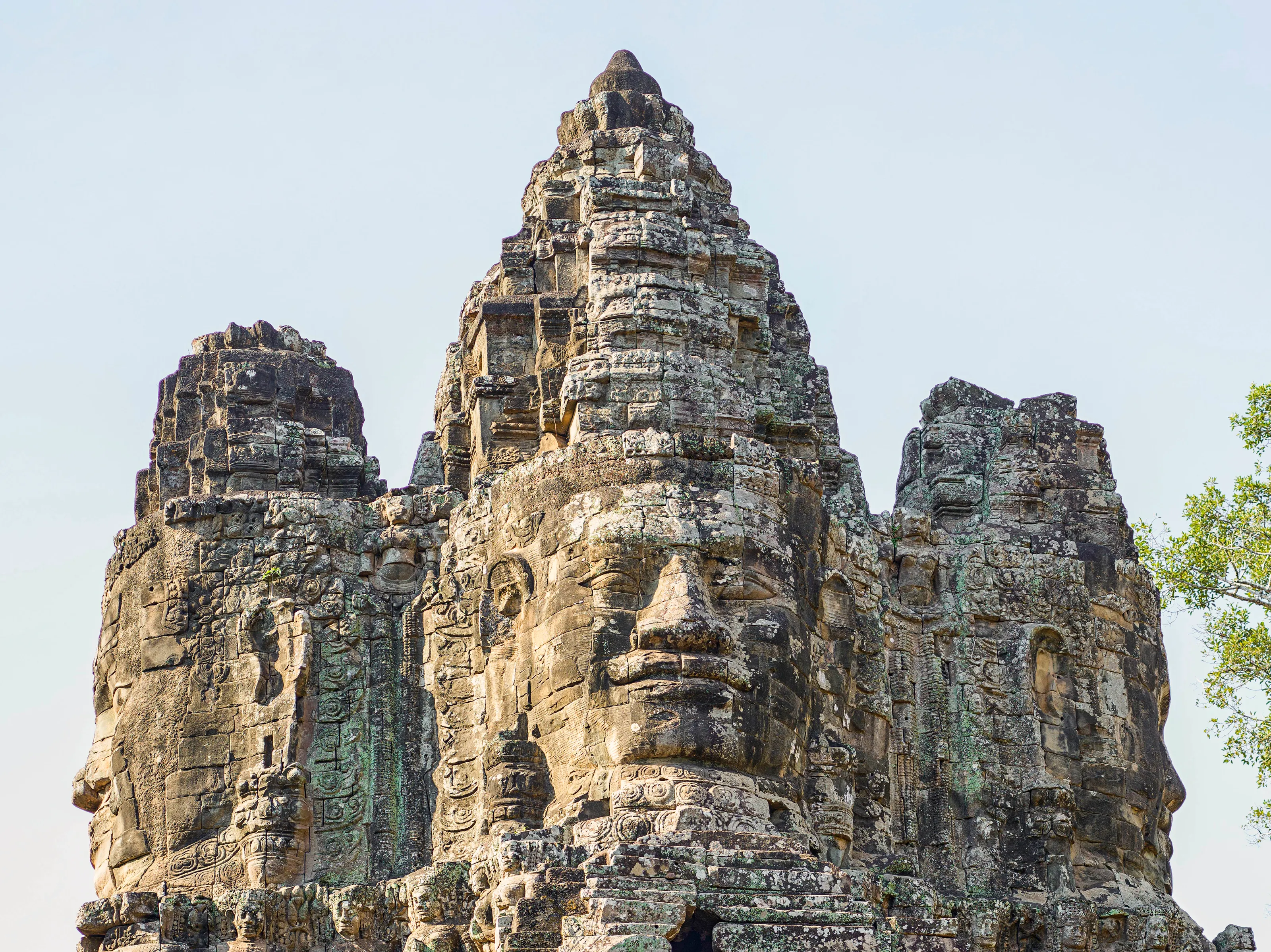
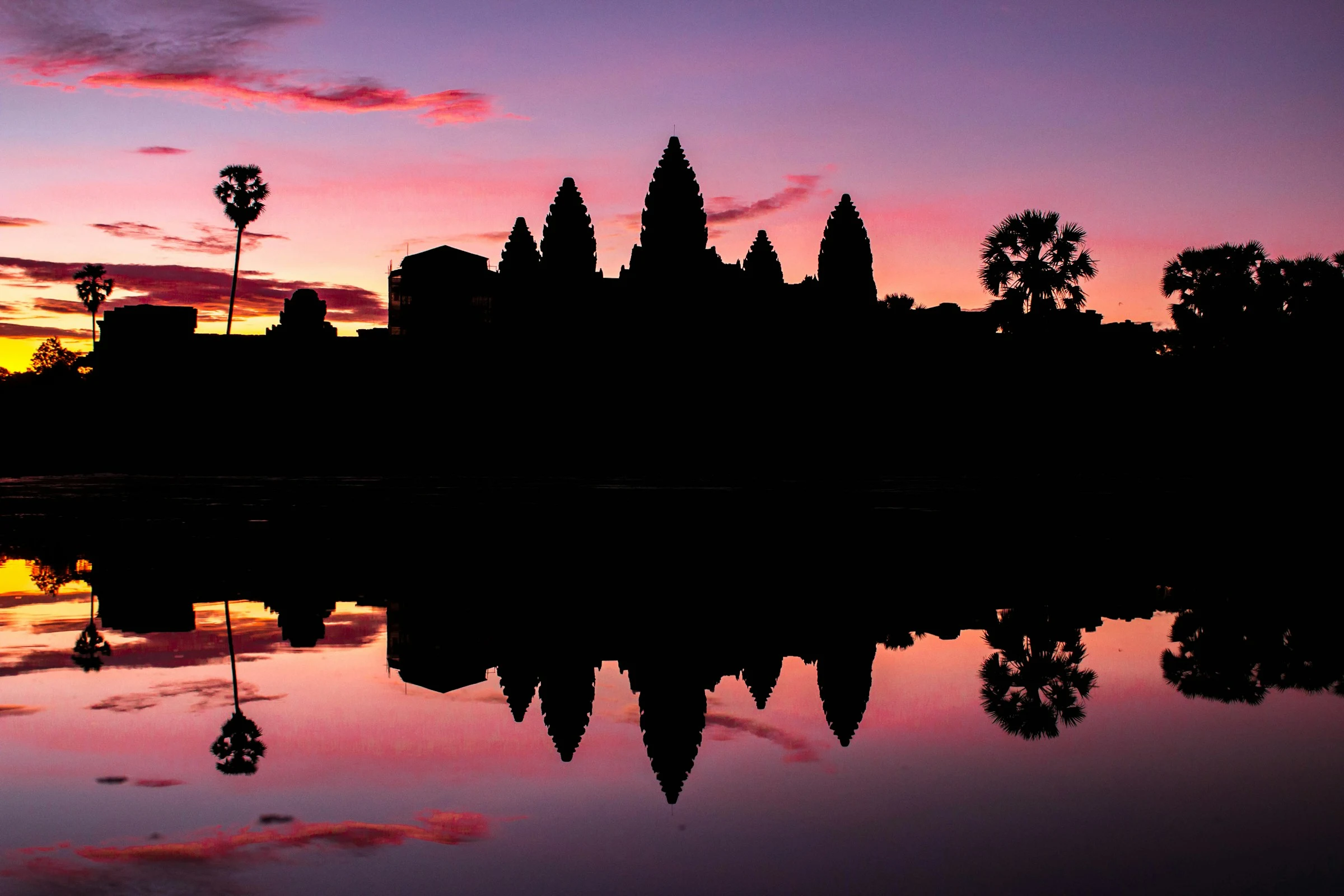
Angkor was the centre of the Khmer Empire from the 9th to the 15th century (Wikipedia, DE). The archaeological park covers more than 400 km2 with around 200 temples according to Wikipedia (FR), and its limits vary by source. The places illustrated below are Angkor Wat, the face towers of Angkor Thom, Ta Prohm, Banteay Srei and the Tonle Sap lake.
Angkor Wat
Built under Suryavarman II, who ruled from 1113 to about 1150, Angkor Wat was dedicated to Vishnu before gradually passing to Theravada Buddhism; it remains an active site (Wikipedia, EN). The site covers 162.6 hectares and its moat is 190 m wide. It lies six or eight kilometres north of town depending on the source. At the equinoxes the sun rises in line with the central tower.
Angkor Thom and the face towers
Founded by Jayavarman VII, the walled city of Angkor Thom contains the Bayon, whose towers are decorated with carved faces interpreted as the king as the bodhisattva Lokeshvara (Wikipedia, EN). Wikipedia (DE) counts 49 towers at the Bayon.
Ta Prohm
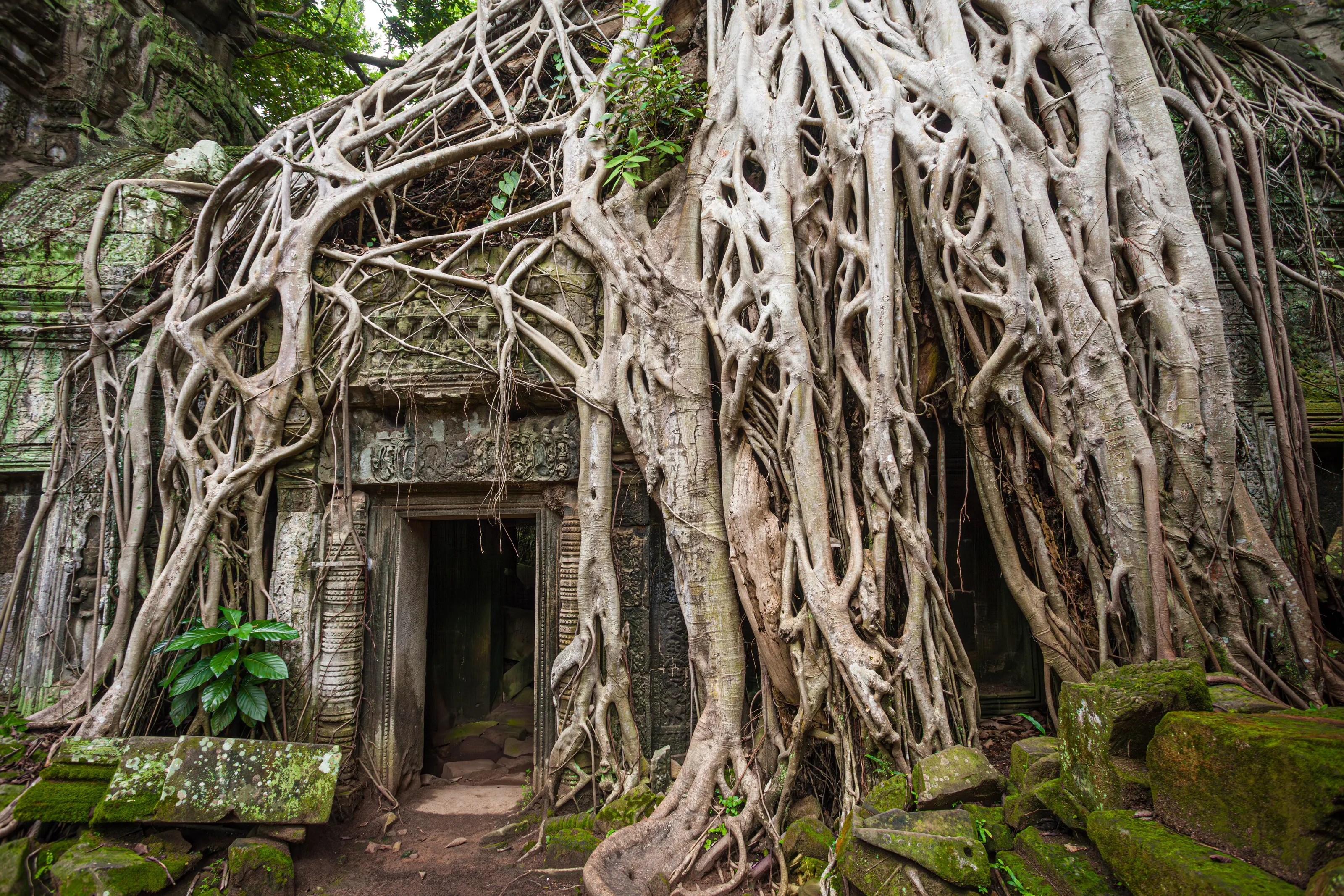
Built under Jayavarman VII and dedicated to his parents, Ta Prohm is famous for huge trees whose roots embrace the stone walls. An inscription records more than 12,000 people serving the temple (Wikipedia, FR, EN).
Banteay Srei
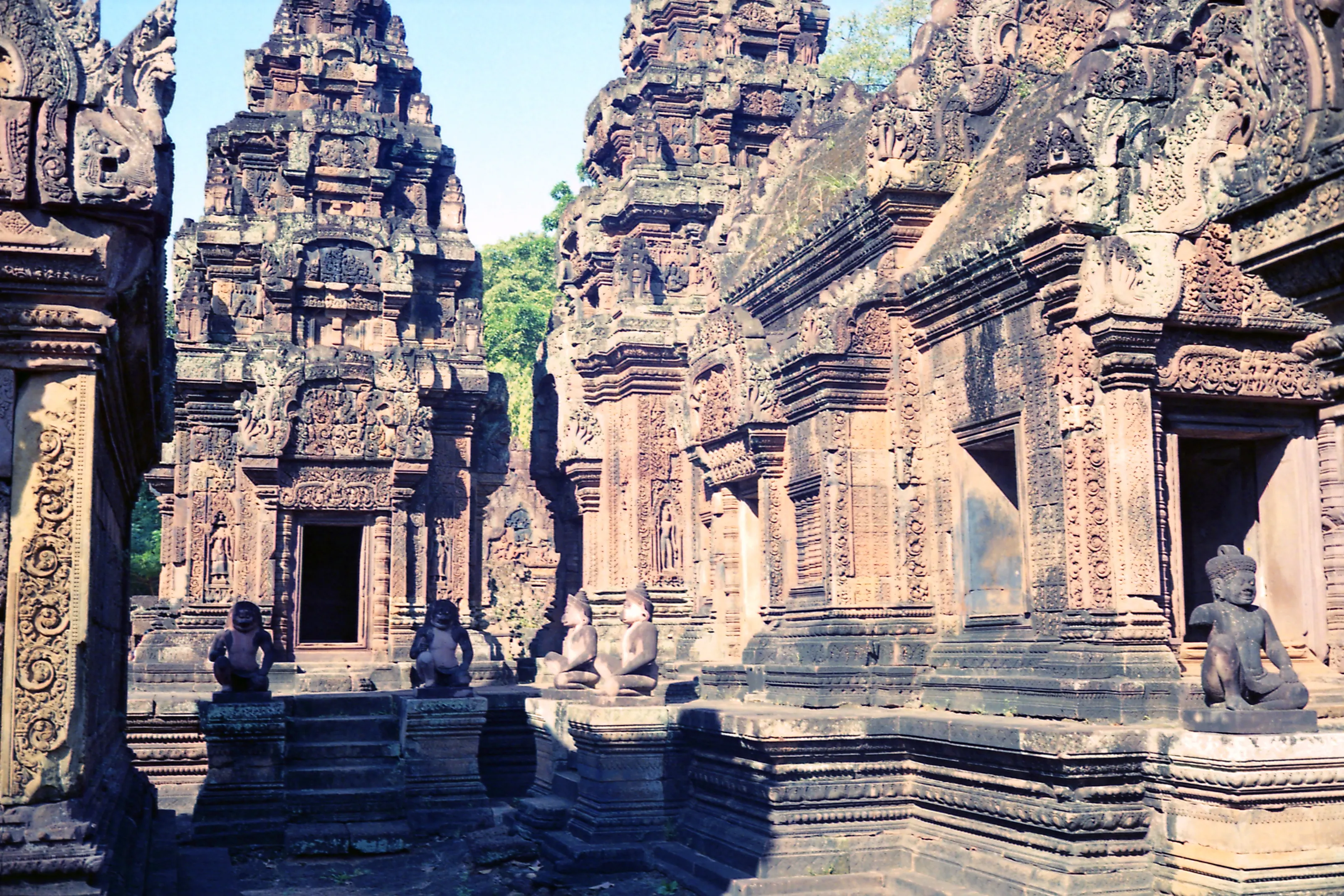
About twenty kilometres north-east (20 km according to Wikipedia FR, 30 km according to Wikipedia EN), this small temple was consecrated in 967 according to Wikipedia (DE) and is regarded as one of the most delicately carved in Angkor. It was restored by anastylosis in the 1920s and 1930s (Wikipedia, FR).
The Tonle Sap
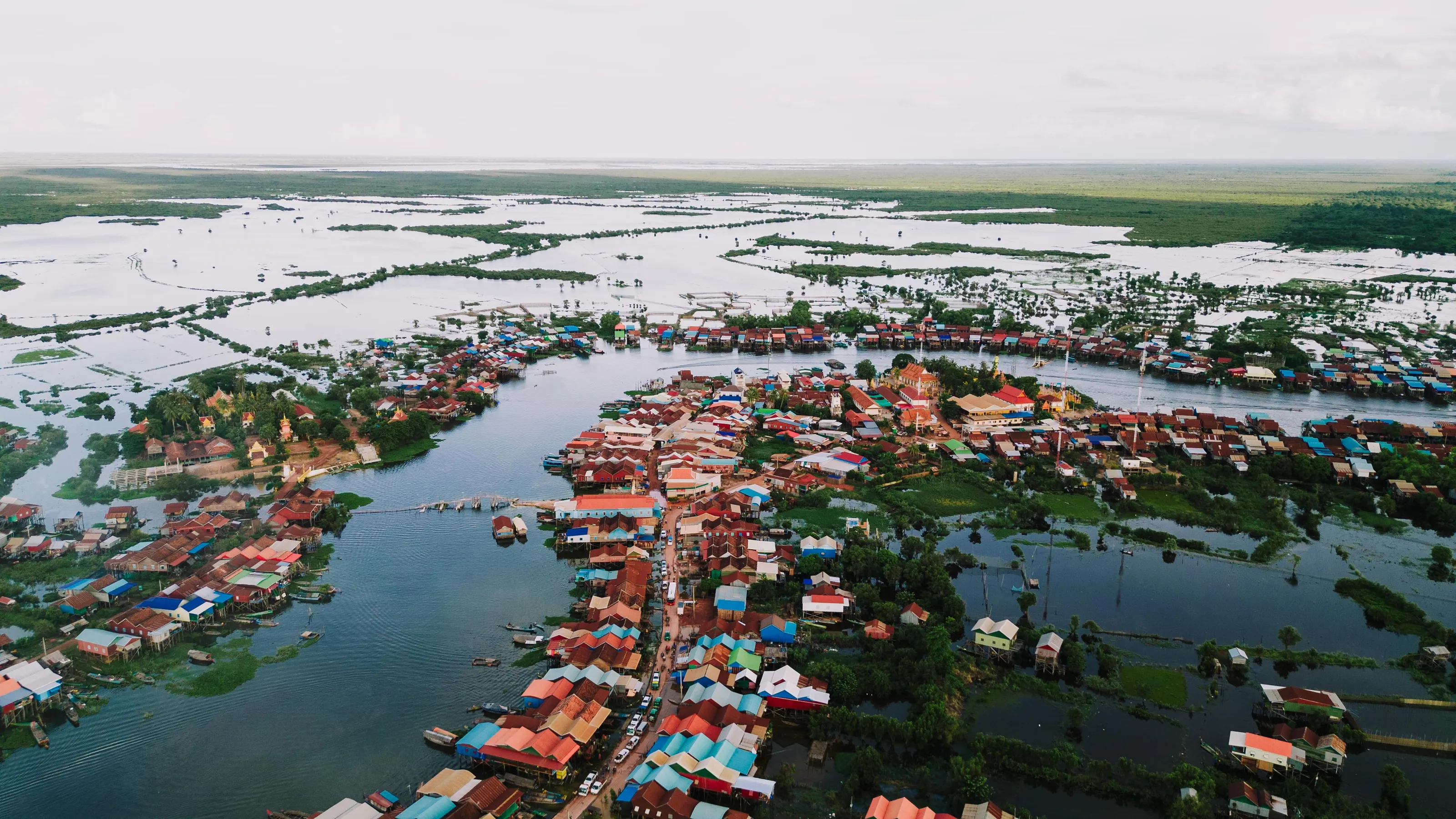
The Tonle Sap, a great freshwater lake, is rich in fish and the setting for villages on stilts. The floating village of Chong Kneas lies about 30 minutes south of town (Wikipedia, EN). Wikivoyage (EN) warns that the boat fee to Kampong Phluk is not always announced in advance.
Preparing your visit, in text
An entry ticket, managed by the APSARA authority, is required for foreigners (Wikipedia, EN): find out about tickets and hours before you go. In the temples, shoulders and knees must be covered, and access to the upper level of Angkor Wat may otherwise be refused (Wikivoyage, ES). The two usual routes are the Small and Grand Circuits (Wikipedia, FR).
Museums and culture
A national museum, memory museums and apsara dance
The museums
The Angkor National Museum, south of the site, presents the golden age of Khmer civilisation and sculptures from the temples (Wikipedia, FR). Wikivoyage (EN) also lists the War Museum and the Landmine Museum, run by a former deminer (Wikipedia, DE). We do not quote prices.
Dance and crafts
Traditional apsara dance performances are given in a theatre in town, daily according to Wikivoyage (ES). Silk and handicraft workshops can be visited freely, says Wikivoyage (DE).
Responsible tourism
Wikivoyage (EN) strongly discourages orphanage visits, since most children there still have parents and such visits often do more harm than good. Prefer social enterprises and workshops that train craftspeople.
Food and drink
Amok, restaurant lanes and night markets
Amok and Khmer cooking
Wikivoyage (EN) mentions fish amok, a steamed fish dish in a fragrant sauce. Most restaurants serve both Khmer and Western dishes (Wikivoyage, DE).
Where to eat
Restaurants cluster around Pub Street and its lanes, the Old Market, the Kandal area and a few nearby streets (Wikivoyage, EN, DE, ES). You will find world cuisine and quieter places.
Markets
The Old Market mixes souvenirs and goods for residents according to Wikipedia (FR); Wikivoyage (EN) advises bargaining and notes that some stalls sell unreliable antiques. Night markets are another option.
Getting around
Tuk-tuks, motorbike taxis and bicycles
Tuk-tuks and motorbike taxis
Tuk-tuks and motorbike taxis are the usual transport: the city had about 6,000 tuk-tuk drivers in 2019 (Wikipedia, EN). Agree the price before boarding; it can double at night or in bad weather (Wikivoyage, ES).
Visiting the temples
You can visit the temples by tuk-tuk with a driver for the day, by bicycle or by scooter. The town centre is compact and flat (Wikivoyage, ES), but roads are dusty and shadeless (Wikivoyage, DE).
Before sunrise
To see Angkor Wat at sunrise, rent a bicycle the day before, because rental shops rarely open before 7:00 (Wikivoyage, EN, ES).
Budget and precautions
Tourist-town price levels, to be checked
Price level
Siem Reap lives on tourism: prices are higher than in other parts of Cambodia according to Wikivoyage (ES). We give no ranges or figure-based comparisons because we could not cross-check them on two independent, up-to-date sources: the airport transfer fare, for example, differs from page to page. Payments are made in riel and US dollars.
Flights
The flight is the most variable item. SniperAir monitors prices to SAI and compares them with the route's history, but it does not sell or book tickets. Phnom Penh, Bangkok or Hanoi can complement your watch if you combine several stops.
Entry rules and precautions
Entry rules for Cambodia depend on your nationality, notably for the visa: check them on official sites and read your country's travel advice, including for the Thai border area. Protect yourself from heat and sun, drink bottled water and follow the dress rules in temples.
Best time to go
Two seasons: dry from November to April, wet from May to October
November to February
The coolest and busiest dry season, with almost no rain from December to February (Wikipedia, DE). Days are still hot.
March to April
The end of the dry season, very hot; dust rises on the roads (Wikivoyage, EN).
May to October
The rainy season: September is the wettest month according to Wikipedia (EN, DE); flooded plains are visible from viewpoints.
All year round
Early morning, before the heat, is the best time to visit the temples in any season.
The climate is tropical monsoonal: highs never fall below 30 C according to Wikipedia (EN), averaging about 33 C (Wikipedia, DE). Annual rainfall is around 1,400 to 1,500 mm depending on the source, but the driest months differ, so we do not publish precise figures. Check the forecast before you go.
By length of stay
What to do in Siem Reap depending on how long you stay
The essentials
Angkor Wat, the Bayon and Ta Prohm, with a sunrise or sunset, and an evening in town.
Temples and lake
Banteay Srei, a museum, an apsara dance show and an excursion on the Tonle Sap.
Further afield
More temples in the park, a day by bicycle or tuk-tuk, or a departure to Phnom Penh.
In pictures
Siem Reap in pictures
You might also like
Similar destinations

FAQ
Frequently asked questions about flights to Siem Reap
How do I get from Siem Reap airport (SAI) to the town centre?
The airport is about 50 km from town, or 40 to 60 minutes by car according to Wikivoyage (DE). Minibuses, taxis and tuk-tuks exist; fares vary, so check them before you travel.
When is the best time to visit Siem Reap?
November to February, the coolest dry season. The rainy season runs from May to October; September is the wettest month.
Is Siem Reap expensive?
Prices are higher than in other parts of Cambodia. We quote no amounts because we could not cross-check them. The flight is the item you can optimise with a price alert.
How long should I stay in Siem Reap?
Three days for Angkor Wat, the Bayon, Ta Prohm and Banteay Srei; add a day for the Tonle Sap or other temples.
How do I visit the Angkor temples?
By tuk-tuk with a driver, by bicycle or by scooter. An entry ticket is required for foreigners: find out before you go. Cover shoulders and knees.
What should I eat in Siem Reap?
Fish amok and Khmer cooking; Pub Street, the Old Market and the night markets are a good start.
How much does a flight to Siem Reap usually cost?
The price depends mainly on your departure city, the season and how far ahead you book. The opportunities section above shows real examples of prices SniperAir has already detected for this destination.
How can I be alerted when a flight to Siem Reap drops below my budget?
Create an alert profile with your departure airport, Siem Reap (SAI) as the destination and your maximum budget. You are notified automatically as soon as a matching price is detected. SniperAir monitors prices and alerts you; it does not sell or book tickets.
Ready to head to Siem Reap?
Set your budget and let SniperAir monitor fares for you.
Create my alert