

Cheap flights to Hanoi
Set your departure airport and maximum budget: SniperAir tracks prices to Hanoi and alerts you the moment a deal matching your criteria appears.
Quick summary
Country
Vietnam
Continent
Asia
Airport
HAN
Currency
Vietnamese dong (VND)
Time zone
UTC+7 (no daylight saving time)
Deals already spotted to Hanoi
Real flight examples detected by SniperAir, with their reference price.
Loading examples…
Why track Hanoi with SniperAir
You do not need to compare prices every day
Choose your departure
Enter your departure airport and your maximum budget for a flight to Hanoi (HAN).
SniperAir keeps watch
Our systems continuously compare new prices with the real price history of the route. SniperAir monitors prices and alerts you: it does not sell or book tickets.
You receive an alert
As soon as a price matches your criteria, you are notified, without having searched for anything yourself.
Airport and getting into town
An airport north of the city, then an express bus or taxi to the Old Quarter
Noi Bai (HAN)
Noi Bai International Airport lies north of the city: 35 km according to Wikivoyage (EN) but 45 km according to Wikivoyage (FR), so sources differ. The express bus 86 reaches the Old Quarter area in about 45 minutes per Wikivoyage (EN); bus 07 is cheaper and slower, at 60 to 90 minutes. Taxis and ride-hailing apps complete the choice. International flights use Terminal 2, which was being expanded as of March 2025 (Wikivoyage EN). Hanoi has direct flights from many Asian capitals, the Gulf and several European cities; there is none from North America, so Ho Chi Minh City, Taipei, Seoul or Tokyo are common connecting points.
Distances and times are approximate, based on Wikivoyage (EN, FR); check timetables and routes before you travel. We do not quote fares.
Hanoi is the capital of Vietnam. It was founded in 1010 by Ly Thai To as Thang Long, "ascending dragon", according to Wikipedia (EN); it lost its capital status to Hue in 1802 and regained it under French Indochina and again on reunification in 1976. It lies in the Red River delta and is better described as a city of lakes than a river city: the central districts hold nearly 77 lakes according to Wikipedia (FR).
Landmarks
The Temple of Literature, Hoan Kiem Lake, the One Pillar Pagoda and the mausoleum
Central Hanoi is best explored on foot, from Hoan Kiem Lake to the Ba Dinh district. Wikivoyage (EN) notes that few buildings in the centre rise above five storeys and that the Old Quarter ranks second only to Hoi An for uninterrupted colonial and pre-colonial architecture. The places below are illustrated; the Imperial Citadel of Thang Long, a UNESCO World Heritage Site since 2010, is described at the end of the section.
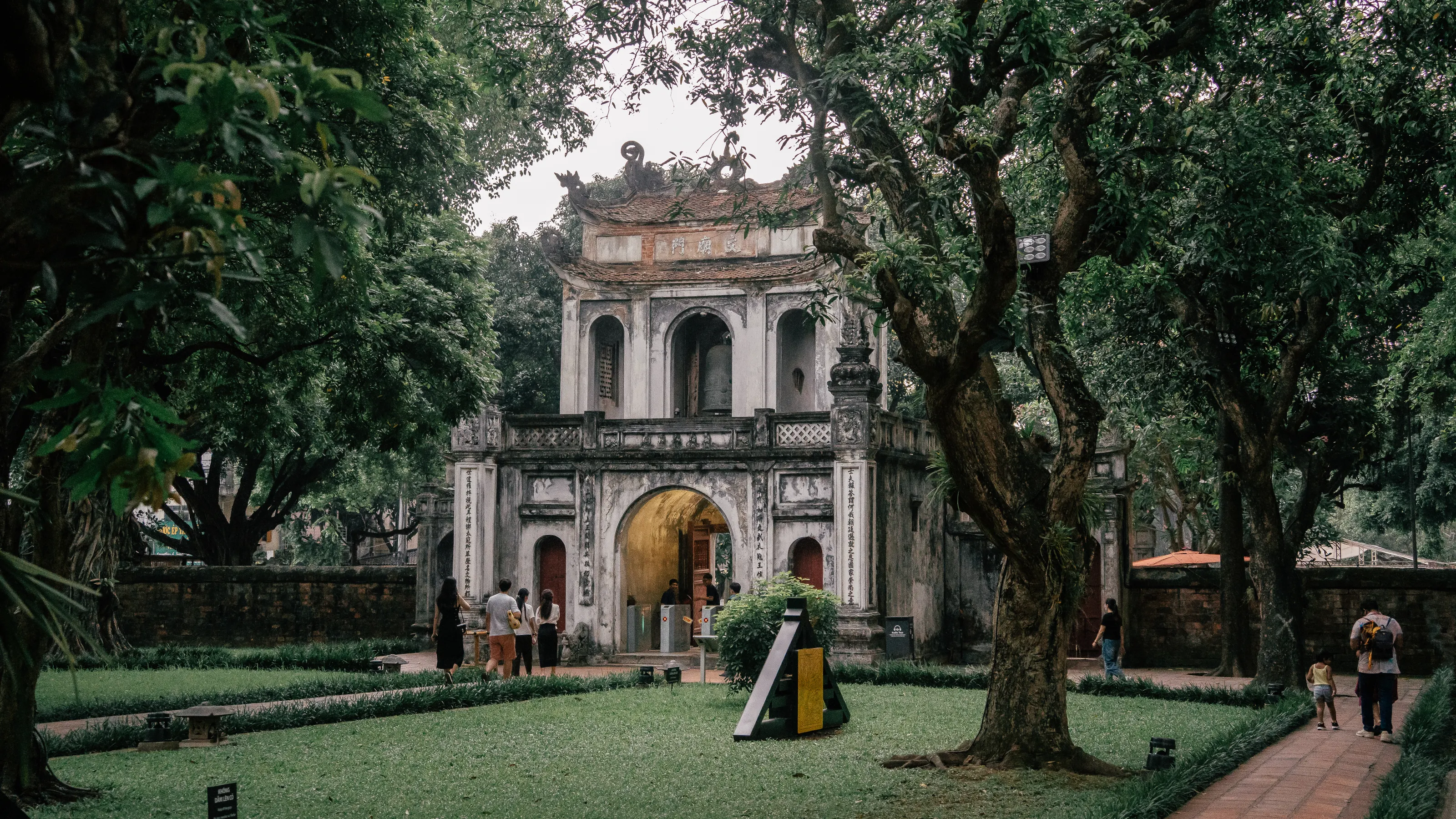
The Temple of Literature
Founded in 1070 and turned into the country's first university six years later, according to Wikivoyage (EN, DE), this Confucian complex unfolds courtyards, gates with ornate roofs and gardens over 54,000 m² per Wikivoyage (DE). The 82 doctoral stelae on stone turtles have been on UNESCO's Memory of the World register since 2010. The Pavilion of the Constellation of Literature, dating from 1805, is one of its emblems. Go early to avoid the crowds.
Hoan Kiem Lake and the Turtle Tower
The "Lake of the Returned Sword" is the heart of the city: according to the legend retold by Wikivoyage (EN), the sword of Le Loi was given back to a divine turtle after the victory over the Chinese in 1428. The small Turtle Tower stands on an islet and Ngoc Son Temple on another island. The lakeside is traffic-free at weekends, making it a favourite place for a stroll.
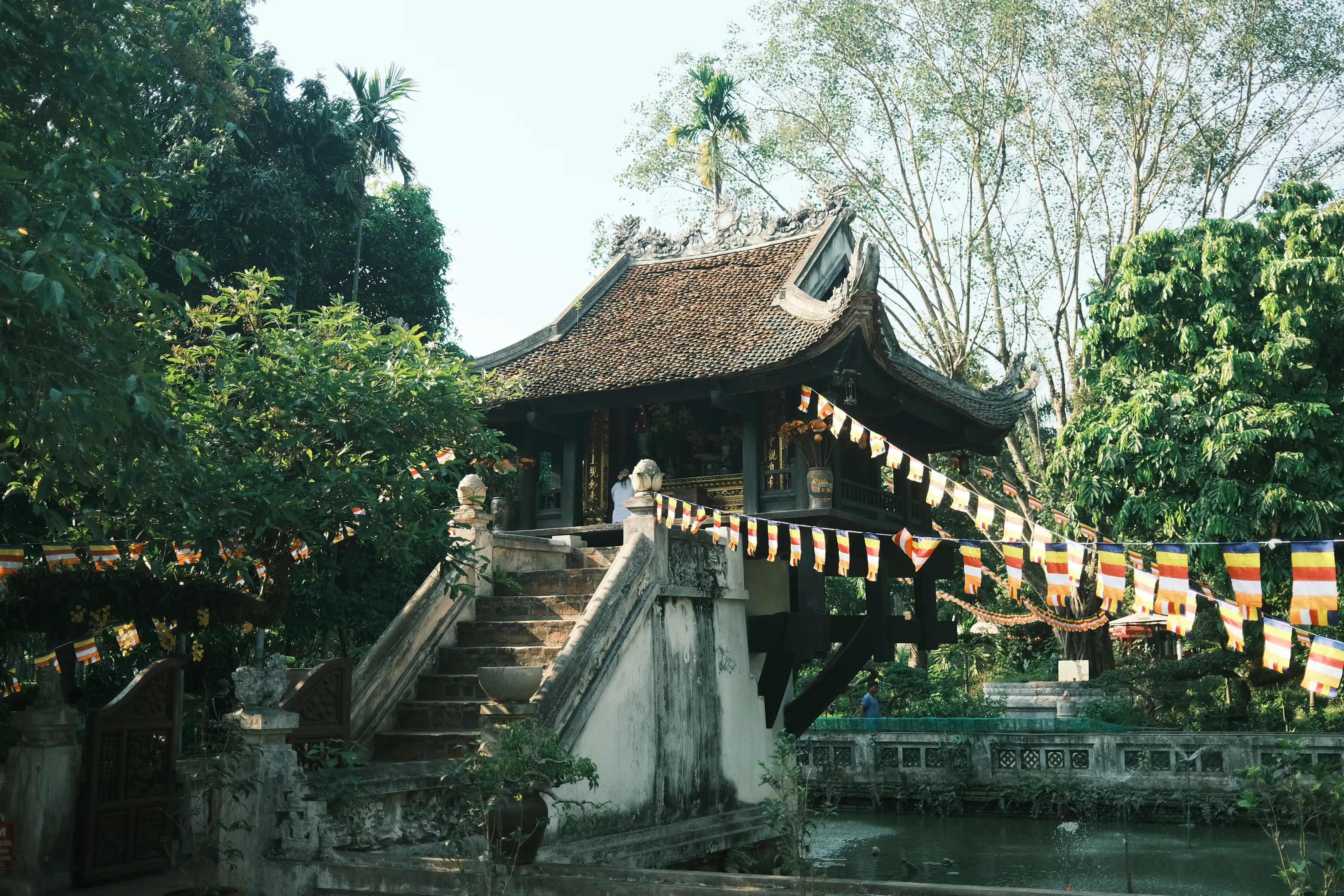
The One Pillar Pagoda
This small wooden temple stands on a single stone pillar 1.25 m in diameter and is designed to resemble a lotus blossom rising from a pond; the emperor had it built in 1049 per Wikivoyage (EN). French Union forces destroyed it in 1954 before withdrawing, and it was rebuilt. It stands next to the Ho Chi Minh complex.
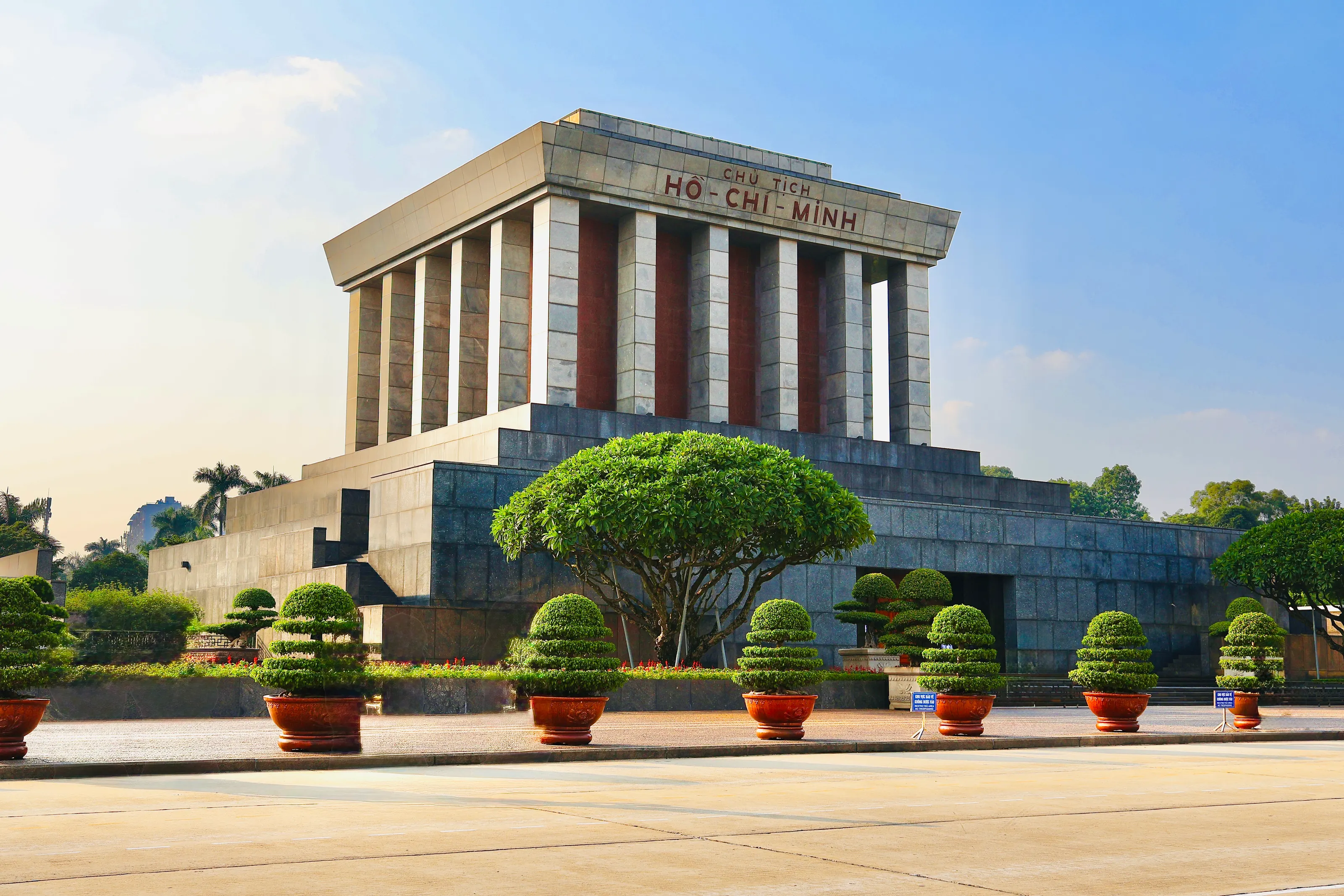
The Ho Chi Minh Mausoleum and Ba Dinh Square
The mausoleum, sober and monumental, can be visited under conditions: limited morning hours, shoulders and knees covered, silence, and photos only from outside, per Wikivoyage (EN). It closes for a couple of months at the end of the year for maintenance. Nearby are Ba Dinh Square, the stilt house where Ho Chi Minh lived, the museum named after him and the One Pillar Pagoda.
Citadel, West Lake and the Old Quarter
The central sector of the Imperial Citadel of Thang Long is a UNESCO site and served as a military headquarters during the war. West Lake, to the north-west, is a calm, mostly residential area with the Tran Quoc Pagoda, the oldest Buddhist temple in Hanoi per Wikivoyage (EN). The Old Quarter, known as the 36 streets, groups craftsmen and traders by trade; the century-old Long Bien Bridge can be crossed on foot, by bike or by motorbike. Train Street draws many visitors but safety there is precarious: follow local instructions.
Museums and culture
Ethnology, fine art, national history and water puppets
Culture and ethnology
The Museum of Ethnology presents the life and rituals of Vietnam's ethnic groups, with reconstructed houses in an open-air section, per Wikivoyage (EN). It lies west of the centre in Cau Giay district and deserves half a day. The Vietnamese Women's Museum, renovated, is often overlooked by visitors.
Fine art and history
The Fine Arts Museum, opposite the Temple of Literature, gathers Buddhist art, lacquer and silk paintings and revolutionary art; the National Museum of Vietnamese History occupies a 1932 Indochinese-style building by the architect Ernest Hebrard, per Wikivoyage (EN). The Ho Chi Minh Museum, whose building is meant to evoke a white lotus, tells the leader's life story. We do not quote prices: they change and opening hours vary.
Water puppets and Hoa Lo prison
Water puppetry, a tradition of the Red River delta, is performed in a theatre near Hoan Kiem Lake per Wikivoyage (EN). Hoa Lo Prison, a former colonial prison now partly a museum, is on Ly Thuong Kiet street according to Wikivoyage (ES). Book shows ahead in high season.
Food and drink
Pho, bun cha, bia hoi and iced lemon tea
Pho and bun cha
Pho, rice noodle soup with beef (bo), chicken (ga) or vegetarian (chay), is Hanoi's most famous dish according to Wikivoyage (EN). Bun cha, grilled pork served over rice vermicelli with herbs and a dipping sauce, is another local speciality. Many meals are eaten at low plastic tables on the pavement; hygiene and freshness vary, so choose busy places.
Bia hoi, iced tea and drinks
Bia hoi, a fresh preservative-free beer, is served at corners all over the Old Quarter, notably at the crossing of Ta Hien and Luong Ngoc Quyen known as Beer Street. Young locals gather near the cathedral for iced lemon tea (tra chanh) and sunflower seeds, and fruit shakes (sinh to) are served on To Tich street. The Old Quarter closes early on weekdays, around midnight.
Markets and neighbourhoods
Street markets and small stalls in the Old Quarter sell fruit, sausages, doughnuts and hot dishes; always check your change. Learn a few words of Vietnamese, as many vendors speak little English. The West Lake area offers calmer and more varied tables.
Getting around
Heavy traffic: buses, metro, taxis and walking
Walking, motorbike taxis and taxis
Traffic crawls for much of the day and public transport has not kept up with the city's growth, according to Wikivoyage (EN). The Old Quarter is best seen on foot. For taxis, Wikivoyage (FR) reports tampered meters and detours: watch the meter or use a ride-hailing app. With motorbike taxis (xe om), always agree the price before you get on.
Buses and metro
Buses are cheap and air-conditioned but the lines are complex; Wikivoyage (EN) advises picking up a printed map near the opera house. The metro has Line 2A from Cat Linh to Yen Nghia, in service since 2021 per Wikipedia (FR), and Line 3 from Cau Giay to Nhon; they are not yet connected. The lines mainly serve trips towards the west.
Crossing the street and day trips
Cross slowly and at a steady pace: motorbikes will flow around you. Hanoi is the starting point for many trips in the north (Ha Long Bay, Ninh Binh, Sa Pa), which many travellers arrange from the city by train, bus or with an agency.
Budget and precautions
An affordable capital, but check prices on the spot
Price level
Hanoi is an affordable capital for visitors from Europe or the Americas, especially for street food and local transport. We do not quote figures, as we could not cross-check them on two independent open sources; prices vary widely between a street stall and a hotel restaurant.
Payments and scams
Cash payments remain common in the Old Quarter. Wikivoyage (EN) advises checking the change you get back and agreeing the price before a ride. Souvenir shops sell copies and clothes of very uneven quality.
Flights and precautions
SniperAir monitors prices to HAN and compares them with the route's history, but it does not sell or book tickets. Check entry requirements for Vietnam for your nationality with the official authorities, as rules change. Vietnam is generally regarded as safe, but air pollution can be high in winter: Wikivoyage (EN) says Hanoi has ranked among the most polluted cities in the world in some years.
When to go
Hot stormy summers, cool grey winters, gentler autumn and spring
Winter (December to February)
Cool, grey and damp with drizzle; the coldest month averages around 16 degrees C per Wikipedia (EN). December and January are the driest months, but the lack of heating in many homes makes the cold feel sharper, and pollution is higher.
Spring (March to May)
It warms up, with frequent light rain; April and May are cited among the two pleasant in-between seasons by Wikipedia (FR). Tet, the lunar new year, falls between late January and February: many shops close and transport is very busy.
Summer (June to September)
Hot, very humid and stormy, with mosquitoes; typhoons are possible. Wikivoyage (EN) calls the summer almost intolerable. The hottest month averages about 29 degrees C per Wikipedia (EN).
Autumn (October to November)
The best time according to Wikivoyage (EN): less humidity, milder temperatures and the scented flowering of milkwood trees along many streets.
Hanoi has a monsoon-influenced humid subtropical climate (Koppen Cwa), averaging 23.6 degrees C over the year with about 1,612 mm of rain on 114 days and humidity above 80%, according to Wikipedia (EN). Most of the rain falls from May to October. Days of clear blue sky are rare per Wikipedia (FR). We do not give monthly averages because sources differ slightly.
By length of stay
What to do in Hanoi depending on how long you stay
The historic core
Hoan Kiem Lake and the Turtle Tower, the Old Quarter on foot, the Temple of Literature, a bowl of pho or bun cha and a bia hoi at a street corner.
Museums and mausoleum
The Ho Chi Minh complex with the mausoleum and the One Pillar Pagoda, the Museum of Ethnology, the Fine Arts Museum, the Thang Long citadel and West Lake.
The north of the country
Hanoi as a base for Ha Long Bay, Ninh Binh or Sa Pa, with one or two nights away, planned in advance.
In pictures
Hanoi in pictures
You might also like
Similar destinations

FAQ
Frequently asked questions about flights to Hanoi
How do I get from Hanoi airport to the centre?
Noi Bai (HAN) is 35 to 45 km north depending on the source. Express bus 86 reaches the Old Quarter in about 45 minutes, bus 07 is slower, and taxis or ride-hailing are other options. Check timetables before you travel.
When is the best time to visit Hanoi?
Autumn (October to November) is the most pleasant, along with April-May. Summer is hot, humid and stormy; winter is cool, grey and damp, with higher pollution.
Is Hanoi expensive?
It is an affordable capital for street food and local transport. We do not quote figures because we could not cross-check them on two independent sources.
How long should I stay in Hanoi?
Two days for the Old Quarter, the lake and the Temple of Literature; three to four days with museums and the mausoleum; more if Hanoi is your base for the north.
How do I get around Hanoi?
On foot in the Old Quarter, by bus, metro (lines 2A and 3), taxi or motorbike taxi. Traffic is heavy: agree the price before you get on or use an app.
What should I eat in Hanoi?
Pho, bun cha, bia hoi at a street corner, iced lemon tea and fruit shakes from To Tich street.
How much does a flight to Hanoi usually cost?
The price depends mainly on your departure city, the time of year and how far ahead you book. The "opportunities" section above shows real examples of prices SniperAir has already detected to this destination.
How do I get alerted when a flight to Hanoi drops below my budget?
Create an alert profile with your departure airport, Hanoi as the destination and your maximum budget. You are notified automatically as soon as a matching price is detected.
Ready to head to Hanoi?
Set your budget and let SniperAir monitor fares for you.
Create my alert