

Cheap flights to Da Nang
Set your departure airport and maximum budget: SniperAir tracks prices to Da Nang and alerts you the moment a deal matching your criteria appears.
Quick summary
Country
Vietnam
Continent
Asia
Airport
DAD
Currency
Vietnamese dong (VND)
Time zone
UTC+7 (no daylight saving time)
Deals already spotted to Da Nang
Real flight examples detected by SniperAir, with their reference price.
Loading examples…
Why track Da Nang with SniperAir
You do not need to compare prices every day
Choose your departure
Enter your departure airport and your maximum budget for a flight to Da Nang (DAD).
SniperAir keeps watch
Our systems continuously compare new prices with the real price history of the route. SniperAir monitors prices and alerts you: it does not sell or book tickets.
You receive an alert
As soon as a price matches your criteria, you are notified, without having searched for anything yourself.
Airport and getting into town
An airport a few minutes from the centre, then bus or taxi to the beach
Da Nang (DAD)
Da Nang International Airport is 3 km southwest of the centre, a 10-minute trip at most according to Wikivoyage (EN). Frequent flights link the city with Hanoi and Ho Chi Minh City, and with several Asian cities. Taxis wait outside the terminal; city buses 6 and 10 head to the centre, cross the Han River and continue to My Khe beach. Shuttles to Hoi An take about 45 minutes. From Hue the road crosses the Hai Van Pass, about 100 km according to Wikivoyage (DE), and the train takes about 2.5 hours according to Wikivoyage (EN).
Distances and times are approximate, based on Wikivoyage (EN, DE); timetables and routes change, so check them before you travel. We do not quote fares.
Da Nang is a city in central Vietnam, on the Han River estuary and at the foot of the Son Tra Peninsula, according to Wikipedia (FR). It is the centre of commerce, education and transport for central Vietnam. The Hai Van Pass separates it from Hue, the former imperial capital, to the north. According to Wikipedia (EN) it lies 764 km from Hanoi and 964 km from Ho Chi Minh City.
Landmarks
The Dragon Bridge, the Marble Mountains, pagodas, Ba Na Hills and the Hai Van Pass
Da Nang packs an urban beach, bridges, mountains and temples into a few kilometres. Wikivoyage (EN) describes it as a city without the grandeur of Hanoi or the hustle of Ho Chi Minh City, but close to Hoi An, the Cham site of My Son and Hue. The places below are illustrated; My Khe beach and the Son Tra Peninsula are described at the end of the section.
Ba Na Hills and the Golden Bridge
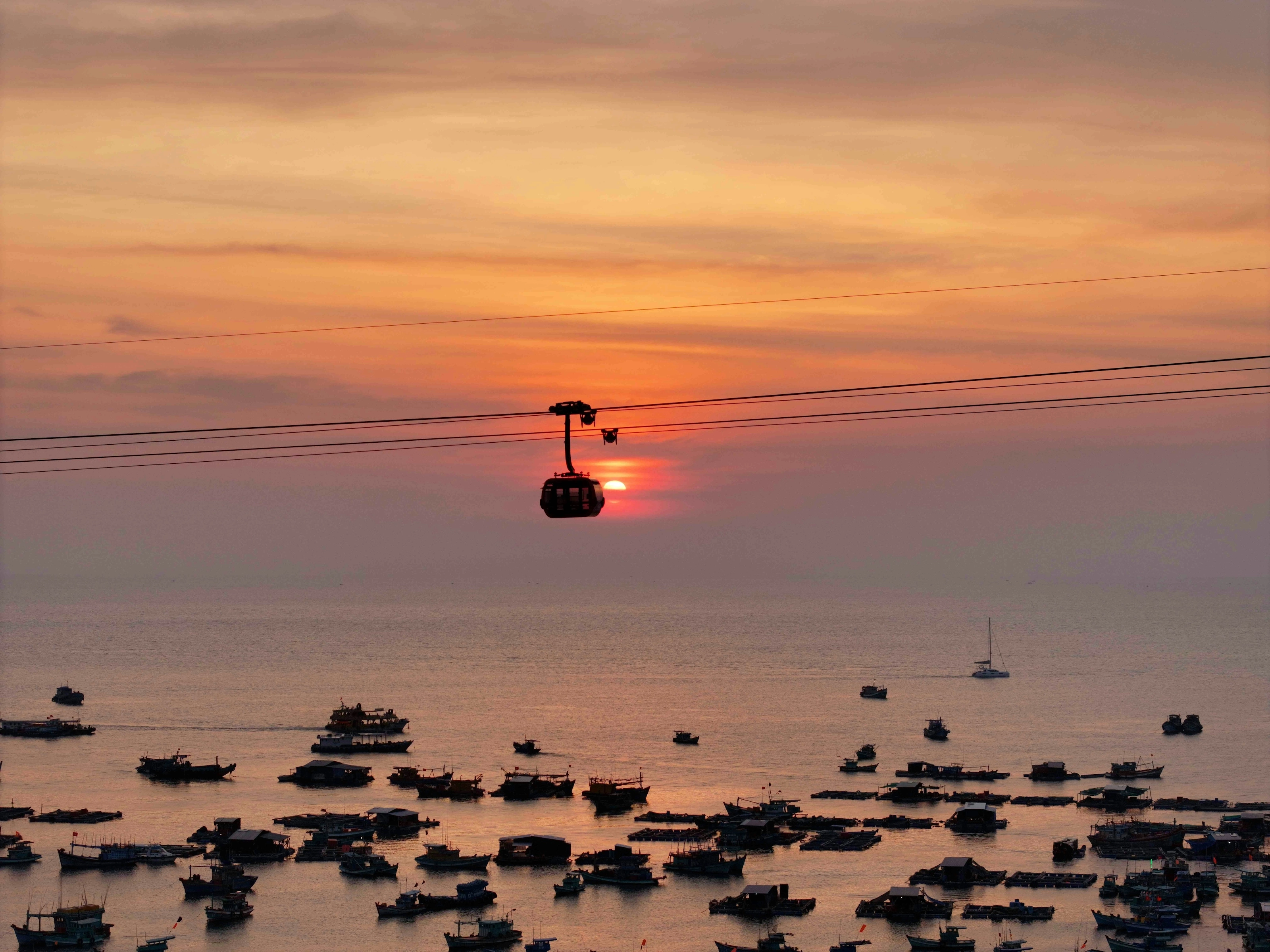
Ba Na Hills, about 40 km west of the city and 1,487 m above sea level according to Wikivoyage (EN), was a French hill resort in the 1920s. A cable car opened in 2009 goes up there and set two Guinness World Records according to the same source. A suspended footbridge held up by giant stone hands has become one of Vietnam's best-known images. Fog is frequent: set out early.
The Dragon Bridge
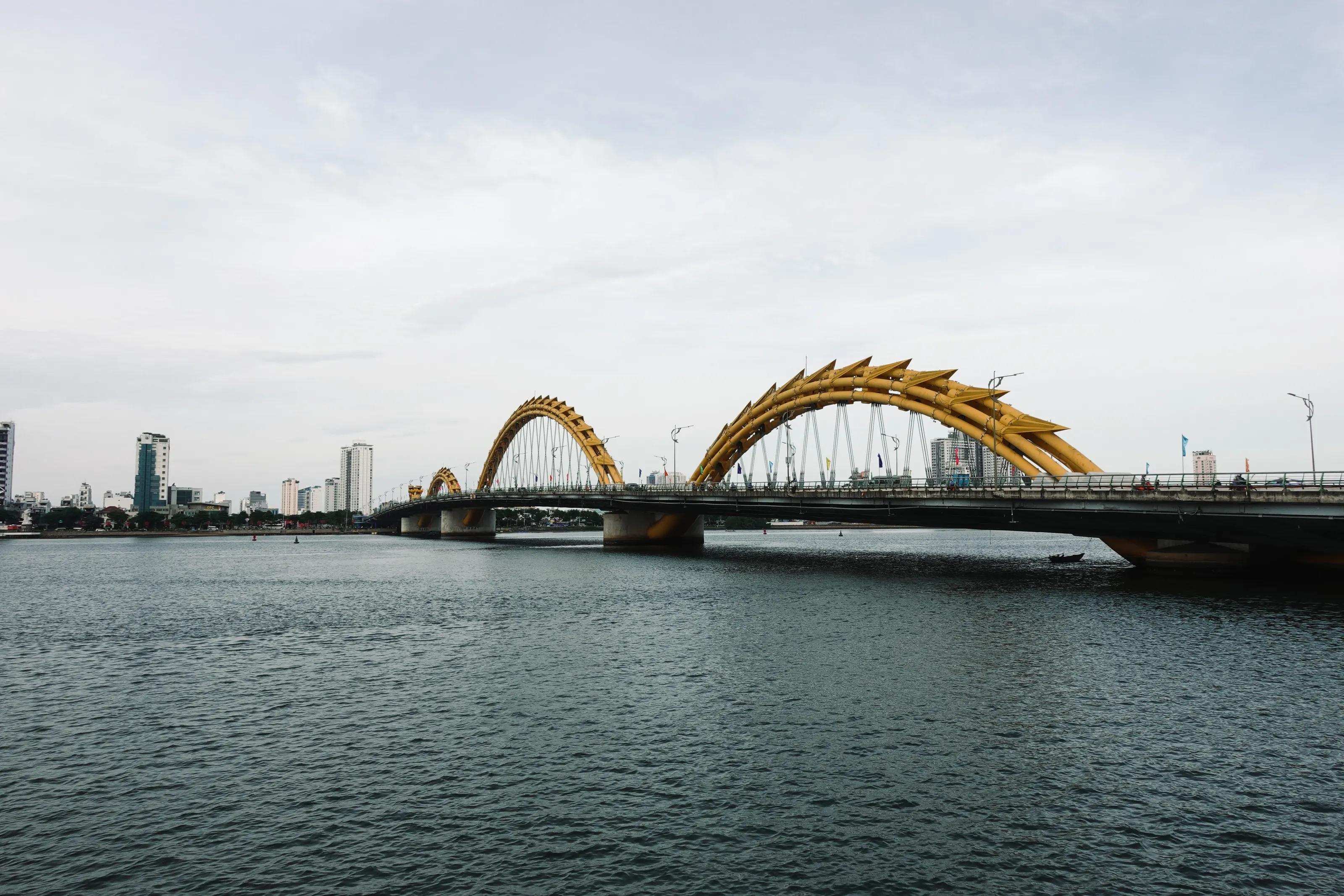
The Dragon Bridge crosses the Han River, one of the many bridges Wikivoyage (EN) mentions in the city. Its yellow dragon-shaped structure, with a dragon's head and a fish's body according to Wikipedia (FR), is the city's modern emblem. The Love Bridge, further north, is the other bridge often cited. In the evening the riverside becomes a place for a stroll.
The Marble Mountains
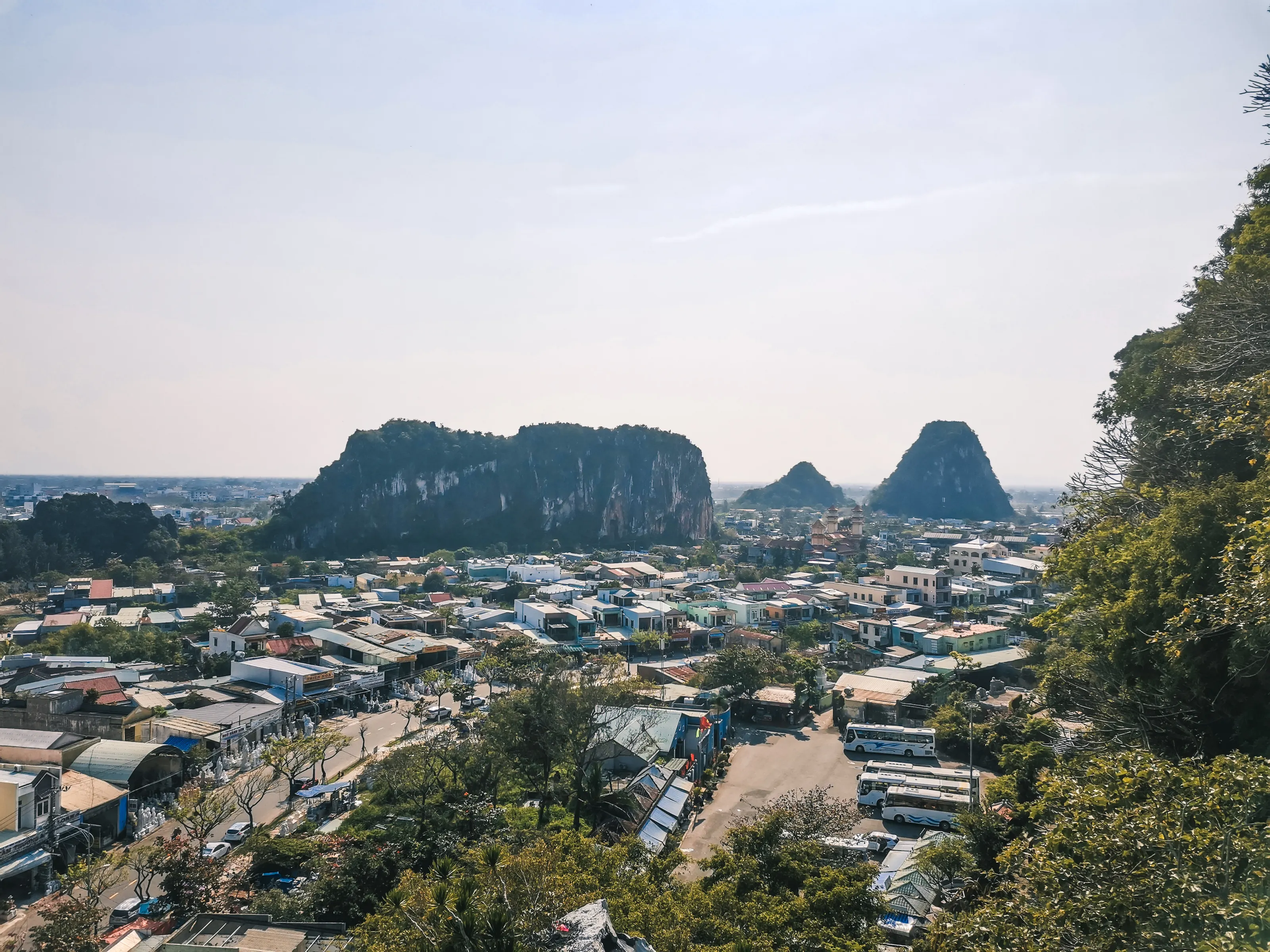
South of the city, on the road to Hoi An, five limestone peaks shelter Buddhist temples in their caves and are a popular pilgrimage site according to Wikivoyage (FR). The mountains also serve as a viewpoint over the coast. Around them, marble-carving workshops sell statues (Wikivoyage DE).
Pagodas and temples
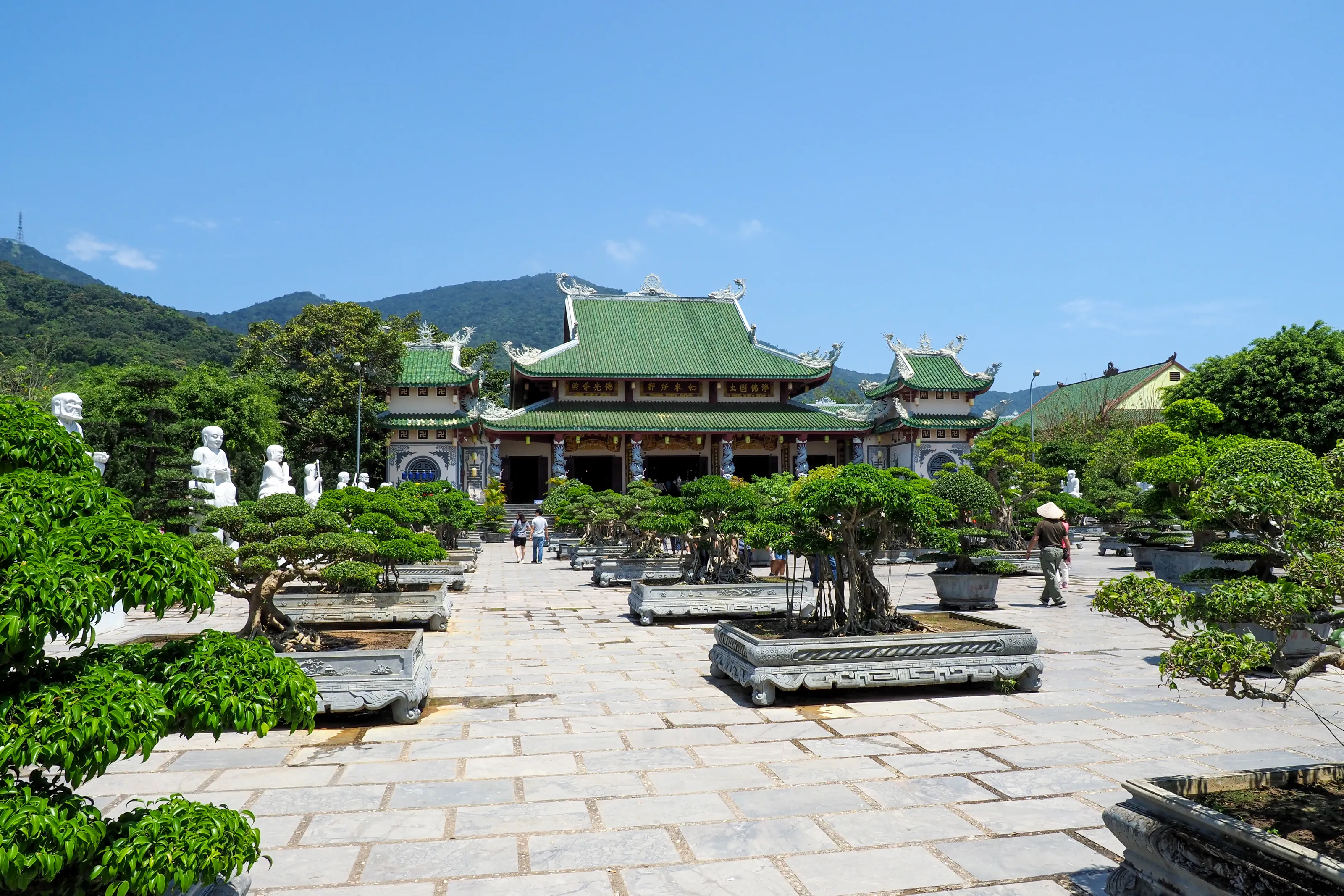
Among the pagodas of the Son Tra Peninsula, Linh Ung Pagoda is the largest in Da Nang according to Wikipedia (FR); a 67 m Bodhisattva statue stands there per Wikivoyage (DE). The paved courtyards, bonsai trees and glazed roofs of many pagodas make a calm setting a few minutes from the beach.
The beach and the fishermen
My Khe Beach, nicknamed China Beach, runs along the city's east side and continues nearly 40 km south to Hoi An according to Wikivoyage (EN). Wikivoyage (DE) calls it a surfers' paradise with clean sand and fairly empty by day; fishermen set out in small boats at sunrise. The coast is filling with high-rise hotels.

Son Tra, Hai Van and Hoi An
The Son Tra Peninsula, nicknamed Monkey Mountain, is largely a nature reserve and home to red-shanked douc langurs according to Wikivoyage (EN). The Hai Van Pass road between Da Nang and Hue is one of the region's great motorbike rides and marks a weather divide between north and south according to Wikipedia (DE). Hoi An and the My Son sanctuary are classic excursions from the city.
Museums and culture
The Museum of Cham Sculpture, a window onto a civilisation
The Museum of Cham Sculpture
Founded in 1915 by Henri Parmentier, the Museum of Cham Sculpture houses the world's largest collection of Cham civilisation antiquities, according to Wikipedia (FR). Wikivoyage (EN) calls it mandatory before visiting the My Son ruins. It stands in the city centre and takes an hour or two.
Military and colonial history
Da Nang was the first point of French colonial invasion and the place where US combat troops first landed during the Vietnam War, according to Wikivoyage (EN); helicopter hangars remain on the road to My Khe and are easier to see at the airport.
Culture and markets
Han Market, near the river, and the night market offer local products and small meals. We do not quote prices, since they change, and opening hours vary by season.
Food and drink
Seafood, mi Quang and spicy central cooking
Seafood and mi Quang
Da Nang is not a culinary capital like Hue, but it has plenty of variety according to Wikivoyage (EN). Seafood (hai san) is very popular: fish, shrimp, squid, clams and snails. The signature regional dish is mi Quang, Quang Nam-style noodles in a turmeric broth with chicken, shrimp, quail eggs, peanuts and rice crackers.
Other specialities
Bun cha ca (vermicelli with fish cakes) and bun mam (vermicelli with a strong fish sauce) are among the local dishes; central Vietnamese love spicy food and even small chillies can be strong. Wikivoyage (EN) also notes many vegetarian restaurants, mostly vegan, called quan chay.
Markets and the seafront
The night market by the river lets you eat and drink cheaply according to Wikivoyage (FR). Seafood restaurants line the beach; airport meals are pricey according to Wikivoyage (EN).
Getting around
Wide roads and light traffic: taxi, bus or two-wheeler
Taxis and apps
Taxis wait outside the airport and ride-hailing apps have a dedicated pickup point. The city has wide roads and fairly light traffic compared with Hanoi or Ho Chi Minh City, according to Wikivoyage (EN). Always agree the price or check the meter.
Buses, trains and regional trips
Buses 6 and 10 link the airport to the centre and My Khe beach. The railway station is served by the Hanoi-Saigon train, which takes about 2.5 hours to Hue according to Wikivoyage (EN). Shuttles and taxis reach Hoi An in about 45 minutes.
Two-wheelers and excursions
The Hai Van Pass and the Son Tra Peninsula are two classic motorbike rides. Rent a two-wheeler only if you are comfortable with local driving and covered by your insurance; otherwise take a driver.
Budget and precautions
A booming beach destination, with prices to check
Price level
Da Nang is a modern beach destination where high-rise hotels have replaced old backpacker lodges according to Wikivoyage (EN). We do not quote figures, as we could not cross-check them on two independent open sources; prices vary by season and proximity to the beach.
Busy periods
Vietnamese visitors also come to the city, and during holidays it fills up according to Wikivoyage (EN). Book ahead of festivals and public holidays.
Flights and precautions
SniperAir monitors prices to DAD and compares them with the route's history, but it does not sell or book tickets. Check entry requirements for Vietnam for your nationality with the official authorities. On the beach, respect swimming flags and instructions, particularly in typhoon season.
When to go
Dry season from January to August, typhoons from September to December
Dry season (January to April)
Generally drier and milder weather before the summer heat. A good period for the beach and excursions, based on the two-season split given by Wikipedia (EN).
Summer (May to August)
The hottest months are June to August, with up to 40 degrees C and plenty of humidity according to Wikivoyage (EN, ES). Beaches are very busy during the holidays.
Autumn (September to November)
The start of the typhoon and wet season, which runs from September to December according to Wikipedia (EN); tropical storms are common from October to November.
Winter (December)
The wet season ends; cold spells can occur per Wikipedia (EN). The sea is less calm and swimming is less safe.
Da Nang has a tropical monsoon climate with two seasons: typhoons and rain from September to December and a dry season from January to August, with an annual average temperature of about 26 degrees C according to Wikipedia (EN). We do not give monthly averages because sources differ.
By length of stay
What to do in Da Nang depending on how long you stay
The city and the beach
My Khe beach, the Dragon Bridge, the Museum of Cham Sculpture, Han Market and a seafood meal.
Mountains and pagodas
The Marble Mountains, the Son Tra Peninsula and Linh Ung Pagoda, Ba Na Hills and an evening by the river.
Hoi An, Hue and My Son
Excursions to Hoi An, the My Son sanctuary and Hue via the Hai Van Pass, with Da Nang as a base.
In pictures
Da Nang in pictures
You might also like
Similar destinations

FAQ
Frequently asked questions about flights to Da Nang
How do I get from Da Nang airport to the centre?
The airport (DAD) is 3 km southwest of the centre, a 10-minute trip at most. Buses 6 and 10 link the centre and the beach, and taxis or ride-hailing apps are another option. Check timetables before you travel.
When is the best time to visit Da Nang?
From January to August, in the dry season, avoiding the June to August heat peak if possible. Typhoons and rain are more frequent from September to December.
Is Da Nang expensive?
It is a modern beach destination where prices vary with the season. We do not quote figures because we could not cross-check them on two independent sources.
How long should I stay in Da Nang?
Two days for the city and the beach; three to four days with the mountains and pagodas; more for Hoi An, My Son and Hue.
What is there to see near Da Nang?
Hoi An is about 45 minutes away by shuttle, the My Son sanctuary and Hue are possible excursions, and Ba Na Hills are about 40 km to the west.
What should I eat in Da Nang?
Seafood, mi Quang, bun cha ca and bun mam; vegetarian restaurants (quan chay) are also widespread.
How much does a flight to Da Nang usually cost?
The price depends mainly on your departure city, the time of year and how far ahead you book. The "opportunities" section above shows real examples of prices SniperAir has already detected to this destination.
How do I get alerted when a flight to Da Nang drops below my budget?
Create an alert profile with your departure airport, Da Nang as the destination and your maximum budget. You are notified automatically as soon as a matching price is detected.
Ready to head to Da Nang?
Set your budget and let SniperAir monitor fares for you.
Create my alert