
Cheap flights to Vientiane
Set your departure airport and maximum budget: SniperAir tracks prices to Vientiane and alerts you the moment a deal matching your criteria appears.
Quick summary
Country
Laos
Continent
Asia
Airport
VTE
Currency
Lao kip (LAK)
Time zone
UTC+7
Deals already spotted to Vientiane
Real flight examples detected by SniperAir, with their reference price.
Loading examples…
Why watch Vientiane with SniperAir
A calm, golden Mekong capital, worth catching at the right moment
Choose your departure
Enter your departure airport and your maximum budget for a flight to Vientiane (VTE).
SniperAir watches
Our systems continuously compare new prices with the route's real price history. SniperAir monitors prices and alerts you; it does not sell or book tickets.
You get an alert
As soon as a price matches your criteria, you are notified without having searched anything yourself.
Vientiane is the capital and largest city of Laos, on the banks of the Mekong close to the Thai border. It had 840,000 inhabitants at the 2023 census according to Wikipedia (EN, FR). Wikivoyage (EN) describes a once sleepy, charming city that has changed with a population boom, yet still has plenty of gold-encrusted temples, a cosmopolitan dining scene and a pleasant riverside promenade.
Genuinely old monuments are few, since the city was sacked several times in Burmese and Siamese wars, so people come for the temples, a walk by the river at sunset and as a gateway to the rest of the country. A flight is the most variable cost of a trip to Laos. Prices change with the season and the departure city: a SniperAir alert lets you spot a good fare to Vientiane (VTE) without checking prices every day.
Airport and getting into town
An airport close to the centre, with a limited network
Vientiane Wattay International Airport (VTE)
Wattay is the capital's international airport, about 3 km west of the city according to Wikivoyage (EN) and 4 km in Wikivoyage (DE), so it is very close to downtown. It was last expanded in 2020, and international and domestic flights use different wings of the same terminal (Wikivoyage, EN). As of early 2025 there were direct flights from 15 Chinese cities and from Hong Kong, Kuala Lumpur, Singapore, Yangon, Seoul, Busan, Bangkok, Phnom Penh, Da Nang, Ho Chi Minh City and Hanoi, per the same source; routes change, so check before booking.
Approximate distances from Wikivoyage (EN, DE); routes change. We do not quote transfer fares because sources disagree.
From the terminal, a shuttle, a taxi or a tuk-tuk will do, and many hotels offer a pick-up. Wikivoyage (EN) warns that touts at arrivals ask inflated fares for a ride into town: always agree the price before you get in, or use a ride-hailing app.
Travellers coming from Thailand often fly to Udon Thani on the Thai side and cross the Friendship Bridge at Nong Khai. By rail, a fast line links Kunming and Vientiane, but its station is about 15 km from downtown; another station, opened in July 2024 closer in, serves trains from Thailand (Wikivoyage, EN). Domestic flights also connect to Luang Prabang and Pakse.
Landmarks and icons
Pha That Luang, Patuxai and Wat Si Saket
Officially founded in 1560 when King Setthathirath moved the capital of Lan Xang there (Wikipedia, FR), Vientiane keeps mostly religious monuments, restored after Siam sacked the city in 1827. These are the places pictured below.
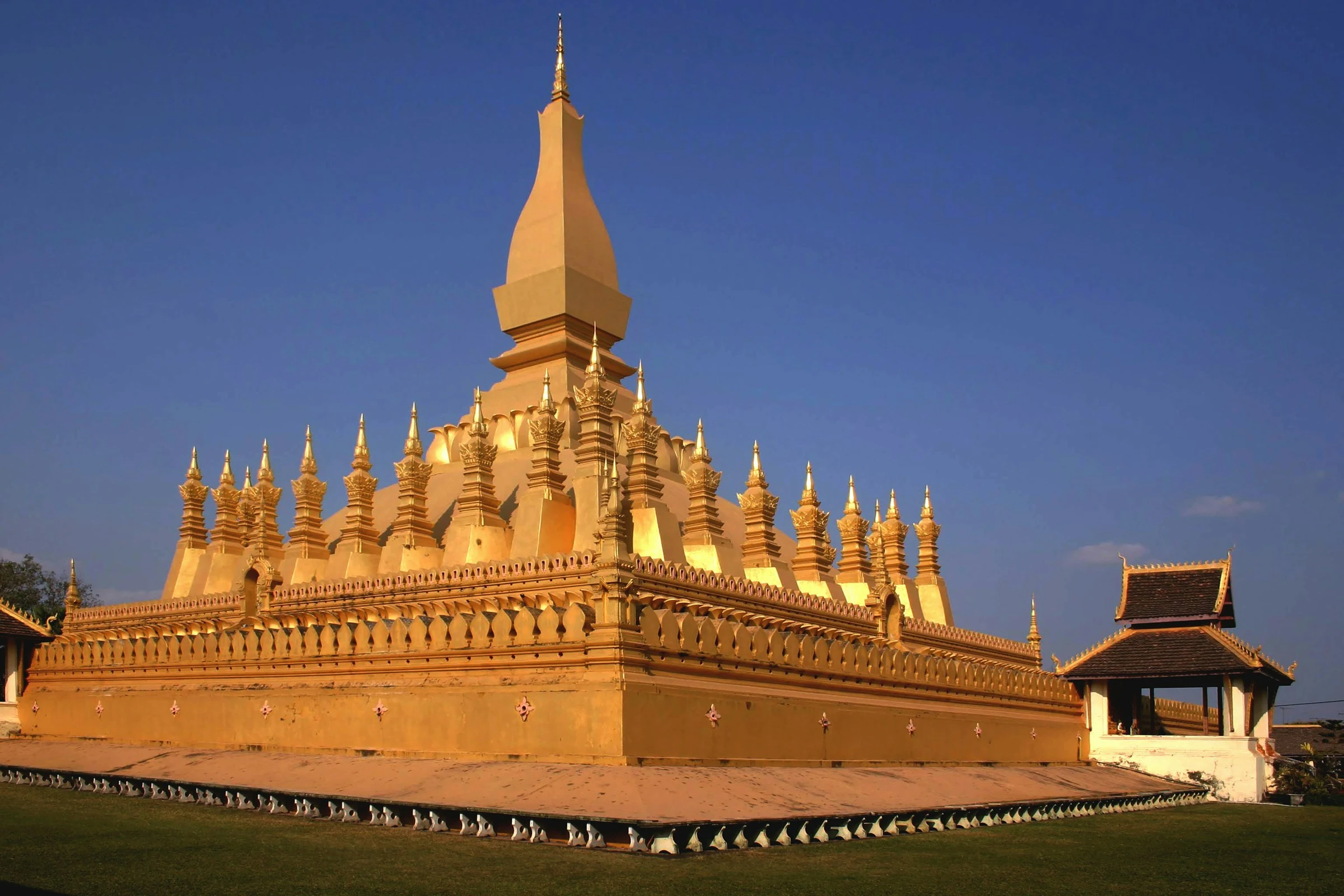
Pha That Luang
This large gilded stupa is the national monument of Laos and the country's most important religious site (Wikivoyage, EN). The present version dates from 1566 according to the same source, although it was ransacked and renovated many times; French restorations took place in 1900 and 1931 (Wikipedia, FR). It lies about 4 km from the centre, in line with the Patuxai avenue, and hosts a big festival each November.
Patuxai
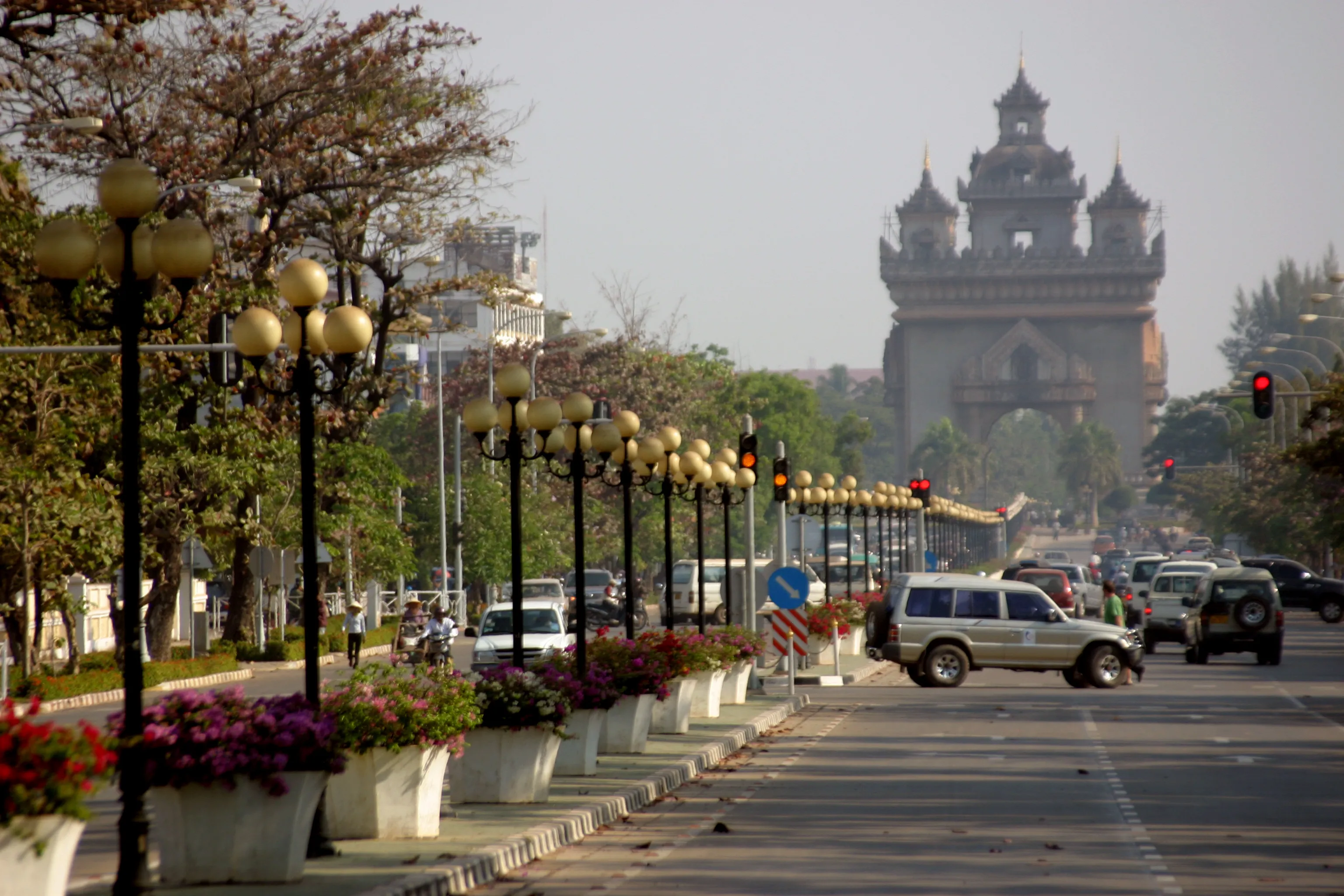
Wikivoyage (EN) calls this Victory Gate a local take on the Arc de Triomphe: it has four gates instead of two and is slightly taller. It honours the victims of Laos's wars; construction began in 1958 and finished in 1962 using cement meant for an airport, hence the nickname of the vertical runway (Wikipedia, FR). You can climb to the top for a view, and opening hours differ between sources.
Lane Xang Avenue
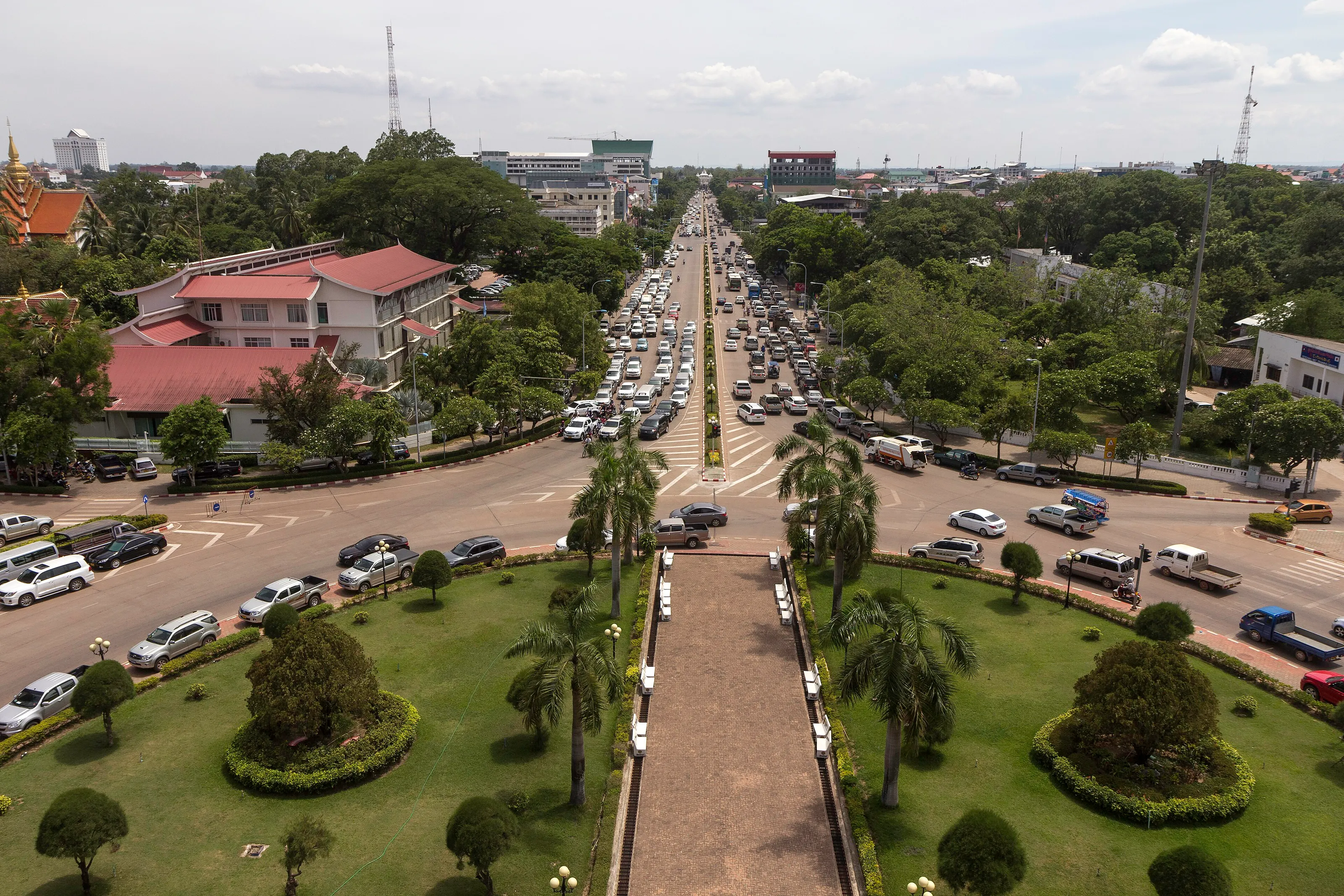
The wide avenue linking the Patuxai to the centre is nicknamed the Champs-Élysées of Vientiane (Wikipedia, FR). From above it shows how airy the capital is, with large trees, lawns and few tall buildings. Wikipedia (FR) notes that no skyscraper was planned, and the tallest building in 2010 had about fifteen floors.
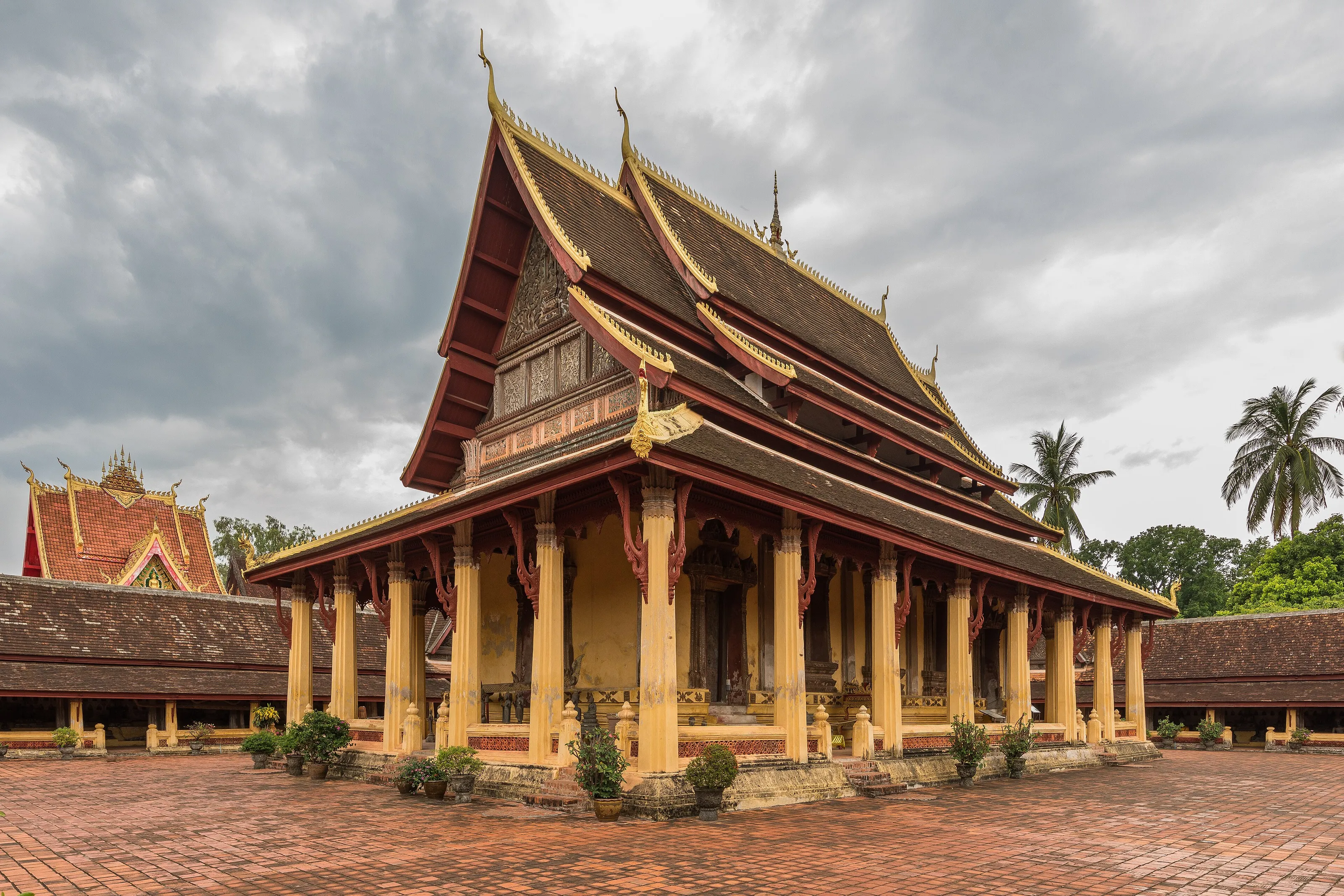
Wat Si Saket
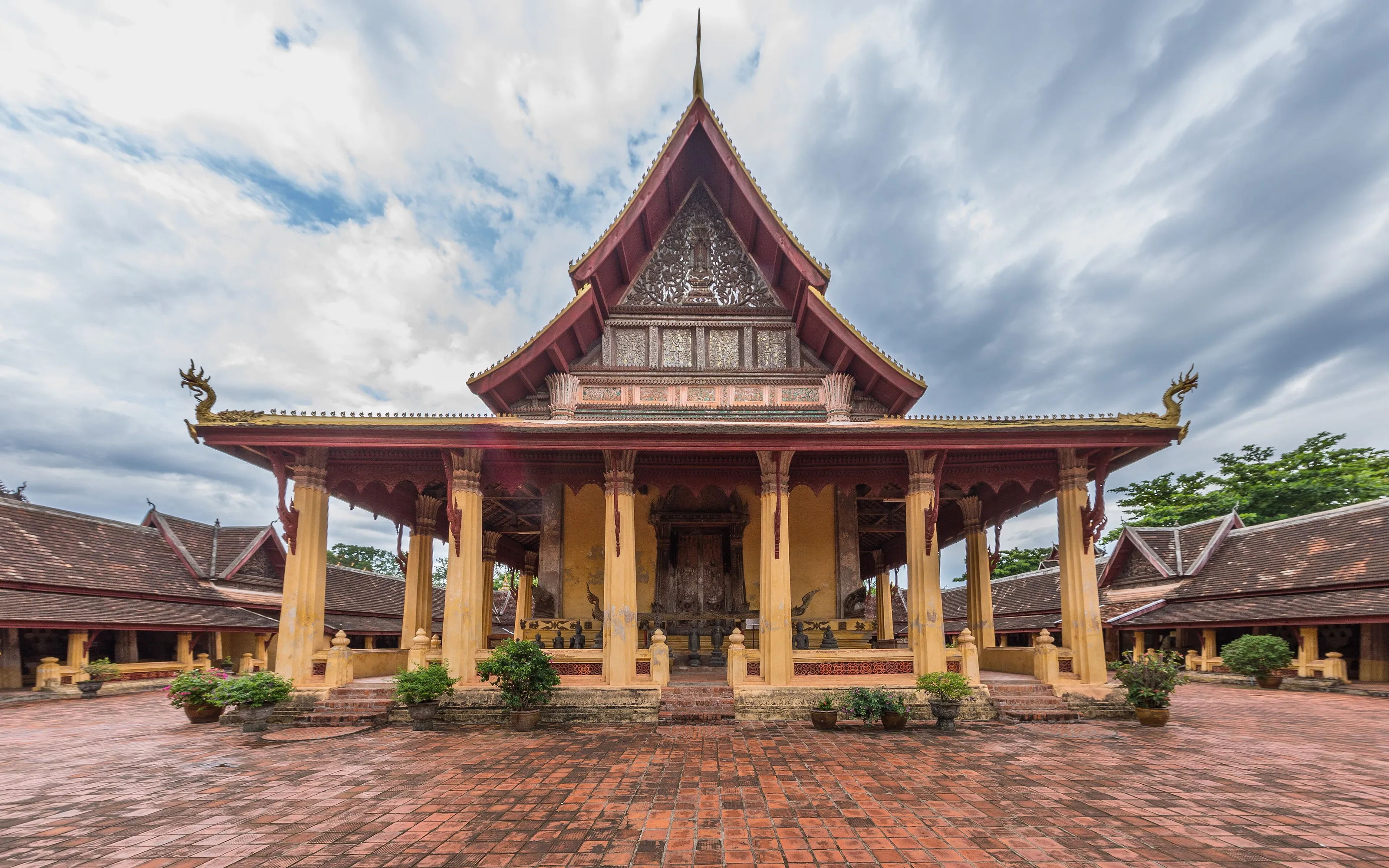
Built in 1818, it was the only temple spared when Siam sacked the city in 1827 (Wikipedia, FR). It has a Burmese-style library and a cloister that holds about 10,000 Buddha images, per the same source. It stands in the historic centre on Setthathirat Road, opposite Haw Pha Kaew.
Other shrines include Wat Si Muang, the most venerated in the city, Haw Pha Kaew, now a museum, and the Sacred Heart cathedral of 1928 (Wikipedia, FR). The Buddha Park (Xieng Khuan), a collection of concrete statues by the Mekong, is about 20 km out.
Museums and culture
A national museum, war memory and temple museums
Museums
Wikipedia (FR) lists the National Museum of Laos, devoted to the country's history, and the Kaysone Phomvihane Museum, dedicated to the second president. Haw Pha Kaew, a former temple turned museum, mainly shows Buddhist objects. Wikivoyage (EN) adds a textile museum in a semi-open setting and the COPE Visitor Centre. We do not quote fees.
COPE and the memory of war
The COPE Visitor Centre explains the legacy of unexploded ordnance in Laos and the work of a rehabilitation centre for amputees, with exhibits and short films (Wikivoyage, EN, FR). It is informative and sobering.
Festivals and crafts
The annual That Luang festival gathers worshippers in November. For crafts, Wikivoyage (FR) lists traditional textiles, silk, silver and basketry, especially at the Talat Sao morning market.
Food and drink
Mekong fish, Beerlao and food from around the world
Lao cooking
Wikivoyage (FR) mentions tom yam, pho, spring rolls and a rich street-food scene. Say if you want food spicy, and ask for no MSG if you have an allergy.
By the river
At nightfall, locals and visitors eat grills, especially Mekong fish, with a Beerlao, the national beer, watching the sun set over the river (Wikivoyage, FR). Wikivoyage (EN) describes a remarkably cosmopolitan dining scene and a riverside promenade.
Markets and world cuisine
Talat Sao, the morning market, is a large bazaar built with Vietnamese help in the 1970s (Wikipedia, FR). The city also has good French, Italian, Indian and Thai restaurants per Wikivoyage (FR), a legacy of colonial times and capital status.
Getting around
Bikes, tuk-tuks and cheap buses
On foot and by bike
The centre can be covered on foot, especially in the cool season, but Wikivoyage (EN) notes few footpaths outside it, and Pha That Luang is about 4 km away. Bicycles and scooters are easy to rent, with traffic still tolerable according to Wikivoyage (FR).
Tuk-tuks and jumbos
Tuk-tuks are everywhere, along with larger jumbos. Agree the fare before riding; foreigners seldom get local prices (Wikivoyage, EN). A few ride-hailing apps also work in the centre.
Buses and excursions
Buses link the central station to the Friendship Bridge and to the Buddha Park (Wikivoyage, EN, FR). The buses are old, with little English signage. For excursions, a driver for the day is another option.
Budget and precautions
Modest price levels, with figures to check
Price level
Vientiane remains an affordable capital for a European traveller, with many guest houses and cheap street food per Wikivoyage (FR, DE). We give no ranges or fares because we could not cross-check them on two current independent sources: the pages consulted quote kip amounts that are several years old. The currency is the kip (LAK).
Flights
Flights are the most variable item. SniperAir monitors prices to VTE and compares them with the route's history, but it does not sell or book tickets. Bangkok, Hanoi or Phnom Penh can complete your watch if you combine several stops.
Entry rules and precautions
Entry rules for Laos depend on your nationality, notably for visas: check official sites and your own government's travel advice. Wikivoyage (ES) mentions illegal drugs being offered to tourists and a dengue risk in the rainy season, so use mosquito repellent.
Best time to go
Dry from November to April, rains from May to October
November to February
The most pleasant dry season, with the coolest days; Wikivoyage (DE) suggests October or November to February for walking in town.
March to May
The hot season: Wikivoyage (EN) mentions up to 40 C, with humidity that makes it feel heavier.
May to October
The wet season, around 30 C, with frequent tropical downpours, especially in July and August (Wikivoyage, EN).
November
The That Luang festival, a major moment of devotion, takes place this month per Wikipedia (FR) and Wikivoyage (FR).
The climate is tropical savanna, with temperatures generally from 17 to 35 C according to Wikipedia (FR). Sources disagree on how long the dry season lasts (November to April or to March), so we do not publish more precise figures. Check the forecast before you go.
By length of stay
What to do in Vientiane by length of stay
The essentials
Pha That Luang, the Patuxai, Wat Si Saket, the morning market and a sunset over the Mekong.
Museums and surroundings
COPE, a museum, the Buddha Park and an evening on the riverbank.
Further afield
An excursion outside the city, or a departure to Luang Prabang or the south of the country.
In pictures
Vientiane in pictures
You might also like
Similar destinations

FAQ
Frequently asked questions about flights to Vientiane
Where is Vientiane airport (VTE)?
Wattay Airport is about 3 to 4 km west of the centre, depending on the source. A shuttle, taxi, tuk-tuk or hotel transfer takes you into town; agree the fare in advance.
When is the best time to visit Vientiane?
From November to February, the dry and coolest season. March to May is very hot, and rain falls mostly from May to October.
What is there to see in Vientiane?
Pha That Luang, the Patuxai, Wat Si Saket, the morning market, the COPE Visitor Centre and a walk along the Mekong.
Is Vientiane expensive?
It remains affordable for a European traveller, but we give no amounts because we could not cross-check them. Flights are the cost you can optimise with a price alert.
How long should I stay in Vientiane?
Two days cover the main sights; add a day for COPE, the museums or the Buddha Park.
How much does a flight to Vientiane usually cost?
The price depends mainly on your departure city, the season and how far ahead you book. The opportunities section above shows real examples of prices SniperAir has already detected for this destination.
How can I be alerted when a flight to Vientiane drops below my budget?
Create an alert profile with your departure airport, Vientiane (VTE) as the destination and your maximum budget. You are notified automatically as soon as a matching price is detected. SniperAir monitors prices and alerts you; it does not sell or book tickets.
Ready to head to Vientiane?
Set your budget and let SniperAir monitor fares for you.
Create my alert