
Cheap flights to Brno
Set your departure airport and maximum budget: SniperAir tracks prices to Brno and alerts you the moment a deal matching your criteria appears.
Quick summary
Country
Czech Republic
Continent
Europe
Airport
BRQ
Currency
Czech koruna (CZK)
Time zone
UTC+1 (UTC+2 during summer time)
Deals already spotted to Brno
Real flight examples detected by SniperAir, with their reference price.
Loading examples…
Why track Brno with SniperAir
You do not need to compare prices every day
Choose your departure
Enter your departure airport and your maximum budget for a flight to Brno (BRQ).
SniperAir keeps watch
Our systems continuously compare new prices with the real price history of the route. SniperAir monitors prices and alerts you: it does not sell or book tickets.
You receive an alert
As soon as a price matches your criteria, you are notified, without having searched for anything yourself.
Airport and getting into town
A small airport about 8 km away, linked to the centre by bus
Brno-Tuřany (BRQ)
Brno-Tuřany airport is about 8 km south-east of the centre. A city bus line reaches the station and the centre about every 30 minutes during the day, according to Wikivoyage (EN), in a little under half an hour; a night bus takes over. There is no direct train. A taxi takes roughly fifteen to twenty minutes outside rush hour. The airport has few routes: many travellers use Vienna (VIE, about 1 h 30 by bus or train), Prague (about 2 h 30 by train), Bratislava (about 1 h 30) or, for eastern Moravia, Ostrava.
Distances and times are approximate, based on Wikivoyage (EN) and Wikipedia; bus and train timetables change: check them before you travel. We give no fares.
Brno is the second-largest city in the Czech Republic, with about 400,000 inhabitants, and the historic centre of Moravia, of which it was the capital until 1948 according to Wikivoyage (EN). It is also the country's biggest student city relative to its population, which gives it a lively cultural and night life. The centre is compact and walkable; the main station is only a few minutes from it.
Old town and landmarks
Cathedral, fortress, modernist villa and medieval squares
Brno works on two levels: the medieval and Baroque town, with its squares and spires, and the modernist heritage of the early twentieth century. The places below are illustrated; the ossuary, the astronomical clock and the parks are described in text only.
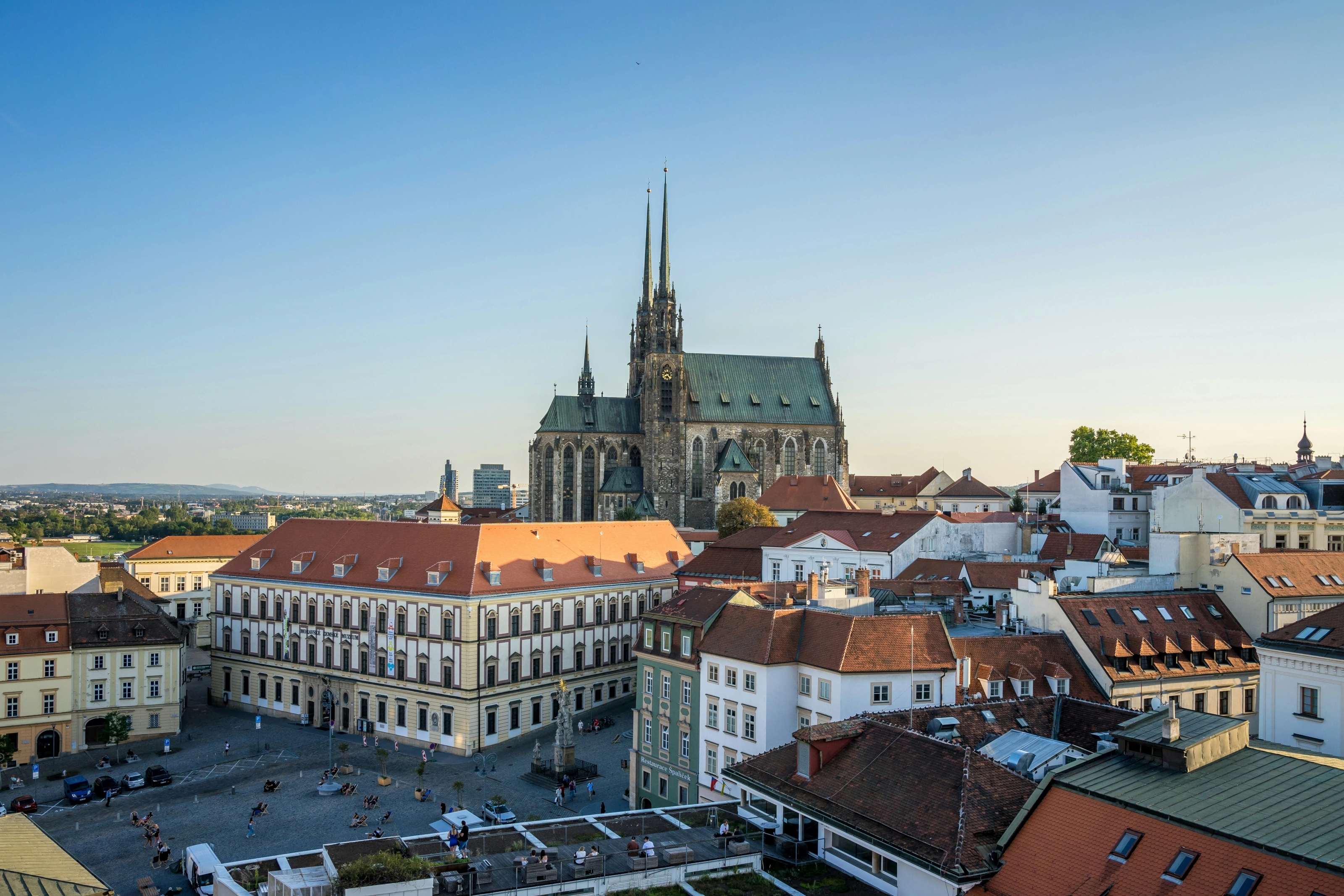
Saints Peter and Paul Cathedral
On Petrov hill, the Gothic cathedral with its two spires is one of the city's symbols. A local tradition has its bells ring noon at 11 o'clock, in memory of the Swedish siege of 1645. The hill also gives a view over the centre and the neighbouring gardens.
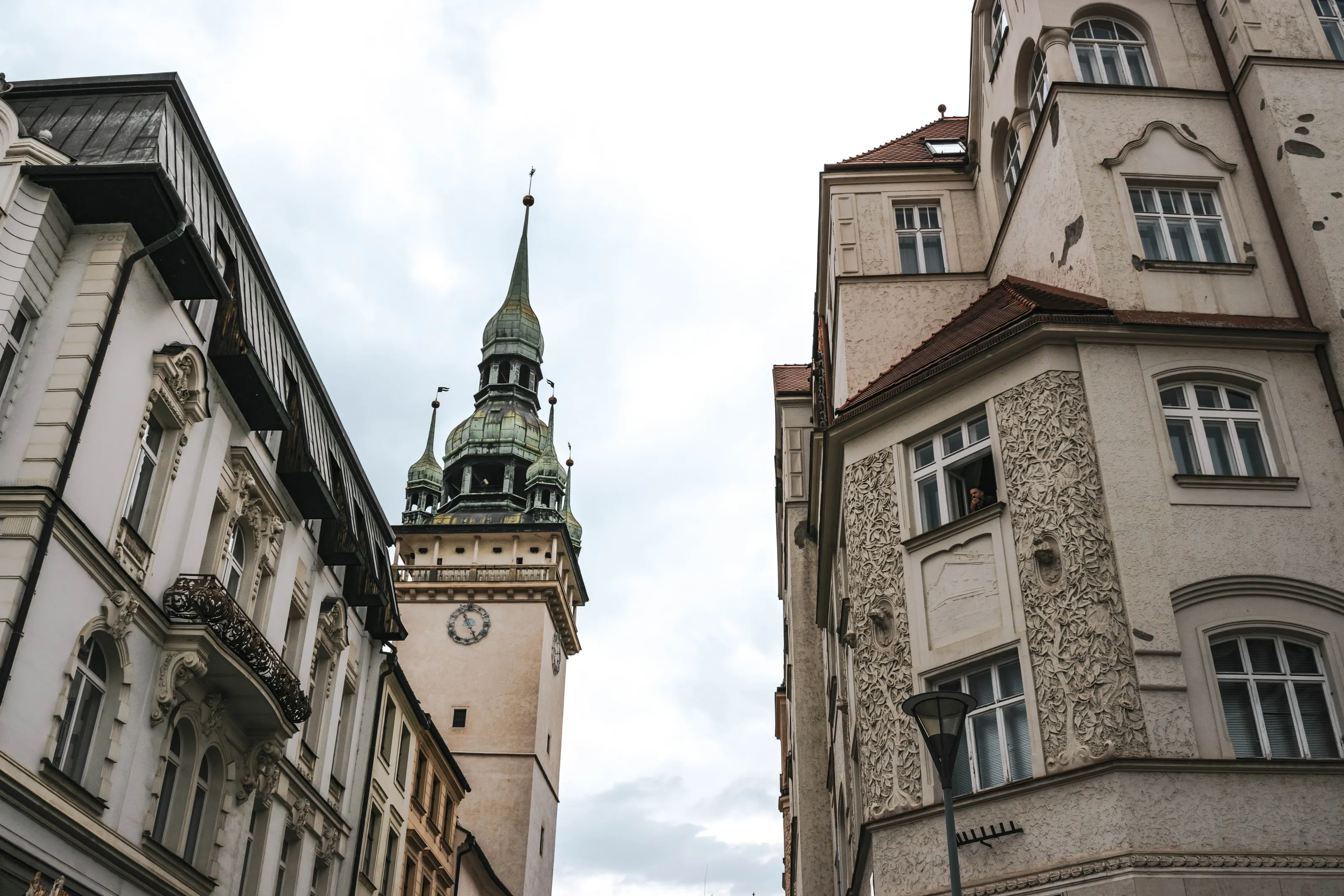
The Old Town Hall tower
On Radnická street, the green-spired tower is one of Brno's oldest civic monuments; you can climb it for a view of the old town. A stuffed crocodile, nicknamed the "Brno dragon", hangs in the entrance passage and is the subject of a local legend. The Old Town Hall also houses a tourist information point.
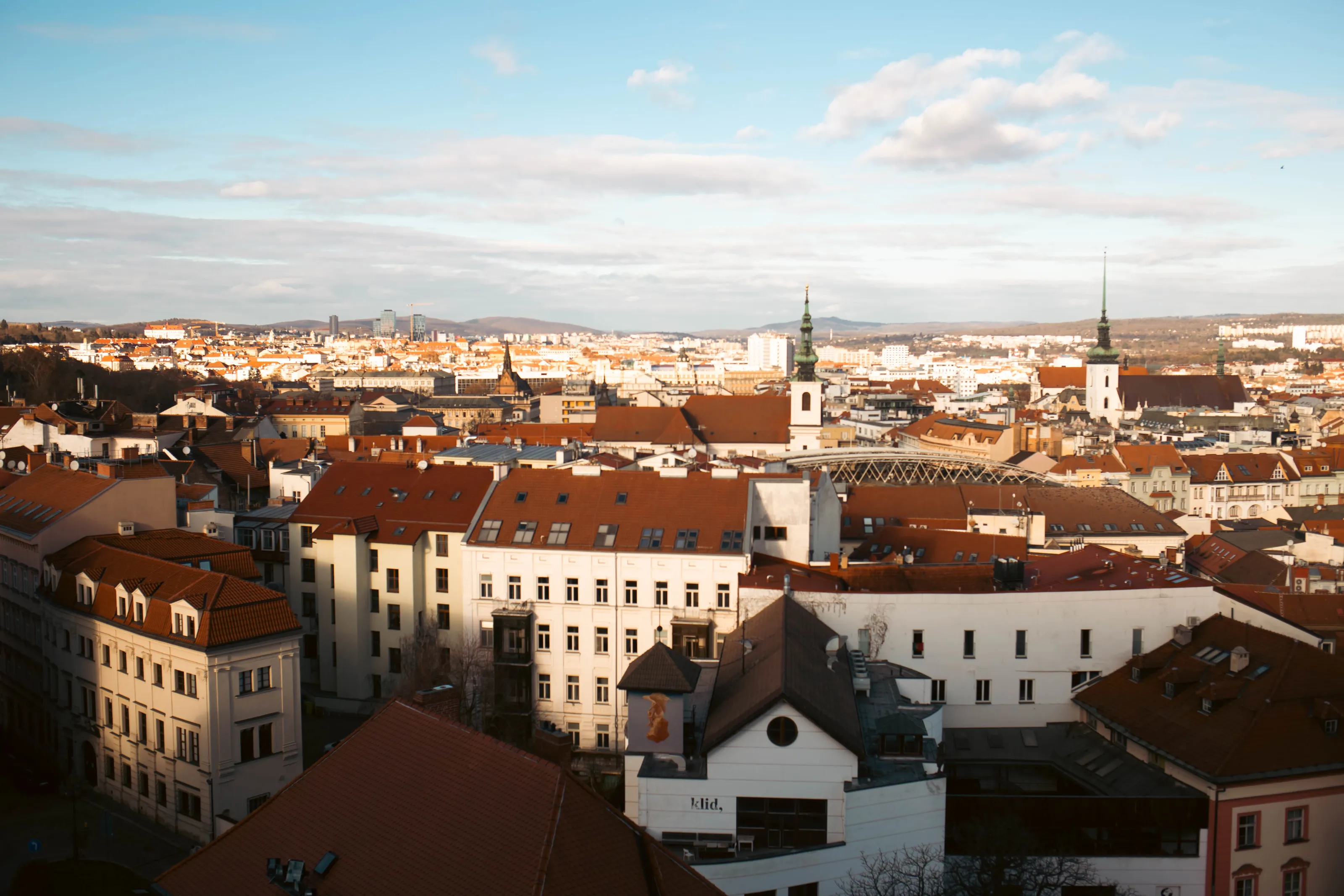
The old town rooftops
From the tower or the heights, the old town reads as a sea of red roofs, spires and small squares. Brno has one of the largest protected historic zones in the country after Prague and Olomouc, according to Wikivoyage (EN).
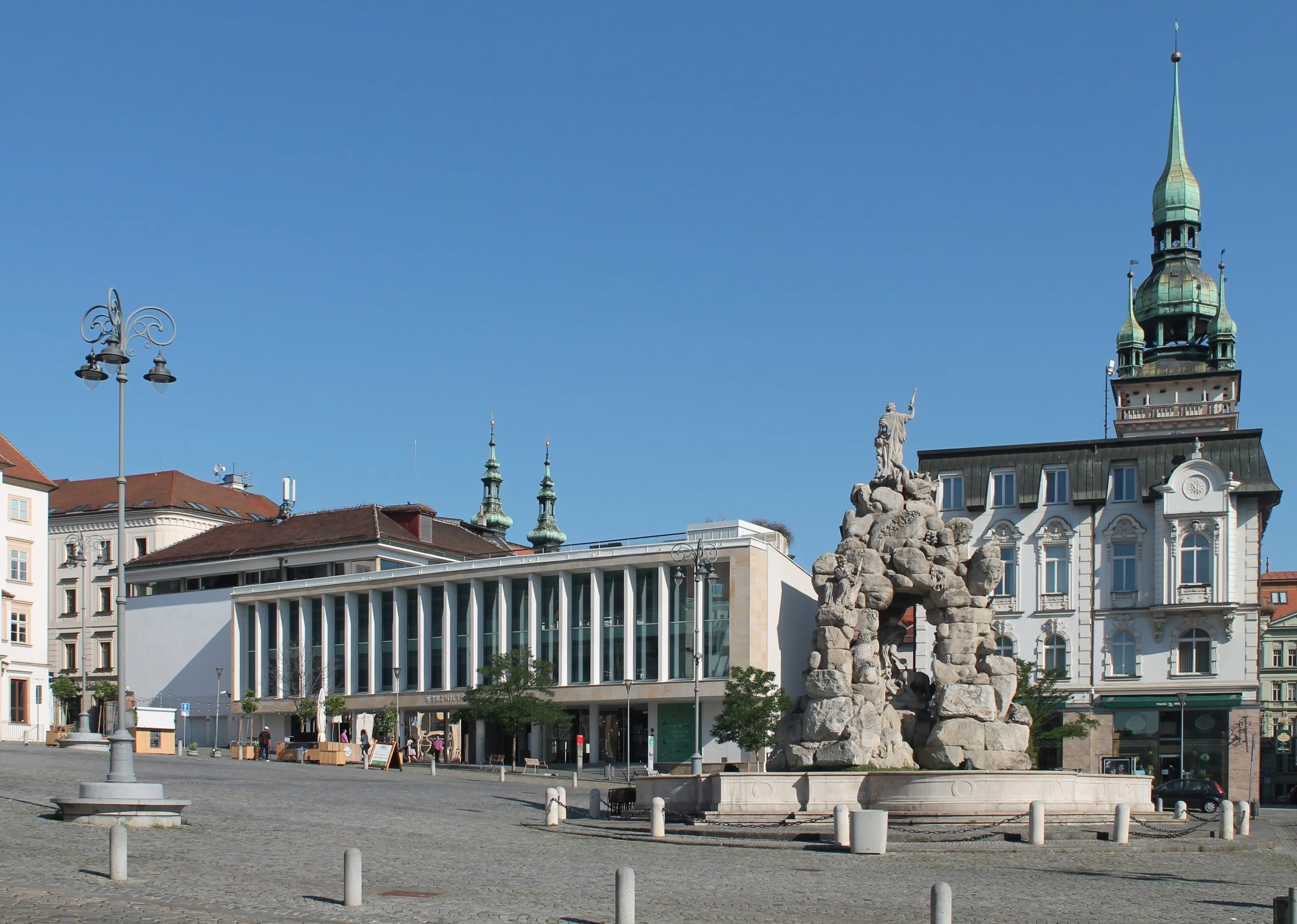
Zelný trh, the cabbage market
A central square since the Middle Ages, Zelný trh still hosts a fruit and vegetable market. The Baroque Parnas fountain stands in the middle; beneath the square lies a labyrinth of cellars open to visits. The neighbouring Dietrichstein Palace houses the Moravian Museum.
Špilberk Castle
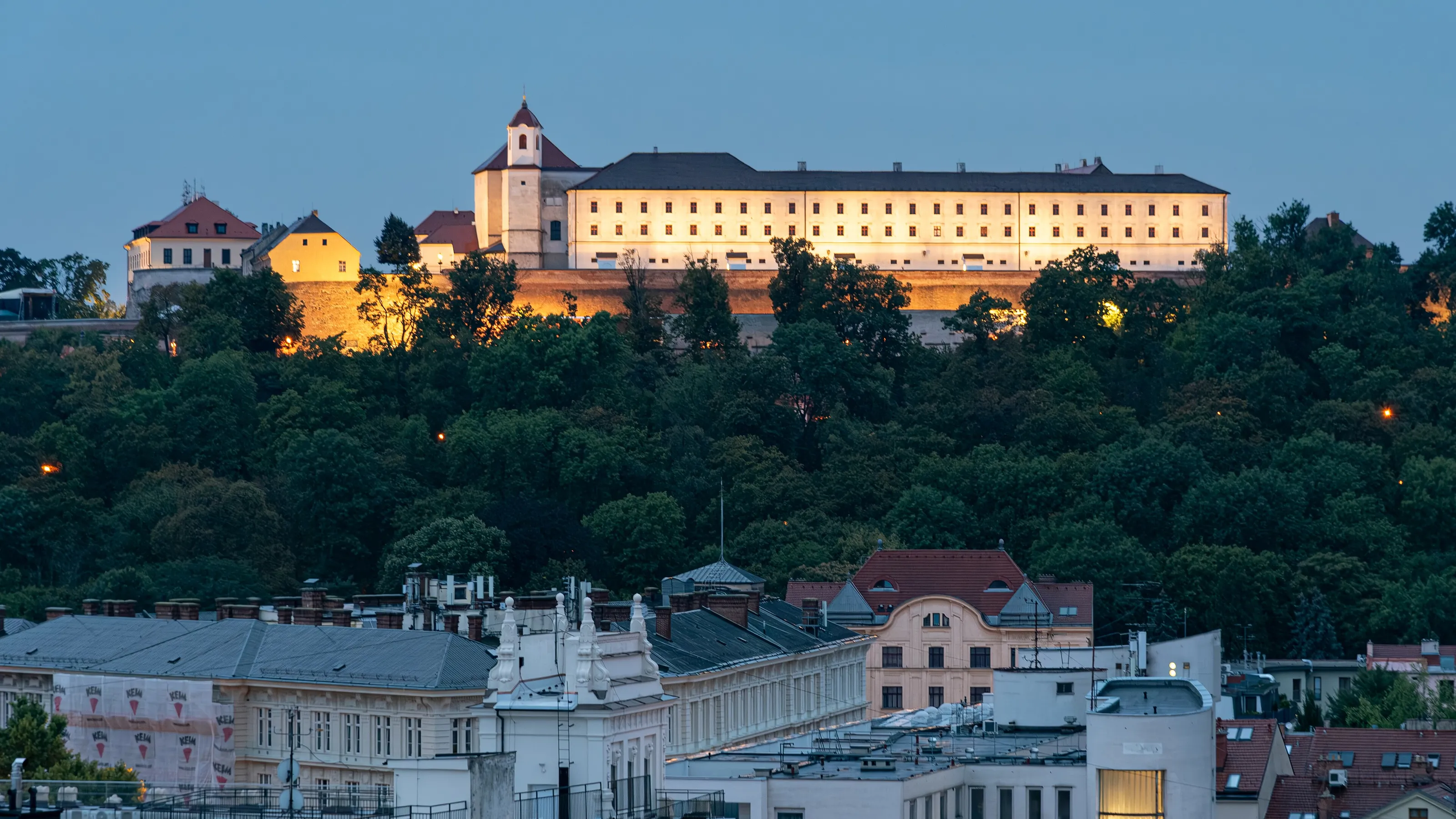
A former royal residence, Špilberk fortress became a feared prison under the Habsburgs and is now a city museum. It overlooks the centre from its wooded hill, and its gardens are a pleasant walk; at dusk it is floodlit.
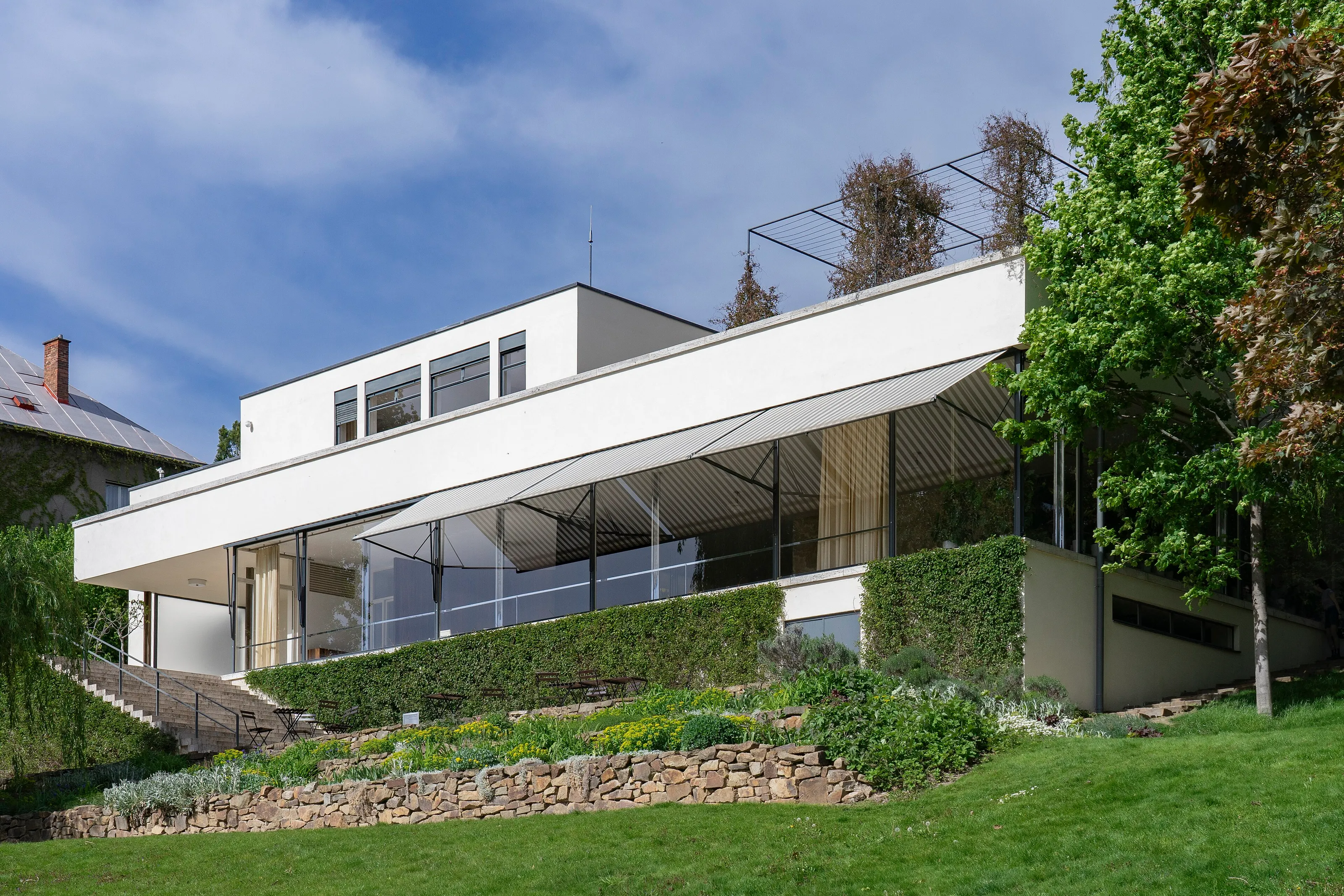
Villa Tugendhat
Designed by Ludwig Mies van der Rohe and built around 1930, Villa Tugendhat is a milestone of modern architecture. It has been a UNESCO World Heritage Site since 2001. Visits are guided and in high demand: check the conditions and times in advance.
Ossuary, clock and parks, in text
The ossuary beneath St James's Church is said to be the second largest in Europe after the Paris catacombs, according to Wikivoyage (EN). The astronomical clock on Freedom Square (náměstí Svobody), of unusual shape, is known for releasing a glass ball at 11 am. Lužánky park, regarded as the oldest public park in the country according to Wikivoyage (EN), and the Denis Gardens are green pauses a short walk from the centre.
Museums and culture
Moravia, art, technology and theatre
The Moravian Museum
The biggest museum in Moravia and the second biggest in the country according to Wikivoyage (EN), it is housed in the Dietrichstein Palace on Zelný trh. It covers the region's history, archaeology and natural sciences.
The Moravian Gallery and the Technical Museum
The Moravian Gallery brings together old, modern and contemporary art. The Technical Museum in Brno devotes its halls to machines, industry and transport; check its opening hours before you come.
Mendel, theatre and music
The monk Gregor Mendel, founder of genetics, worked in the Augustinian abbey in Old Brno, where a museum is dedicated to him. Brno is also a theatre city: the Reduta Theatre is regarded as the oldest theatre building in Central Europe, and the Mahen Theatre was the first in Europe lit by Edison's light bulbs, according to Wikivoyage (EN). The composer Leoš Janáček lived and worked here. We give no ticket prices.
Food and drink
Svíčková, Moravian wine and beer
The dishes
Czech cooking is hearty. Svíčková (marinated beef in a creamy vegetable sauce, served with knedlíky, bread dumplings) is a classic; you will also find roast duck, cabbage and meat in sauce. Koláče, small Moravian pastries, are eaten at any hour.
Wine and beer
Brno is the gateway to South Moravia, the country's main wine region: look for regional wines in cellars and wine bars. In autumn, burčák, a seasonal grape juice in the middle of fermentation, is drunk. Czech beer is served everywhere, in breweries and pubs alike.
Markets and cafés
Zelný trh market offers fruit, vegetables and regional products; the old town's cafés serve coffee and pastries all day. Students liven up the bars and cafés around Freedom Square.
Getting around
Tram, trolleybus, bike and train
An integrated network
Brno is served by an integrated network of trams (šalina in the local dialect), trolleybuses, buses and regional trains. Tickets are paid by the minute or by the day, and contactless card payment is possible on board according to Wikivoyage (EN). Day service stops around 11 pm; night buses leave from the main station.
By bike and on foot
The centre is flat and compact. Cycle paths and bike-sharing exist; on weekdays, cycling is banned in the pedestrian zone around Freedom Square during the day, according to Wikivoyage (EN).
Trains and buses out of town
Brno is a rail junction on the Prague-Vienna and Prague-Budapest lines. Prague is about 2 h 30 by train, Vienna about 1 h 30, Bratislava about 1 h 30, Ostrava about 2 h 15 and Olomouc about 1 h 30, according to Wikivoyage (EN). Several bus companies also link the city to the neighbouring capitals.
Budget and precautions
An affordable budget for Europe, gentler than Prague
Price level
Brno is affordable compared with Western Europe and generally gentler than Prague, with inexpensive restaurants, beer and transport. The currency is the Czech koruna (CZK). We give no figures because we could not cross-check them on two independent open sources.
Flights
The flight remains the most variable item. SniperAir monitors prices to BRQ and compares them with the route's history, but it does not sell or book tickets. Prague (PRG), Vienna (VIE) or Bratislava (BTS) can be entry points to watch in parallel, a few hours away by train or bus.
Formalities and precautions
The Czech Republic is part of the Schengen area: entry formalities depend on your nationality, so check them on official sites. Also consult the official recommendations of your country of departure. As in any European city, keep an eye on your belongings in busy places.
When to go
Hot summers, cold winters, lovely shoulder seasons
Winter (December to February)
Cold, sometimes foggy or snowy, with Christmas markets in December. The city is quiet and prices gentler.
Spring (March to May)
Terraces reopen and parks turn green again; a pleasant time to walk around town.
Summer (June to August)
Warm to hot, with storms. Terraces are full, and the international fireworks competition takes place in late May and early June.
Autumn (September to November)
Soft light, the harvest in South Moravia, burčák and colour in the parks; a very good season for food.
Brno has a continental climate, with warm summers and cold winters. We give no precise temperatures because we could not cross-check them; check the forecast before you go. May-June and September-October are generally the most pleasant times to walk and eat outdoors.
By length of stay
What to do in Brno depending on how long you stay
The essentials
The cathedral, the Old Town Hall, Zelný trh, Špilberk, the ossuary and a Moravian meal.
Villas and museums
Villa Tugendhat, the Moravian Museum, Mendel's abbey, the parks and an evening of theatre or music.
Moravia
Trips to the Moravian Karst to the north, the South Moravian vineyards and the Lednice-Valtice landscape, or by train to Vienna, Bratislava or Prague.
In pictures
Brno in pictures
You might also like
Similar destinations
FAQ
Frequently asked questions about flights to Brno
How do I get from Brno airport to the centre?
The airport (BRQ) is about 8 km south-east of the centre. City buses reach the main station in roughly half an hour, with a night service; a taxi takes a little less outside rush hour. Timetables change: check them before you travel.
When is the best time to visit Brno?
May to June and September to October for walking, drinking outdoors and the Moravian wine harvest; July and August if you like the heat, December for the Christmas markets.
Is Brno expensive?
The budget is affordable for Europe: usually gentler than Prague or Western European capitals, with inexpensive restaurants and transport. We give no amounts because we could not cross-check them.
How long should I stay in Brno?
Two days for the centre, Špilberk, the ossuary and a visit to Villa Tugendhat; four days if you add the museums, the parks and a trip to South Moravia or the Moravian Karst.
How do I get around Brno?
On foot in the compact centre. An integrated network of trams (called šalina), trolleybuses, buses and regional trains serves the city; contactless payment on board is possible according to Wikivoyage. Day service stops around 11 pm, with night buses afterwards.
What should I eat and drink in Brno?
Svíčková (beef in a creamy vegetable sauce) with knedlíky dumplings, South Moravian wines, Czech beer and Moravian pastries; Zelný trh market is a good place to start.
How much does a flight to Brno usually cost?
The price depends mainly on your departure city, the time of year and how far ahead you book. The "opportunities" section above shows real examples of prices SniperAir has already detected to this destination.
How do I get alerted when a flight to Brno drops below my budget?
Create an alert profile with your departure airport, Brno as the destination and your maximum budget. You are notified automatically as soon as a matching price is detected.
Ready to head to Brno?
Set your budget and let SniperAir monitor fares for you.
Create my alert