
Cheap flights to Ostrava
Set your departure airport and maximum budget: SniperAir tracks prices to Ostrava and alerts you the moment a deal matching your criteria appears.
Rank
3rd city in the country
Airport (OSR)
about 20 to 25 km from the centre
Climate
continental
Quick summary
Country
Czech Republic
Continent
Europe
Airport
OSR
Currency
Czech koruna (CZK)
Time zone
UTC+1 (UTC+2 during summer time)
Deals already spotted to Ostrava
Real flight examples detected by SniperAir, with their reference price.
Loading examples…
Why track Ostrava with SniperAir
You do not need to compare prices every day
Choose your departure
Enter your departure airport and your maximum budget for a flight to Ostrava (OSR).
SniperAir keeps watch
Our systems continuously compare new prices with the real price history of the route. SniperAir monitors prices and alerts you: it does not sell or book tickets.
You receive an alert
As soon as a price matches your criteria, you are notified, without having searched for anything yourself.
Airport and getting into town
A regional airport about twenty kilometres away, linked by bus and train
Leoš Janáček Ostrava (OSR)
Mošnov airport, named after the composer Leoš Janáček, is about 20 to 25 km south of the centre (sources vary around this figure). It was the first Czech airport to have its own rail link, opened in 2015 according to Wikipedia (EN): the train reaches Ostrava's main station. A bus also runs, in about 40 minutes according to Wikivoyage (EN), and a taxi takes about half an hour outside rush hour. Connections are limited: many travellers use Prague, Katowice (KTW, in Poland, about 90 km away according to Wikipedia (EN) and a little over an hour by motorway according to Wikivoyage (EN)) or Vienna.
Distances and times are approximate, based on Wikipedia (EN) and Wikivoyage (EN); train and bus timetables change: check them before you travel. We give no fares.
Ostrava is the third-largest city in the Czech Republic, with a little under 300,000 inhabitants, and the centre of the country's second-largest urban area after Prague, according to Wikivoyage (EN). It lies in Moravian Silesia, close to the Polish and Slovak borders. A mining and steel city since the eighteenth century, it has reinvented itself: former industrial installations have become cultural venues.
Industrial reinvention and landmarks
Blast furnaces, cathedral and parks: the identity of a reinvented industrial city
Ostrava does not look like the Czech art cities: its interest lies in an industrial heritage turned into a cultural setting, and in surprisingly green parks. The places below are illustrated; the New Town Hall, Stodolní and Landek are described in text only.
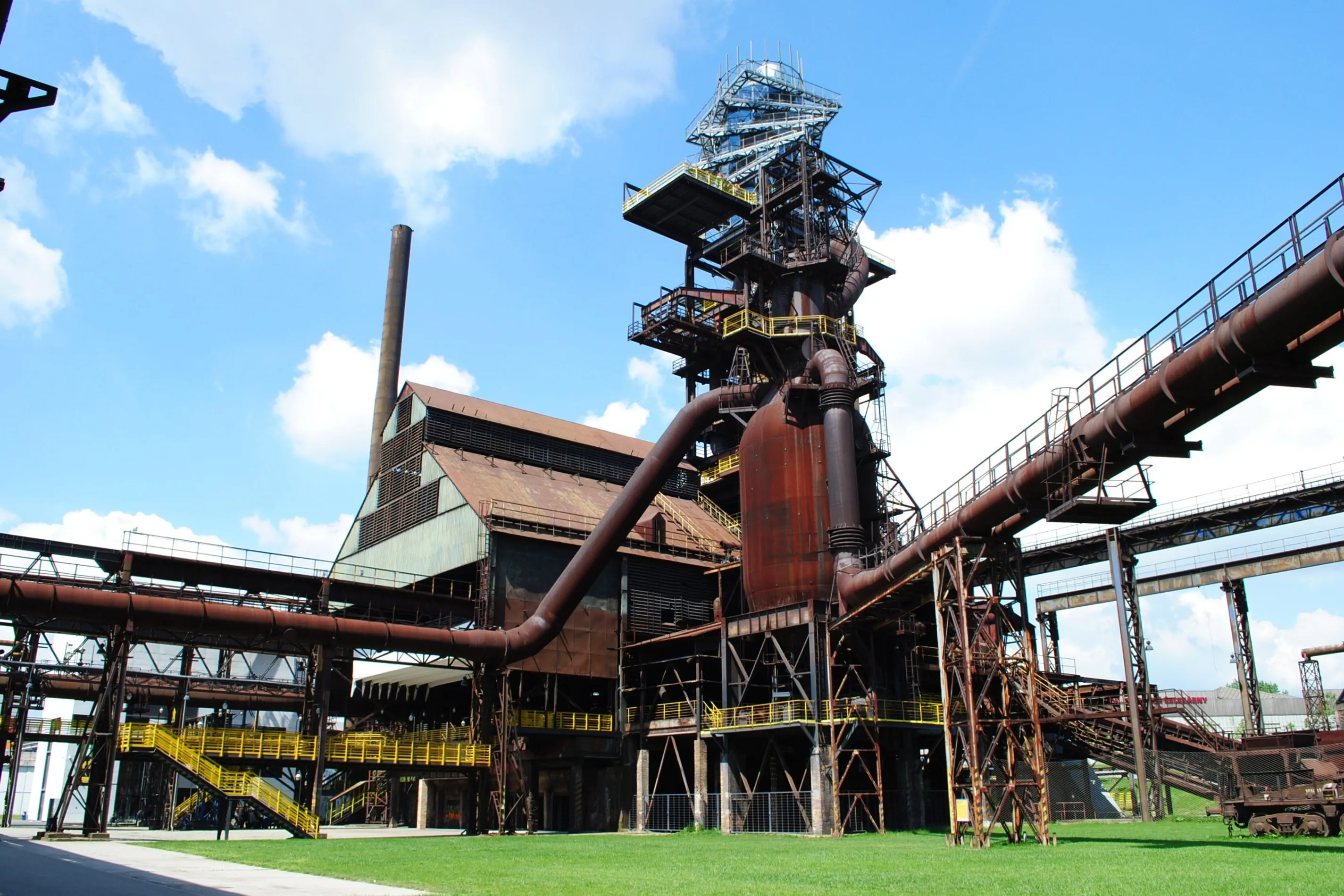
Dolní Vítkovice, from blast furnace to cultural venue
Dolní Vítkovice is the former Vítkovice mine, coking plant and blast furnace complex. Reconverted, it hosts tours, exhibitions, concerts and festivals; one blast furnace can be visited up to a viewing platform. Wikivoyage (EN) states that the whole site has been protected as a national cultural monument since 2002. Guided tours run on seasonal schedules: check them before you come.
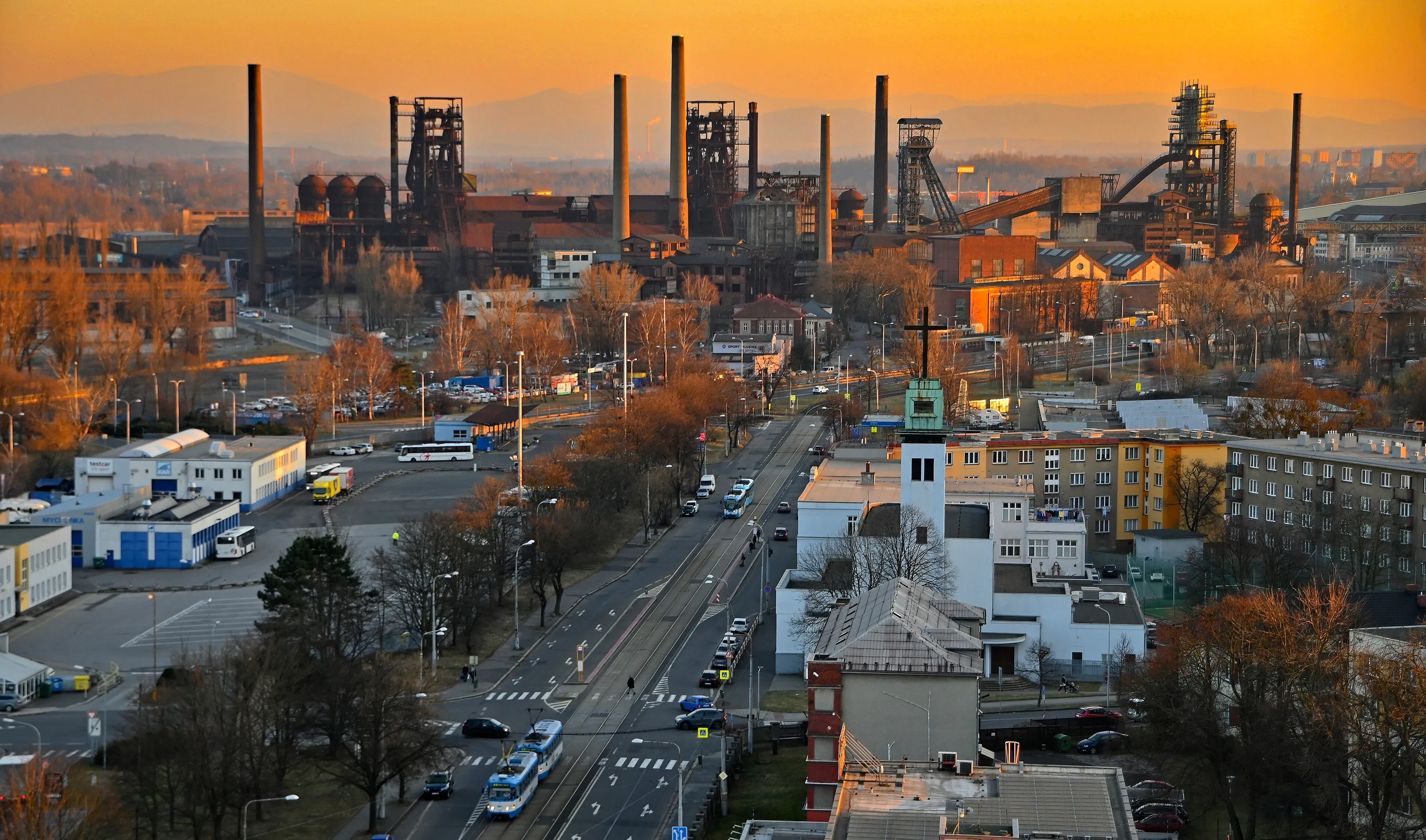
Blast furnaces and chimneys at dusk
Seen from above, the blast furnaces, chimneys and brick buildings of Dolní Vítkovice show the scale of the industry that made the city; the hills of the Beskids are outlined behind.
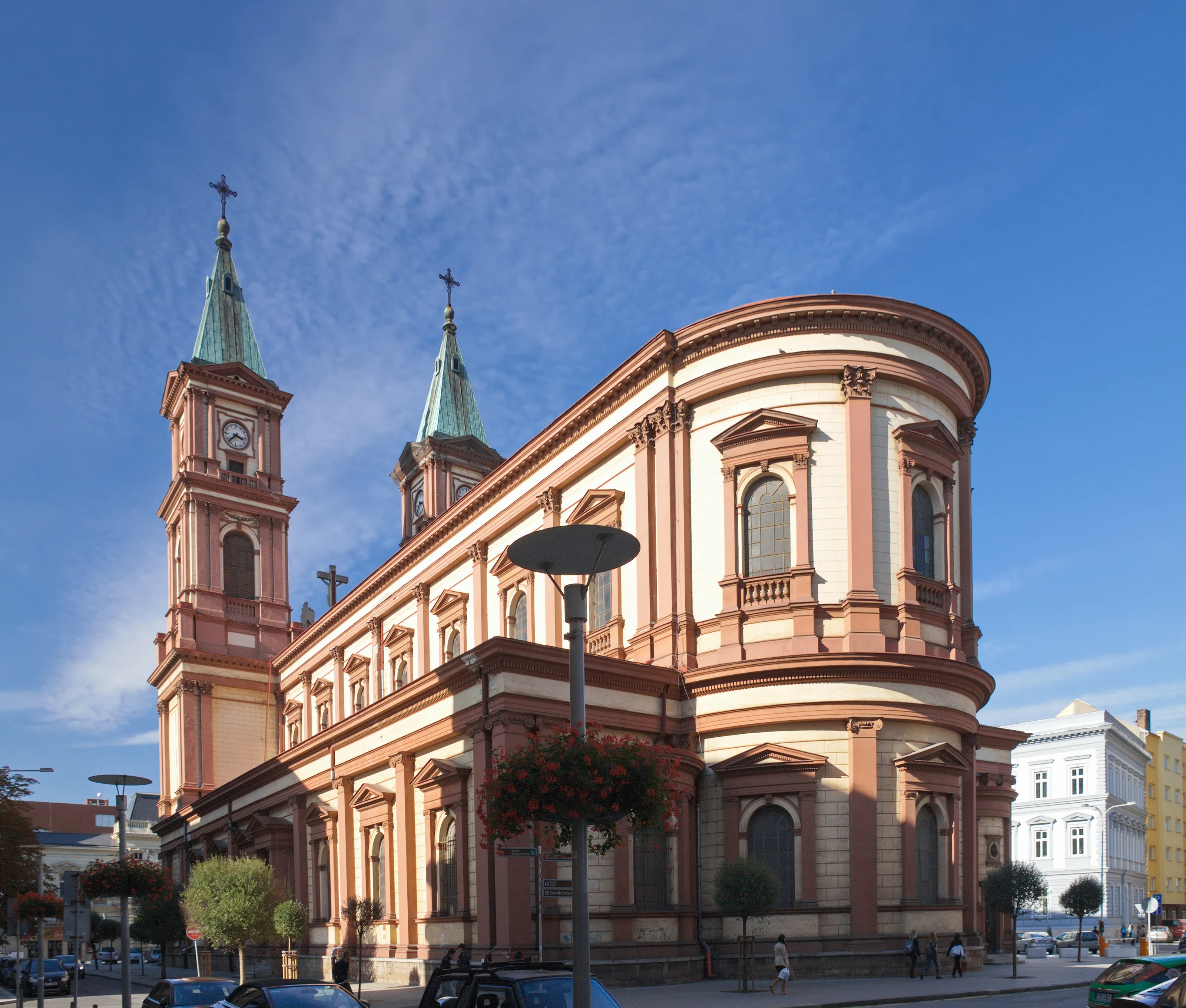
The Cathedral of the Divine Saviour
In the centre, the Cathedral of the Divine Saviour, with its two green-spired bell towers, is one of the city's main churches. A nineteenth-century building in pink and cream tones, it offers a religious counterpoint to Ostrava's industrial past.
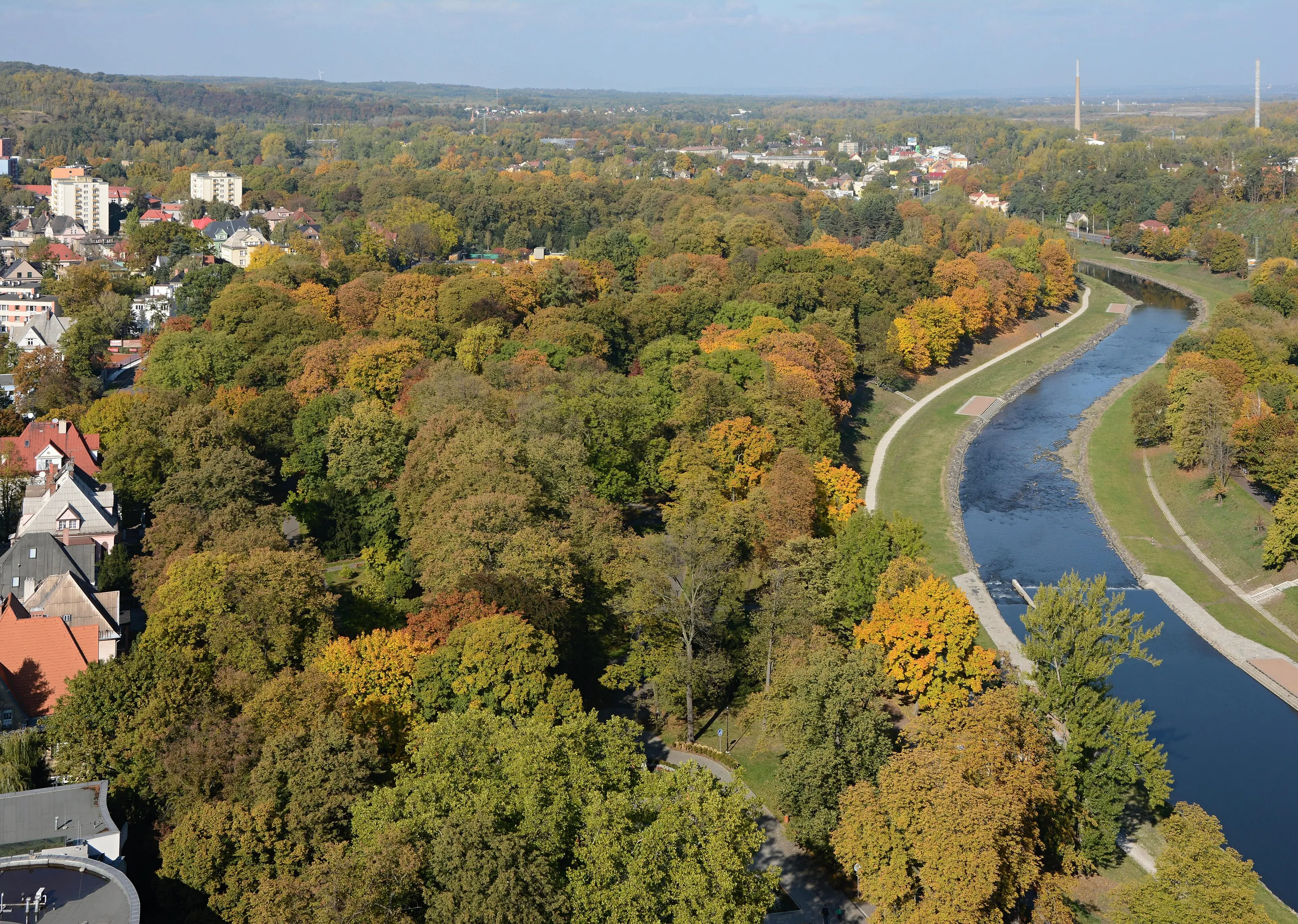
Komenského park and the Ostravice river
On the banks of the Ostravice, the river that marked the historic border between Moravia and Silesia, Komenského park is a large mass of trees, especially glowing in autumn. It is a quiet walk a short distance from the centre.
The New Town Hall and its viewing tower
The New Town Hall, completed in the 1930s and very large for the country, is topped by a tower about 85 m high with a viewing platform open most days according to Wikivoyage (EN): you can see the city, the Beskids and, on a clear day, Poland.
Stodolní and the nightlife
Stodolní street, near the old town, concentrates bars, clubs and terraces: it is Ostrava's nightlife district, popular with students and locals.
Landek and Silesian Ostrava
Landek park, with the country's largest mining exhibition according to Wikivoyage (EN), and Landek hill offer a dive into the miners' past. Silesian Ostrava Castle, from the thirteenth century, is the city's oldest monument.
Museums and culture
Mines, art and the city's history
The Landek mining museum
Housed in the former Anselm mine at Landek park, the museum is the country's biggest mining museum according to Wikivoyage (EN); it explains the history of coal in the region, from prehistory to the industrial era.
The Michal Mine and Dolní Vítkovice
The Michal Mine, protected as a national cultural monument since 1995 according to Wikivoyage (EN), can be visited with guides; Dolní Vítkovice also offers science exhibitions and tours.
The Ostrava Museum and the art gallery
The Ostrava Museum, in the Old Town Hall, presents the city's history and an indoor astronomical clock. The Ostrava art gallery, focused on modern and contemporary Czech art, completes the offer; check opening hours before you come. We give no ticket prices.
Food and drink
Soups, beer and simple Czech cooking
Specialities
Local cooking is simple and hearty. Kyselo is a sour soup, often made with potatoes, mushrooms and egg; zelňačka is a cabbage soup. You will also find potato pancakes, svíčková and knedlíky, classics across the Czech Republic.
Beer and pubs
Czech beer is drunk everywhere, and the brewery and pub tradition is strong in an industrial city. The Stodolní area and the centre concentrate the addresses.
Cafés and markets
The centre has cafés and restaurants serving Czech and international food; in the converted industrial sites there are cafés with terraces, especially in summer.
Getting around
Tram, bus and train
Trams, trolleybuses and buses
The municipal network of trams, buses and trolleybuses is fast, frequent and cheap according to Wikivoyage (EN); contactless payment with a bank card is possible on board, with 10-minute, 60-minute or day tickets. It is the simplest way to reach Dolní Vítkovice.
Trains
Fast trains stop at the main station (Ostrava hl. n.) and at Svinov, both quite far from the old town. Prague is about 3 hours by Pendolino, Brno about 2 h 15 to 2 h 30, Olomouc about 1 hour according to Wikivoyage (EN).
Excursions
Katowice, in Poland, is about 90 km away. The Beskids, a mid-mountain range to the south-east, are the natural excursion for hiking and, in winter, skiing.
Budget and precautions
An affordable budget, gentler than Prague
Price level
Ostrava is affordable compared with Western Europe and Prague, with inexpensive restaurants, beer and transport. The currency is the Czech koruna (CZK). We give no figures because we could not cross-check them on two independent open sources.
Flights
The flight remains the most variable item. SniperAir monitors prices to OSR and compares them with the route's history, but it does not sell or book tickets. Prague (PRG) and Katowice (KTW) can be entry points to watch in parallel.
Formalities and precautions
The Czech Republic is part of the Schengen area: entry formalities depend on your nationality, so check them on official sites. Also consult the official recommendations of your country of departure. As Ostrava is an industrial region, air quality can be poorer in winter: sensitive people should check local readings.
When to go
Continental: warm summers, cold winters
Winter (December to February)
Cold and often grey; Christmas markets liven up the centre in December. A good time for museums and cafés.
Spring (March to May)
Parks turn green again and terraces return: a pleasant time to walk.
Summer (June to August)
Warm, sometimes stormy; the industrial sites, music festivals and terraces are at their peak.
Autumn (September to November)
Beautiful light and parks in fiery colours; the best time for photography in town.
Ostrava has a continental climate, with warm summers and cold winters. We give no precise temperatures because we could not cross-check them; check the forecast before you go. May-June and September-October are generally the most pleasant.
By length of stay
What to do in Ostrava depending on how long you stay
The essentials
Dolní Vítkovice, the New Town Hall tower, the centre and the cathedral, an evening on Stodolní.
Mines and museums
Landek park and its mining museum, the Michal Mine, the Ostrava Museum and Silesian Ostrava Castle.
The region
Trips to the Beskids, to Olomouc or into Poland, or by train to Brno or Prague.
In pictures
Ostrava in pictures
You might also like
Similar destinations
FAQ
Frequently asked questions about flights to Ostrava
How do I get from Ostrava airport to the centre?
Leoš Janáček Airport (OSR), at Mošnov, is about 20 to 25 km south of the centre. A bus reaches the bus station in about 40 minutes according to Wikivoyage (EN), and a dedicated rail link has existed since 2015; a taxi takes about half an hour. Check timetables before you travel.
When is the best time to visit Ostrava?
May to September for the open-air industrial sites, terraces and summer music festivals; autumn is lovely in the parks, winter is cold and grey.
Is Ostrava expensive?
The budget is affordable for Europe, generally gentler than Prague. We give no amounts because we could not cross-check them.
How long should I stay in Ostrava?
One to two days for Dolní Vítkovice, the centre and a museum; three or four days if you add Landek, Silesian Ostrava and a trip to the Beskids.
How do I get around Ostrava?
By tram, bus and trolleybus; contactless payment on board is possible according to Wikivoyage (EN). Take the tram to the industrial sites. Trains arrive at the main station or at Svinov, both far from the historic centre.
What should I eat in Ostrava?
Kyselo, a sour soup with potatoes, mushrooms and egg, zelňačka cabbage soup, potato pancakes and, of course, Czech beer.
How much does a flight to Ostrava usually cost?
The price depends mainly on your departure city, the time of year and how far ahead you book. The "opportunities" section above shows real examples of prices SniperAir has already detected to this destination.
How do I get alerted when a flight to Ostrava drops below my budget?
Create an alert profile with your departure airport, Ostrava as the destination and your maximum budget. You are notified automatically as soon as a matching price is detected.
Ready to head to Ostrava?
Set your budget and let SniperAir monitor fares for you.
Create my alert