
Cheap flights to Friedrichshafen
Set your departure airport and maximum budget: SniperAir tracks prices to Friedrichshafen and alerts you the moment a deal matching your criteria appears.
Quick summary
Country
Germany
Continent
Europe
Airport
FDH
Currency
Euro (EUR)
Time zone
UTC+1 (UTC+2 during summer time)
Deals already spotted to Friedrichshafen
Real flight examples detected by SniperAir, with their reference price.
Loading examples…
Why track Friedrichshafen with SniperAir
A small airport on the shores of Lake Constance
Choose your departure
Enter your departure airport and your maximum budget for a flight to Friedrichshafen (FDH).
SniperAir keeps watch
New fares are compared with the real history of the route. SniperAir tracks prices and alerts you: it does not sell or book tickets.
Get an alert
As soon as a fare matches your criteria you are notified, without having to rerun the search yourself.
Airport and getting into town
An airport about 3 km out, linked to town by train
Bodensee-Airport Friedrichshafen (FDH)
The airport lies about 3 km north of town, according to Wikipedia. It has its own railway halt on the Ulm-Friedrichshafen line: the ride to Friedrichshafen Stadt station takes about six minutes, according to Wikivoyage, although not every train stops there. A shuttle is also mentioned on the airport's official website. Scheduled and charter flights vary by season, so we name no routes or airlines and quote no fares.
Distances and times are approximate, from Wikipedia and Wikivoyage; seasonal flights and train, ferry and boat timetables change, so check them before you travel.
Friedrichshafen is a small city of around 60,000 people on the north-eastern shore of Lake Constance, in Baden-Württemberg. If a flight to FDH does not suit you, other gateways exist: Zurich, reached by train to Romanshorn and then by ferry, Memmingen, linked by train, or Stuttgart, from where trains reach the city via Ulm. Friedrichshafen Stadt station and the harbour station are both within walking distance of the centre. Long-distance coaches stop near the station. Tracking fares into Zurich or Stuttgart and continuing by train is often a good alternative.
Lake, church and Zeppelin
A rebuilt city, a huge lake and the legacy of the airships
Friedrichshafen was almost completely destroyed in the Second World War because of its armaments factories, so few buildings predate 1945. The Baroque Palace Church and the former harbour station, built in Bauhaus style and now a museum, are among the rare survivors. The rest of the city is modern, turned towards the lake and the story of the airships: this is where Ferdinand von Zeppelin set up production of his rigid airships. The places below are illustrated; the Dornier Museum, the Graf-Zeppelin-Haus and modern airship flights are described in text.
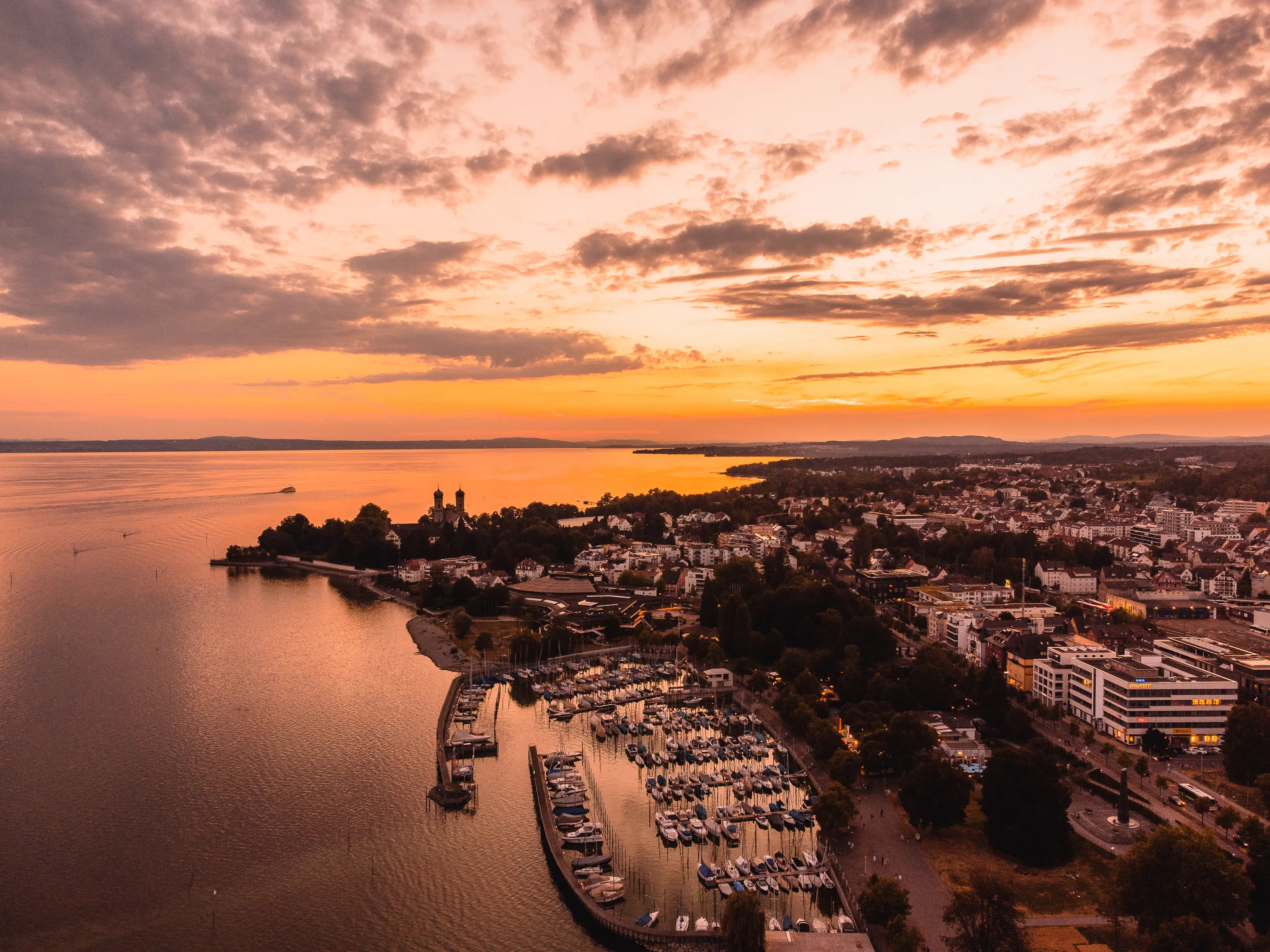
The harbour and the bay at sunset
On the shore of Lake Constance, the bay and the marina make one of the town's finest settings, especially at dusk. The lake covers about 536 km², making it the third largest lake in central Europe, shared by Germany, Austria and Switzerland, according to Wikipedia. On a clear day you can see the Alps across the water.
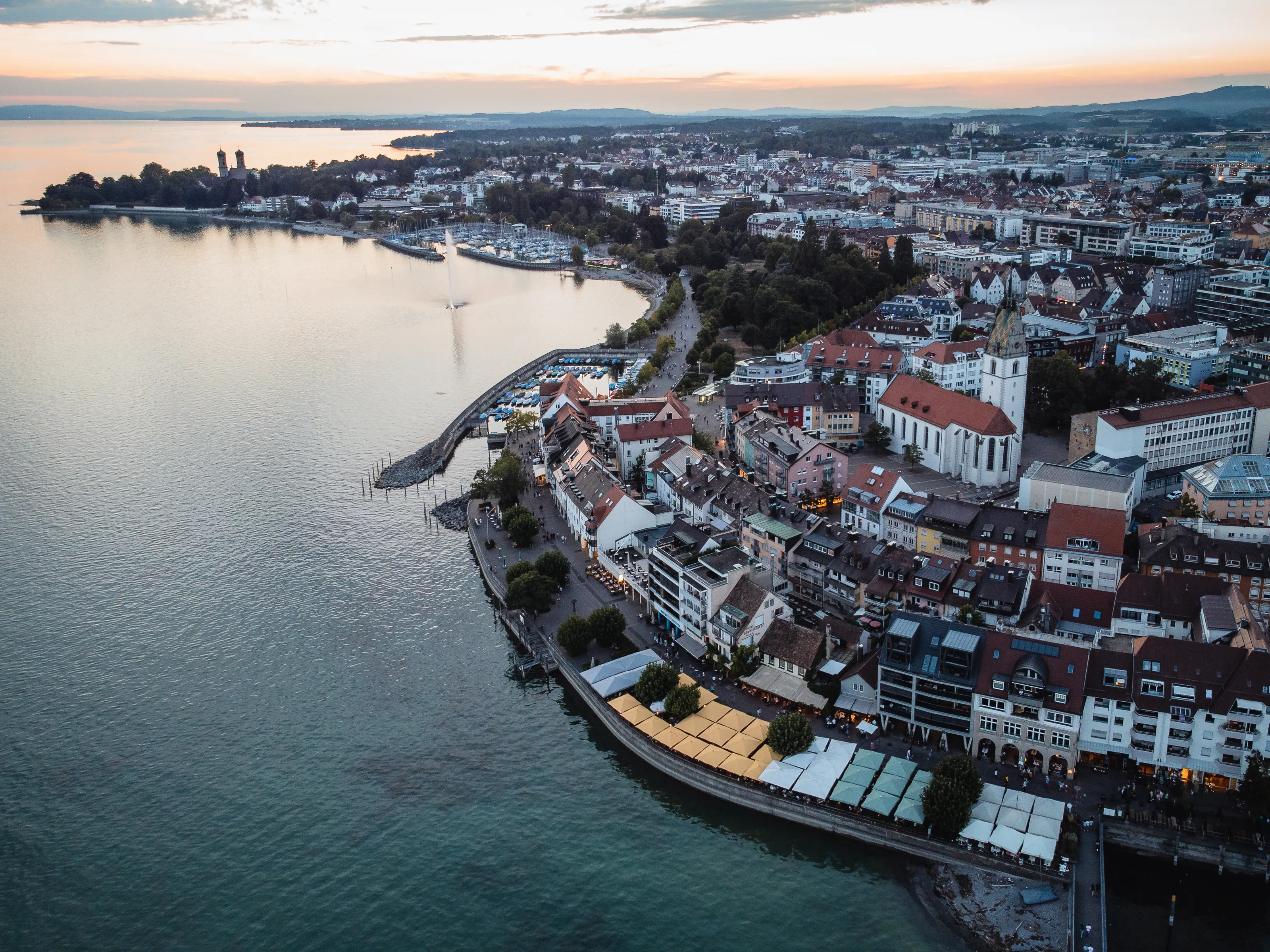
The lakefront and the centre
The town stretches along the shore with one of the longest lakeside promenades, according to Wikivoyage. You can walk between the harbour and the Palace Church with views over the water and, in good weather, the mountains. The centre, rebuilt after the war, is compact and easy on foot.
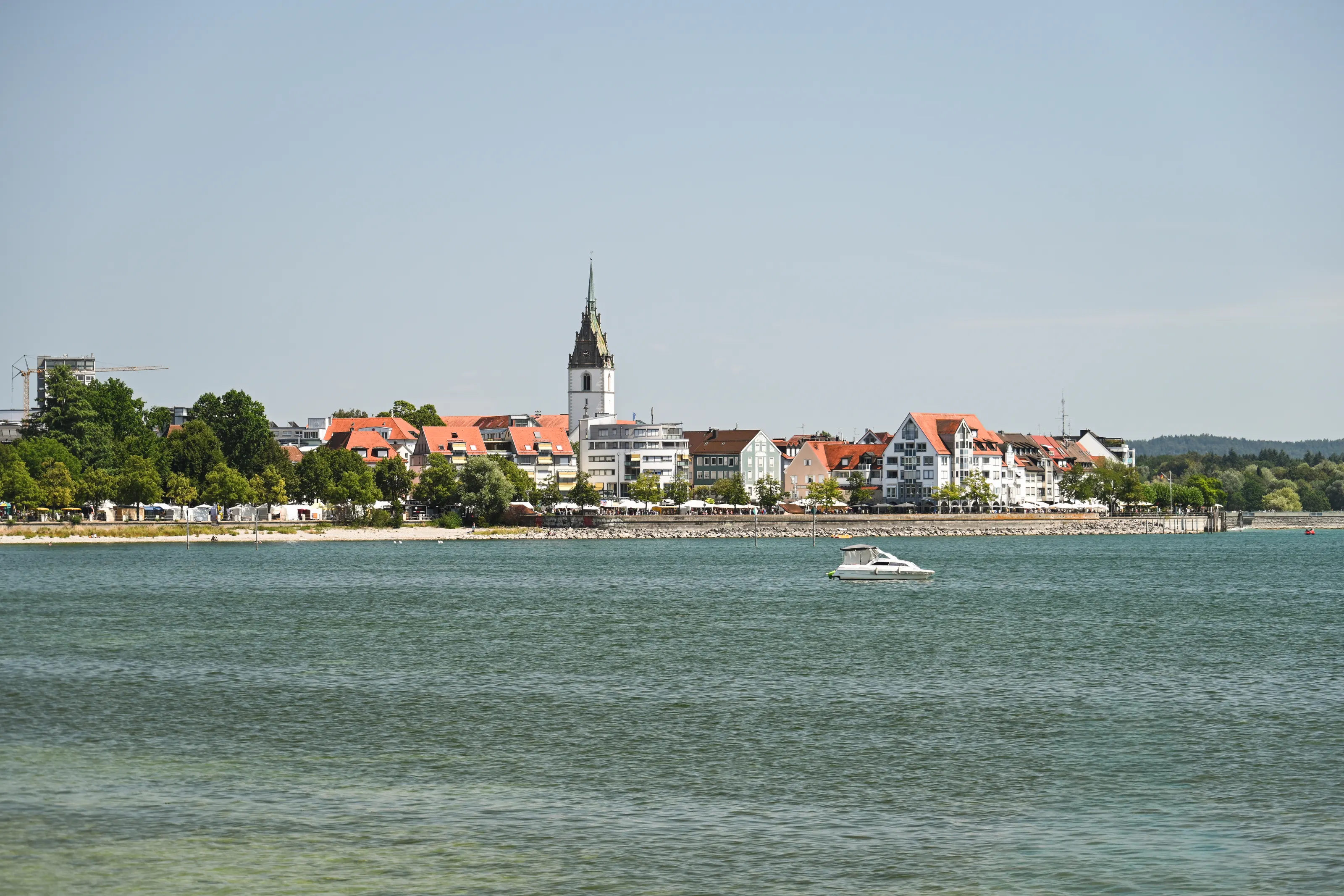
The town seen from the lake
From the water the town looks like a line of red roofs on the edge of a huge calm expanse. Boats link Friedrichshafen with Konstanz and the Swiss shore, giving a different viewpoint, and you can also hire a bike to follow the cycle route round the lake.
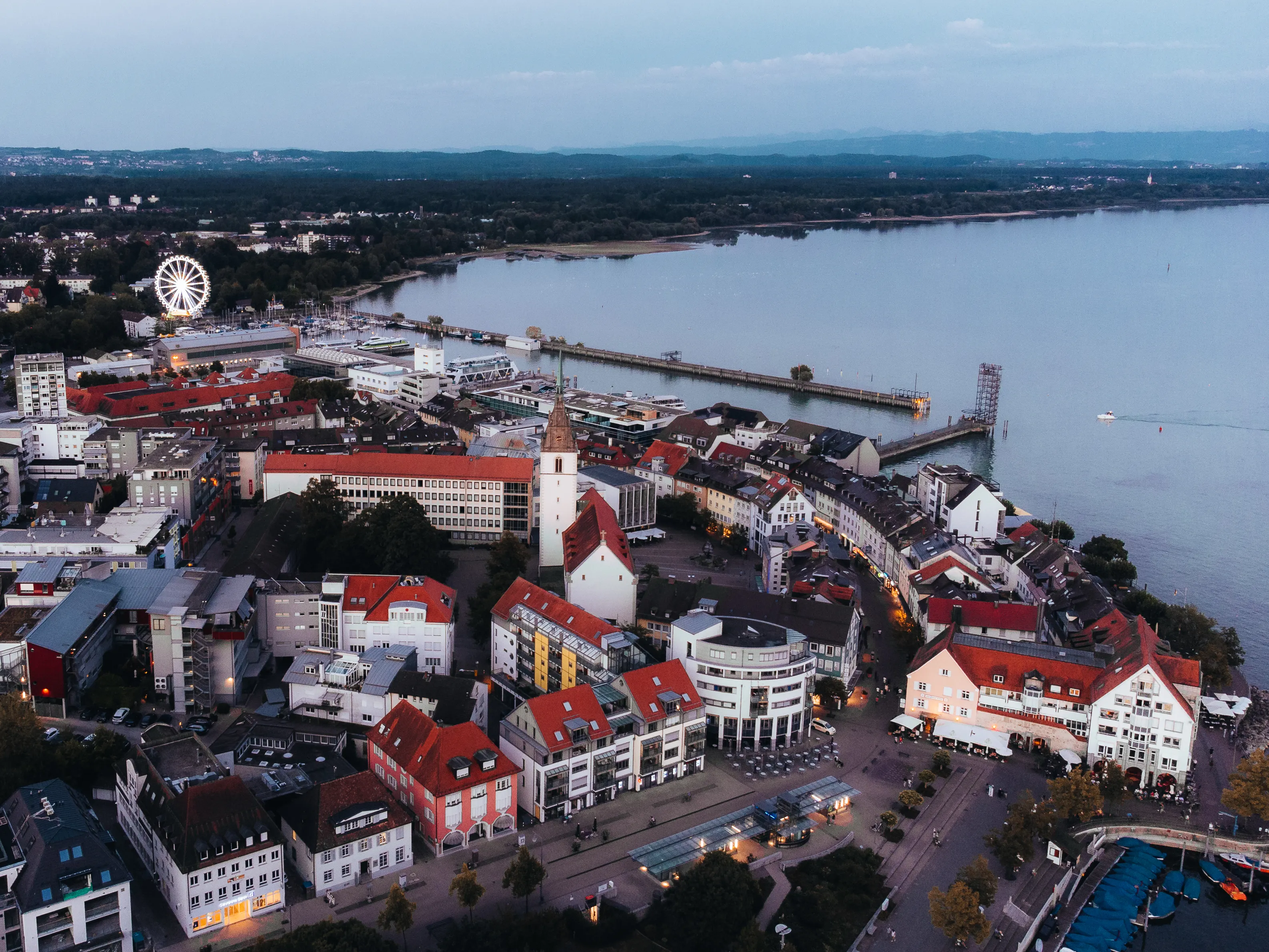
The pier and its tower
The pier juts into the lake, and at its end stands the Moleturm, a 22 m viewing tower built in 2000 with views over the harbour, the town and the Palace Church. Access is by stairs, with no lift, according to Wikivoyage. The city's big trade fairs, AERO and Interboot, take place not far away near the airport.
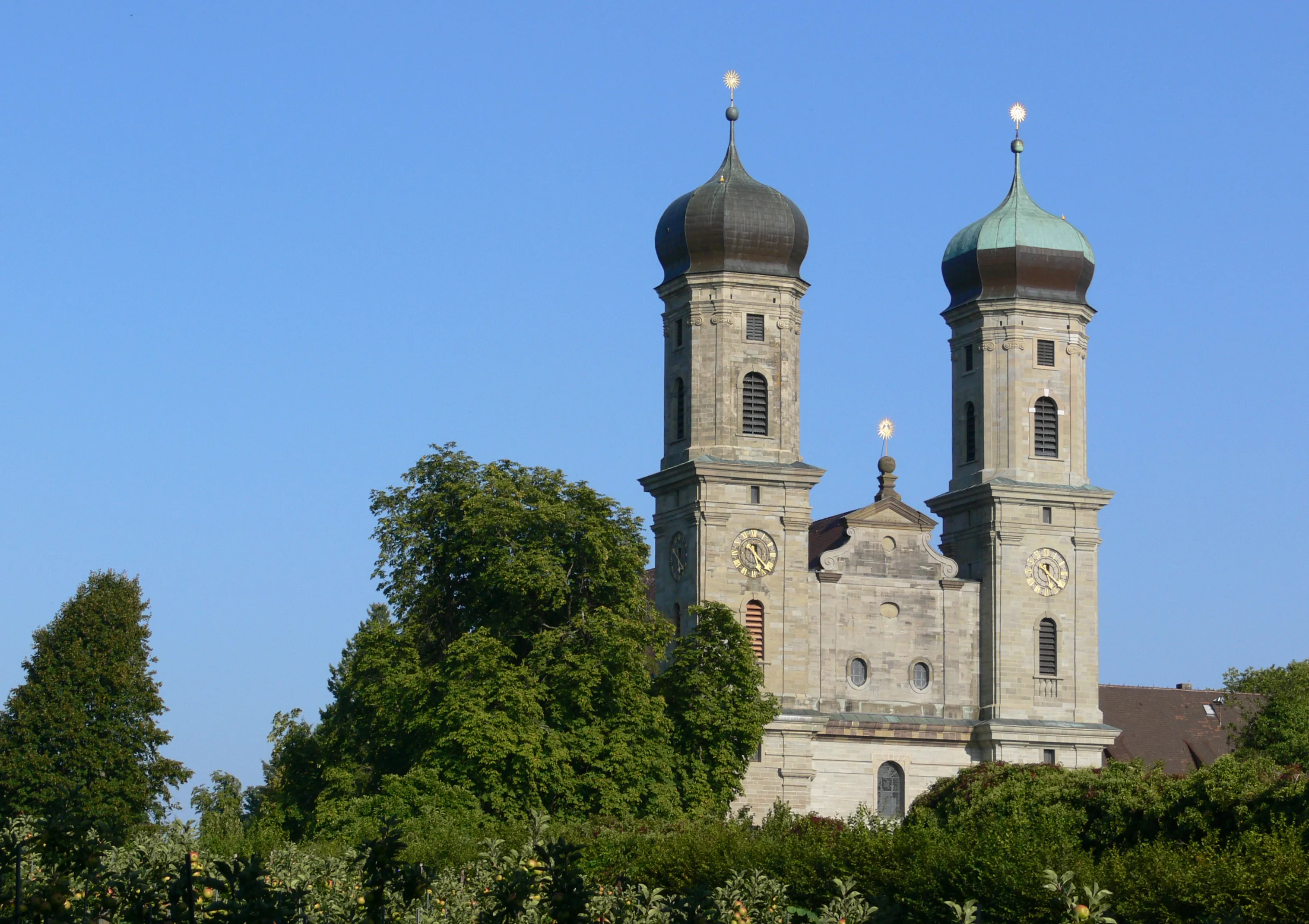
The Palace Church (Schlosskirche)
The former church of the Hofen monastery, built in the late 17th century, the Schlosskirche with its two 55 m onion-domed towers is the town's landmark and a fine example of Upper Swabian Baroque. It was partly destroyed in 1944 and rebuilt after the war, and is now a Protestant church.
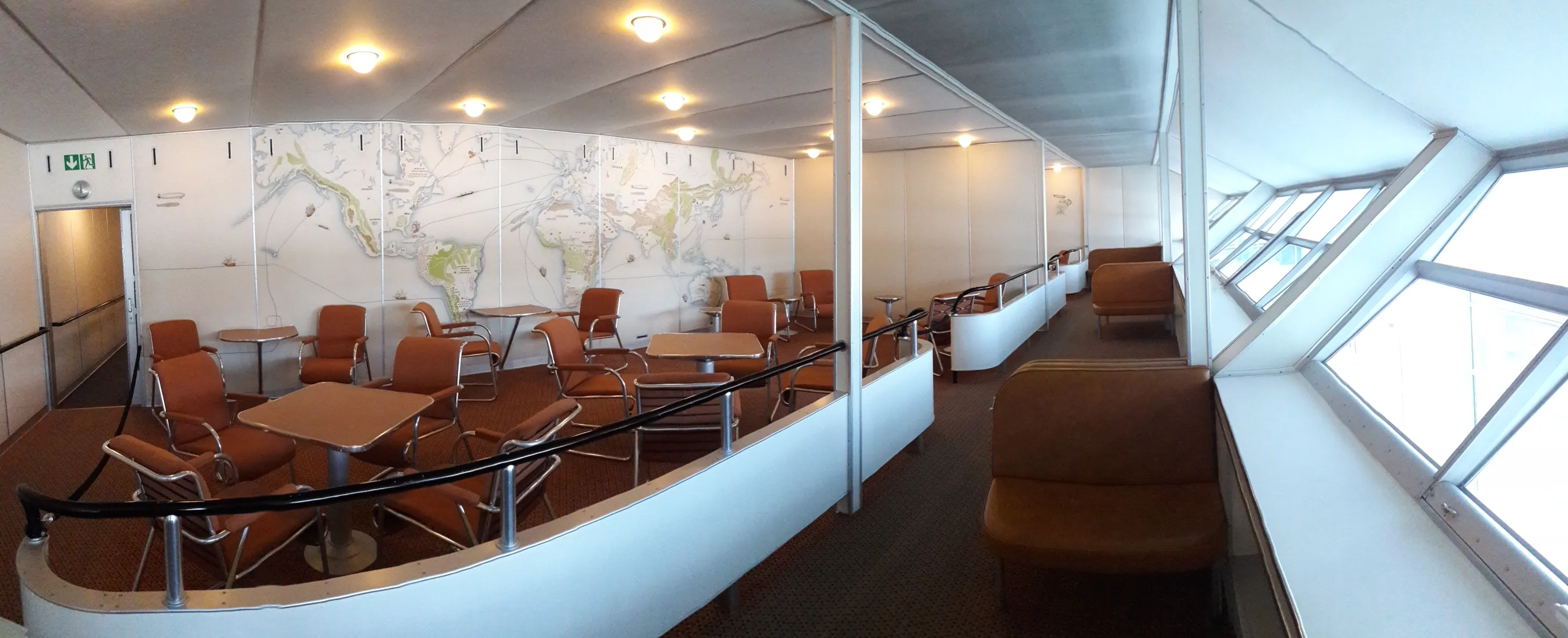
The Zeppelin Museum
Housed in the former harbour station, the Zeppelin Museum presents, according to Wikipedia and Wikivoyage, the world's largest collection on airship history. It also offers a roughly 33 m reconstruction of part of the Hindenburg, whose lounges you can walk through, and an art collection. The official website lists a permanent exhibition and a technology tour; temporary exhibitions change.
Dornier, Graf-Zeppelin-Haus and modern airships in text
The Dornier Museum, near the airport, tells the story of aviation and aerospace. The Graf-Zeppelin-Haus is a cultural and congress centre hosting concerts and shows; the city offers many cultural events each year according to Wikipedia. The Zeppelin NT company still builds small semi-rigid airships, and sightseeing flights operate from the airport, according to Wikivoyage; we give neither times nor prices. Several lake towns, such as Meersburg, Lindau or the UNESCO-listed island of Reichenau, make good excursions.
Museums and culture
Airships, aviation, school life and art
The Zeppelin Museum
The best-known museum in town tells the history, construction and travel of airships. According to its official website it offers a permanent exhibition, a technology tour and an art collection. Temporary exhibitions, some of which also examine the airship story under National Socialism, change: check the programme.
The Dornier Museum
Located next to the airport, it presents the history of aviation and aerospace around original aircraft, according to Wikivoyage. It pairs well with a visit to the Zeppelin Museum.
The Schulmuseum and culture
The Schulmuseum, a school museum, recreates classrooms of the past, and the city stages many cultural events each year. We do not quote prices or opening hours.
Food and drink
Lake fish, fruit and lakeshore wines
Fish from the lake
Lake Constance is home to around 45 fish species, among them the whitefish known as Felchen in German, the star of the fish restaurants around the lake. It is often served whole or as a fillet, pan-fried in butter, according to Wikipedia.
Fruit and wine
The region enjoys a microclimate favourable to orchards: the lakeshore orchards produce a large share of Germany's apples, according to Wikipedia. Lake Constance is also one of Germany's well-known wine-growing regions, with events at harvest time in autumn.
Cafes and brasseries
The lake promenade, the harbour and the centre have plenty of cafes and restaurants. We name no venues, since their hours and menus change.
Getting around
On foot, by bike, by boat and by train
On foot and by bus
Most places can be reached on foot, according to Wikivoyage. The city has a bus network, including a night service, but bike or car is best for exploring the surroundings.
By bike
The Lake Constance cycle route passes through the town, and renting a bike is easy. Trips to Meersburg or Lindau follow the shore.
By boat and by train
A car and passenger ferry links Friedrichshafen with Romanshorn in Switzerland in about 45 minutes, and a catamaran, for pedestrians and cyclists only, reaches Konstanz in about 40 minutes, according to Wikivoyage. Trains serve Ulm, Stuttgart, Lindau and the lakeshore line; in summer they can be crowded with cyclists.
Budget and precautions
A lakeside city, fairly easygoing on prices
Price level
Friedrichshafen is a medium-sized German city: accommodation and dining cost more in high season and during big trade fairs, when roads are also busy. We do not give figures because we could not cross-check them against two independent sources.
Flights
The flight is the most variable cost. SniperAir tracks fares to FDH and compares them with the route's history, but it does not sell or book tickets. Zurich, Stuttgart and Memmingen are gateways worth watching in parallel.
Entry rules and precautions
Germany is in the Schengen area; Switzerland, which you reach by ferry, applies its own rules: check entry requirements for your nationality on official sites. In stormy weather the lake can change quickly, so follow the forecast if you go sailing.
When to go
Mild summers, misty winters and lovely shoulder seasons
Winter (December to February)
Cool, with frequent fog over the lake and sometimes snow in the nearby Alps. The town is quiet.
Spring (March to May)
Orchards blossom along the shore, and seasonal boats resume crossings to Konstanz and Switzerland.
Summer (June to August)
The season for lakeside walks, swimming and boat or bike excursions. Roads and trains can be busy.
Autumn (September to November)
Soft light, grape and apple harvests around the lake, and sometimes very clear views of the Alps when the foehn blows.
The climate is shaped by the lake and the nearby Alps: temperatures are rather mild compared with the hinterland, with foehn winds, occasional strong thunderstorms and frequent fog in winter, according to Wikipedia. We do not give precise temperatures; check the forecast before you go.
By length of stay
What to do in Friedrichshafen depending on how long you stay
The essentials
The lake promenade, the Schlosskirche, the Moleturm and the Zeppelin Museum.
Airships and lake
The Dornier Museum, a ferry crossing to Romanshorn or a catamaran to Konstanz, and a bike or boat excursion to Meersburg or Lindau.
Round the lake
A stay to cycle or sail around the lake, taking in Reichenau island, Ravensburg, Bregenz and the Swiss towns of the south shore.
In pictures
Friedrichshafen in pictures
You might also like
Similar destinations
FAQ
Frequently asked questions about flights to Friedrichshafen
How do I get from Friedrichshafen airport to the centre?
The airport (FDH) is about 3 km north of town. A railway halt links it with Friedrichshafen Stadt station in about six minutes, though not every train stops there; a shuttle is also mentioned on the airport's website. Check times before you travel.
When is the best time to visit Friedrichshafen?
From May to September for the lake promenade and boat or bike excursions; in autumn for the grape and apple harvests; winter is quiet and often misty.
Is Friedrichshafen expensive?
It is a medium-sized German city; prices rise in high season and during big trade fairs. We do not quote amounts because we could not cross-check them.
How long should I stay in Friedrichshafen?
Two days are enough for the promenade, the Schlosskirche and the Zeppelin Museum. Allow four days or more if you add the Dornier Museum and excursions round the lake.
Why is Friedrichshafen linked to Zeppelins?
Count Ferdinand von Zeppelin set up production of his rigid airships here at the end of the 19th century, and LZ 1 rose in 1900 from Manzell Bay. The Zeppelin NT company still builds small airships here.
What should I eat and drink in Friedrichshafen?
Fish from the lake, especially whitefish, known as Felchen, along with apples, fruit and wines from the region.
How much does a flight to Friedrichshafen usually cost?
The price depends mainly on your departure city, the time of year and how far ahead you book. The "opportunities" section above shows real examples of prices SniperAir has already detected to this destination.
How do I get alerted when a flight to Friedrichshafen drops below my budget?
Create an alert profile with your departure airport, Friedrichshafen as the destination and your maximum budget. You are notified automatically as soon as a matching price is detected.
Ready to head to Friedrichshafen?
Set your budget and let SniperAir monitor fares for you.
Create my alert