
Cheap flights to Brindisi
Set your departure airport and maximum budget: SniperAir tracks prices to Brindisi and alerts you the moment a deal matching your criteria appears.
Quick summary
Country
Italy
Continent
Europe
Airport
BDS
Currency
Euro (EUR)
Time zone
UTC+1 (UTC+2 during summer time)
Deals already spotted to Brindisi
Real flight examples detected by SniperAir, with their reference price.
Loading examples…
Why track Brindisi with SniperAir
You do not need to compare prices every day
Choose your departure
Enter your departure airport and your maximum budget for a flight to Brindisi (BDS).
SniperAir keeps watch
Our systems continuously compare new prices with the real price history of the route. SniperAir monitors prices and alerts you: it does not sell or book tickets.
You receive an alert
As soon as a price matches your criteria, you are notified, without having searched for anything yourself.
Airport and getting into town
An airport right by the city, with a bus to the station and port
Brindisi-Salento (BDS)
Brindisi Airport, also known as Aeroporto del Salento, lies on the edge of the city, about 3 km from the centre according to Wikivoyage (DE). A regular bus links the airport, the railway station and the ferry port, with a departure about every 30 minutes from 6:00 to 22:00 according to the same source; Wikivoyage (EN) mentions the "AP" line between the station and the ferry terminal. Car-rental desks operate at the airport, handy for beaches and the Salento. From Lecce, a regional train takes about half an hour and a Frecciabianca about 15 minutes; from Bari the drive takes roughly an hour (Wikivoyage EN).
Distances and times are approximate, from Wikivoyage (EN, FR, DE, ES); timetables change, so check them before you travel. We do not quote fares.
Brindisi is an Apulian city of a little over 80,000 residents according to Wikipedia (FR, ES, DE), at the heel of the Italian boot. The third-largest city of the Salento peninsula according to Wikivoyage (EN), it is one of the busiest ports on the Adriatic, with ferries to Greece and Albania. It is also home to the United Nations Logistics Base (UNLB), which supports peacekeeping operations.
Landmarks
A Roman column, a natural harbour, the Sailor's Monument and Romanesque churches
Founded by the Messapians, a people of Illyrian origin, under the name Brunda, "deer's head", after the shape of its natural harbour, the city became Brundisium after the Roman conquest of 267 BC (Wikivoyage EN, DE, ES). It was one of the great ports of the Roman Empire, linked with Rome by the Via Appia and the Via Traiana. The places below are illustrated; the Swabian castle, the cathedral and the temple of San Giovanni al Sepolcro are covered at the end of the section.
The waterfront and the Roman column
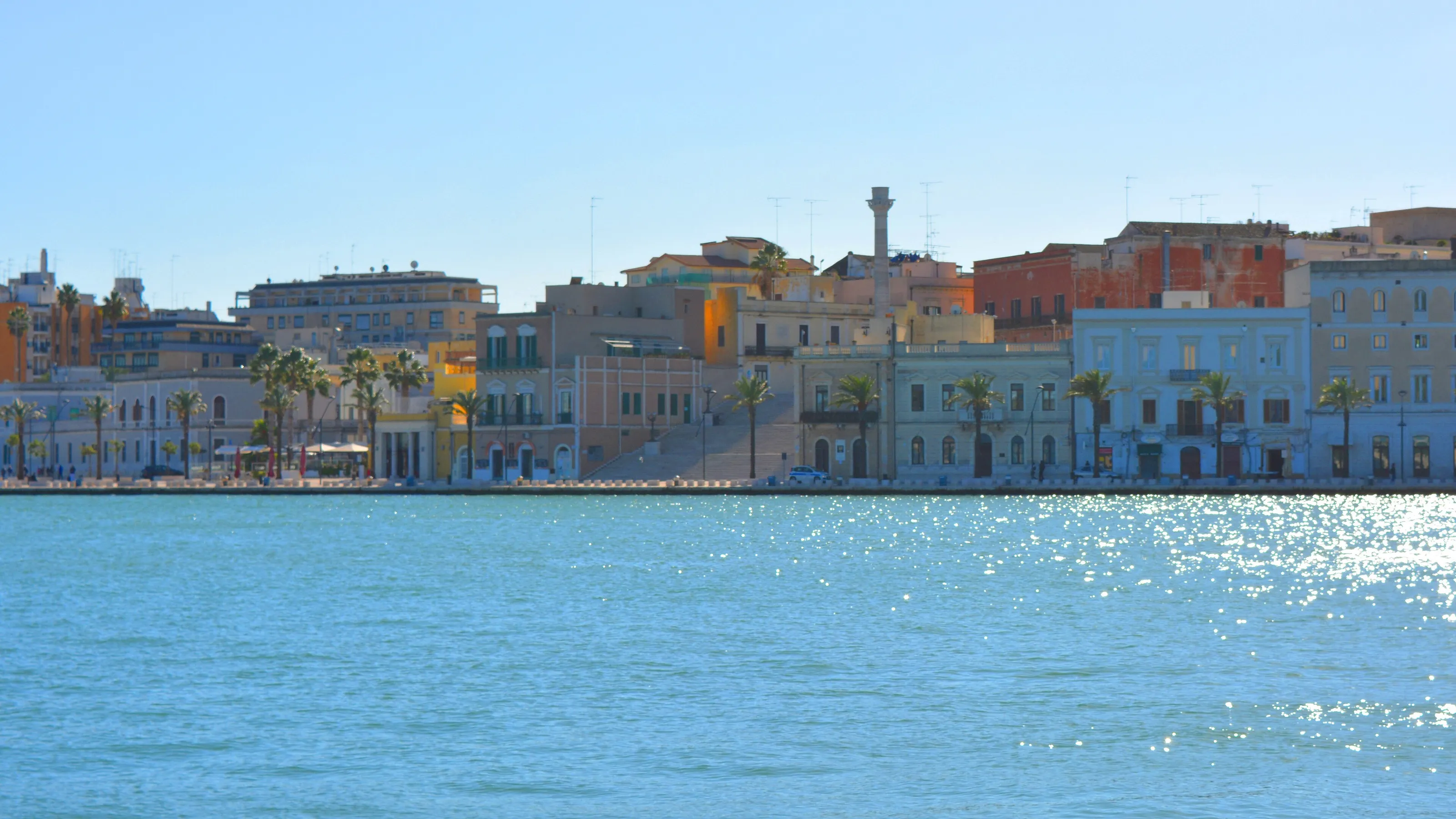
Brindisi's waterfront lines up colourful facades and palm trees facing the inner harbour. Above the roofs a Roman column, a symbol of the city, stands out; it was thought to mark the end of the Via Appia but probably served mainly a commemorative purpose according to Wikivoyage (EN). Only one of the two 2nd-century columns survives, about 19 m high, the other having collapsed in 1528; its ruins now support the statue of St Oronzo in Lecce.
The natural harbour
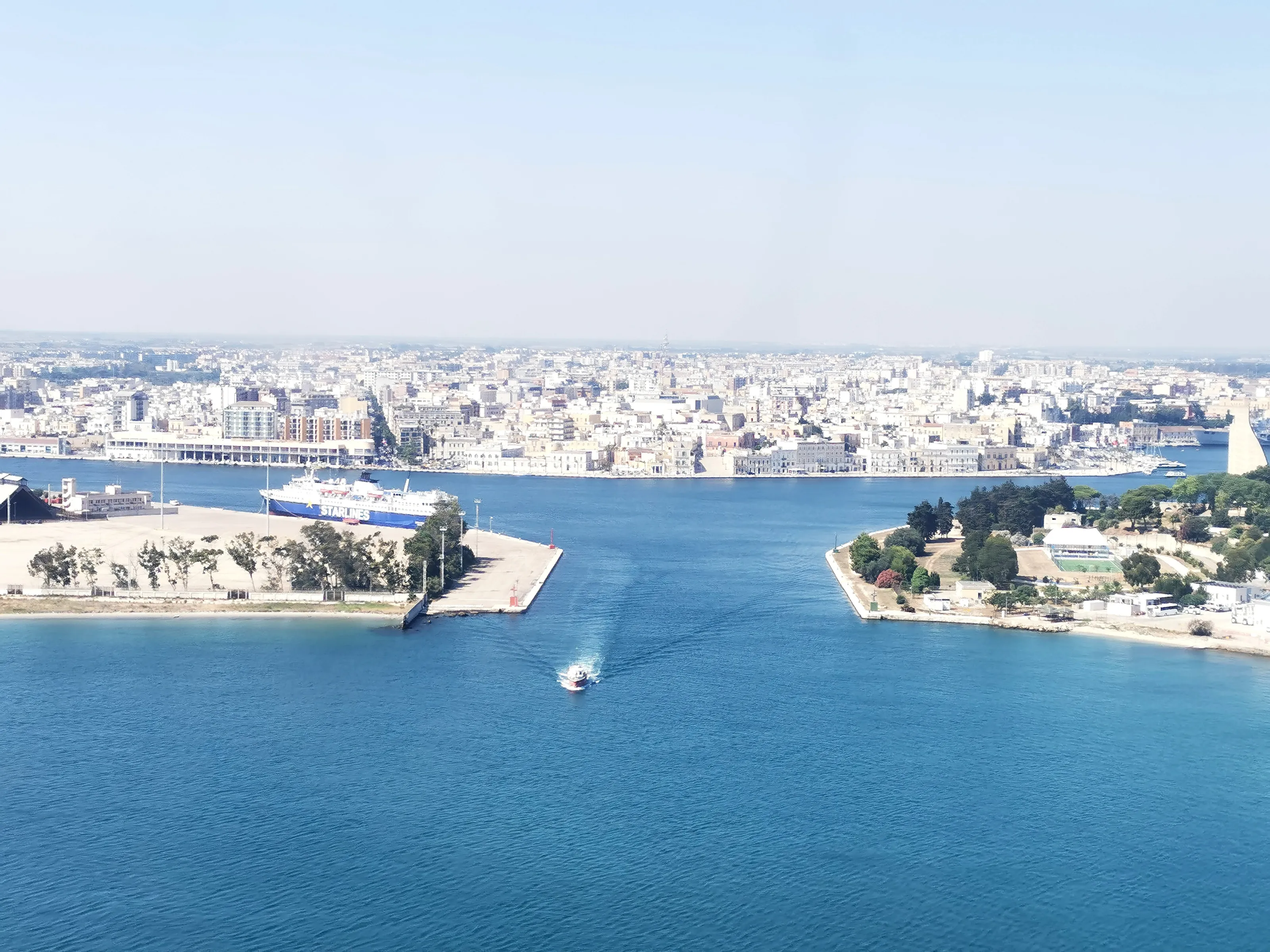
The harbour that made the city's fortune forms a deep basin that Wikivoyage (EN) compares to a deer's antlers, hence the ancient name Brunda. With the opening of the Suez Canal in 1869 the city enjoyed a new heyday, and from September 1943 to February 1944 Brindisi was even the temporary seat of the Italian government (Wikivoyage EN, DE, ES; Wikipedia FR).
A stone staircase
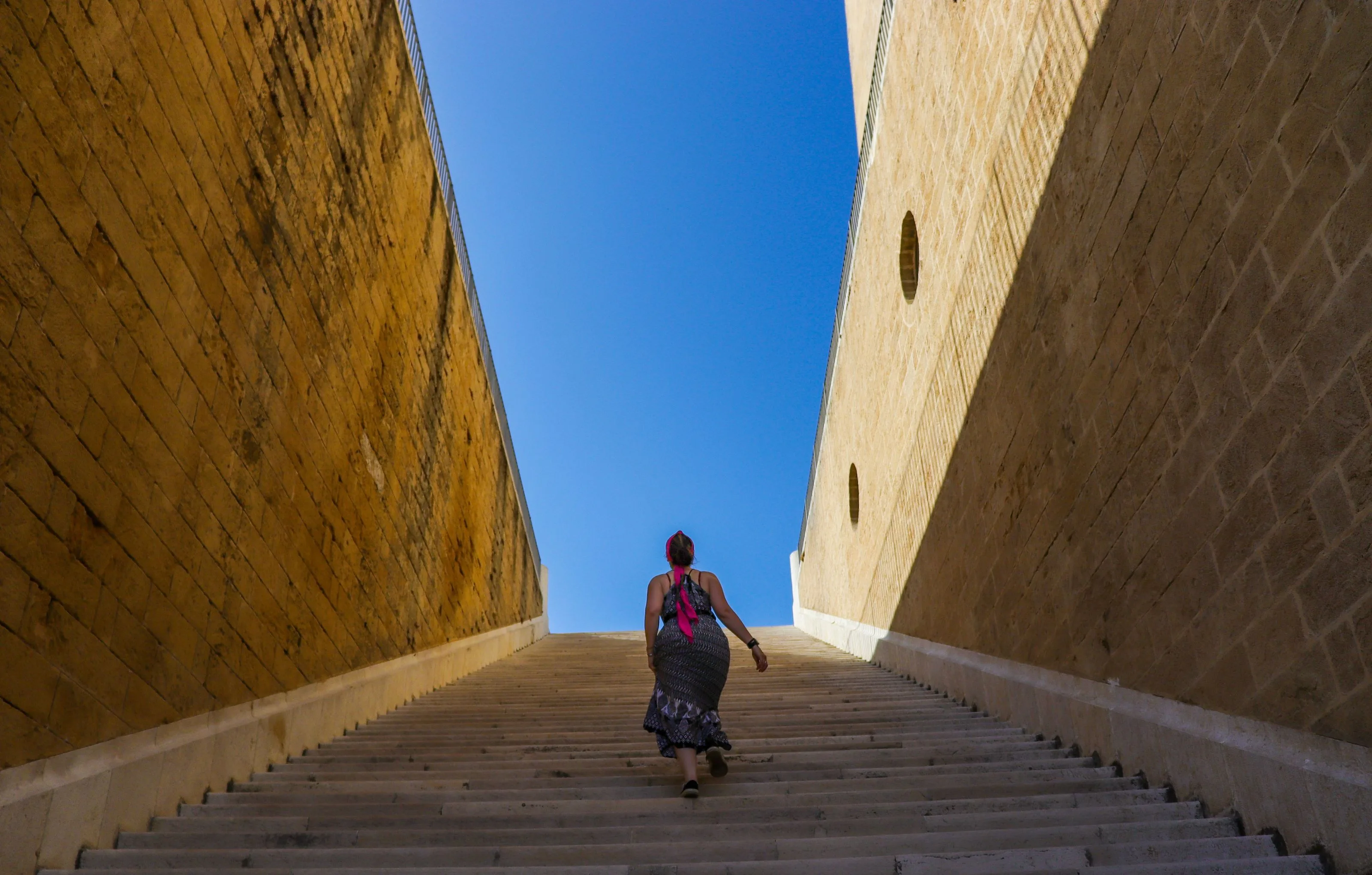
Between two ochre stone walls, a broad staircase climbs towards the sky, a play of light and shadow typical of buildings in local stone. The centre is small: it is a little over a kilometre from the station to the Roman column, and most sights can be seen on foot in an afternoon (Wikivoyage EN).
The Italian Sailor's Monument
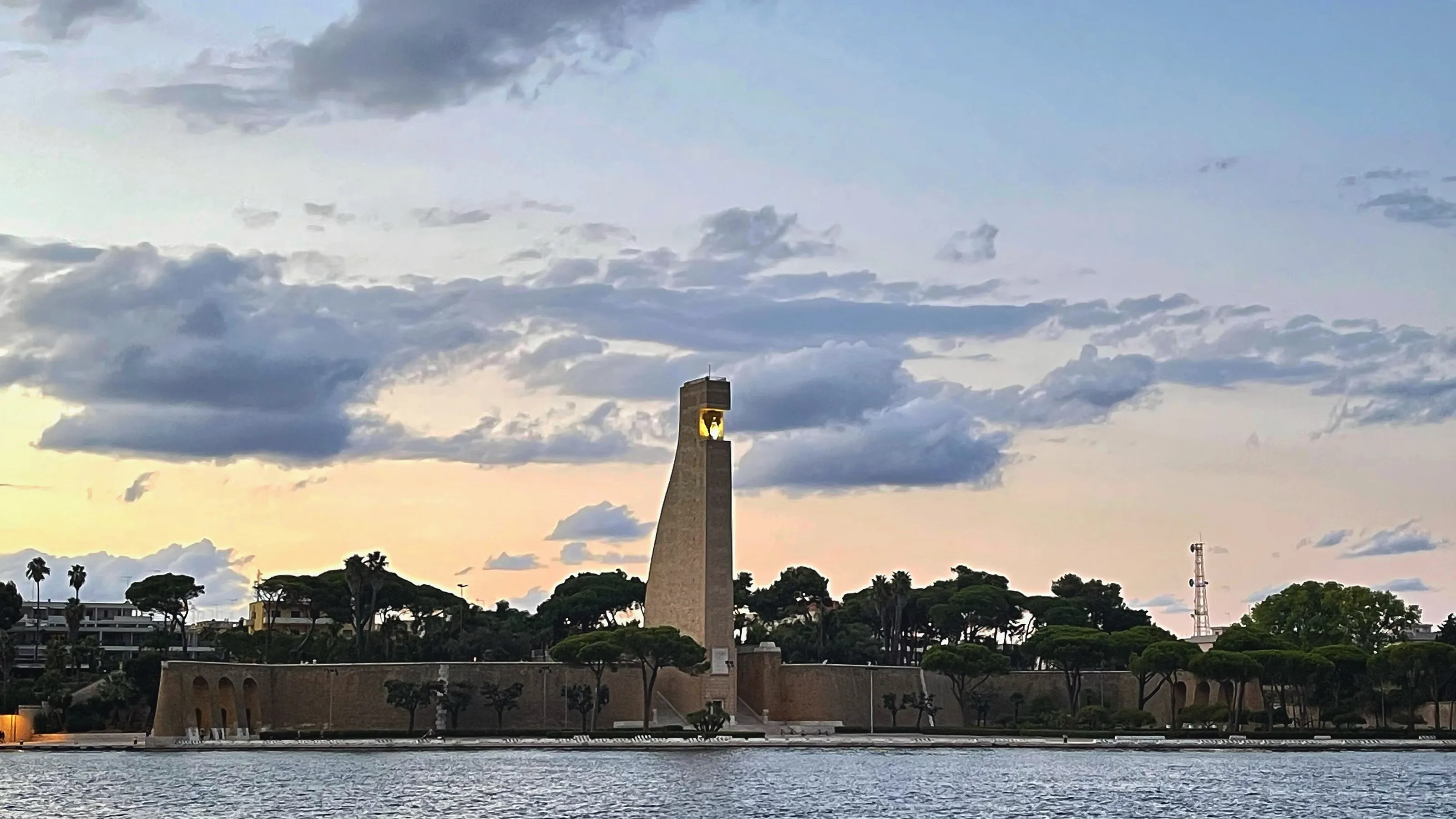
Standing 53 m high and shaped like a rudder, built in 1933 of reinforced concrete clad in limestone, it honours the roughly 6,000 Italian sailors who died in the First World War (Wikivoyage EN). You can visit the crypt or climb a helical staircase to a viewpoint over the city and the harbour. A boat crosses the inner bay about every 20 minutes according to Wikivoyage (DE).
Santa Maria del Casale, near the airport
This Gothic-Romanesque church, completed in 1322 according to Wikivoyage (EN), stands right beside the airport. Its facade is decorated with geometric patterns in grey and yellow stone, with a cusped entrance porch, and the interior keeps 14th-century frescoes in late Byzantine style. It was declared a national monument in 1875.
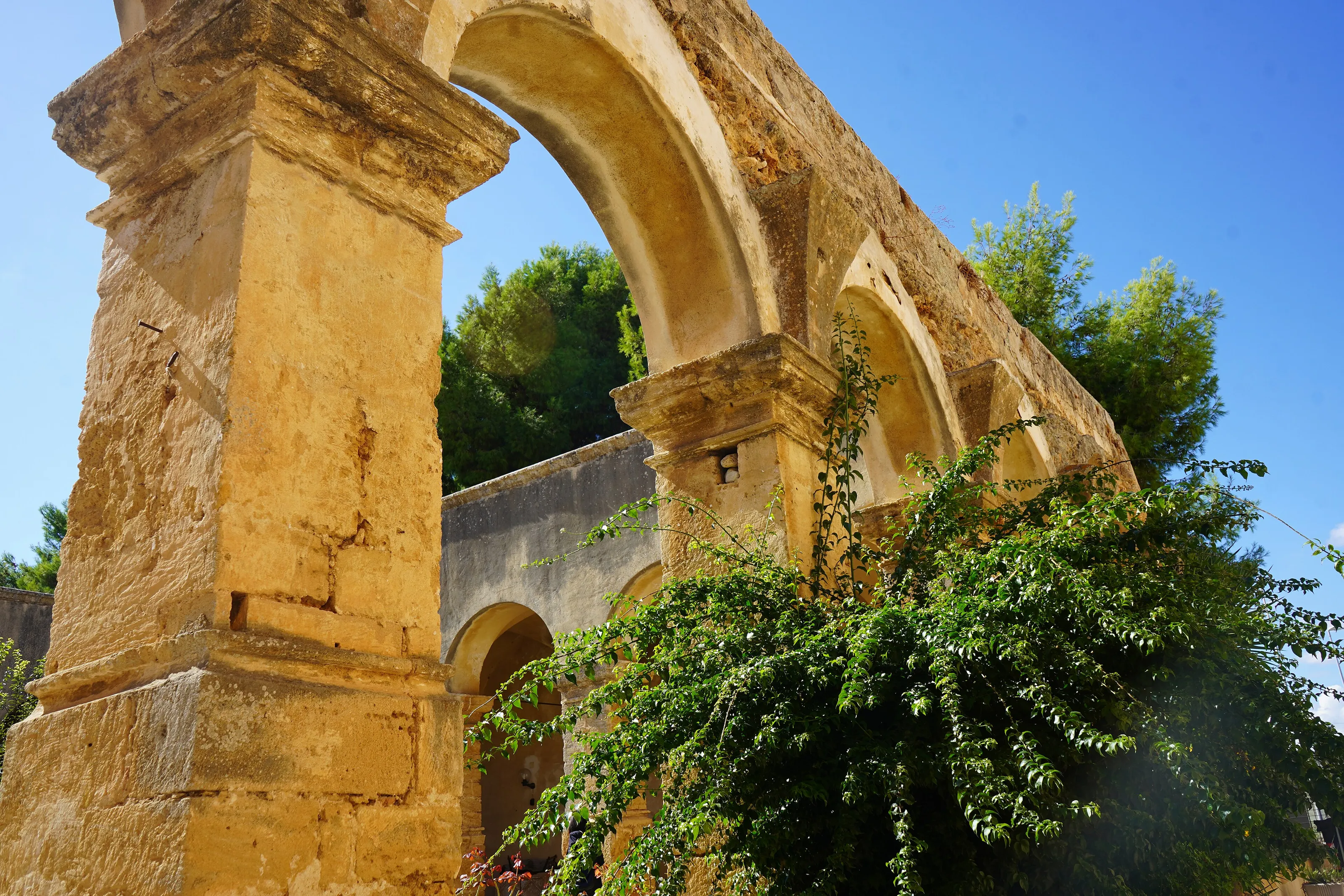
Swabian castle, cathedral, San Giovanni al Sepolcro
The Swabian castle, built under Frederick II in the 13th century, received its four towers from the Aragonese according to Wikipedia (FR); it is now used by the navy and is not open to visitors (Wikivoyage DE). The Romanesque cathedral, built from 1098 to 1132, was almost entirely rebuilt after the 1743 earthquake (Wikivoyage EN). The temple of San Giovanni al Sepolcro, a round Norman church of the 11th century, is one of southern Italy's major Romanesque buildings.
Museums and culture
Archaeology, Roman remains and the Crusader Middle Ages
The Ribezzo Archaeological Museum
Set beside the cathedral on Piazza Duomo, it is preceded by the Templars' portico, a 13th-century loggia of the former bishop's palace (Wikipedia FR; Wikivoyage EN). We do not quote prices or opening times.
Roman remains under the theatre
The archaeological site of San Pietro degli Schiavoni lies beneath the Teatro Verdi: a Roman quarter was found there, with a paved street, remains of a domus with mosaics and a thermal complex (Wikivoyage DE).
Palazzo Granafei Nervegna
This building on Via Duomo keeps the original capital of one of the Roman columns and hosts exhibitions upstairs (Wikivoyage EN). Brindisi was also a great Crusader port: Frederick II sailed from here in 1227 on the Sixth Crusade (Wikipedia EN).
Food and drink
Simple Apulian cooking: pasta, seafood and pettole
Local cooking
Wikipedia (FR, EN) describes simple cooking built on inexpensive ingredients such as barley flour, cheaper than wheat, with a strong place for vegetables, snails and bluefish. Pettole, fried yeast-dough fritters, are a typical recipe.
Pasta and sea
Wikivoyage (EN) lists spaghetti with clams and orecchiette with turnip tops as Apulian classics, and says locals speak highly of the area's seafood.
Market and opening hours
The Piazza Mercato market runs every day except Saturday (Wikivoyage EN). Off-season, many shops close in the early afternoon, around 1 pm to 4 pm. We do not recommend specific addresses and do not quote prices.
Getting around
On foot in the centre, buses, and a car for the beaches
Walking
The centre is small: a little over a kilometre separates the station from the Roman column, and nearly everything can be seen on foot in an afternoon (Wikivoyage EN). The areas north and south of the centre, taken up by many military installations, are not pleasant to cover on foot.
Buses and boat
Buses link the airport, the station and the ferry terminal; the "AP" line serves Costa Morena (Wikivoyage EN, DE). For the Sailor's Monument, a boat crosses the inner harbour (Wikivoyage DE).
Driving
The beaches to the north and the surroundings are best reached by car (Wikivoyage EN): a rental desk at the airport is handy for the Salento.
Budget and precautions
A low-key port city to approach with common sense
Price level
We give no figures because we could not cross-check them against two independent sources; prices for lodging, meals and transport change from year to year.
Precautions
As in any port city, keep your bag and papers safe, especially around the station and the port, and avoid crossing military or industrial areas on foot.
Flights and entry
SniperAir tracks prices to BDS and compares them with the route's history, but it does not sell or book tickets. Also watch Bari (BRI), about an hour by road according to Wikivoyage (EN). Italy is part of the Schengen area: check entry rules for your nationality and your government's official advice.
When to go
Hot dry summers, mild winters, sirocco storms in spring and autumn
Winter (December to February)
Mild, with frequent rain; snow is rare according to Wikivoyage (EN).
Spring (March to May)
The sirocco can bring thunderstorms, even red Saharan sand (Wikivoyage EN). Days suit visits to the Romanesque churches and the harbour.
Summer (June to August)
Hot, dry and very sunny; the heat index regularly exceeds 30 °C and can reach 37 °C in July and August according to Wikipedia (EN).
Autumn (September to November)
As in spring, the sirocco can trigger storms; September remains pleasant for the city and the coast.
Brindisi has a Mediterranean climate (Csa) according to Wikipedia (EN), with hot dry summers and mild winters with moderate rainfall. Wikivoyage (EN, ES) mentions summers that are sometimes humid. We give no average figures.
By length of stay
What to do in Brindisi depending on how long you stay
The essentials
The waterfront and the Roman column, the cathedral, Piazza Duomo with the Ribezzo museum, and the boat crossing to the Sailor's Monument.
Churches and remains
Santa Maria del Casale, San Giovanni al Sepolcro, San Benedetto and the archaeological site of San Pietro degli Schiavoni.
Salento and coast
Lecce by train, the Torre Guaceto nature reserve or Bari, with Brindisi as your base.
In pictures
Brindisi in pictures
You might also like
Similar destinations
FAQ
Frequently asked questions about flights to Brindisi
How do I get from Brindisi airport to the centre?
Brindisi-Salento (BDS) is on the edge of the city, about 3 km from the centre. A regular bus runs to the station and the ferry port. Timetables change: check them before you travel.
When is the best time to visit Brindisi?
In spring and early autumn, with possible sirocco storms. Summer is hot and dry; winter is mild, with frequent rain.
What is there to see in Brindisi?
The Roman column marking the end of the Via Appia, the natural harbour, the Sailor's Monument, the cathedral, San Giovanni al Sepolcro and Santa Maria del Casale.
Is Brindisi expensive?
We give no figures because we could not cross-check them against two independent sources. Prices vary by season.
What should I eat in Brindisi?
Pasta with clams, orecchiette with turnip tops, seafood and pettole, fried yeast-dough fritters.
How long should I stay in Brindisi?
One day for the centre; three days adding the churches and Roman remains; four days or more for Lecce and the coast.
How much does a flight to Brindisi usually cost?
The price depends mainly on your departure city, the time of year and how far ahead you book. The "opportunities" section above shows real examples of prices SniperAir has already detected to this destination.
How do I get alerted when a flight to Brindisi drops below my budget?
Create an alert profile with your departure airport, Brindisi as the destination and your maximum budget. You are notified automatically as soon as a matching price is detected.
Ready to head to Brindisi?
Set your budget and let SniperAir monitor fares for you.
Create my alert