
Cheap flights to Palma de Mallorca
Set your departure airport and maximum budget: SniperAir tracks prices to Palma de Mallorca and alerts you the moment a deal matching your criteria appears.
Quick summary
Country
Spain
Continent
Europe
Airport
PMI
Currency
Euro (EUR)
Time zone
UTC+1 (UTC+2 during summer time)
Deals already spotted to Palma de Mallorca
Real flight examples detected by SniperAir, with their reference price.
Loading examples…
Why track Palma de Mallorca with SniperAir
You do not need to compare prices every day
Choose your departure
Enter your departure airport and your maximum budget for a flight to Palma de Mallorca (PMI).
SniperAir keeps watch
Our systems continuously compare new prices with the real price history of the route. SniperAir monitors prices and alerts you: it does not sell or book tickets.
You receive an alert
As soon as a price matches your criteria, you are notified, without having searched for anything yourself.
Airports and getting into town
One airport for the whole island, a short ride from the capital
Palma de Mallorca Airport (PMI)
Palma Airport is the island's only commercial airport and where most visitors arrive, according to Wikivoyage. It lies about 8 to 9 km east of the city centre (the two Wikivoyage articles give slightly different figures), roughly 15 minutes by taxi in normal traffic. It opened in 1960 and shares its two runways with an air force base; in practice it works as a single terminal with several departure modules. A city bus runs to the centre about every 15 minutes from 06:15 until midnight, according to Wikivoyage, and other routes serve S'Arenal, the western resorts and the rest of the island. Car hire desks are in the terminal.
Distances and frequencies are approximate, based on Wikivoyage (EN) and Wikipedia (EN); timetables change by season, so check before you travel. We do not quote fares.
Palma is the capital and largest city of the Balearic Islands, on the south coast of Mallorca on the Bay of Palma, with about 438,000 residents in 2024 according to Wikipedia. It is the eighth-largest city in Spain. The Cabrera archipelago, though well offshore, is part of the municipality. Mallorca is the largest of the Balearic Islands, with sunny beaches, old towns, mountain scenery and good food and wine, as Wikivoyage puts it.
An island rather than a single city
Distances are short: Palma to Alcudia on the north coast is only 55 km, and even the farthest point, Cala Ratjada, is about 83 km or 70 minutes by road, according to Wikivoyage. Almost any accommodation can therefore be a base for the whole island. Palma is also a port, with ferries to Barcelona, Valencia, Denia, Ibiza and Menorca; the Getting around section has the details.
Landmarks and nature
A Gothic cathedral facing the sea, a round castle and a mountain island
Palma began as a Roman foundation in 123 BC on the site of an earlier Talaiotic settlement, then spent more than three centuries as the Muslim city of Medina Mayurqa until King Jaime I of Aragon conquered it in 1229, according to Wikipedia and Wikivoyage. The old town is compact and walkable and holds most of the landmarks. The places below are illustrated.
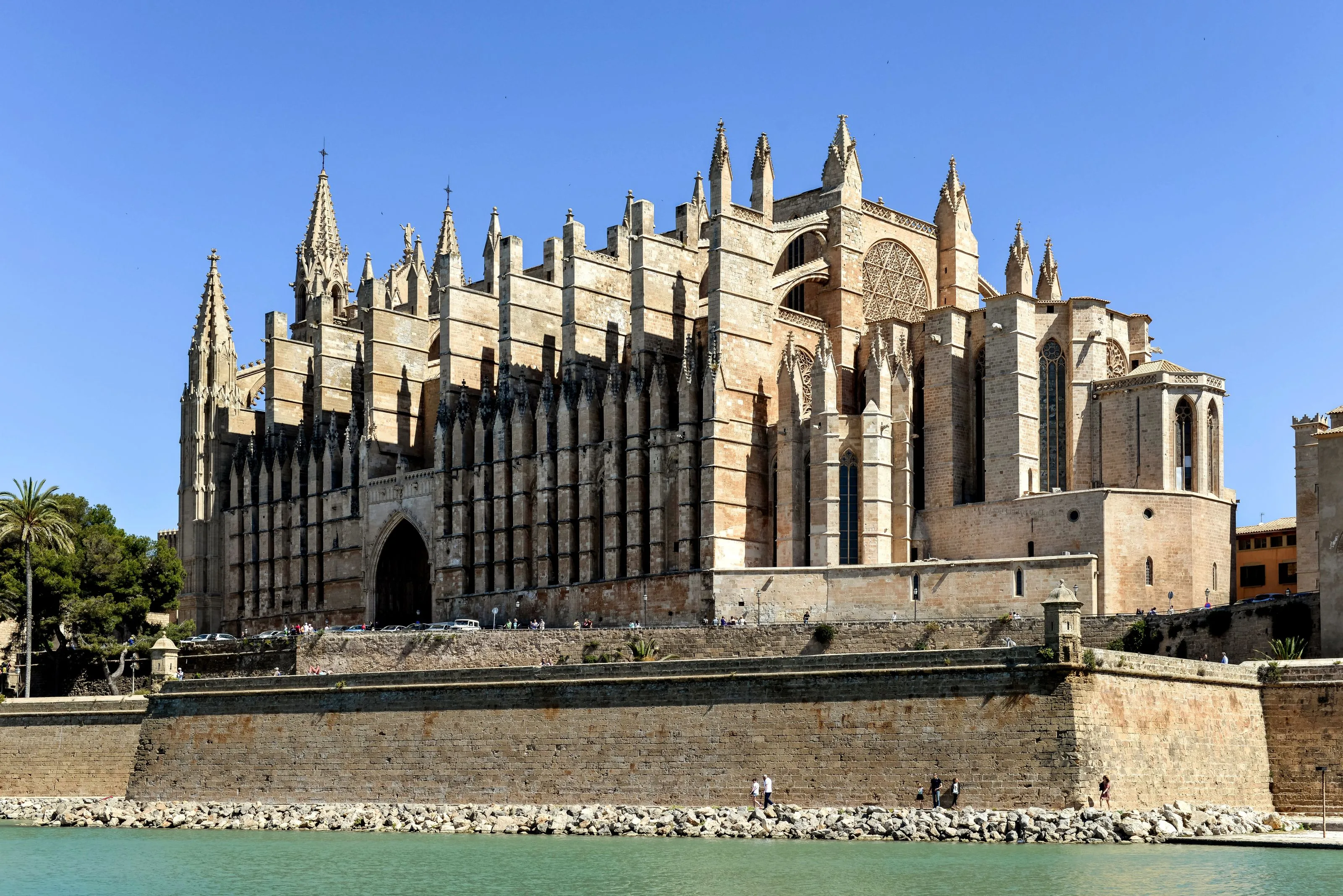
The cathedral, La Seu
Work on the cathedral started in 1229 and was not completed until 1601, in a mostly Gothic style, according to Wikivoyage; Wikipedia (ES) adds that it was consecrated in 1346 and has the largest rose window of the Gothic world. Wikivoyage notes that Gaudi tried to improve it and then quit. The Royal Chapel holds the tombs of kings Jaime II and Jaime III. In the photo the cathedral rises behind a crenellated palace, palm trees and plane trees.
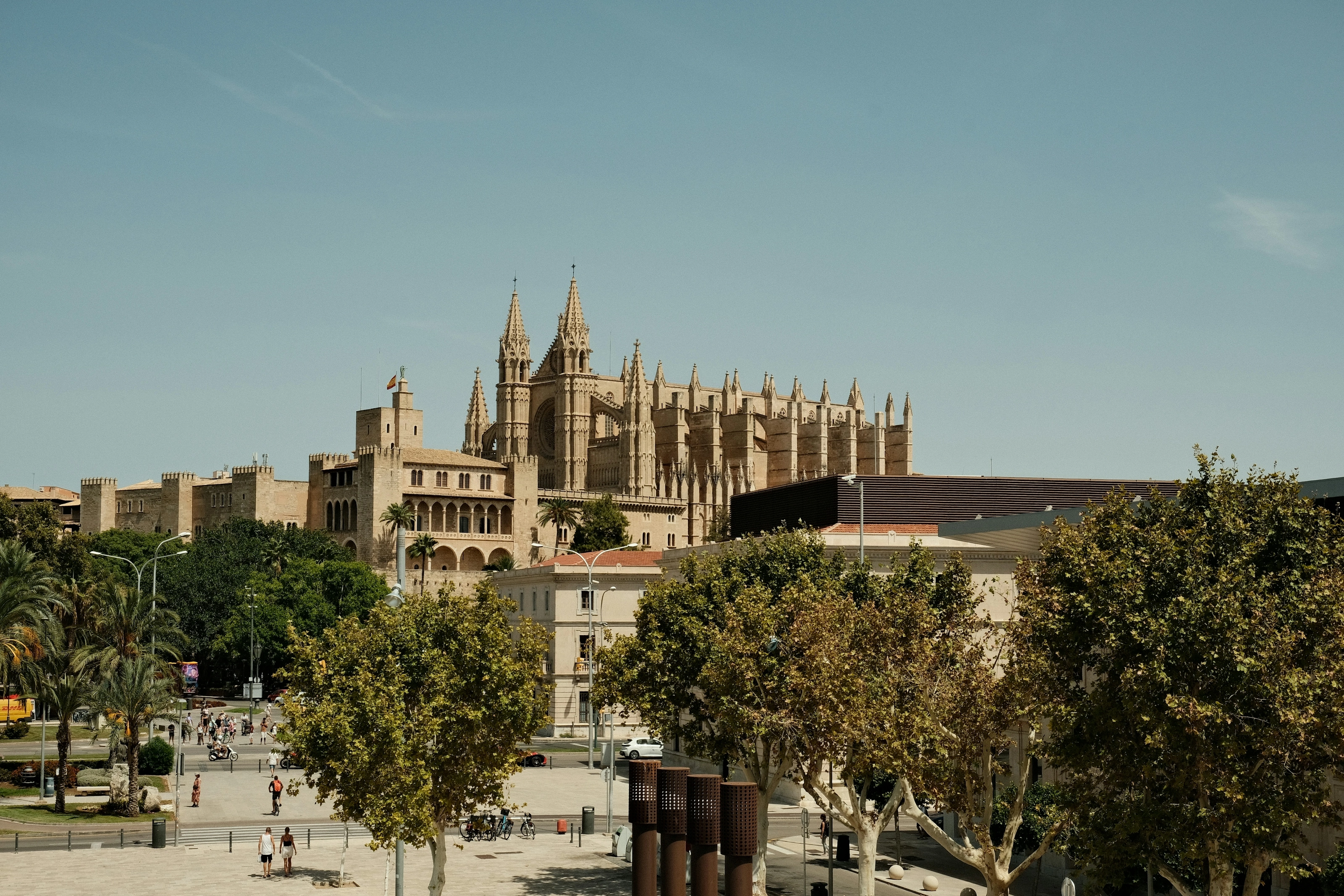
The east end from the sea wall
Seen from the seaward side, the cathedral towers above the old fortifications with its buttresses and its great rose window. At the foot of the walls lie the Parc de la Mar and an artificial lake, as Wikivoyage describes, and the seafront promenade continues along the walls to the marina and the harbour.
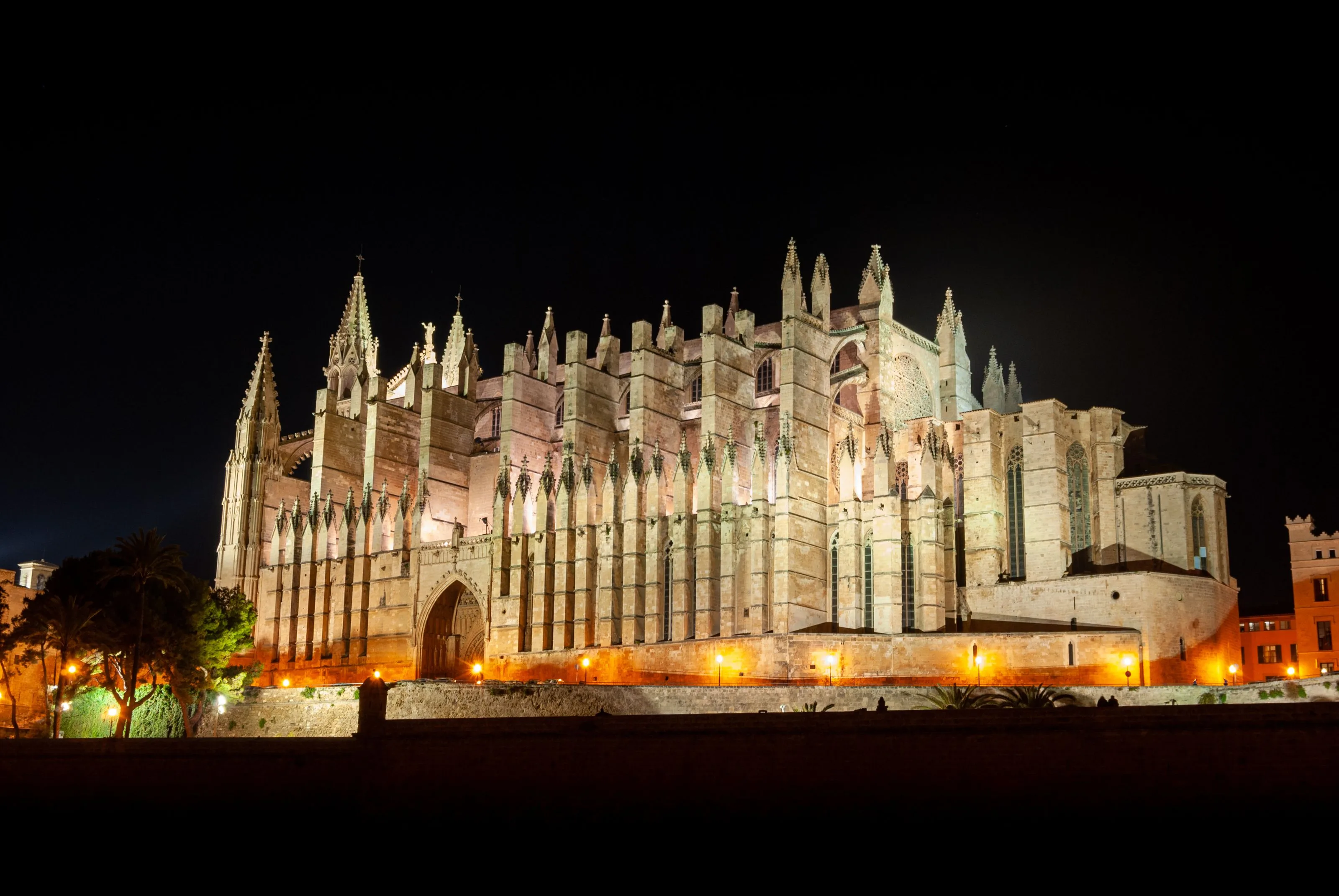
The cathedral at night
After dark the cathedral is floodlit. Wikivoyage describes the southern end of the seafront as a strip of pubs and clubs with discos until dawn and the floodlit cathedral in the background. The neighbouring Royal Palace of La Almudaina was rebuilt from 1309 and is still used as a residence by the Spanish royal family, according to the same source.
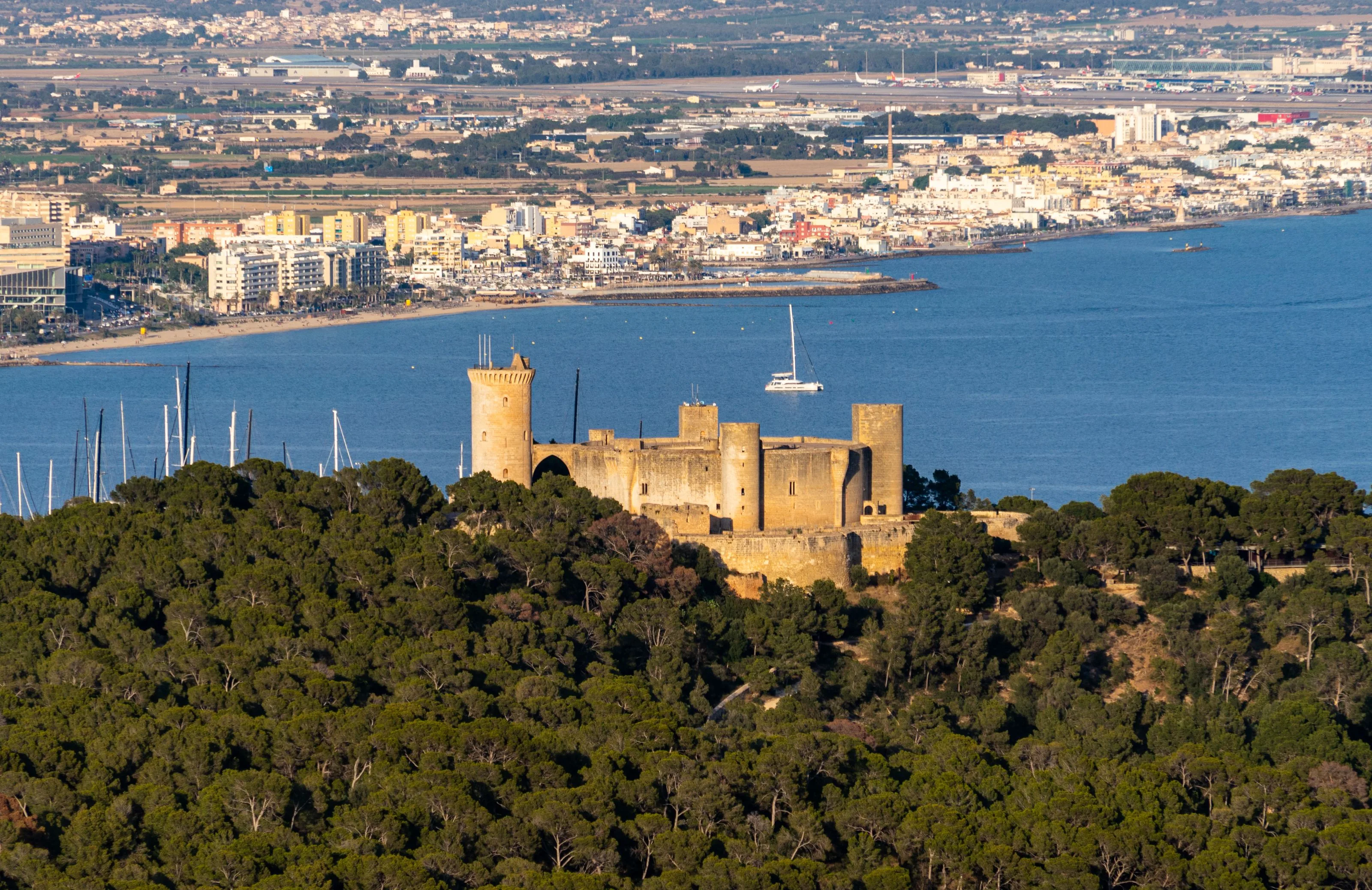
Bellver Castle
Bellver Castle, from the 14th century, stands on a pine-covered hill above the bay and is known for its unique circular plan with three large towers and a central courtyard, according to Wikivoyage. It houses a small museum and offers a broad view over the bay and the city; in the photo you can see the curve of the beach and, far behind, the airport area.
Arab baths, Llotja and squares
The Arab Baths, built in the 10th century, are the only building in Palma dating from the Arab period according to Wikivoyage. The Llotja, the medieval merchants' exchange, is a masterpiece of local Gothic by the architect Guillem Sagrera according to Wikipedia (DE), and the Plaça del Mercat has several Art Nouveau buildings.
Beyond the city
North-west of Palma, the Serra de Tramuntana runs for more than 90 km with 54 summits above 1,000 m, according to Wikipedia (DE); Wikivoyage (FR) says it is a World Heritage landscape crossed by the GR 221 trail. Valldemossa recalls the winter of Chopin and George Sand, and the old wooden train to Soller leaves from central Palma. To the south, the Cabrera archipelago is an uninhabited national park 20 km offshore, according to Wikivoyage.
Museums and culture
Modern art, island history and medieval heritage
Fundacion Juan March and Es Baluard
The Fundacion Juan March, in a stately 17th-century mansion, shows modern art with big names such as Picasso, Miro and Dali, according to Wikivoyage. Es Baluard, the contemporary art museum, has a three-storey collection of 19th- and 20th-century works by Balearic artists, according to the same source.
Cathedral and city museums
The cathedral ticket includes the Diocesan Museum of sacred art, with religious paintings and silverware, according to Wikivoyage. The Museum of Mallorca presents the heritage of the city. We do not quote prices: tickets and opening hours change.
Joan Miro at Cala Major
The Catalan painter Joan Miro lived and worked in Cala Major, on the western edge of Palma, and his studio house is now home to a foundation, according to Wikipedia (DE). Architecture fans will also notice the Modernisme buildings of the early 20th century scattered across the centre.
Food and drink
Ensaimada, sobrasada, roast suckling pig and Mallorcan wine
Pastry and cured meats
The ensaimada is the island's signature pastry, a spiral of sweet dough eaten at breakfast, plain or filled with cream, angel hair or chocolate, according to Wikipedia (ES). Sobrasada, a raw cured sausage, is the great local product, along with camaiot and botifarro; Wikivoyage (ES) adds pamboli, bread rubbed with oil and tomato.
Typical dishes
Porcella asada, roast suckling pig with potatoes and herbs, is a family-meal dish; trempo, a summer salad of tomato, onion and pepper, cools the table, according to Wikipedia (ES). In the centre you will also find paella and wood-fired steak, according to Wikivoyage, which jokes that the phrase for a full English breakfast is desayuno London.
Wine and a night out
Binissalem wine, almonds, olives and vegetables are traditional farm products of the island according to Wikipedia (FR). In the evening the seafront offers bars and clubs, and the old town has cafes around the cathedral and its streets.
Getting around
Buses, trains, hire cars and ferries to see the whole island
In Palma and to the airport
The old town is best on foot; its narrow streets are not comfortable for cycling, and bikes work better along the beach outside the centre, according to Wikivoyage. City buses are run by EMT, and the A1 line links the airport to the centre. Taxis wait at the port, the airport and the station.
Train, bus and car
Red-and-yellow TIB buses serve other towns from April to October, according to Wikivoyage. From the intermodal station at Plaça d'Espanya, trains run to Inca, Sa Pobla and Manacor, and the wooden train to Soller leaves from a street across the road. To explore freely, Wikivoyage (DE) calls a hire car essential: toll-free motorways radiate from Palma.
Ferries and other islands
Ferries sail to Palma from Barcelona (about 7 hours), Denia (5), Valencia (7), Ibiza (2 to 4) and Menorca (6), according to Wikivoyage, with operators such as Trasmed, Baleària and GNV. The port is 2 km south-west of the centre. A second port, Alcudia in the north, has links to Barcelona and Menorca, according to Wikivoyage (DE).
Budget and precautions
A mass-market destination, so prices swing with the season
Price level
Palma and the Balearic Islands are among the busiest tourist areas in Europe, according to Wikipedia (FR), and demand is very seasonal, with a peak from May to September according to Wikivoyage. We do not quote figures, because we could not confirm them across two independent sources.
Currency and payment
The currency is the euro. Spain is in the Schengen area, so check the entry rules for your nationality.
Flights and precautions
SniperAir watches prices to PMI and compares them with the route's history, but it does not sell or book tickets. You can also watch Ibiza (IBZ) or Menorca (MAH) for comparison. Wikivoyage (ES) warns about pickpockets around the cathedral and the terraces, so keep your belongings in sight.
When to go
A Mediterranean climate, with a season from late April to October
Winter (December to February)
Mild, with an average daily maximum of about 15 C in January according to Wikipedia (FR); snow is exceptional in Palma but common on the Tramuntana summits according to Wikipedia (ES). Many tourist businesses close in winter, according to Wikivoyage.
Spring (March to May)
The tourist season begins in late April, according to Wikivoyage (FR). Days are mild and the mountains are good for walking.
Summer (June to August)
Hot and dry: July has fewer than two rainy days on average according to Wikipedia (FR), which gives a mean August maximum of 31 C. Wikivoyage says the sea breeze keeps temperatures in check; bring a jacket for the evening.
Autumn (September to November)
Wikivoyage suggests September: the hottest days and the peak of crowds are past, but the sea is warm and calm. October and November are the wettest months, with about ten rainy days each, according to Wikipedia (FR).
The mean annual temperature in Palma is about 18 C according to Wikipedia (FR, ES), with 350 to 500 mm of rain a year. Frost is rare, around eight days a year and light, according to Wikipedia (FR). We do not quote precise monthly averages, because the sources differ.
By length of stay
What to do in Palma de Mallorca depending on how long you stay
The essentials
The cathedral, the Almudaina palace, the Arab Baths, the Llotja and a walk along the seafront.
Mountains and coves
Bellver Castle, a modern art museum, the Soller train and Valldemossa, then a cove or a beach.
The whole island
The Tramuntana, Alcudia and Pollenca in the north and Cabrera in the south, with Palma as a base or a touring stay.
In pictures
Palma de Mallorca in pictures
You might also like
Similar destinations
FAQ
Frequently asked questions about flights to Palma de Mallorca
How do I get from Palma airport to the city centre?
The airport (PMI) is about 8 to 9 km east of the centre. A city bus runs about every 15 minutes and a taxi takes roughly 15 minutes, according to Wikivoyage. Check timetables before you travel.
When is the best time to visit Palma?
The season runs from late April to October. September is often recommended for warm sea and fewer crowds; winter is mild but some businesses close.
Do I need a hire car in Mallorca?
Wikivoyage (DE) calls it essential for exploring the island freely, with toll-free motorways radiating from Palma. TIB buses serve other towns, mainly April to October.
How long should I stay in Palma?
Two days for the old town and its museums; four days if you add Bellver Castle, Soller and Valldemossa; longer for the Tramuntana, the north and the coves.
What are the typical dishes?
Ensaimada, sobrasada, porcella asada and trempo, according to Wikipedia (ES); Wikivoyage (ES) adds pamboli and autumn bunyols.
How do I reach the other Balearic islands?
By ferry from Palma: Ibiza takes 2 to 4 hours and Menorca about 6, according to Wikivoyage, or you can fly. Ibiza and Menorca both have their own SniperAir pages.
How much does a flight to Palma de Mallorca usually cost?
The price depends mainly on your departure city, the time of year and how far ahead you book. The "opportunities" section above shows real examples of prices SniperAir has already detected to this destination.
How do I get alerted when a flight to Palma de Mallorca drops below my budget?
Create an alert profile with your departure airport, Palma de Mallorca as the destination and your maximum budget. You are notified automatically as soon as a matching price is detected.
Ready to head to Palma de Mallorca?
Set your budget and let SniperAir monitor fares for you.
Create my alert