
Cheap flights to Salamanca
Set your departure airport and maximum budget: SniperAir tracks prices to Salamanca and alerts you the moment a deal matching your criteria appears.
Quick summary
Country
Spain
Continent
Europe
Airport
SLM
Currency
Euro (EUR)
Time zone
UTC+1 (UTC+2 during daylight saving time)
Deals already spotted to Salamanca
Real flight examples detected by SniperAir, with their reference price.
Loading examples…
Why track Salamanca with SniperAir
Castile's golden-stone city and a university town since 1218
Choose your departure
Enter your departure airport and your maximum budget for a flight to Salamanca (SLM).
SniperAir keeps watch
Our systems continuously compare new prices with the real price history of the route. SniperAir monitors prices and alerts you: it does not sell or book tickets.
You receive an alert
As soon as a price matches your criteria, you are notified, without having searched for anything yourself.
Salamanca is the capital of its province in Castile and León, about 800 m above sea level on the northern Meseta, straddling the Tormes river (Wikipedia EN, ES, DE). It has around 145,000 inhabitants (144,458 in 2024 per Wikipedia EN, 146,110 in 2025 per Wikipedia DE). Its Old City has been a UNESCO World Heritage Site since 1988 and the city shared the title of European Capital of Culture with Bruges in 2002 (Wikipedia EN, DE). The University of Salamanca, founded in 1218 and granted the title of university in 1254, is one of the oldest in Western Europe and the oldest still operating in Spain (Wikipedia EN, FR, DE). That student life is what shapes the city today, with tens of thousands of students and many foreigners who come to learn Spanish, especially in summer (Wikipedia EN, DE). This guide presents Salamanca as open sources describe it; SniperAir tracks flight prices to this destination, compares them with the route's real price history and alerts you when one falls below your budget.
Airport and getting into town
An airport with very few flights: Madrid is the real gateway
Salamanca - Salamanca-Matacán Airport (SLM)
Salamanca Airport (SLM) sits on the Matacán military base east of the city, about 14 km away according to Wikipedia (EN), 15 km according to Wikivoyage (EN) and 17 km according to Wikipedia (ES). The sources describe very limited, seasonal commercial traffic: summer routes to Palma de Mallorca (Wikipedia EN), charter flights to Palma and Gran Canaria in summer (Wikipedia ES), and "only occasional summer flights" for Wikivoyage (EN). These routes change from one season to the next, so we publish no list and no timetable. The nearest large international airport is Madrid-Barajas (MAD), roughly 200 to 230 km away depending on the source (Wikivoyage EN: about 200 km; Wikipedia EN: 228 km).
Distance from SLM to the city: 14 km (Wikipedia EN), 15 km (Wikivoyage EN), 17 km (Wikipedia ES). Distance from Madrid: about 205 km by road (Wikivoyage EN), 215 km (Wikipedia DE), 220 km (Wikipedia FR), 228 km (Wikipedia EN). No fares published.
In practice most visitors land in Madrid and continue by rail or road. Wikivoyage (EN) says the fast Alvia trains from Madrid-Chamartín take about 1 hour 40 minutes, slower trains up to 3 hours, and that buses run from Madrid (about 3 hours) and Valladolid (about 90 minutes). Other guides quote anything from about 1 hour 40 to 2 hours 20 depending on the train, so check the exact service before booking. For a price alert, watch MAD first, and SLM only if a seasonal link exists from your home airport. Entry conditions, travel advice and flight links can change depending on your country of departure: check your own government's official recommendations before you book.
Landmarks
Cathedrals, carved facades and the Plaza Mayor
Salamanca is a city of golden sandstone where almost every facade tells part of the Spanish Renaissance. Here are five places to look for first, followed by other sights named in the sources.
The two cathedrals
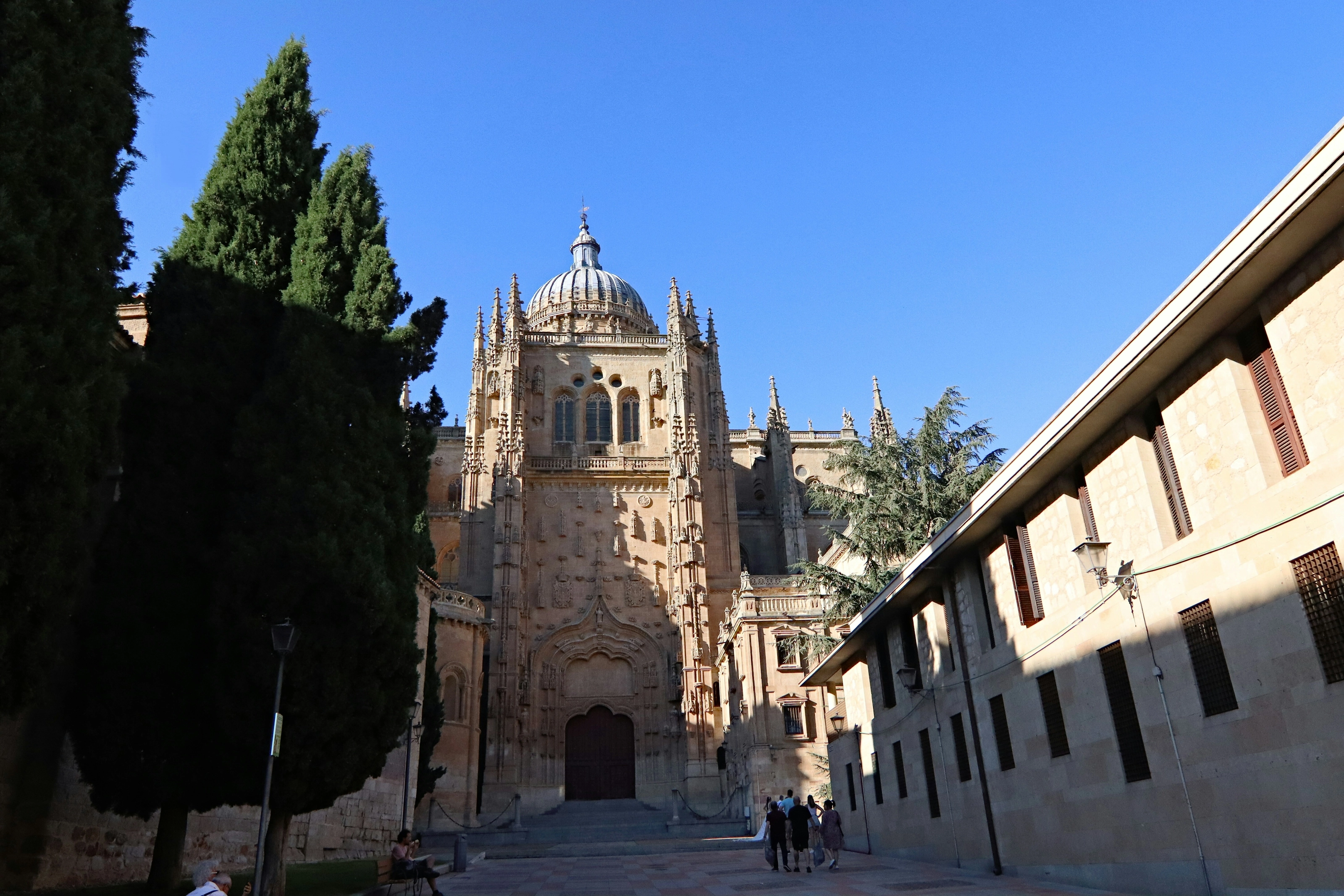
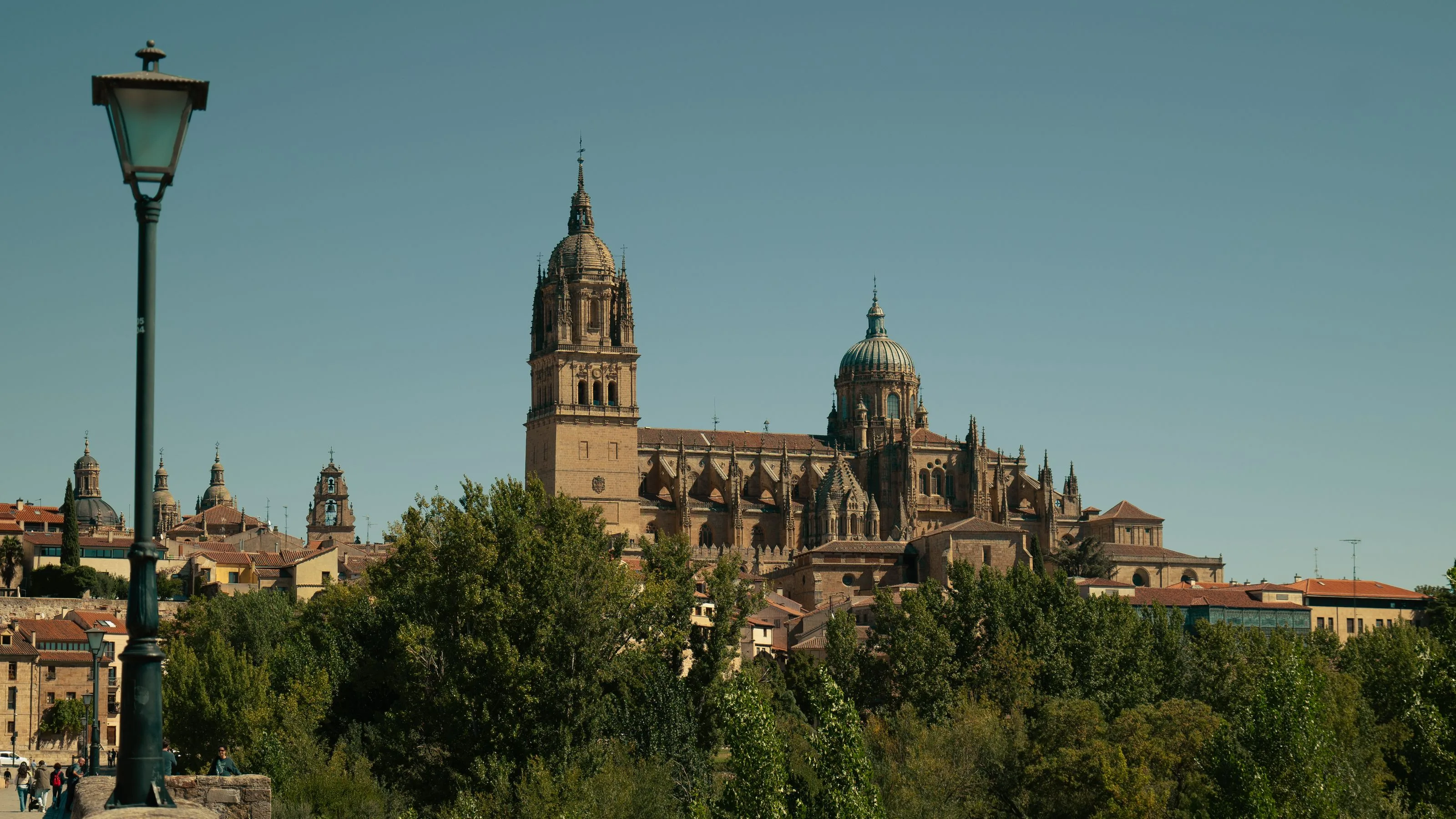
Salamanca has two cathedrals joined together: the Romanesque Old Cathedral of the 12th century and the much larger New Cathedral, begun in the 16th century in Gothic style and finished in the 18th (Wikipedia EN, DE). Their meeting point, the Patio Chico, is one of the city's most charming corners (Wikipedia FR). The main tower still shows a crack left by the 1755 Lisbon earthquake (Wikipedia EN, ES, DE). A route through the towers, called Ieronimus, offers views over the city (Wikipedia ES).
The plateresque facade of the university
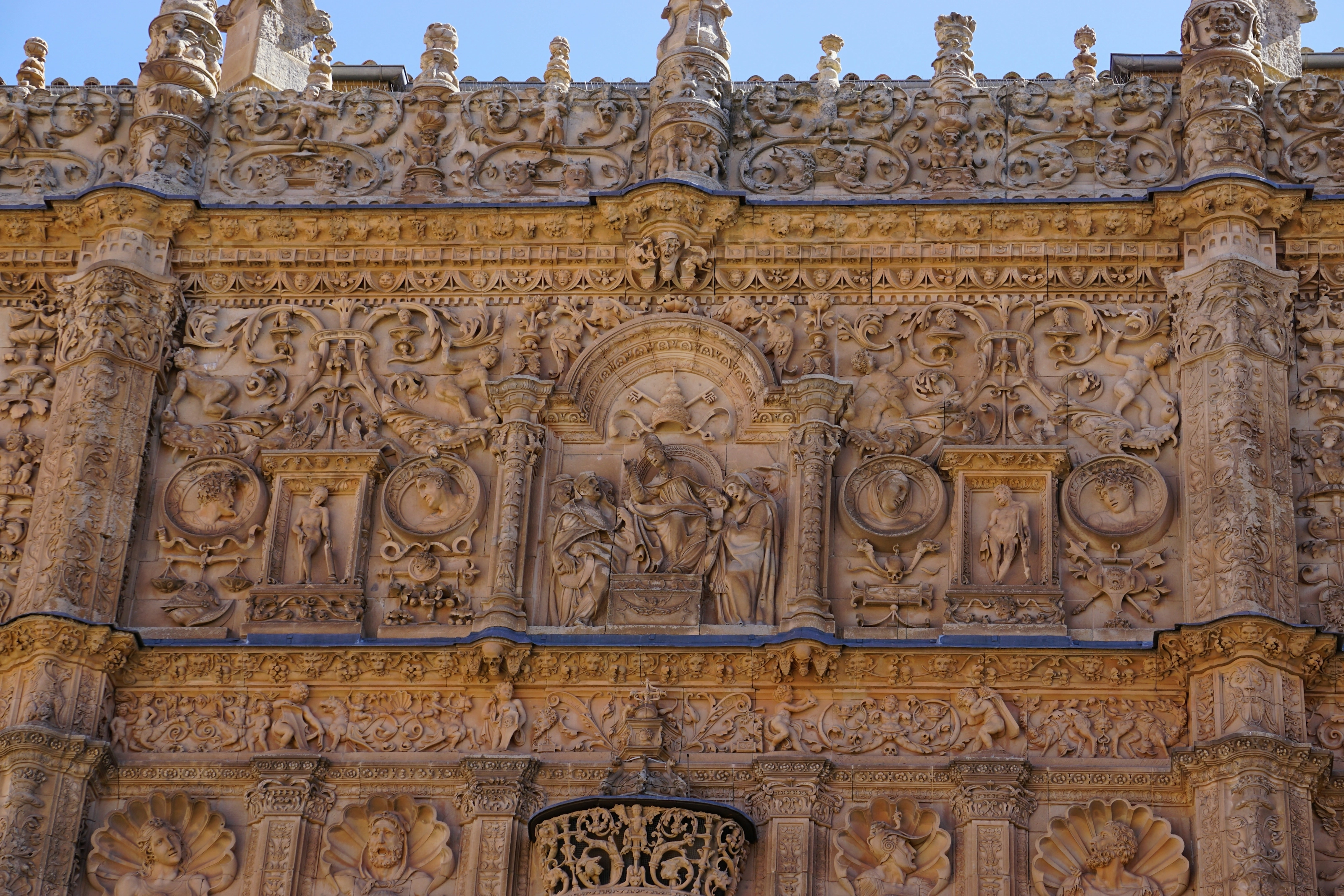
The Escuelas Mayores stand around a courtyard. Their main portal is a masterpiece of plateresque style, covered in sculpture, medallions and fine ornament (Wikipedia EN, DE). Tradition says that a student who spots the little frog, in fact a toad perched on a skull and hidden in the facade, will pass their exams (Wikipedia FR, DE). The Patio de Escuelas also holds the statue of Fray Luis de León (Wikipedia ES).
The Plaza Mayor
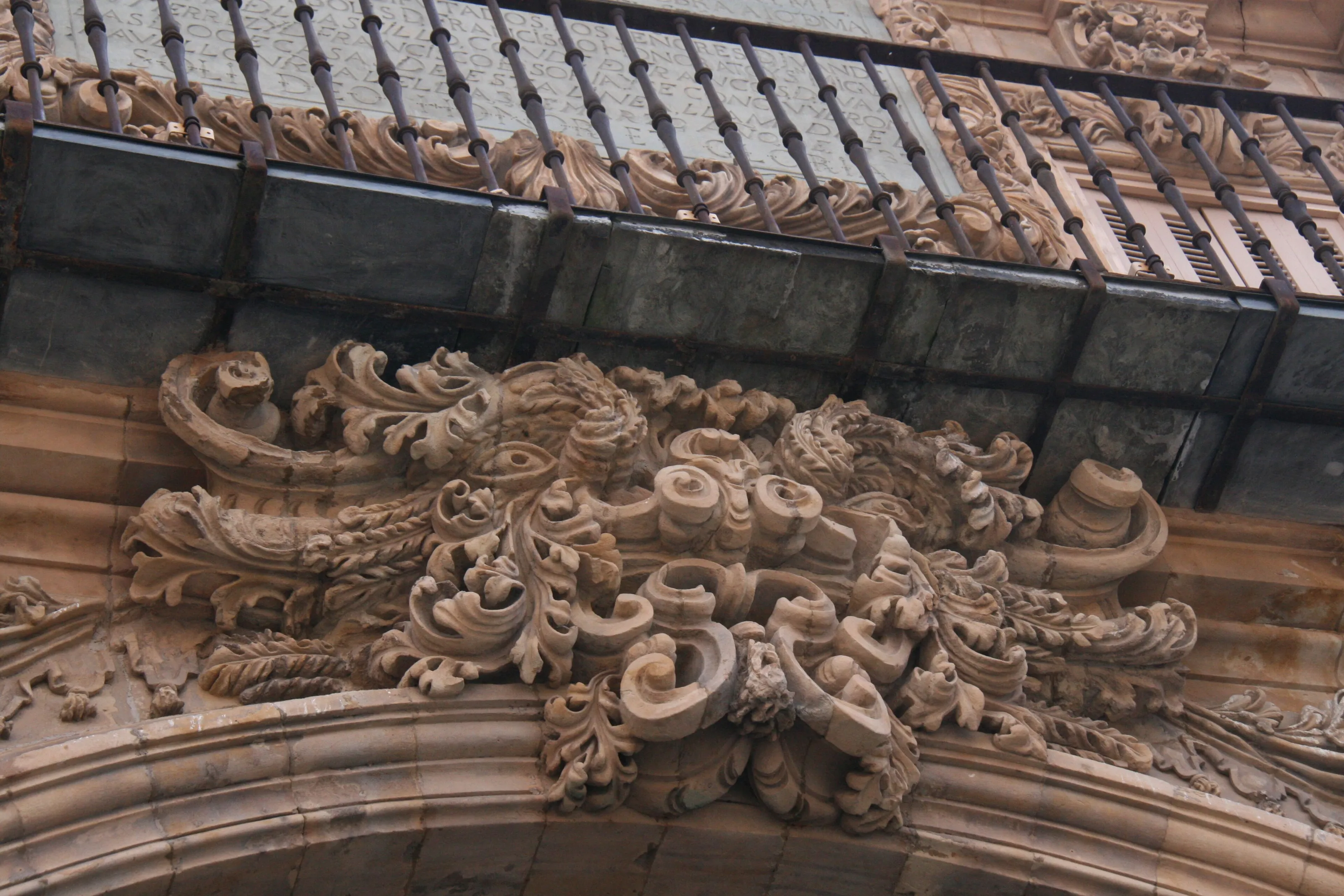
The Baroque Plaza Mayor, designed by members of the Churriguera family and built in the 18th century, is the heart of the city (Wikipedia FR, EN). Wikivoyage (EN) calls it the finest plaza in Spain, and Wikipedia (DE) notes that bullfights were once held there. In 2005 the city celebrated the 250th anniversary of its completion (Wikipedia EN). Its arcades and facades carry rich sculpted ornament, such as the carving above some of the arches.
Rooftops of the old town
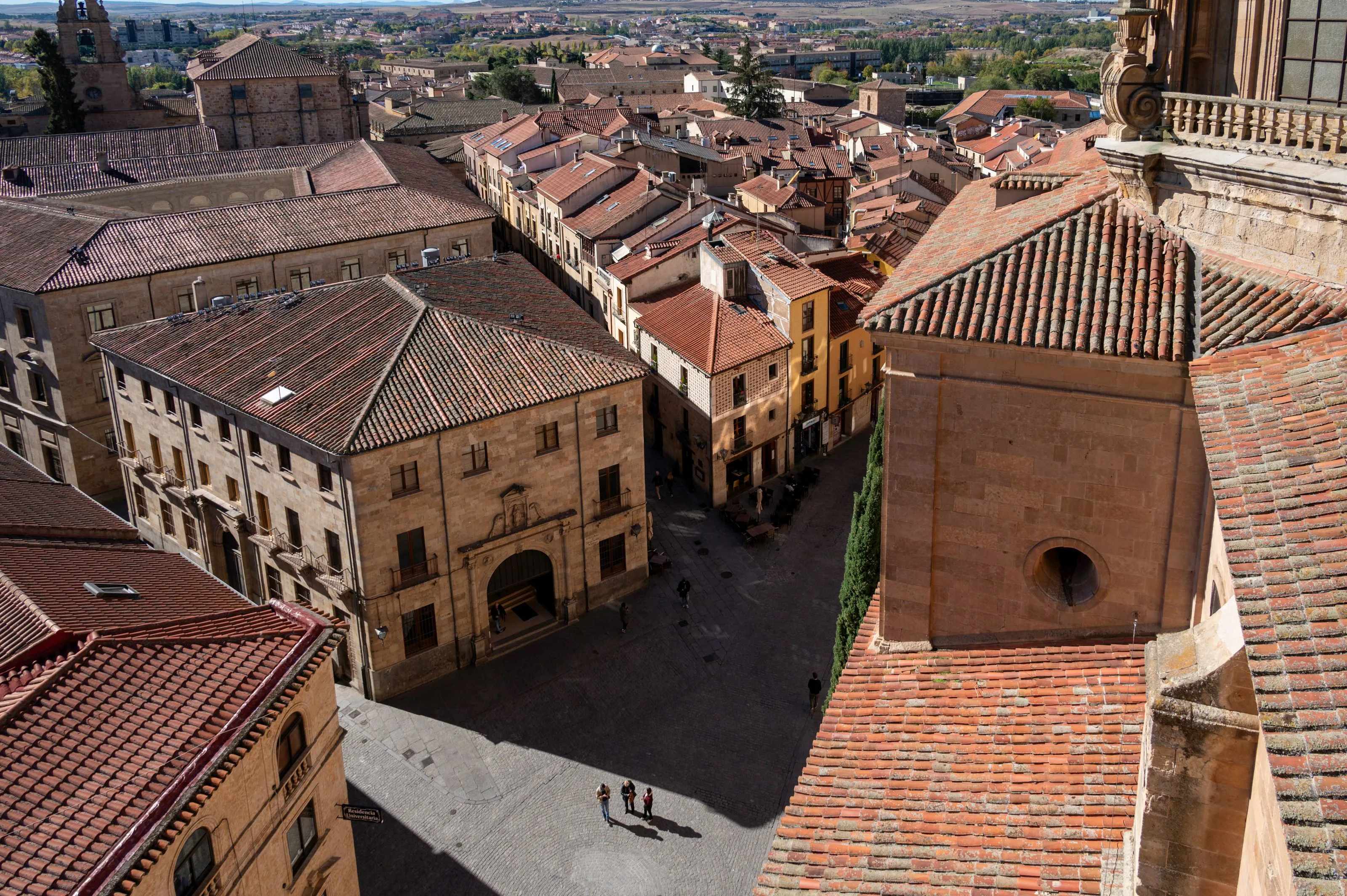
From above, the old town reads as a patchwork of red-tiled roofs and narrow lanes, dotted with belfries and domes. The cathedral towers offer viewpoints (Wikipedia ES). The Baroque Clerecía, home to the Pontifical University, is recognisable by its twin towers of about 50 m (Wikipedia FR, ES).
The cathedrals seen from the river
Along the Tormes the domes and belfries of the cathedrals rise above the trees. The river is crossed by the Roman bridge, of which fifteen arches date from the 1st century AD, the rest having been rebuilt in 1627 after a flood (Wikipedia FR, ES). Wikivoyage (EN) says the bridge has been pedestrian-only since 1973. Near it stands the stone bull mentioned in Lazarillo de Tormes (Wikipedia ES).
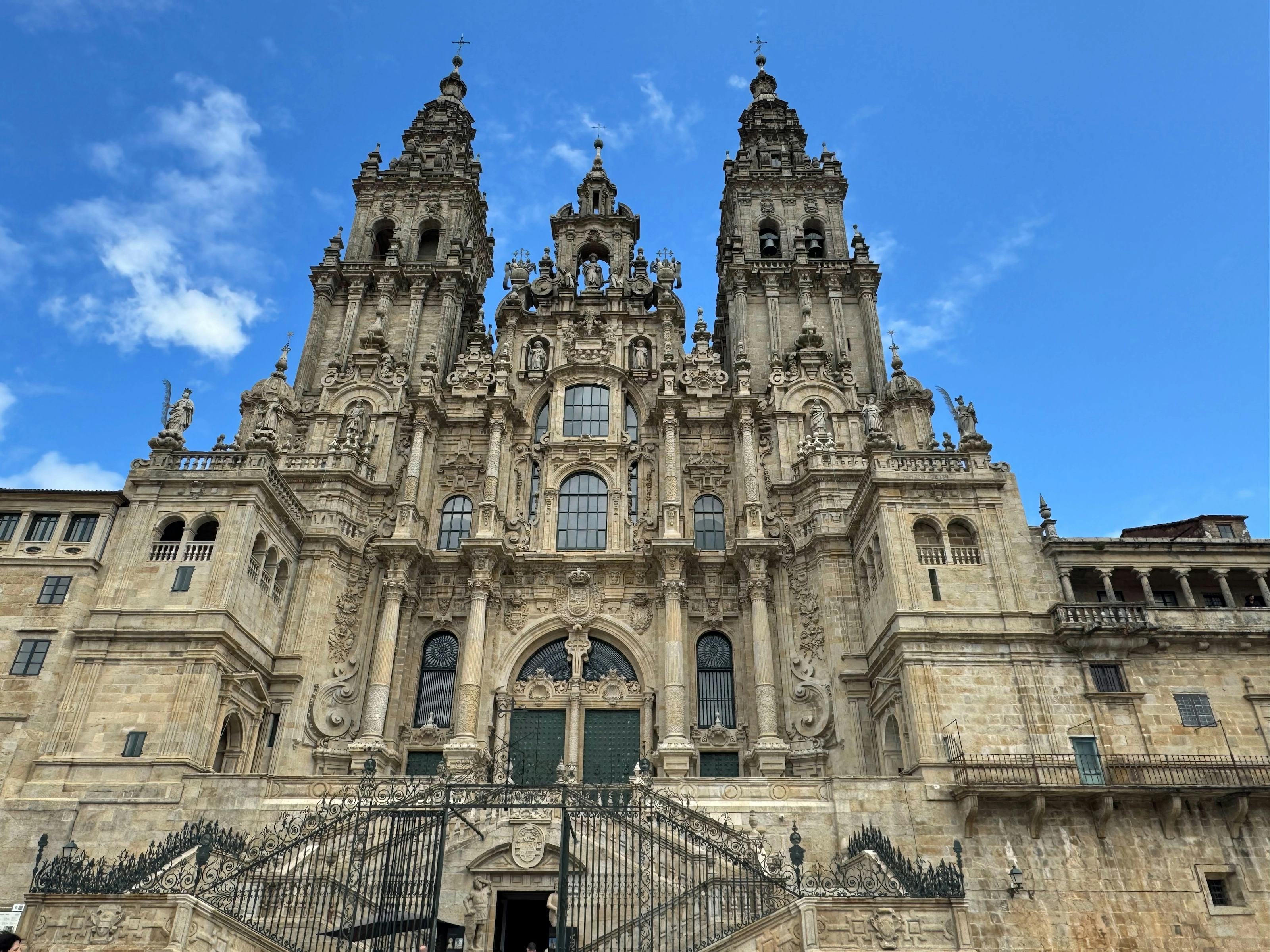
Other places in Salamanca: the Dominican convent of San Esteban, with its plateresque facade shaped like a triumphal arch (Wikipedia FR), where Christopher Columbus found support while preparing his voyage (Wikipedia EN); the Casa de las Conchas, a late 15th-century palace whose facade is covered in more than 300 sandstone shells (Wikipedia DE; 365 per Wikipedia FR); the plateresque Palacio de Monterrey (Wikipedia FR, ES); the 15th-century Torre del Clavero (Wikipedia ES); and the Convento de las Dueñas, whose irregular pentagonal cloister is among the loveliest in the city (Wikipedia ES; Wikivoyage EN).
Museums and culture
Museums: Art Nouveau, contemporary art and university memory
Casa Lis, the Art Nouveau and Art Deco museum
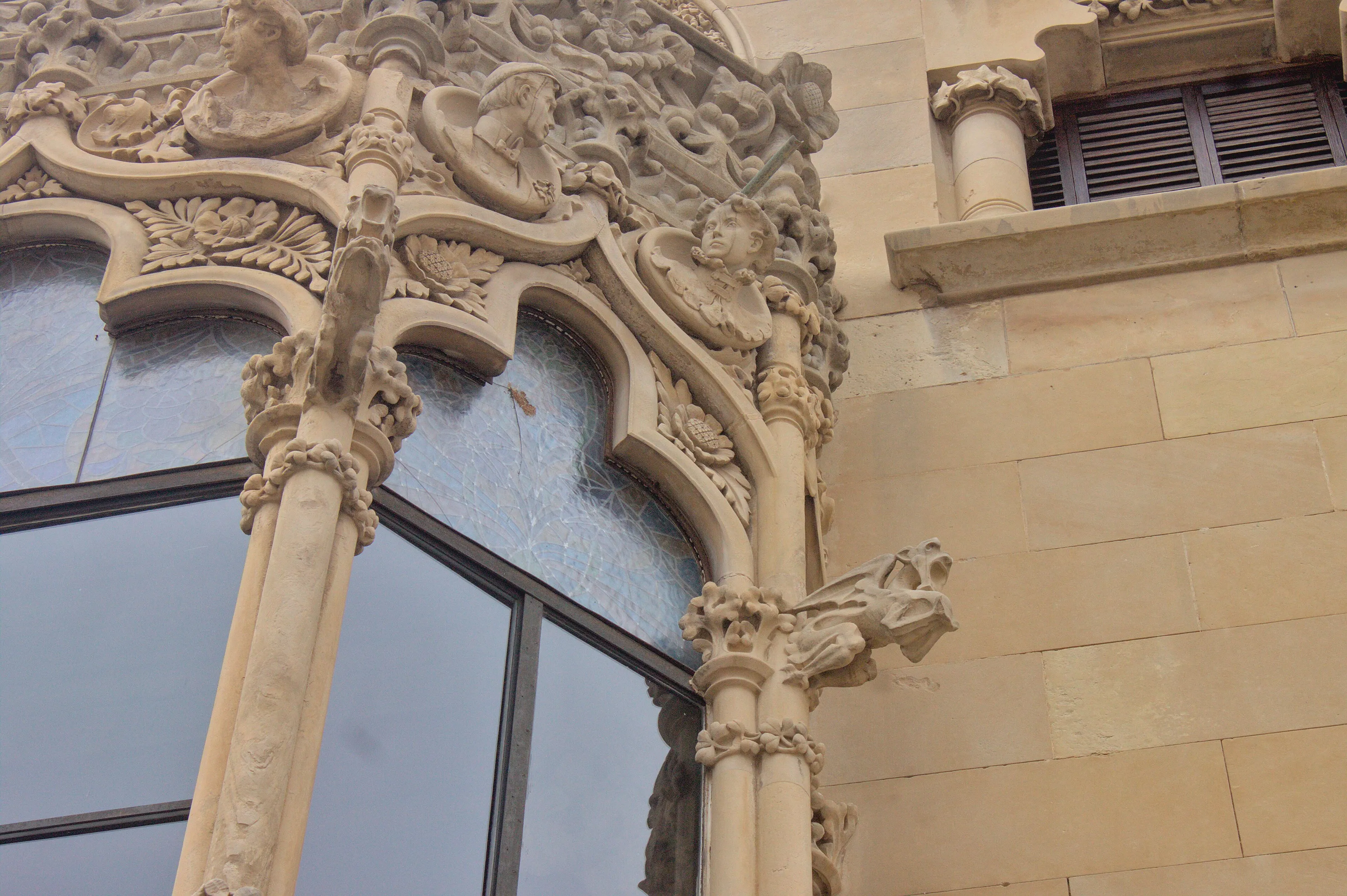
The Casa Lis is a modernist palace of 1905 with an iron facade, built on the old city wall; it houses the Art Nouveau and Art Deco collections donated by Manuel Ramos Andrade (Wikipedia EN, ES). Wikipedia (ES) ranks it among the city's most iconic buildings. We give no fare and no opening hours.
DA2 Domus Artium and the city museums
The DA2 Domus Artium 2002, a contemporary art centre that opened in April 2002 for the European Capital of Culture year, occupies the former provincial prison built in 1930 and keeps original features such as the cell doors (Wikipedia ES). Wikipedia (EN, ES) also lists the Museum of Commerce and Industry, the automotive history museum, the Unamuno house museum and the Museum of Salamanca, set in the Casa de los Abarca.
The university library and religious treasures
Wikipedia (ES) describes the old university library as one of the first university libraries in Europe, with more than 2,800 manuscripts and 60,000 incunabula and early printed books. Convents and the cathedral also keep collections of religious art, such as the diocesan museum in the Old Cathedral (Wikipedia ES). Opening days and access conditions change, so check before you go.
Food and drink
Hornazo, chanfaina and pork specialities
Typical dishes
According to Wikipedia (ES), Salamanca's cooking draws on the cured meats of the province, especially from Guijuelo. The most typical dishes are chanfaina (a rice stew with blood, lamb's feet and tripe), chichas made from pork, tostón (roast suckling pig) and hornazo, a meat pie filled with pork, chorizo, ham and hard-boiled eggs (Wikipedia ES, EN). Wikivoyage (EN) notes that many tapas are pork-based: ribs, chorizo, ham, bacon.
Sweets and traditions
Among the sweets Wikipedia (ES) lists chochos de yema, perrunillas and the bollo maimón, a sponge cake. On Lunes de aguas, the Monday after Easter Monday, people traditionally head out to the countryside to eat hornazo (Wikipedia ES). The Abastos market, built in iron between 1899 and 1909, sells the typical produce of the province (Wikipedia ES).
Where to taste
Bars and restaurants cluster in the centre around the Plaza Mayor (Wikivoyage EN). Wikivoyage (EN) also mentions vegetarian options, although meat dominates the menus. We name no address and no brand; ask locally.
Getting around
On foot, city buses, trains and coaches
The centre is walkable
Wikivoyage (EN) notes that the main sights are close together and easy to reach on foot. The city has an urban bus network with several daytime lines and two night lines (Wikipedia EN, ES), and a small tourist train circles the old town (Wikipedia ES). We publish no fares.
Train and coach stations
The Vialia-Estación de Salamanca is the main rail hub; Wikipedia (ES) lists links to Madrid, Valladolid, Burgos, Zaragoza, Bilbao, Irún, Porto and Lisbon among its main destinations, though services change. Wikivoyage (EN) places the station about 1 km north-east of the centre and the bus terminal about 1 km north-west. A city bus links the station to the old town.
By road
Salamanca is linked by motorway to Madrid (A-50 via Ávila), Valladolid (A-62), Zamora and Cáceres (A-66) and Portugal (A-62), according to Wikipedia (EN, DE). Wikivoyage (EN) gives about 205 km to Madrid, 115 km to Valladolid and 100 km to Ávila.
Budget and precautions
Budget, safety and general precautions
Price level
The open sources we consulted give no recent, cross-checked price ranges for Salamanca, so we publish no amounts. The currency is the euro. Wikivoyage (EN) points out that some sights, including several museums and monuments, can be entered free at certain times: check the conditions before you go.
Busy periods
Wikivoyage (EN) says Holy Week and the fiesta of the Virgen de la Vega in September are very busy and advises booking ahead. Salamanca's Holy Week has had the status of a Fiesta of International Tourist Interest since 2003 (Wikipedia EN, FR).
Flights, entry rules and precautions
SniperAir tracks prices and alerts you; it does not sell or book tickets. Entry rules, travel advice and health cover depend on your country of departure and can change: check your own government's official recommendations. Wikivoyage (EN) lists the usual precautions: watch for traffic, look after your belongings and avoid drunk people, as anywhere.
When to go
A continental climate: cool winters, hot summers
Winter
Wikipedia (EN) describes cool winters with frequent frosts. At about 800 m on the Meseta, pack warm clothes.
Spring
A transitional season that brings Holy Week, famous for its solemn and sober processions (Wikipedia EN), and Lunes de aguas, when hornazo is eaten outdoors (Wikipedia ES).
Summer
Summers are warm to hot but nights stay cool, according to Wikipedia (EN); it is also the season of Spanish courses for foreigners (Wikipedia DE, ES).
Autumn
Rain returns gradually, and September brings the fiesta of the Virgen de la Vega, the city's patron, which opens the week of fairs (Wikipedia ES).
Wikipedia (EN, ES) classes the climate at Salamanca airport as cold semi-arid (BSk), close to the boundary with Mediterranean climates, with rainfall spread across the year and a drier summer; Wikipedia (DE) gives about 400 mm of rain a year, mostly in the winter half. We publish no monthly temperature averages because the sources we consulted offered no cross-checked figures.
By length of stay
What to do in Salamanca depending on your length of stay
The essentials
The Plaza Mayor, the cathedrals, the university facade, the Roman bridge and the Casa de las Conchas, with a tapas break.
Salamanca in depth
Add the Casa Lis, the DA2, the convent of San Esteban, the Convento de las Dueñas, the Clerecía and the cathedral towers.
Beyond the city
Ávila, Valladolid or Zamora, named in Wikivoyage (EN) distances and Wikipedia (EN) road links, are possible excursions.
In pictures
Salamanca in pictures
You might also like
Similar destinations
FAQ
Frequently asked questions about flights to Salamanca
Are there direct flights to Salamanca?
Salamanca-Matacán Airport (SLM) has very limited, seasonal commercial traffic, with summer flights to Palma de Mallorca and charters (Wikipedia EN, ES; Wikivoyage EN). Most travellers use Madrid-Barajas (MAD), roughly 200 to 230 km away depending on the source.
How do I get from Madrid to Salamanca?
By Alvia train from Madrid-Chamartín, in about 1 hour 40 minutes for the fastest services according to Wikivoyage (EN), by coach in about 3 hours, or by road (A-50, about 205 km). Check timetables and journey times before booking.
Why is Salamanca famous?
For its university founded in 1218, its UNESCO-listed old town (1988), its Plaza Mayor and its two cathedrals (Wikipedia EN, FR).
What should I eat in Salamanca?
Hornazo, chanfaina, tostón and the cured meats of Guijuelo, according to Wikipedia (ES), plus pork-based tapas (Wikivoyage EN).
What are the entry requirements for Spain?
They depend on your country of departure and can change: check your own government's official recommendations before you book.
How many days do you need in Salamanca?
Two days cover the essentials, three let you add museums and convents, and four or more leave room for Ávila, Valladolid or Zamora.
How much does a flight to Salamanca usually cost?
The price depends mainly on your departure city, the time of year and how far ahead you book. The "opportunities" section above shows real examples of prices SniperAir has already detected to this destination.
How do I get alerted when a flight to Salamanca drops below my budget?
Create an alert profile with your departure airport, Salamanca (SLM) as the destination and your maximum budget. You are notified automatically as soon as a matching price is detected. SniperAir monitors and alerts, it does not sell or book tickets.
Ready to head to Salamanca?
Set your budget and let SniperAir monitor fares for you.
Create my alert