
Cheap flights to Santiago de Compostela
Set your departure airport and maximum budget: SniperAir tracks prices to Santiago de Compostela and alerts you the moment a deal matching your criteria appears.
Quick summary
Country
Spain
Continent
Europe
Airport
SCQ
Currency
Euro (EUR)
Time zone
UTC+1 (UTC+2 during summer time)
Deals already spotted to Santiago de Compostela
Real flight examples detected by SniperAir, with their reference price.
Loading examples…
Why track Santiago de Compostela with SniperAir
You do not need to compare prices every day
Choose your departure
Enter your departure airport and your maximum budget for a flight to Santiago de Compostela (SCQ).
SniperAir keeps watch
Our systems continuously compare new prices with the real price history of the route. SniperAir monitors prices and alerts you: it does not sell or book tickets.
You receive an alert
As soon as a price matches your criteria, you are notified, without having searched for anything yourself.
Airport and getting into town
An airport at Lavacolla linked to the stations by bus, and a centre you can walk
Santiago de Compostela-Rosalía de Castro (SCQ)
Santiago airport, at Lavacolla, has a single terminal, opened in 2011, says Wikivoyage (EN). It handles seasonal budget flights from western Europe and domestic flights from Madrid, Bilbao, Barcelona, Seville, Málaga, Valencia and the Canaries, according to the same source. Bus 6A runs to the stations about every 30 minutes in half an hour, and a taxi takes a quarter of an hour, says Wikivoyage (EN); Wikivoyage (DE) confirms a shuttle every 30 minutes. The Camino passes right by the airport. By train, A Coruña is half an hour away and Ourense about 40 minutes, says Wikivoyage (DE); for Madrid, the sources give 3 to 5 hours depending on the train.
Distances and times are approximate, from Wikivoyage (EN, DE, FR, ES); timetables and routes change, so check them before you travel. We do not quote fares.
Santiago de Compostela is the capital of Galicia, in north-west Spain. It has about 100,000 inhabitants (100,965 in 2025 according to Wikipedia DE, ES). Its old town has been a UNESCO World Heritage Site since 1985 (Wikipedia DE, ES). The places of interest lie in a compact area, so you walk, says Wikivoyage (EN). Galician is co-official with Spanish, and signs mix the two languages.
Landmarks
The cathedral, the Obradoiro and the granite old town
Santiago is best explored around its cathedral, the end of several pilgrimage routes. According to tradition the tomb of the apostle James was discovered in the 9th century, say Wikivoyage (EN) and Wikipedia (DE). The places below are illustrated; the palaces on the square, the Quintana and the Camino are covered at the end of the section.
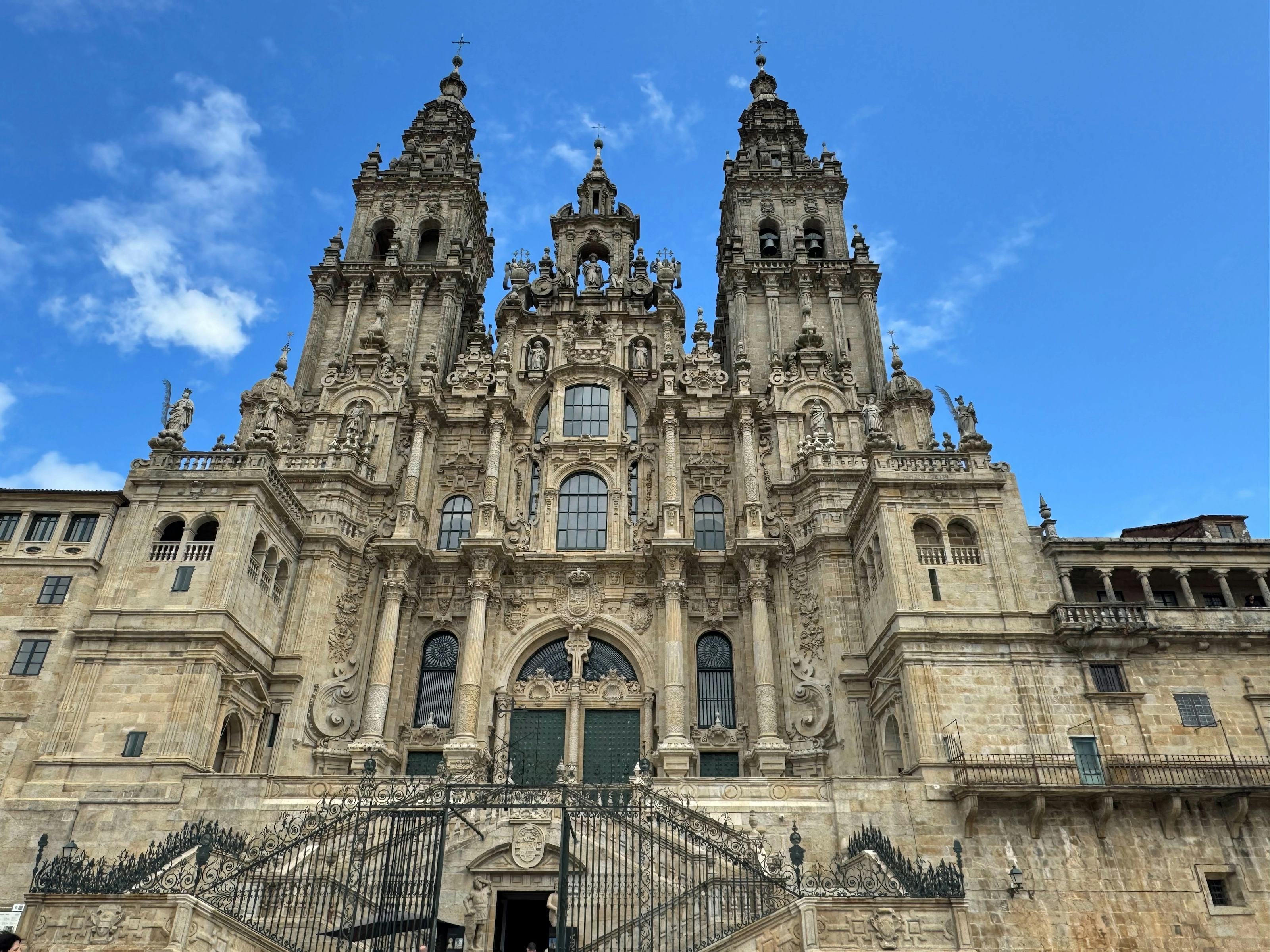
The Obradoiro façade
The west front, with its two towers, is 18th-century Baroque, says Wikivoyage (EN). The cathedral was begun in 1075 and consecrated in 1211, according to the same source; it is mostly Romanesque, but each façade is different. You enter through the Pórtico da Gloria, and the crypt holds the supposed tomb of St James.
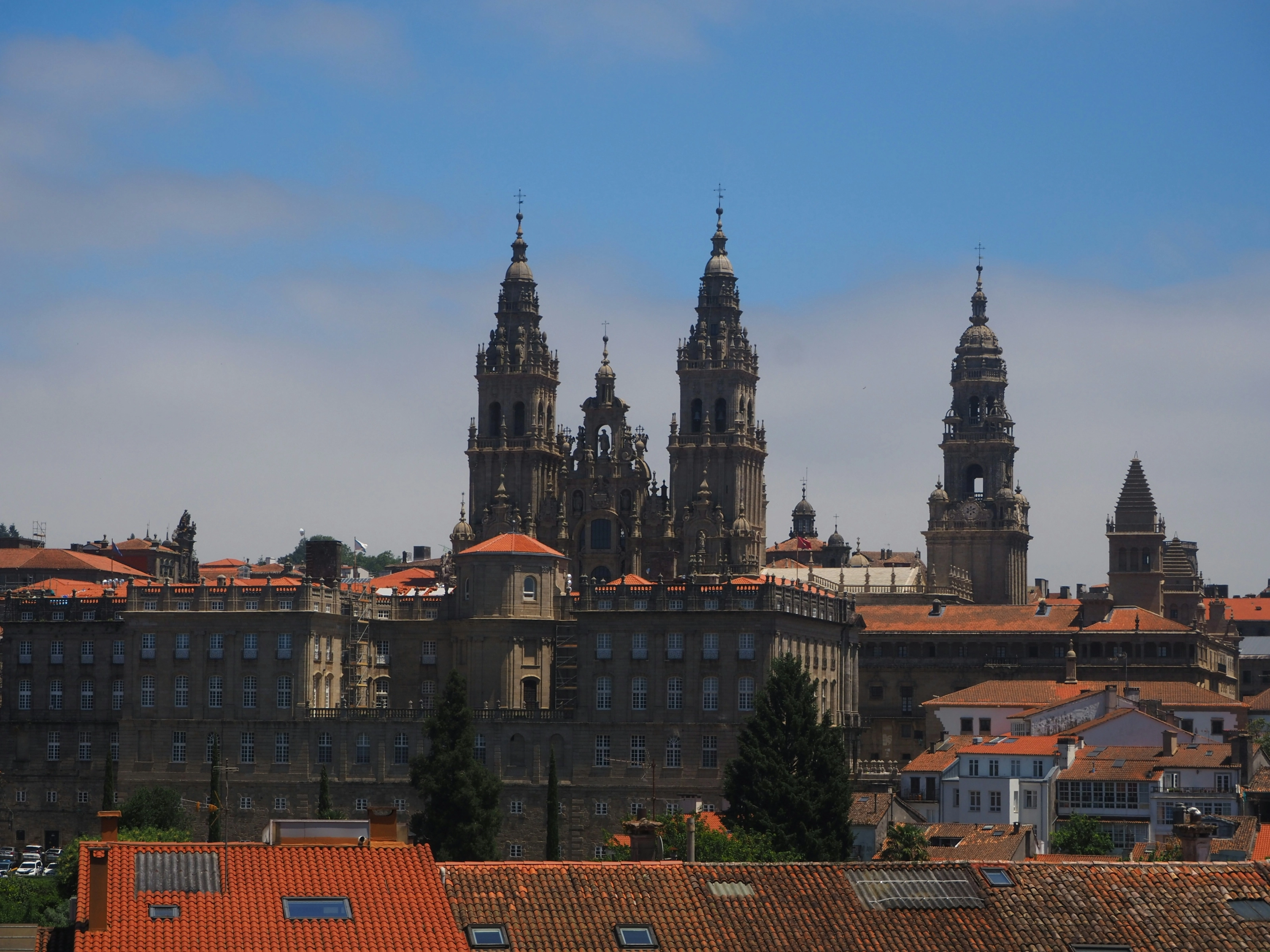
The towers above the roofs
From above, the cathedral's towers rise over the large stone buildings and red-tiled roofs of the old town. The Camino ends here, and pilgrims arrive from every direction.
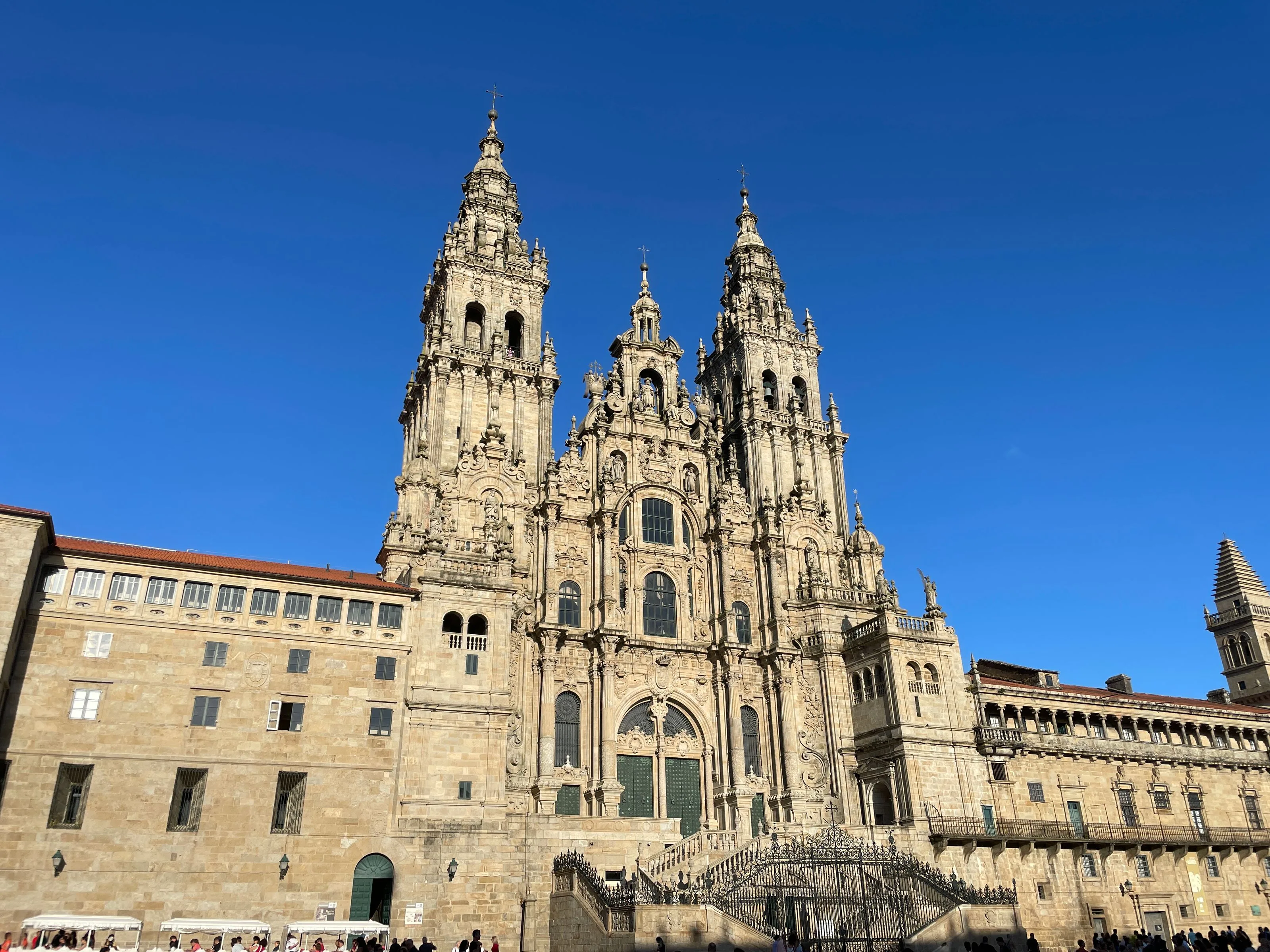
Praza do Obradoiro
The Obradoiro takes its name from the stonemasons' workshop. Around the square stand the Gelmírez Palace, the Rajoy Palace, now the city hall, the San Jerónimo college and the former royal hospital, now a parador, says Wikivoyage (EN). This is where pilgrims pause on arrival.
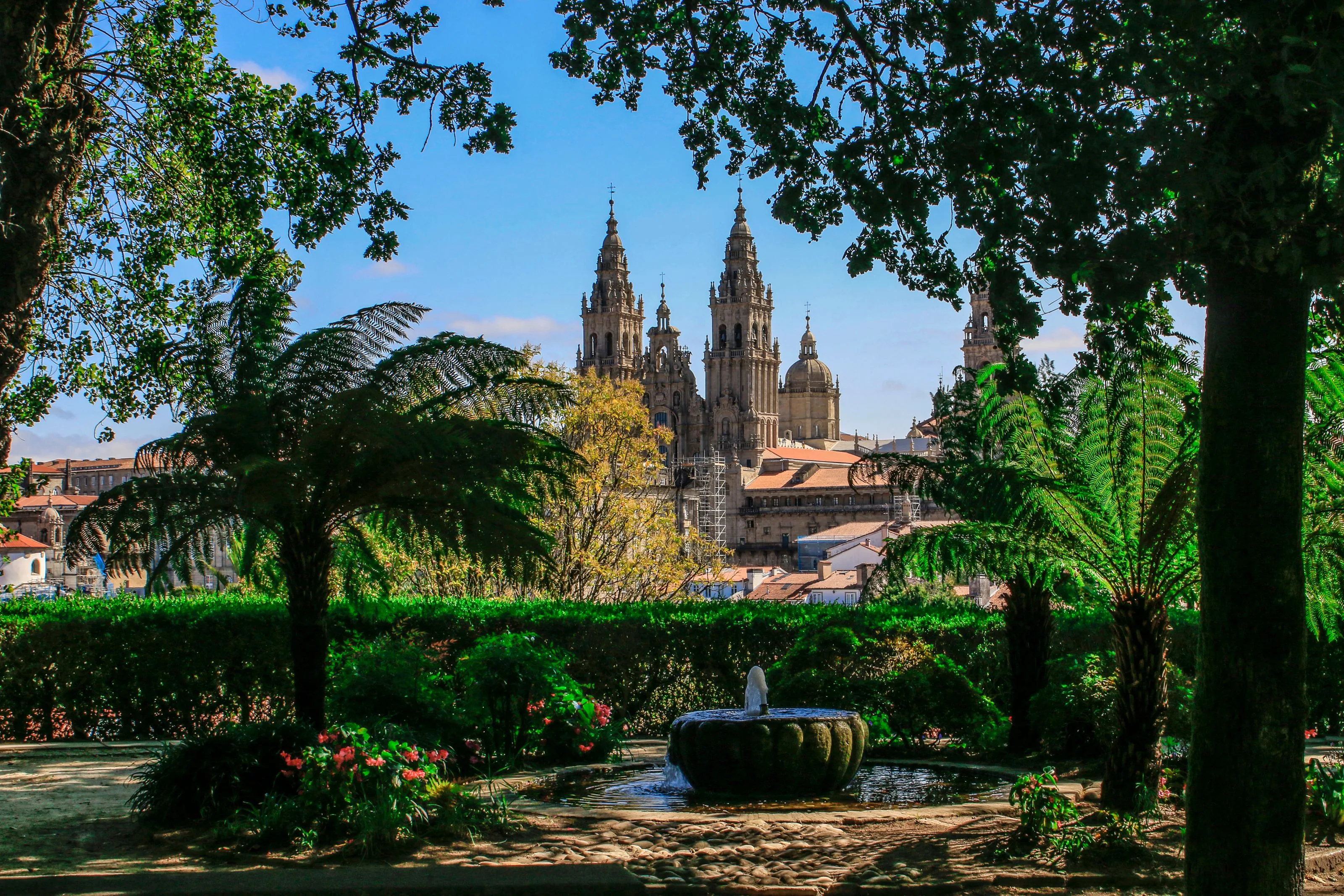
Parks and gardens
The city has many green spaces: the Alameda, with its viewpoint over the cathedral, Bonaval park and Belvís park, say Wikivoyage (ES) and Wikivoyage (DE). The statues of the 'Two Marías' stand at the entrance to the Alameda.
Quintana, Praterías and San Martiño Pinario
The Praza da Quintana adjoins the cathedral on the east side; the Holy Door is opened to pilgrims only in Jacobean Holy Years, those in which 25 July falls on a Sunday, says Wikivoyage (EN). The Praza das Praterías and the Benedictine monastery of San Martiño Pinario, rebuilt in the 16th century, are next door.
The Camino and day trips
The Camino Francés starts at Saint-Jean-Pied-de-Port, 780 km away, says Wikivoyage (EN). The pilgrim reception office issues the arrival certificate. A Coruña (74 km), Pontevedra (62 km), Finisterre (82 km) and Ourense (105 km) are possible outings, according to the same source.
Museums and culture
Pilgrimage, sacred art, contemporary art and Galician culture
The Cathedral Museum and the Museum of Pilgrimages
The Cathedral Museum includes the Gelmírez Palace, the Renaissance cloister, the crypt, tapestries and the library, where the botafumeiro, a huge incense burner, is kept, says Wikivoyage (EN). The Museum of Pilgrimages on Praza das Praterías explains the phenomenon of pilgrimage and the iconography of St James.
Sacred and contemporary art
The Museum of Sacred Art of San Paio de Antealtares is in a Benedictine convent. The CGAC, the Galician centre of contemporary art, is a building by the Portuguese architect Álvaro Siza, says Wikivoyage (EN). The Granell Foundation presents the work of the Galician surrealist painter Eugenio Granell.
Galician culture
The Museum of the Galician People, in a former convent, is known for its triple helical staircase, says Wikivoyage (EN). The Cidade da Cultura, on Monte Gaiás, hosts large exhibitions. We do not quote admission prices.
Food and drink
Octopus, seafood, tarta de Santiago and the Abastos market
Seafood and octopus
The city has a strong seafood tradition, with pulpo (octopus) in the lead, says Wikivoyage (EN). Rúa do Franco, the liveliest street of the old town, offers Galician specialities such as pulpo cocido and vieira, says Wikivoyage (DE).
Tapas and sweets
Tapas are served everywhere, with Padrón peppers, some hot and some not, says Wikivoyage (EN). Tarta de Santiago is an almond cake decorated with the Cross of St James in icing sugar, says Wikivoyage (DE).
The market
The Mercado de Abastos, 200 m east of the cathedral, sells fresh produce, and some vendors will cook on the spot, says Wikivoyage (EN). We do not name businesses.
Getting around
On foot, by city bus and by regional train
On foot
The centre is small: everything is visited on foot, says Wikivoyage (EN). Stone lanes can be slippery in the rain.
Bus and taxis
The city bus serves the stations, the airport and the centre; some 15 taxi firms operate, says Wikivoyage (EN).
Trains and coaches
The station is about 1 km south of the cathedral, says Wikivoyage (EN). A Coruña is about 30 minutes by train, says Wikivoyage (DE). Coaches run from Madrid in about nine hours, says Wikivoyage (EN).
Budget and precautions
A reasonable budget for Spain, and weather to plan for
Price level
We do not quote figures because we could not cross-check them on two independent sources. The city is very busy in summer and around St James's Day, which can push up accommodation prices.
Flights
SniperAir tracks prices to SCQ and compares them with the route's history, but it does not sell or book tickets. Porto, Vigo and A Coruña can be watched in parallel, with direct trains or buses, says Wikivoyage (EN).
Precautions
Pack a raincoat: Wikivoyage (EN) describes wet winters and frequent downpours from September to June. The city is very crowded during the festival of St James, around 24 to 25 July.
When to go
An Atlantic climate, mild and rainy
Winter (December to February)
Wet and cool, with frequent rain, says Wikivoyage (EN).
Spring (March to May)
Mild and changeable; the Camino fills with pilgrims.
Summer (June to August)
Mild, with summers cooler than inland Spain; the festival of St James enlivens the city around 25 July.
Autumn (September to November)
The rain returns from September, says Wikivoyage (EN); the atmosphere is calmer.
The climate is oceanic (Cfb) according to Wikipedia (ES), with wet winters, mild summers and frequent downpours from September to June, says Wikivoyage (EN). We do not quote temperatures because they could not be cross-checked; check the forecast before you go. June and September are often pleasant for walking.
By length of stay
What to do in Santiago de Compostela depending on how long you stay
The essentials
The Obradoiro façade, the cathedral, the Quintana, Rúa do Franco and the Mercado de Abastos.
Museums and parks
The Cathedral and Pilgrimage museums, the CGAC, the Museum of the Galician People, the Alameda and Bonaval.
The Camino and the coast
A stage of the Camino on foot, A Coruña, Pontevedra or Finisterre.
In pictures
Santiago de Compostela in pictures
You might also like
Similar destinations
FAQ
Frequently asked questions about flights to Santiago de Compostela
How do I get from Santiago airport to the centre?
The airport (SCQ) is at Lavacolla. Bus 6A reaches the stations in about half an hour, with a departure every 30 minutes; a taxi takes about 15 minutes. Check timetables before you travel.
When is the best time to visit Santiago de Compostela?
June and September are often pleasant; around 25 July for the festival of St James, with big crowds. Pack a raincoat in any season.
Is Santiago de Compostela expensive?
We do not quote figures because we could not cross-check them on two sources; accommodation prices can rise in summer and in Holy Years.
How long should I stay in Santiago de Compostela?
Two days for the cathedral and the old town; four days if you add the museums, the parks and a day trip.
What should I eat in Santiago de Compostela?
Octopus, seafood, Padrón peppers and tarta de Santiago; Rúa do Franco and the Abastos market are good places to start.
What is a Jacobean Holy Year?
A year in which 25 July falls on a Sunday: the cathedral's Holy Door is then opened to pilgrims, says Wikivoyage (EN). 2027 fits this rule.
How much does a flight to Santiago de Compostela usually cost?
The price depends mainly on your departure city, the time of year and how far ahead you book. The "opportunities" section above shows real examples of prices SniperAir has already detected to this destination.
How do I get alerted when a flight to Santiago de Compostela drops below my budget?
Create an alert profile with your departure airport, Santiago de Compostela as the destination and your maximum budget. You are notified automatically as soon as a matching price is detected.
Ready to head to Santiago de Compostela?
Set your budget and let SniperAir monitor fares for you.
Create my alert