
Cheap flights to Cairns
Set your departure airport and maximum budget: SniperAir tracks prices to Cairns and alerts you the moment a deal matching your criteria appears.
Quick summary
Country
Australia
Continent
Oceania
Airport
CNS
Currency
Australian dollar
Time zone
UTC+10 (no daylight saving time in Queensland)
Deals already spotted to Cairns
Real flight examples detected by SniperAir, with their reference price.
Loading examples…
Why track Cairns with SniperAir
You do not need to compare prices every day
Choose your departure
Enter your departure airport and your maximum budget for a flight to Cairns (CNS).
SniperAir watches
Our systems continuously compare new fares with the route's real price history. SniperAir tracks prices and alerts you: it does not sell or book tickets.
You receive an alert
As soon as a fare matches your criteria, you are notified, without having searched for anything yourself.
Airport and getting into town
An airport about 7 km north of the centre, 10 to 20 minutes away
Cairns (CNS)
Cairns International Airport is about 7 km north of the city centre. Taxis and ride-hailing reach the centre in about ten to twenty minutes depending on traffic; buses and door-to-door shuttles also serve hotels and the boat terminals. The airport handles Australian domestic flights and a few international routes, notably to Asia and New Zealand; from Europe, the journey almost always involves at least one connection.
Distances and times are approximate, cross-checked on Wikipedia (FR, EN, DE, ES) and Wikivoyage; they vary with traffic. Fares are not given because they change.
Cairns is the main city of Far North Queensland, on the tropical north-east coast of Australia, with about 150,000 to 170,000 people depending on the boundary used. It lies more than 1,700 km from Brisbane by road: flying is the most practical way to get there. Founded in the nineteenth century as an export port for gold and agriculture, it has become a departure point for the Great Barrier Reef, a UNESCO World Heritage property.
Landmarks
The gateway to the reef, the Kuranda train and the rainforest
Cairns itself is a fairly simple seaside town: it is its surroundings, from rainforest to reef, that make it interesting. The places below come with photos; the Esplanade, with its public seawater swimming lagoon and promenades, the harbour and Port Douglas, a small resort about an hour's drive north, are described in text only.
The Great Barrier Reef
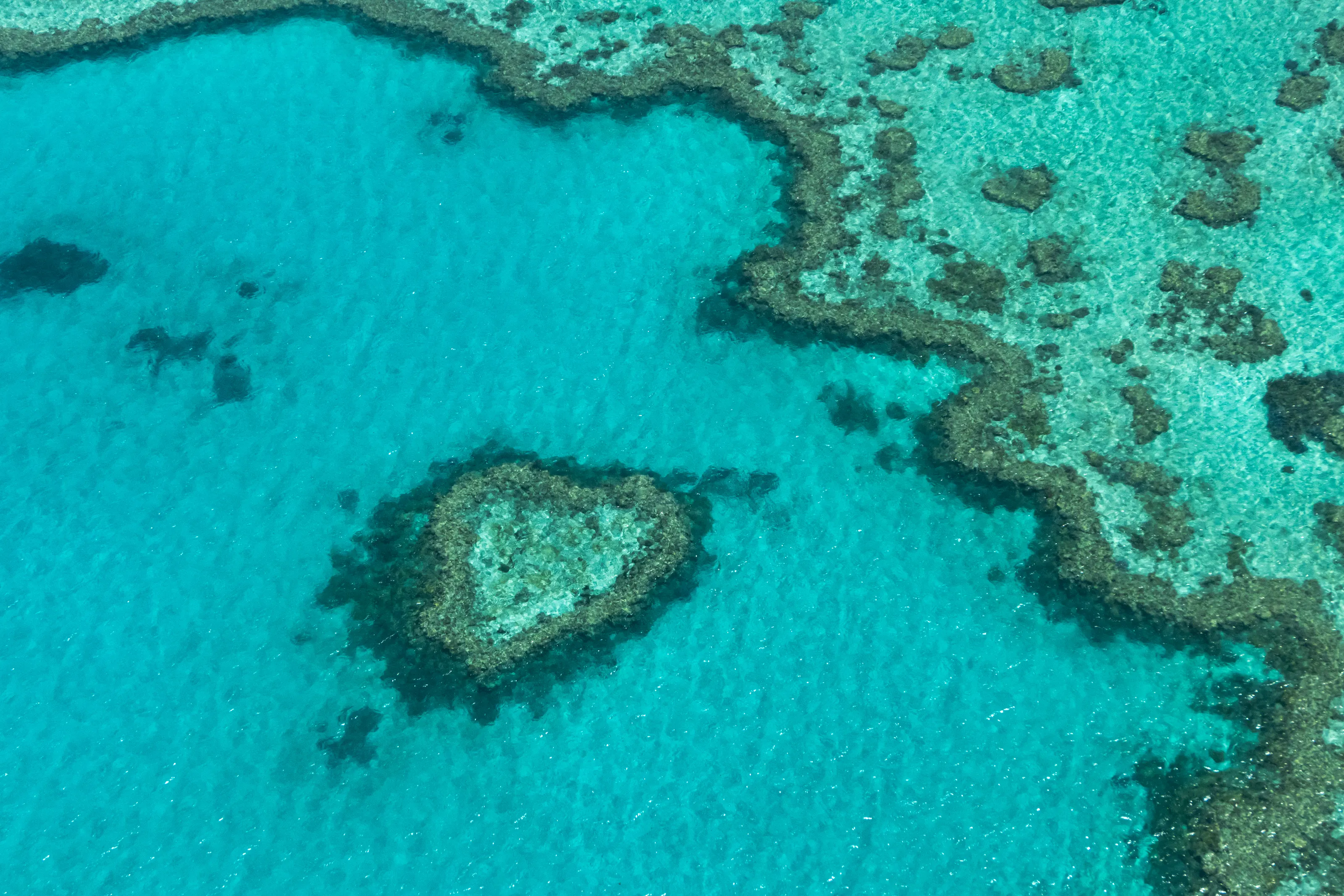
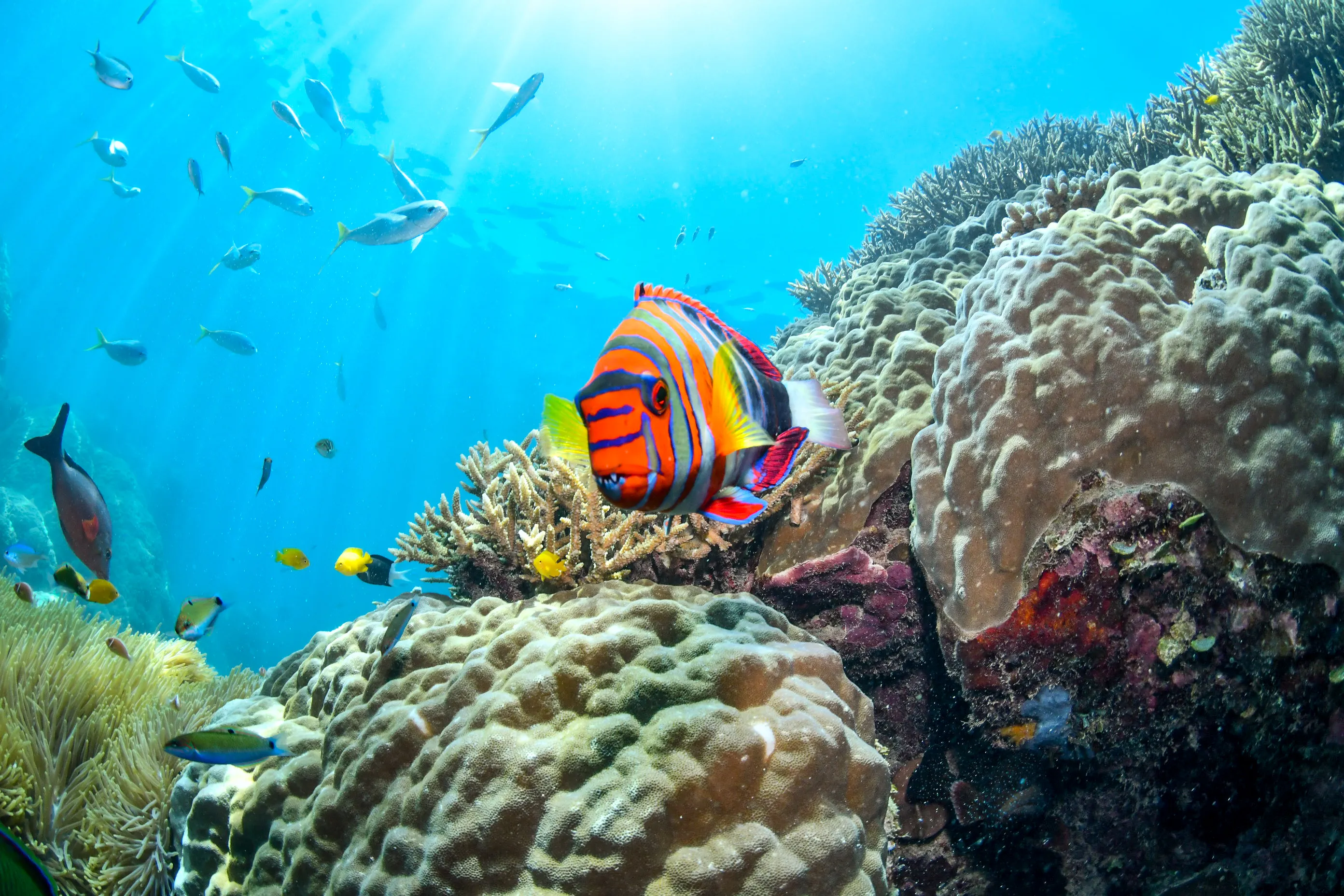
The world's largest coral reef system stretches for more than 2,000 km along the Queensland coast; you reach it by boat from Cairns (about an hour and a half by fast boat for the outer reefs) or from Port Douglas, with day trips. The photo shows a heart-shaped reef, Heart Reef: it lies much further south, in the Whitsundays region, several hundred kilometres from Cairns, and is mostly seen on scenic flights; here it illustrates the beauty of the reef in general.
The Kuranda Scenic Railway
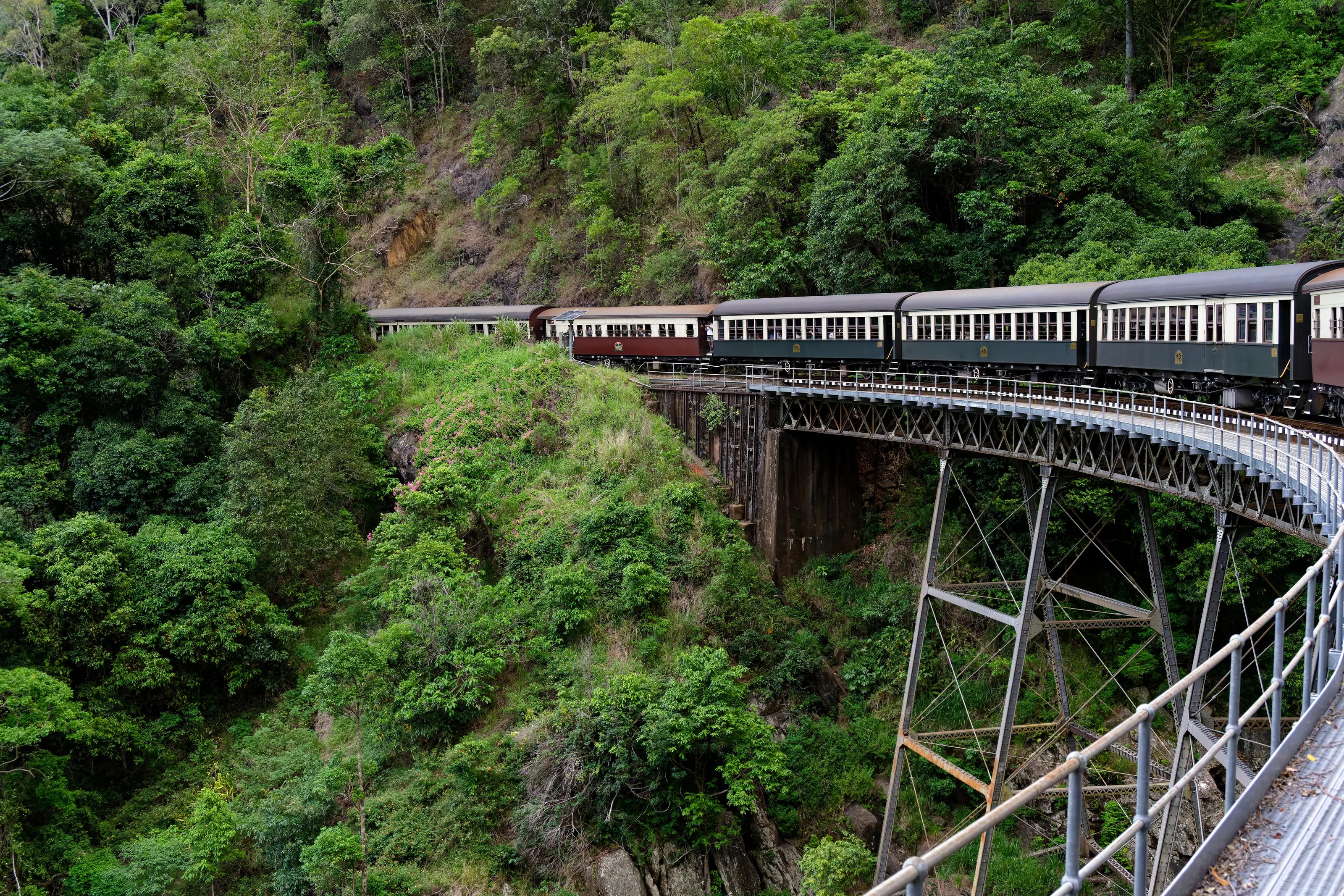
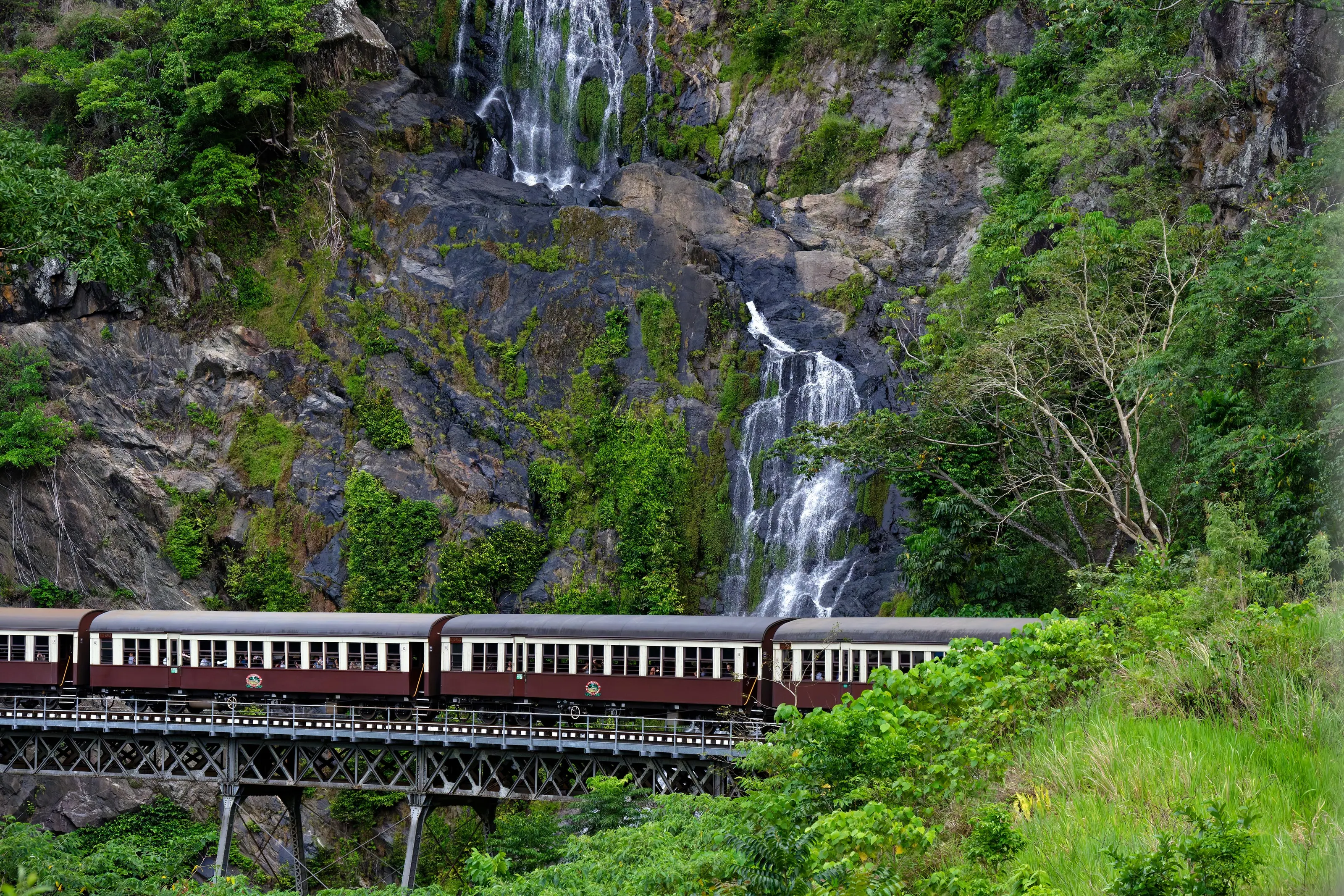
The Kuranda Scenic Railway leaves Cairns and climbs through the rainforest to the village of Kuranda on a 37 km mountain line completed in 1891. The trip usually takes nearly two hours each way, with tunnels, steel bridges and views over gorges. Many people return by cableway above the canopy: check the timetables.
Stoney Creek Falls
Along the railway, a waterfall drops down a cliff beside the track, above a metal bridge. The stop lets you see it up close; the falls carry more water during the wet season.
Barron Falls
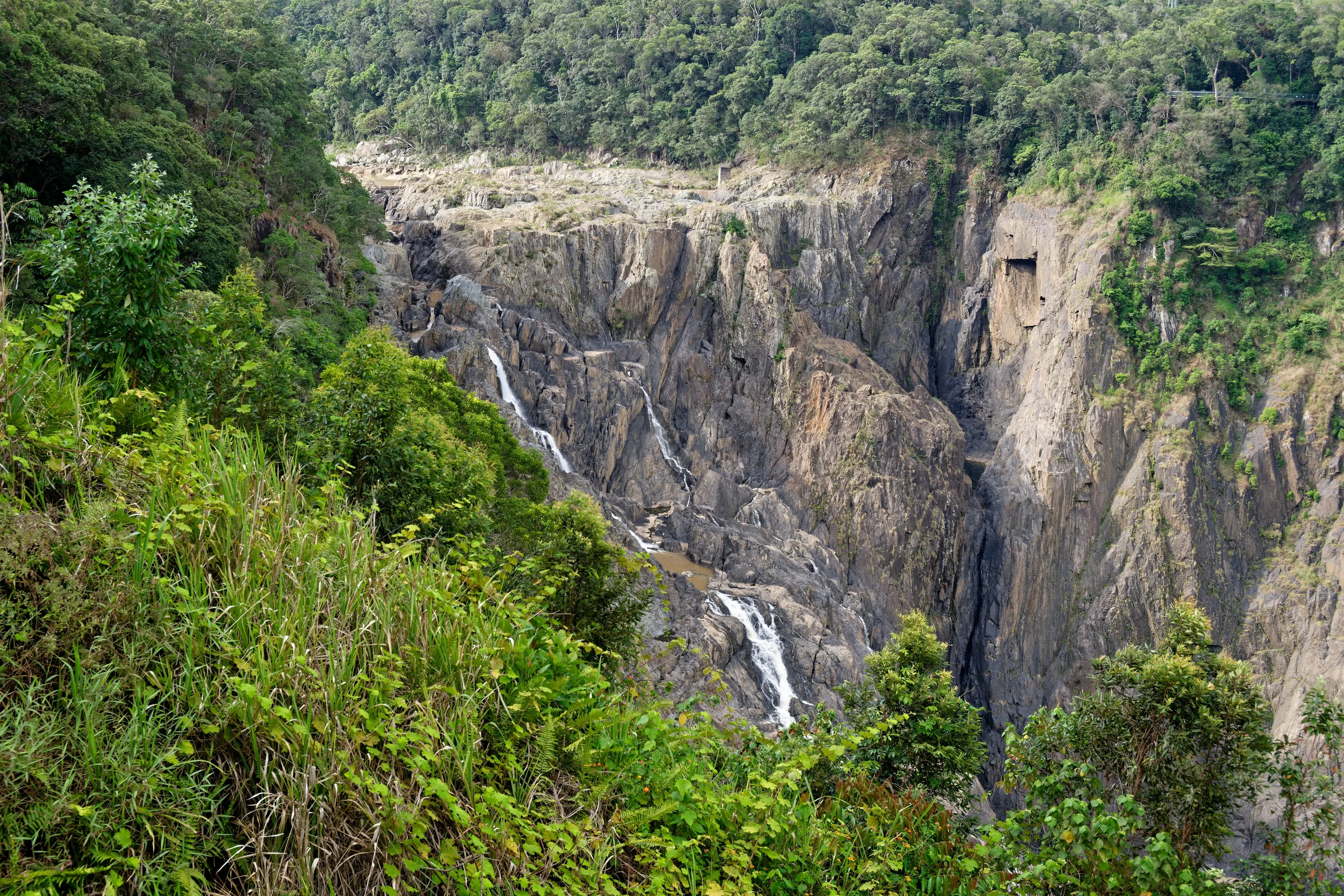
The Barron River falls drop into a deep gorge at Kuranda; they are seen from viewpoints reached from the village or the train. They are impressive during the wet season, but the flow can be low in the dry season, as in the photo.
The Daintree rainforest
North of Cairns, about 100 km away (nearly two hours by road), the Daintree rainforest is part of the Wet Tropics of Queensland, a UNESCO World Heritage property. You walk along streams, forest-fringed beaches and trails; the region is known for its biodiversity. Wear closed shoes, bring insect repellent and respect the crocodile signs.
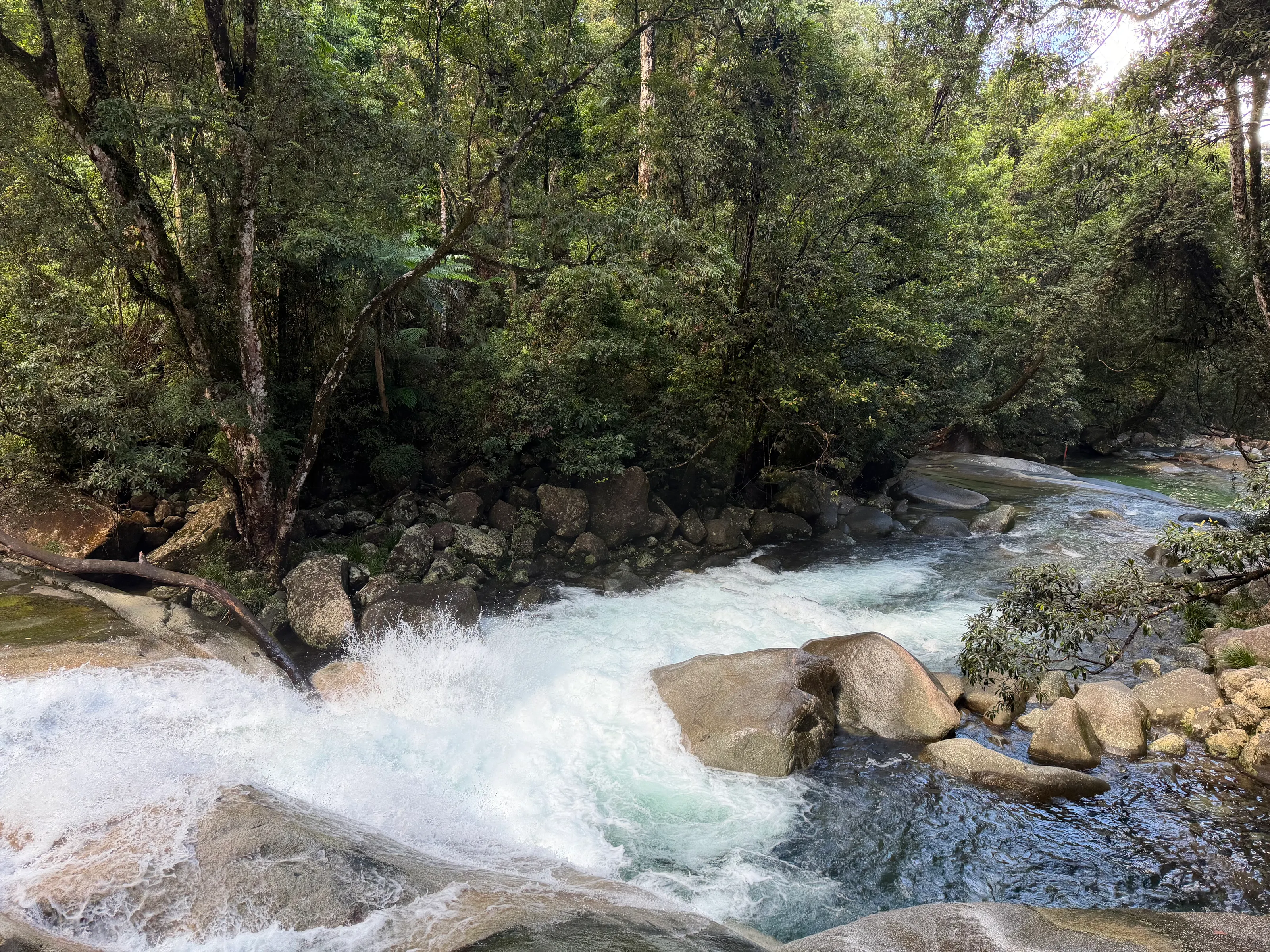
Panorama
Underwater, coral and colourful fish
Day trips and nature
Reef, rainforest, islands and beaches of Far North Queensland
On the reef: diving, snorkelling and islands
Boats leave Cairns every day for the reefs, with snorkelling, diving and sometimes scenic flights. Nearby islands such as Green Island and Fitzroy Island can be reached by boat in under two hours. The reef is protected: do not touch the coral, do not stand on it, do not take anything and follow the operators' instructions. Reef-friendly sunscreens and protective suits are generally preferable to heavy creams to limit the impact.
Stinger season
Between roughly October and May, dangerous jellyfish (notably stingers) are found in Queensland's coastal waters. During this period operators provide protective suits and sea swimming is often limited to netted enclosures: follow local signs and the lifeguards' advice. The period can vary from year to year.
Atherton Tablelands, Port Douglas and beaches
The Tablelands, a cool plateau behind Kuranda, offer crater lakes, waterfalls, and coffee, tea and fruit farms. To the north, the coastal road to Port Douglas follows beaches and forested hills. Estuary waters are home to crocodiles: swim only in signed areas.
Museums and culture
Aboriginal culture, history, art and an aquarium
Cairns Art Gallery
Housed in a former public building in the city centre, the gallery shows art from North Queensland, the Pacific and Aboriginal and Torres Strait Islander communities. Exhibitions change regularly.
Cairns Museum
The local history museum tells of the founding of the city, the gold rush, Chinese immigration and life in the Far North; it occupies a heritage building in the centre. It can be visited in about an hour.
Aboriginal culture and aquarium
The Tjapukai cultural park at Caravonica presents the culture of the region's Aboriginal peoples with dances, demonstrations and stories. Cairns Aquarium gives a glimpse of reef and rainforest habitats, handy on rainy days. We do not give prices, which change.
Food and drink
Tropical fruit, barramundi and Tablelands coffee
Tropical fruit and northern produce
Tropical Queensland grows mangoes, bananas, pineapples and passion fruit; the markets of Cairns and the Tablelands are a good place to try them. Coffee and tea grown on the Tablelands are served in many cafés.
Fish and seafood
Barramundi, the emblematic fish of northern Australia, appears on many menus, along with reef fish, prawns and oysters. Some menus also offer crocodile or kangaroo meat as a curiosity.
Neighbourhoods and markets
Nightlife and restaurants are concentrated around the Esplanade and nearby streets, with Asian and modern Australian cuisines. Evening markets offer snacks and souvenirs; check locally, as times change.
Getting around
Bus, car, the Kuranda train and boats to the reef
In town
The centre is compact and walkable, with the Esplanade on the waterfront. Buses serve the northern beaches and the rest of the urban area; taxis and ride-hailing complete the offer.
Trips to the reef and Kuranda
Reef boats leave from the harbour terminals in the centre. For Kuranda, the scenic train, the cableway or a car are all possible; the mountain road is winding.
Car and the Daintree
For the coastal road, Port Douglas and the Daintree, a car gives the most freedom; Australians drive on the left. Crossing the Daintree River is by ferry on some routes: check the timetables. Respect crocodile signs and do not swim in rivers or estuaries.
Budget and entry
A high price level, especially for boat trips
Price level
Cairns is expensive compared with many European countries, especially for boat trips, accommodation in the dry high season and car rental. Markets, simple meals and walks in town help keep the budget down. We do not give figures: prices vary with the season and the exchange rate.
Flights
The long-haul flight remains the most variable item. SniperAir tracks prices to CNS and compares them with the route's history.
Entry and precautions
Australia generally requires an electronic travel authorisation or a visa depending on nationality: check the official Australian government websites. Also consult the official advice of your country of departure. On the ground, respect swimming rules, crocodile and jellyfish signs, and protect yourself from the sun.
When to go
A dry season and a wet season, with stingers in summer
Dry season (June to October)
Less rain, clearer skies and daytime temperatures of about 26 °C in July: the best time for the reef, the rainforest and walks, but also the busiest.
Start of the wet season (November to December)
Heat and humidity rise and storms appear; stinger season begins and the reef can still be visited with precautions.
Wet season (January to April)
Hot and humid, with highs close to 32 °C in January, heavy rain, and risks of flooding and tropical cyclones; the waterfalls are at their best.
End of the wet season (May)
The rain eases, the rainforest is very green and crowds remain moderate; stingers may still be present.
Beware of the reversed seasons: Australia is in the southern hemisphere, so austral summer runs from December to February and winter from June to August, the opposite of Europe. In Cairns the climate is tropical, with two seasons rather than four.
Rain is concentrated mainly between November and May, with monsoons and sometimes floods that can cut roads and rail lines; the tropical cyclone season follows roughly the same period: check official bulletins. From June to October the weather is drier and more pleasant for sightseeing.
By length of stay
What to do in Cairns depending on your length of stay
The essentials
A boat trip to the reef and an evening on the Esplanade.
Rainforest and mountains
A day in Kuranda by train and cableway, with the Barron Falls.
The Far North
An excursion to the Daintree and Port Douglas, or a night on an island near the reef.
In pictures
Cairns in pictures
You might also like
Similar destinations
FAQ
Frequently asked questions about flights to Cairns
How do I get from Cairns airport to the centre?
The airport (CNS) is about 7 km north of the centre. Taxis and ride-hailing usually take 10 to 20 minutes; buses and door-to-door shuttles are also available.
When is the best time to visit Cairns?
During the dry season, roughly June to October. The wet season (November to May) is hotter, with rain, cyclone risks and stingers. Seasons are reversed compared with Europe.
Is Cairns expensive?
The price level is high, especially for boat trips and accommodation in the dry season. Simple meals and markets help keep the budget under control.
How long should I stay in Cairns?
Three days let you combine a reef trip and a day in Kuranda; add one or two days for the Daintree and Port Douglas.
How do I get around Cairns and the surrounding area?
On foot in the centre, by bus for the northern beaches, by train or cableway for Kuranda and by car for the Daintree; Australians drive on the left. Reef boats leave from the harbour.
What should I eat in Cairns?
Tropical fruit, barramundi and reef fish, and Tablelands coffee and tea.
How much does a flight to Cairns usually cost?
The price depends mainly on your departure city, the period and the booking date. The "opportunities" section above shows real examples of prices already detected by SniperAir for this destination.
How do I get alerted when a flight to Cairns drops below my budget?
Create an alert profile with your departure airport, Cairns as the destination and your maximum budget. You are notified automatically as soon as a matching fare is detected.
Ready to head to Cairns?
Set your budget and let SniperAir monitor fares for you.
Create my alert