
Cheap flights to Nelson
Set your departure airport and maximum budget: SniperAir tracks prices to Nelson and alerts you the moment a deal matching your criteria appears.
Quick summary
Country
New Zealand
Continent
Oceania
Airport
NSN
Currency
New Zealand dollar
Time zone
UTC+12 (UTC+13 during austral daylight saving time)
Deals already spotted to Nelson
Real flight examples detected by SniperAir, with their reference price.
Loading examples…
Why track Nelson with SniperAir
You do not need to compare prices every day
Choose your departure
Enter your departure airport and your maximum budget for a flight to Nelson (NSN).
SniperAir watches
Our systems continuously compare new fares with the route's real price history. SniperAir tracks prices and alerts you: it does not sell or book tickets.
You receive an alert
As soon as a fare matches your criteria, you are notified, without having searched for anything yourself.
Airport and getting into town
An airport very close to the centre, but with no regular international flights
Nelson (NSN)
Nelson Airport is in Annesbrook, south-west of the centre, about 6 km away. An urban bus line (EBus) links it to the centre, with a bus every 30 minutes during the day according to Wikivoyage, and door-to-door shuttles and taxis are also available. Allow about ten minutes by car. It is one of the busiest airports in the country, but it has no regular international service: from Europe you need a long-haul flight to a major New Zealand airport (Auckland, Wellington or Christchurch), then a domestic flight.
Nelson is a city of about 50,000 people on Tasman Bay, at the very top of the South Island. It is the oldest city in the South Island, founded in 1841; its Māori name is Whakatū. It is the gateway to three national parks (Abel Tasman, Kahurangi and Nelson Lakes) and is nicknamed "Sunny Nelson" for its sunshine.
Beaches and Tasman Bay
Golden sand, calm water and rocky islets
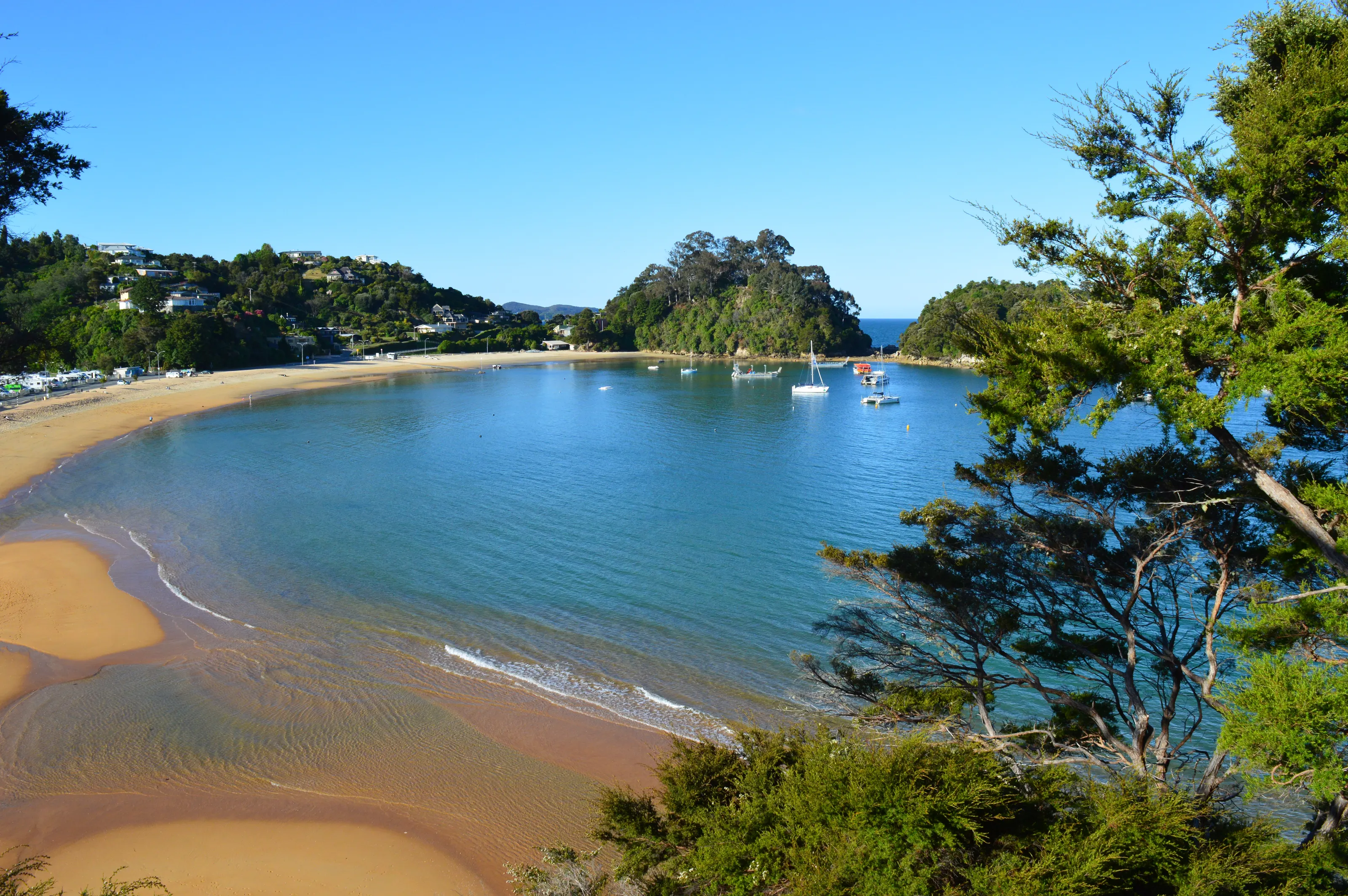
The coast west of Nelson is a string of golden-sand bays with often calm water. Kaiteriteri, at the entrance to Abel Tasman National Park, is one of the best known: it is also the departure point for many water taxis and kayak trips. Allow around an hour by road from Nelson.
Kaiteriteri Bay
Kaiteriteri is a crescent-shaped bay with a golden-sand beach, wooded hills and yachts at anchor. The bay is a gateway to Abel Tasman Park by boat or kayak, and people swim here in summer. It is very busy during the austral summer holidays.
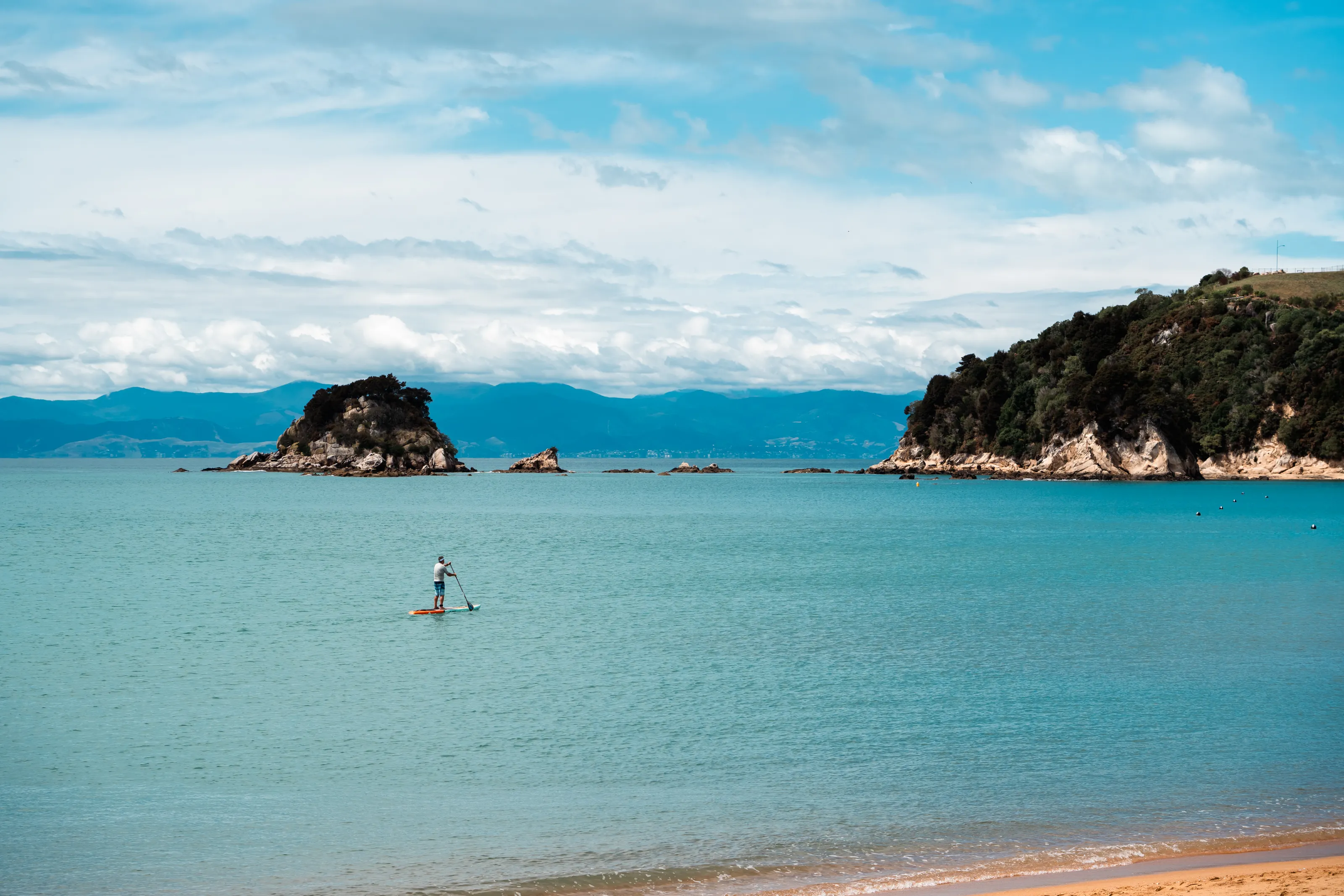
Paddleboarding by the islets
On the sheltered waters of Tasman Bay, paddleboarding, kayaking and sailing are classic activities: the water is often calm and turquoise, with rocky islets close to shore. Conditions change quickly: check forecasts, tides and rental operators' advice before setting out, and do not stray far from the shore.
Abel Tasman National Park
Coast Track, coves and forest down to the sea
Abel Tasman National Park is the smallest of the country's national parks (about 237 km²), but one of the most visited. Its coast is lined with pale-sand beaches, forest and turquoise water. The three photos in this section are nature scenes; the one of the unnamed cove cannot be tied to a precise spot.
The Coast Track and water taxis
The Abel Tasman Coast Track runs along the coast for about 60 km; it is one of the country's "Great Walks". Access is mainly via Mārahau or Kaiteriteri, and water taxis let you walk just part of the route. Some estuary crossings depend on the tide. In summer a direct service sometimes leaves from Nelson's port: check beforehand.
Kayaking and safety
Kayaking is one of the best ways to discover the coves. Take advice from rental firms and guides, check the weather and tides, and stay cautious: wind can pick up fast and the weather can change. Dogs are not allowed in the park.
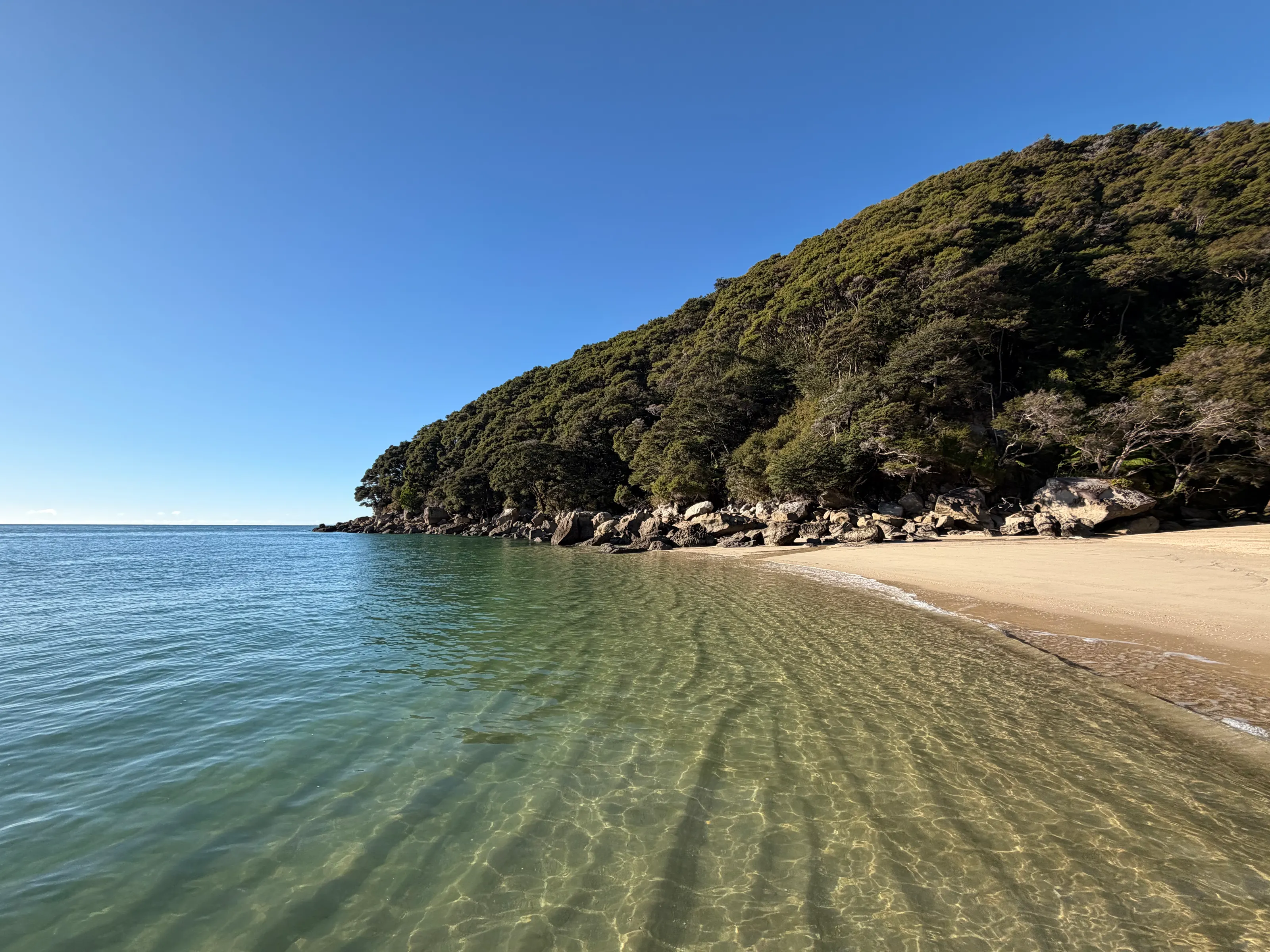
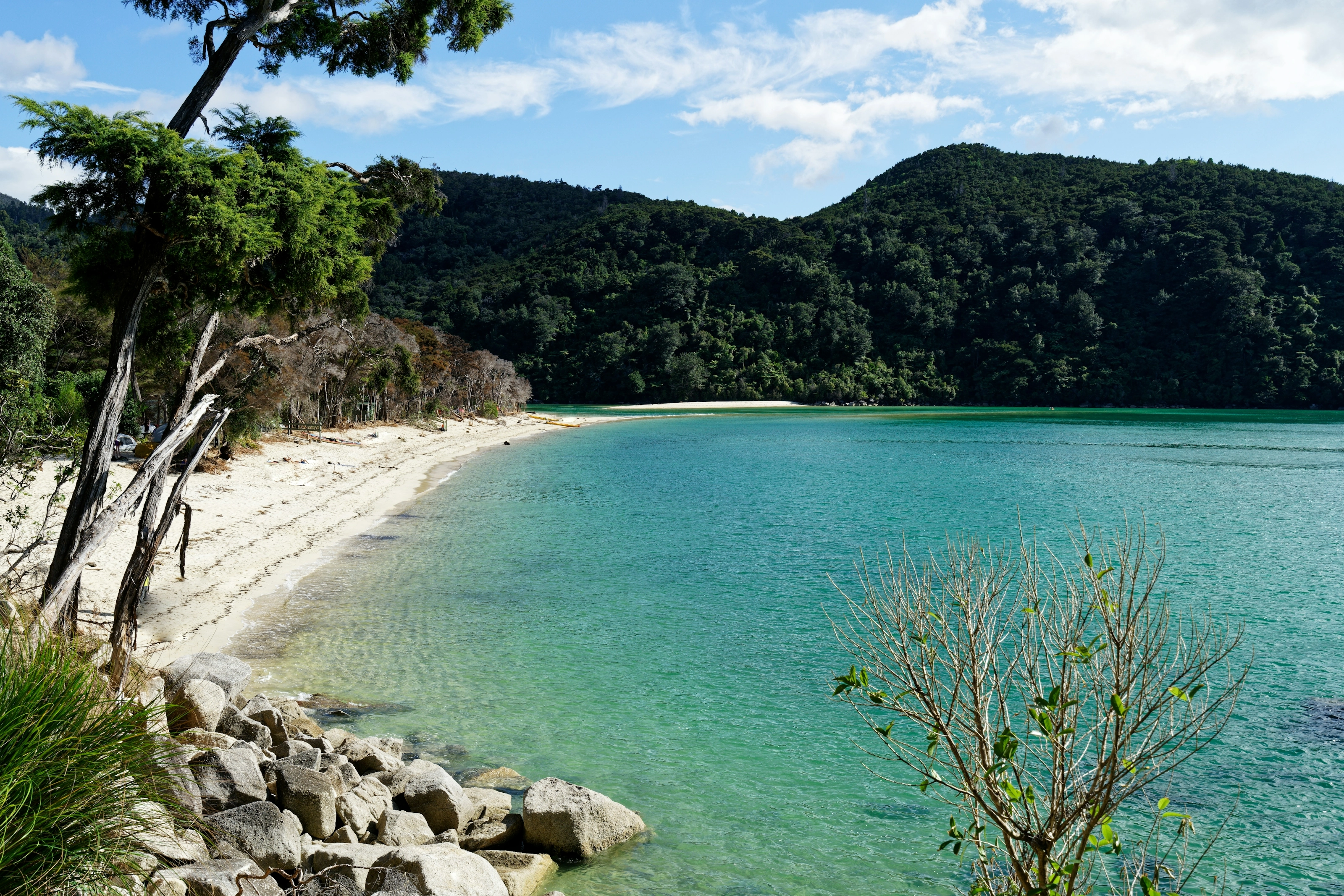
A golden-sand beach
The park's beaches alternate golden sand, rocks and forest right down to the water. The water is clear but stays cool, and the beaches are mostly reached on foot or by boat.
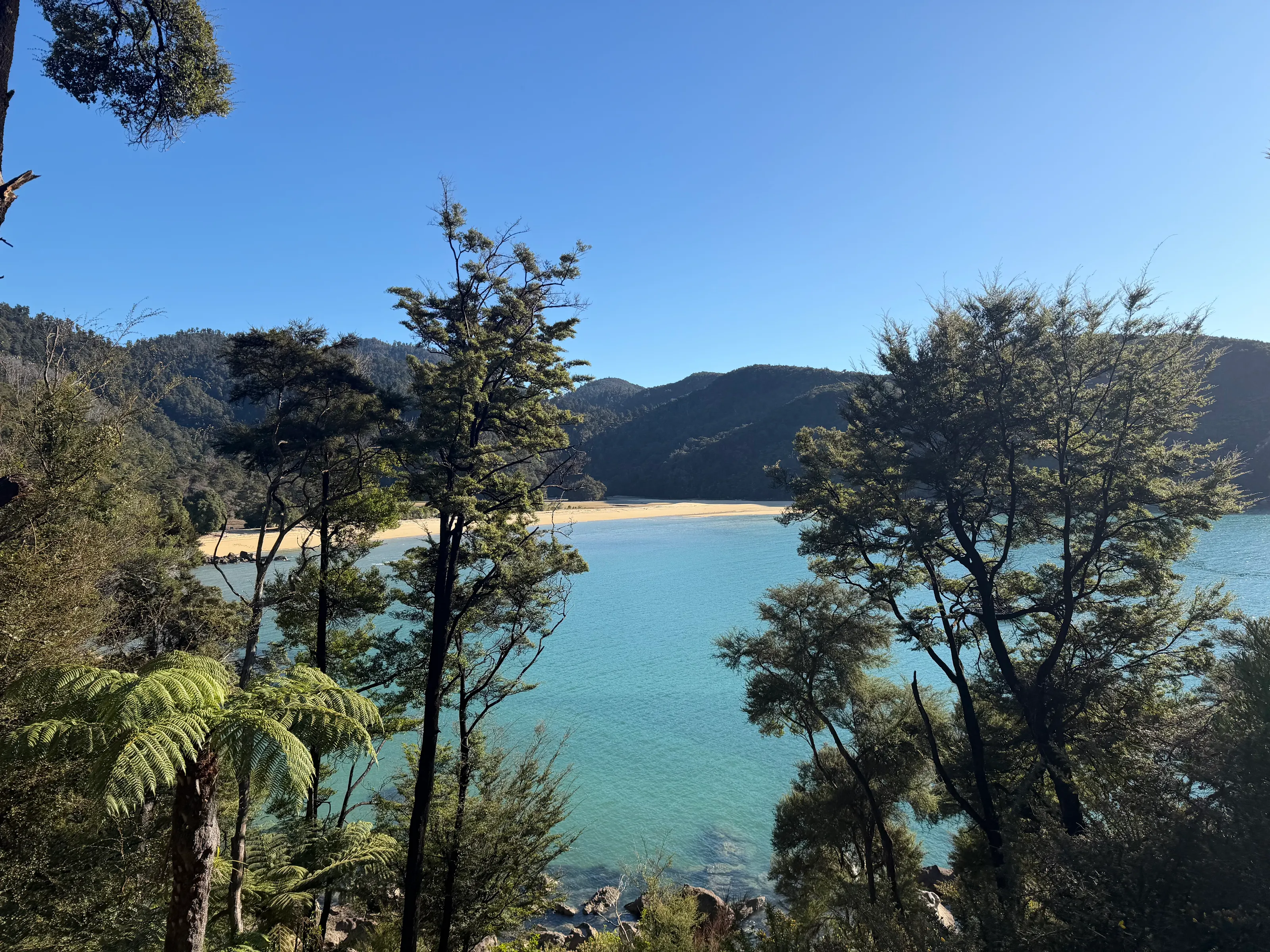
The bay between the ferns
Along the park's coast, paths cross native forest where tree ferns grow, with fine views over turquoise bays. Carry water and sun protection.
A cove on the coast
This pale-sand cove edged by forest illustrates the kind of landscape found on the north coast of the South Island. We do not tie it to a specific place.
Marlborough Sounds (outside Nelson)
A network of sounds to the north-east
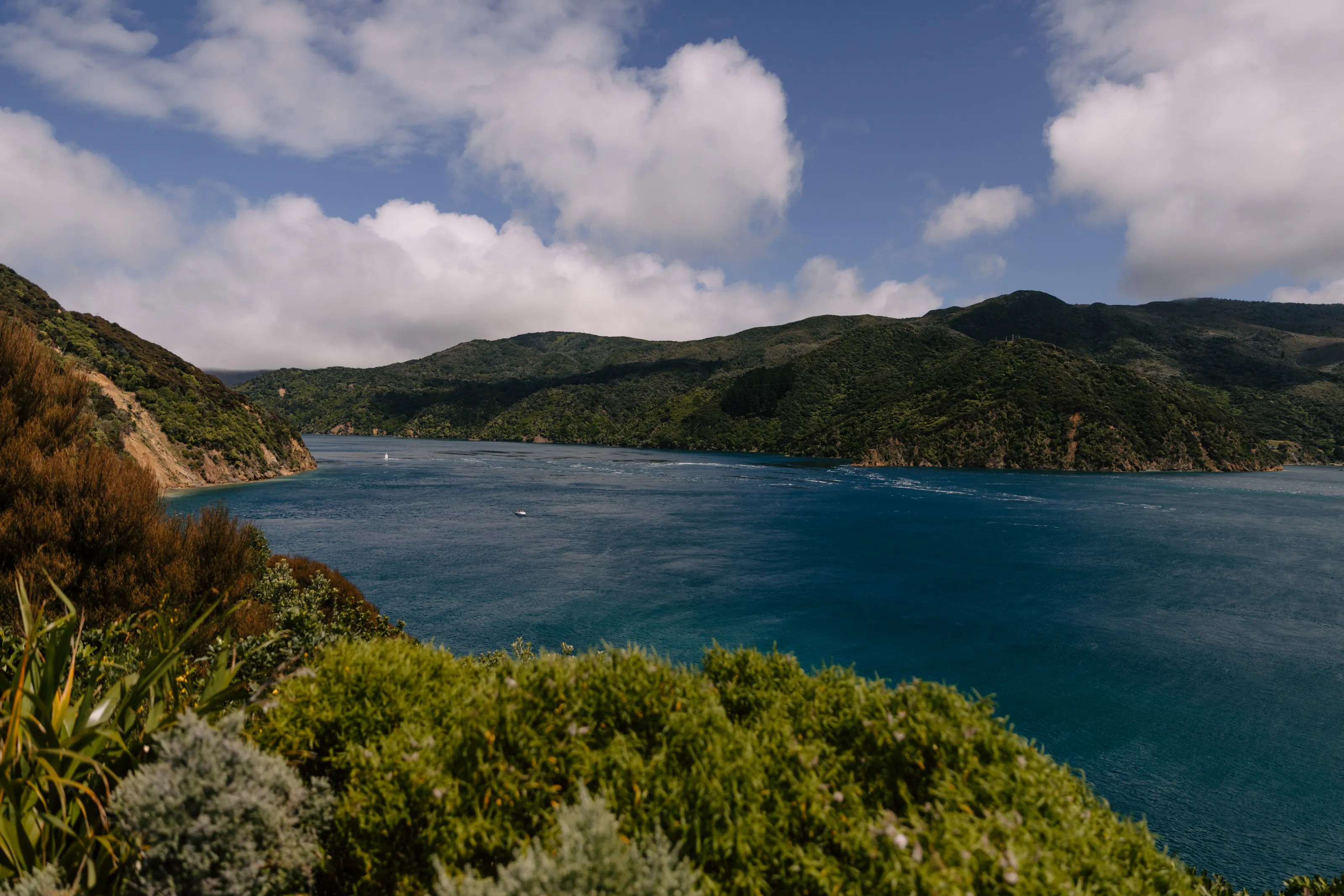
The Marlborough Sounds lie east of Nelson, outside the city: a maze of sea-drowned valleys covering about 4,000 km², explored by boat, on foot or by car. The port of Picton, at the head of the sound, is about 2 hours by road from Nelson, and is where the ferry from Wellington arrives. In neighbouring Marlborough, vines are grown: Sauvignon Blanc is its signature.
An arm of the Marlborough Sounds
Hills covered in forest and scrub plunge into deep, dark water, with no coastal road for long stretches; many hamlets are reachable only by boat. The photo shows an arm of the sound, taken outside Nelson.
The city, culture and museums
Cathedral, art gallery, crafts and the centre of New Zealand
The places in this section are not illustrated: they are described in text only.
The city of Nelson
Christ Church Cathedral, at the top of the granite steps from Trafalgar Street, is a city landmark. A short path leads from the Botanic Garden to the "Centre of New Zealand", a monument on Botanical Hill with a fine view: it does not mark the country's true geographic centre, but a reference point from the early land surveys. The Saturday Market on Montgomery Square is popular for local crafts and produce.
Museums and galleries
The Suter Art Gallery, on Bridge Street, shows New Zealand art, notably from the 19th century. Founders Heritage Park brings together relocated historic buildings, with mini-exhibitions, an organic brewery and a small train at weekends. Broadgreen Historic House, built in 1855, is a period home; the Miyazu Japanese Garden recalls the twinning with a Japanese city. We give no fares, which change.
Crafts and the arts
Nelson is known for its crafts, especially pottery, and for its festivals: the Nelson Arts Festival takes place in October. The World of WearableArt Awards began here in 1987; according to Wikivoyage the event has since moved to Wellington. The physicist Ernest Rutherford was born in Brightwater, near Nelson.
Māori culture
Nelson is called Whakatū in Māori, and several iwi (tribes) live in the region. Approach this history with curiosity and respect.
Food and drink
Seafood, hops, craft beer and wine
Fish, seafood and cafés
Port Nelson is the largest fishing port in Australasia, hence very fresh fish; fish and chips are an institution. Cafés and restaurants use plenty of local produce, and the Saturday market showcases local growers.
Hops and craft beer
The first settlers found that hops grew well here, and the region developed varieties specific to New Zealand, some of which carry the names of Nelson and Motueka. The harvest takes place in early autumn. Craft beer benefits, with several breweries.
Wine and fruit
The district has about twenty wineries, and neighbouring Marlborough is world-famous for its Sauvignon Blanc. Orchards and fruit farms also supply seasonal produce: apples, berries and more.
Getting around
Buses, bikes, cars and water taxis
In town
The centre is small enough to walk. An urban bus network serves the city, with four routes every 30 minutes, and regional services to Richmond, Wakefield and Motueka. Nelson also has a network of cycle routes and mountain-bike trails.
To the parks and beaches
For Abel Tasman, Kaiteriteri and the coast, a rental car gives the most flexibility. In summer, water taxis reach the park's beaches from Kaiteriteri or Mārahau; book and check the timetables.
From the rest of the country
By road, Picton is about 2 hours away, Blenheim about 1.5 hours and Christchurch about 6 hours, via the coast or the Lewis Pass. Long-distance buses and domestic flights also link Nelson with the rest of the island.
Budget and precautions
A medium-to-high budget, without cross-checked figures
Price level
Nelson is a medium-to-high budget destination compared with many European countries: accommodation can be expensive and in high demand in summer, especially near Abel Tasman. Many beaches and trails are free. We give no figures, as we could not confirm them from two independent sources.
Flights
The long-haul flight remains the most variable cost. SniperAir tracks prices to NSN and compares them with the route's history, but it does not sell or book tickets.
Entry requirements and precautions
New Zealand generally requires a travel authorisation or a visa depending on nationality: check the official New Zealand government websites. Also consult the official recommendations of your country of departure. The weather changes fast: for hiking and kayaking alike, check forecasts, tides and local advice before setting out.
When to go
Reversed seasons, one of the sunniest regions in the country
Austral summer (December to February)
Mild and sunny, with daytime temperatures of around 20 to 22 °C. It is high season: beaches, kayaking and hiking, but accommodation is in great demand.
Austral autumn (March to May)
Mild, bright days and fewer crowds; this is when the hops are harvested.
Austral winter (June to August)
Cool, with possible frosts and the stormiest weather of the year; some water activities are limited.
Austral spring (September to November)
Changeable but warming weather, gardens in bloom; the Nelson Arts Festival is held in October.
Mind the reversed seasons: New Zealand is in the southern hemisphere, so austral summer runs from December to February and winter from June to August, the opposite of Europe.
Nelson has one of the sunniest climates of New Zealand's larger cities: more than 2,300 hours of sunshine a year depending on the source, and rather moderate rainfall. The weather stays variable, though: pack a jacket.
By length of stay
What to do in Nelson depending on the length of your stay
The essentials
The cathedral, the Saturday Market, the Suter Art Gallery, a beach or a stroll around town.
Abel Tasman
A day of kayaking or hiking on the Coast Track, with a water taxi.
Further afield
The Marlborough Sounds and vineyards, Nelson Lakes or Golden Bay.
In pictures
Nelson and its surroundings in pictures
You might also like
Similar destinations
FAQ
Frequently asked questions about flights to Nelson
How do I get from Nelson Airport to the centre?
The airport (NSN) is about 6 km south-west of the centre. An urban bus line, shuttles and taxis cover the trip, about ten minutes by car.
When is the best time to visit Nelson?
The austral summer (December to February) is the mildest and sunniest period; March and April are quieter. The seasons are reversed compared with Europe.
Is Nelson expensive?
The budget is medium to high. Accommodation is in high demand in summer, especially near Abel Tasman; many beaches and trails are free.
How long should I stay in Nelson?
Two days for the city, one to two more for Abel Tasman, and longer for the Marlborough Sounds.
How do I get around Nelson?
On foot in the centre, by urban bus, by bike, and by rental car for the beaches and parks. Water taxis serve the bays of Abel Tasman.
What should I eat in Nelson?
Fish and seafood, craft beer made with local hops, seasonal fruit and, close by, the wines of Marlborough.
How much does a flight to Nelson usually cost?
The price depends mainly on your departure city, the period and the booking date. The "opportunities" section above shows real examples of prices already detected by SniperAir for this destination.
How do I get alerted when a flight to Nelson drops below my budget?
Create an alert profile with your departure airport, Nelson as the destination and your maximum budget. You are notified automatically as soon as a matching fare is detected.
Ready to head to Nelson?
Set your budget and let SniperAir monitor fares for you.
Create my alert