
Cheap flights to Bern
Set your departure airport and maximum budget: SniperAir tracks prices to Bern and alerts you the moment a deal matching your criteria appears.
Quick summary
Country
Switzerland
Continent
Europe
Airport
BRN
Currency
Swiss franc (CHF)
Time zone
UTC+1 (UTC+2 during summer time)
Deals already spotted to Bern
Real flight examples detected by SniperAir, with their reference price.
Loading examples…
Why track Bern with SniperAir
Switzerland's federal city, human in scale, curled inside a bend of the Aare
Choose your departure
Enter your departure airport and your maximum budget for a flight to Bern (BRN).
SniperAir keeps watch
Our systems continuously compare new prices with the real price history of the route. SniperAir monitors prices and alerts you: it does not sell or book tickets.
You receive an alert
As soon as a price matches your criteria, you are notified, without having searched for anything yourself.
Bern is Switzerland's federal city: the government and parliament have sat here since 1848 according to Wikipedia (EN, DE), although the country has no capital in the strict sense and Bern is only the fifth-largest city, with roughly 140,000 residents depending on the Wikipedia edition (DE, EN). Founded in 1191 by Duke Berthold V of Zähringen on a peninsula of the Aare, it joined the Swiss Confederation in 1353, and its medieval centre has been a UNESCO World Heritage Site since 1983 (Wikipedia EN, DE). It is a city for walking: about six kilometres of covered arcades, more than a hundred fountains, a clock tower, the bears that give the city its emblem, and river swimming in summer. This guide presents Bern as open sources describe it; SniperAir tracks flight prices to BRN, compares them with the real price history of the route and alerts you when one falls below your budget. Because Bern's own airport is small, alerts for Zurich and Geneva are a useful alternative.
Airport and getting into town
A small airport south of town, and two big airports within reach by train
Bern-Belp (BRN)
Bern Airport (BRN) is in Belp, about ten kilometres south-east of the centre, and opened in 1929 according to Wikipedia (DE). Take bus 160 from Belp station and then a regional train: about forty minutes in all, says Wikivoyage (EN). Services are few: some European cities and Mediterranean beach destinations, with no flights to other Swiss cities according to Wikivoyage (DE). We publish neither a list of routes nor timetables, which change with the season.
Distances and times are approximate, from Wikipedia (DE) and Wikivoyage (EN, DE); timetables change, so check before you travel. We do not publish fares.
For a wider choice of flights, many travellers fly into Zurich (ZRH), Geneva (GVA) or Basel: Wikivoyage (EN) lists InterCity trains twice an hour to Geneva, Basel and Zurich, and the Zurich and Geneva airports connect directly to Bern station. The journey takes about 1 h 20 from Zurich and 1 h 30 from Geneva according to Wikivoyage (FR), while Wikivoyage (DE) says about two hours, so check the timetable. Bern is a hub of the Swiss rail network with international connections. If you cannot find a BRN flight at your price, set up an alert for ZRH or GVA.
Landmarks
Old town, the Aare, the clock tower and the Rosengarten
The photos below mostly show the historic centre and the banks of the Aare. The Federal Palace, the BärenPark, Einstein's house and the Gurten are covered at the end of this section.
The minster and the old town above the Aare
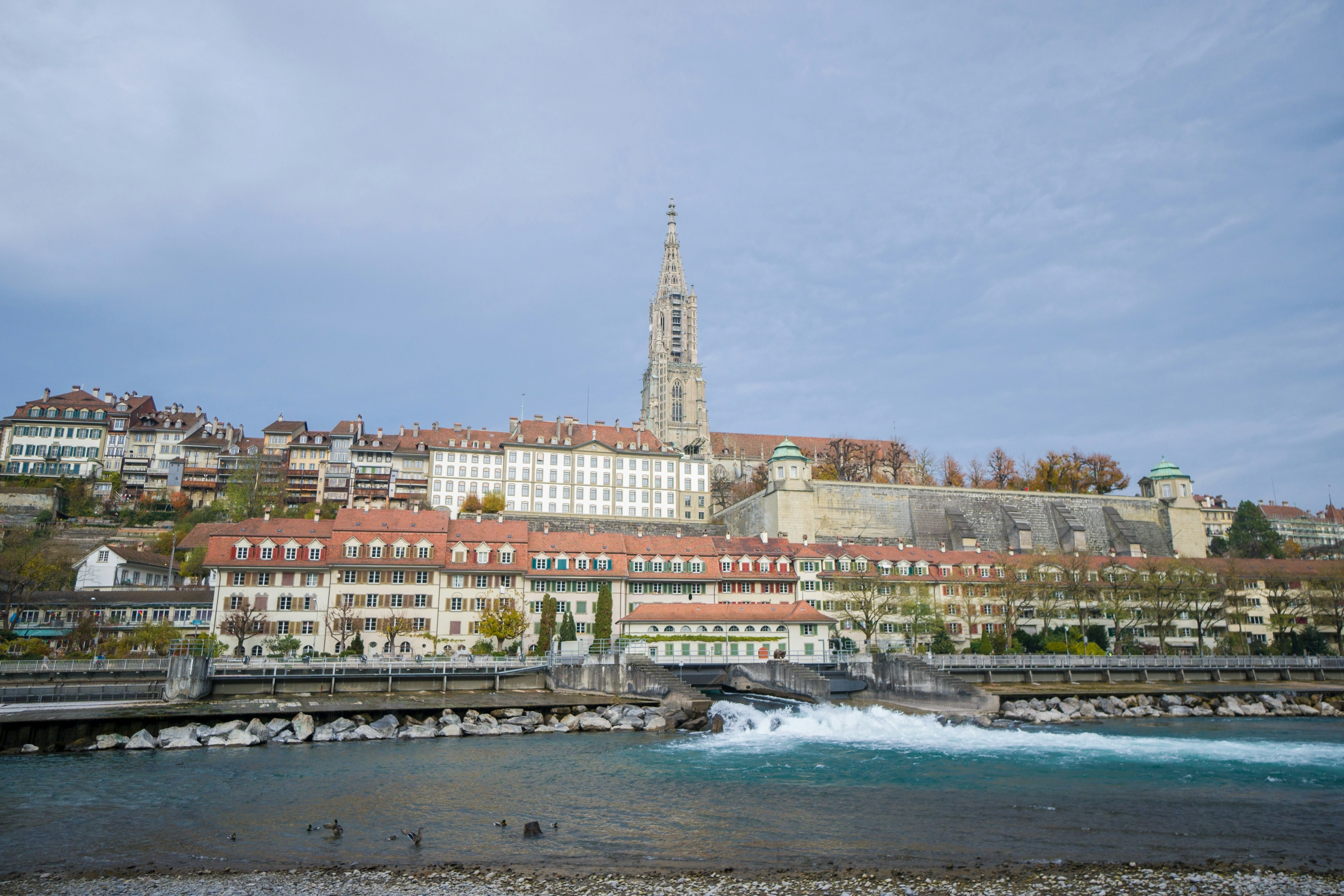
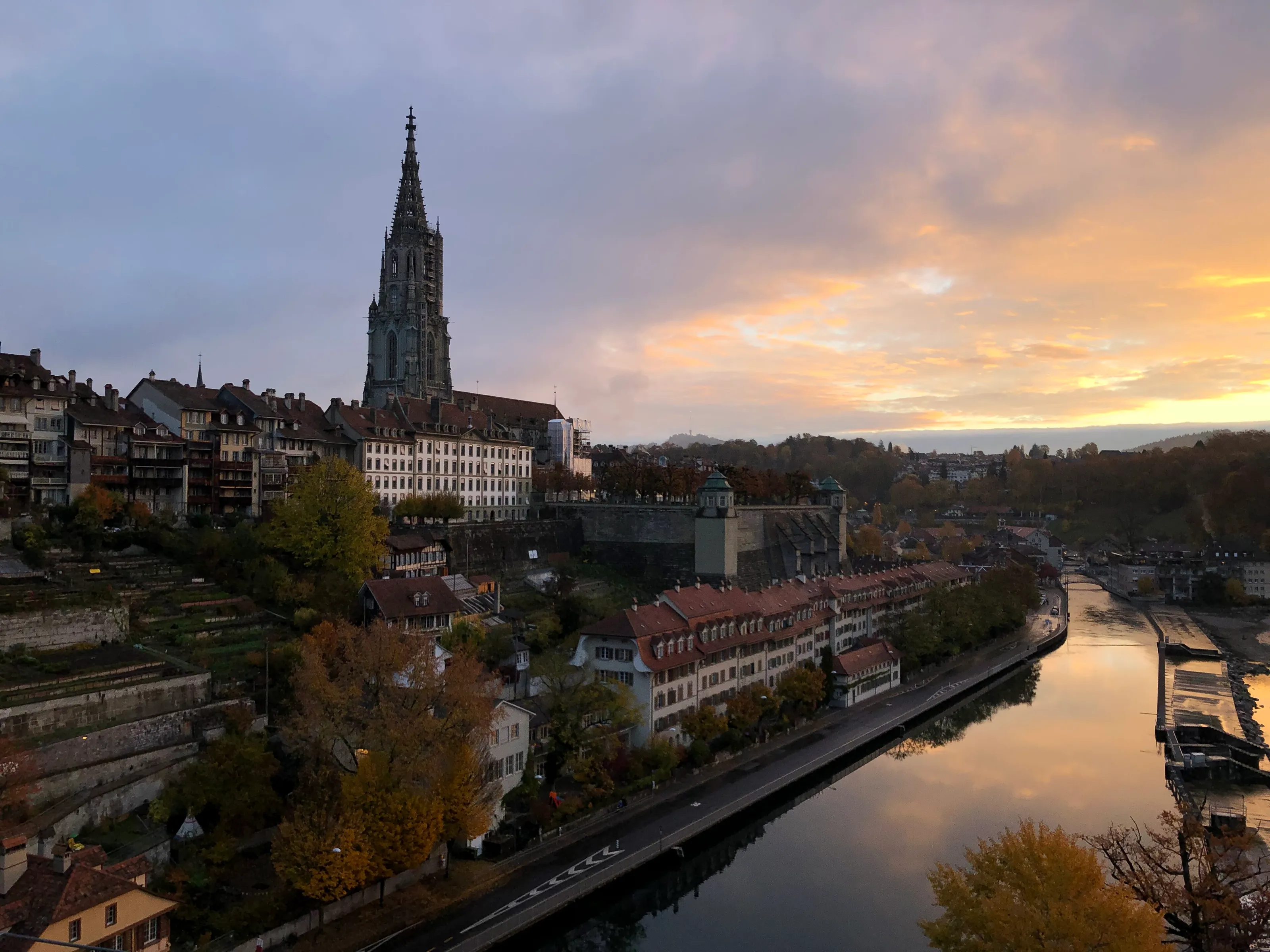
Bern's skyline is recognised by the spire of its minster, the Münster, rising over the red roofs of the old town. This late-Gothic masterpiece was begun in 1421 and its tower was only completed in the late nineteenth century according to Wikipedia (DE, ES). The city was rebuilt in sandstone after the fire of 1405 and has kept a remarkably unified look (Wikipedia FR). The stone gives the whole ensemble its light colour.
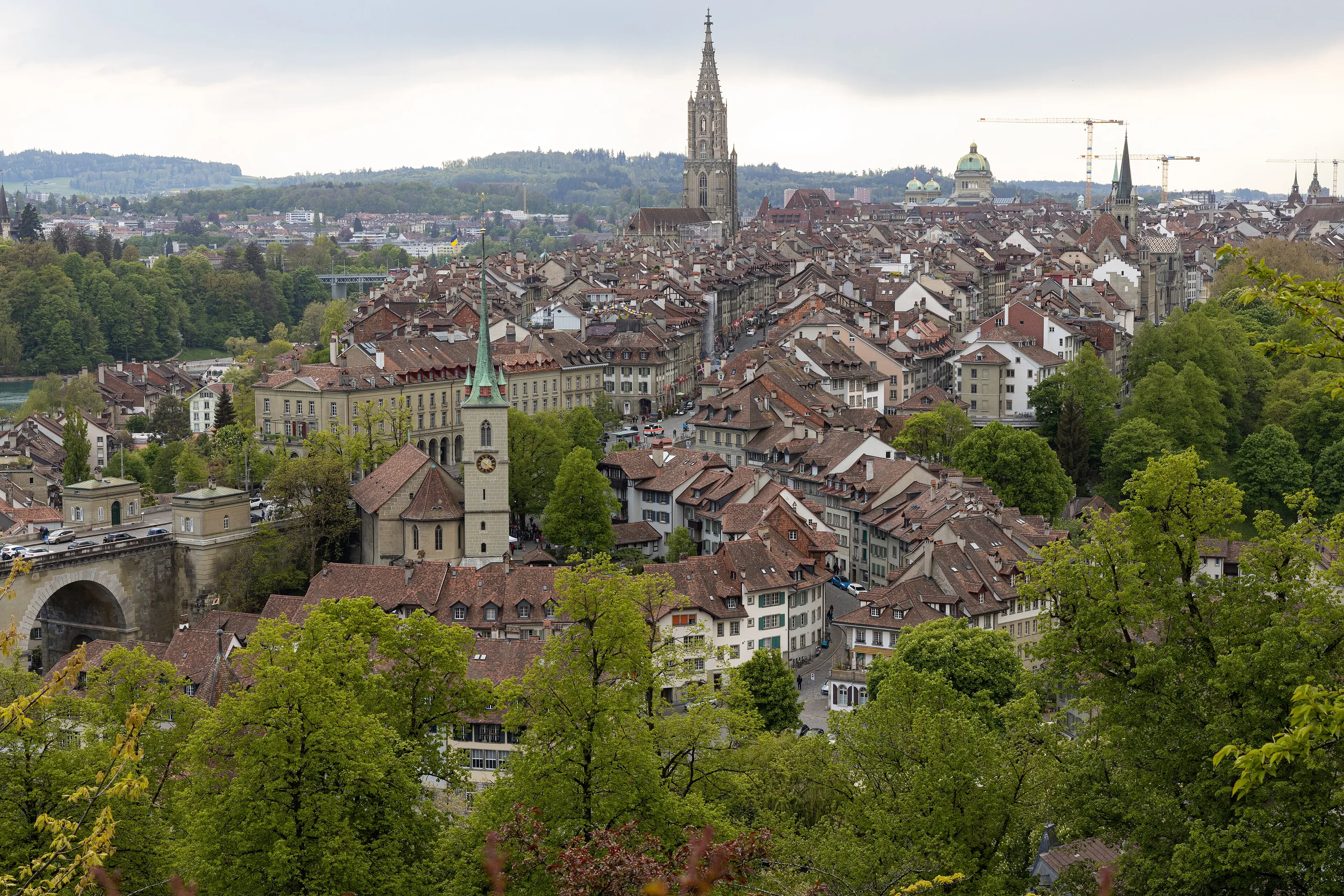
The Rosengarten and the view over the old town
The Rosengarten, above the old bear pit, offers the most famous view over the old town and the loop of the Aare (Wikivoyage DE, EN). Wikivoyage (ES) counts about 220 varieties of roses there and a restaurant with a view. Take bus 12 from the station, says Wikivoyage (EN). The peninsula of the old town, with its tiled roofs, churches and building cranes, can be taken in at a glance.
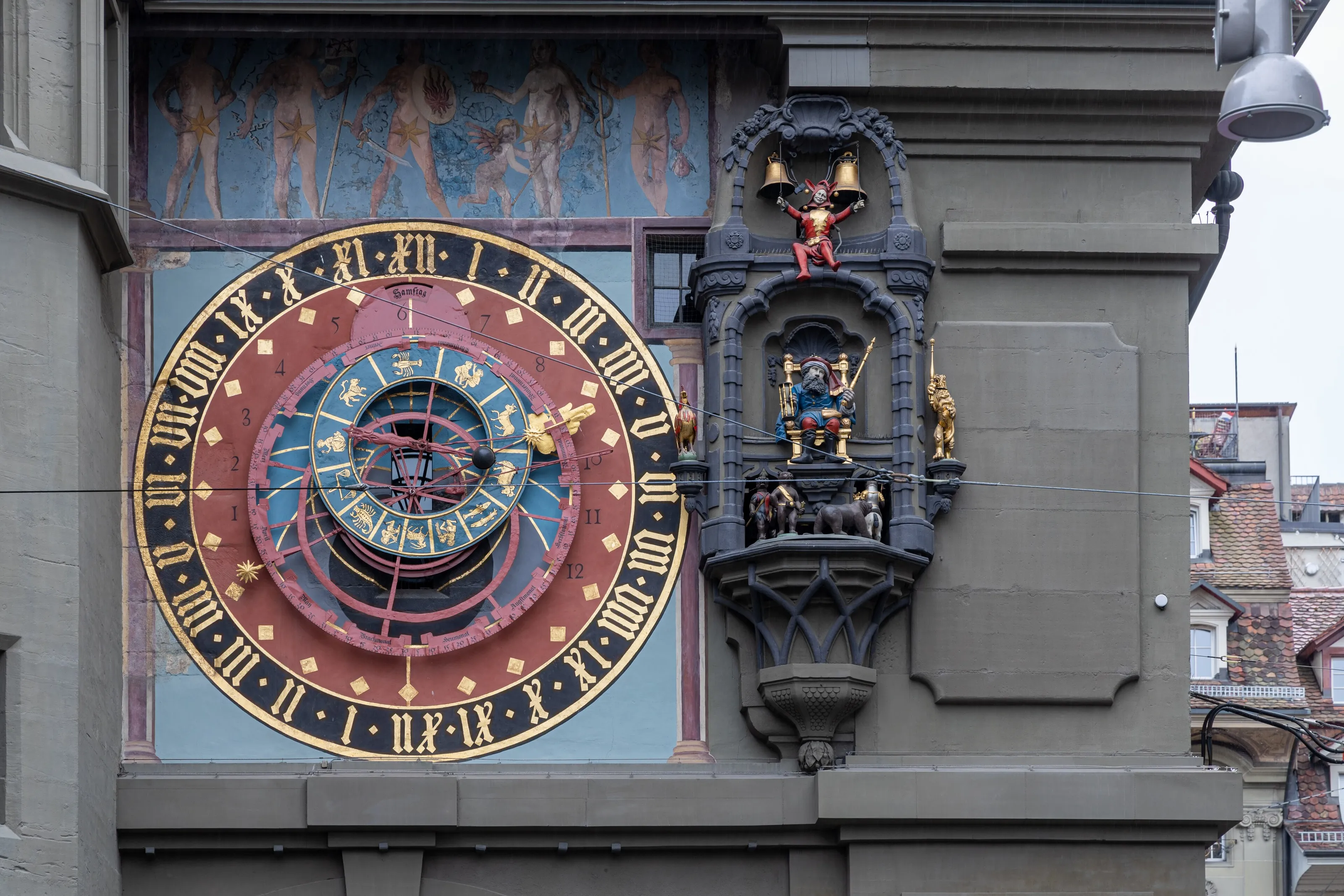
The clock tower (Zytglogge)
The Zytglogge was a guard tower and a prison before it became, from the fifteenth century, the tower of an astronomical clock, says Wikivoyage (EN). The show of mechanical figures starts a few minutes before each hour; the dial also shows the month, the day, the zodiac sign and the phase of the Moon. The tower marked the western edge of the city from 1191 to 1256 (Wikipedia FR).
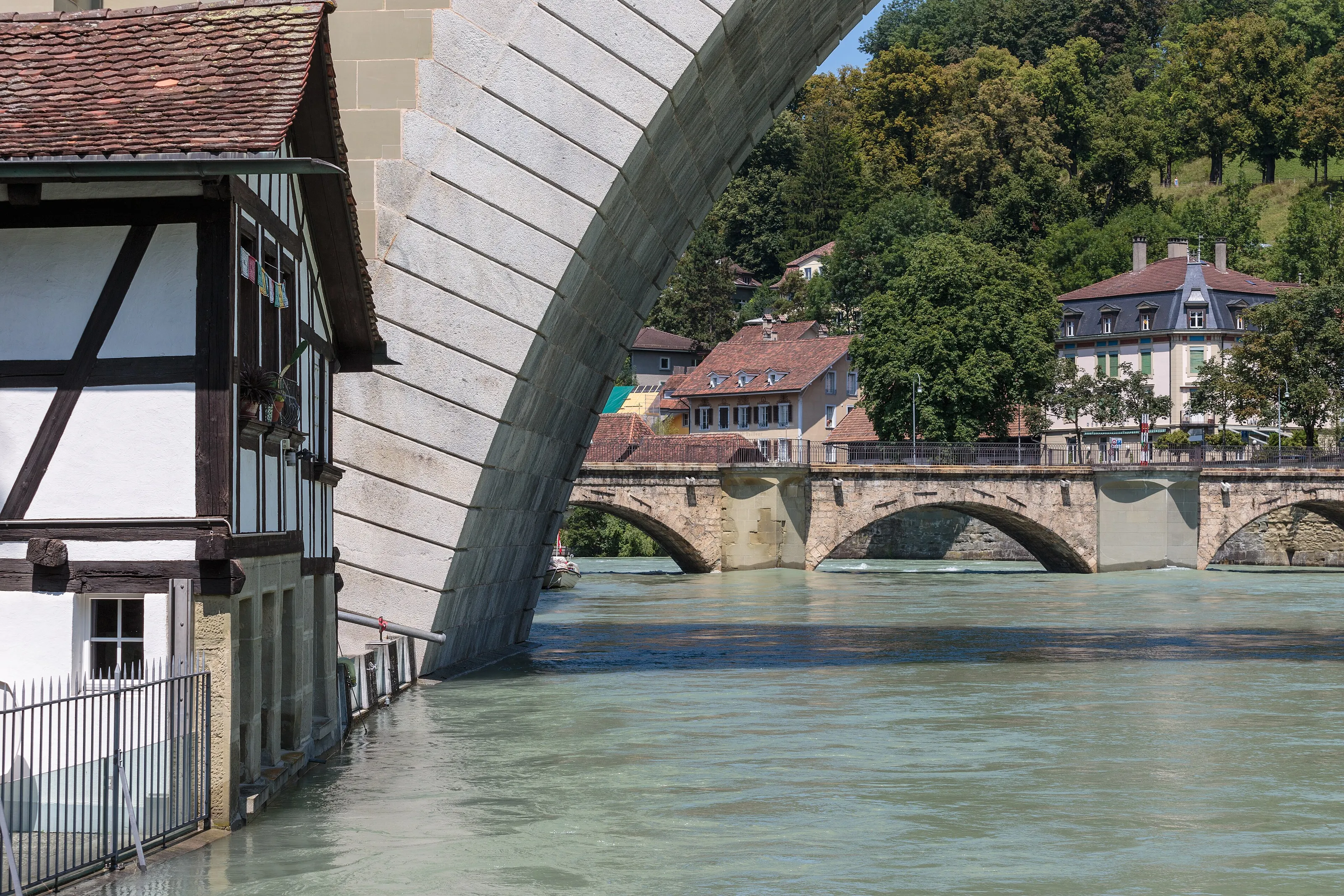
The Aare and the Matte district
The turquoise Aare wraps around the old town; below the terrace, the Matte district stretches along the water. Several stone bridges cross the river, among them the Nydeggbrücke near the BärenPark (Wikivoyage EN). The low quarters by the river (Matte, Marzili) are separated from the high ones by several dozen metres of height difference (Wikipedia FR).
The Aare at dusk: swimming in the river
In summer Bernese people let the current of the Aare carry them, between the Eichholz and the Marzili pool or between the Lorraine and the Kornhausbrücke, according to Wikivoyage (EN, DE); entry to the public pools is free. Some stretches, especially around the old town, are for experienced swimmers accompanied by locals. Always check the weather, the flow and the water temperature before you swim.
In town: the Federal Palace, home of parliament, built in three stages between 1852 and 1902 (Wikipedia DE), overlooks the Bundesplatz and its fountain of 26 jets (Wikivoyage ES); the BärenPark, opened in October 2009 beside the Aare next to the old bear pit (Wikipedia DE), houses the city's emblem animal; Einstein's house at Kramgasse 49, where the physicist lived from 1903 to 1905 (Wikipedia EN, Wikivoyage EN); and the Käfigturm and Blutturm towers recall the old city walls. The Gurten, an 858 m hill reached by funicular from the number 9 tram, offers a panorama of the Bernese Alps (Wikipedia FR, Wikivoyage EN).
Museums and culture
Museums and culture: Paul Klee, fine art, history and science
Paul Klee and fine art
The Zentrum Paul Klee, a building formed of three waves east of the centre, is devoted to the artist who spent long years in Bern; trolleybus 12 goes there, says Wikivoyage (EN, ES). The Kunstmuseum, the fine arts museum, gathers eight centuries of painting with works by Ferdinand Hodler, Paul Klee and Pablo Picasso (Wikivoyage EN).
History, Einstein and the mountains
The Bern Historical Museum combines ethnographic collections with the history of Bern from prehistory to the present, and Einstein's house completes the visit (Wikivoyage EN). The Swiss Alpine Museum, on the same square, covers geology, glaciers, wildlife and mountaineering (Wikivoyage EN). We give no opening hours or admission prices: they change regularly.
Festivals and events
The Zibelemärit, the onion market, takes place on the fourth Monday in November: about 30 tonnes of onions and more than 600 stalls, with confetti and small plastic hammers, according to Wikipedia (DE) and Wikivoyage (DE). The Gurten Festival in July and a jazz festival held since 1976 complete the calendar (Wikivoyage EN). During the Museum Night, cultural venues stay open late (Wikivoyage DE). Check dates before you book.
Food and drink
Bernese platter, the onion market and tables in the old town
The Bernese platter
The Bernese platter (Berner Platte) is a dish of smoked and boiled meats, beef, tongue, bacon, ribs and sausages, served with juniper sauerkraut, beans and potatoes, according to Wikipedia (DE, FR). Wikipedia (DE) traces it to the victory meal held after the battle of Neuenegg on 5 March 1798. It is a hearty dish, more of a winter one.
Eating under the arcades
The old town and the station district concentrate restaurants and cafes; Wikivoyage (EN, DE) notes that Italian, Asian and world cuisines are widespread, and advises comparing before sitting down in a traditional Swiss restaurant aimed heavily at tourists. The shops of Rathausgasse and the parallel streets sell crafts and original objects (Wikivoyage EN).
Picnics by the water
The banks of the Aare and the Gurten are popular picnic and barbecue spots with locals (Wikivoyage EN, DE). We name no brand and no specific restaurant.
Getting around
On foot, by tram and by regional train
An old town for walking
The centre is small and best explored on foot; Wikivoyage (EN) advises leaving the car at a park-and-ride, since driving in is difficult and spaces are scarce and expensive. The city is bike-friendly, but its relief sometimes calls for a little stamina or an electric bike (Wikivoyage EN).
Tram, bus and S-Bahn
Bernmobil trams, trolleybuses and buses fan out from the station at intervals of 5 to 30 minutes; the S-Bahn serves the suburbs and neighbouring towns such as Biel, Thun, Fribourg and Solothurn (Wikivoyage EN). Tickets are valid on all modes within a zone. Many accommodations hand out a free transport ticket for the length of your stay according to Wikivoyage (EN, ES): ask your hotel rather than take it for granted.
Easy excursions
Thun, Biel and Interlaken are reached by train in roughly half an hour to an hour according to Wikivoyage (DE); the station is close to the old town. We publish no fares.
Budget and precautions
Budget, formalities and precautions
Price level
Switzerland is among the most expensive destinations in Europe: Wikivoyage (EN, ES) warns that eating out in Bern can be costly for foreign visitors and advises comparing restaurants. We give no figures because we could not confirm them on two independent open sources.
Currency and payment
The currency is the Swiss franc (CHF). Check the exchange and payment conditions of your card before you leave. Shops close early and, as a rule, on Sundays, except in the main station (Wikivoyage EN, DE): check opening hours locally.
Flights, formalities and precautions
SniperAir monitors prices and alerts you; it does not sell or book tickets. Switzerland is not in the European Union but applies the Schengen rules: entry conditions depend on your nationality and may change, so consult your own government's official advice before you book. Keep an eye on your belongings in busy places and, if you swim in the Aare, follow local advice.
When to go
Four distinct seasons: mild summers, cold winters
Winter (December to February)
Cold, with about 99 frost days a year and a January average near 0 C (Wikipedia FR, DE). It snows on roughly fourteen days a year on average (Wikipedia FR, EN). The November Zibelemärit opens the festive season.
Spring (March to May)
Temperatures climb gradually; a good time for museums and a first walk to the Rosengarten before the summer crowds.
Summer (June to August)
July averages around 18 to 19 C and thunderstorms are frequent: summer gets about twice as much rain as winter (Wikipedia DE). This is the season for swimming in the Aare and for the Gurten Festival.
Autumn (September to November)
Autumn colours the Gurten and the banks of the Aare; days shorten and the air cools. The heat record is 37 C in August 2003 (Zollikofen, Wikipedia FR).
Bern has a temperate Cfb climate with an annual mean of about 9 C and well-marked seasons, according to Wikipedia (FR, DE). Wikipedia (ES) speaks of a semi-continental climate: descriptions vary, but all agree on cold winters and mild, damp summers. We give no other monthly averages because reference periods differ between sources.
By length of stay
What to do in Bern depending on how long you stay
The essentials
The old town and its arcades, the Zytglogge, the Minster, the Rosengarten and the BärenPark, with a Bernese platter or a coffee under the arcades.
Museums and the Aare
Add the Zentrum Paul Klee, the Kunstmuseum or the Historical Museum with Einstein's house, a swim in the Aare in summer and a trip up the Gurten.
Bern as a base
Use Bern as a starting point for Thun, Biel or Interlaken by train, or come back in November for the Zibelemärit.
In pictures
Bern in pictures
You might also like
Similar destinations
FAQ
Frequently asked questions about flights to Bern
How do I get from Bern airport to the centre?
Bern-Belp airport (BRN) is about ten kilometres south-east of the centre: bus 160 to Belp station, then a regional train, about forty minutes in all according to Wikivoyage. Timetables change, so check them before you travel.
Do I need to fly into Zurich or Geneva to reach Bern?
Bern airport has few connections. Many travellers land in Zurich or Geneva and take an InterCity train to Bern, which takes between an hour and a half and two hours depending on the source.
When is the best time to visit Bern?
From May to September for swimming in the Aare and café terraces; in November for the onion market. Winter is cold but the old town is still pleasant to explore.
Is Bern expensive?
Yes, like the rest of Switzerland: travel sources warn that eating out can be costly. We give no figures because we could not confirm them.
How long should I stay in Bern?
One day is enough for the old town; two to three days allow museums, the Gurten and the Aare, and four days or more let you branch out to Thun, Biel or Interlaken.
What should I try in Bern?
The Bernese platter, a classic of meats and sauerkraut, and in November the specialities of the onion market; the city also offers a wide variety of world cuisines.
How much does a flight to Bern usually cost?
The price depends mainly on your departure city, the time of year and how far ahead you book. The "opportunities" section above shows real examples of prices SniperAir has already detected to this destination.
How do I get alerted when a flight to Bern drops below my budget?
Create an alert profile with your departure airport, Bern (BRN) as the destination and your maximum budget. You are notified automatically as soon as a matching price is detected. SniperAir monitors and alerts, it does not sell or book tickets.
Ready to head to Bern?
Set your budget and let SniperAir monitor fares for you.
Create my alert