
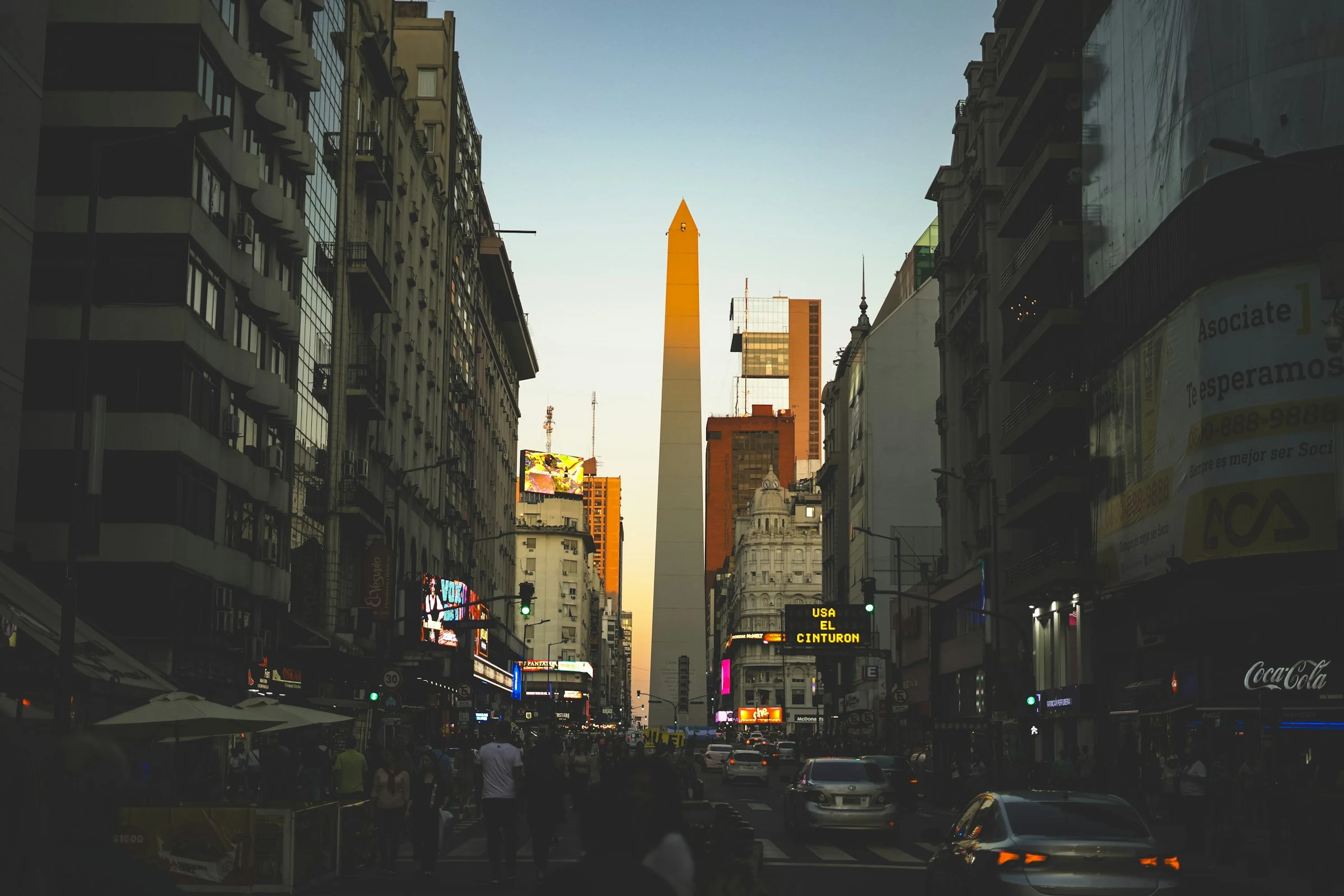
Cheap flights to Buenos Aires
Set your departure airport and maximum budget: SniperAir tracks prices to Buenos Aires and alerts you the moment a deal matching your criteria appears.
Quick summary
Country
Argentina
Continent
South America
Airport
EZE
Currency
Argentine peso (ARS)
Time zone
UTC-3
Deals already spotted to Buenos Aires
Real flight examples detected by SniperAir, with their reference price.
Loading examples…
Why track Buenos Aires with SniperAir
You don't need to compare prices every day
Choose your departure
Set your departure airport and your maximum budget for a flight to Buenos Aires.
SniperAir tracks the route
Our systems continuously compare new prices against the route's real history.
You get an alert
As soon as a price matches your criteria, you're notified — without searching yourself.
Buenos Aires Airports
Two airports, two different purposes
Ezeiza International Airport
The main international airport, about 35 km southwest of downtown — generally 13 to 14 hours on a direct flight from Paris.
Aeroparque Jorge Newbery
Right in the city centre, on the Río de la Plata, dedicated to domestic flights within Argentina.
History
A capital shaped by European immigration
First founded in 1536 and definitively in 1580, Buenos Aires became one of South America's most cosmopolitan cities from the late 19th century onward, driven by major waves of Italian and Spanish immigration. This meeting of European cultures, Afro-Argentine communities and gaucho traditions gave birth to tango in the port's working-class neighbourhoods at the turn of the 20th century.
Plaza de Mayo, the country's political heart
Bordered by the Casa Rosada (presidential palace), the colonial Cabildo and the metropolitan cathedral, Plaza de Mayo remains the stage of Argentine political history, from the 1810 independence cries to the demonstrations of the Mothers of the Plaza de Mayo.
Tango
Far more than a tourist show
Born in the conventillos (tenement housing) of La Boca and San Telmo in the late 19th century, tango has been listed as UNESCO Intangible Cultural Heritage since 2009. To experience it authentically, look for a real milonga — a social dance where locals dance with each other — rather than a show calibrated for tourists, though the professional performances remain technically impressive.
San Telmo, the historic birthplace
The city's oldest neighbourhood blends colonial architecture, a Sunday flea market and traditional tango houses like El Viejo Almacén.
Neighbourhoods
La Boca, Recoleta, Palermo: radically different atmospheres
La Boca, a former working-class port neighbourhood of Italian immigrants, is known for the colourful tin houses of Caminito street — a photogenic must-see, best visited during the day for safety reasons.
Recoleta and its cemetery
An upscale, Paris-like neighbourhood, Recoleta houses a monumental cemetery where many Argentine figures rest, including Eva Perón, in sculpted mausoleums worthy of an open-air museum.
Palermo, between parks and nightlife
The city's largest neighbourhood splits into several zones: Palermo Soho for boutiques and street art, Palermo Hollywood for nightlife, and the Palermo woods for a green break by the lakes.
Gastronomy
Asado, a national institution
As Argentina is one of the world's largest beef producers, asado (slow-grilled barbecue) remains the essential culinary experience of any Buenos Aires trip — best discovered at a traditional parrilla. Empanadas, small savoury pastries, are eaten everywhere as a snack. Wine, especially Mendoza's Malbec, naturally accompanies most meals.
Getting around
The Subte and the colectivos
The Subte (metro, 6 lines) remains the fastest way to cross the city at rush hour. The colectivos (buses) cover a denser but slower network. The rechargeable SUBE card is required for all public transport. For night trips or luggage, ride-hailing apps are recommended over hailing a taxi on the street.
By length of stay
What to do in Buenos Aires depending on how long you stay
The essentials
Plaza de Mayo, San Telmo, La Boca and Caminito, with a tango evening.
Go deeper
Add Recoleta and its cemetery, Palermo, and an evening at a real parrilla.
Day trips
A day in Tigre and its delta, or the start of a combined trip with Mendoza, Iguazú or Patagonia.
When to go
When to visit Buenos Aires
Southern summer (Dec-Feb)
Hot and humid, holiday atmosphere, but many locals leave for the coast in January.
Southern autumn (Mar-May)
Pleasant temperatures, one of the best times to visit the city.
Southern winter (Jun-Aug)
Cool but rarely freezing, lower tourist crowds.
Southern spring (Sep-Nov)
Jacaranda trees blooming in the streets, mild climate, highly recommended period.
You might also like
Similar destinations
FAQ
Frequently asked questions about flights to Buenos Aires
Is Buenos Aires just about tango?
No — the city combines a dense political history, neighbourhoods with very distinct identities (La Boca, Recoleta, Palermo) and a food culture built around asado, alongside its well-earned reputation for tango.
What's the best airport to arrive in Buenos Aires?
Ezeiza (EZE) is the main international airport. Aeroparque (AEP), more central, is mainly used for Argentine domestic flights.
How much does a flight to Buenos Aires usually cost?
It mainly depends on your departure city, the season and how far in advance you book. The 'deals' section above shows real prices already detected by SniperAir for this destination.
How long is a flight to Buenos Aires from Paris?
About 13 to 14 hours on a direct flight.
Is La Boca safe for tourists?
The tourist area around Caminito is generally safe during the day; it's best to avoid straying from the main streets or visiting the neighbourhood after dark.
How do I get alerted when a flight to Buenos Aires drops below my budget?
Create an alert profile with your departure airport, Buenos Aires as the destination and your maximum budget. You'll be notified automatically as soon as a matching price is detected.
Ready to head to Buenos Aires?
Set your budget and let SniperAir monitor fares for you.
Create my alert