
Cheap flights to Easter Island
Set your departure airport and maximum budget: SniperAir tracks prices to Easter Island and alerts you the moment a deal matching your criteria appears.
Quick summary
Country
Chile
Continent
South America
Airport
IPC
Currency
Chilean peso
Time zone
UTC-6 (UTC-5 in summer)
Deals already spotted to Easter Island
Real flight examples detected by SniperAir, with their reference price.
Loading examples…
Why track Easter Island with SniperAir
You don't need to compare prices every day
Choose your departure
Enter your departure airport and your maximum budget for a flight to Easter Island (IPC).
SniperAir keeps watch
Our systems continuously compare new prices with the route's real price history. SniperAir tracks prices and alerts you: it does not sell or book tickets.
You get an alert
As soon as a price matches your criteria, you are notified without having searched for anything yourself.
Airport and transfer
A single airport, steps from Hanga Roa
Mataveri International Airport
Mataveri is the island's only airport and sits on the edge of Hanga Roa, the only town: the centre is a 15 to 25 minute walk depending on the source (Wikivoyage FR, EN, DE, Wikipedia ES). A daily flight links Santiago de Chile in about 5 hours to 5 h 25 depending on the source. Accommodation hosts often arrange a pickup; otherwise a taxi will do. We give no fares or timetables, as they change.
Flight time taken from Wikivoyage (FR, EN) and Wikipedia (ES). Flights are few: check schedules. No fares given.
Easter Island, or Rapa Nui, is a territory of Chile isolated in the Pacific, about 3,500 to 3,700 km from the Chilean coast depending on the source (Wikipedia DE, Wikivoyage EN). The island is triangular, about 24 km long, and its population is almost entirely concentrated in Hanga Roa. Because air service is limited, book early, especially around the Tapati festival. Special entry rules exist to protect the island, notably a limited length of stay: find out before you leave.
Rapa Nui and the national park
A Polynesian people and a UNESCO-listed national park
The Rapanui people
The Rapanui are a Polynesian people who still speak their own language, Rapanui (Wikipedia ES). The island has been part of Chile since 1888; the moai are the legacy of their ancestors and part of a living culture, to be discovered with respect.
The national park
Rapa Nui National Park, inscribed on the UNESCO World Heritage List in 1995 (Wikipedia DE, ES), covers most of the sites: Rano Raraku, Orongo, Tongariki, Anakena. A park entry fee exists and gives access to the sites; we give no amount because sources differ. According to Wikivoyage (EN), a registered guide may also be required for most sites: check with your host.
Respecting the sites
Stay on the paths, do not climb the statues or the platforms (ahu), and do not take stones (Wikivoyage EN). The moai are more fragile than they look.
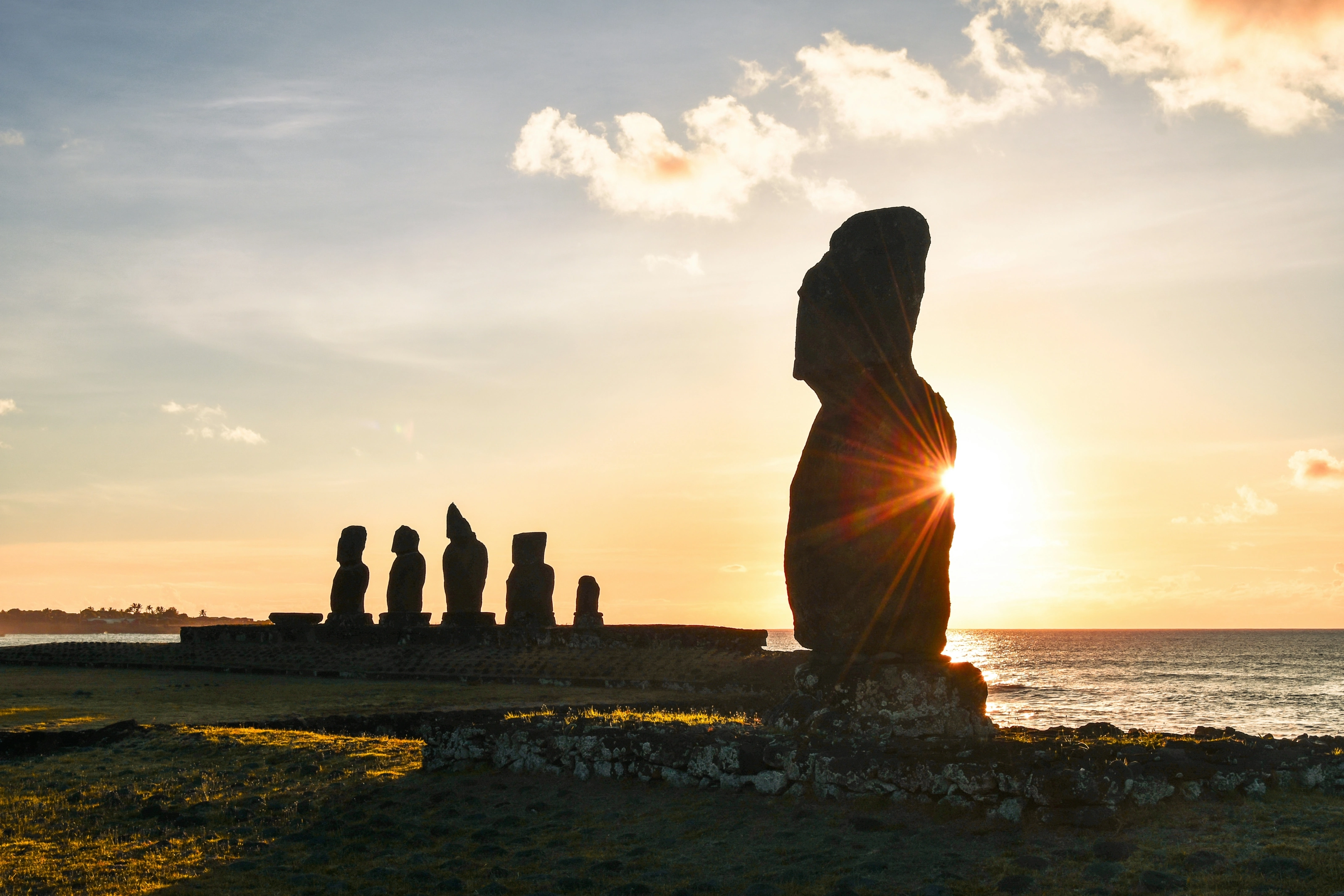
Ahu Tahai at sunset
Near Hanga Roa, the moai of Ahu Tahai stand silhouetted against the low sun over the ocean. It is a typical end-of-day scene.
Rano Raraku
Rano Raraku: the moai quarry
The Rano Raraku volcano is the quarry from which most of the island's moai came. You can see statues at different stages of carving, some unfinished, as well as a crater with a freshwater lake (Wikivoyage EN). The famous red hats, or pukao, came from another quarry, at the Puna Pau crater. According to Wikivoyage (EN), you can enter Rano Raraku only once with the park ticket.
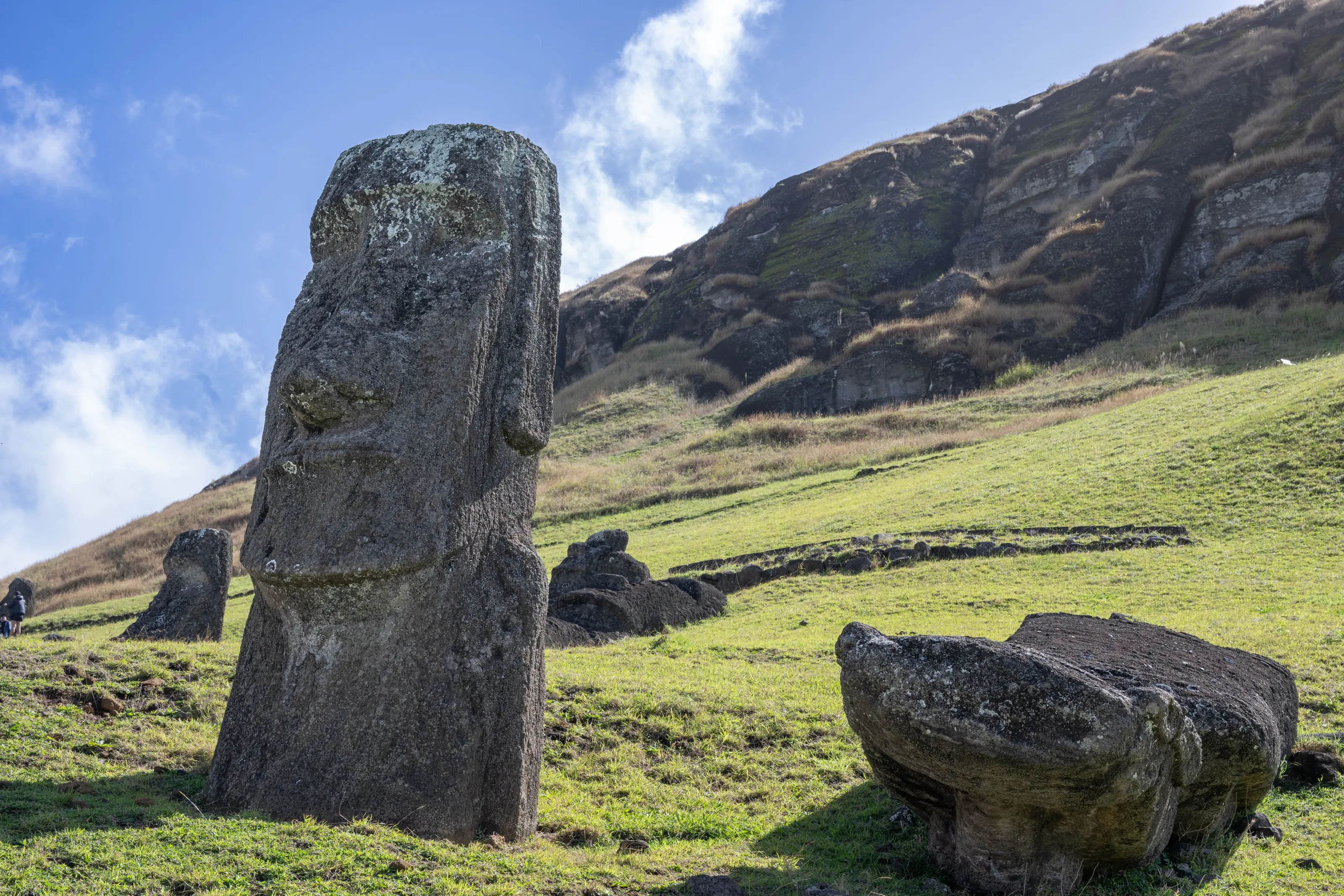
Moai on the volcano's slope
A moai stands in the grass at the foot of the volcano's slope, with a fallen statue in the foreground. Morning light and a blue sky bring out the relief.
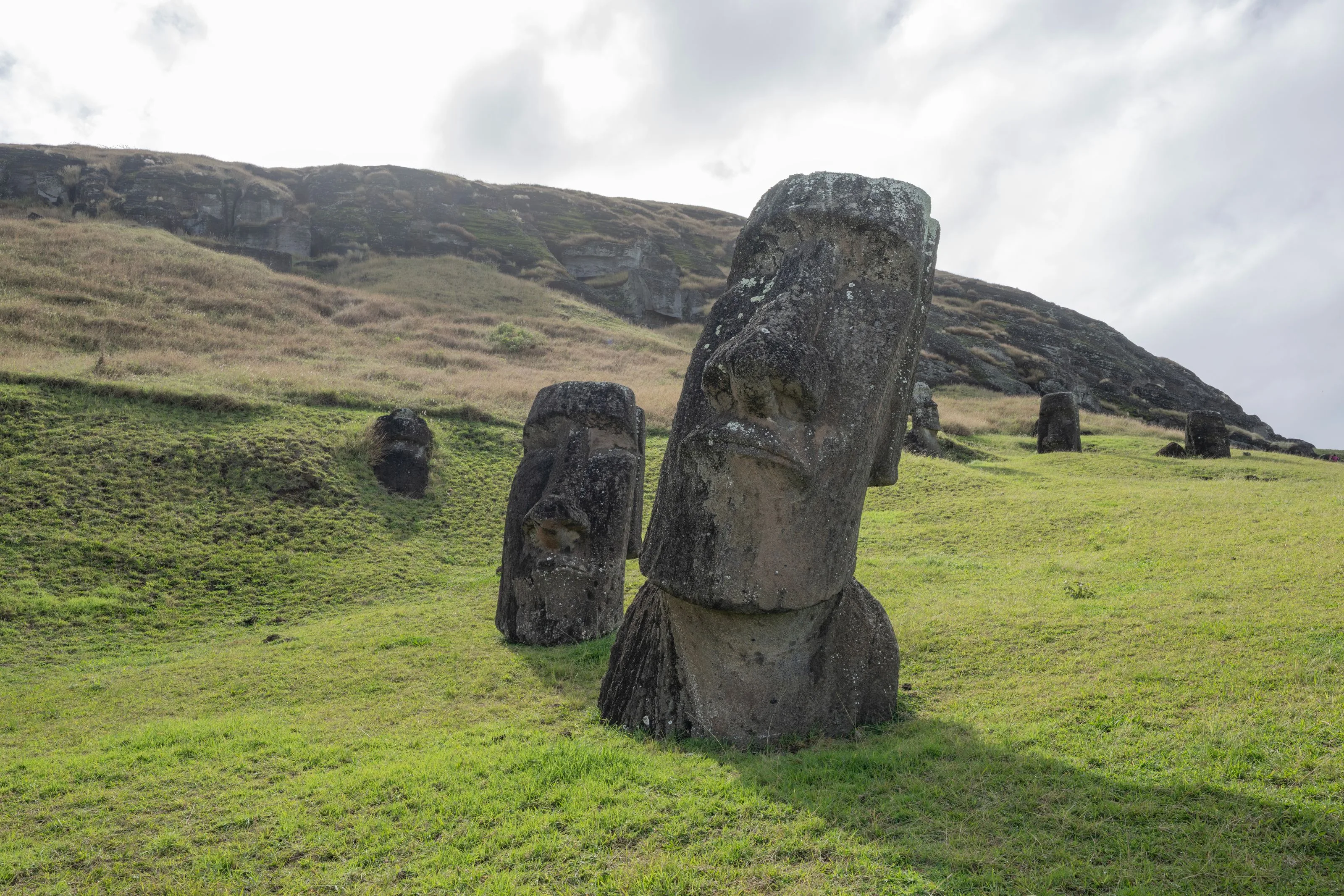
Faces in the grass
Several moai emerge from the grass on the slope, their heads raised to the sky, some buried up to the neck.
Ahu Tongariki
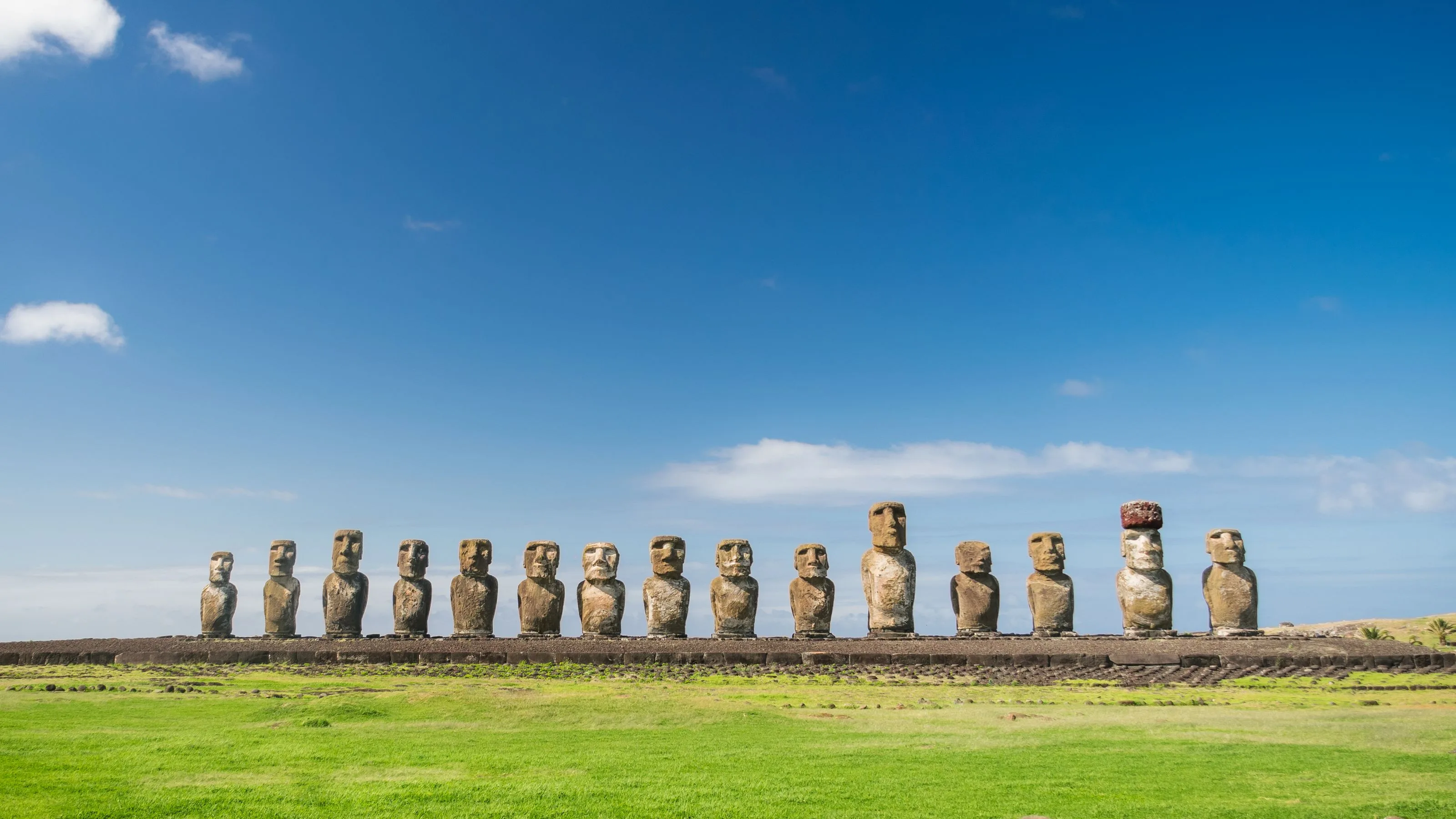
Ahu Tongariki: fifteen moai facing the Pacific
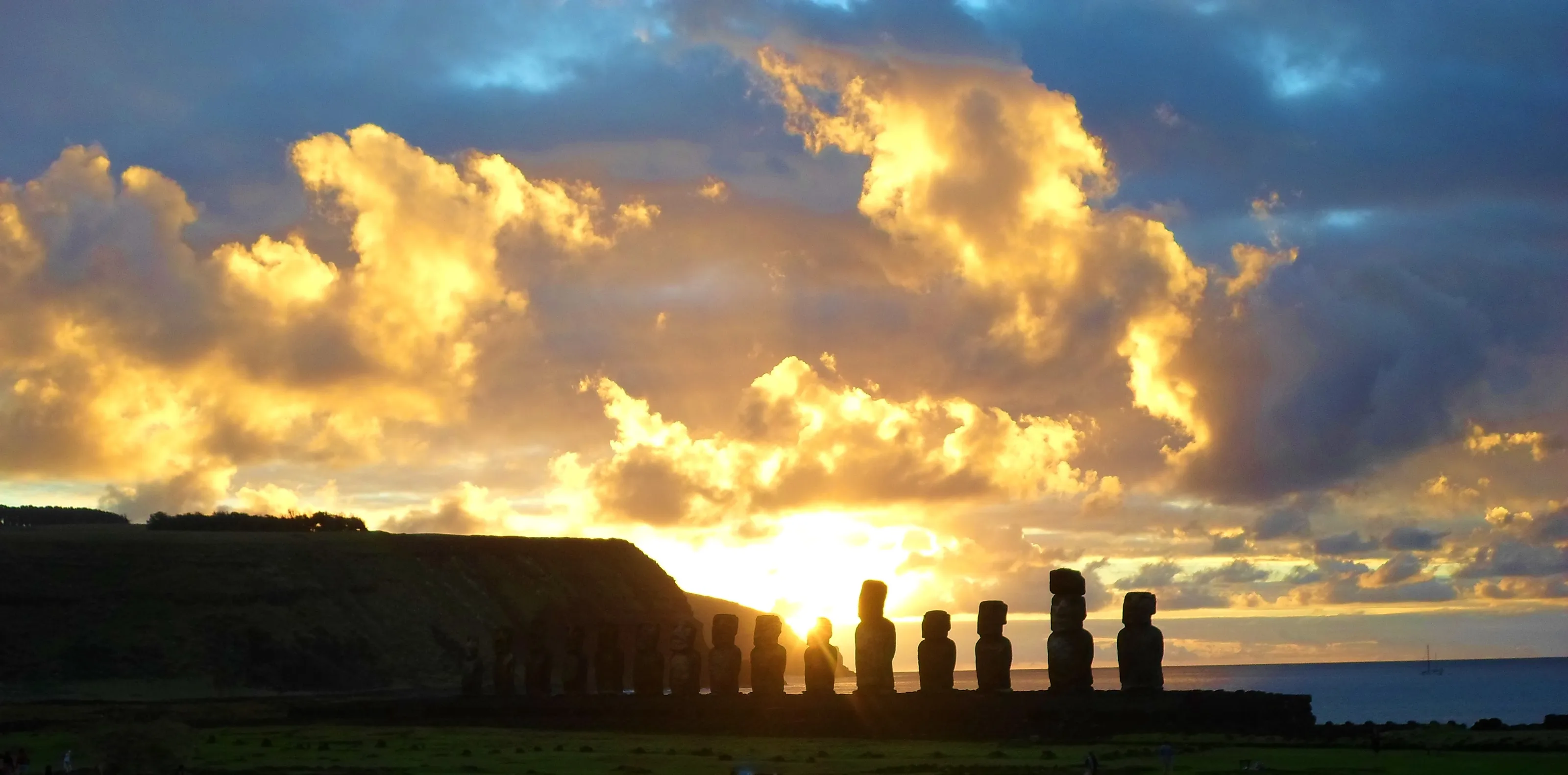
Ahu Tongariki is the island's largest ceremonial platform: fifteen moai in a row, about 150 m long (Wikivoyage EN). It lies on the east coast, near Rano Raraku, and the statues stand in silhouette at sunrise, as in our header photo. We give no visiting hours, as they change.
Fifteen moai under a blue sky
A row of moai on their platform, in front of a large green meadow. One of them wears a red hat, a pukao.
Anakena and the beaches
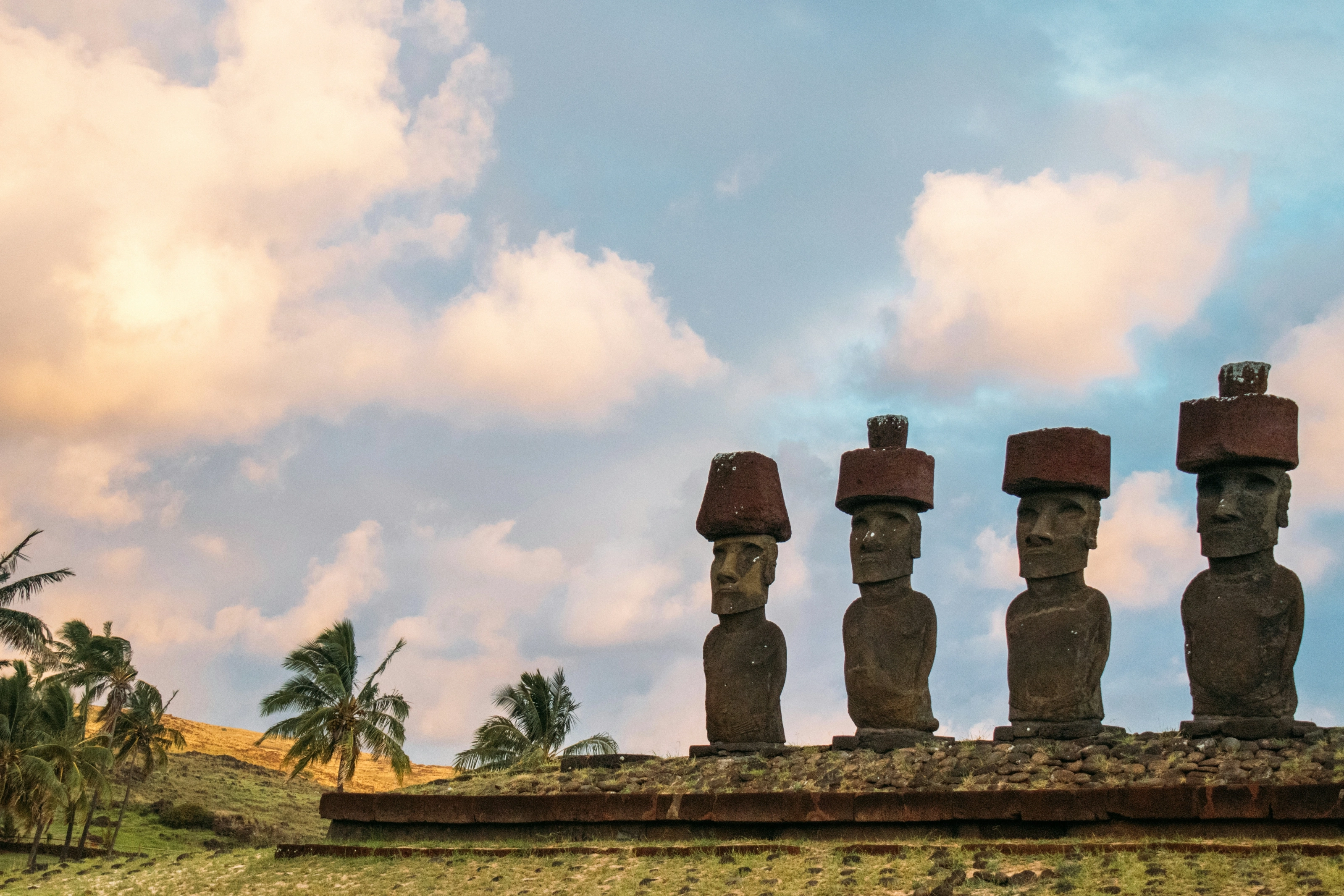
Anakena: pale sand, palm trees and moai
Anakena, in the north, is one of only two sand beaches on the island, along with Ovahe (Wikipedia DE). It is about 20 km from Hanga Roa (17 to 20 km depending on the source) and has no accommodation, because it is part of the national park (Wikivoyage EN, ES). People come to swim and to see the moai of Ahu Nau Nau. The coast is rocky with no reef: be careful in the water and protect yourself from the sun.
Moai wearing pukao
Four moai wearing red pukao stand out against palm trees and a cloudy, pink-tinted sky. This is probably Ahu Nau Nau at Anakena, but the exact location of this photo is not confirmed.
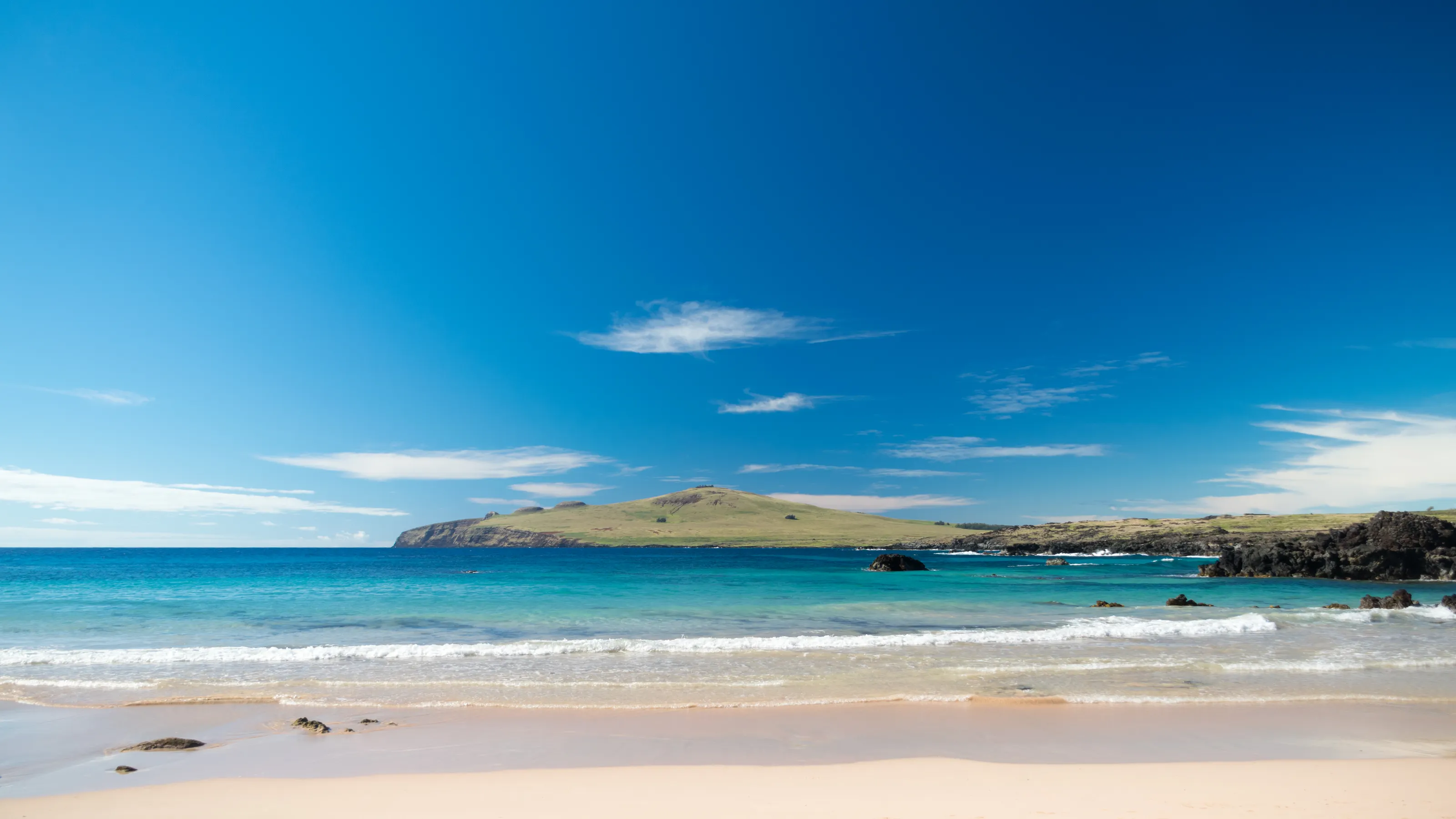
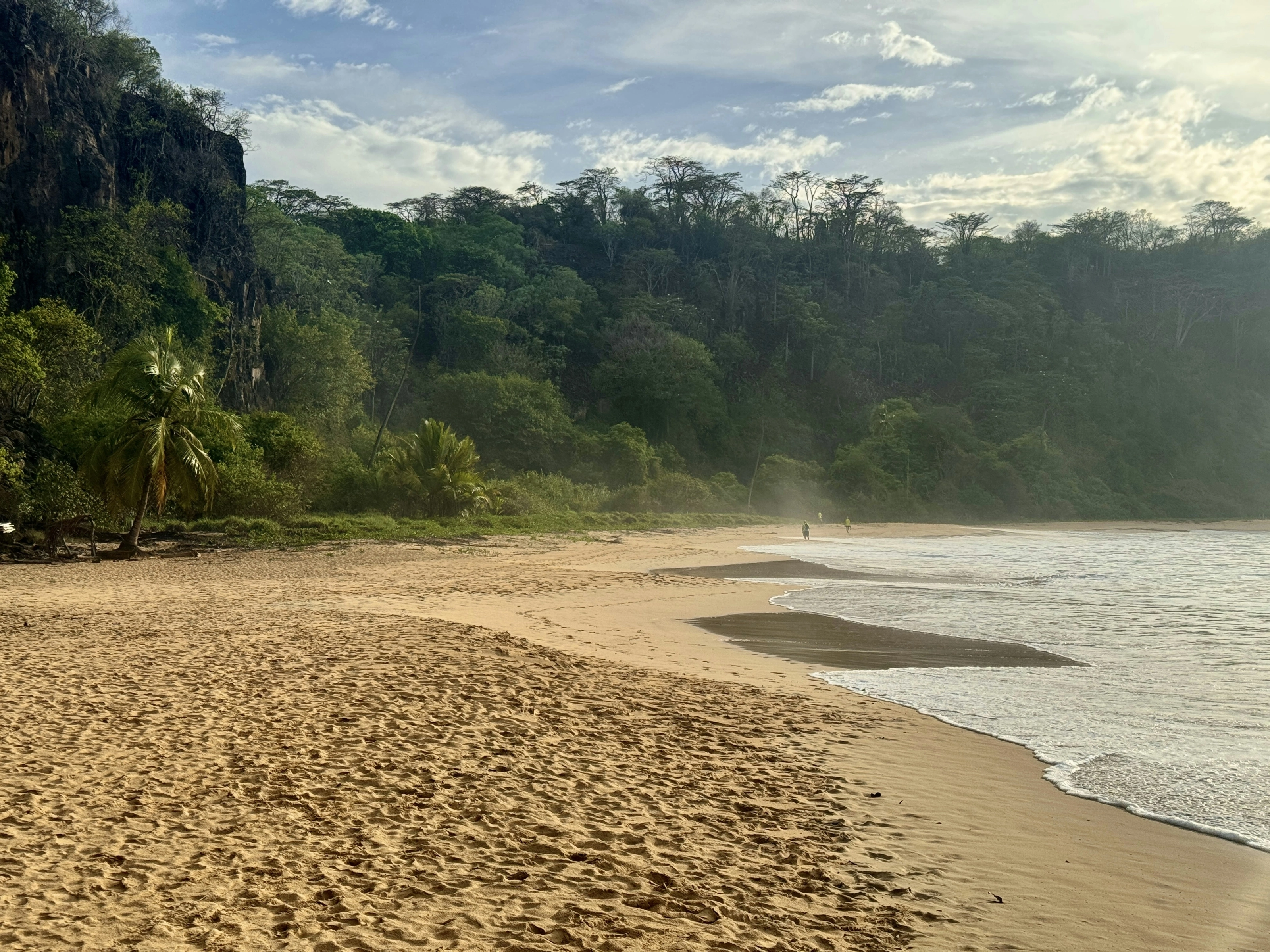
A pale sand beach
Pale sand, gentle turquoise waves and a grassy headland in the distance. The exact location of this photo is not confirmed.
Rano Kau and Orongo
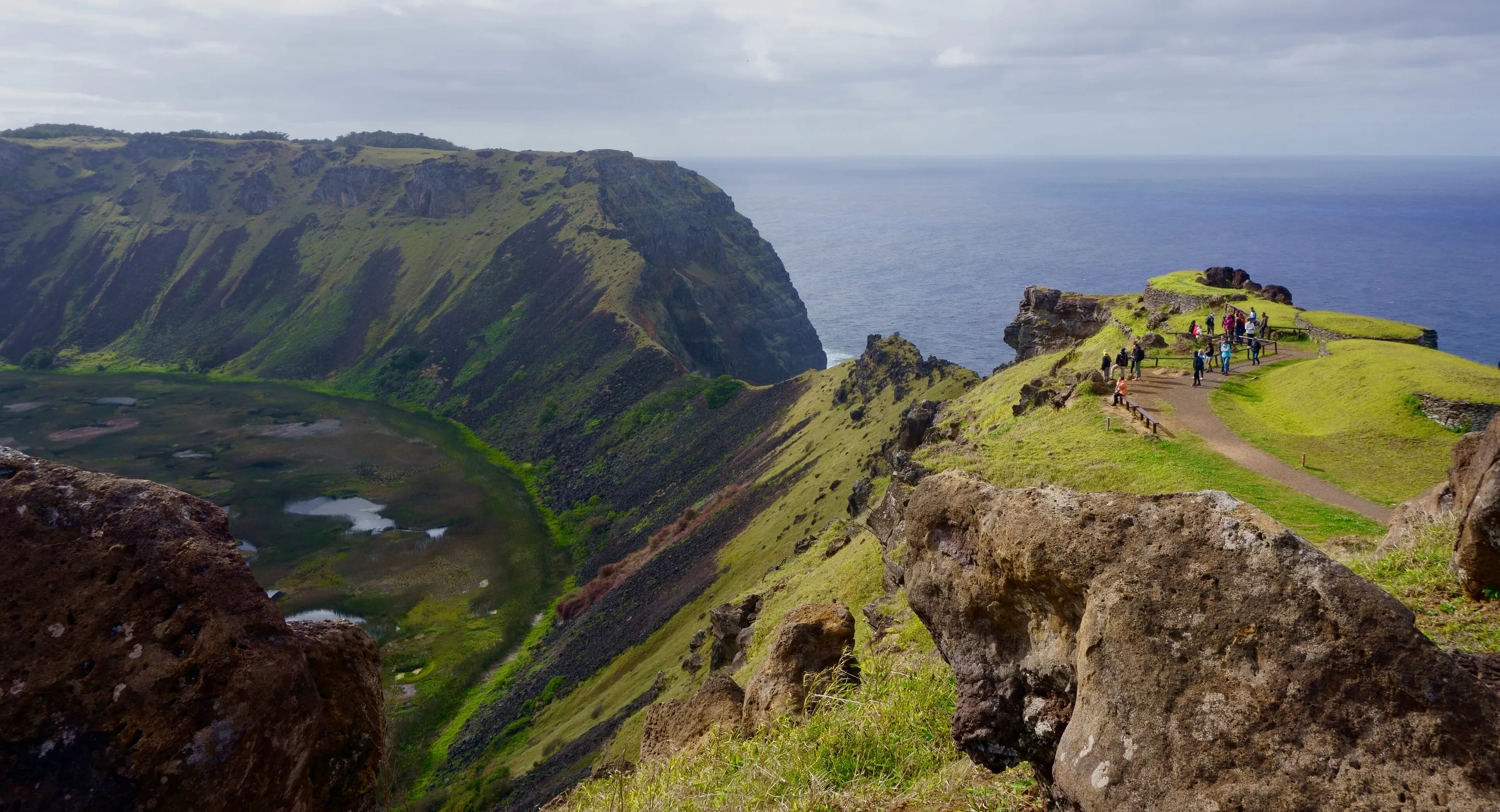
Rano Kau: a crater and the village of Orongo
Rano Kau is a crater in the south-west of the island, with a freshwater lake at the bottom. On its rim stands Orongo, a restored ceremonial village facing the islets of Motu Nui and Motu Iti, where the birdman cult took place (Wikivoyage EN). You can reach it from Hanga Roa by car or on foot (Wikivoyage EN, ES). As at Rano Raraku, entry to Orongo is limited to one visit with the park ticket.
The crater and the Orongo path
The crater covered in grass and small pools, and the ridge path where visitors walk toward the Orongo site, facing the ocean.
Hanga Roa, museums and culture
Englert Museum, fishing harbour and the Tapati festival
Museo Antropológico Padre Sebastián Englert
Founded in 1973, this museum in Hanga Roa holds about 1,500 pieces on the island's cultural heritage (Spanish Wikivoyage). We give no prices or opening hours: check them before you go.
Sites that are open-air museums
The island is itself an open-air museum, with its moai, platforms and petroglyphs (Spanish Wikivoyage). Orongo and the Rano Raraku quarry are two particularly telling examples.
Hanga Roa harbour
The small fishing harbour of Hanga Roa is busy with fishermen's colourful boats, with an ahu beside it (Wikivoyage EN). We have no photo of this place.
Tapati Rapa Nui
Each February, the Tapati festival brings together traditional dance, music and competitions for about ten days (Wikivoyage EN, ES). Exact dates change: check them before booking.
Food and drink
Tuna, empanadas, umu and pisco sour
Fish and seafood are at the heart of the table: tuna is the most common, served in many ways, including in empanadas; octopus is also common, while lobster is subject to restrictions (Wikivoyage EN). The traditional hot-stone cooking, the umu, resembles the Chilean curanto (Spanish Wikivoyage). Po'e is a banana cake. Most other produce is imported, which explains the high prices.
Drinks
Pisco, which comes from the mainland, is the most common spirit; try a pisco sour (Wikivoyage EN, ES). We have no photo of these dishes, and we cite no venues.
Getting around
On foot, by car, by scooter, by taxi or on a guided tour
In Hanga Roa
The town can be covered on foot. There are no minibuses or colectivos, but plenty of taxis (Wikivoyage DE).
To the sites
Distances are short, but only the streets of Hanga Roa and the road to Anakena are paved (Wikivoyage EN). You can rent a car, a scooter or a bicycle, or book a guided tour of half a day or a full day. A good approach is to take a tour on the first day, then explore on your own after that (Wikivoyage EN, ES).
Caution
The sun is strong and the island offers little shade: bring water, sun protection and walking shoes. Check the official recommendations of your country of departure before you travel.
Budget
An expensive destination, shaped by isolation and limited flights
Easter Island is one of the most expensive destinations in Chile: remoteness raises food and accommodation costs, and the flight from Santiago weighs on the budget. The overall level is therefore clearly above an average Chilean city. The national park entry fee and guided tours add to the cost of the stay. We give no figures, because prices change with the season and the exchange rate.
The airfare remains the most variable item. SniperAir tracks prices to IPC and compares them with the route's history.
When to go
When to visit Easter Island? Mild subtropical climate, reversed seasons
Austral summer (December to February)
Warm and humid: the daily mean is about 24 °C in February (Wikivoyage EN). The Tapati festival takes place in February.
Autumn (March to May)
Temperatures drop only slightly, but rain increases: May is the wettest month (Wikipedia ES).
Austral winter (June to August)
Cooler, with a daily mean of about 18 °C in August (Wikivoyage EN); the sea generally stays above 18 °C.
Spring (September to November)
October and November are among the driest months (Wikipedia DE).
The climate is oceanic subtropical: seasons are only mildly marked, it can rain all year, with about 1,150 mm a year (Wikipedia DE), and wind is frequent. There is no dry season. The southern hemisphere reverses the seasons: summer begins in December.
By length of stay
How many days on Easter Island
The essentials
Rano Raraku, Tongariki, Ahu Tahai at sunset, Orongo and the museum, with a guided tour on the first day.
Going deeper
Add Anakena, hikes to Rano Kau or Maunga Terevaka, diving or snorkelling.
Taking it slowly
Add the quieter sites, evenings of traditional dance and time for the beach.
In pictures
Easter Island in pictures
You might also like
Similar destinations
FAQ
Frequently asked questions about flights to Easter Island
How do I get from Easter Island airport to the centre of Hanga Roa?
Mataveri airport (IPC) is on the edge of Hanga Roa: the centre is a 15 to 25 minute walk depending on the source, or a taxi ride. Many hosts arrange a pickup. We give no fares.
When is the best time to visit Easter Island?
There is no dry season: the climate is mild subtropical, with a mean of about 24 °C in February and 18 °C in August, and rain possible all year. February hosts the Tapati festival.
Is Easter Island expensive?
Yes: remoteness, imported goods, the flight from Santiago and the national park entry fee make the destination expensive. We give no figures, because prices change.
How many days should I plan on Easter Island?
Three days cover the main sites; four to five days let you add Anakena, hikes or diving; six days or more give a slower pace.
How do I get around Easter Island?
On foot in Hanga Roa, then by rental car, scooter or bicycle, by taxi or on a guided tour for the sites. Only the streets of Hanga Roa and the road to Anakena are paved.
What should I try on Easter Island?
Tuna, as a dish or in empanadas, seafood, hot-stone cooking (umu), banana po'e and pisco sour.
How much does a flight to Easter Island usually cost?
The price depends mainly on your departure city, the period and the booking date. The opportunities section above shows real examples of prices already detected by SniperAir to this destination.
How do I get alerted when a flight to Easter Island drops below my budget?
Create an alert profile with your departure airport, Easter Island as the destination and your maximum budget. You are notified automatically as soon as a matching price is detected.
Ready to head to Easter Island?
Set your budget and let SniperAir monitor fares for you.
Create my alert